On Mother’s Day, I had dinner alone at the Italian restaurant where my late husba
My Son Skipped Mother’s Day With Me — Then Paid for His In-Laws’ Dinner With My Membership
ON MOTHER’S DAY, I WENT TO DINNER ALONE AT AN ITALIAN RESTAURANT. I RAN INTO MY SON AND HIS WIFE’S FAMILY JUST AS I’D FINISHED PAYING MY CHECK. THEN I HEARD HIM READING OUT MY MEMBERSHIP NUMBER TO THE MANAGER. AND WHAT I DID NEXT…
MADE EVERY ONE OF THEM GO PALE
My name is Tanya Alcott.
I was sixty-nine years old the Mother’s Day I ate dinner alone at the restaurant where my late husband had proposed to me forty-two years earlier.
I paid my own check.
Left twenty-five percent for the server.
Put on my coat.
Then the doors to the private dining room slid open.
Out came my son.
His wife.
Her parents.
Her sister and brother-in-law.
And my eight-year-old granddaughter.
Three days earlier, my son had texted me that his wife had a migraine and they would be staying home for Mother’s Day.
I stepped behind the coat rack before they saw me.
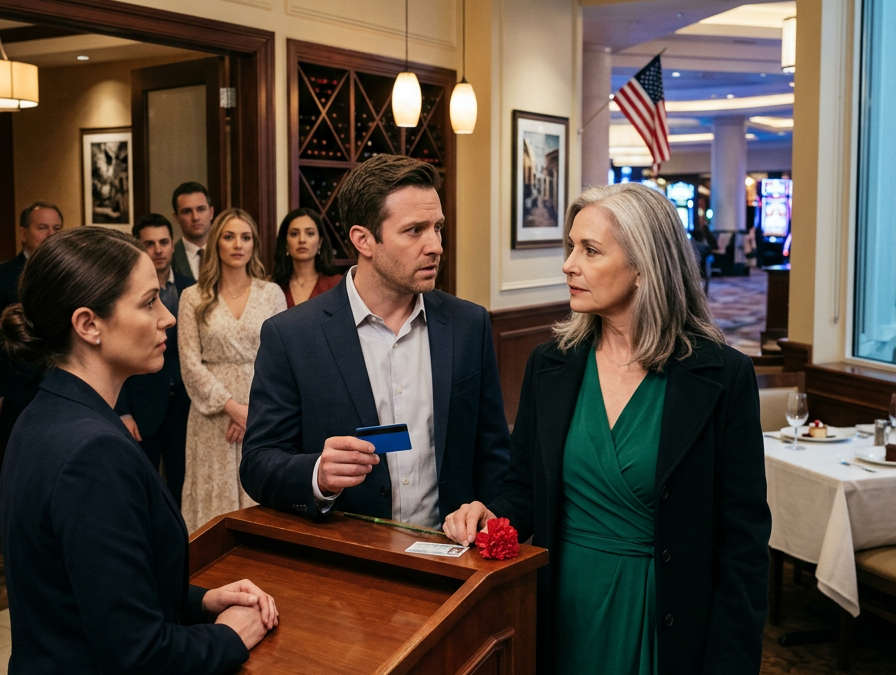
Then I watched my son walk to the host podium carrying a black leather bill folder.
He pulled a blue casino rewards card from his wallet.
My card.
When the manager asked for the account number, Trevor recited it from memory.
Digit by digit.
Like it belonged to him.
Then he told her I was home sick.
He told her I had authorized him to use the account.
I had not said a word.
What happened at that podium began months earlier.
Maybe years.
If I am being completely honest, it began the first time I paid a gambling debt because I loved my son more than I trusted consequences.
The restaurant was called Trattoria Fontana.
Downtown Kettle Run, Pennsylvania.
Carmine Fontana opened it in 1971.
In December of 1983, a skinny electrical engineer named Glenn Alcott proposed to me at the corner table near the front window.
He had rehearsed the question.
I ruined the rehearsal by saying yes before he finished.
Carmine sent over a bottle of Chianti and refused to charge us.
Our son Trevor was born in January 1988.
That May, Glenn brought me back to Fontana’s for my first Mother’s Day as a mother.
One o’clock.
Exactly.
He carried a single red carnation from a gas station.
Slightly wilted.
I teased him.
He brought the same kind every year after that.
Thirty-four years.
Same restaurant.
Same hour.
Same cheap red flower.
After Fontana’s moved into the new River Forge Casino Resort in 2019, Glenn complained for six months.
“You shouldn’t have to walk through a casino to get good gnocchi.”
“You don’t.”
I reminded him.
“You come through the hotel lobby.”
“Same building.”
“We’re old, Glenn.”
“Speak for yourself.”
Through one wall of the dining room, we could hear the slot machines.
Three bright notes.
Pause.
Three more.
Then jingles.
Electronic bells.
Money being converted into sound.
One evening Glenn listened for a few seconds and said:
“They’re ringing for somebody else’s money.”
I remember that sentence now more often than almost anything else he said.
At some point, a hostess told us members of the casino’s loyalty club received ten percent off dining.
Glenn was an engineer.
I had spent forty-one years as an actuary.
A ten-percent discount appealed to both of us for reasons too embarrassing to explain.
So we joined Forge Rewards.
At the membership desk, I chose a four-digit PIN.
0119.
Trevor’s birthday.
Then I put the blue card into the junk drawer beside my kitchen sink.
I used it exactly once.
According to River Forge, somebody using my account visited the casino one hundred twenty-six times between January 2025 and April 2026.
For forty-one years, I priced risk for Commonwealth Fidelity Life.
Mortality tables.
Smoking histories.
Heart disease.
Occupational hazards.
I calculated the probability that bad things would happen to people.
Then I turned those probabilities into premiums.
My job taught me an important lesson.
Feelings are information.
They are not evidence.
Trevor’s gambling problem began around 2018.
Sports betting apps at first.
Then casino gambling.
In spring 2019, he owed nine thousand dollars.
I paid it.
I told myself it was one mistake.
In 2021, the number became sixteen thousand.
Glenn paid that one without telling me until afterward.
Four months later, Glenn died from a heart attack.
In February 2023, Trevor sat at my kitchen table with both hands pressed together and told me:
“Sixty-one thousand.”
I remember the exact number.
Actuaries remember numbers the way musicians remember melodies.
He expected me to pay.
I said no.
Not angrily.
My hands were shaking beneath the table.
But I said it.
“No.”
His face changed.
“Mom.”
“No.”
“You have the money.”
“I have retirement savings.”
“Dad would have helped me.”
That was the worst part.
Because he was right.
Glenn probably would have.
And then, six months later, there would have been another number.
And another.
So instead I said:
“I will pay for help.”
Trevor looked away.
“I won’t pay for the hole.”
I spent fourteen thousand five hundred dollars on thirty days at Wellspring House, a residential treatment program outside Harrisburg.
Then, on March 9, 2023, I drove Trevor to River Forge.
Not to gamble.
To enroll in Pennsylvania’s self-exclusion program.
The gaming-control office was small.
Beige walls.
A box of tissues on the desk.
The employee explained everything.
A year.
Five years.
Trevor chose five.
They photographed him.
He signed.
From then on, if he entered a gaming floor covered by the program, there could be consequences.
If he won money, he would not get to keep it.
He barely looked at me in the parking garage afterward.
“Dad would have paid.”
“Yes.”
I gripped my purse.
“He probably would have.”
Trevor stared through the windshield.
“You think you’re teaching me some lesson.”
“No.”
I looked at him.
“I’m trying to keep you alive long enough to learn your own.”
My refusal had consequences for his family.
Trevor and his wife Marissa sold their small brick Cape Cod on Mulberry Street.
The place had a swing set Glenn helped build for Tess.
They sold at a loss to pay debt.
Marissa’s parents, Sal and Rosemary Caruso, paid another twenty-two thousand dollars toward Trevor’s credit cards.
Sal took much of it from retirement savings.
He mentioned that fact at almost every holiday afterward.
“You had money.”
Marissa told me once.
“You watched us lose our house.”
Rosemary said:
“You look at people like numbers.”
I did not argue.
People in pain rarely hear arguments.
By summer 2024, Trevor seemed better.
Meetings.
Steady work.
Tess began coming to my house every Sunday for blueberry pancakes.
Thursday afternoons became ours too.
I picked her up from school.
We bought soft pretzels.
Homework at my kitchen table.
I began to believe the worst had passed.
Then, in January 2026, a glossy black envelope arrived.
Silver lettering.
Congratulations, Tanya.
You’ve reached Platinum.
I laughed aloud.
Forge Rewards thanked me for my loyalty.
The letter displayed my membership number.
410273886.
Platinum benefits.
Priority valet.
Dedicated host.
Complimentary dining credit.
Special events.
Mother’s Day brunch.
I had never gambled there.
Not one dollar.
But I had eaten at Fontana’s for years.
I assumed the computer had confused restaurant visits with casino activity.
Computers make mistakes.
My career taught me that too.
I tore the letter in half.
Dropped it into recycling.
Then pulled it back out.
The half with the number.
Forty-one years of keeping records had trained me not to throw away identifiers.
I put it beneath a lemon-shaped magnet on the refrigerator.
Then forgot about it.
Five weeks later came Tess’s eighth birthday.
The party was at the Caruso house.
Rosemary loved hosting.
White tablecloths.
Trays of food.
Everything slightly competitive.
I brought Tess a children’s microscope with forty prepared slides.
For about ninety seconds, it was a wonderful day.
Then I went into the kitchen.
Rosemary stood by the island with two women from church.
“Two hand pays since Christmas.”
She was saying.
“River Forge loves me right now.”
I did not know the term hand pay yet.
Rosemary saw me.
Her smile stayed.
Her eyes changed.
“Some of us don’t spend our Thursday nights at the slots.”
Her friends looked down.
I genuinely thought she meant somebody else.
Then I asked Marissa:
“Fontana’s again for Mother’s Day?”
Before Marissa could answer, Rosemary said:
“Some mothers earn their Mother’s Day.”
Marissa continued slicing cake.
Did not correct her.
Did not look at me.
I carried plates into the dining room.
Tess leaned close.
“Grandma?”
“Yes?”
“Are you sick?”
My hand stopped.
“What do you mean?”
“Mommy says you have a problem.”
Then she ran away.
Children do that.
Drop a grenade.
Then go play.
I told myself it was a misunderstanding.
Then March twelfth arrived.
Thursday.
My day with Tess.
I parked outside Kettle Run Elementary at the usual time.
Walked into the office.
Mrs. Jablonsky checked her screen.
Then looked up.
Her expression changed.
“Mrs. Alcott.”
“Yes?”
“I’m sorry.”
My stomach tightened.
“You’ve been removed from Tess’s pickup list.”
I stared.
“When?”
“March second.”
“Who requested it?”
“Her mother.”
Through the glass wall, I could see Tess in the hallway with her teacher.
She saw me.
Waved.
Then noticed her teacher’s hand on her shoulder.
Her wave stopped.
“I’m sorry.”
Mrs. Jablonsky said again.
“I know.”
I smiled faintly.
“You don’t make the list.”
I walked back to my car.
Called Trevor.
Voicemail.
Again.
Voicemail.
Third time, he texted.
Can’t talk. Marissa will call.
Marissa called the next night.
No hello.
“We know about the casino.”
I was standing at the stove stirring soup.
“What casino?”
“Please don’t do that.”
“Do what?”
“Trevor found your card.”
My eyes moved toward the refrigerator.
The half-letter.
My membership number.
“Platinum, Tanya.”
Her voice broke.
“They don’t give that out for eating pasta.”
“I have never gambled at River Forge.”
“You made Trevor sign that exclusion.”
“Yes.”
“You told him he had a sickness.”
“He did.”
“And all that time you were gambling every Thursday.”
“No.”
“My mother has seen you.”
That stopped me.
“Rosemary?”
“Yes.”
Marissa started crying.
“I’m not putting Tess in a car with somebody who is lying to herself.”
“Let me show you the account.”
“I’m done.”
She hung up.
Later that night, Trevor texted.
Let it cool down. Marissa’s emotional.
Then:
Working overnights now at Amberly Foods Tuesdays and Thursdays. Extra money. We’ll talk soon.
I read that message several times.
The job sounded plausible.
Distribution centers run overnight.
Extra money made sense.
But one sentence from Marissa would not leave my mind.
Trevor found your card.
Found it where?
My card had been in the kitchen junk drawer since 2019.
I had not carried it in years.
I did not open the drawer that night.
Perhaps because some part of me did not yet want an answer.
One week later, at 1:40 in the morning, Trevor called.
A widow’s phone ringing at that hour can stop her heart.
I grabbed my glasses.
“Trevor?”
“I’m fine.”
“Are you hurt?”
“No.”
His voice sounded bright.
Too bright.
“The car’s acting weird.”
“What kind of weird?”
“Transmission maybe.”
Then:
“Can you send four hundred?”
“Until when?”
“Friday.”
“It is Friday.”
“Next Friday.”
Behind his voice came a sound.
Three bright notes.
Then three more.
Then a cascade.
My body went cold.
I had heard those sounds through Fontana’s wall for six years.
“Where are you?”
“At work.”
“What is that sound?”
Pause.
Not long.
Enough.
“Forklift alarms.”
“Forklifts?”
“They beep constantly.”
I listened.
Three notes.
Three more.
Then a little musical tumble.
“Bring me the repair estimate.”
Silence.
“What?”
“I’ll pay the repair shop directly.”
Longer silence.
Then the chiming abruptly stopped.
Like a door had closed.
“Never mind.”
Trevor said.
“I’ll figure it out.”
He hung up.
I sat in bed until dawn.
Thinking one sentence.
Forklifts do not play melodies.
At six, I made coffee.
Then did what I had done through every difficult actuarial review of my career.
Separated fact from fear.
On the back of an electric bill, I wrote:
Platinum account in my name.
Trevor found my card.
Rosemary bragged about two hand pays.
Casino sounds on Trevor’s phone at 1:40 a.m.
Four facts.
No conclusions.
Facts first.
At nine, I called Forge Rewards.
The representative confirmed my account was active.
Platinum.
Detailed activity required in-person identification.
“At the casino desk?”
“Yes, ma’am.”
“On the gaming floor?”
“Yes.”
I thanked him.
Then sat in my kitchen.
I had never walked onto that floor.
Not once.
Even when Trevor enrolled in self-exclusion, the office was accessible through another corridor.
I had avoided the machines on principle.
It took me almost another month to go.
During that month, Easter arrived.
Nobody invited me.
I made Tess a basket anyway.
Chocolate.
Jelly beans.
A detective novel.
Yellow stuffed duck.
I went to the duplex after church.
Marissa opened the door only a few inches.
“I brought this for Tess.”
She took the basket.
“I won’t stay.”
“Good.”
“Is Trevor here?”
“Working.”
“On Easter?”
“Holiday overtime.”
Then Sal came up carrying deviled eggs.
He handed me a folded pamphlet.
“Rosemary found this.”
Gamblers Anonymous.
I recognized the state helpline printed at the bottom.
I had called it myself three years earlier for Trevor.
“No shame in getting help.”
Sal said.
I folded it.
“Thank you.”
Through the narrow doorway, Tess stood in her Easter dress holding the yellow duck.
She watched me leave.
Four days later, I had lunch at Fontana’s.
Thursday.
My old ritual.
The staff called the corner spot Glenn’s table.
Nina Fontana ran the restaurant now.
Carmine’s granddaughter.
I had known her since childhood.
She sat across from me.
“Mrs. A?”
“Yes?”
“You okay?”
“Why?”
“You haven’t touched your gnocchi.”
“Tired.”
She turned her water glass.
“Can I tell you something?”
I looked at her.
“Tuesday night.”
She lowered her voice.
“I was locking up around eleven-fifteen.”
Then:
“Trevor walked past the host stand.”
My face stayed still.
“Toward the casino.”
“He was alone?”
Nina hesitated.
“With Marissa’s mother.”
“Rosemary.”
“Yes.”
“They were laughing.”
Nina touched my hand.
“I remembered what happened a few years ago.”
She did not know every detail.
Enough.
“Thank you.”
I paid.
Drove home.
Then opened the junk drawer.
Rubber bands.
Dead batteries.
Old takeout menus.
Birthday candles.
Glenn’s blue Forge Rewards card.
Still there.
The slot beside it—
empty.
My card was gone.
I emptied the drawer completely.
Laid everything out across the counter.
Twice.
No card.
Then I remembered November 9, 2024.
Trevor fixing my garbage disposal.
Me driving to the hardware store.
Eleven minutes.
My son alone in my kitchen.
I put everything back.
Except Glenn’s card.
That went on the windowsill.
The next Tuesday night, I drove to River Forge.
I did not go inside.
I drove level by level through the garage.
On level three, I found Rosemary’s white Buick.
Rosary hanging from the mirror.
Empty.
I sat forty minutes.
Then left.
Thursday afternoon, I returned.
This time I walked onto the gaming floor.
The first thing I noticed was the cold.
The second was the carpet.
Red and gold.
Then sound.
Hundreds of electronic machines.
Music.
Bells.
Coins that were not coins.
People staring at screens.
Halfway to the rewards desk, a machine nearby began chiming.
Three notes.
Three more.
Then the exact cascade from Trevor’s phone.
A light spun overhead.
An attendant hurried over carrying paperwork.
Hand pay.
Now I knew the sound.
At the rewards desk, I showed my identification.
“I need win-loss statements.”
“For which years?”
“2025.”
Then:
“And this year.”
The printer began.
The woman handed me two pages.
I carried them outside the gaming floor.
Found a café table.
Unfolded the report.
Account:
410273886.
Tanya Alcott.
Platinum.
Calendar year 2025:
97 trips.
Total coin-in:
$412,600.
Net loss:
$38,950.
January through April 15, 2026:
29 trips.
Coin-in:
$126,300.
Net loss:
$11,830.
Total losses:
$50,780.
I sat very still.
Coin-in does not mean somebody arrived with half a million dollars in cash.
Money circulates through machines.
Wins get replayed.
Credits get replayed.
The same dollar can be wagered repeatedly.
That was not the important figure.
Net loss was.
More than fifty thousand dollars.
In my name.
Then I read the trip dates.
Tuesdays.
Thursdays.
Some Saturdays.
Mostly late nights.
Eleven p.m.
Two a.m.
Three a.m.
The exact hours Trevor claimed to be working his second job.
March nineteenth appeared.
So did April fourteenth.
The night I had watched Rosemary’s Buick from the garage.
I went back to the desk.
“Change my PIN.”
The employee turned the keypad toward me.
I chose four digits with no family meaning.
For the first time since 2019, my son’s birthday was not the key to anything I owned.
“Deactivate the card?”
I thought.
“No.”
Not yet.
If the card stopped working immediately, Trevor would know.
I wanted the first conversation to happen at my kitchen table.
Mother to son.
I went home with the statement.
Sat beneath the same light where Trevor once told me he owed sixty-one thousand dollars.
Then another question emerged.
Rosemary had said she received two hand pays.
The report showed activity in my name.
But hand pays require identification.
Trevor could not provide his own without risking detection because of self-exclusion.
So whose identification had been used?
I wrote another line on the electric bill.
Whose license?
Then I called Trevor.
Not about gambling.
“Disposal’s jammed again.”
He came Saturday at ten.
Same red toolbox Glenn gave him at sixteen.
He kissed my cheek.
“Smells good.”
Banana bread.
I had made it without thinking.
Maybe some part of me wanted the kitchen to smell like his childhood.
He crawled under the sink.
Talked about Tess.
Spelling bee.
Lost tooth.
First Communion.
Marissa’s family planning the party.
“How are those overnight shifts?”
“Brutal.”
He laughed.
“But the pay helps.”
I watched him work.
Then noticed a flattened callus on his right thumb.
Maybe from work.
Maybe from pressing buttons.
Maybe meaningless.
I did not need it.
The paper was enough.
He stood.
“Nothing wrong with the disposal.”
“I know.”
His smile disappeared.
“Sit down.”
He did.
I turned over the Forge statement.
Pushed it toward him.
He read.
I watched him find the dates.
His face lost color.
“Mom…”
“410273886.”
He looked up.
“My account.”
Silence.
“My card.”
“Somebody could’ve—”
“March nineteenth.”
He stopped.
“You called me from that floor.”
“That’s not—”
“I heard the machines.”
His shoulders dropped.
And then he said:
“It’s just points, Mom.”
I stared at him.
“Fifty thousand dollars is not points.”
He looked away.
“Where did the money come from?”
Silence.
“Trevor.”
“Two credit cards.”
Then:
“A loan against the truck.”
I let the information sit.
Then he said:
“It’s not like I stole from you.”
I looked at him.
“You stole my name.”
He flinched.
Then shame turned into anger.
“You wouldn’t help me.”
“We’ve done this before.”
“Dad would have.”
“I know.”
“You had the money.”
“I still do.”
His eyes snapped toward me.
I had never told him how much Glenn and I had saved.
That was deliberate.
“And I will not use it to make gambling easier.”
He rubbed his face.
Then said quietly:
“Rosemary drives.”
I waited.
“She plays too.”
“Does Marissa know?”
His head came up.
“No.”
“Does she know you took my card?”
“No.”
“Does she know the platinum account is yours?”
“No.”
I nodded once.
Then reached toward the wall calendar.
Circled May tenth.
Mother’s Day.
“Twenty-two days.”
Trevor stared.
“What?”
“You have twenty-two days.”
I held up one finger.
“You return my card.”
Second.
“You tell Marissa everything.”
Third.
“You call the same helpline I called three years ago.”
He began crying.
“If you do those things, I will pay for treatment again.”
He looked up.
“Directly.”
I continued.
“Never cash to you.”
He nodded desperately.
“And if I don’t?”
“I tell the people who need to know.”
He understood.
Gaming-control officials.
The casino.
His wife.
I softened.
“I’ll sit beside you when you tell Marissa if you want.”
He cried harder.
“I’m sorry.”
“I know.”
“I’ll fix it.”
I believed him.
That was my mistake.
Or maybe simply my job.
Mothers believe their children until the evidence becomes heavier than hope.
Trevor used the first three days of his deadline to tell another story.
Rosemary began telling people I was the gambler.
That I had tried to blame Trevor after being caught.
A neighbor called to warn me.
People at the pharmacy gave me sympathetic looks.
A bank teller touched my hand.
Marissa texted:
Stay away from Tess with your lies.
I could have answered.
I did not.
Trevor had twenty-two days.
I had given my word.
So I waited.
Tess’s First Communion arrived during that deadline.
She mailed me an invitation herself.
Purple crayon.
Please come Grandma.
I sat in the last pew at St. Cecilia’s.
Navy suit.
My mother’s old rosary in my purse.
When Tess saw me during the procession, she smiled so broadly she forgot she was supposed to keep her hands folded.
She waved.
Then remembered herself.
I cried into a tissue.
After church, Rosemary hosted forty people beneath a white tent.
I planned to leave.
Tess grabbed my hand.
“You have to see my cake.”
So I stayed.
For twenty minutes, nobody spoke to me.
Then Rosemary tapped a knife against a glass.
“Before Tanya leaves…”
Forty people turned.
“Somebody should ask her about her platinum card.”
Sal lifted his beer.
“Woman can’t stay off the slots.”
A few people laughed uncertainly.
Marissa stood.
“You made Trevor sign that exclusion.”
Her voice shook.
“You called him sick.”
She pointed.
“Then you gambled every Thursday yourself.”
People stared.
Rosemary folded her hands.
“Some mothers earn Mother’s Day.”
I had the statement at home.
I could have driven back.
Returned.
Thrown it on the table.
But Trevor still had eight days.
I keep my word.
Even when the other person does not.
So I walked toward Tess.
Knelt in the grass.
Placed my mother’s rosary in her hands.
“This belonged to your great-grandmother.”
Her eyes widened.
“She would have been proud of you.”
I kissed her forehead.
“So am I.”
At the side gate, Trevor stood alone.
He would not look at me.
“Eight days.”
I said.
Then left.
What none of them knew was that I was not bankrupt.
Far from it.
Between my pension, retirement savings, investments, and what Glenn left behind, I had roughly $1.9 million.
The house had been paid off for twenty years.
I lived simply because that was how Glenn and I lived.
Rosemary told half the parish I was losing everything at the casino.
In reality, I could have paid for that entire Communion party without noticing the withdrawal.
But that was exactly why Trevor did not know.
The last thing a compulsive gambler needs is certainty that his mother can absorb every loss.
On May fifth, I wrote a formal letter.
River Forge compliance.
Pennsylvania Gaming Control Board office at the property.
I explained that my rewards account had been used without my consent.
I identified Trevor.
I noted his self-exclusion date.
Attached the statements.
Signed.
Then wrote across the envelope:
HAND DELIVER MONDAY, MAY 11.
I placed it beside my car keys.
On May seventh, Trevor texted.
Mom. Marissa has a bad migraine. Staying home Sunday. Happy early Mother’s Day. Love you. ❤️
I stared at the message.
Sunday was day twenty-two.
I typed:
Sunday is day 22, Trevor.
Delivered.
Read.
Typing dots.
Then nothing.
That was when I knew.
Some part of me still hoped.
Mothers keep lights on after everyone else would switch them off.
But he had made his choice.
Mother’s Day morning, I went to the cemetery.
Glenn was buried beneath a maple tree.
I cleaned pollen from his headstone.
Then told him everything.
“You would have paid him.”
I smiled sadly.
“That was always our problem.”
On the way home, I stopped at the gas station where Glenn had bought my Mother’s Day carnation every year.
Red.
$1.99.
For the first time in my life, I bought one for myself.
I called Fontana’s.
My usual one o’clock table was unavailable.
Mother’s Day crowd.
Nina promised Glenn’s table at five-thirty.
“Nobody else gets it today.”
“That’s lovely.”
I dressed slowly.
Emerald wrap dress Glenn bought for our thirtieth anniversary.
Hair down the way he liked.
Carnation in my purse.
Compliance envelope still waiting for Monday.
No plan.
Only the deadline.
Fontana’s was crowded.
Every table held a mother.
Flowers.
Wine.
Family.
I sat at Glenn’s table overlooking the Susquehanna.
Put the carnation in the little vase.
Ordered gnocchi.
One Chianti.
Then tiramisu.
Through the wall, the slots chimed.
Three notes.
Three more.
They no longer frightened me.
Around seven, I realized I had been staring at my phone for ninety minutes.
I put it away.
At 7:42, I went to pay.
$68.40.
Tip.
Twenty-five percent.
Nina kissed my cheek.
I moved toward the coat alcove.
Then the private-room doors opened.
Sal came out first.
Red-faced.
Tie loose.
Rosemary on his arm.
White orchid corsage.
Marissa’s sister Gianna.
Her husband.
Tess.
Marissa.
No migraine.
Then Trevor.
Black bill folder in hand.
They were laughing.
Nobody saw me behind the coats.
Why would they?
They thought I had eaten at one and gone home.
The family headed toward the lobby.
Trevor stopped at the podium.
Nina smiled.
“Happy Mother’s Day.”
“Everything was perfect.”
He placed the folder down.
Then pulled out the blue card.
My card.
“We’re using comps.”
My heart became very quiet.
Nina swiped it.
“PIN?”
Trevor entered four digits.
0119.
Beep.
Declined.
He tried again.
Declined.
Nina frowned.
“The system wants the account number.”
Trevor recited it without looking.
“410273886.”
My number.
In my son’s voice.
Nina typed.
Then stopped.
“Tanya Alcott.”
She looked at Trevor.
“This belongs to your mother.”
“She gave it to us.”
Trevor smiled.
“For Mother’s Day.”
“For balances over five hundred, I need the member PIN or photo ID.”
“She’s home sick.”
Nina stared.
“She was here.”
Trevor stopped smiling.
“What?”
“She paid at this podium five minutes ago.”
Rosemary returned from the lobby.
“What’s taking so long?”
Nina explained.
Rosemary leaned against the podium.
“Just run it.”
“Nina.”
She lowered her voice slightly.
“There’s plenty on the account.”
Then:
“She owes this family.”
That was when I stepped out.
Four steps.
My heels sounded loud against the tile.
I laid my driver’s license beside the blue card.
Then my red carnation.
“That’s my number.”
Nobody moved.
“I’m the account holder.”
Trevor turned.
I had seen my son sick.
Drunk.
Terrified.
Heartbroken.
I had never seen his face lose color that way.
“Please do not redeem those comps.”
I looked at Nina.
“I have never gambled at River Forge.”
Rosemary recovered first.
“She’s lying.”
Her voice rose.
“She’s platinum.”
I ignored her.
Looked toward Gianna.
“Would you take Tess for gelato?”
Gianna studied my face.
Then nodded.
“Whatever she wants.”
I smiled at Tess.
“My treat.”
When the child was gone, I turned back.
“Nina, please call security.”
Marissa made a small sound.
“And ask for someone from the gaming-enforcement office.”
Trevor whispered:
“Mom.”
“My son has been on the state self-exclusion list since March 9, 2023.”
Every person around the podium went pale.
Rosemary’s hand slid away from the counter.
Sal stared at Trevor.
Marissa took one step toward her husband.
“What is she talking about?”
Trevor looked down.
“You told me it was her.”
I said quietly:
“I gave him twenty-two days to tell you.”
Marissa looked at me.
“What?”
“Twenty-two days ago.”
Then at Trevor.
“In my kitchen.”
Sal’s face reddened.
“Who do you think you are calling security on your own son on Mother’s Day?”
I still did not answer him.
The security shift manager arrived.
He checked Trevor’s identification against the self-exclusion record.
The photograph appeared on his tablet.
Trevor three years younger.
Gray-faced.
Standing against the beige wall.
The same day I had paid for parking and driven him home.
“Sir.”
The manager said.
“I need your ID.”
Trevor handed it over.
“This is dinner.”
His voice cracked.
“It’s just points.”
The security manager looked at him.
“Self-exclusion applies to comps too.”
Then he told Nina to cancel the redemption.
She printed a fresh bill.
More than one thousand dollars.
Sal stared at it.
Then slowly took out his own credit card.
The slot machines chimed through the wall.
Nobody at the podium laughed.
Trooper Anna Quigley from the gaming-enforcement unit arrived minutes later.
I told her the story in six sentences.
Then I remembered the envelope.
It was still in my purse.
I had meant to deliver it Monday.
Instead, I handed it to her on Mother’s Day.
She began reading.
Meanwhile, security reviewed account activity.
“Most recent use Thursday, May seventh.”
The manager said.
11:20 p.m.
The same date Trevor texted me about Marissa’s migraine.
He continued scrolling.
“There are four hand pays attached to this account.”
My eyes moved toward Rosemary.
“Total approximately eleven thousand eight hundred fifty.”
Then:
“Tax documentation was issued under one name.”
The manager looked up.
“Rosemary Caruso.”
Marissa turned toward her mother.
Slowly.
“Mom?”
Rosemary’s mouth moved.
No sound.
Then everything came at once.
“That was my money.”
She pointed at Trevor.
“He owed us twenty-two thousand.”
Marissa stared.
“You knew?”
Rosemary stopped.
“Mom.”
Nothing.
“You knew he was gambling?”
The trooper asked Rosemary to remain for a statement.
Security barred her from returning to the property pending review.
My blue card went into an evidence bag.
Then they asked Trevor to accompany them.
At the edge of the restaurant, where Fontana’s tile became casino carpet, Trevor stopped.
Turned.
“Mom.”
His voice sounded eight years old.
“Why would you do this to me?”
I took my time.
“I paid your debt once.”
He looked at me.
“Your father paid once.”
My throat tightened when I said Glenn.
“It didn’t save you either time.”
Then:
“Maybe the truth will.”
He stared at me.
Then walked away with security.
Marissa sat down hard on the bench near the podium.
Rosemary stood alone near the wine racks.
Then Gianna returned with Tess.
Chocolate gelato covered half her chin.
“Grandma.”
I knelt.
Wiped her face.
“Where’s Daddy?”
“Talking to some people about a grown-up mistake.”
“Is he okay?”
“Yes.”
I looked at Marissa.
“He’s okay.”
Tess licked the spoon.
“Are we still doing pancakes?”
I waited.
Marissa did not look at me.
Then she gave one small nod.
“If your mom says yes.”
I told Tess.
“Sunday at nine.”
I picked up my coat and driver’s license.
Left the carnation in the vase at the podium.
Then walked through the hotel lobby.
I still did not go through the casino.
Four days later, Marissa called.
No apology.
I had stopped expecting one.
“You should have told me.”
“I told the person who promised he would.”
Silence.
“He didn’t.”
“I know.”
Another silence.
Then:
“Tess wants blueberry pancakes.”
“What time?”
“Nine.”
She has been at my kitchen table nearly every Sunday since.
Marissa drops her off.
For a while, she stayed in the car.
Later, she began waving.
Eventually, she started walking Tess to the porch.
Relationships sometimes return in inches.
Not speeches.
The morning after Mother’s Day, Fontana’s sent the red carnation back to my house in one of their little glass vases.
Nina’s note said:
Glenn’s table is always yours, Mrs. A.
I cried over that.
More than I cried at the podium.
On June first, Trevor checked himself into Wellspring House.
Thirty days.
I paid the treatment center directly.
Exactly as promised.
He called once.
“Mom.”
“Hi.”
Long silence.
Then:
“I’m here.”
“I know.”
Another silence.
“I’m sorry.”
“I know.”
That was the first honest phone call we had had in a year and a half.
The legal and regulatory consequences of the casino activity moved through their own processes.
Trevor faced consequences connected to violating self-exclusion.
The rewards balance was canceled.
Any disputed gambling proceeds were handled according to applicable gaming rules.
Rosemary had tax records connected to the hand pays under her identification, creating problems she had never considered when she agreed to participate.
For years, she had described me as a woman who viewed people as numbers.
Now numbers were doing what numbers do.
Recording.
Not judging.
Just refusing to disappear.
I met with our estate attorney too.
Glenn and I had worked with Bernadette Carian for twenty years.
I changed my plan.
Tess’s education would be protected.
Whatever she decided to become.
College.
Training.
Something none of us had imagined.
Trevor’s future inheritance moved into a separate trust.
Independent trustee.
Treatment payments allowed directly to providers.
No unrestricted distributions while he remained unstable.
Two years of documented recovery before anything could be reconsidered.
Bernadette looked at me.
“Do you want him to know how much?”
“No.”
“Why?”
I thought about the blue card.
The platinum letter.
My refrigerator magnet.
“He can learn things the way I did this spring.”
I said.
“One honest page at a time.”
Back home, I took Glenn’s old Forge Rewards card from the windowsill.
Placed mine beside it after it was returned.
Then cut both in half.
I used my good sewing scissors.
These days, the only loyalty card I carry for Fontana’s is a little paper punch card Nina made for my Thursday lunches.
She laminated it.
Said I could not be trusted with ordinary paper.
One Sunday morning, Tess came into the kitchen holding something behind her back.
“What?”
“Nothing.”
“That usually means something.”
She handed me a red paper carnation.
Made at school.
The petals were uneven.
The stem bent.
Purple crayon across one side:
FOR THE MOTHER’S DAY YOU MISSED.
I had to sit down.
Tess looked concerned.
“You don’t like it?”
“Oh, sweetheart.”
I pulled her into me.
“It’s perfect.”
Later, while she ate pancakes, I placed the paper flower in the little vase near the window.
My son once told me:
It’s just points.
He was wrong.
Nothing about it was just points.
It was my name.
My husband’s restaurant.
My granddaughter’s Thursdays.
My son’s relapse.
His mother-in-law’s resentment.
A blue card taken from my kitchen drawer.
A lie repeated often enough that an eight-year-old started wondering whether Grandma was sick.
Money was almost the least important part.
That surprised the actuary in me.
For decades, I believed numbers made messy things cleaner.
Sometimes they do.
The account statement gave me truth.
Dates.
Losses.
Times.
But numbers cannot explain what it feels like to stand outside your granddaughter’s school while she waves and is not allowed to walk toward you.
They cannot price the exact weight of your own son reciting your membership number like his.
They cannot calculate the value of a red carnation bought by a dead husband for thirty-four Mother’s Days.
That afternoon at the podium, I did not expose Trevor because I stopped loving him.
I exposed the truth because I still did.
That is the part some people never understand.
Rescuing someone and loving someone are not always the same act.
For years, Glenn and I rescued.
Nine thousand.
Sixteen thousand.
Then treatment.
House loss.
Credit cards.
Every rescue bought time.
None bought recovery.
Eventually, loving Trevor required allowing the system he had tried to deceive to see him clearly.
Not the story he told.
Not the story Rosemary told.
Him.
That may have been the hardest thing I have ever done as a mother.
Rosemary used to say:
“Some mothers earn their Mother’s Day.”
She had it backward.
No mother has to earn the right to have been a mother.
Motherhood is not an award children hand out for obedience.
It is not canceled because you say no.
It is not proven by paying debts.
And it is certainly not measured by whether everybody wants you at the restaurant.
Sometimes mothering a grown child means standing beside him.
Sometimes it means paying for treatment.
Sometimes it means refusing him cash.
Sometimes it means allowing him to dislike you.
And sometimes, on Mother’s Day, it means standing beside a restaurant podium and saying:
That number is mine.
The name is mine.
The truth is mine.
And I will not let you use any of them to keep destroying yourself.
Trevor is still working on recovery.
I do not measure it by promises anymore.
I measure it by smaller things.
Meetings attended.
Bills paid.
Calls made when he is struggling instead of after he has already fallen.
Honesty that arrives before discovery.
He comes for pancakes occasionally now.
Not every Sunday.
Those mornings belong mostly to Tess.
The first time Trevor came back, he stood in my kitchen staring at the junk drawer.
Then asked:
“You still keep cards in there?”
“No casino cards.”
He nodded.
“Good.”
I put coffee in front of him.
He looked toward Glenn’s old chair.
“I keep thinking about Dad.”
“So do I.”
“He really would have paid the sixty-one thousand.”
“Yes.”
Trevor laughed sadly.
“And you think that would have killed me.”
“No.”
I looked at him.
“I think it would have helped you keep killing yourself.”
He nodded.
That was growth.
Painful growth.
But growth.
One Thursday, months later, I went to Fontana’s for lunch.
Nina led me to the corner table.
“Gnocchi?”
“Of course.”
“Chianti?”
“One.”
She smiled.
I placed a red carnation in the little vase.
I still buy one sometimes.
Not every Thursday.
That would become ridiculous.
But enough.
Outside the window, the Susquehanna moved slowly.
Behind the wall, machines chimed.
Three bright notes.
Three more.
Once, those sounds made my heart jump.
Now they are merely data.
Somebody else’s risk.
Somebody else’s money.
Somebody else’s decision.
Mine are different now.
My accounts are protected.
My granddaughter’s future is protected.
My son has a path forward if he chooses to walk it.
I cannot walk it for him.
That may be the final lesson.
I spent my career studying probability.
What are the odds?
How likely is the worst thing?
How much reserve do you need if it happens?
But motherhood never worked like actuarial science.
You cannot price the chance your child will break your heart.
You cannot insure against disappointment.
You cannot build enough reserves to guarantee somebody you love will make good decisions.
You can only decide what you will do when the numbers finally arrive.
That spring, mine arrived on two warm sheets of paper.
$38,950.
$11,830.
One hundred twenty-six casino trips under my name.
Twenty-two days I gave my son to tell the truth.
One Mother’s Day dinner eaten alone.
One red carnation I bought for myself.
One podium.
One account number.
And one sentence I finally understood.
I paid your debts once, Trevor.
Your father paid them once.
Neither saved you.
Maybe the truth will.
I still believe that.
Because money can cover a loss.
It cannot cure the reason someone keeps making one.
Silence can preserve a family’s appearance.
It cannot preserve the family.
And love can survive being told no.
If it cannot, it was never love that was asking.
On Sunday mornings, Tess sits at my table while blueberry batter hisses on the griddle.
There are no electronic bells.
No casino points.
No rumors.
Sometimes she brings the red paper carnation downstairs from the vase because she likes to rearrange things.
“Grandma?”
“Yes?”
“Why do you keep this ugly flower?”
“It isn’t ugly.”
“It’s a little ugly.”
I laugh.
“Okay.”
She grins.
“So why?”
I take it from her.
Smooth one crooked paper petal.
“Because somebody made it for me.”
She considers that.
Then shrugs.
“That makes sense.”
And in the end, after all the calculations and all the lies and all the money, maybe that is the number I care about most.
One little girl.
Still at my table.
Still asking questions.
Still knowing exactly whose grandmother I am.
