After hours inside a stalled department-store elevator, I was exhausted an
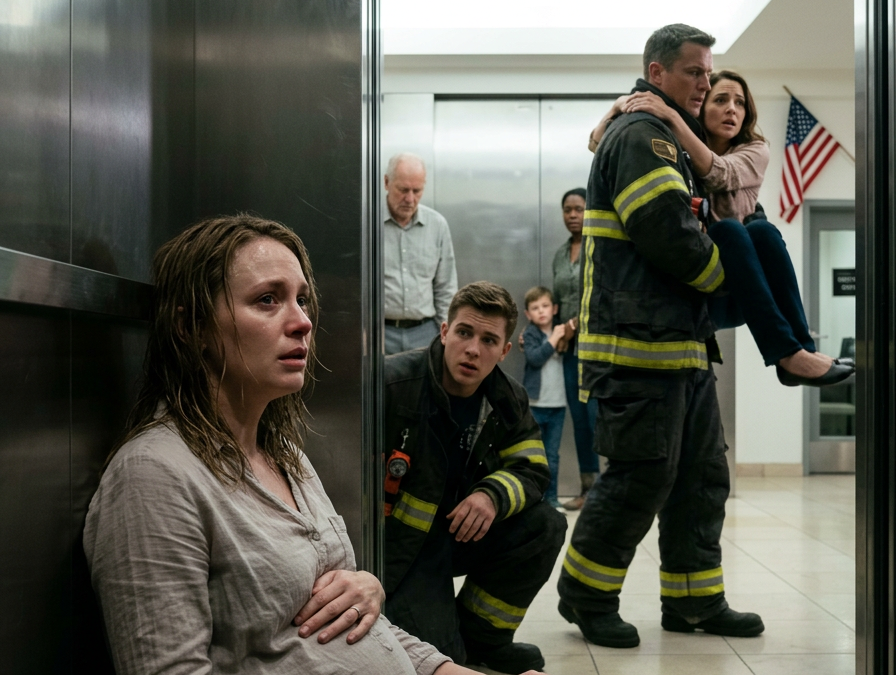
After Seven Hours Trapped in a Chicago Department-Store Elevator, I Was Barely Conscious and Six Months Pregnant When the Rescue Doors Opened—Yet My Husband Alex, the Fire Department Lieutenant Leading the Response, Walked Past Me and Carried His Frightened Ex-Girlfriend Vanessa Out First; I Gave a Young Firefighter My Wedding Ring and One Final Message, Then Woke in the ICU to Hear Alex Defending His Choice Outside My Door, Unaware That I Had Kept Detailed Notes About Every Minute Inside That Elevator
When the elevator doors finally opened after seven hours, I was barely conscious.
The air inside had gone hot, stale, and thin.
My vision kept narrowing at the edges.
My hands were wrapped around my six-month pregnant belly because by then I could barely feel my baby moving.
Then the rescue lights poured into the elevator.
And I saw my husband.
Lieutenant Alex Davis.
Fire department rescue squad.
The man I had spent seven hours believing would come for me first.
He rushed inside.
For one impossible second, relief hit me so hard I nearly cried.
Then Alex walked straight past me.
Vanessa was curled in one corner, shaking and sobbing.
“Vanessa.”
His voice broke.
“It’s okay. I’m here.”
He scooped her into his arms.
She wrapped both arms around his neck.
I tried to say his name.
Nothing came out except a thin breath.
Alex carried her away.
He never looked back.
My name is Lauren Davis.
I had been trapped in that elevator from shortly after two in the afternoon until almost nine at night.
It happened inside a massive downtown Chicago department store.
Power failure.
Then generator failure.
Eight people.
An elderly man.
A little boy.
Two teenage girls.
A delivery driver named Tyler.
Vanessa.
Me.
And my unborn daughter.
Before pregnancy, I had worked in emergency nursing.
That background became the only reason the elevator did not fall apart emotionally within the first hour.
I moved the elderly man close to the crack between the doors where a little air still came through.
I put the little boy farther from the adults so nobody accidentally crowded him.
The teenage girls took turns fanning the air with shopping bags.
Tyler used his phone flashlight.
I ripped pages from the notebook in my purse and began logging symptoms.
Time.
Breathing.
Level of consciousness.
Complaints.
Vanessa sat beside me at first.
Pale.
Hands trembling.
“I’m scared of the dark.”
“I know.”
“I can’t breathe.”
“Slow down.”
I gave her half my water.
Then she whispered, “I wish Alex were here.”
I pretended not to hear that part.
As the hours passed, ventilation worsened.
The boy began crying uncontrollably.
The elderly man complained of pressure in his chest.
I told everybody to stop unnecessary talking.
Save oxygen.
Save energy.
Then Vanessa began screaming.
“I don’t want to die in here!”
Her panic bounced off the walls.
“Lauren, you’re a nurse. Do something!”
I pushed myself upright.
My lower back screamed.
The baby kicked hard.
I hit the emergency button again.
Nothing.
I pounded an SOS rhythm on the doors until my hand went numb.
Still nothing.
Then I bent over my belly.
“Hold on a little longer, sweetheart.”
At that moment, I still believed Alex would come.
Not just because he was my husband.
Because rescue was literally his profession.
No one understood confined spaces better.
No one knew more clearly than Alex that I was twenty-four weeks pregnant.
No one knew how terrified I was of something happening to our child.
By the sixth hour, Vanessa lost control.
She grabbed both my wrists.
Her nails dug into my skin.
“Give me your spot near the doors.”
The opening she wanted was the only place where any real air reached us.
I had saved it for the elderly man and the child.
“Sit down.”
“I can’t breathe!”
“None of us can.”
“You hate me.”
I stared at her.
“Because I came back into Alex’s life.”
Everyone turned toward us.
“You want me to pass out.”
I did not defend myself.
I slowly removed her hands from my wrists.
Then I moved the elderly man closer to the gap.
I draped my jacket over the little boy.
“Vanessa, if you still have enough air to scream this loudly, you’re not in the worst condition.”
Her face twisted.
“The old man’s lips are turning blue.”
I pointed toward the boy.
“He’s overheating.”
Then my own baby moved weakly.
“They need that air more than you.”
Vanessa stared at me.
Then clutched her chest and collapsed.
Part of it was panic.
Part of it looked theatrical.
But I could not take the risk.
Tyler helped me lower her safely.
I checked her breathing.
Then searched her purse for medication.
There was a bottle.
Xanax.
No asthma inhaler.
No rescue medication.
I put the bottle back.
“You don’t have asthma medication.”
She blinked up at me.
“If this is panic, stop screaming.”
Her eyes filled.
“You’ll scare everyone else.”
She looked at me with pure hatred.
By the seventh hour, my ears were ringing.
My fingers had gone cold.
The baby’s movements were frighteningly weak.
I used the last of my concentration to update the notebook.
Elderly man: hypoxia.
Boy: elevated temperature.
Vanessa: severe panic response.
Tyler: scratches on arm.
Pregnant woman.
Lauren Davis.
Decreased fetal movement.
I stared at my own name.
Then slowly removed my wedding ring.
Alex had placed it on my finger three years earlier.
At our wedding, he had said, “Lauren, my job may pull me away sometimes. But when you need me, I’ll be the first one running toward you.”
I believed him.
Even after he missed ultrasounds.
Even after Vanessa returned from London.
Even after he left our bed in the middle of the night because she called crying.
Even while sitting in that elevator losing oxygen.
I believed the moment Alex saw me, he would know.
Then the doors opened.
And he carried Vanessa away.
A young firefighter named Marcus found me.
“Ma’am?”
He crouched.
“Can you hear me?”
I opened my hand.
The ring lay in my palm.
“Give this to Alex.”
Marcus stared.
“What?”
I used the last breath I had.
“Tell him my baby and I won’t be waiting for him anymore.”
Then everything disappeared.
I woke in intensive care.
Oxygen.
IV.
Fetal monitors around my belly.
A doctor stood beside me.
“The baby is stable for now.”
I closed my eyes.
“But there were significant fluctuations in fetal heart rate caused by prolonged hypoxia.”
My hand moved to my stomach.
“We’re going to keep you under strict observation.”
The doctor paused.
“Where is your family?”
I stared at him.
“Your husband accompanied another patient to the trauma ward.”
Of course he did.
Three years of marriage.
Three years of making excuses.
Alex had a dangerous job.
Long shifts.
Sudden calls.
A demanding mother.
An old emotional wound named Vanessa.
I understood everything.
That had become my problem.
I understood so much that eventually Alex did not need to consider me at all.
I attended appointments alone.
Paid bills alone.
Organized firehouse family support.
Helped his mother.
Managed pregnancy symptoms.
And because I kept functioning, everybody decided I must not need help.
Half an hour later, I heard Alex outside my room.
“Where is she?”
Then Marcus.
A metallic sound.
My ring dropping into Alex’s palm.
“Lieutenant, your wife asked me to give you this.”
Silence.
Then Marcus continued.
“She said she and the baby won’t be waiting for you anymore.”
Alex’s breathing changed.
“Where is Lauren?”
The nurse looked into my room.
“Do you want him inside?”
I shook my head.
“No.”
She closed the door.
Alex called my name from the hall.
I put both hands around my belly.
“Starting today, baby, Mommy is done waiting.”
Alex stayed outside all night.
A nurse told me he never sat down.
Never drank water.
Just stared toward my door.
I felt nothing.
Late concern is like expired medicine.
It may still look useful.
It no longer saves anyone.
At seven the next morning, the doctor returned.
“The fetal heart rate dipped dangerously overnight.”
I nodded.
“You need absolute bed rest.”
Another note went onto the chart.
“No unnecessary emotional stress.”
He looked at me.
“As a former ER nurse, you understand what prolonged hypoxia can do during pregnancy.”
“I do.”
“Then don’t push yourself like that again.”
I smiled weakly.
“If I hadn’t, the old man and the child might not have made it.”
He stopped writing.
Three soft knocks came from the door.
“Lauren.”
Alex.
I froze.
“It’s me.”
The nurse looked at me.
“Don’t open it.”
Alex tried again.
“I know you’re awake.”
I watched the fetal monitor.
“I just want to see you.”
A pause.
“And the baby.”
I spoke toward the door.
“You must have finished making sure Vanessa is okay.”
Silence.
Then Alex said, “She has PTSD.”
I almost laughed.
“I was afraid she’d have another panic attack.”
“So my pregnancy wasn’t quite as important as her being scared.”
“That’s not what I meant.”
“Then what did you mean?”
He inhaled.
“When I entered the elevator, Vanessa was on the floor screaming my name.”
I waited.
“I thought you could hold on longer.”
There it was.
“You’re an ER nurse.”
His voice softened.
“You’re stronger than she is.”
I laughed.
It hurt my ribs.
But I laughed anyway.
“So that’s what strength gets me.”
“Lauren…”
“It makes me safe to abandon.”
“No.”
“Being strong means I’m always allowed to be last.”
“That’s not what I said.”
“I am not an emergency supply you can use after everyone else is handled.”
My voice cracked.
“I am your wife.”
Then:
“And the mother of your child.”
I heard a dull thud outside.
Maybe Alex leaning into the wall.
“Let me in.”
“No.”
“I can explain.”
“Save your explanation for the official report.”
Another long silence.
Then the doorknob moved.
The nurse stopped him immediately.
“Sir. The patient has refused visitors.”
Alex’s voice changed.
“Lauren, don’t use our child to pressure me.”
My eyes snapped open.
I sat upright despite the nurse trying to stop me.
The night before, I had sat inside a dying elevator holding our baby while oxygen disappeared.
Alex had carried another woman away.
And now he accused me of using our child.
I grabbed my phone.
Called Sarah.
My college roommate.
Divorce attorney.
She answered half asleep.
“Lauren?”
“Sarah.”
“What happened?”
“I need divorce papers.”
A pause.
One second.
Then she was completely awake.
“Where are you?”
“Maternal-fetal care at Chicago Medical.”
“Alex there?”
“Outside.”
“I’m coming.”
Then attorney Sarah took over.
“Do not sign anything.”
“Okay.”
“Keep every medical report.”
“I will.”
“Keep every incident record.”
“Okay.”
“Do not be alone with him.”
Alex had heard me through the door.
“Lauren.”
I looked toward it.
“Are you serious?”
“When those elevator doors opened, you seemed pretty serious too.”
He said nothing after that.
At ten, Vanessa arrived.
I heard her before I saw her.
Crying.
“Alex, it’s all my fault.”
He answered automatically.
“It’s not your fault.”
How many times had I heard that?
When Vanessa moved back to Chicago and called Alex from O’Hare after eleven at night because her luggage was missing.
He left dinner.
“It’s not her fault.”
When she had a stomachache and Alex missed one of my ultrasounds.
“It’s not her fault.”
When he installed curtains in her new apartment.
Fixed her plumbing.
Delivered medicine.
“It’s not her fault.”
Vanessa’s life contained a remarkable number of emergencies that only my husband could solve.
Then she pushed open my hospital door without permission.
Alex followed her.
Vanessa wore a hospital gown and a small forehead bandage.
A superficial injury.
She stood at the foot of my bed.
“I didn’t ask him to carry me out first.”
I stared at her.
“I was just scared.”
“Did anybody tell you I’m under strict orders to avoid stress?”
She looked toward Alex.
“He’s worried about you.”
“So he barges into my room?”
I looked back at her.
“And you come with him?”
Alex frowned.
“Lauren, don’t talk to her like that.”
I pointed toward my chart.
“How should I talk?”
He reached toward the file.
I slapped his hand away.
“Don’t touch that.”
He froze.
“You do not have permission to review or sign anything for me.”
Vanessa started crying harder.
“You’ve hated me since I came home.”
I said nothing.
“If my being here makes you uncomfortable, I’ll leave.”
I nodded.
“Good.”
She blinked.
“Leave.”
Alex said my name sharply.
I pressed the nurse call button.
When the nurse arrived, I said, “Please remove these visitors.”
Alex stared at my bare ring finger.
“Where’s your ring?”
I met his eyes.
“Did they give it back to you?”
“I don’t need it.”
“I won’t accept a divorce.”
“You don’t need to accept it.”
He flinched.
“Just like I didn’t need your permission to take the ring off.”
Before he could respond, my mother-in-law entered.
Brenda Davis arrived like a prosecutor who had already decided the verdict.
Purple pantsuit.
Perfect hair.
Designer purse.
Gold bracelet I had bought her.
She looked first at Vanessa.
Then me.
Not my monitors.
Not my belly.
Not the fetal heart tracing.
“Enough.”
I stared.
“Vanessa couldn’t sleep all night.”
Of course.
“And instead of comforting her, you’re humiliating Alex.”
Brenda planted her purse on the table.
“You are still part of this family.”
I leaned into the pillow.
“Am I?”
“If you apologize to Vanessa, we can forget all of this.”
I actually laughed.
“Apologize?”
“Yes.”
“For what?”
“For making everything worse.”
Brenda spoke as if explaining manners to a difficult child.
“Alex is a firefighter. Who he saves first is a professional decision.”
I stared at her.
“Do you know how low your grandson’s heart rate went last night?”
“But the baby is fine.”
The room went silent.
That sentence clarified everything.
As long as my child survived, nothing counted.
Vanessa crying was a crisis.
My baby almost dying was apparently acceptable because the monitor was still beeping this morning.
Alex looked horrified.
“Mom.”
“What?”
“Don’t say that.”
“What did I say wrong?”
Brenda rolled her eyes toward me.
“She thinks she’s the only pregnant woman in history.”
I sat upright.
“Brenda, working while pregnant was your reality.”
The nurse stepped closer.
“My medical reality is that I am currently on strict bed rest.”
Then I picked up my phone.
“Since we’re discussing obligations, let’s settle a few.”
Alex frowned.
“What are you doing?”
“Finances.”
Brenda stiffened.
Over three years, I had paid for things Alex never knew about.
Private physical therapy for Brenda.
School fees for relatives.
Cabin repairs.
Family dinners.
Emergency loans.
Utilities.
Groceries.
Monthly transfers.
I read the amounts from my banking history.
One by one.
Brenda grew pale.
Alex looked confused.
I had protected him from all those requests because I did not want conflict between him and his mother.
That had been another version of the same mistake.
I kept absorbing pressure so everyone else could stay comfortable.
“Total?”
Brenda whispered.
“A little over fifty-five hundred dollars I can document immediately.”
Then I opened automatic payments.
Canceled her monthly transfer.
Canceled the cabin utilities.
“Starting today, my money supports me and my child.”
Brenda looked furious.
“You have obligations.”
“I did.”
“You’re my daughter-in-law.”
“Not for much longer.”
Vanessa swayed dramatically near the door.
“Alex, I’m dizzy.”
His hand reached for her automatically.
That tiny movement told me more than every apology he had offered.
Then Sarah walked in.
Black coat.
Manila envelope.
She looked at the room.
Then at me.
“Divorce papers.”
Alex turned.
“Stay out of our family business.”
Sarah smiled without warmth.
“Mr. Davis, I represent Lauren.”
She lifted a legal pad.
“I’m also taking notes.”
Brenda looked appalled.
“You’re really divorcing him?”
“Yes.”
“You’re carrying a Davis baby.”
I rested my hand on my belly.
“I’m carrying my child.”
Alex stepped closer.
“Are you really going to push us this far?”
I looked at him.
“You pushed us this far when the elevator opened.”
Vanessa whispered, “You think I took him from you.”
I looked at her.
“But I didn’t mean to.”
“Do you really want to discuss the elevator?”
She stopped.
Alex frowned.
“What does that mean?”
Then Marcus appeared.
Folder in hand.
“Lieutenant.”
He stopped when he saw everyone.
“We finished collecting statements from the trapped civilians.”
Brenda straightened.
“Good.”
She looked at me triumphantly.
“Let’s hear them.”
Vanessa reached for Alex.
“I don’t feel well.”
This time he did not move.
Marcus opened the folder.
The mother of the little boy had reported that I maintained order, gave the best ventilated space to her son and the elderly man, and used my own clothing to help the child.
She also said Vanessa repeatedly screamed.
Demanded the air gap.
Grabbed my arm.
Tyler’s statement matched.
Vanessa claimed asthma.
No inhaler.
Only anti-anxiety medication.
She had accused me of deliberately endangering her.
Alex turned slowly toward Vanessa.
“You grabbed Lauren?”
“I was scared.”
I said quietly, “It’s not her fault.”
Alex’s face drained of color.
Marcus continued.
“There is one more issue.”
He looked at Alex.
“Professional standards wants you at the firehouse at three.”
“For what?”
“Scene triage.”
Alex frowned.
Marcus lowered his voice.
“From the time you carried Vanessa away until the medical team reached Lauren, there was a three-minute-and-twenty-second gap.”
Nobody spoke.
Three minutes and twenty seconds.
Barely one song.
In an oxygen-deprived elevator, it was long enough for my child to slip toward crisis.
Alex looked at me.
“I didn’t know you were that bad.”
“You didn’t know because you didn’t look.”
That destroyed him more effectively than shouting ever could.
I remained hospitalized for five days.
Alex came every day.
He brought soup.
Fruit.
Baby clothes.
Muffins.
Nurses stopped everything at the desk.
Sometimes I saw him down the hallway holding my wedding ring.
I loved him.
That did not disappear overnight.
But love is not an emergency oxygen tank.
It cannot protect you from someone who repeatedly chooses not to see you.
During those hospital days, Sarah reviewed a pregnancy journal I had kept at my midwife’s recommendation.
It was not originally evidence.
Just notes about emotions and support.
Alex missed twelve medical appointments.
Vanessa appeared seventeen times.
Airport.
Apartment.
Illness.
Nightmares.
Job interviews.
Plumbing.
Curtains.
It was all there.
I had spent months documenting my own abandonment without understanding that was what I was doing.
The fire department investigation worsened.
Alex had failed basic triage.
He had extracted a patient with minor physical injuries and panic symptoms before checking the rest of the elevator.
He had not noticed his unconscious pregnant wife.
He was temporarily removed from frontline command pending review and retraining.
Then another fact emerged.
The entire story Alex had built around Vanessa was questionable.
Ten years earlier, during severe flooding, Alex had been injured in a structural collapse.
He always said Vanessa saved his life.
Held his hand.
Kept him awake.
That supposed debt explained everything.
Or so he believed.
A veteran firefighter finally told him the truth.
The girl who actually kept Alex conscious and ran for help had been a bystander.
Vanessa had been trapped nearby.
Terrified.
In shock.
She had not corrected Alex afterward when he assumed she was the one who saved him.
Alex confronted her.
Eventually she admitted it.
She had been afraid he would stop caring about her if he knew.
Ten years of guilt.
Ten years of emotional debt.
Built on a lie.
I did not change my divorce plans.
Even if Vanessa had truly saved his life, that would never justify leaving his pregnant wife unconscious in a rescue scene.
The lie explained Alex.
It did not excuse him.
After discharge, I rented an apartment near the hospital.
Small.
Bright.
Safe.
Sarah picked me up.
Alex was waiting in the parking garage.
He held blueberry muffins.
My first-trimester favorite.
He had finally remembered.
“Take the house.”
“No.”
“I’ll move out.”
“I already rented somewhere.”
His face changed.
“You’re moving?”
“I already did.”
“I’m worried about you.”
I smiled tiredly.
“That feels a little late.”
He asked for my address.
I refused.
Then I gave him boundaries.
Communication through Sarah.
No private visits.
No Vanessa.
No Brenda.
He asked, “If I do everything, will you reconsider?”
“No.”
My answer came immediately.
He held out the wedding ring.
“Just keep it.”
I did not touch it.
When we drove away, he was still standing there with the muffins in one hand and the ring in the other.
At my new apartment, Sarah helped arrange care.
A woman named Martha came several mornings a week.
Competent.
Direct.
No unnecessary questions.
The first thing she told me was, “In this house, you and the baby come first.”
I almost cried.
Then Brenda and Vanessa found my address.
They showed up together.
Pounded on the door.
I refused to open it.
Brenda shouted through the hallway.
“Who do you think you are making my grandchild live in a rental?”
Vanessa played peacemaker.
“Maybe Lauren is confused.”
I turned on the smart doorbell microphone.
“The doctor ordered bed rest.”
Brenda stared into the camera.
“If you keep banging, I am calling police.”
“Since when do you talk to me like a stranger?”
“Since I stopped being part of your family.”
Her face changed.
“No man wants a pregnant divorced woman.”
“Then bring a chair and wait for me to come crawling back.”
I turned off the audio.
Then Vanessa cried into the camera.
“Lauren, if you hate me, blame me. Don’t punish Alex.”
I turned the microphone back on.
“Vanessa.”
She looked toward the lens.
“If you cry outside my door again, I will print the official incident report and post it in the lobby.”
She went still.
“The part where you physically grabbed a pregnant woman because you wanted the air gap.”
Brenda stopped moving too.
“You both care deeply about what people think.”
I smiled.
“So don’t come back.”
They left.
A professional standards hearing followed.
I attended despite my doctor’s concerns because I wanted the facts preserved.
Not revenge.
Facts.
The incident timeline went onto a screen.
Elevator failure.
Emergency call.
Generator failure.
Symptoms.
Door breach.
First extraction.
Vanessa.
Minor injury.
Panic response.
Then the little boy.
Then the elderly man.
Then me.
Twenty-four weeks pregnant.
Unconscious.
Fetal bradycardia.
The lead investigator asked Alex why he failed to perform rapid triage.
He admitted he had seen Vanessa first.
He admitted he knew I was pregnant.
He admitted he never noticed I was unconscious.
I submitted the pages I had written inside the elevator.
Crumpled.
Sweat-stained.
Indentations from fingernails.
Clinical notes written while my own brain was being starved of oxygen.
Someone in the room exhaled heavily.
Vanessa was questioned too.
She cried.
Said she did not remember.
Tyler spoke up.
“Being scared isn’t the problem.”
He looked at her.
“Putting your hands on a pregnant woman is.”
Marcus described entering after Alex had already left with Vanessa.
“I found Mrs. Davis in the back corner.”
Then the investigator asked, “When did she give you the ring?”
Alex looked up.
Marcus glanced at me.
I nodded.
“Before we loaded her out.”
His voice tightened.
“She was barely conscious.”
The room went silent.
Alex was suspended from command pending retraining.
Afterward, he approached me.
“I only found out today what you did in there.”
“You didn’t find out late because nobody told you.”
I looked at him.
“You found out late because you never believed I might need saving.”
He had no answer.
Then the veteran firefighter told him publicly about Vanessa’s false life-saving story.
I left before the confrontation finished.
That weekend, Brenda called a family dinner.
She filled the table with aunts, cousins, older relatives, people recruited to convince me that divorce was an overreaction.
I attended.
Not because I expected support.
Because I was done hiding.
I sat near the door.
Brenda began with the family narrative.
Alex was a firefighter.
He had made a professional decision.
Vanessa was like a sister.
I was jealous.
Pregnancy was making me emotional.
Then she demanded that I apologize.
I let everyone finish.
Then placed a ledger on the table.
Financial records.
Three years of support.
Medical treatments.
School tuition.
Cabin repairs.
Loans.
Utilities.
Restaurants.
Help for relatives who had now gathered to judge me.
The room became quieter with every page.
Then I placed my pregnancy journal beside it.
“Twelve appointments.”
I looked at Alex.
“You attended two.”
His face went pale.
“One you left early because Vanessa called.”
I turned another page.
“One you dropped me off because Vanessa had stomach pain.”
Then I looked at everyone.
“I worked twelve-hour ER shifts for the money on these pages.”
Brenda sputtered.
“Family helps family.”
“Exactly.”
I closed the ledger.
“I helped.”
Then:
“You turned help into entitlement.”
Vanessa arrived midway through dinner.
Perfect timing.
She cried.
Offered to disappear.
Said she would sacrifice herself if only I forgave Alex.
I pulled out the official report.
Read it aloud.
Demanded ventilated space.
Physical contact with pregnant passenger.
Claimed asthma without evidence of acute respiratory attack.
Minor injuries.
No medical basis for priority extraction.
By the time I finished, Vanessa had stopped crying.
I stood.
“I won’t be eating dinner.”
Then I left a copy of the financial records with Alex.
“Not because I want repayment.”
I looked at him.
“Because I want it clear that I owe this family nothing.”
Behind me, Brenda shouted, “If you leave now, don’t come back.”
I paused at the door.
“I hope not.”
Outside, an anonymous number sent me an old photograph of Vanessa leaning against Alex after the flood years earlier.
Message:
“You aren’t his first love. Don’t compete. You’ll lose.”
I laughed.
Then typed:
“I’m not competing. You can have him.”
The next morning, Alex sent me proof.
He had investigated the old rescue himself.
Vanessa had never saved him.
When we later met in my apartment courtyard with Martha nearby, Alex admitted everything.
He had confused guilt with duty.
My strength with invulnerability.
My patience with permission.
“I thought you could always wait.”
I looked at him.
“That was the problem.”
He held the ring again.
“I keep thinking about that elevator.”
I said, “Taking the ring off didn’t hurt.”
His eyes reddened.
“The part that hurt was sitting there unable to breathe.”
Then:
“When I took the ring off, I felt relieved.”
He looked shattered.
He asked whether we could wait until after the baby was born to divorce.
No.
He offered money.
No.
He offered to make Vanessa apologize.
No.
He asked about a complete family.
I rested a hand on my stomach.
“I’d rather my daughter grow up in a safe family than a complete one.”
That same day, Vanessa appeared at the maternity clinic where I used to work.
Crying publicly.
Telling pregnant patients I had destroyed her life.
I went there with Sarah.
Vanessa confronted me.
“Why are you taking Alex away from me?”
I stared at her.
“I’m not taking him.”
Then, “I’m leaving him.”
I gestured toward her.
“I’m throwing him toward you.”
The room went silent.
A prenatal emergency class happened to be in progress.
Confined-space first aid.
I picked up a marker.
“Let’s discuss a real scenario.”
Elderly man.
Child.
Pregnant woman.
Person in severe panic.
“Who gets priority near the air gap?”
The class answered correctly.
The elderly man.
Child.
Pregnant woman.
“Correct.”
Then:
“Not whoever cries the loudest.”
Vanessa grabbed my arm.
I looked down at her hand.
“Let go.”
She did not.
“I have PTSD.”
“I understand losing control.”
Then I looked directly at her.
“I don’t understand grabbing a pregnant woman when you lose it.”
A woman in the back stood.
Chloe.
The little boy’s mother.
She had been in the elevator.
“I’m a witness.”
Vanessa went pale.
Chloe described exactly what happened.
My jacket around her child.
The air gap.
The false asthma claim.
Alex carrying Vanessa away while I remained unconscious.
When Vanessa protested that everyone was taking my side because I was pregnant, Chloe said, “We’re taking her side because she’s telling the truth.”
Security arrived.
Then Alex appeared on the stairs.
Vanessa ran toward him.
For once, he did not catch her.
“Why did you come here?”
“To apologize.”
“By screaming at her workplace?”
Vanessa cried harder.
“You don’t trust me because of her.”
Alex looked at her.
“No.”
His voice was calm.
“I don’t trust you because I finally see you.”
Security removed Vanessa.
I handed Alex a document.
Formal grievance.
Against him.
He stared.
“Lauren.”
“You were my husband.”
I looked at him.
“That made me excuse you personally.”
Then:
“But you were also the incident commander.”
I pointed toward the complaint.
“The person you failed that day was not only your wife.”
My voice remained steady.
“She was a pregnant civilian.”
After that, Alex stopped trying to contact me directly.
He cooperated with department review.
Retraining.
Psychological evaluation.
He eventually requested reassignment away from frontline command.
My divorce continued.
During mediation, Alex said he still loved me.
I asked him why love had never made him stay through an ultrasound.
Why love had never prevented him from running to Vanessa.
Why love had not made him look toward the back of the elevator.
He had no answer.
Eventually he said, “When I saw Vanessa crying, my body reacted before my brain.”
I nodded.
“Thank you for finally being honest.”
He looked confused.
“Your instinct chose her.”
I signed my papers.
“My reasoning chooses to leave you.”
Later that day, he stood outside the ultrasound room while the baby’s heartbeat thundered through the door.
For once, he heard an appointment from beginning to end.
He asked afterward, “Can I touch your belly?”
I looked at his hand.
Remembered the elevator.
“No.”
He accepted it.
Vanessa continued sending messages.
Threats.
Guilt.
Claims that Alex still loved her.
I ignored them.
Then came the final disciplinary hearing.
Alex stood in his dress uniform before command staff, civilians, and witnesses.
He publicly admitted the failure.
“I allowed personal bias to influence triage.”
His voice broke when he said my name.
“This was not a reasonable professional judgment.”
Then:
“It was negligence.”
He accepted responsibility.
Vanessa tried one last time to make herself the victim.
Alex stopped her.
“My evacuation decision was mine.”
Then:
“Your actions in the elevator were yours.”
For the first time, the line between them became clear.
I stood.
I did not ask for Alex to be ruined.
I said the only reason I attended was to make sure another pregnant woman would not be left behind because somebody else screamed louder.
Chloe stood too.
“The quietest person isn’t always the safest.”
That sentence eventually became larger than the hearing.
Alex received suspension and retraining.
He later signed the divorce papers.
Afterward, he brought me the wedding ring in a clear evidence bag.
Label:
Wedding ring.
Quantity: one.
Pending return.
“I don’t know what to do with it.”
I looked at the bag.
“Put it in the incident archive.”
He stared.
“It belongs to that accident.”
His eyes filled.
“I really lost you.”
“No.”
I looked at him.
“You lost me when the elevator opened.”
The divorce became final on a Monday.
Outside the courthouse, Alex asked whether he could attend one final prenatal appointment.
“No.”
He nodded.
Then wished me a safe delivery.
I told him, “I hope you learn how to actually save people.”
After that, my life became quieter.
Sarah.
Martha.
Nora.
Chloe and her son.
Medical appointments.
Remote work.
Baby clothes.
Sunlight in the apartment.
I stopped measuring a family by how many relatives were involved.
I measured it by whether I felt safe inside it.
Then Serena was born.
Rainy autumn morning.
Strong lungs.
Healthy.
When the midwife placed her on my chest, I remembered the elevator.
My hands around my belly.
“Hold on a little longer.”
We had.
I named her Serena because I wanted peace attached to her from the beginning.
Sarah notified Alex the next day.
He did not appear at the hospital.
He sent flowers.
A financial gift for the baby.
And one card.
“Lauren, thank you for bringing her safely into the world. I will respect your boundaries. I will fulfill my responsibility as her father. I will never forget what I lost.”
I handed the check to Sarah for documentation.
Then life became small in the best possible way.
Feeds.
Laundry.
Warm bottles.
Serena breathing beside my bed.
Alex followed the parenting arrangement.
He paid support.
Requested information through Sarah.
Never appeared uninvited.
Then Brenda reminded me why boundaries had to remain specific.
Six weeks after Serena came home, I received an email.
“Davis Family Welcome Luncheon for Serena.”
Eighty guests.
Banquet hall.
Three-tier cake.
Professional photographer.
Gift registry.
My daughter’s hospital photograph across the invitation.
Hosts:
Alex and Lauren Davis.
I was no longer Lauren Davis.
I had authorized none of it.
Then I saw the link.
“Serena Education Fund.”
Controlled by Brenda.
More than twelve thousand dollars had already been collected.
I called Sarah.
She told me not to contact Brenda directly.
We contacted Alex.
His answer arrived quickly.
He had sent his mother one photograph privately because she begged to see her granddaughter.
He knew nothing about the luncheon.
The registry.
The fund.
Then came the moment I had not expected.
Alex did not defend himself.
Within an hour, he canceled the entire event.
Every guest received a message.
“The luncheon was not authorized by Lauren or me. Serena’s photograph was used without Lauren’s permission. Do not send gifts or money. Existing contributions must be returned.”
Not:
Lauren is upset.
Not:
My ex-wife misunderstood.
He wrote:
“Lauren or me.”
He took responsibility.
He canceled the hall.
Photographer.
Cake.
Paid cancellation fees himself.
Then we learned Brenda had already spent part of the donated money.
Deposits.
Photography.
Flowers.
Matching outfits for herself, Alex, and Serena.
The fund used Serena’s name publicly.
My name appeared nowhere in the account.
That became a formal accounting matter.
Alex agreed to reimburse everything and return the original contributions.
Then Brenda posted online about controlling mothers who use boundaries to destroy families.
She used Serena’s photograph again.
This time Alex called her himself.
The call was recorded and provided to both attorneys.
“Take the photograph down.”
“She is my granddaughter.”
“She is Lauren’s child and mine.”
“You are letting that woman control you.”
A pause.
Then Alex said something I never expected to hear.
“Lauren did not take my marriage.”
Another pause.
“She did not take my command.”
Then:
“My decisions cost me those things.”
The post disappeared six minutes later.
That did not restore trust.
But I noticed.
Our parenting mediation happened two weeks afterward.
Alex accepted supervised visits.
No Brenda.
No Vanessa.
No unauthorized photographs.
No accounts or events in Serena’s name without both parents signing.
The mediator asked, “Do you object?”
“No.”
His attorney whispered something.
Alex repeated, “I do not object.”
When we discussed a legitimate education account for Serena, I expected Alex to ask for control.
Instead, he proposed a custodial account with statements available to both parents and withdrawals limited to documented education or medical expenses.
He would fund it personally.
The original family gifts should remain returned.
“Why?” the mediator asked.
Alex answered, “Because they gave that money under false information. Keeping it would preserve the method even if we changed the account.”
That sounded like something I might have said.
I did not smile.
But I noticed that too.
His first supervised visit lasted ninety minutes.
He changed one diaper.
Prepared a bottle.
Held Serena while she slept.
The coordinator’s report noted that he cried quietly.
But he did not use the baby to send messages to me.
When the session ended, he left.
No request for more time.
No scene.
Consistency began there.
Not flowers.
Not speeches.
Leaving when he was supposed to leave.
Three months later, the department store’s insurer and city risk office proposed a settlement over the elevator failure.
It was substantial.
Money was not enough.
I asked for another term.
Training.
A response program for confined spaces.
Pregnancy.
Children.
Older adults.
Quiet patients.
Visible panic versus medical severity.
The store agreed to upgrade emergency communication and backup ventilation in its elevators.
The fire department revised rapid-triage training.
The city funded workshops.
The program was called Quiet First.
Marcus helped build scenarios.
Nora contributed maternal care protocols.
Chloe reviewed the family communication material.
My original notebook pages became part of the training.
Alex asked to participate.
My first response was no.
Sarah said, “Training is not reconciliation.”
She was right.
I agreed.
As a trainee.
Not a featured speaker.
During the first Quiet First session, responders entered a mock dark elevator containing weighted mannequins.
Pregnant unconscious passenger.
Older man.
Child.
Alert adult having a loud panic attack.
The test was simple.
Would rescuers scan the quiet bodies first?
Several experienced firefighters failed.
Not because they lacked skill.
Because sound steals attention.
Then Alex entered.
He stopped at the threshold.
Looked everywhere.
Found the pregnant mannequin first.
Assigned one responder to the child.
Another to the elderly patient.
Only after the critical patients were covered did he approach the loudly panicking adult.
Forty seconds.
When Alex stepped out, he saw me behind the observation glass.
We looked at each other.
He lowered his head once.
Not an apology.
Not a plea.
Acknowledgment.
I returned it.
That was enough.
Brenda kept trying for months.
Photographs.
Visits.
Holidays.
Eventually, one request was approved.
A birthday card.
No guilt.
No demands.
No ownership language.
The card came in a plain envelope.
“Serena, I hope you grow up knowing that love must respect the person it claims to love.”
I placed it in a memory box.
Not because Brenda had earned access.
Because the sentence was worth keeping.
Serena’s first birthday happened in my apartment.
Small.
Six people.
Sarah.
Martha.
Nora.
Chloe and her son.
Me.
Alex had his scheduled visit earlier that day.
He gave Serena one board book about fire trucks.
Inside he had written:
“May you always be seen before you have to call out.”
He did not ask to attend my party.
When his time ended, he kissed Serena’s head and left.
That evening, I opened the memory box.
Hospital card.
Parenting agreement.
Settlement.
Copy of the elevator log.
The wedding ring was not there.
It remained with the fire department incident archive.
That felt correct.
Some objects belong to the life they ended.
Not the life that followed.
I stood beside Serena’s crib and listened to her breathing.
Strong.
Even.
Peaceful.
For years, I believed strength meant I could carry more.
Wait longer.
Forgive faster.
Need less.
That elevator taught me otherwise.
Strength was keeping records.
Accepting help.
Saying no.
Refusing surprise visits.
Refusing public performances disguised as love.
Allowing a father to rebuild a relationship with his daughter without reopening access to the woman he failed.
Strength was not dragging everyone out of the elevator myself.
It was making sure the next rescue team looked into every corner.
Alex and I never reconciled.
We became careful co-parents.
He remained consistent.
Support.
Visits.
Training.
Boundaries.
He never again used Serena as a path back to me.
Vanessa left Chicago.
I later heard she entered treatment for her panic and dependency issues.
I hoped it helped.
Her healing no longer belonged to my story.
Brenda eventually stopped calling me cold.
Perhaps she changed.
Perhaps she simply discovered the word no longer worked.
Either way, I got peace.
When Serena was eighteen months old, she took her first steps near the big apartment window.
Martha sat on the floor holding out both hands.
Sarah recorded from the couch.
I stood behind my daughter.
Close enough to catch her.
Far enough to let her move.
One step.
Two.
Three.
She stopped.
Looked back at me.
Then kept going.
I thought about those elevator doors.
When they opened, I believed I was watching my family end.
I was wrong.
I was watching another one begin.
Not perfect.
Safe.
A family where the quietest person still gets seen.
Where care arrives before regret.
Where nobody has to sacrifice a ring, a breath, or a piece of themselves to prove they deserve priority.
My name is Lauren.
My daughter and I stopped waiting.
That is how we finally moved forward.
