After I told my sister I could not pay for her son’s summer camp
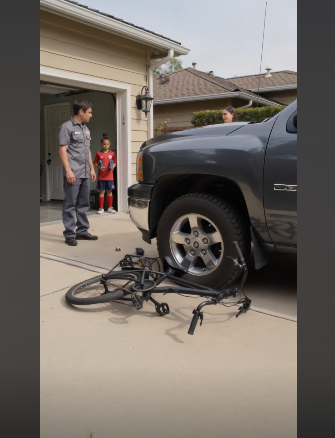
“Sorry—I accidentally backed Dad’s truck over your $5,800 e-bike,” my sister said after I refused to pay for her son’s summer camp. Dad added, “Your child can walk like everyone else.” I didn’t argue. That night, I canceled the card they had been using and closed the account that covered their biggest monthly expense. At 7:09 the next morning, my sister found the final notice on her door—and suddenly, the damage to my bike no longer seemed funny…
The Bell That Survived the Truck
“Your daughter can walk like everyone else.”
My father said it while the front tire of his truck was still resting against the collapsed frame of Kora’s electric bike.
He did not raise his voice. That made the sentence worse.
It sounded settled, almost practical, as if an eleven-year-old girl losing the one thing that gave her independence were simply a correction to a family budget.
My sister Noel stood beside him in my driveway with her arms crossed. Five minutes earlier, she had told me she had accidentally backed over the bike. Now the careful apology was already gone from her face.
Behind them, the late-afternoon sun reflected off the hood of Dad’s dark gray pickup. Beneath the passenger side, Kora’s bike lay folded at the center bar, its rear wheel tilted at an angle that no repair shop could correct. The cargo rack I had installed for her school backpack and soccer bag had twisted away from the frame.
Near the garage door, a small brass bell shaped like a ladybug rested on the concrete.
It had come loose without breaking.
The bike had not been as fortunate.
Kora stood in the hallway behind me, wearing her red soccer jersey and holding one cleat in each hand. She had been on her way outside when she heard her grandfather’s voice.
She did not cry.
She looked from the bike to Noel, then to Dad, then back to me.
Children understand family rankings long before adults admit they exist. I could see Kora calculating hers.
My father nodded toward the wrecked bike.
“Five thousand eight hundred dollars for a child’s bicycle was unnecessary,” he said. “Noel’s boy doesn’t even get to attend summer camp, and your daughter has an electric bike.”
“The two things are not connected.”
“They are in this family.”
Noel lifted one shoulder.
“If you’d helped with Trey’s camp, none of this would have happened.”
That was the moment her accident became an admission.
Three days earlier, she had called and asked me to pay twenty-four hundred dollars for her nine-year-old son’s summer program. It was a private outdoor camp outside Columbus, not a school requirement or an emergency. I had told her I was not paying for it.
I had not said I lacked the money.
I had said no.
Noel had spent most of her adult life hearing those two words as if they meant the same thing.
Dad moved closer to the truck.
“You spend freely when it’s for Kora.”
“She’s my daughter.”
“Trey is your nephew.”
“I help Trey. I’m not responsible for every expense Noel chooses.”
Noel’s eyes narrowed.
“You sit in this nice house with your utility-company salary and act like helping us would ruin you.”
“I pay your car insurance.”
“That has nothing to do with camp.”
“I co-signed your apartment.”
“You offered.”
“I rent the storage unit where Dad keeps this truck.”
Dad’s mouth tightened.
“That doesn’t give you the right to hold it over our heads.”
“No,” I said. “It explains why your argument makes no sense.”
The truck remained in the driveway, still angled toward the exact place where Kora had parked her bike after school every day for five months. The bike had not been hidden near the curb or left behind the truck. It had been beside the garage, visible from the street.
Noel had driven up the driveway slowly enough to stop after the first wheel touched it.
Instead, she kept going.
My neighbor, Lewis Grant, stood in his yard across the hedge, holding a garden hose that had not moved for several minutes. Lewis was my crew supervisor at Central Ohio Electric. He had trained me when I was twenty-one, corrected me without humiliating me, and once told me that confidence meant nothing around live equipment if knowledge did not support it.
He was not staring.
He was making himself available as a witness.
I looked at Noel.
Then at Dad.
Then at my daughter.
“I am not going to yell,” I said.
Noel rolled her eyes.
“Good. Because you’re already making this larger than it is.”
“I want both of you to remember that I did not yell.”
Dad gave a short laugh.
“Is that supposed to frighten us?”
“No.”
I stepped into the garage and picked up the ladybug bell.
The brass was warm from the sun. A shallow scratch crossed one red-painted wing, but when I tilted it, the bell rang once.
Kora’s eyes followed it.
“I’m going inside with my daughter,” I said. “Move the truck off my property.”
Noel opened her mouth.
I closed the front door before she could speak.
Kora stood in the hallway for several seconds. Her cleats hung loosely from her hands.
“Was it really an accident?” she asked.
I placed the bell on the entry table.
“No.”
Her chin trembled.
“Did Aunt Noel do it because you wouldn’t pay for Trey?”
“Yes.”
“Is Trey mad at me?”
“No. Trey did not make this decision.”
“Grandpa said my bike was showing off.”
“He was wrong.”
“Why did he say I can walk?”
“Because some adults confuse making a child uncomfortable with teaching a lesson.”
She looked toward the closed door.
“Did I do something?”
“No.”
“Did you?”
“I said no to paying for a camp.”
“Is that bad?”
“No.”
Kora set the cleats on the floor.
“Are you mad?”
“Yes.”
“You don’t sound mad.”
“I can be angry without giving them control of what I do next.”
She looked at the bell.
“Can the bike be fixed?”
“I don’t know yet.”
I did know.
The central frame was bent. The battery casing had cracked, and the rear wheel had folded inward. Even if a shop offered to rebuild it, I would never trust the structure beneath my daughter again.
“I’ll take it to the dealer,” I said.
Kora nodded, though disappointment settled visibly across her face.
She had received the bike on her eleventh birthday.
The school was a little more than two miles from our house, close enough to make the district’s long bus route feel absurd and far enough that carrying a backpack, soccer equipment, and a musical-instrument case became exhausting. Kora had asked for a practical commuter bike, not a toy. I chose a premium cargo e-bike with wide tires, safety lights, mirrors, and a frame that fit her as she grew.
She helped me compare models.
She saved money from pet-sitting to buy the ladybug bell herself.
On the morning of her birthday, she rang it eleven times in the driveway, one ring for every year she had been alive. Mrs. Davidson from two houses down came outside in her robe to applaud. Lewis brought her a reflective vest and taught her to inspect the tires before riding.
The bike changed our mornings.
Kora left twenty minutes later than she did for the bus and still arrived early. She carried her own gear. She visited the library after school without waiting for me. She rode to soccer practice with two teammates on the neighborhood path.
The bike was not proof that she had more than Trey.
It was proof that I had planned around my daughter’s real life.
My family rarely understood the difference.
I was thirty-three years old and had worked as a line technician for Central Ohio Electric for twelve years. I climbed poles, inspected high-voltage equipment, repaired storm damage, and spent many winter nights restoring power while other families stayed warm inside their homes.
The work paid well because the work was difficult.
My father still called it “pole work.”
Vic Ryland had driven delivery trucks for thirty years. His job had been visible. People recognized the brown uniform, the route, and the retirement pension. When he stopped working, the company gave him a banquet and a plaque.
My work happened above the trees.
People noticed it only when the lights went out.
At Thanksgiving, Dad asked when I planned to move into management and find something with a desk.
At Christmas, he introduced me to relatives by saying, “Beck works for the electric company,” then changed the subject before anyone could ask what that meant.
None of this would have mattered if he had not also relied on the income he dismissed.
Three years earlier, Dad moved into an apartment complex that did not allow oversized vehicles in its garage. His Ford pickup was too tall for the entrance and too long for the assigned outdoor spaces.
I rented a private storage bay on Broad Street.
The agreement was in my name.
The monthly charge came from my account.
Dad received a guest code and treated the place as though the storage company had given it to him as a retirement benefit.
Noel had depended on me for longer.
She lost a receptionist job at a veterinary clinic in February after months of missed shifts. She said the manager had been unfair. The manager said she stopped calling when she did not plan to arrive.
Noel’s unemployment support ended in May.
Her apartment rent was eleven hundred seventy-five dollars per month. She lived there because I had guaranteed the lease when her credit and income were not enough for approval.
Her car insurance was charged to my credit card because her previous policy had ended after three missed payments. She had promised to replace my card as soon as she returned to steady work.
That promise was twenty-four months old.
I had continued paying because Trey needed a stable home, a ride to school, and a mother who could reach job interviews.
Helping them had never felt like a mistake until the day Noel drove Dad’s truck over Kora’s bike and explained that my help had not been generous enough.
That evening, Lewis called while I was making grilled-cheese sandwiches for Kora.
“I saw the whole thing,” he said.
“I figured you did.”
“She lined up twice.”
I closed my eyes.
“What do you mean?”
“She started into your driveway, backed out, then adjusted the angle before coming in again. Your bike camera probably caught it.”
I looked toward the small security screen mounted above the kitchen counter.
After a package disappeared from our porch the previous winter, I had installed two cameras: one above the front door and one beneath the garage light.
“I haven’t checked.”
“You should.”
“I will.”
Lewis was silent for a moment.
“What are you planning?”
“Documentation.”
“That sounds like you.”
“I’m ending the insurance payment.”
“Good.”
“I’m ending Dad’s storage arrangement.”
“Also good.”
“I’m withdrawing the apartment guarantee when the lease reaches renewal.”
Lewis let out a slow breath.
“That one affects Trey.”
“It does. That’s why I’m giving Noel the full notice period and information for income-based housing. I’m not putting them out tomorrow.”
“That matters.”
“I’m not trying to make them suffer.”
“What are you trying to do?”
I looked at the ladybug bell resting near Kora’s plate.
“I’m removing my money from a system that uses my daughter as the price of admission.”
Lewis did not respond immediately.
Then he said, “The wire doesn’t care how confident somebody feels. It cares what they know.”
It was something he had told me on my first storm call.
“I remember.”
“Your family is about to learn what they never bothered to know.”
After Kora went to bed, I pulled the damaged bike into the garage.
Dad had moved his truck from the driveway, but the tire marks remained across the black frame. I photographed every angle. I placed the cracked battery in a fire-resistant utility container and called the dealer’s emergency line for disposal instructions.
Then I opened the garage-camera recording.
At 4:52 p.m., Noel’s sedan appeared and stopped at the curb.
Dad sat in the passenger seat.
Noel climbed out, walked around the sedan, and entered Dad’s truck, which had been parked two houses away.
She drove toward my driveway.
Then she stopped.
Backed out.
Turned the wheel.
Entered again at a sharper angle.
The camera did not record sound from that distance, but it did not need to.
The bike stood in full view.
Noel aligned the truck directly with it.
The tire crossed the rear wheel.
The truck stopped for one second.
Then moved forward again.
Dad’s sedan followed.
He got out, looked at the damage, and stood beside the truck until I opened the front door.
I saved the recording to three separate locations.
At 9:14, Noel sent me a text.
You could have prevented all of this by helping Trey.
I replied once.
Are you confirming that the bike was damaged because I declined to pay for camp?
Three dots appeared.
Disappeared.
Returned.
Finally, she wrote:
I’m saying choices have consequences.
I saved the message.
A minute later, Dad texted.
It was a bicycle, Beck. Stop acting like she lost a house. Maybe now she’ll understand that other children have less.
I saved that one too.
The evidence was no longer only video.
It had motive written in their own words.
I opened Noel’s insurance account, where I was listed as the authorized payer but not the policyholder. I removed my credit card and downloaded confirmation that the company would contact Noel to replace the payment method before the next due date.
Coverage did not vanish that night. She had ten days.
That mattered.
I wanted her responsible, not stranded without warning.
Next, I logged into the storage account. I removed Dad’s guest code and scheduled termination of the unit at the end of the month. The truck had already been returned there after leaving my house, which the facility’s entry log confirmed.
I sent Dad an email.
Your guest access to Unit 14 has been suspended. The truck is connected to a documented property-damage claim and must remain available for inspection. Once the inspection is complete, you may schedule a supervised pickup through the storage office. The rental ends on the final day of this month. Future storage will be your responsibility.
Then I opened the leasing company’s portal for Noel’s apartment.
The current lease ran for another four months. I could not remove myself from the active agreement without their consent, nor would I have tried to destabilize Trey with no warning.
I sent formal notice that I would not renew as guarantor.
The company confirmed that Noel would have sixty days before renewal to qualify independently, find another guarantor, or transfer to a less expensive property.
One card removed.
One door closed.
One signature scheduled to end.
Then I contacted my homeowners insurer and submitted the camera footage, photographs, purchase receipt, and messages.
The claims representative asked whether I wanted to pursue recovery from the driver and vehicle owner.
“Yes.”
“Do you believe the damage was deliberate?”
“I’m sending you the recording.”
There was a pause while she opened the file.
“I understand.”
She assigned a claim number and scheduled an adjuster for Monday.
I also completed a formal property-damage report through the county’s online system. I did not use dramatic language. I described what the camera showed, identified the vehicle, attached the messages, and listed the replacement value.
Documentation is strongest when it does not need adjectives.
At 10:47, I sat at the kitchen table with a legal pad.
I wrote down every recurring expense I had been carrying for Noel and Dad.
Twenty-four months of car insurance: six thousand nine hundred sixty dollars.
Thirty-six months of truck storage: six thousand three hundred dollars.
Apartment guarantee: no direct monthly payment, but my credit and legal responsibility had supported the lease.
Emergency grocery transfers over two years: two thousand four hundred fifty dollars.
Past-due electric bill paid the previous winter: eight hundred twenty dollars.
Trey’s school clothing, sports registration, and birthday gifts: money I did not regret and would not count against him.
The damaged bike: five thousand eight hundred dollars.
The total was larger than the issue in the driveway.
That was the point.
The bike was not an isolated conflict.
It was the first time they had made my daughter pay for my refusal to continue.
My phone lit up at 11:12.
The message came from my former wife, Mara.
Beck, did Kora receive the birthday checks I sent through Noel?
I stared at the screen.
What birthday checks?
Mara replied immediately.
Two hundred dollars each year for the last three birthdays. I mailed them to Noel’s apartment because the first one came back after your move, and she said she would pass them along. Kora never mentioned them, so I wanted to make sure.
Kora had never received a check from Mara.
I called her.
She answered on the second ring.
“You didn’t know?”
“No.”
“I’m sorry. I should have asked sooner.”
“Do you have copies?”
“My bank should.”
“Request them.”
“Do you think Noel kept them?”
“I don’t know yet.”
Mara became quiet.
“We haven’t always agreed, Beck.”
“That’s true.”
“But I would never let someone take from Kora because we disagreed.”
“I know.”
“I’ll send everything tomorrow.”
I did not call Noel.
The old version of me would have.
He would have demanded an explanation at midnight, listened to her cry, accepted half an apology, and ended the call feeling guilty for upsetting Trey’s mother.
Instead, I added Mara’s message to the folder.
The ladybug bell sat beside my laptop.
It had survived because it was small enough to roll free.
I was beginning to understand that survival and avoidance were not the same thing.
Sometimes the part that survives is the part you use to rebuild.
At 7:09 the next morning, Noel opened the red notice from her insurance company.
I knew the time because her first voicemail arrived at 7:14.
“Beck, your card is gone. They say I need a new payment method before next week. I have an interview Monday. I can’t handle this right now. Call me.”
At 7:22, she sent a text.
You are risking Trey’s stability over a bike.
I did not respond.
At 7:40, Dad called.
I answered.
“Where is my truck?”
“In the storage unit.”
“My code doesn’t work.”
“I removed guest access.”
“You can’t lock me out of my own truck.”
“The storage contract is mine. The truck needs to remain available for an insurance inspection because it was used to damage Kora’s property.”
“This is a family issue.”
“It became an insurance issue when Noel drove over the bike.”
“I want the code.”
“You can schedule pickup after inspection.”
Dad’s voice sharpened.
“I paid for that truck.”
“And I paid to store it for three years.”
“You offered.”
“Yes.”
“So now every favor comes with conditions?”
“No. Every favor has ended because you used the benefit I provided to harm my daughter.”
He breathed into the phone.
“Don’t talk about your sister like that.”
“I described her actions.”
“You know Noel is under pressure.”
“Pressure does not steer a truck.”
“She made a mistake.”
“She adjusted the angle twice. The camera recorded it.”
Silence.
Dad recovered.
“You had no right to record her.”
“She was in my driveway.”
Another silence.
Then he said, “Delete it.”
“No.”
“Beck.”
“The adjuster comes Monday.”
“You would involve strangers against your father?”
“I involved documentation after my father watched his granddaughter’s property being destroyed and called it a lesson.”
He hung up.
The calls continued through Saturday.
Mom had died when Noel and I were teenagers, so there was no one left in the family who could pretend to mediate without choosing a side. Our aunt Denise called once and said Dad was furious.
“I’m not asking you to fix it,” I told her.
“I know. I’m calling to say I saw the family messages.”
“What messages?”
“Noel posted something in the group chat Tuesday night. She deleted it later.”
“What did it say?”
Denise hesitated.
“I took a screenshot because it sounded strange.”
She sent it while we were on the phone.
Noel had written:
Beck said no to camp because all his money goes to making Kora feel special. Dad says we should remind him his kid isn’t the only one who matters.
Dad replied:
That bike is the symbol. Take care of the symbol and maybe he’ll understand.
Denise wrote:
Please leave the children out of this.
Noel responded:
Nobody is touching a child. It’s just an expensive object.
The date was three days before the driveway incident.
I added the screenshot to the folder.
“Why didn’t you tell me?” I asked.
“I thought they were venting.”
“They planned it.”
“I know that now.”
“Did anyone else see it?”
“Everyone in the chat.”
“Did anyone challenge them besides you?”
“No.”
The answer did not surprise me.
Still, it hurt.
That afternoon, Kora walked with me to the bike dealer.
The service manager inspected the frame, battery, and wheels.
“I wouldn’t rebuild this,” he said quietly.
Kora stood beside the display of helmets.
“Could you put my bell on a new bike?”
He looked at her.
“Yes.”
She held it tightly.
“We’ll order one,” I said.
Kora turned toward me.
“Do we have to wait for Aunt Noel to pay?”
“No.”
“Are you buying it twice?”
“Yes.”
“That’s not fair.”
“No.”
“Then why do it?”
“Because the unfair part belongs to the adults. You still need transportation.”
She looked at the rows of bikes.
“I can walk for a little while.”
“You can.”
“I don’t want Grandpa to think I can’t.”
I crouched beside her.
“Walking is not shameful.”
“He made it sound like it was.”
“He was using it as a punishment. You get to decide what it means when you do it.”
She nodded slowly.
“Can I walk to school until the new bike comes?”
“I’ll go with you the first time.”
“I know the way.”
“I know.”
“Can you drive behind me instead?”
The request surprised me.
“Why?”
“So I can do it myself and still know you’re there.”
That was Kora.
Eleven years old, already learning the difference between support and control.
“I can do that.”
The adjuster came Monday.
She photographed the bike and inspected the tire marks on Dad’s truck at the storage facility. Dad arrived with a representative from the facility but said little after seeing the camera footage.
The insurer determined the bike was a total loss.
Because the incident appeared intentional, my homeowners policy would not absorb the cost as an ordinary accident. The company sent a formal recovery demand to Noel and Dad.
My attorney, Claire Bowman, reviewed the documents that afternoon.
Her office overlooked a shopping plaza near downtown Columbus. She read the texts, the camera timeline, the insurance notice, the storage agreement, and Mara’s message about the checks.
“Do you want repayment or punishment?” she asked.
“Repayment for the bike and the checks. Boundaries for everything else.”
“Good answer.”
“I also want written acknowledgment that Noel and Dad acted deliberately.”
“That may become part of a settlement.”
“What about the insurance and storage money?”
“You probably cannot recover voluntary support payments simply because the relationship deteriorated. They were benefits you chose to provide.”
“I understand.”
“They matter as context, not as damages.”
“That’s how I see them.”
Claire leaned back.
“The birthday checks are different. If Noel received and deposited money intended for Kora, that needs to be documented.”
“Mara requested the bank records.”
“We’ll wait for them.”
“I’m ending the lease guarantee at renewal.”
“That is your right, provided you follow the agreement and notice terms.”
“I am.”
“You’re doing more careful work than many clients who arrive here already determined to destroy their relatives.”
“I don’t want to destroy anyone.”
“What do you want?”
I pictured Kora in the hallway, listening to Dad say her bike was unnecessary.
“I want them to experience the cost of depending on someone they refuse to respect.”
Claire nodded.
“Then stay factual.”
On Sunday, Noel and Dad came to my house.
I had told them I would speak at one in the afternoon on the front porch. Lewis washed his truck next door, not because it needed washing, but because he understood the value of a visible witness.
Noel climbed out of her sedan first.
She had replaced the payment method on her insurance with a temporary loan from Aunt Denise, so she was still covered. The red notice had frightened her into action, which was the entire point of removing my card.
Dad moved more slowly.
Without access to the storage unit, he had spent two days calling facilities, comparing prices, and learning that climate-controlled truck storage cost more than he assumed.
Noel stopped at the foot of the porch steps.
“Give Dad the code.”
“No.”
“The inspection is complete.”
“He can schedule pickup tomorrow. The rental ends this month.”
“This has gone too far.”
“It went too far when you aimed the truck at Kora’s bike.”
She looked toward Lewis’s yard.
“Are you arranging an audience?”
“I arranged a witness.”
Dad stepped forward.
“Handle family matters inside the family.”
I took the folder from the porch table.
“Family matters are still subject to receipts.”
Noel’s eyes moved to the folder.
“What is that?”
“The record.”
I removed the first page.
“The bike replacement is five thousand eight hundred dollars.”
“You paid less than that for the new one.”
“I have not received the final invoice. The recovery request is based on the value of the bike you destroyed.”
“It was used.”
“Five months old.”
Dad shook his head.
“This is absurd.”
I turned the next page.
“Your messages confirm motive.”
Noel’s face tightened.
“You have no right to my private texts.”
“You sent me one directly. Aunt Denise preserved the family chat. The driveway camera recorded the rest.”
I read Noel’s message aloud.
You could have prevented all of this by helping Trey.
Then Dad’s.
Maybe now she’ll understand that other children have less.
Neither of them spoke.
I held up the group-chat screenshot.
“That bike is the symbol,” I read. “Take care of the symbol and maybe he’ll understand.”
Dad looked toward the driveway.
“I was angry.”
“You planned to teach me a lesson by destroying something my daughter used every day.”
“It should never have cost that much.”
“The price does not give you ownership.”
Noel folded her arms.
“You care more about money than family.”
I opened the ledger.
“For twenty-four months, I paid your car insurance. Six thousand nine hundred sixty dollars.”
Her arms lowered slightly.
“For thirty-six months, I paid to store Dad’s truck. Six thousand three hundred dollars.”
Dad looked at me.
“I didn’t know it was that much.”
“You never asked.”
I continued.
“I guaranteed your apartment. I covered groceries, utilities, and school expenses when you could not. I did those things because Trey deserves stability.”
Noel’s eyes became wet.
“Then why are you taking it away?”
“I am not taking back the past. I am ending the future obligation.”
“You know I don’t qualify alone.”
“You have four months to find work, increase your income, locate another guarantor, or move to a property you can afford.”
“My interview is tomorrow.”
“Good.”
“You expect me to ride a bus across town?”
“I expect you to arrange transportation that does not depend on my credit card.”
Dad gripped the porch railing.
“You are humiliating your sister.”
“No. I am describing the responsibilities she has avoided.”
“You think you’re better than us because you make more.”
“No.”
I looked at him.
“I think you enjoyed the benefits of my work while dismissing the work itself.”
His expression changed.
“That is not true.”
“You called my career pole work. You told Kora her bike was showing off. You used a truck I had stored for free to make your point. Then you said she could walk.”
“I was trying to teach her gratitude.”
“She was grateful. You were resentful.”
Dad’s hand remained on the railing.
I turned to Noel.
“Mara sent Kora six hundred dollars in birthday checks through your address.”
Noel became completely still.
Dad looked at her.
“What checks?”
“I don’t know what he’s talking about.”
I held up copies of the bank records Mara had sent.
Three checks.
Each endorsed and deposited into Noel’s account.
The endorsement on the back read:
For deposit only.
Noel Ryland.
Her face lost color.
“I was going to replace it.”
“Three years ago?”
“I used it for Trey.”
“It was not for Trey.”
“He needed things.”
“Kora was the named recipient.”
“You always have money for Kora.”
“That does not make her money yours.”
Dad released the railing.
“Noel.”
She looked at him.
“I was behind on rent.”
“You told me Beck paid the electric bill that month.”
“He did.”
The porch became quiet.
Lewis turned off the hose.
I placed the bank records back in the folder.
“The legal claim includes the bike and the checks. The insurance company has sent its own demand. Claire will communicate with you about mediation.”
Noel wiped her face.
“You’re taking your own sister to court.”
“I am asking my sister to repay what she intentionally damaged and what she kept from my daughter.”
“What about Dad?”
“He provided the truck and encouraged the plan. The claim names both of you.”
Dad looked older than he had when he arrived.
“You would do this to your father?”
“You did it to your granddaughter first.”
The words landed harder than I expected.
He bent slightly, not falling, but absorbing information his pride had resisted.
His eyes moved toward the faint mark on the driveway where the damaged battery had rested.
“This is the last insurance payment,” I said. “The last free storage month. The last lease guarantee. I will still buy Trey birthday gifts. I will still attend his school events if I am invited. I will not use a child to punish his mother.”
Noel looked up.
“Then help with camp.”
“No.”
The answer was calm.
Final.
“Why?”
“Because you asked for a luxury expense while unemployed and chose retaliation when I refused.”
“Trey will be disappointed.”
“Disappointment is survivable. Entitlement becomes expensive.”
Dad’s jaw tightened again.
“You always have an answer.”
“No. I finally stopped answering for everyone else.”
I stepped back toward the front door.
“Do not return without arranging it first. Future communication about the claim goes through Claire.”
Noel remained at the bottom of the steps.
Dad turned toward the car.
He had told Kora she could walk.
Watching him cross the driveway on his own feet did not feel like victory.
It felt like the natural end of his sentence.
The consequences arrived gradually.
Noel took two buses to the job interview Monday morning.
The trip required fifty minutes instead of twelve.
She was offered a warehouse position at a pet-supply distributor for fourteen dollars and fifty cents per hour. It was not the work she wanted, but it was stable. The company offered predictable shifts, health coverage after ninety days, and a path to inventory supervision.
She accepted.
Her first independent insurance payment required a larger deposit than she expected. Aunt Denise loaned her the money with a written repayment schedule rather than an open-ended promise.
Noel complained that the family had become transactional.
Denise told her, “The family became transactional when you destroyed something because Beck would not buy what you wanted.”
Dad retrieved his truck after the inspection.
He moved it to an outdoor lot on the east side for two hundred twenty dollars per month.
The first week, he left it on the street outside his apartment and received two parking notices because he had never learned the alternate-side schedule. He blamed the city, the apartment manager, and me before finally admitting he needed a permanent plan.
He paid the lot.
For the first time in three years, the cost of owning his truck belonged to him.
Kora walked to school for six days.
I drove behind her the first two mornings, staying far enough away that she could feel independent and close enough to see every crossing.
On Wednesday, she turned at the corner of Broad and James, spotted my truck, and waved.
She had known I was there.
She smiled, turned forward, and kept walking.
That morning, I ordered the replacement bike.
The mediation took place six weeks after the driveway incident.
Noel sat beside a legal-aid attorney. Dad had hired a lawyer he knew through a retired drivers’ association. Claire sat beside me with the gray folder, camera footage, receipts, texts, bank records, and insurer’s report arranged in careful order.
The mediator was a retired judge named Helen Mercer. She spoke softly and asked direct questions.
Noel repeated that she had not intended to destroy the bike completely.
Helen watched the video.
“You adjusted the truck’s angle twice,” she said.
“I was trying to park.”
“The driveway is empty except for the bike.”
Noel looked at the table.
Dad said he had believed the bike was an irresponsible purchase and wanted Beck to reconsider how he spent money within the family.
Helen removed her glasses.
“Mr. Ryland, you did not damage your son’s property to begin a budget conversation. You helped your daughter damage your granddaughter’s transportation because your son declined a separate request.”
Dad did not answer.
The insurer requested full replacement value from Dad’s vehicle policy. His policy carrier reviewed the deliberate-act issue and negotiated payment through a property settlement while reserving its own decisions about future coverage.
Noel agreed to repay the six hundred dollars in birthday checks immediately.
The bike claim was settled through a combination of insurance recovery and a repayment plan from Noel and Dad.
More important to me, both signed a written acknowledgment.
It did not use dramatic language.
It stated that the bike had been damaged deliberately following a disagreement about money, that Kora had not caused the disagreement, and that no adult should have involved her property in it.
Noel resisted the sentence at first.
Helen looked at her.
“Which part is inaccurate?”
Noel read it again.
Then she signed.
Dad held the pen for nearly a minute.
Finally, he signed too.
Afterward, he found me in the courthouse hallway.
The building smelled like floor cleaner and old paper. People moved past us carrying folders and coffee cups.
“I never thought it would reach this point,” he said.
“You planned the beginning. You just did not plan the rest.”
He looked toward the windows.
“I was angry because you always say no to Noel now.”
“I say no more often because yes never helped her stand.”
“She’s your sister.”
“I know.”
“You think I favored her.”
“I think you protected her from every consequence and expected me to fund the protection.”
He rubbed one hand over his jaw.
“Your mother worried about Noel.”
“Mom died when she was nineteen.”
“That’s why I helped.”
“So did I.”
He looked at me.
“Maybe I leaned too hard on you.”
“You did.”
The word hung between us.
Dad had spent most of his life avoiding sentences that began with I was wrong.
I did not rescue him by finishing one.
“Can I see Kora?” he asked.
“Not yet.”
His face tightened.
“She’s my granddaughter.”
“She heard what you said.”
“I know.”
“Have you apologized?”
“I signed the paper.”
“That was for the claim.”
“What does she want me to say?”
“It needs to come from you.”
He looked down.
“I don’t know how.”
“Learn.”
The replacement bike arrived on a Saturday afternoon.
Lewis came over with a socket set, torque wrench, and a six-pack of root beer.
He did not ask whether I needed help.
He arrived dressed to work.
We opened the box in the garage.
The new bike was the same matte black as the old one. I had considered choosing another color, but Kora told me she did not want Noel’s decision to change what she liked.
We installed the mirrors.
Adjusted the handlebars.
Mounted the cargo rack.
Tested the lights.
Checked the battery connection.
Lewis tightened each bolt, then handed the wrench to me so I could check it again.
“Trust and verify,” he said.
“That sounds like line work.”
“Everything worth doing is line work if you respect the load.”
Kora heard us and appeared in the garage doorway.
She had grown quiet during the weeks since the incident, though not in the same way. She was not afraid. She was observing.
Her eyes moved over the new frame.
“Is that mine?”
“It is.”
She stepped closer and touched the handlebar.
Then she noticed the empty bell mount.
“Where’s the ladybug?”
I reached into my jacket pocket.
I had carried the bell more often than I admitted.
The brass surface still held the scratch from the driveway. I had cleaned it but refused to polish the mark away.
I placed it in Kora’s hands.
She turned it over.
“It survived.”
“Yes.”
“Can we use the same one?”
“I was hoping you would.”
She attached it to the handlebar and tightened the small screw herself.
Then she rang it once.
The sound filled the garage.
Lewis looked toward the ceiling as though checking an invisible wire.
I looked away for a second because my eyes had gone hot.
Kora climbed onto the bike.
She adjusted the seat.
Checked the mirrors.
Tested both brakes.
Then she rolled down the driveway, across the faint mark left by the old battery, and into the street.
At the end of the block, she rang the bell.
Once.
Not eleven times like her birthday.
One clear note.
The sound traveled back to us.
Lewis opened a root beer.
“You did good.”
“I bought a bike.”
“No.”
He handed me the bottle.
“You taught her that what happened was not the end of the object or the story.”
I watched Kora turn the corner.
“She taught me that.”
The family did not repair itself quickly.
Noel worked.
At first, she complained about the early shifts, bus transfers, and the way her feet hurt after standing for eight hours.
Then the warehouse promoted her to inventory coordinator.
She learned the software system faster than expected. Her manager praised her organization. For the first time in years, Noel had regular income she could predict.
She moved from the Sullivan Avenue apartment into a smaller duplex closer to work. It had one fewer bedroom and a fenced yard. Trey slept in the larger room while Noel used a converted office space.
The move embarrassed her.
Then the reduced rent allowed her to pay insurance, groceries, and utilities without calling me.
Aunt Denise helped her create a budget.
I did not.
That distinction mattered.
Trey did not attend the private summer camp.
He joined a city recreation program instead. The fee was one hundred eighty dollars, and scholarships were available for families rebuilding income.
Noel filled out the application herself.
When Trey told Kora he wished they had gone to the same camp, she said, “Maybe next year we can choose one together.”
Neither child blamed the other.
Adults often damage families by assuming children require the same grudges we do.
Dad remained more difficult.
He paid for the outdoor storage lot but complained at every family gathering about the expense. He avoided my house. He sent Kora a birthday card containing fifty dollars and no personal message.
She returned the money.
I asked why.
“He didn’t write anything.”
“You can keep a gift even if the note is bad.”
“It feels like he’s paying instead of talking.”
I sealed the money in a new envelope and mailed it back with no commentary.
Three weeks later, Dad called.
“She sent it back.”
“Yes.”
“That was rude.”
“She wanted a message.”
“I signed the card.”
“She wanted words.”
“What am I supposed to say?”
“The truth.”
He became quiet.
“I was raised differently.”
“So was I.”
“That is easy for you to say.”
“It has not been easy.”
“What if she doesn’t forgive me?”
“That is possible.”
He let out a breath.
“Then why try?”
“Because an apology is not a purchase.”
A month passed.
Then Dad asked to meet Kora at a public park near her soccer field.
I told her the request.
“You don’t have to go.”
“Will you stay?”
“Yes.”
“Can Lewis come?”
I smiled.
“He can sit nearby.”
Dad arrived without the truck.
He had walked from the parking lot carrying a small paper bag.
Kora sat beside me on a bench.
Dad stopped several feet away.
“Can I sit?”
She nodded.
He lowered himself onto the other end of the bench.
For a while, he watched children play near the basketball court.
Then he looked at Kora.
“I said your bike was showing off.”
“Yes.”
“I said you could walk.”
“Yes.”
“I helped Noel damage the bike because I was angry at your father.”
Kora’s fingers tightened around the edge of the bench.
Dad continued.
“You did nothing wrong.”
She looked at him.
“I knew that later.”
“You should have known it immediately because I should never have made you question it.”
He opened the paper bag.
Inside was a small wooden box.
“I made this.”
Dad had learned basic woodworking after retirement. The box was simple, with a brass hinge and a ladybug carved into the lid.
“For your bike bell when you don’t want it outside,” he said.
Kora did not take it immediately.
“Why a ladybug?”
“Because your dad told me the bell survived.”
She looked at me.
I nodded.
Dad placed the box on the bench between them.
“I thought having less taught gratitude,” he said. “But I used loss to make myself feel right. That was not teaching.”
Kora stared at the carved lid.
“Are you still mad about the bike?”
“No.”
“Are you mad Dad said no to camp?”
“No.”
“Are you mad he stopped paying for things?”
Dad looked toward the field.
“Sometimes.”
Kora’s expression remained serious.
“That means you’re not done learning.”
Lewis, seated at a picnic table thirty feet away, covered a smile with his coffee cup.
Dad nodded.
“No. I suppose I’m not.”
Kora picked up the box.
“I’m not ready to let you ride in the truck with me.”
“That’s fair.”
“I don’t ride in the truck,” she added.
“I know.”
“You can come to my next soccer game.”
Dad’s eyes became wet.
“I would like that.”
Forgiveness did not arrive that afternoon.
Access did.
A small amount.
Earned through the first honest conversation Dad had offered.
Noel’s apology took longer.
She sent messages through Dad, Aunt Denise, and Trey, each one asking when the family would return to normal.
I answered the same way.
Normal was the system that allowed her to need indefinitely while everyone else adjusted.
We were not returning to it.
At Thanksgiving, Noel arrived at Aunt Denise’s house carrying a covered casserole and a white envelope.
She had cooked the dish herself.
That alone unsettled the family.
After dinner, she asked to speak to Kora in the living room.
I remained near the doorway.
Noel sat on the couch. Kora chose the chair across from her.
“I wrote this because I kept trying to explain instead of apologize,” Noel said.
She handed Kora the envelope.
Kora opened it.
The letter was two pages.
Noel wrote that she had been angry with me and jealous of the stability I had built. She admitted seeing Kora’s bike as proof that my daughter received things Trey did not. She acknowledged that instead of improving her own situation, she tried to reduce Kora’s.
The final paragraph read:
You were never responsible for what I could not afford. Your bike did not take anything away from Trey. I damaged something you loved because I wanted your father to feel guilty. I made you carry an adult argument that did not belong to you. I am sorry. I will repay the money and keep working whether you forgive me or not.
Kora read it twice.
Then she folded it.
“Did you mean it?”
“Yes.”
“Would you still be sorry if Dad had not canceled your insurance payment?”
Noel’s face tightened.
“At first, probably not.”
The honesty surprised all of us.
Noel continued.
“At first, I was sorry about what happened to me. Not about what I did to you.”
“What changed?”
“I started paying for my own life.”
Kora looked at the letter.
“Was that hard?”
“Yes.”
“Dad says hard and wrong aren’t the same.”
Noel glanced toward me.
“He’s right.”
Kora placed the letter back in the envelope.
“I don’t want you to buy me anything.”
“All right.”
“But you can come to my game with Grandpa.”
Noel nodded.
“Thank you.”
The claim repayment lasted eighteen months.
Dad and Noel each paid a portion monthly. Noel returned the birthday money first. The insurer’s recovery settlement covered much of the bike. The remaining balance came from them on a schedule arranged through mediation.
Every payment arrived on time.
I did not celebrate them.
Repayment was not humiliation.
It was completion.
The more important changes were quieter.
Noel stopped calling me when an ordinary bill arrived.
Dad stopped referring to my career as pole work.
At one soccer game, a relative asked what I did. Dad answered before I could.
“He maintains the regional power grid. Storm response, high-voltage repair, all of it.”
His description was slightly overdone.
I let him have it.
Trey spent Saturdays at our house occasionally. He and Kora remained close. When his own bike chain broke, he asked if I could teach him to repair it rather than buy a new one.
Lewis showed both children how to remove the rear wheel.
Noel watched from the driveway.
She did not ask me to pay for a replacement bike.
She asked where to find an affordable set of tools.
Two years after the driveway incident, Kora outgrew the original seat height. We adjusted the new bike together in the garage.
The ladybug bell still worked.
The scratch had darkened with age.
“Should we replace it?” I asked.
“No.”
“Why not?”
“It reminds me that the whole bike can be gone and one part can still come back.”
She rang it.
The sound had not changed.
Dad stood near the garage entrance holding a box of replacement reflectors. He had called before arriving.
Noel and Trey were coming later for dinner.
Our family was not the same.
It was more careful.
Invitations were explicit.
Money was discussed before commitments were made.
No one used children to settle adult resentment.
When Noel needed help completing a certification course for warehouse management, she asked me to review the schedule, not pay the tuition. Her employer reimbursed most of it after she passed.
When Dad needed knee surgery, he arranged transportation through his retirement plan before asking whether I could drive him.
I did drive him.
That was the difference.
Help had become a request rather than an expectation.
One summer evening, Kora and I sat on the front steps while she cleaned dust from the bike chain.
The stain on the driveway had faded until only I knew where to look.
“Do you still think about it?” she asked.
“The old bike?”
“That day.”
“Sometimes.”
“Were you trying to get revenge?”
“No.”
“It looked like revenge to Aunt Noel.”
“I understand why.”
“What was it, then?”
I considered the answer.
“A circuit can carry only so much load.”
She smiled.
“You’re making this about electricity.”
“I make most things about electricity.”
“Go on.”
“When one line carries everyone’s demand, eventually it overheats. You either reduce the load or the entire system fails.”
“So you cut the power.”
“I stopped supplying it.”
“To Aunt Noel and Grandpa.”
“To the parts of their lives they expected me to support without respecting me or you.”
Kora spun the front wheel.
“Did it work?”
“It changed things.”
“That’s not the same.”
“No.”
“What worked?”
I looked toward the house.
The ladybug box Dad made sat on the entry shelf. Noel’s apology letter remained in Kora’s desk drawer. Trey’s repaired bike leaned against our fence. Lewis was grilling across the street and arguing with his radio.
“You kept riding,” I said.
Kora looked at me.
“That’s the answer?”
“It is for me.”
She stood, put on her helmet, and rolled the bike down the driveway.
At the edge of the street, she stopped.
“Dad?”
“Yes?”
“I knew you were behind me when I walked to school.”
“I know.”
“I didn’t wave the first two days because I wanted you to think I didn’t need you.”
“That sounds familiar.”
She laughed.
“On Wednesday, I figured needing you nearby wasn’t the same as not being able to walk.”
“No. It isn’t.”
She pushed forward.
The bell rang once as she reached the corner.
The sound crossed the evening air and returned to me softer but clear.
People remember the truck because it was large.
They remember the bike because it was expensive.
They remember the red insurance notice, the locked storage gate, the legal folder, and the payment schedule because consequences are easier to see when they have numbers attached.
I remember the bell.
A small brass object rolled out from beneath something heavier.
It carried one scratch.
It kept its voice.
That was the lesson my daughter deserved.
Not that other people would never aim their resentment at what she loved.
Not that family always understood the cost of its own dependence.
Not that money protected anyone from hurt.
The lesson was that damage did not get to define the rest of her life.
We documented the truth.
We ended the support that had become entitlement.
We repaired what could be repaired.
We replaced what could not.
We allowed apologies to arrive slowly and required behavior to support them.
And every morning, Kora rode past the place where the old bike had fallen.
She never rang the bell eleven times again.
She rang it once.
One clean note.
Enough to announce that she was still there.
