At Christmas dinner, Aunt Margaret announced in front of twenty-three rela
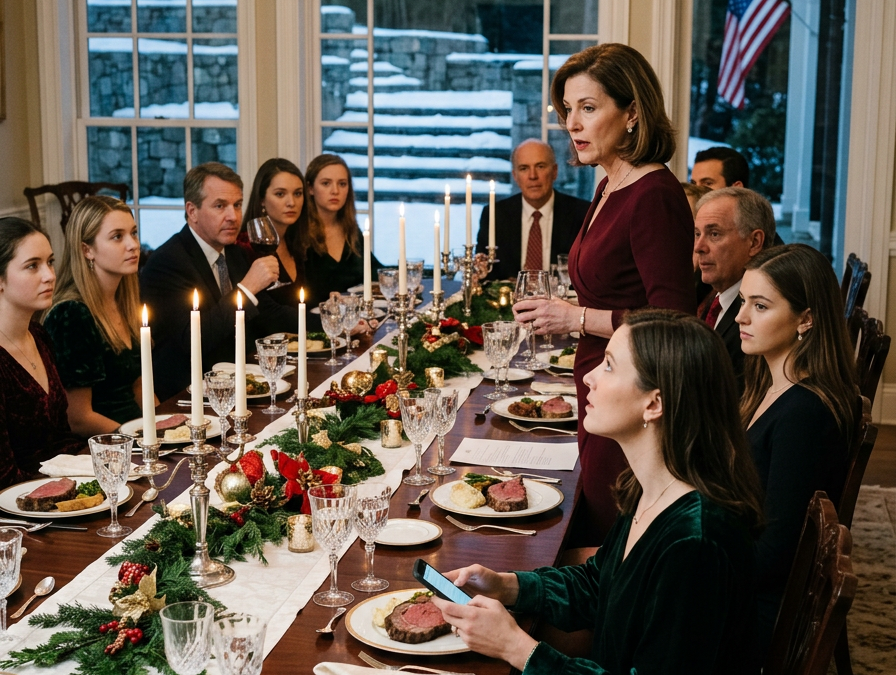
At Christmas Dinner, Aunt Margaret Announced My $147,000 “Family Allowance” Was Over and Ordered Me Out of the Apartment by February 1. Twenty-Three Relatives Called It “Tough Love.” Then My Phone Lit Up With Three Messages From Grandmother Eleanor’s Estate Administrator About Margaret’s Spending.
I had learned to expect uncomfortable moments at Ashford family gatherings.
Christmas at Aunt Margaret’s Connecticut estate, however, was setting a new standard.
Twenty-three relatives filled the formal dining room.
The table was long enough to seat a small board of directors, polished mahogany beneath white linen runners, silver candlesticks, crystal glasses, and a centerpiece large enough to block half the family from seeing one another.
Snow rested on the stone terrace outside.
Inside, everything was warm, expensive, and carefully arranged.
Including me.
For most of my life, the Ashfords had assigned everyone a role.
Margaret was the successful eldest daughter.
Uncle Richard was the practical businessman.
Victoria was Margaret’s polished, ambitious daughter.
James was the family entrepreneur.
Sophie, at nineteen, was still young enough that nobody had completely decided who she was supposed to become.
And me?
Emma Ashford.
Twenty-nine.
Single.
Quiet.
Apparently without a serious career.
The family disappointment.
I had stopped correcting them years ago.
Margaret stood at the head of the table holding her wine glass.
“I think we should address something before dessert.”
Everyone looked toward her.
I already knew.
She had spent most of dinner looking at me with the particular satisfaction she usually reserved for announcing decisions that affected other people.
“Emma’s monthly allowance ends today.”
The room became quiet.
Margaret smiled.
“She’s twenty-nine years old. There comes a point when family support stops helping and starts preventing someone from becoming independent.”
Victoria nodded immediately.
“Finally.”
She looked at me.
“Maybe now you’ll get a real job instead of doing that little charity thing.”
I continued cutting my prime rib.
Small, even pieces.
No reaction.
The “little charity thing” was the Ashford Legacy Foundation.
I had established it five years earlier.
It was currently valued at approximately twelve million dollars.
We funded scholarships, literacy programs, community medical clinics, food-security initiatives, transitional housing support, and education programs across several states.
The foundation had already distributed more than four million dollars.
Nobody at the table knew.
Not because it was secret.
Because when I had first tried explaining it, Victoria had said:
“That’s sweet.”
Then spent twenty minutes discussing the restaurant she wanted to open.
I had learned.
If people are committed to misunderstanding you, more information simply gives them additional material to rearrange.
Uncle Richard swirled his wine.
“The family trust wasn’t designed to support people forever.”
“No,” Harold agreed.
Margaret’s husband sat beside her wearing a burgundy dinner jacket that looked as though he’d spent an hour choosing it.
“At some point, responsibility has to matter.”
Richard looked at me.
“Your grandmother would probably agree.”
That one hurt.
I didn’t show it.
Grandmother Eleanor had been gone for three years.
I thought about her every day.
She was the only person in the Ashford family who had ever understood that quiet did not mean uncertain.
She used to tell me:
“Never confuse the loudest person at the table with the person who understands the most.”
Margaret had always disliked that saying.
Probably because Grandmother usually said it after Margaret left the room.
James leaned forward.
“How much has Emma received anyway?”
He looked around as though inviting everyone into a game.
“Someone should calculate it.”
Margaret had prepared for this.
Of course she had.
She picked up a folded sheet beside her plate.
“One hundred forty-seven thousand dollars since she turned eighteen.”
Several people reacted.
Victoria’s eyebrows rose theatrically.
“Seriously?”
Margaret nodded.
“Plus the apartment we’ve allowed her to live in without rent.”
I drank some water.
The apartment wasn’t theirs.
It had never been theirs.
I had purchased it two years earlier after the previous owner decided to sell.
Before that, I had paid rent directly.
Margaret apparently believed the apartment was part of a family property portfolio because Grandmother had helped me find it.
I had never corrected her.
It seemed almost impressive how much confidence the Ashfords could build on information they had never verified.
Victoria laughed.
“One hundred forty-seven thousand dollars?”
She turned toward me.
“That’s more than some people earn in years.”
“True.”
“And what exactly do you do all day?”
“Work.”
“At shelters?”
“Sometimes.”
“Reading programs?”
“Yes.”
“You visit senior centers?”
“Occasionally.”
She looked around.
“Exactly.”
Margaret’s husband shook his head.
“The Ashfords built businesses.”
I almost smiled.
“Did they?”
He missed the tone.
“Your grandmother understood influence.”
That part was true.
“She built a name that meant something.”
Also true.
“Not whatever this is.”
I kept eating.
The irony was almost painful.
Grandmother had spent her final year teaching me how to manage the trust everyone else at the table believed Margaret controlled.
Margaret took a breath.
“There is one more matter.”
Of course there was.
“Emma, you’ll also need to leave the apartment by February first.”
Sophie looked up immediately.
“What?”
Margaret ignored her.
“Two months should be enough time to find something appropriate for your actual budget.”
Sophie stared at her.
“Aunt Margaret, it’s Christmas.”
Margaret’s expression hardened.
“It’s called setting boundaries.”
“She’s family.”
“Exactly why somebody should have done this earlier.”
Margaret turned toward me.
“Still single.”
I put down my fork.
“No real career.”
I remained quiet.
“No visible ambition.”
Still quiet.
“Just drifting through life while other people protect you from reality.”
Uncle Richard raised his glass.
“To learning responsibility.”
Several people joined him.
I noticed Sophie didn’t.
Neither did I.
My heart rate remained steady.
My hands remained still.
Honestly, the performance was almost less severe than I had expected.
Grandmother had prepared me for people like this.
Not by teaching me how to defeat them.
By teaching me not to let their confidence become evidence.
Victoria leaned closer.
“What are you going to do?”
“About?”
“Everything.”
She gestured vaguely.
“Money. Housing. Life.”
“I’ll figure something out.”
Margaret laughed.
“That’s what you always say.”
“I’ve managed so far.”
“Because Grandmother spoiled you.”
That made me look up.
Margaret smiled.
“She convinced you there was something special about drifting around helping people.”
I met her eyes.
“She thought helping people mattered.”
“It does.”
Margaret gave the room a patient smile.
“But adults also need practical lives.”
My phone vibrated in my pocket.
I ignored it.
James spoke.
“You should move somewhere cheaper.”
“Maybe.”
“Back to the Midwest.”
“Maybe.”
“You could get a studio for twelve hundred dollars.”
Victoria opened an apartment app on her phone.
“I’ll find something.”
“That’s very thoughtful.”
She didn’t catch the sarcasm.
“Here’s one.”
She held up her screen.
“One bedroom. Twelve hundred fifty.”
“Beautiful.”
“It’s small.”
“I’m familiar with small spaces.”
“Maybe retail,” Victoria continued.
“What?”
“For work.”
I almost laughed.
“You seem organized.”
“Thank you.”
“Or something administrative.”
“Good suggestion.”
Margaret nodded approvingly.
“Steady paycheck. Benefits.”
My phone vibrated again.
Then a third time.
Harold noticed.
“Popular tonight.”
He smiled toward the table.
“One of your charity friends?”
“Possibly.”
I excused myself.
The hallway outside the dining room felt cooler.
Quieter.
I pulled out my phone.
Three messages.
Peter Whitmore.
Peter had worked with Grandmother for more than twenty years.
After her death, he became the administrative officer responsible for accounting, compliance, and reporting for the Eleanor Ashford Family Trust.
The first message read:
Emma, sorry to contact you tonight. I need to discuss Margaret’s recent trust expenses.
Second:
Current quarterly withdrawals tied to Margaret’s household have reached approximately $390,000 against a $50,000 discretionary allocation.
Third:
Her assistant has also submitted an $80,000 holiday-event reimbursement and preliminary documentation for a family New Year’s trip.
I stared at the screen.
Then toward the dining room.
Margaret was currently explaining that I needed to learn to live within my means.
Grandmother had a sense of timing even from beyond the grave.
I typed:
How much is the proposed New Year’s trip?
Peter replied almost immediately.
Approx. $200,000 for St. Barts, depending on final guest count.
I closed my eyes.
Grandmother had written the trust to support family stability.
Education.
Reasonable housing.
Healthcare.
Business development when justified.
Emergency support.
Charitable initiatives.
She had not created it to finance luxury travel whenever Margaret wanted a photograph of the family beside an infinity pool.
I typed:
Can you call?
My phone rang seconds later.
“Emma.”
“Hi, Peter.”
“I’m sorry.”
“Don’t be.”
“I’ve tried handling this administratively.”
“I know.”
“The frequency is increasing.”
“How far over?”
“On the current quarter alone, approximately three hundred forty thousand dollars above the discretionary limit.”
“And the historical review?”
He hesitated.
“That is why I called.”
“How much?”
“Approximately nine hundred forty thousand dollars in unsupported or excess withdrawals over the review period.”
I closed my eyes.
“How?”
“Decorating charges coded as property preservation.”
Of course.
“Vehicle expenses coded as estate transportation.”
Of course.
“Private events classified as beneficiary-development expenses.”
I almost laughed.
“Creative.”
“Very.”
“What else?”
“The proposed St. Barts trip is being presented as a family-governance retreat.”
That time I actually laughed.
Peter waited.
“I’m sorry.”
“No. That may be the best thing I’ve heard tonight.”
“Emma, we need direction.”
I looked toward the library.
Grandmother’s library.
Rows of books she had collected over fifty years.
Economics.
History.
Poetry.
Biographies.
Estate law.
Management.
When I was fourteen, she gave me my first book about charitable endowments because I had asked why wealthy families sometimes seemed to become less responsible with every generation.
She had laughed for nearly a minute.
Then told me:
“Because money can cushion people from feedback.”
I understood that sentence better every year.
“Peter.”
“Yes?”
“What’s Margaret’s exact discretionary distribution?”
“Fifty thousand per quarter under the current schedule.”
“And how much has she requested or charged this quarter?”
“Approximately three hundred ninety thousand, excluding the St. Barts proposal.”
“Decline the St. Barts request.”
“Understood.”
“Freeze reimbursement for any charges above the quarterly limit until we review them.”
“Understood.”
“And prepare a complete beneficiary-spending report.”
“Already started.”
“Good.”
I paused.
“Can you come here?”
“Tonight?”
“If you’re willing.”
“I can be there in about forty minutes.”
“Bring the governing documents.”
There was a brief silence.
“You’re ready?”
I looked toward the dining room.
“They’ve decided my allowance ends.”
Peter was quiet.
“What allowance?”
“Exactly.”
Then he laughed.
It was rare enough that I smiled.
“I’ll be there.”
I returned to dinner.
Dessert had arrived.
Chocolate torte.
Coffee.
Brandy.
And apparently the continuation of my financial intervention.
Margaret looked pleased to see me.
“We’ve been discussing your options.”
“How productive.”
James leaned forward.
“I had a great idea.”
“I’m sure.”
“You could work for Aunt Margaret.”
Margaret smiled.
“Assistant role.”
Victoria nodded.
“That would actually be perfect.”
I looked at Margaret.
“What would I do?”
“Scheduling.”
She considered it.
“Correspondence.”
“Trust paperwork?”
Her eyes narrowed slightly.
“Maybe eventually.”
I took a sip of coffee.
“Interesting.”
“Forty thousand a year,” James suggested.
Margaret looked almost offended by the generosity.
“Perhaps.”
Then:
“Six-month trial.”
“Naturally.”
Harold laughed.
“You’d finally see how expensive real life is.”
“Would I?”
“No family cards.”
“Terrifying.”
“No trust safety net.”
“Of course.”
Margaret gave me a serious expression.
“We’re not doing this to embarrass you.”
I almost admired her ability to say things directly contradicted by her facial expression.
“We’re being realistic.”
“Good.”
“You’ve had nearly thirty years to become independent.”
My phone lit up on the table.
Peter.
Margaret noticed.
“Another emergency?”
“Possibly.”
I stood.
“Excuse me.”
She sighed loudly.
“Always disappearing when things become uncomfortable.”
I stopped.
For a second, I considered answering.
Then decided not to spend the moment early.
I walked into the library and closed the door.
“Peter?”
“I’m leaving now.”
“Anything else?”
“Yes.”
I sat.
“What?”
“Margaret’s assistant submitted another corporate card file.”
“How much?”
“Thirty-two thousand.”
“For?”
“Holiday floral installations.”
I looked toward the ceiling.
“Thirty-two thousand dollars in flowers?”
“Apparently several installations were imported.”
“Naturally.”
“The issue is not only amount.”
“What is?”
“They were charged to the trust as estate-maintenance expenses.”
The house Margaret lived in was personally owned by her and Harold.
Not the trust.
Grandmother had contributed toward the original purchase years ago, but the property itself was not an estate asset.
“Decline it.”
“Understood.”
I paused.
“Peter, I want tonight handled carefully.”
“I assumed.”
“No speeches from you.”
“Of course.”
“No dramatic accusations.”
“Never.”
“We explain the governing documents.”
“Yes.”
“The spending.”
“Yes.”
“Then the new controls.”
“Understood.”
“And nobody loses basic support because they were rude to me.”
Peter paused.
“Your grandmother would appreciate that distinction.”
“So do I.”
“Margaret may not.”
“She will learn.”
When I returned to the dining room, Sophie had apparently tried defending me again.
“You could at least extend the support six months.”
Margaret cut her off.
“Absolutely not.”
“Aunt Margaret—”
“Emma has had enough time.”
Sophie looked toward me apologetically.
Margaret continued.
“This family has carried her long enough.”
The doorbell rang.
Harold frowned.
“Who is that?”
The housekeeper appeared several moments later.
“Mrs. Ashford?”
“Yes?”
“Mr. Peter Whitmore is here.”
The room changed.
Margaret’s smile disappeared.
“Peter?”
“The estate administrator.”
“I know who Peter is.”
The housekeeper looked uncomfortable.
“He says it’s important.”
Margaret looked toward me.
I folded my napkin.
“I asked him to come.”
Every head turned.
Margaret laughed once.
Not because anything was amusing.
“You?”
“Yes.”
“Why would you call Peter?”
“Because we need to discuss the trust.”
Her expression hardened.
“You have nothing to discuss with the trust administrator.”
Peter appeared in the doorway before I could answer.
Dark overcoat.
Leather briefcase.
Calm expression.
“Good evening.”
He nodded to the room.
“My apologies for interrupting Christmas.”
Margaret straightened.
“Peter.”
“Mrs. Ashford.”
She gestured toward me.
“Emma seems confused about something.”
Peter looked at me.
Then back at Margaret.
“I believe there are several points requiring clarification.”
Margaret hesitated.
“Fine.”
“Would you prefer a private meeting?”
Margaret immediately looked around at the table.
Her audience.
“No.”
She smiled tightly.
“Anything you need to say can be said here.”
Peter gave me one brief glance.
Last chance.
I nodded.
“Very well.”
He placed his briefcase on a side table and removed a thick folder.
“I’m here regarding the Eleanor Ashford Family Trust.”
Uncle Richard shifted.
“What about it?”
“Specifically, recent beneficiary spending and trust-governance procedures.”
Margaret took another drink.
“I manage the family’s trust expenses carefully.”
Peter remained polite.
“Mrs. Ashford, I want to clarify terminology.”
Her eyes narrowed.
“You’re a beneficiary.”
Silence.
“Not the trustee.”
Margaret stared.
“What?”
Harold leaned forward.
“Margaret has been running the trust since Eleanor passed.”
Peter opened the folder.
“No.”
One word.
Quiet.
Precise.
More effective than a speech.
“This is the amended trust declaration Mrs. Eleanor Ashford executed approximately six months before her death.”
He placed a copy on the table.
Margaret stared at it.
“I’ve seen the trust documents.”
“You’ve seen portions relevant to your beneficiary rights.”
“I was Eleanor’s eldest daughter.”
“Yes.”
“She told me I would manage the family.”
Peter’s tone remained respectful.
“That is a family conversation. It is not the legal appointment reflected here.”
Margaret looked toward me.
Then at Peter.
“Who is the trustee?”
Peter didn’t answer immediately.
He turned the document.
Pointed to the signature section.
“Following Mrs. Ashford’s death and the completion of the transition period, controlling trustee authority passed to Emma Ashford.”
Nobody moved.
Nobody spoke.
Victoria finally laughed nervously.
“That’s not possible.”
Peter looked at her.
“It is.”
Margaret’s voice came out almost as a whisper.
“Emma?”
“Yes.”
“Emma controls the trust?”
Peter corrected gently.
“Emma administers the trust according to Mrs. Eleanor Ashford’s instructions.”
Uncle Richard stood slightly.
“Since when?”
“Approximately six months after Mrs. Ashford’s passing.”
Three years.
Three years of Sunday dinners.
Birthdays.
Weddings.
Thanksgivings.
Three years of Margaret telling people she managed Grandmother’s legacy.
Three years of relatives asking me whether I was ever going to become financially independent.
And all that time, every significant discretionary trust decision had crossed my desk.
Margaret looked at me.
“You never said anything.”
“No.”
“Why?”
“You never asked.”
She gave a disbelieving laugh.
“What would I have asked? Whether the unemployed cousin secretly controlled forty million dollars?”
“The foundation keeps me fairly busy.”
Victoria stared at me.
“Wait.”
She looked at Peter.
“Emma doesn’t have a job.”
“Miss Ashford runs the Ashford Legacy Foundation.”
Victoria frowned.
“The charity?”
“Yes.”
“The little organization?”
Peter looked almost offended on my behalf.
“The foundation currently manages approximately twelve million dollars in assets and commitments.”
The room went completely silent again.
“It has distributed more than four million dollars in charitable grants and direct program support.”
Sophie looked at me.
“Emma?”
I nodded.
“You built that?”
“With a very good team.”
Harold shook his head.
“No.”
I looked at him.
“No what?”
“You live in a small apartment.”
“I like my apartment.”
“Margaret lets you stay there without rent.”
“No.”
That answer landed harder.
Margaret looked confused.
“What?”
“I own the apartment.”
“Since when?”
“Two years.”
Margaret stared.
Peter confirmed.
“Emma purchased the unit with personal funds.”
Harold looked from Peter to me.
“Where did you get that kind of money?”
“Investments.”
Margaret laughed bitterly.
“What investments?”
“The boring kind.”
She looked furious.
“You let us believe we were supporting you.”
“No.”
I stayed calm.
“You believed you were supporting me.”
“There is a difference.”
Uncle Richard spoke.
“What about the one hundred forty-seven thousand?”
I looked at Margaret.
“Yes.”
Peter opened another report.
“That number appears to include education support, medical reimbursements, and several distributions made before Emma became trustee.”
Margaret said:
“Exactly.”
Peter continued.
“Emma has not taken a personal discretionary distribution from the family trust since assuming trustee control.”
That ended the argument.
Victoria looked physically stunned.
“Nothing?”
“Nothing.”
“Three years?”
“Correct.”
Margaret gripped her glass.
Peter continued.
“Her personal housing, transportation, and living expenses have not been paid by the trust.”
Harold leaned back.
The expression on his face was almost mathematical.
He was trying to reconstruct every assumption he had made about me using new information.
Margaret recovered first.
“Fine.”
Her voice was tight.
“Emma is trustee.”
She looked around.
“Wonderful surprise.”
Then at me.
“What does that have to do with Christmas dinner?”
Peter opened another section.
“Your quarterly discretionary allocation.”
Margaret’s face changed.
“What about it?”
“Under the current trust schedule, your household discretionary allowance is fifty thousand dollars per quarter.”
“I know.”
“Current-quarter charges associated with your beneficiary account total approximately three hundred ninety thousand dollars.”
Victoria stopped breathing for a second.
Harold looked at Margaret.
“Three hundred ninety?”
“Those are family expenses.”
Peter remained calm.
“Some may qualify.”
“Most do.”
“That is what the review will determine.”
Margaret looked toward me.
“You authorized these before.”
“I allowed several requests while monitoring the pattern.”
“So this is about tonight.”
“No.”
“It’s because I stopped your allowance.”
“I don’t receive your allowance.”
The room became uncomfortable.
Margaret’s face flushed.
Peter continued.
“There are also approximately nine hundred forty thousand dollars in excess, unsupported, or misclassified expenses requiring review across the broader period.”
Harold stared at her.
“Nine hundred forty thousand?”
Margaret turned.
“Don’t look at me like that.”
“What did you spend nearly a million dollars on?”
“It’s not a million.”
“Margaret.”
“Property improvements.”
Peter spoke.
“Some improvements were charged as preservation of trust assets.”
Harold frowned.
“This house isn’t owned by the trust.”
“Correct.”
Margaret said quickly:
“Grandmother helped buy it.”
“That does not make every redecorating project a trust obligation.”
Peter turned a page.
“Several vehicle charges.”
“Family transportation.”
“Private events.”
“Family events.”
“Travel.”
“Family travel.”
I listened.
Every expense had been given the same magic adjective.
Family.
In Margaret’s vocabulary, family meant no one should ask who paid.
Peter continued.
“There is also a pending request for approximately two hundred thousand dollars for a St. Barts trip.”
Victoria looked toward Margaret.
“The New Year’s trip?”
“Yes.”
Margaret sat straighter.
“It’s tradition.”
“No,” I said.
She turned.
“We’ve traveled together every New Year’s for years.”
“That makes it recurring.”
I took a sip of water.
“Not mandatory.”
Her eyes narrowed.
“You canceled it?”
“Yes.”
Victoria’s mouth opened.
“We’ve already told people.”
I looked at her.
“Then tell them plans changed.”
“You can’t just—”
She stopped.
Because yes.
Under the trust terms, I could decline a discretionary luxury request.
Margaret looked around the room as though waiting for someone to restore the old hierarchy.
Uncle Richard finally spoke.
“Emma, let’s be reasonable.”
“I am.”
“This is family.”
“Yes.”
“You shouldn’t use the trust to settle personal disagreements.”
“I agree.”
That seemed to surprise him.
“Then why are you doing this?”
“Because the spending is far outside the written limits.”
I looked around the table.
“Nobody is losing basic support.”
“Nobody’s education is being stopped.”
“Nobody is losing medically necessary assistance.”
“Nobody is suddenly without reasonable housing.”
I turned toward Margaret.
“But unrestricted spending beyond the trust schedule stops.”
She stared at me.
“Immediately?”
“Immediately.”
Harold finally found his voice.
“What does that mean for us?”
“Your scheduled quarterly allocation remains.”
“Fifty thousand?”
“For your household discretionary category.”
He looked genuinely horrified.
“That isn’t enough.”
I let the silence sit.
Then:
“Adjust your lifestyle.”
Margaret flinched.
I continued.
“That’s what you told me earlier.”
Nobody spoke.
I didn’t smile.
That mattered.
If I smiled, they could call it revenge.
It wasn’t.
It was symmetry.
Peter removed another document.
“Mrs. Ashford, we’ll also need a repayment arrangement for any final amount determined to be outside permitted trust categories.”
Margaret stared at him.
“Repayment?”
“Yes.”
“How much?”
“The preliminary review figure is approximately nine hundred forty thousand dollars.”
Harold leaned back heavily.
“We don’t have that available in cash.”
Peter nodded.
“That is why a payment structure may be appropriate.”
Margaret looked at me.
“You approved this?”
“I approved offering a structured repayment plan rather than demanding immediate settlement.”
Peter added:
“Emma specifically requested that the process not create unnecessary disruption.”
That was important.
The family needed to hear it.
Margaret didn’t seem grateful.
She looked humiliated.
“You’re controlling everything.”
“No.”
I looked at her.
“The trust document controls most of this.”
“And you control the document.”
“No.”
“Grandmother did.”
The room became quiet again.
Grandmother.
That name still had power here.
I looked toward the library.
“She created limits because she knew family money could become family entitlement.”
Margaret whispered:
“She didn’t trust me.”
I didn’t answer quickly.
“She trusted you to be her daughter.”
Margaret’s eyes filled.
“That wasn’t the same as trusting you to manage forty million dollars for twenty-three relatives.”
Victoria looked down.
Uncle Richard seemed uncomfortable.
Harold stared at his plate.
Peter continued through the beneficiary schedule.
Richard’s discretionary amount.
The cousins’ education and housing provisions.
Business-loan procedures.
Emergency-health support.
Then James asked:
“My company.”
Everyone looked at him.
He swallowed.
“The two-hundred-thousand-dollar loan.”
Peter checked the file.
“Approved eighteen months ago.”
James looked at me.
“You approved it?”
“Yes.”
“Why?”
“The business plan was solid.”
He looked stunned.
“You read it?”
“Every page.”
“You never said anything.”
“It wasn’t necessary.”
James’s voice became quieter.
“I’ve been making payments.”
“I know.”
“Am I in trouble?”
“No.”
His shoulders dropped.
“You’re actually ahead of schedule.”
James looked around.
He seemed more embarrassed by that praise than he would have been by criticism.
“Thank you.”
“You’re welcome.”
Victoria spoke next.
“My restaurant.”
Peter checked another document.
“Trust-backed startup loan.”
She slowly turned toward me.
“You approved that too?”
“After revisions.”
Her face changed.
“What revisions?”
“The original lease was too expensive.”
Victoria blinked.
“My lawyer told me the trust rejected the first location.”
“I did.”
“You?”
“Yes.”
“The second location was your recommendation?”
“I asked the administrator to send three alternatives.”
Victoria stared.
Her restaurant was profitable.
Very profitable.
For years she had described it as proof that Margaret had taught her financial discipline.
I had no interest in taking that story away from her.
“The restaurant succeeds because you run it well.”
I said it before she could misunderstand.
“The trust only helped create the opportunity.”
Her eyes filled.
“You’ve been doing this for everyone.”
“That was the job.”
Margaret laughed weakly.
“The job?”
“Grandmother asked me to take care of the family without allowing the trust to become a reason nobody learned how to take care of themselves.”
Sophie looked from me to Margaret.
“That’s why Emma didn’t cut anyone off.”
I looked at her.
“Exactly.”
Margaret wiped one eye.
Her makeup had begun to run slightly.
“Emma.”
I waited.
“I’m sorry.”
The room remained silent.
“About tonight.”
She struggled.
“About the comments.”
“Okay.”
“About the apartment.”
“Okay.”
“I thought—”
She stopped.
I knew what she wanted to say.
I thought you needed us.
I thought you were failing.
I thought I had the right to judge you.
Instead she whispered:
“I was wrong.”
I nodded.
“Yes.”
Her eyes narrowed slightly at how calmly I accepted it.
“I’m admitting it.”
“I heard you.”
“Don’t you have anything else to say?”
I considered that.
“An apology doesn’t need to become another performance.”
That landed.
Margaret looked away.
Peter began packing part of his folder.
I stopped him.
“One more thing.”
He waited.
“Starting January first, I want all beneficiary discretionary requests processed through the formal portal.”
Margaret looked horrified.
“Portal?”
“Yes.”
“No more assistant-submitted family cards without documentation.”
Harold sighed.
“Do we need receipts for everything?”
“Above the threshold.”
“This is humiliating.”
“No.”
I looked at him.
“Bookkeeping is not humiliation.”
Peter almost smiled.
I continued.
“Business requests receive business review.”
“Education requests remain straightforward.”
“Medical support remains protected.”
“Luxury spending comes from personal funds after scheduled distributions.”
Richard asked:
“And refinancing?”
“Any trust-backed asset follows the existing approval process.”
“What about my commercial properties?”
“Same as before.”
“Meaning you approve?”
“Meaning the trust reviews.”
That distinction mattered.
I did not want to become Margaret in the opposite direction.
I had authority.
That did not mean every decision should become personal.
Victoria finally spoke.
“Emma.”
“Yes?”
“We’ve been awful.”
I looked at her.
“You’ve been thoughtless.”
She seemed surprised.
“That’s different.”
“How?”
“Awful implies this is all you are.”
I folded my hands.
“I don’t think that’s true.”
Her eyes filled.
“You still believe that after tonight?”
“I believe people can behave badly without becoming permanently defined by their worst dinner.”
Sophie gave me a small smile.
Grandmother would have liked that answer.
Margaret looked toward the untouched dessert.
“What happens now?”
“Tonight?”
“With the family.”
I stood.
“Tonight you finish Christmas if you want.”
“And the trust?”
“Peter sends formal documents Monday.”
“And us?”
“That’s separate.”
Margaret looked confused.
“Separate?”
“Yes.”
“Trust administration is not the same as family reconciliation.”
I picked up my coat.
“The fact that I remain fair financially does not mean we’re suddenly fine personally.”
That was another distinction Grandmother had taught me.
Never use money to buy closeness.
Never use money to punish distance.
I walked toward the foyer.
Margaret called:
“Emma.”
I stopped.
“Can we talk?”
“We just did.”
“Not like this.”
“Eventually.”
“When?”
“When I believe the conversation isn’t about the trust.”
She went silent.
That was the answer.
Sophie followed me into the hallway.
She looked close to tears.
“I’m sorry.”
“You don’t need to apologize.”
“I should have said more.”
“You’re nineteen.”
“Still.”
“You did speak.”
“Not enough.”
I smiled.
“You don’t have to become responsible for everyone else’s courage.”
She looked down.
Then:
“Can I call you?”
“Of course.”
“Not about money.”
I laughed softly.
“That’s probably wise.”
She hugged me.
I hugged her back.
Then she whispered:
“You’re nothing like they said.”
I stepped away.
“Sophie.”
“What?”
“I was always exactly this person.”
She understood.
“They just never looked.”
“Exactly.”
I drove home through quiet Connecticut streets.
Snow had begun falling.
My phone rang before I reached the highway.
Victoria.
I let it go.
James.
Voicemail.
Margaret.
Voicemail.
Harold.
Voicemail.
Then Mom’s cousin Lydia.
I turned the phone on silent.
Grandmother’s voice returned in my memory.
One of our last conversations.
We had been in her library.
She was weaker by then, but her mind remained exact.
“Emma, there are two mistakes people make with power.”
I had been twenty-six.
“What?”
“Using it too quickly.”
She took a breath.
“And being afraid to use it when responsibility requires it.”
I remembered asking:
“How do you know the difference?”
“You ask who benefits.”
I didn’t understand.
She explained.
“If using power mainly satisfies your anger, wait.”
“If using it protects something you were entrusted to protect, act.”
That had stayed with me.
Tonight, canceling Margaret’s luxury travel request didn’t feel triumphant.
It felt necessary.
Requiring documentation wasn’t punishment.
It was governance.
Protecting forty million dollars intended to support several generations was the responsibility I had accepted.
Grandmother also said something else.
“Be careful when people mistreat you.”
“Why?”
“Because the moment you gain leverage, you will be tempted to become them.”
That frightened me more than Margaret ever had.
I reached my apartment.
My apartment.
I smiled at the thought.
Apparently I had until February first to move out.
I parked in my own garage space.
Went upstairs.
Made tea.
The living room was small compared with Margaret’s estate.
I liked it.
Books.
A worn armchair from Grandmother’s house.
A simple couch.
Two framed photographs.
One of my parents.
One of Grandmother and me standing outside a scholarship ceremony.
Nothing in the room was designed to prove anything.
My phone showed fifteen missed calls.
I ignored them.
Instead, I opened the Ashford Legacy Foundation dashboard.
Twelve million dollars.
Five years earlier, we had started with approximately one million.
Not all growth came from investment returns.
We had raised external donations.
Built partnerships.
Created matching programs.
At first, the foundation had two employees.
Now it had nine full-time staff and a network of contracted program managers.
We had funded dozens of scholarships.
Expanded reading programs.
Helped support small community clinics.
Financed transitional-support programs for families rebuilding stability.
The work was never glamorous.
That was why I loved it.
Results mattered more than appearance.
I opened the latest grant report.
A literacy initiative we funded had expanded into twelve schools.
Another project had helped a rural clinic add weekend appointments.
A scholarship recipient was beginning medical school.
Victoria’s words returned.
“The little charity thing.”
I smiled.
Then my phone buzzed.
Peter.
Your grandmother would have been proud tonight.
Thank you for handling the distinction between accountability and retaliation carefully.
Merry Christmas.
I stared at the message.
Then wrote:
Merry Christmas, Peter.
Another message appeared.
Margaret.
Emma, please. I know you’re angry. I was wrong. I want to fix this.
I didn’t answer.
Not because I wanted her to suffer.
Because one evening of panic did not equal understanding.
The following Monday, Peter’s office sent the formal beneficiary package.
The new process was straightforward.
Quarterly distributions deposited automatically.
Documentation requirements above specified thresholds.
Independent review for business loans.
Annual beneficiary reports.
No open-ended estate card.
No luxury travel charged as “family governance.”
Margaret reacted exactly as expected.
She called at eight-thirty in the morning.
“This is ridiculous.”
“Good morning.”
“I need approval to buy groceries now?”
“No.”
“That’s what this feels like.”
“Your regular distribution goes directly to your account.”
“And if I exceed it?”
“You use your own money.”
Silence.
“Emma, you know our expenses.”
“Some of them.”
“The house alone costs—”
“Then review the house.”
“You expect us to sell?”
“I didn’t say that.”
“What are you saying?”
“Your lifestyle is your decision.”
My tone remained even.
“The trust is no longer automatically responsible for the difference between what you receive and what you spend.”
Margaret was quiet.
Then:
“Grandmother never made me live like this.”
“Grandmother was alive to approve requests.”
“So?”
“So now the written terms apply.”
She exhaled.
“This still feels personal.”
“I understand.”
“Then change it.”
“No.”
Another silence.
“Why not?”
“Because feeling uncomfortable with a boundary does not make the boundary unfair.”
That was the first time Margaret hung up on me.
I let her.
Two days later, Harold called.
He was calmer.
“I’ve reviewed our household expenses.”
“Good.”
“I didn’t realize how high they’d become.”
I said nothing.
“Margaret handled most of it.”
“Okay.”
“That’s not an excuse.”
That surprised me.
“No.”
He continued.
“We can reduce substantially.”
“Good.”
“The repayment plan.”
“Peter has options.”
“Could we use proceeds from selling one vehicle?”
“Yes.”
“Would that count?”
“Of course.”
He paused.
“Thank you for not demanding everything immediately.”
“That wouldn’t help anyone.”
Harold became quiet.
“I’ve been thinking about Christmas.”
I waited.
“I called you irresponsible.”
“Yes.”
“While apparently knowing almost nothing about how you supported yourself.”
“Also yes.”
He sighed.
“That’s embarrassing.”
I almost told him he deserved the discomfort.
Instead:
“Then learn from it.”
“I plan to.”
That was better.
James came to my foundation office the following week.
Unlike Margaret, he made an appointment.
He stood in the lobby staring at photographs from programs we funded.
Children holding scholarship certificates.
Community volunteers.
A new clinic wing.
A literacy center.
He looked genuinely uncomfortable.
“I had no idea.”
“I know.”
A staff member passed.
“Morning, Emma.”
“Morning.”
James waited until she left.
“How many people work here?”
“Nine full-time.”
“This isn’t a hobby.”
“No.”
He stared at a map showing projects.
“I made fun of this.”
“Yes.”
“I’m sorry.”
“Thank you.”
He sat across from me.
“I brought my company repayment records.”
“You don’t need to give them to me personally.”
“I know.”
He placed the folder on my desk.
“I wanted you to see them.”
I reviewed the summary.
He really was ahead.
“You’ve done well.”
He looked surprised.
“You mean that?”
“Why wouldn’t I?”
“I mocked you on Christmas.”
“That doesn’t change whether your business is healthy.”
James laughed softly.
“You really are Grandmother’s choice.”
I didn’t know how to respond.
Then he asked:
“Can I ask something?”
“Sure.”
“Why didn’t you tell us?”
This question had begun appearing everywhere.
“I tried telling people about the foundation when I started it.”
“I don’t remember.”
“Exactly.”
He winced.
“I suppose I deserve that.”
“I’m not trying to score points.”
“I know.”
I looked at him.
“Eventually I realized everyone had already decided what success looked like.”
“Margaret.”
“Not only Margaret.”
James nodded.
“Me too.”
“Yes.”
He looked around.
“I think I thought charity was what people did after making real money.”
I smiled.
“Plenty of people do.”
“But you built the charity as the work.”
“Yes.”
“Why?”
“Because I wanted to.”
He laughed.
“Grandmother used to say you were the only person in the family who could answer that question without giving a business reason.”
“She said that?”
“All the time.”
That warmed something in me.
Victoria took longer.
Her first call was defensive.
“Are you going to change my restaurant loan?”
“No.”
“Really?”
“Why would I?”
“Because of Christmas.”
“The loan is performing.”
“So I’m fine?”
“Financially, yes.”
She seemed almost disappointed that she couldn’t turn the situation into a larger conflict.
Then she asked:
“Are you mad at me?”
“Yes.”
At least I was honest.
“Oh.”
“You publicly mocked my work.”
“I know.”
“You suggested I take a retail job because you assumed I couldn’t support myself.”
“I know.”
“You treated me like a person whose worth depended on income.”
Victoria became quiet.
“That’s pretty ironic.”
“Very.”
Then:
“I was awful.”
Again, I corrected it.
“You behaved badly.”
“Why do you keep saying it that way?”
“Because if I tell you that you’re simply an awful person, you can either defend yourself or accept a permanent label.”
I paused.
“If I tell you your behavior was bad, then you have something you can change.”
Victoria didn’t respond for several seconds.
“Did Grandmother teach you that too?”
“No.”
I smiled.
“Therapy.”
Victoria laughed unexpectedly.
“You go to therapy?”
“Yes.”
“Why?”
“Because managing a family trust worth forty million dollars while relatives think you’re unemployed is stressful.”
She laughed harder.
So did I.
That was the first normal conversation we’d had in years.
Then Sophie called.
She didn’t ask about the trust.
She asked whether I wanted coffee.
We met near her college.
For two hours, she told me about classes, friends, and how worried she was about choosing a major.
Nobody asked for money.
I liked that.
Before we left, she said:
“I don’t want the increased allowance.”
“What?”
“The thirty-five thousand.”
“Why?”
“Because I defended you?”
“No.”
I shook my head.
“Grandmother specifically provided additional education support at your age.”
“Oh.”
“This isn’t a reward.”
Sophie looked relieved.
“I didn’t want it to be.”
“Good.”
She smiled.
“Can I save most of it?”
“Please do.”
“Can you help me?”
“With saving?”
“Investing.”
I smiled.
“Yes.”
That conversation felt more like honoring Grandmother than anything that happened Christmas night.
Three months passed.
The St. Barts trip never happened.
Margaret posted photographs from a much smaller New Year’s dinner at home.
No captions about sacrifice.
No complaints.
Harold sold one luxury vehicle.
They reduced household staff hours.
Margaret stopped redecorating.
The world continued.
That was the extraordinary discovery.
The Ashfords had spent years behaving as though reducing luxury spending would fundamentally damage their lives.
It didn’t.
They remained wealthy.
Comfortable.
Protected.
Just less insulated from arithmetic.
The repayment process began.
Nobody lost their home.
Nobody lost medical support.
No student’s tuition stopped.
The trust grew instead of shrinking.
At the foundation, I kept working.
Then Margaret asked to meet.
Not at her house.
At my office.
I almost declined.
Then agreed.
She arrived wearing a simple coat.
No assistant.
No Harold.
No Victoria.
She stood in the lobby staring at our donor wall.
Then at photographs from scholarship programs.
“You built all this?”
“With help.”
“Stop saying that.”
I looked at her.
“For once, take credit.”
I almost laughed.
“Okay.”
She sat across from me.
“I have spent three months trying to decide whether I’m sorry because you turned out to be powerful.”
That was unexpectedly honest.
I waited.
“At first, I think I was.”
She looked ashamed.
“I was afraid.”
“Of the trust controls?”
“Yes.”
“Repayment?”
“Yes.”
“Lifestyle?”
“Yes.”
She folded her hands.
“And then I realized that was not the same as being sorry about you.”
I stayed silent.
Margaret continued.
“I kept thinking about what you said.”
“Which part?”
“That you were always the same person.”
I nodded.
“I treated you like a failure because you weren’t performing success in a language I recognized.”
That was accurate.
“I like visible things.”
“I know.”
“Businesses.”
“Houses.”
“Events.”
“Status.”
She gave me a look.
“Do you have to list everything?”
“No.”
“Thank you.”
Then she smiled faintly.
“I thought your quietness meant you had less.”
“Less ambition?”
“Yes.”
“Less competence?”
She nodded.
“Less importance?”
Her eyes filled.
“Yes.”
That one hurt more even though I had known it already.
Margaret whispered:
“I’m sorry.”
This time, I believed she understood more.
Not everything.
Enough for a beginning.
I asked:
“What would you have done if Peter had come that night and told you I really was unemployed?”
Margaret looked confused.
“What?”
“If everything you believed about me had been true.”
I leaned forward.
“If I had no foundation.”
“No apartment.”
“No investments.”
“If I genuinely needed help.”
She became very still.
“Would you still regret humiliating me at dinner?”
That question took her a long time.
Eventually:
“Yes.”
I watched her carefully.
“Why?”
“Because I should not have needed you to secretly be successful before treating you with dignity.”
There it was.
The answer I needed.
My eyes burned unexpectedly.
“Thank you.”
She started crying.
Not theatrically.
Quietly.
“I should have understood that before Peter opened a folder.”
“Probably.”
She laughed through the tears.
“You’re not going to make this easy.”
“No.”
“I suppose that’s fair.”
We talked for almost an hour.
Not about distributions.
Not about repayment.
About Grandmother.
About Margaret growing up as the eldest daughter.
About being told from childhood that she would preserve the Ashford name.
She admitted that every visible success had become proof that she deserved that role.
Every expensive gathering.
Every business venture.
Every photograph.
“If I stopped looking successful, I was terrified people would notice how much Grandmother had helped me.”
That made sense.
Margaret had spent years judging people for needing family money while quietly depending on family money herself.
Projection was not unusual.
Just painful.
“Do you forgive me?”
She finally asked.
“Partly.”
Margaret blinked.
“Partly?”
“Forgiveness isn’t paperwork.”
I smiled.
“It doesn’t become effective on a signature date.”
She laughed.
“Fair.”
“Watch what happens next.”
“What does that mean?”
“It means if your behavior changes consistently, the relationship changes.”
“And if it doesn’t?”
“Then the boundaries remain.”
She nodded.
Grandmother would have approved.
A year after that Christmas, the family gathered again.
Margaret hosted.
Smaller dinner.
Fourteen people instead of twenty-three.
No imported floral installation.
No elaborate place cards.
No speeches about responsibility.
I arrived carrying dessert.
Margaret opened the door herself.
“Merry Christmas.”
“Merry Christmas.”
She hugged me.
Then whispered:
“I paid for everything myself.”
I laughed.
“Congratulations.”
“That sounded sarcastic.”
“Only slightly.”
The dinner felt different.
Not perfect.
Richard still talked too much.
James still liked discussing business.
Victoria still cared about appearances.
But nobody used another person’s life as entertainment.
At one point, Sophie told the family she was considering changing majors.
Uncle Richard started:
“But career prospects—”
Margaret interrupted.
“Let her finish.”
Everyone looked at her.
Margaret looked surprised by herself too.
Sophie finished.
Nobody solved her life for her.
Progress.
Later, Victoria asked about the foundation.
Real questions.
“What program grew the most this year?”
“Literacy.”
“Why?”
“We partnered with several local organizations that already had community trust.”
“Can the restaurant sponsor one?”
I looked at her.
“You don’t have to.”
“I know.”
She smiled.
“I want to.”
We discussed it.
No family discount.
No special treatment.
Her restaurant later funded a reading program for three years.
James expanded his company without additional trust borrowing.
He told me:
“I wanted to know if I could.”
He could.
Richard refinanced one commercial property using ordinary bank financing instead of trust support.
He complained about interest rates for six months.
But he did it.
Margaret and Harold completed most of their repayment plan early after selling an underused vacation property.
The most surprising change was Margaret’s.
She joined one of our foundation advisory committees.
Not the board.
I wasn’t ready for that.
She didn’t ask.
She volunteered with donor events.
At the first event, I watched her spend twenty minutes talking to a scholarship recipient.
Not about the Ashford name.
Not about herself.
She listened.
Afterward, she found me.
“I understand why you do this.”
I smiled.
“Some of it?”
“Some.”
Then she added:
“It feels different when nobody knows how much the table settings cost.”
I laughed.
“That’s a start.”
Two years later, Peter presented the annual trust report.
The trust had grown from approximately forty million to more than forty-six million despite distributions and charitable commitments.
Beneficiary spending had stabilized.
Business repayment performance improved.
More funds had been directed toward education, healthcare, and long-term investments.
Grandmother’s structure was working.
At the annual family meeting, Peter finished his presentation.
Then Uncle Richard asked:
“Emma, what do you think Grandmother would say?”
Everyone looked at me.
Years earlier, that attention would have made me uncomfortable.
I considered it.
“She’d probably say we’re still spending too much on wine.”
Everyone laughed.
Peter nodded.
“Almost certainly.”
Then I became serious.
“I think she’d be glad the trust is doing what she intended.”
“Supporting the family without replacing personal responsibility.”
“Creating opportunity without becoming entitlement.”
“Preserving assets without making money the center of every relationship.”
Margaret looked down.
I continued.
“And using part of what we inherited to help people outside this room.”
Sophie smiled.
Victoria nodded.
Even Richard looked thoughtful.
Afterward, Margaret approached me.
“You sounded like her.”
“Grandmother?”
“Yes.”
“That’s terrifying.”
She laughed.
“I mean it as a compliment.”
“I’ll accept it.”
Then she looked around at the family.
“Do you ever wish you’d told us earlier?”
I had been asked that question many times.
My answer had changed.
“Sometimes.”
Margaret waited.
“I used to think there was value in seeing how people treated me when they believed I had nothing.”
“And now?”
“Now I think there was also a point where my silence stopped being protection and became avoidance.”
She looked surprised.
“You think you made mistakes too?”
“Of course.”
“What?”
“I let resentment grow because correcting people felt exhausting.”
I shrugged.
“I didn’t cause the behavior.”
“But I could have set boundaries sooner.”
Margaret nodded.
“Grandmother would approve of that answer too.”
“Probably.”
A few months later, Sophie graduated from college.
At her celebration, nobody talked about salary.
Nobody asked whether her career sounded prestigious enough.
She had chosen education policy.
Uncle Richard started to say something about corporate opportunities.
Then caught himself.
“Are you happy with it?”
Sophie smiled.
“Yes.”
“Then congratulations.”
I almost applauded.
At dinner, Margaret stood to toast her daughter.
Everyone became slightly nervous.
Margaret noticed.
“Oh, relax.”
People laughed.
She raised her glass.
“To Sophie.”
She looked at her.
“For becoming exactly whoever she decides to become.”
That was all.
No ranking.
No prediction.
No definition.
Just permission.
Afterward, Sophie found me.
“Did you hear Mom?”
“I did.”
“That’s because of you.”
“No.”
I shook my head.
“That’s because of her.”
Sophie looked confused.
“I forced a boundary.”
I continued.
“She chose whether to learn from it.”
That distinction mattered to me.
I didn’t want to become the hero of a story in which everyone else changed because I secretly controlled the money.
People change because they decide to.
Authority can create consequences.
It cannot manufacture character.
Grandmother understood that.
Years later, Peter retired.
At his farewell dinner, he handed me an envelope.
“What is this?”
“Something Eleanor left with me.”
My throat tightened.
“She told me to give it to you when I retired or when I believed you no longer needed my supervision.”
I laughed.
“Which is it?”
“Both.”
Inside was a handwritten letter.
Emma,
If you’re reading this, Peter has finally decided you’re unlikely to ruin everything.
I laughed through tears.
The letter continued.
Money will make your relatives strange.
It has made every generation of this family strange in slightly different ways.
Do not hate them for it.
Do not excuse them either.
Your job is not to make everyone happy.
Your job is to protect what was entrusted to you without allowing the trust to become more important than the people it was created to serve.
You will be tempted to use financial authority to win arguments.
Don’t.
You will also be tempted to avoid necessary decisions because people will call boundaries unkind.
Don’t do that either.
Fairness will sometimes disappoint everyone.
That is not evidence you are wrong.
And Emma, remember something I hope you already know:
I did not choose you because you care least about money.
I chose you because you understand that money is useful only when attached to purpose.
Love,
Grandmother
I sat with the letter for a long time.
Peter pretended to be interested in dessert so I could recover.
Eventually, I asked:
“Did you know what it said?”
“No.”
“Really?”
“Professional ethics.”
“Peter.”
He smiled.
“Mostly.”
I folded the letter carefully.
Grandmother had been right.
Again.
The Christmas confrontation had become family legend by then.
People told a simplified version.
Margaret tried to remove Emma from the apartment.
Peter arrived.
Everyone discovered Emma controlled the trust.
Luxury trip canceled.
Family learned a lesson.
Clean.
Satisfying.
Almost funny.
Reality had been harder.
There were months of resentment.
Uncomfortable meetings.
Payment plans.
Arguments.
Family members testing boundaries.
Me questioning whether I had been too strict.
Me wondering whether I had waited too long.
Margaret learning how to separate embarrassment from remorse.
Victoria learning that financial success did not justify condescension.
Richard learning that independence meant more than telling other people to become independent.
Me learning that power is not proven by how dramatically you use it.
That was the part I valued.
I had never needed to make Margaret lose everything.
I had never needed to remove everyone’s distributions.
I could have.
The trust gave me substantial discretion.
But Grandmother had not appointed me to win.
She appointed me to preserve.
Sometimes preserving money required saying no.
Sometimes preserving family required leaving the door open after saying it.
Years after that Christmas, the Ashford Legacy Foundation opened a new literacy and community resource center in Connecticut.
Margaret attended.
Victoria sponsored part of the reading room through her restaurant.
James funded several computer stations.
Richard donated anonymously, which was perhaps the most surprising part.
Sophie helped design the policy program.
The building carried Grandmother Eleanor’s name.
At the opening, a reporter asked:
“Emma, what inspired your family’s philanthropy?”
I almost laughed.
There were many possible answers.
Inheritance.
Conflict.
Grandmother.
Responsibility.
Instead, I said:
“My grandmother believed wealth should create options, not identities.”
The reporter wrote it down.
Behind her, Margaret was helping arrange books.
Two fell from the display.
She bent down, laughing.
No designer photographer.
No formal dinner.
No audience she wanted to impress.
Just Margaret putting books back on a shelf.
I watched her for a second.
Then she noticed.
“What?”
“Nothing.”
“You’re staring.”
“I’m allowed.”
She smiled.
“You know, I still think the St. Barts trip would have been nice.”
I laughed.
“I’m sure.”
“Maybe someday.”
“With your own money.”
She placed a hand over her heart.
“Still so strict.”
“Consistent.”
“Grandmother trained you too well.”
“Probably.”
She became serious.
“She chose correctly.”
That one still meant something.
Later that night, I returned to the apartment everyone once believed Margaret had allowed me to occupy.
I still lived there.
I could afford somewhere larger.
I didn’t want larger.
The same armchair remained beside the window.
Grandmother’s letter was framed on the wall.
My tea was warm.
Snow began outside.
Not unlike that Christmas years earlier.
I thought about the woman I had been at Margaret’s table.
Quiet.
Listening.
Everyone interpreting that quietness as weakness.
They were wrong.
But I had also learned something since then.
Quiet strength does not mean remaining silent forever.
Strength sometimes says:
No.
Show me the receipts.
That expense isn’t covered.
That joke isn’t acceptable.
You may disagree with me.
The boundary remains.
Strength can also say:
I forgive you.
Try again.
You are more than your worst moment.
We can build something different.
Those two kinds of strength are not opposites.
They need each other.
My phone buzzed.
Family group chat.
Margaret:
Christmas at my place this year. Normal budget. Peter would be proud.
James:
Define normal.
Victoria:
No imported flowers.
Richard:
I liked the flowers.
Sophie:
Nobody asked you, Uncle Richard.
Then Margaret tagged me.
Emma, are you coming?
I smiled.
Years ago, the question would have been whether I could afford to come.
Whether I belonged.
Whether my life looked successful enough for the Ashfords.
Now it was simply:
Are you coming?
I typed:
Yes.
Margaret replied:
Good. You’re bringing dessert.
I laughed.
Some traditions were worth keeping.
I set the phone down and looked at Grandmother’s letter.
The family once believed I was the person being supported.
In reality, I had spent years supporting structures that helped nearly all of them.
But even that wasn’t the final lesson.
The important truth wasn’t that the “family failure” secretly held authority.
It was that nobody should have needed that revelation to treat me decently.
If I really had been struggling, their public judgment would still have been unnecessary.
If my foundation had only been a tiny volunteer project, it still would have mattered to me.
If I had rented the apartment instead of owning it, I still would have deserved dignity.
If I had needed temporary family support, that wouldn’t have made me less human.
Learning that changed the Ashfords more than discovering the trust documents ever could.
It changed me too.
I no longer measured justice by whether someone who underestimated me later discovered I was powerful.
I measured it by whether I could hold power without becoming dismissive myself.
Grandmother had given me forty million dollars’ worth of responsibility.
The harder inheritance was her standard.
Protect what matters.
Use power carefully.
Stay kind without becoming passive.
Stay firm without becoming spiteful.
And never confuse the size of someone’s lifestyle with the size of their worth.
That Christmas, Margaret had raised a glass to teaching me responsibility.
Years later, I could admit she accidentally succeeded.
Just not in the way she intended.
She reminded me that responsibility sometimes means allowing people to experience the ordinary consequences of their own choices.
No dramatic retaliation.
No grand punishment.
Just the bill arriving where it belonged.
The limit being enforced.
The truth being stated.
And a door remaining open for anyone willing to walk back through it differently.
Grandmother would have liked that.
So did I.
