At dinner time, my elderly neighbor knocked on my door and quietly said, “C
“Come Stay At My House — And Don’t Tell Them.” At 2 A.M., My Neighbor Pointed At My Window…
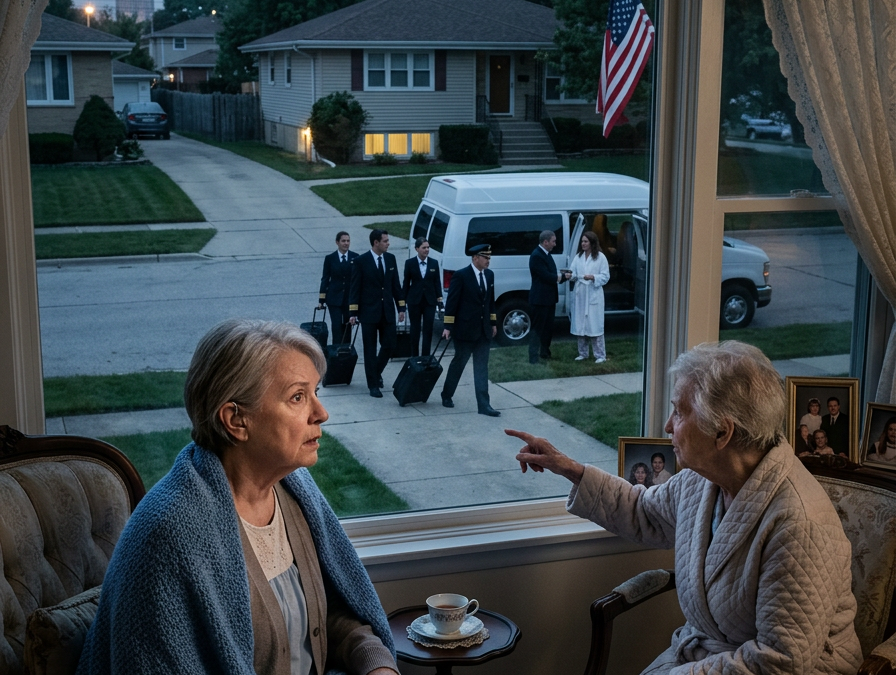
MY ELDERLY NEIGHBOR KNOCKED AT DINNERTIME: “SLEEP AT MY HOUSE TONIGHT. DON’T TELL YOUR SON OR DAUGHTER-IN-LAW.” I ASKED, “WHY?”. “AT 2 A.M., YOU’LL SEE.” I BROUGHT A PILLOW AND BLANKET. AT 2 A.M., SHE WOKE ME AND POINTED OUT THE WINDOW AT MY HOUSE.
I FROZE…
My name is Dixie Atkins.
I was seventy-three years old when my eighty-six-year-old neighbor knocked on my kitchen door at 6:40 on a Wednesday evening and whispered:
“Sleep at my house tonight.”
I stared at her.
Opal Hensley had lived directly across Larksburg Lane from me for thirty years.
She had borrowed flour.
Returned newspapers.
Watered my begonias when I traveled.
She had never once arrived at my kitchen door looking frightened.
“Why?”
She leaned closer.
“Don’t tell Wade.”
A pause.
“Or Shayla.”
My son.
My daughter-in-law.
“What’s going on?”
“At two in the morning, you’ll see.”
That was all she would say.
So that night, at seventy-three years old, I packed a pillow and my mother’s old blue afghan and walked across the street like a girl going to a sleepover.
My son watched from the porch.
His wife smiled.
And at exactly two in the morning, Opal shook my shoulder, pointed through her front window toward my house, and showed me what had apparently been happening beneath my bedroom for seven months.
To understand why I had missed it, you need to understand my hearing.
I live in Des Plaines, Illinois, not far from O’Hare.
Airplanes pass over my neighborhood constantly when the wind is right.
After thirty-eight years in the same house, I can identify some of them by sound.
A 737 whistles.
A 787 carries a deeper hum.
It is the sort of useless skill people develop by living long enough in one place.
I wear hearing aids in both ears.
Every night at ten, I remove them and place them in a navy-blue case on my nightstand.
Click.
That little plastic sound is the end of my day.
After that, the house becomes distant.
Muted.
Peaceful.
I had made peace with that years earlier.
My son and daughter-in-law had apparently built a business around it.
Wade and Shayla moved into my house the previous September.
I had undergone a right-knee replacement.
Their lease was ending.
Wade said they could help me while I recovered.
It sounded sensible.
For the first month, it even was.
Then one month became three.
Three became six.
By the following September, they had lived with me one year and three days.
Small things changed.
The Wi-Fi password.
Nobody gave me the new one.
My mail began appearing on the kitchen counter in neat stacks.
Sometimes already opened.
“Thought it was a bill.”
Shayla would say.
My late husband Hollis’s winter coat disappeared from the front closet.
Nobody knew where it went.
My good casserole dish vanished too.
Then came the basement.
That should have been the part I questioned.
In November, after heavy rain, Shayla came upstairs holding her phone.
“Black mold.”
Her face was serious.
“Everywhere.”
By dinner, the basement door had been sealed with thick clear plastic and blue painter’s tape.
“For your lungs.”
Wade told me.
“You had pneumonia last year.”
Shayla’s younger brother Colt supposedly owned a remediation company.
Convenient.
I wrote a check for $6,850.
I did not go downstairs.
I wish I had some grand explanation for why.
I don’t.
I trusted my son.
That is sometimes enough to explain a great deal of foolishness.
That September Wednesday, I was making pot roast.
Wade and Shayla were watching television.
Opal knocked three times at the kitchen door.
Not the front.
That alone was strange.
Shayla called from the couch:
“Who is it?”
“Opal.”
My neighbor took my wrist.
Her fingers were cold.
“Sleep at my house.”
“Why?”
“At two.”
She looked down the hallway.
“Don’t tell them.”
Then she raised her voice.
“My hip again, Dixie.”
A performance.
“For heaven’s sake, Opal.”
I played along.
“You should call your niece.”
“She’s in Madison.”
Then she lowered her voice.
“Bring your hearing aids.”
I should have asked more.
Instead, I agreed.
At nine-thirty, I came downstairs carrying my pillow and afghan.
Wade stood immediately.
“Want me to walk you over?”
“It’s forty yards.”
“You sure?”
“I’ve survived longer journeys.”
Shayla stayed on the couch.
She smiled.
A warm smile.
The warmest she had given me in months.
“Stay all night, Mom.”
Then:
“Don’t rush back.”
That sentence bothered me before I knew why.
Opal’s house smelled like peppermint tea and floor wax.
Her nursing-school photograph from 1962 hung beside the front door.
White cap.
White uniform.
Stubborn chin.
She had worked ICU nights for nearly four decades.
“My body never learned retirement.”
She told me once.
“I wake up between one and four no matter what.”
That night she had placed a kitchen chair beside the front window facing my house.
“Tell me.”
I said.
She poured tea.
“At two.”
“Why not now?”
“Because you would walk straight across the street and ask Wade.”
I said nothing.
“And Wade would have a story.”
That was true.
Opal told me she had already tried calling the city.
A code inspector visited one morning in June.
Middle of the day.
Worst possible time to investigate something happening overnight.
Wade answered the door.
He told the inspector Shayla’s airline coworkers sometimes stopped by.
Nothing illegal.
Nothing unusual.
The inspector left.
Two days later, Shayla confronted Opal near the roses.
Told her to mind her business.
Opal stopped reporting it.
“But I kept watching.”
She said.
Then she told me something else.
“Your side door.”
“What about it?”
“People use it at night.”
My stomach tightened.
“How many?”
“Depends.”
“Since when?”
“February.”
I stared.
She looked almost apologetic.
“You sleep hard.”
“No.”
I corrected her.
“I sleep deaf.”
The difference mattered.
The electric bill came back to me.
Three hundred ninety dollars in July.
For two decades, summer bills rarely exceeded one-forty.
Shayla had blamed the heat wave.
And my old air conditioner.
I accepted it.
Because acceptance was easier than suspicion.
And suspicion had my son’s face.
Around midnight, I fell asleep in Opal’s chair.
At two exactly, she touched my shoulder.
“Dixie.”
I opened my eyes.
“Window.”
A white high-roof van rolled down the street with its headlights off.
It stopped outside my house.
Side door slid open.
Four people stepped down.
Dark jackets.
White shirts.
Rolling suitcases.
Airport crew.
One man had four gold stripes on his sleeves.
Captain.
I knew those stripes.
I had worn them.
The group did not use the front door.
They walked down the side of my house.
Through the gate Hollis installed in 1998.
Then down the exterior concrete stairs to the basement entrance.
Someone pressed a keypad.
Across the street, through my hearing aids, I heard:
Four beeps.
One chirp.
The narrow basement windows glowed yellow.
My supposedly mold-infested basement.
Sealed for ten months.
Lit at two in the morning.
Then the side door opened from inside.
A woman stood there wearing a white bathrobe.
Shayla.
She handed each arriving crew member something small.
Keys or cards.
One of them gave her an envelope.
She tucked it into her robe pocket.
The van driver lit a cigarette.
The flame illuminated his face.
Cubs cap.
Beard.
Colt.
I stopped breathing.
At 2:04, four airline crew entered my house.
Two minutes later, the van left.
At 3:10, it returned.
Two different crew members came out with luggage.
They climbed into the van.
Early flights.
Commuting crews.
Crash pad.
The phrase came back to me from another lifetime.
“How long?”
I whispered.
“Most nights since February.”
Opal said.
“Thursdays are busiest.”
“Why?”
“New people.”
I began remembering things.
White towels Shayla washed constantly.
Dryer running after midnight.
Coconut shampoo in the upstairs hallway.
A woman dragging a suitcase down my side yard in May.
Shayla had told me:
“Coworker. Flight canceled.”
I never saw anyone sleep on our couch.
“Are you going home?”
Opal asked.
I looked across the street.
“No.”
“Why not?”
“Dark is for observing.”
I pulled the afghan tighter around myself.
“Morning is for moving.”
At seven, I walked home.
Pillow under my arm.
Wade was drinking coffee in his blue Keystone Freight Logistics polo.
“How’s Opal?”
“Better.”
Second lie in twelve hours.
He kissed my cheek.
“Late for work.”
Then left.
I stood in the kitchen and looked at the basement door.
Plastic.
Blue tape.
Ten months of lies.
That Thursday night, I left my hearing aids in after ten.
I lay in bed listening.
At 1:58, four beeps came through the heating register.
Then the chirp.
The ductwork carried it upward.
After that:
Door scraping.
A distant toilet flush.
A woman laughing.
Quickly hushed.
I went downstairs without turning on lights.
Placed my hand against the plastic sealing the basement doorway.
Warm.
The basement air smelled like coconut shampoo.
Fabric softener.
Coffee.
Mold does not use fabric softener.
The next morning, I began checking documents.
I found the canceled check to “Clear View Mold Solutions.”
$6,850.
The endorsement on the back:
Colt Rener.
Then I searched Illinois business records.
No Clear View Mold Solutions.
Not registered.
Not real.
A business that did not exist had remediated mold I no longer believed existed.
Friday evening, I asked Shayla:
“Do you have the mold photos?”
“Why?”
“Insurance may reimburse remediation.”
That got her attention.
Minutes later, she sent two pictures.
Black mold on white drywall.
Cracked beige outlet cover.
Brown water stain shaped almost like Florida.
Saturday morning, I went to the public library.
A young librarian named Matteo helped me search where the images came from.
Both appeared online.
Buckeye Restoration Group.
Dayton, Ohio.
2019.
Same wall.
Same outlet.
Same stain.
Three hundred miles away.
Someone else’s basement.
I stared at the computer.
Matteo’s voice became careful.
“Ma’am?”
“Yes?”
“Whose basement are you researching?”
I stood.
“Mine.”
Tuesday, I typed:
Crash pad Des Plaines.
One result led to a crew-housing website.
Third listing.
Lark Spur House.
No exact address.
Eleven minutes to O’Hare.
Quiet residential street.
Beds rented monthly.
Hosted by Shayla.
Homeowner.
I nearly laughed.
Homeowner.
The photographs showed my basement.
Hollis’s pine paneling.
His dartboard.
The little bar he built.
And twelve black metal bunks.
Six frames.
Twelve beds.
Navy curtains.
Rates listed.
Seasonal packages.
Every bed booked.
Reviews:
Great location.
Super clean.
Shayla is the best host.
Then:
Old lady upstairs never bothers you.
I set the tablet down.
Old lady upstairs.
That was me.
The next morning, Shayla left for a three-day trip.
San Francisco.
Boston.
Home Friday.
She told me not to “overdo it.”
Wade left for work.
At least I believed he did.
I decided to go downstairs.
Carefully.
Fourteen steps.
My new knee was still not fully trustworthy.
I practiced on the front stairs first.
Up and down.
Again.
Again.
Then I gathered what I needed.
Flashlight.
Phone.
Utility knife.
Painter’s tape.
Opal as lookout.
Thursday at 10:15, I cut the plastic.
Inside the tape, someone had written a date in black marker.
I opened the door.
Went down fourteen stairs.
The smell met me first.
Coconut shampoo.
Fabric softener.
Burnt coffee.
No mold.
Not one black patch.
Not one damp wall.
Instead:
Twelve beds.
Lockers.
Names.
A space heater.
Extension cords.
Luggage.
Curtains.
Against the wall, a laminated rules sheet.
LARKS HOUSE.
HOST: SHAYLA.
Payments due on the first.
Side entrance only.
Never use front door.
Quiet hours.
Then rule six.
The elderly aunt upstairs is deaf.
Don’t knock.
Don’t worry.
She won’t hear a thing.
I stared.
Elderly aunt.
In my house.
Then one curtain moved.
A young woman screamed.
I nearly did too.
She was twenty-four or twenty-five.
Meridian sweatshirt.
Fuzzy socks.
Sleep mask pushed onto her forehead.
We both raised our hands.
“I’m sorry.”
She whispered.
Then:
“Are you the aunt?”
“I’m the one who’s supposed to be deaf.”
Her name was Jenna Kowalski.
Flight attendant.
Commuted from Pittsburgh.
Could not afford an apartment near O’Hare.
She had landed from Seattle hours earlier.
“Shayla said she owned the house.”
“She doesn’t.”
Jenna went pale.
“She said senior girls stayed here.”
“Senior girls?”
“She said you rented upstairs.”
I looked around.
“Did you pay for winter?”
“Twelve hundred.”
“Credit card?”
“Yes.”
I asked about the keypad.
“1998.”
She said.
“Shayla said her husband’s uncle built the room that year.”
I looked at Hollis’s wooden sign:
HOLLIS’S HIDEAWAY — 1998.
I almost smiled.
Then I gave Jenna my phone number.
“Say nothing for a few days.”
She studied me.
Then nodded.
I photographed everything.
Rules.
Whiteboard.
Names.
Beds.
Windows.
Extension cord.
Keypad.
Then resealed the plastic.
That afternoon, Opal called.
“Wade’s truck.”
“He’s early?”
“Three hours.”
Wade came inside smelling like beer.
His work polo wrinkled.
Receipt from a tap house sticking from his pocket.
“Slow day.”
He said.
Then went upstairs.
His phone lit on the kitchen counter while he showered.
I did not touch it.
Did not need to.
Three notifications appeared.
Sportsbook loss.
Debt-collection balance over forty thousand dollars.
Then a text from Shayla.
Willowmere Thursday October 1 at 10.
Deposits on her card.
Once she’s in upstairs = 22 beds.
Twenty-two beds.
My bedroom included.
I stood still until the screen went dark.
Then I checked my own credit-card statement.
There it was.
Willowmere Senior Living.
$2,500 deposit.
Unauthorized.
Shayla still had my card details from grocery orders after my surgery.
I called Willowmere.
A woman named Gail found the file.
“Your daughter-in-law is listed as responsible party.”
“My what?”
“Your responsible party.”
“And my tour?”
“October first.”
“I never authorized the deposit.”
Silence.
Then:
“We can refund it if you request cancellation in writing before the deadline.”
“Do it.”
I emailed immediately.
“And please don’t notify Shayla yet.”
Gail hesitated.
Then:
“Understood.”
Twenty-two beds.
They were preparing to remove me from my own house and turn the rest into crew housing.
Friday morning, I met my attorney.
Lucinda Pharaoh.
She had handled Hollis’s estate.
Her office occupied an old yellow Victorian in Park Ridge.
I laid everything across her conference table.
Fake mold company.
Check endorsement.
Online crash-pad listing.
House rules.
Photos.
Unauthorized senior-living deposit.
Lucinda read.
Twice.
Then said:
“You have several options.”
“I know.”
“You can report suspected financial exploitation.”
“I know.”
“You can file civil claims.”
“Yes.”
“You can formally terminate their occupancy.”
I nodded.
Then:
“What do you actually want?”
I had thought about that all night.
“Twelve people paid money.”
“Correct.”
“They thought Shayla had authority.”
“Apparently.”
“They work.”
“Yes.”
“One woman put the winter payment on a credit card.”
Lucinda waited.
“It is not their fault that my daughter-in-law lied.”
Legally, she told me, things were more complicated than that.
I understood.
But I knew what I wanted.
“I want every renter made whole.”
“And then?”
“I want my basement back.”
“Police?”
“Not first.”
She studied me.
“You want to confront them.”
“October first.”
“Why that date?”
“Move-in night.”
“What time?”
“Two in the morning.”
Lucinda took off her glasses.
“You realize everyone involved thinks you’re a helpless old woman.”
“They’ve been saying so for a year.”
She put her glasses back on.
“Then we should make sure the paperwork is not helpless.”
That weekend, Shayla held a dinner party in my backyard.
White lights.
Steaks.
Wine.
Colt.
Flight-attendant friends.
I sat quietly.
After dessert, Shayla tapped her glass.
“Big news.”
Everyone looked.
“We booked Mom a tour at Willowmere.”
People made pleased noises.
“For her safety.”
She rested one hand on my shoulder.
“She can’t do stairs.”
Then:
“She can’t even hear the smoke alarm.”
Someone asked what I had done for work.
Shayla answered.
“Mom worked at the airport.”
Colt laughed.
“Baggage?”
A few others laughed because he did.
I folded my napkin.
“I’ll think about Willowmere.”
That was all.
Across the street, Opal flashed her porch light.
Off.
On.
Off.
On.
Our signal.
I see you.
The next afternoon, I opened Hollis’s closet.
Took down a black hatbox.
Inside was my old captain’s hat.
Black.
Patent-leather visor.
Gold oak leaves across the brim.
Scrambled eggs.
Captain’s braid.
My wings were still pinned to the band.
Mom worked at the airport.
I had allowed that sentence to stand for years because correcting people rarely interested me.
But I did not work at the airport.
I worked above it.
I was born in Enid, Oklahoma.
My father repaired crop dusters.
At seventeen, I spent waitressing money on my first flying lesson.
I studied aviation.
In the 1970s, airlines were not eager to put women in cockpits.
I taught.
Flew freight.
Checks and documents across several states at night.
Then, in 1985, Meridian hired me.
My first base was New York.
I lived part-time in a crash pad in Queens.
Twelve beds.
One bathroom.
That was why I knew the term.
I made captain in 1996.
In 2008, I became the first woman at Meridian to command one of their 777 routes.
My photograph hung on the legacy wall near crew scheduling at O’Hare.
I retired at sixty-five.
Thirty-three years.
My hearing paid part of that bill.
Shayla was a Meridian flight attendant.
She walked past my photograph regularly.
Apparently she never looked closely.
Wade believed my retirement had left me nearly broke because Meridian’s bankruptcy had reduced part of my pension.
I never corrected that either.
He never asked about my retirement accounts.
My 401(k).
My investments.
My paid-off house.
The statement from Harrow & Pike sat in my desk.
Roughly $1.4 million.
I lived simply because I preferred it.
Not because I had to.
The following Monday, Jenna sent twelve full names from the crew group chat.
I ordered twelve cashier’s checks.
$1,200 each.
Then I met another tenant.
Ray Delgado.
Captain.
Fifty-seven.
787.
Commuted from Albuquerque.
When I entered the diner, he stood so abruptly he hit his knee against the table.
“Captain Atkins?”
I looked at him.
“You know me?”
“You signed off my IOE.”
Then I remembered.
Years earlier.
Newly upgraded captain.
Careful.
Quiet.
Good instincts.
“You were in my basement?”
“Since March.”
He looked sick.
“Shayla said Wade’s aunt owned the upstairs.”
“Deaf?”
His face tightened.
“Yes, ma’am.”
“And you believed her.”
“I inspect every bolt on an airplane.”
He looked down.
“Never asked for a lease.”
I told him what I planned.
He listened without interrupting.
That is something good pilots learn early.
“October first is move-in night.”
He said.
“Colt brings the new people around two.”
“How many?”
“Six.”
“Who will already be there?”
“Me.”
“Jenna.”
“Anita Soulberg.”
“Good.”
He looked at me.
“What do you need?”
“Eyes open.”
Then:
“And your name on paper.”
Lucinda prepared documents.
Owner’s notice.
The rentals had never been authorized by the homeowner.
The basement was not approved as sleeping space.
The arrangement would end.
Every renter who had prepaid would be refunded.
Then separate receipts and assignments.
Each crew member would acknowledge receiving repayment from me and transfer to me their right to seek the corresponding amount they had paid Shayla.
Lucinda also prepared demand letters.
One for Wade and Shayla.
One for Colt regarding the fake mold remediation.
She was careful.
“No threats in exchange for money.”
“I don’t want threats.”
“I want facts.”
“Good.”
She tapped the stack.
“Twelve coworkers can be manipulated individually.”
Then:
“One creditor holding twelve signed claims is harder.”
I packed the folders into Hollis’s old canvas tool bag.
The week before October first, Shayla discovered I had canceled Willowmere.
The automated reminder arrived at dinner.
She stared at her phone.
Then at me.
“You canceled.”
“Yes.”
“After everything we’ve done?”
“What have you done?”
Her voice rose.
“We gave up our lives to babysit you.”
“I never asked for babysitting.”
“Fine.”
She leaned forward.
“Then maybe you should start paying rent.”
Wade said:
“Shay.”
I looked at him.
Then her.
“I’ll go to senior living when I choose.”
I set down my fork.
“Not when my credit card does.”
Shayla froze.
For one second, she saw me.
Not the deaf old woman.
Something else.
Wade stared at his pork chop.
Said nothing.
That silence told me more than an argument could.
The night before October first, I found Wade sitting on the front steps holding a beer.
Not drinking.
I sat beside him.
My knee first.
A 737 passed overhead.
We watched its lights.
Then Wade said:
“Keystone fired me.”
I turned.
“When?”
“April.”
Six months.
“Where do you go every morning?”
He rotated the bottle.
“Sometimes the tap house.”
“Sometimes I sit in the truck.”
My son looked fifty and twelve at the same time.
“I’m in trouble.”
“How much?”
The question almost left my mouth.
Then I stopped.
The basement.
The sportsbook alert.
Forty-one thousand dollars in collections.
I knew enough.
“I’ll pay for counseling.”
He looked at me.
“I will not pay a sportsbook.”
His face changed.
“You knew.”
“Yes.”
“You were never home.”
There it was.
Old wound.
My career.
The birthdays I missed.
The sixteen days a month away.
“I know.”
“You missed my eighth birthday.”
“Denver.”
He stared.
“You remember.”
“I remember every one I missed.”
“You owe me.”
I looked at him.
“I owed you time.”
Then:
“I’m sorry for what I missed.”
He said nothing.
“But gambling is not reimbursement.”
He stood.
Went inside.
At 11:47, I remained on the step.
Two hours and thirteen minutes until move-in.
At 1:30, I put in my hearing aids.
Left the navy case open.
Dressed in gray slacks and a wool sweater.
Put Hollis’s canvas bag over my shoulder.
Then walked outside.
Fourteen front steps.
Side yard.
Hollis’s gate.
Basement steps.
At the keypad, I entered:
1998.
Four beeps.
One chirp.
Door opened.
Ray, Jenna, and Anita sat waiting.
Fully dressed.
I entered.
Ray nodded at me.
Not neighbor to neighbor.
Captain to captain.
I sat in Hollis’s brown recliner.
At 1:45, Opal arrived carrying peppermint tea and a folding chair.
She settled beside me.
“Two o’clock.”
She said.
“Let them see.”
At 1:58, headlights crossed the basement windows.
Suitcase wheels bumped through the side yard.
Six crew members came down the stairs.
Two pilots.
Four flight attendants.
Exhausted.
Polite.
Uniformed.
The first young officer entered and stopped.
The woman behind him bumped into his bag.
They stared.
Old woman in gray sweater.
Older woman with thermos.
Three tenants sitting awake.
No one smiling.
Ray stood.
“Set your bags down.”
Then:
“The owner wants a word.”
Six faces turned toward the door.
Shayla entered last.
White bathrobe.
Laminated house rules under her arm.
Phone in hand.
“Welcome to Lark House. Code is—”
Then she saw me.
The papers slipped.
“Mom.”
I smiled.
“I’m awake.”
Then tapped my hearing aid.
“Ears in.”
She recovered quickly.
“Everybody, this is my husband’s aunt.”
I watched the new people.
“She rents upstairs.”
Then:
“She’s harmless.”
I opened Lucinda’s folder.
“Then let’s read your rules.”
I held up the color photograph.
The real rules were still posted on the wall.
Same page.
Same type.
I read.
“Side gate only.”
Silence.
“Never use front door.”
Then:
“The elderly aunt upstairs is deaf.”
I looked at Shayla.
“Don’t knock.”
Opal poured tea.
The tiny stream sounded enormous.
Then I finished.
“She won’t hear a thing.”
Shayla crossed her arms.
“I manage the house for the family.”
“Show them my signature.”
“It was verbal.”
“Show them a lease.”
She had none.
Jenna spoke softly.
“You told me you owned it.”
Another flight attendant nodded.
“Me too.”
Shayla’s thumbs moved quickly over her phone.
Footsteps sounded above.
Then down the exterior steps.
Wade came in wearing pajama pants and an old Bears T-shirt.
He saw the room.
Went pale.
“Mom.”
“Sit down.”
“There was nowhere else to go.”
He sat on the edge of a bunk.
Knees raised.
Shayla looked around.
Frustration cracked through her.
“Nobody here cares what some old woman thinks.”
Ray stood.
“Actually.”
Every head turned.
“This is Captain Dixie Atkins.”
Shayla laughed once.
“She worked at the airport.”
Ray did not smile.
“She signed off my captain qualification.”
The flight attendant with silver in her hair stared at me.
“The legacy wall?”
“Yes.”
“That’s you?”
Anita stood instinctively.
The young first officer straightened.
Something changed in the room.
Not because I had become more important in that instant.
Because they finally realized Shayla’s story about me had been false in more ways than one.
Shayla’s voice sharpened.
“She just worked at the airport.”
I looked directly at her.
“I didn’t work at the airport.”
A 787 passed above us.
Low hum.
Every airline person in that basement recognized it.
“I worked above it.”
Nobody laughed.
Then I pointed toward the windows.
Fourteen inches high.
“Look at those.”
People turned.
“Twelve beds.”
“One actual exit.”
“Space heater on an extension cord.”
The silver-haired purser looked around.
Then said softly:
“Ninety seconds.”
Everyone understood.
Aircraft evacuation standard.
Half the exits blocked.
Ninety seconds.
These were people trained to notice escape routes.
They had been sleeping in a room that demanded they ignore one.
I opened the canvas bag.
“First.”
I said.
“You are getting your money back.”
The young first officer blinked.
“You’re throwing us out now?”
“No.”
I looked at the clock.
“You have until ten.”
Then:
“And every prepaid winter dollar comes back.”
I placed twelve envelopes on Hollis’s card table.
One by one, I called names.
Each envelope contained a cashier’s check.
$1,200.
Then the assignment page.
Jenna signed first.
She wrote:
I paid Shayla Atkins $1,200. She told me she owned the house.
Others followed.
Nobody rushed them.
Nobody pressured them.
Ray took three envelopes for crew members currently flying.
Then Colt came in.
Cubs cap.
Keys.
He stopped on the bottom step.
Looked around.
“I built these bunks.”
He said.
“I’ll put a lien on the house.”
I handed him Lucinda’s letter.
“Read.”
He saw the photographs from Dayton attached to the back.
His face changed.
“That mold job was fake.”
I said.
He looked at Shayla.
She went still.
I looked back at Colt.
“You were paid $6,850.”
He said something I will not repeat.
Then stormed upstairs.
Shayla stared at the signed papers.
“You paid them.”
“Yes.”
“So now we owe you fourteen thousand four hundred.”
“Yes.”
That was the moment the performance ended.
“You always say no.”
She shouted.
“To me.”
“To Wade.”
“To everyone.”
Her face reddened.
“We took care of you for a year.”
“You rented my basement.”
“We could have had children if we had a house.”
I looked at her.
“You wanted my house.”
“Yes.”
Finally.
Honest.
“You should be in Willowmere.”
“Maybe someday.”
I said.
“But not because you need twenty-two beds.”
Her face collapsed.
“You’ll die alone here.”
“Maybe.”
I looked around the room.
“But it will still be my house.”
Wade stared at the floor.
“You were never home.”
He whispered.
“You owe me.”
I felt that sentence.
More than Shayla’s.
More than the money.
More than the basement.
“I owed you a mother who was present.”
I said.
“I wasn’t always.”
He looked up.
“That is mine to regret.”
Then:
“This is arithmetic.”
I placed the demand letter in front of them.
The repayment claim.
The deadline.
Contact through Lucinda.
Then I made one thing clear.
“This is not hush money.”
“No one is buying silence.”
“No one is trading anything.”
“This is documentation of money taken through unauthorized rentals.”
Shayla looked away.
Then I told Wade:
“Go upstairs.”
He looked at me.
“Take off the padlock.”
Silence.
“Remove the plastic.”
For a moment, nobody moved.
Then my son stood.
Walked upstairs.
We heard his steps cross the kitchen.
Then:
Metal hitting tile.
Padlock.
Then the long tearing sound of the plastic coming off the doorframe.
For eleven months, that plastic had told me:
Do not enter.
Danger.
Trust us.
Now the kitchen light poured down all fourteen steps.
I looked at Shayla.
“I heard everything tonight.”
Then:
“And more than you thought all year.”
At 2:40, people began packing.
By 2:45, my house had one owner and nine witnesses.
Nobody was asleep.
By ten that morning, the last suitcase rolled through Hollis’s side gate.
The bunk frames came out afterward.
Ray and Jenna helped carry them.
The crew members found other crash pads.
Airline people always know somebody who knows somebody.
The housing platform removed the listing.
Its policy required proof that hosts owned the property or had written authority.
Shayla had neither.
The remaining crew members signed their statements over the next several days.
Wade and Shayla met Lucinda.
A repayment agreement was arranged.
Four hundred dollars per month for thirty-six months.
Fourteen thousand four hundred.
Colt repaid the $6,850.
No note.
No apology.
Just a cashier’s check.
That told me enough.
Meridian learned about the housing arrangement through its own channels after crew members complained.
What happened between the airline and Shayla was no longer my problem.
She never gave me a real apology.
The closest came while loading a laundry basket into her car.
“You planned all this.”
“Three weeks.”
She stared.
I added:
“You planned yours for eight months.”
She said nothing.
They moved into a one-bedroom apartment in Elk Grove Village by the end of October.
I paid directly for counseling sessions for Wade.
Not his debt.
Counseling.
He attended five.
Five was more than I expected.
The keypad came off the exterior basement door.
I filled the screw holes with wood putty.
You can still see where it was if you know where to look.
The twelve bunks went to a shelter in Palatine.
A place with proper exits.
The clear plastic sheeting went into recycling.
The blue painter’s tape went into the trash.
My basement became Hollis’s room again.
Recliner.
Dartboard.
Three brass darts.
Little television.
Paneling.
The windows remain fourteen inches tall.
Nobody sleeps there.
Hollis said in 1998:
“You can’t put a bed down here, Dixie.”
He was right then.
Still right.
Wade calls on Sundays.
I answer.
We talk.
I ask about counseling.
I do not send money.
When he visits, he knocks at the front door.
That is the rule now.
He follows it.
Our relationship is not repaired.
Relationships are not water heaters.
You do not replace one valve and declare the system fixed.
But sometimes he tells the truth before I ask.
That is new.
Once he said:
“I hated you for missing my eighth birthday.”
“I know.”
“Part of me decided you owed me after that.”
“I know.”
“That doesn’t make what we did right.”
“No.”
He looked down.
“I’m trying to understand both things at once.”
“So am I.”
That may be the closest we have come to peace.
As for my hearing aids, I still remove them most nights at ten.
The navy case still makes its little click.
But sometimes I leave them in longer.
Not because I am afraid.
Because I enjoy hearing my own house.
Furnace.
Pipes.
Planes.
The old floorboard near the hall closet.
Nothing under the floor except ordinary house sounds.
No suitcases.
No strangers.
No keypad.
No people counting on my silence.
Opal turned eighty-seven that November.
I take her pie most Sundays.
We sit in her front room with peppermint tea.
She says she sleeps better now.
“So do I.”
One night, while we were talking, a 787 crossed low over the neighborhood.
She looked toward the ceiling.
“You know what that is?”
“787.”
“How can you tell?”
“Low hum.”
“You still hear pretty well for a deaf old woman.”
I laughed.
“So do you for a nosy old bat.”
She raised her teacup.
“To being underestimated.”
I touched mine against it.
People ask me sometimes whether the worst part was the money.
It wasn’t.
Six thousand eight hundred fifty dollars for fake mold.
Fourteen thousand four hundred in unauthorized rent.
Two thousand five hundred charged toward senior living.
Those numbers were irritating.
Recoverable.
Measurable.
The worst part was the laminated sheet.
Rule six.
The elderly aunt upstairs is deaf.
Don’t knock.
Don’t worry.
She won’t hear a thing.
I had spent decades in cockpits where communication was survival.
Checklists spoken aloud.
Warnings repeated.
Readbacks.
No assumption left unconfirmed when lives depended on it.
Then, inside my own home, my family had built an entire business on the assumption that I could not hear them.
Maybe that is why what I did at two in the morning mattered so much to me.
I did not scream.
Did not call everyone thieves.
Did not throw suitcases onto the street.
I listened.
I documented.
I put the right paper into the right hands.
Then I sat in my husband’s old recliner and let them walk into the truth themselves.
That felt familiar.
In aviation, panic kills judgment.
You trust instruments.
You check the runway.
You know your exits.
You make the next correct decision.
The same rules work surprisingly well in families.
When your son lies, do not fly by grief.
When your daughter-in-law tells you mold exists, look at the wall.
When someone says you are too old to understand what is happening inside your own house, verify.
When somebody calls you deaf because they are counting on silence, put your ears back in.
I was seventy-three.
Bad knee.
Hearing aids.
Gray sweater.
Nobody in that basement expected me to be the person in command.
That was their mistake.
A captain does not stop being a captain because the airplane is gone.
You spend enough years being responsible for everybody aboard, and eventually the habit becomes part of your bones.
At two in the morning on October first, there were twenty people, directly and indirectly, tangled in what had happened beneath my floor.
My son.
His wife.
Her brother.
Twelve crew members.
My neighbor.
My lawyer.
Me.
I could not fix all of them.
I did not need to.
My job was simpler.
Know what belonged to me.
Know what did not.
Protect the people who had been lied to.
Give my son responsibility without rescuing him from it.
And take my house back.
I did.
Some nights, after I close the navy hearing-aid case, I leave it open for one extra second.
The little click waits.
Then I close it.
My decision.
That matters now.
Everything quiet in this house is quiet because I chose it.
Not because somebody downstairs thinks I cannot hear.
