At my brother’s wedding, I found my seat on a folding chair beside the
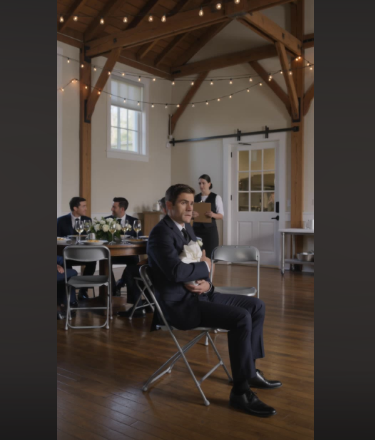
At My Brother’s Wedding, I Was Given a Folding Chair by the Kitchen…
At My Brother’s Wedding, I Was Given A Folding Chair By The Kitchen. His Fiancée Said, ‘It’s Just For Plus-Ones.’ I Looked Around – Everyone Else Had a Seat. Even My Ex. So I Picked Up My Gift, Turned Around, And Said, ‘Plus-One This.’ He Ran After Me In Front Of Everyone…
My brother seated me beside the kitchen at his wedding.
Not near the kitchen.
Beside it.
My chair was positioned six feet from a swinging service door where waiters kept rushing through with trays of food.
On the printed seating chart, my name did not appear under family.
It did not appear under the groom’s side.
It appeared under one line:
**PLUS ONE — ADRIEN**
I had come alone.
I was also the groom’s older brother.
And I had helped him find the caterer.
For about thirty seconds, I stood there holding the engraved wedding gift I had bought him and wondered whether I was overreacting.
Then I saw my ex-girlfriend seated two tables from the bride and groom.
That was when I understood.
The seat was not a mistake.
It was a summary.
—
My name is Adrien.
I was thirty-four when my younger brother Tyler married Marissa.
Tyler was thirty-one.
Growing up, he was the easy one.
Charming.
Funny.
The kind of kid who could break a window, blame the baseball, and somehow leave everyone discussing the baseball’s behavior.
I was the older brother.
Which meant every conflict ended with some version of:
“Adrien, you know better.”
“Adrien, be the mature one.”
“Adrien, he looks up to you.”
At thirteen, maturity meant taking blame because arguing made Mom cry.
At seventeen, it meant paying the insurance deductible after Tyler borrowed my car without permission and backed it into somebody’s truck.
At twenty-one, it meant driving to a county jail at two in the morning after he got arrested for trying to steal cologne for a girlfriend.
I bailed him out.
He promised he would repay me.
He didn’t.
I never mentioned it again.
That was our pattern.
Tyler created impact.
I absorbed it.
Everyone called that brotherhood.
—
By adulthood, I worked in logistics and event operations.
Not glamorous work.
But useful.
Vendor schedules.
Transportation.
Crisis management.
The thousand invisible things that keep events and businesses functioning while everyone else photographs the finished version.
Tyler liked teasing me about it.
Until he needed something.
Then suddenly I was “the only guy who knows how to handle this stuff.”
When he and Marissa got engaged, he called me almost immediately.
“Do you know a good caterer?”
“Yes.”
“Venue people?”
“Yes.”
“Can you look at this transport schedule?”
“Yes.”
“Do you know someone who can get rental heaters if the weather turns?”
“Yes.”
I helped.
Not because he asked beautifully.
Because he was my brother.
And despite everything, I loved him.
—
Marissa and I had never clicked.
She was polished in a way that made ordinary conversation feel like an audition.
Always beautifully dressed.
Always aware of who had entered the room.
Once, when Tyler explained what I did for work, she smiled and said:
“Logistics. That’s cute.”
I said:
“You’re right. Trucks are adorable.”
She did not laugh.
That told me most of what I needed to know.
Still, I did not object to the marriage.
Tyler was an adult.
His wife did not need my approval.
My job was to show up.
So I did.
—
The wedding venue was beautiful.
Converted barn.
Tall oak beams.
String lights.
A lake behind the property catching late-afternoon sun.
Everything looked designed to become somebody’s wedding reel.
I arrived early because Tyler had asked me to.
Of course he had.
One of the rental companies was late.
A table count had changed.
The caterer needed confirmation about a dietary issue.
For ninety minutes, I helped quietly.
Moved numbers around.
Called a vendor.
Found an extension cord.
Directed a delivery driver who had gone to the wrong gate.
Nobody thanked me.
That was normal.
Then I changed my jacket, picked up the gift I had brought, and went to find my seat.
That was when the coordinator looked down at her clipboard.
“Adrien?”
“Yes.”
She hesitated.
“You’re listed with the plus-one overflow.”
I thought I had misheard.
“I’m sorry?”
“Table near service.”
She pointed.
I looked.
A folding table.
Close to the kitchen door.
Not part of the main room.
A few distant guests and vendor contacts.
I said:
“I’m Tyler’s brother.”
Her face changed instantly.
“Oh.”
Exactly.
“Oh.”
—
She started flipping through pages.
“I’m so sorry. Let me check—”
Then Marissa appeared.
Perfect dress.
Perfect makeup.
Smile so controlled it probably required engineering.
“Adrien.”
She kissed the air beside my cheek.
“So glad you made it.”
“I think there’s a seating mistake.”
Her eyes flicked toward the coordinator.
Then back to me.
“No, that’s right.”
I waited.
She laughed lightly.
“We had some really difficult choices.”
“You seated me by the kitchen.”
“Not by the kitchen.”
The service door swung open behind her.
A waiter came through carrying twelve salads.
I looked at her.
She corrected herself.
“Near the kitchen.”
“Marissa.”
“You’re not in the wedding party.”
“I’m his brother.”
“Of course.”
She lowered her voice.
“But we prioritized close friends, older relatives, people who traveled far. You came alone, so it was just easier.”
Just easier.
There are phrases people use when they want you to accept humiliation as logistics.
—
I looked into the room.
Uncle David sat near the center.
Tyler had spoken to Uncle David once in six years.
Cousin Ryan had a prime seat.
Ryan had once stolen cash from our grandmother’s purse.
Then I saw Tessa.
My ex.
Two tables from the sweetheart table.
Laughing with champagne in her hand.
Tyler had introduced us years earlier.
We dated for almost two years.
After the breakup, I learned they had remained friends.
Not ideal.
Not necessarily wrong.
But apparently close enough for premium seating.
Marissa followed my eyes.
“Oh, yeah. Tessa.”
I looked at her.
“She and Tyler stayed close.”
“I’m aware.”
“She’s been very supportive.”
There was a small emphasis on supportive.
Then:
“You don’t mind, do you?”
That was the moment I stopped wondering whether the seating had been accidental.
—
I went to the table anyway.
Sat down.
Servers came through the door every thirty seconds.
Hot air from the kitchen rolled out each time.
The room smelled like rosemary, butter, and fish.
I watched the wedding party enter.
Everyone applauded.
Tyler smiled.
He looked happy.
For one second, I considered staying.
Not for Marissa.
For him.
Then Tyler walked past Tessa’s table.
Leaned down.
Said something.
She laughed.
He touched her shoulder.
Normal enough.
Probably.
But I looked at my folding chair.
Then at the gift beside me.
Then at the room I had helped make function.
And I understood something I should have learned years earlier.
Showing up for someone does not guarantee they will make room for you.
—
I stood.
Picked up the gift.
Walked toward the exit.
Marissa noticed.
“Adrien?”
I kept walking.
“Where are you going?”
I stopped.
People nearby turned.
I could have made a speech.
Could have embarrassed her.
Could have said everything.
Instead I looked at her.
Then at the service table.
“Apparently the plus-one section is leaving early.”
Someone laughed.
I didn’t.
I walked out.
—
Tyler followed me into the parking lot.
“Adrien!”
I kept going.
“Dude.”
That word.
He always used dude when he wanted a situation to become less serious than it was.
I turned.
“What?”
“What are you doing?”
“Leaving.”
“It’s my wedding.”
“I noticed.”
He looked frustrated.
“Come on.”
“You knew where I was sitting?”
He hesitated.
That was enough.
“I saw the chart.”
“Did you?”
“Yes, but Marissa handled most of it.”
I nodded.
“So you saw it.”
“It didn’t seem like a big deal.”
There it was.
Not:
I didn’t know.
Not:
This is a mistake.
It did not seem like a big deal.
—
“You gave Tessa a better seat than your brother.”
His face tightened.
“That’s not fair.”
“It’s literally the seating chart.”
“She’s friends with both of us.”
“I introduced you to the caterer.”
“That’s not the point.”
“What is the point?”
He rubbed the back of his neck.
“Marissa wanted certain people close.”
“Was I creating a problem?”
“No.”
“Then why did she need me far away?”
Silence.
I nodded.
“Right.”
“Adrien.”
He stepped closer.
“Don’t ruin the night over a chair.”
That sentence almost worked.
Because people like me are trained by sentences like that.
**Don’t ruin Christmas over a joke.**
**Don’t upset Mom over money.**
**Don’t make Tyler feel bad.**
**Don’t turn this into a thing.**
The problem was never the chair.
The chair was simply the first time the pattern had a printed label.
Plus one.
—
I unlocked my car.
Tyler said:
“Seriously?”
“Yes.”
“You’re just going to leave?”
I looked at him.
“For once.”
Then got in.
—
I drove for almost an hour without going home.
Eventually I stopped at an overlook outside the city.
Sat on the hood of my car.
Wedding gift beside me.
No dramatic realization.
Mostly exhaustion.
I thought about being seventeen.
Paying that deductible.
Twenty-one.
Jail.
Twenty-five.
Loaning Tyler money for a security deposit.
Twenty-eight.
Helping him negotiate a salary offer.
Thirty-two.
Moving his apartment in August because his friends canceled.
I had become infrastructure.
Reliable things disappear into the background.
Electricity.
Plumbing.
Older brothers who always answer.
Nobody notices infrastructure until it stops working.
That night, I decided mine would.
—
Tyler texted.
**Come back.**
Then:
**Mom’s asking questions.**
Interesting priority.
Then:
**Marissa says she’s sorry if you took it wrong.**
That one almost impressed me.
An apology that included no responsibility in thirteen words.
I turned off my phone.
—
The next morning, I returned one wedding gift.
Not the decanter.
I kept that.
But I had ordered a matching crystal set scheduled for delivery the following week.
I canceled it before shipment.
No spite.
No sabotage.
It was my purchase.
It had not been delivered.
I no longer wanted to give it.
That was the first practical boundary I set.
Small.
Legal.
Boring.
Surprisingly satisfying.
—
I did not call the caterer to punish them.
They had done their job.
In fact, Nancy, the manager, called me first.
“Everything okay?”
“Why?”
“You disappeared.”
I laughed.
“You were busy.”
“I noticed.”
Then she said:
“I wanted to thank you. Yesterday would have been rough without the schedule fixes.”
“You’re welcome.”
There was a pause.
“Tyler said there was family drama.”
“Tyler says a lot of things.”
Another pause.
“Fair.”
That was all.
I did not tell her to charge extra.
Did not threaten referrals.
Did not ask vendors to withdraw discounts.
The contracts belonged to the people who signed them.
Their disputes were theirs.
For once, I let professionals solve problems without becoming part of the machinery.
That was harder than revenge.
—
Two weeks later, Tyler emailed me.
Subject:
**Need help**
I almost laughed before opening it.
Their honeymoon had been extended.
Flights changed.
Passport issue.
Transfer complications.
Some reservation problem.
He wrote:
**You’re the only person I trust to fix this stuff.**
I read that sentence three times.
Not:
I’m sorry about the wedding.
Not:
Can we talk?
Just:
You are useful again.
My hands hovered over the keyboard.
I typed:
**I’m not available to handle this. I hope you get it sorted.**
Then sent it.
No joke about plus ones.
No punishment.
Clearer that way.
—
He called five minutes later.
“Adrien.”
“I’m working.”
“We seriously need help.”
“I know.”
“You said no.”
“Yes.”
Silence.
He had apparently never heard the word spoken in my voice before.
“Why?”
I leaned back.
“Because I don’t want to.”
“That’s it?”
“That’s enough.”
“Man, are you still pissed about the wedding?”
“This isn’t about being pissed.”
“What is it about?”
“You only notice my role in your life when you need something from it.”
He exhaled sharply.
“That’s ridiculous.”
“Then solve this without me.”
I hung up.
That conversation did more for me than any public revenge could have.
—
They solved it.
Of course they did.
That was another lesson.
People survive when you stop rescuing them.
Their trip became shorter.
They spent more money than planned.
A transfer had to be rebooked.
Nobody died.
No one was stranded forever in Singapore.
Tyler discovered customer-service phone numbers.
A miracle.
—
The wedding issue might have ended there if my mother had not called.
“What happened?”
I told her.
She was silent.
Then:
“Tyler says it was a seating mix-up.”
“It wasn’t.”
“He says Marissa did the chart.”
“He reviewed it.”
Another silence.
“I wish you hadn’t left.”
I closed my eyes.
There it was again.
Not:
I wish they had treated you differently.
I wish you had absorbed it more quietly.
“Mom.”
“What?”
“I’ve spent years helping everyone keep the peace.”
“I know.”
“I’m done paying for peace with myself.”
She did not answer.
That became the first difficult conversation my mother and I had ever finished without me apologizing.
Progress.
—
A few relatives contacted me afterward.
I did not make a social-media slideshow.
Did not post screenshots.
Did not drag Marissa’s employer into it.
I simply answered people who asked.
“Yes, I was seated by the service entrance.”
“Yes, I left.”
“No, I’m not interested in making it a campaign.”
Cousin Lauren said:
“I assumed you were helping the kitchen.”
That made me laugh despite myself.
“Apparently so did the seating planner.”
Then she said:
“I’m sorry.”
“Why?”
“I noticed it looked weird. I didn’t say anything.”
I appreciated that apology.
Specific.
No excuses.
—
Tyler disappeared for nearly a month.
Then a letter arrived.
Actual paper.
His handwriting.
That alone surprised me.
It said:
**Adrien,**
**I’ve spent the last few weeks replaying the wedding and a lot of things before it. I kept telling myself the seating wasn’t important because admitting it was important meant admitting I saw it and let it happen.**
I stopped reading.
Then started again.
**You have been the person I call whenever something goes wrong. I treated that like a permanent service instead of a relationship.**
Better.
**I let Marissa decide you would be easier to move than other people because I knew you would probably tolerate it. That is the part I’m most ashamed of.**
I sat very still.
Then:
**You always had my back. I acted like that meant I never had to earn it. I’m sorry. I don’t expect an answer.**
No request.
No:
Can we move on?
No:
But Marissa wanted—
No:
You embarrassed us too.
Just apology.
I put the letter in my desk.
And did not respond.
Not yet.
An apology deserves to be heard.
It does not automatically deserve access.
—
Thanksgiving came two months later.
Mom called.
“I’d like you here.”
“Is Tyler coming?”
“Yes.”
“Marissa?”
A pause.
“She has plans with her family.”
Probably wise.
“No ambush?”
“What?”
“No group conversation where everybody explains why I am difficult?”
Mom sighed.
“No.”
“Then I’ll come.”
—
Tyler was setting out chairs when I arrived.
The irony was almost too good.
He saw me.
Stopped.
Then said:
“Hey.”
“Hey.”
No hug.
No performance.
Dinner was normal enough.
Football.
Turkey.
Someone overcooked green beans.
For most of the evening Tyler left me alone.
That helped.
After dessert, he found me in the kitchen.
“Thanks for coming.”
I nodded.
“Thanks for the letter.”
Relief flashed across his face.
“I meant it.”
“I know.”
“I was an idiot.”
“You were.”
He winced.
Good.
Not because I wanted pain.
Because he did not argue.
Then he said:
“I want us to go back to normal.”
I stared at him.
“That’s exactly what I don’t want.”
He looked confused.
“What?”
“Normal was you calling when you needed money, transportation, contacts, planning, fixing.”
He looked down.
“Normal was me knowing about your problems before I heard about your promotions.”
Silence.
“Normal was you assuming I would swallow disrespect because I always had.”
He nodded.
“So no.”
“What do we do?”
That was the first useful question he had asked.
—
“You show up.”
He waited.
“When nothing is wrong.”
“Okay.”
“You call when you don’t need anything.”
Another nod.
“You stop expecting me to solve consequences.”
“Okay.”
“And when somebody treats me badly, you don’t stand there because defending me might be inconvenient.”
He closed his eyes briefly.
“Okay.”
I folded my arms.
“That doesn’t mean I trust you again.”
“I know.”
“No.”
I looked at him.
“You understand the words. We’ll see whether you know.”
That stung.
He accepted it.
Then left the kitchen without asking for a hug.
That mattered.
—
Over the next six months, Tyler did something unexpected.
He became boring.
In the best possible way.
Tuesday:
**How’s work?**
No favor attached.
Sunday:
**Saw the Bears game. Brutal.**
Wednesday:
A photo of the terrible sandwich he bought near his office.
No emergency.
No request.
He started calling.
Sometimes I answered.
Sometimes I didn’t.
He stopped interpreting delayed replies as rejection.
One Saturday he showed up with coffee and croissants.
“What’s wrong?”
“Nothing.”
“You need money?”
“No.”
“A ride?”
“No.”
“Help moving?”
He laughed.
“No.”
“What do you want?”
“To watch the game.”
Suspicious.
But I let him in.
We watched football.
Ate too much.
Argued about a referee.
He left.
Nothing broke.
I remember standing in the doorway after he drove away thinking:
So this is what a brother feels like when he isn’t also a project.
—
Marissa never apologized to me.
That was her choice.
I heard she was angry about how the wedding story circulated through the family.
I also heard several different versions of why I left.
I stopped correcting them.
People who genuinely wanted to know asked me.
People who preferred gossip were not my responsibility.
A year earlier, I would have tried to control the narrative.
Now I understood that peace sometimes includes allowing people to misunderstand you.
—
Tyler and Marissa had problems.
I knew because eventually Tyler said:
“We’re in counseling.”
I did not ask why.
He told me anyway.
“The wedding thing wasn’t the cause.”
“I figured.”
“It just exposed some stuff.”
I nodded.
“She cares a lot about how things look.”
“So do you.”
He looked at me.
Then laughed sadly.
“Yeah.”
That was growth.
Once, he would have made her the villain.
Now he could see his own role.
They stayed together.
At least for now.
I was glad I had not turned their marriage into my revenge project.
Whatever happened between them belonged to them.
—
That summer Tyler invited me to his birthday cookout.
Backyard.
Burgers.
Cooler full of cheap beer.
No seating chart.
He handed me grill tongs.
“You’re working.”
I stared at him.
“Unbelievable.”
“Family tradition.”
“I charge now.”
He laughed.
Later that evening, after most people had eaten, he raised his bottle.
I immediately said:
“Don’t.”
Everyone laughed.
He ignored me.
“To Adrien.”
“Oh, God.”
“For teaching me that somebody always being there doesn’t mean you get to stop noticing them.”
The yard went quiet.
I looked at him.
That was more vulnerable than anything he had ever said publicly.
Then he added:
“And for still showing up occasionally, despite evidence suggesting poor judgment.”
Better.
I lifted my bottle.
“Took you long enough.”
We clinked.
No applause needed.
—
I still have the wedding decanter.
The one I carried out.
For almost a year it sat unopened in my closet.
Then one winter night Tyler came over.
We were watching a game.
He brought a bottle of scotch.
I opened the cabinet.
Saw the box.
Stopped.
Tyler noticed.
“Is that—”
“Yep.”
He laughed awkwardly.
“You kept it?”
“I paid for it.”
“Fair.”
I opened the box.
Took out the decanter.
Washed it.
Poured the scotch inside.
Tyler watched.
“You sure?”
“It’s glass.”
I handed him a drink.
“It didn’t do anything.”
That was when I realized I had forgiven him more than I thought.
Not forgotten.
Not restored the old arrangement.
Forgiven enough that an object could become an object again.
—
For most of my life, I thought keeping the peace was a virtue.
Sometimes it is.
But peacekeeping can become a convenient name for teaching everyone that you will absorb whatever they refuse to address.
Tyler was not born believing I would always rescue him.
We taught him.
My parents.
Me.
Every time he created a problem and somebody said:
“Adrien, you’re older.”
Every time I paid.
Every time I stayed quiet.
Every time I mistook being dependable for being endlessly available.
I played a role in building that expectation.
Understanding that made boundaries easier.
I was not punishing him.
I was retiring from a job nobody should have assigned me.
—
People sometimes ask what the wedding seat had to do with all those years before it.
Everything.
Nothing.
It was a chair.
A bad seat.
A minor humiliation.
If it had happened inside an otherwise respectful relationship, I might have laughed.
Asked for another chair.
Moved on.
But patterns change the meaning of individual events.
The kitchen table said:
We assume Adrien will tolerate this.
Tyler’s silence said:
He usually does.
My leaving said:
Not anymore.
That was the entire story.
Everything after it was just learning how to live with the new sentence.
—
The best part was not Tyler apologizing.
Not relatives admitting they noticed.
Not discovering he could manage travel problems without me.
It was realizing I no longer needed any of those things to justify walking out.
That is what took me longest to understand.
A boundary is not valid only after everyone agrees you deserved one.
You do not need a jury.
You do not need screenshots.
You do not need public humiliation.
Sometimes you just look at where someone placed you in their life.
And believe them.
Then decide whether you are willing to stay there.
I wasn’t.
So I picked up my gift.
Walked past the kitchen.
Got into my car.
And for the first time in my relationship with my brother, I allowed the person who created the problem to experience it without me fixing anything.
That turned out to be the beginning of something better.
Not because walking away made Tyler suffer.
Because it finally gave both of us the opportunity to learn what brotherhood looked like when I was no longer carrying all of it.
