At my parents’ anniversary weekend, my mother handed
My Parents Booked Me The Cheapest Room For Their Anniversary Weekend Because They Thought I Was Broke, But One Quiet Line At Check-In Made My Whole Family Realize I Owned The Luxury Resort Chain They Had Been Praising All Morning In Front Of Everyone
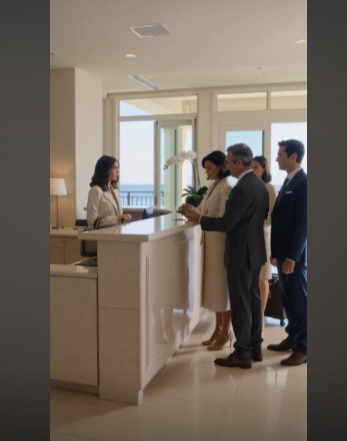
My mother slid the cheapest key sleeve toward me like charity while the manager watched me pretend to be nobody.
The sleeve made a soft scrape across the marble counter, barely louder than a fingernail. It should not have hurt. It was only a rectangle of heavy gray paper with a plastic room key tucked inside, the sort of small ordinary thing guests accepted without a second thought.
But my whole family was gathered around me in the lobby of the Malibu Grand, and my mother had moved it with that careful, apologetic smile she used when she wanted me to be grateful for being managed.
“There you go, sweetheart,” she said. “Nothing fancy, but perfectly comfortable.”
My father stood beside her with his hand on her back. My sister Claire had already taken two steps away, as if she could separate herself from the awkwardness. My brother Jake looked at the floor. Behind the desk, Sarah Martinez, the guest services manager, had gone still with both hands hovering above the keyboard.
And ten feet behind her, James Wellington had just come out of his office.
James saw me before anyone else saw him. His practiced hotel smile opened, then stopped. I gave him the smallest shake of my head, the kind of motion that would have meant nothing to my family but everything to an employee who knew how carefully I guarded silence.
For half a second, I thought he understood.
Then my mother tapped the gray sleeve again and said, louder than she needed to, “We booked you the cheapest room since money’s tight for you.”
James’s eyes moved from the key sleeve to my face. His expression changed into the formal respect I had spent years avoiding in front of my family.
By the time he bowed his head and said, “Welcome back, Ms. Thompson,” my mother’s hand was still resting on the counter.
The whole room seemed to hold its breath.
Two hours earlier, she had been sitting in the front seat of our rental SUV, turned halfway around with her sunglasses perched on top of her head and a tote bag wedged between her feet.
“Now, Emma,” she had said, using the voice she saved for weather warnings and family budgets, “I need to prepare you for your accommodation.”
I was in the back seat between Jake and a garment bag that belonged to Claire. The Pacific Coast Highway curved ahead of us in a blue ribbon of glare and salt air. Out beyond the passenger window, the ocean flashed like broken glass under the noon sun.
Mom had always sounded kindest right before she made me feel smallest.
“We booked you the cheapest room since money’s tight for you,” she said. “It’s still nice. This is a five-star resort, after all. It just isn’t oceanfront like ours.”
The pearl hair clip at the back of her head caught the light as she turned, and for a second I saw the woman who used to pin my dance-recital ribbons to the fridge like they were medals. She looked proud of herself for having softened the blow before I even had a chance to feel it.
“That was thoughtful,” I said.
Jake shifted beside me. He was twenty-five, built like the physical therapist he had become, all shoulders and restless energy. “It’s not like you’re going to be in the room much anyway,” he said, trying to make it sound casual. “We’ll all be together.”
Claire gave a light laugh from the passenger seat. “Exactly. And honestly, Emma, garden side can be charming. Less glare.”
“It’s not garden side,” Dad said, checking the GPS mounted to the dash. “Standard terrace, I think. Helen, did it have a terrace?”
Mom opened the folder in her lap, the one with every reservation printed and highlighted. “It said partial courtyard.”
“That sounds nice,” I said.
No one answered, because they all knew partial courtyard meant the room looked over the service path and the low palms near the laundry entrance.
I had approved the landscaping there myself six months earlier.
The Malibu Grand rose ahead of us as we turned onto the private drive, white stucco and pale stone set against three miles of California coastline. The main building sat above the beach like it had grown out of the cliff. Arched windows caught the light. Palms lined the entrance. Bougainvillea spilled over terraced walls in violent pink waves. The whole property was meant to feel effortless, which meant hundreds of people worked every hour to keep it that way.
I had bought it two years earlier through a financing package so large my father would have needed to sit down before reading the first page. Three hundred forty million dollars for the property, another long stretch of renovations after that, and more sleepless nights than I had ever admitted to anyone.
My family had no idea.
They thought I was still doing freelance design from a modest apartment in Santa Monica. They thought my trips to Napa, Sedona, Aspen, Honolulu, and Palm Springs were contract work for boutique hotels that needed brochures and website refreshes. They thought my refusal to move back to Phoenix meant I was stubborn, not busy. They thought the Honda I drove by choice was proof that I was barely making rent.
At twenty-eight, I had become the family cautionary tale told in a loving voice.
Dad slowed at the gatehouse, and the guard stepped forward in a crisp cream uniform.
“Thompson party,” Dad said, proudly enough to make my chest ache. “Checking in for the anniversary weekend.”
The guard glanced at the tablet in his hand. His eyes flicked over the reservation list, then toward the back seat. I kept my face turned toward the ocean, pretending to admire the view. After a beat, he smiled.
“Welcome to the Malibu Grand, Mr. Thompson. We’re honored to have you with us.”
Mom beamed. “Isn’t that nice?”
“It’s good training,” Dad said.
“It’s more than training,” Claire said. “This place is insane.”
That word had meant different things to different guests. To my family, it meant polished stone, staff at attention, imported flowers, an entrance drive that seemed too clean to be real. To me, it meant payroll, occupancy rates, linen contracts, insurance premiums, storm-drainage engineering, staff retention, guest satisfaction scores, and the daily discipline of making beauty look inevitable.
It meant six years of building Thompson Hospitality Group one property at a time, starting with a failing bed-and-breakfast in Napa that everybody with more experience told me not to buy.
It meant I had answered maintenance calls from a laundry room at midnight, scrubbed wine out of grout before a travel writer arrived, and negotiated with investors who smiled at my age before they listened to my numbers.
It also meant I had kept my mouth shut at every family dinner where my parents worried about my future.
“Emma,” Mom said as the SUV rolled forward, “are you sure you’re okay handling your share this weekend?”
“I’m okay.”
“We can cover breakfast if needed.”
“I can buy breakfast.”
“I know you can buy breakfast,” she said quickly. “I only mean resort breakfast. These places charge eighteen dollars for oatmeal.”
“Twenty-six,” I said before I could stop myself.
Claire turned. “How would you know that?”
I looked toward the pool terrace beyond the palms. “California.”
Dad chuckled. “She’s not wrong.”
Mom’s mouth tightened in that tiny way that meant she thought I was making light of practical concerns. “We just don’t want you embarrassed.”
That was the word that followed me through adulthood like a loose thread caught on a nail.
Embarrassed.
They did not want me embarrassed by an expensive menu, embarrassed by a bill split four ways, embarrassed by a valet tip, embarrassed by Claire’s sensible mortgage talk or Jake’s retirement account or Dad’s careful explanations of compound interest. What they rarely understood was that their effort to prevent my embarrassment had become the source of it.
“I appreciate it,” I said.
That answer had kept peace for years. It had also built a wall so smooth nobody noticed they were leaning against it.
We reached the valet stand, and two attendants stepped forward before the SUV had fully stopped. One opened Mom’s door. Another came to mine. His name was Miguel, and I knew his oldest daughter had just gotten into San Diego State because James had mentioned it during a staffing update. Miguel recognized me immediately.
For one heartbeat, his smile became real.
“Good afternoon,” he said, catching himself so quickly no one else noticed. “Welcome.”
“Thank you,” I said, and let the formal version of myself vanish under the softest possible look.
Claire climbed out and stared toward the entrance. “I feel underdressed.”
“You look beautiful,” Mom said.
Claire smoothed her linen dress. “I mean for the building.”
Jake whistled low. “Dad, how much did this weekend cost again?”
“Enough,” Dad said.
Mom touched his arm. “It’s our thirtieth. We’re allowed one ridiculous thing.”
I had wanted to give them this ridiculous thing myself. When Dad first announced he had booked the Malibu Grand for their anniversary, I had sat alone in my apartment with my phone in my hand for ten full minutes. I could have called him. I could have said, Dad, cancel the reservation. I’ll take care of it. I could have told him the truth then, before travel plans hardened and family assumptions got packed beside sandals and dress clothes.
Instead, I had said, “That sounds beautiful.”
I told myself I was protecting the surprise. I told myself I would find the right moment during the weekend, maybe after dinner on the first night, when Mom and Dad were relaxed and the ocean was dark outside the windows. I imagined raising a glass and explaining it gently, not as a performance, not as a correction, but as a gift.
What I did not admit was that I was still afraid.
Not of them asking for money. My family was not greedy. Not of them resenting me. They would be proud after the shock wore off. I was afraid of the smaller, quieter change. I was afraid of becoming an achievement instead of a daughter.
The first time I understood how my family could turn love into pressure, I was twenty-two and home for Thanksgiving.
I had just left Marriott after four years of hotel management rotations. I had worked front desk, housekeeping coordination, group sales, banquet operations, revenue analytics, and guest recovery, which meant I knew more about hotel life than anyone at that table except the people who had never had to explain why it mattered.
“I’m looking at a property in Napa,” I told them, passing the mashed potatoes to Jake.
Dad laughed because he thought I was joking. “A property, as in a house?”
“A small inn. Twelve rooms. It’s in trouble, but the land is good, and the reviews complain about service more than structure.”
Mom set down her fork. “Honey, buying a failing hotel is not a career plan.”
“It’s an inn.”
“That makes me feel less calm,” Claire said.
She had been twenty-six then, already married in spirit to the idea of order even though Brad would not arrive in her life for another year. She had a teaching job, a five-year plan, and the kind of confidence people have when every adult in the room understands their path.
Dad wiped his mouth with a napkin. “How much are they asking?”
“Eight hundred thousand.”
Jake coughed into his water. Mom stared at me as though I had announced I was moving to the moon.
“I have savings,” I said. “And a small investor group. And the seller is willing to carry part of the note because the property has been sitting.”
“You have savings for a condo,” Dad said. “Not a business that can swallow you alive.”
“I know the numbers.”
“You know front desk scheduling,” he said, not unkindly. “That’s not the same as ownership.”
The wrongness of that sentence lodged in me.
I had not only known front desk scheduling. I had known labor ratios, average daily rates, booking windows, vendor contracts, guest funnels, renovation phasing, and the strange emotional algebra of hospitality, where a guest forgave a broken air conditioner faster if someone remembered their dog’s name. But at that table I was still the child who lost her lunchbox, the teenager who cried when she got a B in chemistry, the daughter who needed Dad to explain risk.
Mom reached across and patted my hand. “We just want you safe.”
Safe was their favorite word for small.
I bought the Napa inn anyway.
For the first eight months, I slept in a back office on a pullout couch because I could not afford a manager and an apartment. I repainted trim after checkout and built a booking strategy on a laptop with a cracked corner. I wrote apology emails at midnight and welcome notes at dawn. I learned which housekeepers took pride in corner folds and which contractors padded invoices. I learned that guests remembered fresh coffee and honest attention more than imported soap.
By the end of the first year, the inn was profitable.
By the end of the second, it was booking out weekends months in advance.
By the end of the third, I had refinanced it, paid back my early investors, and used the equity to acquire a tired desert spa outside Palm Springs.
My family knew none of that.
They knew I was “doing boutique hotel branding.” That phrase had come from me on a Sunday call when Mom asked why I sounded exhausted. It was not a lie so much as a door left half closed. I was doing branding. I was also choosing mattresses, restructuring debt, hiring chefs, and standing in boiler rooms with men who called me “sweetheart” until the bids got rejected.
The longer I stayed private, the harder truth became.
Privacy hardened into habit. Habit became performance. Performance became the version of my life my family believed.
At Claire’s birthday brunch one spring, Mom handed me a grocery gift card in the parking lot behind a Phoenix restaurant.
“Just something extra,” she said, folding my fingers around it before I understood what she was doing. “No pride. Everybody needs help sometimes.”
I had flown in that morning after closing on a Colorado mountain lodge. I had signed documents at seven, boarded a plane at nine, and spent the flight reviewing a staffing plan for a property that would employ eighty-two people by ski season.
I looked down at the gift card.
“Mom, I’m fine.”
“I know you say that.”
“I mean I’m really fine.”
She smiled sadly. “You don’t have to pretend with me.”
There it was again, the kindness that locked me out of my own life.
I could have told her in that parking lot. I could have said, I just borrowed forty-eight million dollars and the bank called me impressive. I could have laughed until she did too, or cried until the old story cracked.
Instead I put the card in my purse and said, “Thank you.”
The consequence of that silence arrived at Christmas, when Dad offered me a part-time bookkeeping role in his accounting practice.
“It’s remote,” he said, sliding a printed job description beside the cranberry sauce. “You could do it alongside your creative work.”
Claire looked relieved. Jake looked embarrassed for me. Mom watched my face like she had handed me a life raft.
“I’m not looking for extra work,” I said.
“It’s not extra work if it gives you stability,” Dad replied.
“I have stability.”
“Sweetheart,” Mom said softly. “You rent.”
That was the wrong detail that stayed with me. Not the job offer. Not the pity. The fact that renting had become evidence against me, as if ownership of a house was the only adult shape they recognized.
My Santa Monica apartment was not tiny. It was spare by choice, with white walls, a balcony just wide enough for two chairs, and a view of the water between buildings. I kept no expensive art there because I spent most of my time in hotels filled with expensive art. I drove an older Honda because I loved how anonymous it made me. I wore simple clothes because luxury taught me how quickly price could become costume.
To my family, simplicity looked like need.
So they built a story around it.
Emma was talented but impractical. Emma was independent but struggling. Emma was brave, yes, but in the way people described someone standing too close to traffic. Emma needed gentle supervision, occasional rescue, and a standard room at an expensive resort so she would not have to admit she could not keep up.
When Dad announced the anniversary trip in the family group chat, he wrote with the rare excitement of a man who had spent thirty years doing responsible math and wanted, for one weekend, to ignore it.
Thirty years with your mother deserves the Pacific. Malibu Grand, three nights, all of us together.
Claire responded with a string of exclamation points. Jake wrote, “Dad going big.” Brad sent a champagne glass. Mom wrote that she had already bought a dress.
I stared at the message until my coffee went cold.
The Malibu Grand was my flagship property.
Its website did not show my name. None of our public-facing material did. Thompson Hospitality Group operated through property brands: the Malibu Grand, Vineyard House Napa, Sonoran Light, Hale Kona, Ridge & Pine, and the rest. Investors knew me. Vendors knew me. General managers knew me. Travel magazines knew my company if they read past the glossy property photographs.
My parents did not.
I typed, That place looks amazing.
The lie felt like sand in my mouth.
A week later, Mom called to discuss room arrangements.
“Your father and I are taking an oceanfront junior suite,” she said. “It’s our anniversary, so we decided not to feel guilty.”
“You shouldn’t.”
“Claire and Brad are taking garden view. Jake said standard is fine for him because he only sleeps in hotel rooms. And for you, we found something very reasonable.”
“For me.”
“Three hundred a night,” she said, as if announcing a medical discount. “Before fees, of course. Still high, but much better than eight hundred for oceanfront. We know freelance income can be uneven.”
I was in my home office at the time, looking at a quarterly report showing Malibu’s weekend oceanfront rate had moved from $760 to $825 due to demand compression. Her number was accurate enough to sting.
“You didn’t have to book me separately,” I said. “I could have handled my room.”
“Nonsense. This is your father’s gift to the family.”
“I could contribute.”
“We don’t want you stretching. That’s the whole point.”
I turned my chair toward the window. A runner in a red cap paused at the intersection below, waiting for traffic. He looked free in the casual way strangers sometimes did when you were trapped inside a conversation.
“Mom,” I said, “I need you to hear me. I can afford the room.”
“I know you always say that.”
“No, I mean—”
“Emma.” Her voice softened. “Let us help without making it awkward.”
The line worked because it made my truth sound like pride.
So I stopped.
A few days later, Claire sent a shared itinerary. She had made columns by person, because Claire believed color-coding was a love language. Mom and Dad’s column included anniversary dinner, spa appointment, oceanfront brunch, and sunset photos. Claire and Brad had morning hike and pool time. Jake had gym and beach. My column included “standard room,” “join when comfortable,” and “budget meals TBD.”
I stared at that last line for a long time.
Budget meals TBD.
Not because it mattered financially. It mattered because it revealed how much they had already discussed me without me. They had imagined me awkward at menus, flushed at wine lists, grateful for appetizers passed across a table. They had built an entire weekend around sparing me from bills that would not have troubled me and never once considered that their sparing might feel like a cage.
I called Dad that evening.
“Can we talk about the itinerary?”
“Sure, kiddo.”
“I don’t need special budget planning.”
“It’s not special. We’re just being mindful.”
“Mindful of what?”
He was quiet for a moment. Then he sighed. “Emma, you’ve chosen a path with ups and downs. There’s nothing wrong with that. But your mother and I don’t want you feeling pressure to pretend this weekend is easy for you.”
I stood in my kitchen, the phone warm against my ear, and looked at the unopened bottle of wine on my counter. It had been sent by a sommelier after our Napa property won a national hospitality award. I had not told my parents about that either.
“Dad,” I said, “do you trust me?”
“Of course.”
“No. Do you trust me as an adult?”
The pause that followed answered before he did.
“That’s not fair,” he said finally.
“It feels like a fair question.”
“We have always trusted your character.”
“My character isn’t my judgment.”
He cleared his throat. “We worry because we love you.”
“I know.”
“And someday, when you have children, you’ll understand that worry doesn’t turn off when they insist they’re fine.”
I wanted to say I was not insisting. I wanted to say I was telling. I wanted to say there was a difference between concern and control, and they had crossed it so gently they thought it was tenderness.
Instead I said, “Okay.”
That became the condition I set for myself without telling anyone.
If they made the weekend about my supposed need, I would stop protecting the misunderstanding. If they let me simply be their daughter, I would choose the gentler moment I had imagined. I did not want a lobby reveal. I did not want a scene. I wanted to tell them over dinner, with candles on the table and the ocean outside, that the place they had chosen because it felt special to them was part of the life I had built.
I called James Wellington the morning before the trip.
“I may be on property this weekend,” I said.
“You’re coming early for the quarterly review?”
“No. Family weekend. My parents’ anniversary.”
“How wonderful. Shall we prepare the penthouse?”
“No. I’m not traveling as owner.”
There was a pause. James was too experienced to question tone, but too responsible to ignore operational implications. “Understood. How would you like staff to handle recognition?”
“Discreetly. I haven’t told my family.”
Another pause. Longer.
“Understood,” he said again, though I could hear the questions lining up behind the word.
“No special treatment,” I said. “Let my parents have the weekend they booked.”
“Emma, with respect, the reservation system flags your profile automatically.”
“I know. I’m booked under my father’s family reservation. It may not connect.”
“If it does?”
“Use judgment.”
That was too much to ask of a man whose entire career had been built on honoring hierarchy, guest preference, and brand standards. James could calm a furious celebrity without letting the lobby know anything had happened. He could convince a bride that rain had improved her photographs. He could remember a returning guest’s preferred pillow firmness after eleven months.
But I had given him a contradiction. Treat me like no one. Also know exactly who I was.
The next morning, I flew from Los Angeles to Phoenix because Mom insisted the family should travel together from there. It made no practical sense, which meant it mattered to her. I took the early flight, packed one carry-on, and wore a cream blazer over jeans because I had learned that expensive clothes were less noticeable when they looked simple.
Mom hugged me at the curb outside their house like she had not seen me in a year, though we had talked three days before.
“You look thin,” she said immediately.
“I look like I always look.”
“Are you eating enough?”
Claire, standing by the SUV, laughed. “Mom, she’s thirty seconds out of the rideshare.”
“She’s allowed one question.”
“You asked three,” Jake said.
Dad came out with a suitcase in each hand and his reading glasses still hanging from the collar of his polo. He looked happy. That was what nearly undid me. For weeks, I had let annoyance collect over the room issue, the itinerary, the careful money talk. Then I saw my father’s face, bright with anticipation, and remembered this weekend was not supposed to be about me.
Thirty years of marriage deserved joy.
Mom had packed snacks in a canvas bag even though we were driving to the airport and then flying back to California. She had labeled envelopes with confirmation numbers. Dad had printed maps. Claire had brought a portable steamer. Jake had forgotten socks and announced it like a crisis.
For several hours, we were almost normal.
On the flight, Mom leaned across the aisle to tell me about the dress she planned to wear to dinner. Dad read a magazine article about coastal erosion and tried to explain it to Jake, who was pretending to sleep. Claire showed me photos of her school’s new library renovation. Brad, sitting two rows ahead, turned around twice to ask whether resort Wi-Fi was usually strong enough for a quick work call.
I almost told them during the flight.
Not everything. Just enough.
I imagined leaning across the aisle and saying, “There’s something funny about this hotel.” I imagined their confusion, then laughter, then a weekend reshaped before anyone had time to harden into hurt. But Mom patted my hand before landing and whispered, “Don’t worry about tipping. Your father brought cash for everyone.”
The door closed inside me again.
At the rental counter in Los Angeles, Dad rejected the first SUV because the daily rate was “highway robbery,” then accepted the second after the agent threw in a discount he had not actually requested. Mom complimented him on still being able to negotiate. Claire rolled her eyes. Jake bought gum and offered everyone a piece. Brad checked email with the grave expression of a man monitoring international diplomacy instead of software bugs.
I watched them and felt the old split open in me.
They were my family. They were ridiculous and loving and loud. They had taught me to write thank-you notes, keep promises, work hard, and treat service workers with respect. Dad had driven me to college in a rented van and cried only when he thought I had walked away. Mom had mailed me soup mix when I got the flu in my first apartment. Claire had edited my scholarship essays. Jake had once punched a locker after a boy made me cry, then got grounded and insisted it had been worth it.
They were not cruel.
That was what made the injury hard to name.
The drive up the coast gave them new material for wonder. Mom counted convertibles. Claire took photos of the ocean through the window. Dad complained about California gas prices with the reverence of a man encountering myth. Jake asked whether famous people stayed at the Malibu Grand. Brad said he had seen it on a travel list once and heard the spa was impossible to book.
“It is,” I said.
Everyone looked at me.
“I mean, places like that usually are,” I added.
Claire grinned. “Listen to our hotel expert.”
“Emma probably knows all the tricks,” Jake said. “Freelance design for fancy places, right?”
“Something like that.”
Dad glanced at me in the rearview mirror. “You should talk to someone while we’re there. Network a little.”
“For work?”
“Why not? Maybe they need brochures. A place like this probably has a marketing department, but personal connections never hurt.”
Mom nodded. “Just don’t lead with needing work.”
I blinked. “I wasn’t planning to ask anyone for work.”
“I know. I mean, you want to seem confident.”
There was no malice in her face. That made the line settle deeper.
“I’ll try to seem confident,” I said.
Jake snorted, thinking I had made a joke. Claire laughed. Dad smiled in the mirror.
I looked out at the water and let the car carry us toward the property.
By the time we reached the gatehouse, my pulse had become a steady knock beneath my ribs. Every staff member who recognized me would have to choose between training and instinct. Every family comment about money would land in a place where my other life had walls, witnesses, and a payroll.
Miguel handled the luggage with practiced grace. He greeted Dad warmly, gave Mom directions to the front desk, and managed not to call me by name. I loved him for it. The lobby doors opened, and the familiar scent of lemon polish, ocean air, and white orchids washed over us.
“This,” Mom whispered, “is heaven.”
The lobby always did that.
I had fought for the fireplace. The original designer wanted a massive abstract sculpture in the center of the room, something dramatic and cold. I wanted a hearth, even in Southern California, because travelers softened around the idea of warmth. We used pale stone, low seating, linen textures, and wide glass so the ocean remained the loudest feature. The effect was luxury without shouting.
My family stood just inside the entrance, stunned into reverence.
Claire turned in a slow circle. “Emma, have you ever stayed anywhere this nice?”
“Once or twice,” I said.
That was true if fifty-six times counted as once or twice in a life full of categories.
Mom laughed. “Don’t get used to it. This is once-in-a-lifetime for us.”
The sentence should have made me happy. I had built a place that made my mother feel lifted out of ordinary life. Instead it twisted through me because I had the power to give her this anytime, and she had no idea she was thanking a stranger.
Dad approached the front desk with his folder open.
Three guest services agents stood ready behind the counter. Sarah Martinez was at the center station, immaculate in a navy blazer, her dark hair pulled back, her smile calm enough to survive hurricanes and honeymoon disasters. She saw Dad first. Then she saw me.
Her smile held.
“Good afternoon,” she said. “Welcome to the Malibu Grand. How may I assist you?”
“Thompson party,” Dad said. “We have rooms for the weekend. Richard and Helen Thompson.”
“Of course, Mr. Thompson.”
Sarah began typing. I watched her professional rhythm, the tiny movements that told me where she was in the system. Reservation found. Guest notes open. Room assignments visible. Payment method confirmed.
Then her fingers slowed.
That was the first public crack.
Her eyes moved to the screen, then to me, then back again.
I felt my shoulders loosen rather than tighten. That surprised me. After years of fearing this exact moment, my body had chosen calm. Maybe because the thing I had protected was already gone. Maybe because my mother was standing beside me with a folder full of assumptions, and I was tired of helping them breathe.
Sarah read the reservation aloud the way staff did when confirming details.
“Mr. and Mrs. Thompson, oceanfront junior suite. Claire and Brad Morgan, garden view king. Jake Thompson, standard terrace. And Miss Emma Thompson…”
She paused.
Mom leaned in. “Standard terrace as well. We were hoping she might be near Jake, if possible. Or near us, if there’s a complimentary option.”
The last sentence stung because it carried two meanings. Near us because we love her. Complimentary because we assume she cannot manage the difference.
Sarah’s face remained smooth. “Let me see what availability allows.”
“Don’t trouble yourself,” I said.
Mom touched my wrist. “It’s no trouble to ask.”
The pressure became physical then. Her fingers were light, but the message was firm. Let me handle this. Let me protect you from wanting too much.
Sarah typed again. The profile link must have surfaced. The owner flag. The internal notes. The travel preferences. The penthouse default. The dietary note from a long-ago working dinner. The instruction that I was never to be charged at properties I owned unless I specifically requested a market-rate test booking.
Her throat moved.
“Miss Thompson,” she said carefully, “I just need to verify—”
“Emma,” Mom interrupted, smiling at Sarah. “She’s Emma. No need for Miss Thompson.”
Sarah looked at me, and I saw apology flicker beneath training.
Dad laughed softly. “She’s not used to being fussed over.”
I almost said, She is used to it. She signs the checks that train people not to show it.
Instead I placed my palm flat against the counter and felt the cool stone under my skin.
“Whatever is easiest,” I said.
The consequence of that sentence was James.
He came out of the office behind the desk holding a tablet, already speaking to an assistant just out of sight. “Sarah, the arrival list for the Harrington group—”
He stopped.
James Wellington was fifty-one, silver at the temples, tall in the composed way of hotel men who had learned never to seem hurried even when pipes burst above a ballroom. I had recruited him from a competitor after my first walk-through of the Malibu Grand revealed a staff that cared more than its ownership did. James had become the soul of the property during renovations. He knew every weak spot in the building and every strong one in the team.
He also knew me well enough to understand the danger in my stillness.
“Ms. Thompson,” he said.
Mom looked pleased for one confused second, assuming the greeting was formal hospitality.
Then James stepped around the desk, not rushing, not theatrical, but with unmistakable purpose. The employees near the concierge station noticed. Miguel, returning with luggage tags, slowed. A couple checking out near the far end of the counter glanced over because tone carries in a lobby even when words do not.
I saw my family seeing people see me.
That was when Mom slid the gray key sleeve toward me.
“There you go, sweetheart,” she said. “Nothing fancy, but perfectly comfortable.”
The pearl hair clip trembled as she turned toward me, and I realized her hand was not steady. She knew something was wrong before she knew what. Mothers sense shifts in rooms before they understand them.
Dad looked from James to me. Claire’s smile vanished. Brad lowered his phone. Jake stopped rocking on his heels.
James bowed his head.
“Welcome back, Ms. Thompson,” he said. “Shall I prepare the penthouse as usual?”
The silence did not fall all at once.
It arrived in pieces.
First Sarah’s fingers left the keyboard. Then Dad’s folder sagged open in his hand. Then Mom’s palm lifted from the key sleeve as if the paper had become hot. Claire made a small sound and swallowed it. Jake’s eyes snapped to me with hurt, disbelief, and a question he was too stunned to ask.
I could have laughed.
A worse version of me might have.
Instead I looked at James and said, “Not yet.”
Those two words were not for him alone. They were for my family, for the lobby, for the years of grocery cards and job descriptions and budget-meal columns, for every careful smile I had used to keep their worry intact.
Not yet.
Because if the truth was going to enter the room, I wanted it to walk in under my own power.
James understood immediately. His face shifted from automatic hospitality to human regret.
“Of course,” he said. “My apologies.”
Mom’s voice came out thin. “Why did he say welcome back?”
No one answered.
Dad looked at me with a fixed expression I had seen only once before, when his own father died and he became older between one breath and the next.
“Emma,” he said. “What is this?”
I picked up the gray key sleeve and turned it once between my fingers. The standard-room assignment had become absurd now, but I still felt the weight of what it represented. Not the room. Never the room. The place they had kept for me in their minds.
“Dad,” I said, “I need you to sit down before we talk.”
“I don’t want to sit down.”
“I know.”
Mom stared at James. “Is there a mistake?”
“No, Mrs. Thompson,” James said gently.
I turned to him. “James.”
He stopped. That was the first time my family heard command in my voice and watched someone at the resort obey it.
I had not raised my tone. I had not become sharp. I had simply used the part of myself they had never met.
Sarah lowered her eyes to the counter, giving me privacy as best she could in a public room. The couple nearby pretended not to listen and failed. The small American flag behind the concierge desk stood still in the conditioned air, its muted colors half-hidden beside a vase of white orchids.
Mom’s mouth opened and closed.
Claire stepped closer. “Emma, why does the manager know you?”
“Because I work with him.”
“At the hotel?”
“In the company.”
“What company?” Jake asked.
There it was. The door, finally open.
I set the key sleeve down between us, not as proof, not as drama, but because my hands needed to be empty.
“Thompson Hospitality Group,” I said. “The company that owns the Malibu Grand.”
Dad’s face changed before anyone else’s. He knew enough about business for the sentence to land in layers.
“Works for,” he said slowly. “Or owns.”
I looked at him.
“Owns,” I said. “I own the controlling stake.”
Claire put one hand over her mouth. Brad whispered something I did not catch. Jake took one step back and bumped into a suitcase.
Mom shook her head once, hard. “No.”
It was not disbelief exactly. It was resistance. She had spent years arranging me in her mind, and now the shelf had collapsed.
“I’m sorry,” I said.
That made her eyes fill faster than any explanation could have.
“You’re sorry?”
“I didn’t want it to happen like this.”
James stood near the desk, his posture respectful and miserable. I could see him calculating whether to disappear. But my family had already seen too much for retreat to help.
Dad’s voice came out very quiet. “How much of this hotel?”
“All of it, through the group.”
“This building.”
“Yes.”
“The resort.”
“Yes.”
“The restaurants, the spa, all of this.”
“Yes.”
Mom looked down at the gray sleeve, the one she had pushed toward me with such tender condescension.
“And we booked you the cheapest room,” she whispered.
No one corrected her, because some sentences need to stand in their own light.
I did not tell them then about the Napa inn, not fully. I did not say eighteen properties in the lobby, or annual revenue, or acquisitions, or investor meetings, or the years I had spent learning how to stand in rooms where people underestimated me without letting my face beg them to stop. Those facts would come later. Facts were easier than wounds.
What mattered first was the line between help and humiliation.
“Mom,” I said, “you thought you were protecting me.”
“I was.”
“I know.”
Her chin lifted with the reflex of someone reaching for familiar ground. “We were trying to make the weekend easier for you.”
“You made my room assignment a family project.”
Her eyes flashed. “That is not fair.”
“Maybe not,” I said. “But it’s true.”
Dad closed the folder. The sound was small and final.
A bell cart rolled somewhere behind us. A child laughed near the entrance, then was hushed by a parent who sensed the air. The lobby continued being a lobby around our private earthquake.
Claire lowered her hand. “How long?”
I looked at my sister. She was pale, more hurt than angry. That cut me differently. Claire and I had fought over clothes, college choices, Christmas schedules, and who Mom called first when something went wrong. But she had also slept beside me on the floor when I had food poisoning at nineteen because she was afraid I would need help standing.
“Six years,” I said.
Jake made a sound like the number had struck him. “Six years.”
“I bought the first property when I was twenty-two.”
“The Napa thing,” Dad said.
I nodded.
“The thing we told you not to do.”
“The thing everyone told me not to do.”
Mom sat down in the nearest lobby chair as if her knees had received the truth before the rest of her. Dad moved beside her automatically. They had been married thirty years, and their bodies knew each other’s emergencies. He put one hand on her shoulder. She did not shrug it off.
“Sarah,” I said quietly, “could you hold the room assignments for a few minutes?”
“Of course, Ms. Thompson.”
Mom flinched at the title.
I noticed, and for the first time, I did not soften it.
James asked the lobby attendant to bring water. He did it discreetly. Two glasses appeared on a side table with no fuss. That was why I trusted him. Luxury, at its best, was not excess. It was attention without noise.
We moved to a seating area near the windows. The Pacific filled the glass beyond us, bright and indifferent. My family sat in a half circle that looked too much like an intervention turned inside out.
I remained standing for a moment.
Not because I wanted height over them. Because if I sat too quickly, I might become the version of myself who accepted the old story out of habit.
“Emma,” Mom said, “please sit.”
“I will.”
“You’re making me nervous.”
“I’m nervous too.”
That startled her.
I sat across from them, not beside them. Distance mattered. For years, closeness had let them pat my knee and end conversations with love before truth had a chance. Across from them, I could see all their faces.
Dad spoke first. “Start with the Napa inn.”
So I did.
I told them about the first property, the cracked tile in the lobby, the old reservation system that crashed every Friday, the owner who had given up but still loved the place enough to choose me over a developer who wanted to flatten it. I told them about sleeping in the office, not in a tragic way, but in the practical way young owners do when cash flow decides your furniture. I told them about repainting baseboards and learning that the smell of fresh coffee could lift a review score half a point if the rest of the stay was honest.
Mom cried quietly when I said I had spent the first Christmas there alone because a pipe froze and I could not leave.
“You told us you had a deadline,” she said.
“I did.”
“A pipe is not a deadline.”
“It was for twelve guests arriving the next day.”
Claire laughed once through tears, then covered her face again.
I kept going. I told them about Palm Springs, then Colorado, then the small Hawaii property that nearly broke me because oceanfront maintenance made desert problems look polite. I told them about lenders who asked whether my father would be involved. I told them about contractors who spoke to male assistants until I fired them. I told them about the first time a guest wrote that one of my hotels had given her family a memory they would keep forever.
Jake leaned forward. “And you never thought to tell us any of this?”
“I thought about it all the time.”
“That’s worse.”
“I know.”
He looked away, jaw tight.
I let that consequence sit. Privacy had protected me, but it had also excluded them. The truth had more than one wound.
Dad rubbed both hands over his face. “How many properties now?”
“Eighteen.”
Mom gave a small gasp. Claire whispered my name.
“California, Arizona, Colorado, Hawaii,” I said. “A few others in development. The Malibu Grand is the flagship.”
“The flagship,” Dad repeated.
His voice held awe, but also grief. He had spent years worrying over my rent while I negotiated management contracts in conference rooms overlooking properties he would have considered once-in-a-lifetime. The mismatch was almost cruel.
Mom looked at me through tears. “Why didn’t you trust us?”
The question opened the old bruise.
“I did trust you to love me,” I said. “I didn’t trust you to see me clearly.”
She pressed a tissue under one eye. “That’s a terrible thing to say to your mother.”
“It’s a terrible thing to feel.”
Dad looked down.
Claire’s voice was soft. “We talked about you a lot.”
“I know.”
“No, Emma. A lot.”
I nodded. “I know.”
“You made us look stupid.”
“That wasn’t my intention.”
“But it happened.” Her eyes shone. “Mom cried about you. Dad worried. Jake and I argued about whether we should say more. I defended you sometimes, and sometimes I didn’t. And all this time you were sitting on—” She gestured helplessly at the lobby. “This.”
“I wasn’t sitting on it,” I said. “I was working inside it.”
That quieted her.
I had not meant it as a correction with teeth, but it had some.
Mom drew herself up. “We would have been proud.”
“I know.”
“Then why keep letting us believe you needed help?”
I looked at the gray key sleeve still in my hand. I had picked it up without noticing. The paper edge had left a faint line across my thumb.
“Because when I told you I didn’t need help,” I said, “you didn’t believe me.”
Mom started to answer, stopped, and looked toward Dad.
Dad did not rescue her.
That was new.
The seating area grew hushed around us. James had moved far enough away to give privacy but close enough to protect it. Sarah kept the desk running with another agent, though I could see the strain in her shoulders. Staff noticed everything. They would know by dinner, not as gossip but as operational fact. The owner’s family had arrived without knowing she was the owner.
I would have to laugh about that someday.
Not yet.
Dad cleared his throat. “We owe you an apology.”
Mom turned sharply. “Richard.”
“We do.” His voice was tired. “Maybe not for caring. But for assuming.”
She looked wounded. “I am her mother.”
“You’re also the person who told the front desk she was Emma, not Miss Thompson.”
Mom’s face went red.
I had almost forgotten that detail in the rush of larger revelations. Hearing Dad name it made the old pressure visible again. Mom had corrected Sarah not because Sarah was wrong, but because formality toward me felt wrong inside the story she knew.
“I didn’t mean anything by it,” Mom said.
“I know,” I said. “That’s part of the problem.”
She looked at me.
“Most of it was small,” I said. “That’s why I kept letting it go. Grocery cards. Job suggestions. Budget meals. Rooms chosen for me. Jokes about creative work. Telling people not to fuss over me because you thought fuss would embarrass me. None of it was unforgivable alone.”
Claire wiped under her eye. “Together, it was a lot.”
“Yes.”
Jake leaned back and looked at the ceiling. “I hate this.”
“Me too,” I said.
Brad, who had been quiet so long I almost forgot he was there, spoke carefully. “For what it’s worth, I think everybody in this circle feels foolish in a different way.”
Claire gave him a look.
He lifted both hands. “Not helpful. I’ll stop.”
Somehow that broke the tension enough for Jake to laugh under his breath. It was small, but I took it.
Mom stared at the ocean beyond the windows. Her anniversary dress was still in a garment bag upstairs somewhere on a bell cart, waiting for the celebration we had all interrupted. I wondered whether she wished she had chosen another resort. I wondered whether I had ruined a weekend that was supposed to honor their life together.
Then I remembered the key sleeve crossing the counter.
No. I had not ruined it alone.
“I was going to tell you tonight,” I said.
Everyone looked at me.
“At dinner,” I continued. “I wanted to explain gently. I wanted this to be part of the gift.”
Mom blinked. “Gift?”
I looked at Dad. “I was going to upgrade you quietly and cover the weekend. Not because you couldn’t, but because I wanted to give you something beautiful for thirty years. I was going to tell you this property was mine after the first toast, when you were happy.”
Dad closed his eyes briefly.
“But then the car happened,” I said. “And the itinerary. And the desk.”
Mom folded the tissue in her lap until it became a tight white square. “The car.”
“You told me I had the cheapest room because money was tight for me.”
“I was trying to prepare you.”
“I know. But preparation can still be a wound.”
Her mouth trembled.
I did not rush to comfort her. That was one of the hardest things I did that day. I let my mother feel what her words had done without snatching it away to prove I was still good.
James approached with measured steps. “Emma.”
The use of my first name was deliberate. It gave me the choice.
“Yes?”
“The penthouse is available, as always. We also have the presidential suite ready for your parents if you would like us to arrange it.”
Mom inhaled. Dad looked at me. Claire stared at the floor. Jake shook his head slowly, as if reality kept adding rooms.
I stood.
This was the moment my family expected either generosity or punishment. Their faces told me. Mom braced for me to say of course, take everything, let me prove I am not hurt. Dad braced for me to say no, keep what you booked, let the lesson sting. Claire braced for drama. Jake braced for awkwardness.
I surprised myself by choosing neither.
“Please prepare the anniversary suite for my parents,” I said. “The one above the north terrace. Ocean view, private dining balcony.”
James nodded. “Of course.”
“For Claire and Brad, an ocean room near them if available. For Jake, one on the same floor.”
“And for you?”
I looked at the gray sleeve in my hand.
“I’ll take my usual room after dinner.”
Mom flinched again.
“Until then,” I said, setting the sleeve on the table beside the water glasses, “leave this room assignment as it is.”
James’s eyes sharpened with understanding.
Dad looked at the sleeve. “Emma.”
“I don’t need the room,” I said. “I need us to look at why you thought it fit me.”
No one spoke.
The sentence did what I had not known I needed it to do. It placed the pressure at the center without turning it into a weapon. It let the gray sleeve remain a small, ugly, useful truth.
James bowed his head. “I’ll make the arrangements.”
When he walked away, Mom pressed the tissue to her mouth.
I sat again.
For a while, nobody knew how to move.
Then Dad said, “I remember that Thanksgiving.”
I looked at him.
“The Napa inn,” he said. “I remember thinking you were being reckless. I remember telling Helen afterward that you’d scare yourself and come home.”
Mom whispered, “Richard.”
“It’s true.” He looked at me. “I didn’t say it to hurt you. I thought failure would be safer if it happened early.”
That sentence was honest enough to hurt less than many gentler ones.
“I know,” I said.
“But you didn’t fail.”
“No.”
“And we kept treating you like you had.”
My throat tightened.
Mom began to cry in earnest then. Not loudly. My mother had too much pride for public sobbing. Her shoulders shook once, and she turned her face toward Dad’s arm. He held her without looking away from me.
Claire moved from her chair to the arm of Mom’s. Jake stood and walked toward the window, then came back because leaving felt worse. Brad took the water glasses from the side table and handed one to Mom, one to me. I accepted mine because kindness was still kindness, even in a hard room.
“I don’t want you to think we’re not proud,” Mom said when she could speak.
“I don’t.”
“You keep saying that, but I don’t know if you believe it.”
“I believe you would have been proud if you had known.”
“That’s not the same.”
“No,” I said. “It isn’t.”
Her eyes met mine.
The truth, once it started, wanted more space.
“I was afraid you’d make it yours,” I said.
Dad’s brow tightened. “What does that mean?”
“Advice. Opinions. Warnings. People to call. Articles to read. Questions about whether I was sleeping enough, whether I was expanding too fast, whether I was being careful, whether I knew what I was doing. I was afraid every win would become a family meeting and every risk would become proof that you’d been right to worry.”
Claire winced.
Jake shoved his hands into his pockets.
Mom’s face went very still.
“I know that sounds ungrateful,” I said.
“It sounds lonely,” Dad replied.
That undid me more than any apology would have.
I looked toward the windows until the ocean blurred. For six years I had told myself loneliness was the price of building something fully mine. I had worn independence like armor and called the weight discipline. I had not let myself count the birthdays I left early for calls, the awards I accepted with employees but not family, the photos I never sent because one question would lead to ten more.
“It was,” I said.
Mom reached for me, then stopped.
That small restraint was new too.
“May I?” she asked.
The question held more repair than the hug itself.
I nodded.
She crossed the space between us and put her arms around me. She smelled like her old perfume and airplane air. I stayed stiff for one second, then held her back. Her hand pressed between my shoulder blades, no longer steering, only there.
“I am so sorry,” she whispered into my hair.
I closed my eyes.
“Not for loving me,” I said.
“For shrinking you while I called it love.”
I had not known she was capable of naming it that way.
Behind her, Dad wiped his eyes with his thumb. Claire openly cried. Jake looked at the ceiling again, which meant he was close. Brad stared at a plant with the desperation of an in-law trapped inside too much family truth.
When Mom let go, she looked older and lighter at the same time.
“What do we do now?” she asked.
“We go upstairs,” I said. “You put on your anniversary dress. Dad pretends he isn’t nervous about the wine list. Claire steams everything within reach. Jake buys socks from the boutique at an offensive markup. Brad answers whatever email has been trying to ruin his day. And tonight we have dinner.”
Jake sniffed. “The boutique sells socks?”
“For forty dollars,” I said.
He stared. “That’s criminal.”
“Jake,” Claire said.
“It’s not criminal,” I said. “It’s resort pricing.”
For the first time since James walked out of his office, everyone laughed.
The sound was fragile, but real.
Sarah returned with new key sleeves, cream instead of gray, discreetly embossed with the property mark. She did not say anything she did not need to say. She handed Mom and Dad their new assignment with a smile that held no curiosity. She gave Claire and Brad theirs, then Jake his.
When she reached me, she paused.
“Ms. Thompson,” she said, “your usual arrangements will be ready whenever you prefer.”
Mom heard the title and did not correct it.
That mattered.
We followed the bell attendant toward the elevators. Other guests moved around us with the lazy happiness of people whose vacations had not cracked open in public. The marble floor reflected light from the ocean. Somewhere near the bar, glasses chimed. The building kept breathing.
Dad fell into step beside me.
“I don’t know how to talk to you right now,” he admitted.
“That’s okay.”
“I want to ask a thousand questions.”
“I know.”
“I also want to pretend I don’t, because I can see how that would be annoying.”
I smiled despite everything. “That is growth.”
He laughed once. “I’m trying.”
At the elevators, Mom stood between Claire and Jake, holding her new sleeve in both hands like it might vanish. The doors opened. A family stepped out with beach bags and sunburned shoulders. We stepped in.
The mirrored walls caught all of us at once.
For years, mirrors in hotels had helped me check the version of myself I needed before entering a room. Calm owner. Interested investor. Firm negotiator. Warm host. Anonymous daughter. In that elevator, all the versions stood together and looked tired of being separate.
Mom caught my reflection.
“I wish I’d known,” she said.
“So do I,” I answered.
The anniversary suite occupied the north corner of the top floor, with a curved balcony overlooking the coast and a living room done in pale linen, walnut, and blue glass. Mom walked in and stopped after three steps.
“Oh,” she said.
It was a small sound, almost private.
Dad set one hand at her waist. The ocean opened beyond them, huge and bright. For a moment, I saw them not as the parents who had misjudged me but as two people who had worked for three decades, paid mortgages, buried parents, raised children, survived lean years, built rituals, and still reached for each other in beautiful rooms.
“This is too much,” Mom said.
“No,” I said. “The room before was too little.”
She turned, and I saw the line land.
Dad looked down at the sleeve in his hand. “We didn’t know.”
“I know.”
“But we chose from what we believed.”
“Yes.”
He swallowed. “That’s the part I don’t like.”
“Me neither.”
The bell attendant placed the luggage in the bedroom and left after I thanked him by name. Mom noticed that.
“You know everyone.”
“Not everyone.”
“But many.”
“Yes.”
“Do they like working for you?”
The question was so simple and so central that it made me pause.
“I hope so,” I said. “I try to make sure they’re paid well, trained well, and treated like professionals. Hospitality asks people to absorb other people’s moods all day. The least ownership can do is not add to the weight.”
Dad looked at me with an expression I could not read. Pride, maybe. Grief too.
“That sounds like something your grandfather used to say about clients,” he said.
“What did he say?”
“That people remember how you made the hard part feel.”
I nodded. “That’s the business.”
“No,” Dad said. “That’s you.”
I had to look away.
Claire and Brad’s room was down the hall. Jake’s was across from them. Mine remained, technically, the standard terrace room on the system until dinner. James sent a text asking whether I wanted the owner profile fully restored. I replied, After dinner.
Then I went alone to the standard room.
I told myself it was practical. I wanted to see the exact room they had booked. I wanted to know whether the air-conditioning clicked, whether the courtyard view felt claustrophobic, whether the bed skirt was pulling at one corner the way housekeeping notes had mentioned. Ownership never turned off.
But the truth was simpler.
I wanted to stand inside the place my family had assigned me.
The room was clean, comfortable, and tastefully done. It had a queen bed, a small desk, a good shower, and a narrow balcony overlooking the service courtyard where a line of palms softened the view of delivery carts. It was not humiliating. Many guests saved for months to stay in rooms like that. It would have been a perfectly good room for someone who chose it.
That was the difference.
Choice.
I set my carry-on beside the bed and opened the balcony door. Below me, two housekeeping staff pushed a cart along the path, laughing about something I could not hear. The ocean was invisible from that angle, but I could smell it.
My phone buzzed.
Jake: Are you okay?
I leaned against the balcony rail.
Me: Yes. Are you?
Three dots appeared, vanished, appeared again.
Jake: I don’t know. I feel like an idiot.
Me: You’re not.
Jake: I made jokes.
Me: You made jokes inside the story you were given.
Jake: Still.
I waited.
Jake: I’m proud of you, Em. Also kind of mad. But proud.
That was the first clean thing anyone said to me after the lobby.
Me: I can live with that.
A minute later, Claire texted.
Claire: Mom is crying again but in a different way.
Me: Is that good?
Claire: Unclear.
Me: Are you okay?
Claire: I’m replaying every time I said “freelance” like it was a disease.
I smiled despite myself.
Claire: I’m sorry.
Me: We’ll talk.
Claire: That means you’re mad.
Me: It means we’ll talk.
Claire: Fair.
Dad did not text. Dad knocked.
I opened the door, and he stood in the hallway with both hands in his pockets.
“Your mother is resting,” he said. “Claire is supervising fabric. Jake went to buy socks and came back personally offended.”
“That sounds right.”
Dad looked past me into the room. “May I come in?”
I stepped aside.
He walked in slowly, taking in the bed, the desk, the courtyard view. He did not insult the room. I appreciated that.
“It’s nice,” he said.
“It is.”
“But you came here for a reason.”
“Yes.”
He nodded, as if that confirmed something.
Dad moved to the small desk and touched the back of the chair, then let his hand fall. “I used to think money made people show off.”
“Sometimes it does.”
“You did the opposite.”
“Sometimes that’s showing off too,” I said.
He looked at me, surprised, then smiled sadly. “You always did hate being obvious.”
I sat on the edge of the bed. He took the chair.
For a moment, we were quiet in the hum of the air conditioner.
“I’m going to ask one business question,” he said. “Then I’ll stop for today.”
“Okay.”
“Are you safe?”
The old word.
I almost reacted. Then I heard his tone. He was not asking whether my choices fit his idea of safety. He was asking whether the ground under me held.
“Yes,” I said. “Leveraged, but responsibly. We have investors, reserves, insurance, experienced leadership. Growth is controlled. I’m not gambling.”
He absorbed that. “You know I understand about half of those words emotionally.”
“I know.”
“But you looked me in the eye when you said them.”
“I did.”
He nodded. “Then I believe you.”
It was such a small sentence, and it arrived years late, but it still found a place in me.
“Thank you,” I said.
Dad leaned back. “I am sorry about the bookkeeping job.”
I laughed before I could stop myself.
His face warmed. “I deserved that.”
“You really did.”
“I thought I was being helpful.”
“You were being Dad.”
“Apparently Dad needed updating.”
“Maybe a software patch.”
He smiled. Then the smile faded.
“Your mother is having a harder time.”
“I know.”
“She built a lot of her motherhood around knowing what you needed.”
“That doesn’t make it accurate.”
“No.”
“I need her to understand that.”
“She will.”
I looked toward the balcony. “Will she, or will she just feel guilty until I tell her it’s fine?”
Dad was quiet.
That was answer enough.
“Don’t make me comfort everybody through the discomfort,” I said. “Please.”
His eyes returned to mine.
“I won’t.”
“You have to help with that. If I say something honest tonight, don’t translate it into something softer.”
He nodded slowly. “Okay.”
“Dad.”
“I said okay.”
He stood, then hesitated near the door.
“For what it’s worth,” he said, “I think you were right to wait until you could stand on your own. I hate that you felt you had to, but I understand it better than I want to.”
After he left, I sat alone in the room for a long time.
The day softened toward evening. Light shifted from white to silver over the courtyard. Somewhere below, a cart wheel squeaked. My phone kept buzzing with operational updates I ignored. The weekend had become two things at once: a family reckoning and a property visit. Only one of those could be handled with a checklist.
At six-thirty, I dressed for dinner.
I wore a navy dress I had bought in New York after a financing meeting where an investor twice my age admitted he had underestimated me. The dress was simple, fitted, and quiet. Luxury had taught me that quiet was often the most expensive language, but I wore it that night for another reason. I wanted no armor my family could mistake for performance.
When I arrived at my parents’ suite, Mom was standing near the balcony doors in a silver dress. Her makeup had been redone carefully. Her eyes were still tired.
“You look beautiful,” I said.
“So do you.”
The compliment landed awkwardly because both of us knew beauty was not the subject.
Claire came out of the bedroom holding a steamer like a weapon. “If anyone sits before we leave, I’m resigning from this family.”
Jake followed in new socks, scowling. “These better last until I die.”
Brad said, “They probably have a warranty if you frame the receipt.”
I looked at Jake’s shoes. “They look nice.”
“They look forty dollars.”
We all smiled, but softly, as if laughter had become a fragile dish we were learning to carry again.
Dinner was at Maris, the resort’s signature restaurant, built along the western edge of the property where the windows turned sunset into theater. I had hired the chef after tasting one spoonful of his corn soup at a pop-up in Santa Barbara. The room was my favorite kind of elegance: white tablecloths without stiffness, candles low enough not to blind, flowers arranged with restraint, silverware heavy in the hand.
The host saw me and managed himself beautifully.
“Good evening,” he said. “Your table is ready.”
No title. No welcome back. Good man.
We followed him through the dining room. Guests glanced up, then away. My parents were too aware of staff now, too conscious of every greeting, every smile. It saddened me a little. The magic of hospitality depends on guests not seeing the gears. My family had walked behind the curtain before the first course.
Our table waited near the window. There were five menus and a wine list bound in blue leather.
Dad touched the wine list like it might bite him.
“Do not say anything about the prices,” Claire warned.
“I wasn’t.”
“You inhaled like an accountant.”
“I am an accountant.”
Mom sat beside him, hands folded in her lap. She looked out at the sunset, then at me.
“Did you choose this restaurant?” she asked.
“Yes.”
“The food, I mean. The chef.”
“Yes.”
“The chairs?”
I smiled. “Not personally. I approved the design.”
“The flowers?”
“Also approved.”
Jake picked up his menu. “Did you approve the sock prices?”
“No.”
“Coward.”
This time the laugh was easier.
The server arrived, introduced herself as Dana, and offered champagne for the anniversary. She looked at me only as much as she looked at everyone else. I could feel the staff trying to give me what I had asked for hours too late: normalcy.
Dad lifted his glass once the champagne was poured.
“To Helen,” he said, turning to Mom. “Thirty years, three children, two mortgages, one flooded laundry room, and more patience than I deserved.”
Mom’s eyes softened. “To Richard. Who still prints confirmations, still drives like speed limits are moral vows, and still makes me feel chosen.”
They touched glasses.
The rest of us lifted ours.
“To thirty years,” Claire said.
“To Mom and Dad,” Jake added.
I raised my glass. “To the life you built.”
Mom looked at me over the rim.
There was gratitude there. Also fear.
We ordered. The first course arrived. Conversation moved carefully around safe subjects: Claire’s school, Jake’s clinic, Brad’s project, Mom’s garden, Dad’s retirement plans that he denied were retirement plans. I answered when spoken to, but no one knew how to ask about my life without stepping into the crater.
Finally Claire set down her fork.
“I can’t do this,” she said.
Brad murmured, “Claire.”
“No, I can’t talk about library shelving while my sister owns the building we’re eating in.”
The server, approaching with a wine bottle, pivoted away with the grace of a dancer.
Dad sighed. Mom closed her eyes.
I said, “Okay.”
Claire leaned forward. “Are you mad at me?”
“Yes.”
She flinched.
“You asked.”
“I know. I just didn’t expect the answer.”
“I’m not only mad,” I said. “But yes.”
She nodded, blinking fast. “Because I pitied you.”
“Sometimes.”
“Because I liked being the stable one.”
The honesty of it stunned me.
Claire looked down at her napkin. “I did. I hated myself for it today, but I did. You were the brave one, and that made me uncomfortable, so I let myself believe brave meant messy.”
I sat very still.
Mom whispered, “Claire.”
“No, Mom. We all did versions of it.” She looked at me. “You scared us because you didn’t need approval the way we understood it. So we called that instability.”
There are apologies that clean the wound because they do not ask to be admired.
“That means a lot,” I said.
Jake pushed one hand through his hair. “I didn’t pity you. I just thought you were insane.”
“Thank you?”
“I mean, I thought you were cool insane. Like you’d live in Los Angeles and know photographers and forget taxes.”
Dad coughed. “She did not forget taxes.”
“No,” I said. “Dad trained us too well.”
Jake’s face tightened. “I should’ve asked more real questions.”
“We all could have.”
Mom had not spoken. She watched the candle between us. The flame moved in the faint draft from the air conditioning.
“I need to say something,” she said finally.
Everyone quieted.
She looked at me. “When you left Phoenix, I felt like you were rejecting the life we had given you.”
I had not expected that.
“I wasn’t.”
“I know that now. Maybe I knew it then, underneath. But it felt like you were saying our kind of life was too small for you.”
Dad reached toward her, then stopped, honoring the space.
Mom went on. “Claire chose a path I understood. Jake chose a path I could explain at church and at family reunions. You chose something I couldn’t picture. And because I couldn’t picture it, I kept imagining you alone and tired and pretending not to be scared.”
“I was alone and tired,” I said. “Sometimes I was scared.”
Her eyes filled again.
“But you made the wrong conclusion from that,” I continued. “You thought being scared meant I was lost. Most of the time, it meant I was doing something hard.”
She nodded slowly.
“I wish you had told me that.”
“I tried in smaller ways.”
“I didn’t hear it.”
“No.”
The server returned with the wine, and we paused as Dad approved a bottle without looking at the price. I knew he did not understand what he had ordered. He looked at me after Dana left.
“Is this good?”
“It’s excellent.”
“How expensive?”
“Dad.”
“Right. Growth.”
He lifted his hands, and the table smiled again.
By the main course, the conversation had changed texture. Questions came, but slower, better. Dad asked how I evaluated a property before buying it. Claire asked whether staff culture differed by region. Jake asked whether hotel gyms were secretly designed by people who hated shoulders. Brad asked about Wi-Fi infrastructure with such intensity that I promised to introduce him to our technology director if he stopped saying “latency” during dinner.
Mom listened more than she spoke.
That worried me.
Near dessert, she excused herself and walked out to the terrace beyond the restaurant. I waited a minute, then followed.
The air outside was cool, with the ocean dark below and the last light fading over the horizon. Mom stood near the railing, arms folded around herself.
“I needed a minute,” she said without turning.
“I know.”
“I keep thinking about you in that first inn.”
I stood beside her. “It was a long time ago.”
“Not to me. I just found out.”
That was fair.
She looked at me then. “Were you waiting for us to become different people before you told us?”
The question was so close to the truth that I had to breathe before answering.
“Maybe I was waiting to become strong enough that your reaction wouldn’t change what I built.”
Her face crumpled.
“I don’t say that to punish you,” I said.
“It still hurts.”
“I know.”
Waves moved below us, invisible except where foam caught the lights from the property.
Mom wiped her cheek carefully, preserving makeup by instinct. “When I corrected Sarah at the desk, when I said you were Emma, not Miss Thompson, I thought I was being friendly.”
“I know.”
“But I also didn’t like hearing someone treat you like someone important.”
That cost her to say. I could hear it.
“Why?” I asked.
She looked out at the water. “Because important people leave.”
I had no answer for that.
“When you were little,” she said, “you used to sit at the kitchen table and tell me every detail of your day. Every hallway conversation, every teacher’s expression, every unfair thing Claire said, every joke Jake made. Then you grew up and moved west, and I got these little edited pieces. I told myself you were struggling because struggling still meant you might need me. Successful meant you had gone somewhere I couldn’t follow.”
The anger inside me shifted. Not gone. Changed shape.
“You made need the bridge between us,” I said.
She nodded, crying silently. “Yes.”
“That was too much weight to put on me.”
“I know.”
We stood there with the ocean moving below.
“I still need you,” I said.
She looked at me quickly.
“Not to rescue me,” I added. “Not to manage me. I need you to know me. Those are different.”
She covered her mouth with one hand.
“I can try,” she said.
“I need more than trying eventually.”
“I know. But tonight, I can start there.”
It was not perfect. Perfect would have felt false.
We went back inside before dessert melted.
After dinner, James approached the table with the timing of a man who had watched the emotional weather improve before stepping into it.
“Mr. and Mrs. Thompson,” he said, “on behalf of the Malibu Grand, happy anniversary. Your daughter asked us to prepare something small.”
Mom looked alarmed. “Emma.”
“It’s small,” I said.
It was not small by most standards. A private dessert tasting arrived with three candles, one for each decade, and a handwritten card from the pastry team. Not from me. From the team. That mattered. I wanted my parents to feel the property’s hospitality, not my money pressed against their embarrassment.
Dad read the card and blinked hard.
Mom touched the edge of the plate. “This is beautiful.”
“The chef was excited,” I said. “He loves anniversaries.”
“You know that?”
“I hired him.”
“Right.” She laughed softly through tears. “I may keep forgetting.”
“That’s okay. I may keep flinching.”
She reached under the table and took my hand.
This time, I let her.
After dinner, I transferred into the penthouse because continuing to occupy the standard room would have turned a point into a punishment. James met me privately near the elevator.
“I’m deeply sorry,” he said.
“You followed instinct.”
“I failed your instruction.”
“My instruction was impossible.”
He looked relieved and still unhappy. “Your family will be treated with absolute discretion.”
“I know.”
“Staff are proud of you,” he said. “They always are. Today, perhaps more than usual.”
I glanced down the hall, where my parents were walking slowly toward their suite. Dad carried Mom’s wrap over one arm. She leaned into him, tired but smiling.
“I don’t want to be a lobby story,” I said.
“You won’t be.”
“James.”
He met my eyes. “You have my word.”
The penthouse was exactly as I had left it after my last quarterly review: wide terrace, pale upholstery, work desk facing the ocean, bedroom larger than my apartment living room. I had never seen it through my family’s eyes until that night. It looked extravagant. It also looked lonely.
I changed into soft clothes and stood on the terrace with a glass of water.
Below, the resort glowed. Guests moved along paths like slow sparks. The pool reflected the darkening sky. Somewhere, music drifted from the bar. Hundreds of employees kept the illusion seamless: cooks, housekeepers, engineers, servers, security, gardeners, reservation agents, night auditors. I knew the cost of every light left on and the value of every moment a guest felt cared for.
I also knew that I had been wrong about one thing.
Keeping my success private had not preserved my family’s love in its purest form. It had preserved their misunderstanding. It had allowed them to love a version of me that was easier for them to worry over.
That did not make their love fake.
It made it incomplete.
The next morning, Mom knocked on the penthouse door at eight-fifteen.
I opened it in leggings and a sweater, hair still damp from the shower. She stood in the hallway holding two coffees.
“I didn’t know what you drink here,” she said.
“Black is fine.”
“I guessed wrong, then.” She handed me one. “Oat milk latte. The girl downstairs said you take coffee black when you’re working and oat milk when you’re pretending not to work.”
I stared at the cup.
Mom’s mouth curved. “She likes you.”
“Her name is Dana.”
“I know. I asked.”
That small thing moved through me.
I stepped aside, and Mom entered the penthouse. She looked around without yesterday’s shock. She took in the terrace, the office setup, the files stacked on the desk, the blazer thrown over a chair, the open laptop with operational dashboards asleep on the screen.
“This feels like you,” she said.
“More than the standard room?”
She winced, then nodded. “Yes.”
We sat on the terrace. The morning was cool and clean, gulls wheeling above the water. Mom held her cup with both hands.
“I’m going to make mistakes,” she said.
“Yes.”
“I don’t want you to forgive them before I correct them.”
I looked at her. “That is a very good sentence.”
“I practiced in the elevator.”
I laughed.
She smiled, then grew serious. “I called your Aunt Linda last night.”
I froze.
“I did not tell her,” Mom said quickly. “I almost did. I wanted to say, can you believe Emma owns this place, can you believe what she did. Then I realized I wanted to use your life to fix my embarrassment.”
I waited.
“So I told her the resort was beautiful and your father cried at dinner.”
“That part is true.”
“He will deny it.”
“He can try.”
Mom looked out at the water. “I want to be proud out loud someday, if you let me.”
Someday.
Not today. Not as a confession she could spend to feel better. Someday, when pride would not become possession.
“Someday,” I said.
She nodded.
That morning, we walked the property together. Not the full operational tour. A mother-daughter walk. I showed her the herb garden near the kitchen and the old tile we preserved from the original entry. I told her why the lobby flowers were white instead of colorful, why the chairs faced the ocean at a slight angle, why the staff uniforms used cream instead of stark white. She listened without interrupting.
At one point, she touched a stone wall near the north terrace.
“You made so many decisions.”
“Yes.”
“I used to think you were drifting.”
“I know.”
“You were steering.”
I smiled. “Often badly at first.”
“But steering.”
“Yes.”
She looked at me with something steadier than awe. Respect, maybe. It felt unfamiliar from her and deeply wanted.
The rest of the weekend unfolded imperfectly, which made it believable.
Claire apologized, then asked too many questions about whether I felt lonely dating as a successful woman. I told her to stop turning my life into a panel discussion. She apologized again and stole half my fries at lunch, which felt more like us.
Jake bragged to a bartender that his sister owned the place, then caught himself mid-sentence and looked at me like a child with a broken lamp. I told him to buy the bartender a normal drink order and never do that again. He agreed so fast I almost laughed.
Brad became fascinated by the operations side and asked exactly three questions before Claire told him he had reached his daily quota. I liked him more for obeying.
Dad was the hardest and the sweetest. He watched everything. The linen delivery. The valet flow. The restaurant pacing. The way employees greeted me when they thought family was not looking. Numbers moved behind his eyes, but he did not force them into the room.
On Saturday afternoon, he and I sat near the pool while Mom had her spa appointment.
“I looked up nothing,” he said.
I lowered my sunglasses. “Excuse me?”
“Your company. I wanted to. I typed the name, then stopped.”
“Why?”
“Because I realized I was about to study you instead of listen to you.”
I turned my face toward the water so he would not see how hard that landed.
“I would like to see the numbers someday,” he added.
“I know.”
“Not to approve them.”
“Dad.”
“I mean it. To understand what you built. Only if you want.”
A year earlier, I would have made a joke. Six months earlier, I would have changed the subject. That afternoon, beside a pool I owned under umbrellas I had chosen after rejecting twelve fabric samples, I said, “I’d like that someday.”
He nodded, eyes bright behind his glasses.
Saturday evening, my parents renewed their vows privately on the north terrace at sunset.
It was not planned. Mom mentioned after lunch that she wished she had brought the little vow book from their wedding. Dad admitted he had packed it and hidden it in his suitcase because he was embarrassed. Claire cried before anyone said anything. Jake pretended to check his phone and filmed the whole thing.
James arranged six chairs, a small table with flowers, and champagne afterward. No officiant. No performance. Just my parents facing each other with the ocean behind them, reading words written thirty years earlier by people young enough to believe love was mostly promise and old enough now to know promise had to be remade through disappointment, bills, children, forgiveness, and ordinary mornings.
Mom’s voice shook when she said, “I will make a home where you are known.”
Dad looked at me then, just once.
I looked away.
Afterward, we toasted on the terrace. The sky went pink, then lavender. Mom held Dad’s hand. Claire leaned into Brad. Jake complained that emotional events should come with warning labels. For a few minutes, nothing needed repair.
Later, Mom found me near the railing.
“I have something,” she said.
She held out the grocery gift card from years earlier.
I stared. “You kept it?”
“You never used it. I found it in your old room last spring when I was cleaning the desk. I thought you were too proud to use it.”
“I forgot it there.”
“I know that now.”
She turned it over in her hands. “I brought it because I was going to tuck it into your suitcase before we left. Just in case.”
I closed my eyes.
“Emma,” she said quickly. “I’m not going to.”
I opened them.
She broke the card in half. Not dramatically. Just firmly, with both thumbs. Then she walked to the trash near the terrace door and dropped it in.
“I’m sorry,” she said.
That apology reached backward farther than the lobby.
“Thank you,” I said.
On Sunday morning, checkout came with the soft melancholy of every good hotel weekend. Suitcases stood by doors. Sunscreen scented the hallway. Dad searched for his reading glasses while wearing them. Claire checked under every cushion. Jake announced that he was taking the expensive socks as a tax deduction for emotional damages.
Mom was quiet.
In the lobby, Sarah handled the final folios discreetly. I had comped my parents’ suite and upgrades, but not because anyone asked. The charges were arranged as an anniversary gift from me, visible only in the way the total made Dad stare and then look at me.
“No,” he said softly.
“Yes,” I said.
“Emma.”
“Dad, let me give my parents an anniversary gift.”
His mouth pressed thin.
Mom touched his arm. “Richard.”
He breathed out. “Thank you.”
“You’re welcome.”
No one mentioned the gray key sleeve. It was gone now, somewhere in the ordinary churn of hotel operations, discarded or recycled or tucked in a back-office bin. It did not need to be preserved. Its work was done.
As the bell staff brought our luggage, Mom stepped close to me. The pearl hair clip lay in her open palm.
“I wore this the day you graduated college,” she said. “I wore it yesterday because I wanted to look nice in pictures. I keep thinking about how you said I made need the bridge between us.”
I looked at the small object, smooth and old-fashioned, familiar from a hundred family photographs.
“I don’t want that bridge anymore,” she said. “I want a better one.”
She placed it in my hand.
“I’m not giving it to you forever. I’m not being symbolic at you.”
“At me?”
“I know myself,” she said. “I would absolutely become symbolic at you if unsupervised.”
I laughed, and she did too.
“Keep it until I come visit you in Santa Monica,” she said. “Not to inspect. Not to rescue. To see your life.”
My fingers closed around it.
“Okay,” I said.
She smiled, nervous and hopeful. “Okay.”
Outside, Miguel brought the SUV around. He greeted my family with the same gracious warmth as before, but now Dad watched him differently, with awareness of the person inside the uniform. He shook Miguel’s hand and asked about his daughter at San Diego State because I had mentioned it over breakfast. Miguel’s face lit.
That, more than the penthouse or the dinner or the numbers, felt like repair.
We loaded the car. The ocean flashed beyond the palms. The Malibu Grand stood behind us, gleaming and busy, already preparing to make another family feel briefly lifted out of ordinary life.
Mom hugged me before getting in.
“I am proud of you,” she said.
“I know.”
She pulled back, searching my face.
“I’m learning how to say it without holding on too tight.”
“I know that too.”
Dad hugged me next, hard and brief. “Send me something to read when you’re ready.”
“About the company?”
“About anything you want me to understand.”
Claire squeezed me and whispered, “I still reserve the right to be bossy as your older sister.”
“Denied.”
“Appeal pending.”
Jake wrapped me in a bear hug. “You’re still buying me lunch next time.”
“You just found out I own resorts, and your first request is lunch?”
“Keeping you humble.”
Brad shook my hand solemnly, then ruined it by saying, “I’m available for Wi-Fi consulting.”
Claire dragged him away.
I watched them climb into the SUV, laughing and wiping eyes and arguing about airport timing. For once, no one asked whether I could afford the ride back. No one offered to cover my meal. No one told me not to be embarrassed.
The car pulled away from the entrance, and Mom looked back through the window.
She lifted her hand.
I lifted mine.
When they disappeared down the drive, James stepped beside me, leaving a respectful distance.
“Successful weekend?” he asked.
I looked at the curve of the road, the palms, the staff moving quietly through morning duties, the lobby doors opening for new arrivals.
“I don’t know,” I said. “But an honest one.”
He nodded. “Those often last longer.”
I went back inside through the lobby where everything had changed and nothing had. The marble still shone. The orchids still opened. The fireplace waited for evening. Guests still arrived carrying luggage and expectations, wanting rest, celebration, escape, proof that life could be beautiful for a few days if someone else handled the details.
I had built that for strangers.
Now, maybe, I could let my family meet me inside it.
Have you ever had to stand quietly in a room while people you loved finally saw the person you had become?
