At my parents’ Fourth of July cookout, my mother laughed with her friends and casually said th
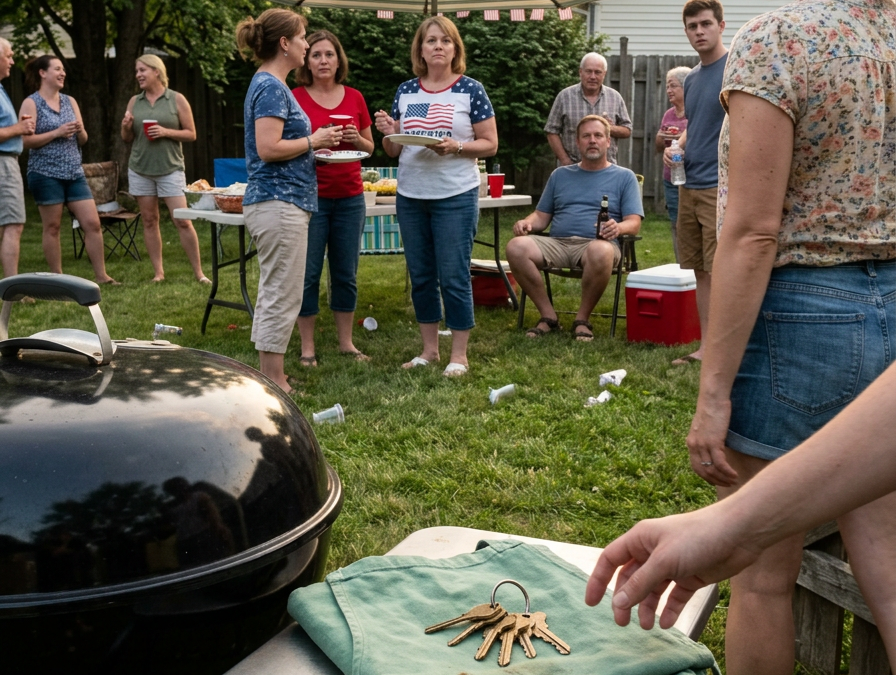
At My Parents’ Fourth of July Cookout, Mom Laughed With Her Church Friends and Said, “Maisie Handles the Cooking and Pearl’s Care. It’s What She’s For.” After Nine Years of Meals, Medications, Appointments, and Cleanup, I Untied My Apron, Set My House Keys Beside the Grill, and Walked Toward the Gate.
The apron strings were still warm when I let them fall.
That is the detail I remember most clearly.
Not my mother’s face.
Not my father in the lawn chair.
Not the church women suddenly going quiet.
The apron.
Green cotton.
Faded around the pocket.
A grease spot near the hem that never completely disappeared no matter how many times I washed it.
I had tied those strings behind my back thousands of times.
That afternoon, I reached behind me, loosened the knot, folded the apron once, and laid it over the porch railing.
Then I took my parents’ house keys from my pocket.
Brass.
Warm already from the July sun.
I placed them carefully on the outer edge of the grill where the metal was hot enough that nobody would casually pick them up without noticing.
Then I walked toward the gate.
No speech.
No accusation.
No dramatic goodbye.
My mother called my name once.
“Maisie.”
Sharp.
Confused.
The tone she used when something in the house failed to operate the way she expected.
I kept walking.
Behind me, someone asked if everything was all right.
My father finally sat forward.
My brother Tyler stopped talking long enough to notice I was leaving.
And for the first time in nine years, I let all of them stand inside the consequences of a house I was no longer holding together.
My name is Maisie Turner.
I was thirty-three years old.
My mother is Diane.
My father is Roger.
My younger brother Tyler was twenty-nine and had somehow reached adulthood believing a washing machine was an advanced industrial device.
And Nana Pearl—my father’s mother—was eighty-one.
She had lived in the back bedroom of my parents’ house for years.
Her memory had become unreliable.
Some mornings she knew the date.
Some evenings she called me by the name of a woman who had been gone for twenty years.
There were days when she could tell you exactly how much cinnamon belonged in an apple pie and could not tell you what month it was.
There were days when she could not remember lunch but could describe the yellow curtains in the kitchen she grew up in when she was seven.
I loved her.
That was the central fact.
It was also the fact my family had quietly built an entire household around.
Because as long as Nana Pearl needed me, everybody knew I would keep coming back.
The cookout was on the Fourth of July.
My mother had invited neighbors, church friends, relatives, people my father used to work with, Tyler’s girlfriend, and several people I barely knew.
It was the biggest gathering of the year.
Naturally, I was cooking.
That morning I had arrived before anyone else.
I got Nana dressed.
Fixed her hair.
Set out her morning medication according to the schedule her physician had approved.
Checked that she had eaten enough.
Started side dishes.
Marinated chicken.
Filled coolers.
Cut vegetables.
Set tables.
Cleaned a bathroom nobody had bothered cleaning before guests arrived.
By early afternoon, I had been moving almost constantly for six hours.
Diane had changed dresses twice.
Roger had moved his lawn chair once because the first location did not have enough shade.
Tyler had contributed by opening a bag of ice and explaining to someone that he was “helping with setup.”
Around three, a woman named Joyce from my mother’s church asked Diane:
“How do you manage all of this?”
The house.
Nana Pearl.
The family.
The gatherings.
My mother laughed.
Warm.
Charming.
The same laugh she used whenever she wanted the room to know that life had been difficult but she, personally, had remained magnificent.
“Oh, I don’t do everything.”
She lifted her iced tea toward me.
“Maisie handles the cooking and Pearl’s care like always.”
Several women smiled.
Diane continued.
“We’re so lucky to have her.”
Then she said it.
“Every family needs a Maisie.”
Pause.
“It’s what she’s for.”
My father nodded.
He did not even look at me.
That was when something inside me became quiet.
Not furious.
Not broken.
Quiet.
Because the sentence was not new.
I had heard versions of it my entire life.
That’s what you’re good at.
That’s why we need you.
You’re the patient one.
You’re the responsible one.
You don’t mind.
Maisie understands.
Maisie can handle it.
Maisie will figure it out.
This time my mother simply removed the decoration from the language.
It’s what she’s for.
Not who I was.
What I was for.
A function.
An appliance with a driver’s license.
I set down the spatula.
Untied the apron.
Placed the keys beside the grill.
And left.
Everyone at that cookout believed I had suddenly lost my temper.
They did not know I had been preparing to leave for months.
Really, years.
The keys on the grill were not the beginning.
They were the final line in a story I had already written quietly while nobody was paying attention.
You have to understand the cooking first.
In my family, food was never merely food.
It was proof.
Proof that I cared.
Proof that I was useful.
Proof that I had not become selfish.
Proof that no matter how much of my life I built somewhere else, some part of me still belonged at Diane Turner’s stove.
It began when I was twenty-four.
My mother had surgery.
Routine recovery.
Nothing dramatic.
She needed help for several weeks.
I came.
I cooked.
Did laundry.
Drove her to follow-up appointments.
My father thanked me at first.
Mom did too.
Then Nana Pearl moved into the house.
The assisted-living community she had been considering felt too expensive to Dad.
“She can stay here.”
That sounded reasonable.
Family helping family.
Dad had the space.
Nana had been independent for decades.
At first, she needed very little.
Meals.
Medication reminders.
Transportation.
Then her memory started changing.
Not all at once.
One missed bill.
A stove burner left on.
A phone call she did not remember making.
My parents decided she should no longer live alone.
Still reasonable.
Then somebody needed to manage the details.
That somebody became me.
Nobody announced it.
There was no family meeting.
No schedule.
No formal conversation.
One small yes at a time.
“Maisie, can you come after work and make sure Mom took the evening pills?”
Sure.
“Can you pick up her refill?”
Sure.
“Can you take her to the doctor Thursday? I already made plans.”
Sure.
“Can you start dinner while you’re here?”
Sure.
“Can you just make enough for everybody?”
Sure.
Then Tyler lost another job and moved back home.
The household expanded.
The meals got larger.
The laundry multiplied.
And my temporary assistance quietly became infrastructure.
By twenty-eight, I had keys to my parents’ house and a permanent hook for my apron near the back door.
I went there before work.
After work.
Weekends.
Holidays.
I knew Nana Pearl’s medication schedule better than Roger did.
Roger was her son.
I knew which blood-pressure readings needed to be written down.
Which tea she would drink.
Which foods she had stopped tolerating well.
Which nights she became more confused.
Which doctor handled which issue.
Where the insurance card lived.
Which pharmacy technician was kind to her.
When she was frightened, she asked for me.
And because she asked for me, the family decided she was my responsibility.
Meanwhile, I worked full time.
For years, I was a dental hygienist.
Eight hours leaning over other people’s mouths.
Bright lights.
Repetitive positions that made my shoulders ache.
Patients who apologized for not flossing as if I personally lived beneath their sink.
It was honest work.
Steady.
Paid reasonably well.
Nobody in my family could have described it beyond:
Maisie works at the dentist.
That was when I first began understanding something.
They thought they knew me because they knew what I did for them.
They knew what time dinner usually appeared.
They knew I remembered Nana’s refills.
They knew I could locate a missing insurance statement.
They knew I would answer the phone.
They did not know my mind.
My plans.
My fatigue.
My ambitions.
My mother had taught me early to apologize for taking up space.
She did not shout constantly.
She did not create public scenes.
Her control was quieter.
She made approval conditional on usefulness.
Tyler was useful simply by being Tyler.
My mother had complicated beliefs about sons.
“He has a harder road.”
I never understood what road she meant.
He got more chances.
More patience.
More explanations.
If Tyler forgot something, he was stressed.
If I forgot something, I was becoming unreliable.
When Tyler lost work, he needed family support.
When I was overwhelmed, I needed to “manage my time better.”
I want to be fair to Diane.
She did not invent this philosophy from nothing.
Her own mother left when Diane was nine.
Diane helped raise younger siblings in a trailer outside Bakersfield while her father worked long shifts in the oil fields.
She learned very young that usefulness created security.
Cook.
Clean.
Keep children quiet.
Make yourself necessary.
If people need you, perhaps they will not leave.
I understand the child inside that lesson.
But understanding where a pattern came from does not mean agreeing to keep living inside it.
My father Roger was different.
He did not control through work.
He simply avoided discomfort so successfully that everyone around him ended up carrying it.
First Nana.
Then Diane.
Then me.
If Mom was angry, Roger became quiet.
If Tyler needed help, Roger found someone else to help him.
If Nana’s medication changed, Dad said:
“Make sure Maisie knows.”
He was not cruel.
He was absent while standing three feet away.
That type of absence has consequences too.
Nana Pearl was different.
She noticed things.
That had always been her gift.
When I was little, she let me sit on the kitchen counter while she baked.
“You’re the only one who listens,” she would say.
I thought she meant I followed recipes.
Later I understood.
She meant I waited.
I did not interrupt.
I let silence exist.
Pearl had a habit of going quiet for a long time and then saying the truest sentence anyone had said all week.
As her memory faded, those sentences became rarer.
But not less true.
One ordinary weekday showed the entire system.
I woke around five.
Drove to my parents’ house before my own shift.
Let myself in.
Green apron.
Same hook.
Same knot behind my back.
I prepared Nana’s morning medication organizer.
Started the slow cooker.
Checked whether groceries were running low.
Then went to the dental office.
Worked eight hours.
Drove back.
Put the apron on again.
Cooked dinner for four, sometimes six depending on who Tyler invited.
People sat in the next room watching television.
I served Nana first.
Then Dad.
Then Mom.
Tyler wandered in asking what was ready.
I ate standing at the counter more often than I realized.
Then dishes.
Nana’s evening routine.
Home.
Sleep.
Repeat.
The keys were always in my pocket.
Heavy.
Not because keys weigh much.
Because they opened every task nobody else wanted to learn.
At twenty-nine, I was exhausted.
I also began building my exit without understanding yet that it was an exit.
The dental office where I worked was being purchased by a larger group.
There were rumors of staffing changes.
I wanted another option.
So I enrolled in an online bookkeeping certificate.
Nothing glamorous.
Practical.
I already liked numbers.
Order.
Systems.
There was comfort in a ledger.
Every amount belonged somewhere.
If something did not reconcile, there was a reason.
Families could pretend.
Numbers usually resisted.
I studied in my car.
That is the part I still find absurd.
I would finish Nana’s evening routine.
Walk outside.
Sit in my car in my parents’ driveway.
Laptop balanced against the steering wheel.
Study forty-five minutes.
Sometimes an hour.
I did not go home first because if I went inside the house to study, someone would ask:
“Since you’re here…”
Laundry.
A snack.
A phone call.
A bill.
A grocery list.
So I learned accounting under the glow of a dashboard.
I told nobody.
Not Mom.
Not Dad.
Not Tyler.
That was the first significant thing I built without announcing it.
I had learned that anything I wanted for myself became available for family scheduling.
If I said:
I have class tonight.
Mom might answer:
Nana still needs dinner.
If I said:
I’m studying.
Tyler might say:
It’ll only take you twenty minutes to pick something up.
I protected the thing by keeping it invisible.
I passed the final certification in spring.
The result appeared in green.
PASSED.
I sat in the driveway.
Started crying.
Quietly.
Not because the certificate itself changed my life.
Because I had completed something that belonged entirely to me.
No one had interrupted it.
No one had approved it.
No one had redefined it.
Then Tyler texted.
When is dinner?
I laughed and cried at the same time.
Wiped my face.
Went inside.
Fried chicken.
That sounds sad.
It was also the beginning.
That Thanksgiving, my cousin Ranata came from Denver.
Ranata was married to a contractor and managed the books for his company.
She was one of the only people in my extended family who spoke to me as if I had a professional brain.
We stood doing dishes while everybody else watched football.
She asked:
“What do you do for yourself?”
I thought she meant hobbies.
“What?”
“For you.”
I rinsed a plate.
“Work?”
“No.”
She dried the plate.
“I mean what do you do that belongs to you?”
I genuinely could not answer.
Ranata watched me.
Then lowered her voice.
“You are the most capable person in this house.”
I laughed.
“That’s not exactly a competitive field.”
“I’m serious.”
She glanced toward the living room.
“And nobody here listens to you.”
Then she changed the subject.
No lecture.
No rescue.
Just a sentence.
That night, around two in the morning, I searched:
average monthly bookkeeping fee small business.
Then:
how many clients can one bookkeeper manage.
Then:
bookkeeping business startup.
The numbers surprised me.
I remember sitting in bed thinking:
I could do this.
That thought felt almost dangerous.
I could build something outside my family.
Something they did not understand.
Something that could eventually pay enough for me to choose.
My first client came in January.
A woman with a flower shop two towns away.
Ranata referred her.
Receipts everywhere.
Inventory tracking inconsistent.
Sales tax confusion.
I spent a Sunday afternoon reconstructing several months of transactions.
She paid me.
I held the payment confirmation and felt like somebody had turned on a light.
I had done work.
Professional work.
Not a favor.
Not family duty.
And another adult had valued it enough to pay me.
By spring:
Four clients.
Then six.
Then eight.
I was good.
It turned out the brain that could track six adults’ dinner preferences, appointment schedules, medication routines, pharmacy pickups, household bills, and Nana’s mood patterns could handle payroll and reconciliation very comfortably.
I had been running operations for free.
Now I was being paid for smaller portions of the same skill.
The mistake was that I still did everything for my family too.
I did not replace one life.
I stacked another on top.
Five in the morning.
Bookkeeping.
Dental office.
Parents’ house.
Dinner.
Nana.
Home.
Repeat.
Mom noticed I looked exhausted.
Her response:
“You’re looking awfully worn out lately.”
I laughed.
She did not.
“Maybe if you had your own family, you wouldn’t have so much time to be dramatic.”
Dramatic.
For being tired while doing work she depended on.
The first true crack appeared one August evening.
Nana Pearl was having a difficult night.
She was confused.
Called me by my late Aunt Louise’s name.
Could not understand why she was not in her old house.
She kept asking:
“Where’s Tom?”
Tom had been my grandfather.
Gone for years.
I sat beside her.
Held her hand.
Repeated what worked.
“You’re safe.”
“I’m Maisie.”
“You’re with Roger.”
“You live here now.”
“No one is making you go anywhere tonight.”
Eventually she calmed.
It took nearly two hours.
I missed dinner preparation.
When I entered the kitchen, Mom stood with her arms crossed.
“It’s almost eight.”
“I know.”
“What are we doing for dinner?”
I stared.
“Nana had a bad evening.”
Diane sighed.
“I know she gets confused.”
“She was frightened.”
“And?”
That word.
And?
“I stayed with her.”
“Maisie.”
Mom looked genuinely irritated.
“That is what you’re here for.”
I stopped.
She continued.
“Don’t make it a whole production.”
That is what you are here for.
Not:
Thank you.
Not:
How is Pearl?
Not:
You look exhausted.
That is what you’re here for.
I made dinner.
Of course.
Old habits are not dissolved by one sentence.
But while I cooked, something stopped negotiating inside me.
There was no amount of service that would turn me into a daughter in Mom’s eyes.
The service was the role.
If I performed better, the reward was more service.
The following day I called Ranata from my car.
Told her everything.
Clients.
Certificate.
Five a.m.
Nana.
Dinner.
What Mom said.
Ranata listened.
Then asked:
“What would happen if you stopped?”
I had no answer.
That terrified me.
I was the operating system of the house.
Meals.
Medication.
Laundry.
Bills.
Appointments.
Groceries.
Cleaning.
Transportation.
I even handled some of Tyler’s laundry.
I still do not remember agreeing to that.
If I stopped, what happened?
Would they adapt?
Would Nana miss medication?
Would Dad panic?
Would Mom finally cook?
Would Tyler discover laundry detergent?
I genuinely could not picture the house functioning without me.
That realization could have made me feel powerful.
Instead it made me feel trapped.
Being indispensable to people who do not value you is not security.
It is captivity disguised as competence.
I did not leave then.
I started watching.
I tracked, mentally at first, everything I did in a week.
Morning medication.
Evening medication.
Blood-pressure log.
Doctor appointments.
Insurance paperwork.
Grocery planning.
Meals.
Dishes.
Laundry.
Bills.
Nana’s tea.
Half a spoon of honey.
Never a full spoon.
A full spoon made it too sweet and then she would refuse to finish it.
No one else knew that.
Not because the information was secret.
Because no one asked.
Then money changed.
By October, my bookkeeping income surpassed my dental-hygiene salary.
That secret side business had become my strongest income stream.
I had savings.
Business reserves.
Recurring clients.
For the first time, money was no longer the wall keeping me in place.
I could leave the dental office.
I could rent something better.
I could support myself entirely through bookkeeping if I structured it correctly.
Nobody knew.
Then came a night I still regret.
My largest bookkeeping client invited me to dinner.
A genuine thank-you dinner.
Nice restaurant downtown.
The first time in years someone wanted to celebrate something I had done professionally.
I bought a blouse.
Did my hair.
I was going.
At four, Mom called.
“I invited some church people.”
“Okay.”
“Eight.”
“For what?”
“Dinner.”
I waited.
“And?”
“I need you to cook.”
“I can’t tonight.”
Silence.
“What?”
“I have something.”
“What?”
“A client dinner.”
Mom laughed.
Not cruelly.
Worse.
Dismissively.
“What could possibly be more important than family?”
Then she began listing a menu.
Roast chicken.
Green beans.
Potatoes.
Dessert in the freezer.
I stood in my own kitchen dressed for a celebration of my own work.
The word no formed in my mouth.
Then habit swallowed it.
I called my client.
Made an excuse.
She was kind.
“Of course.”
But there was a slight pause.
The pause of a professional realizing that another competent adult’s life was controlled by something she did not understand.
I cooked for eight church guests.
People who forgot the meal by morning.
I stood at that stove and finally understood:
There would never be an event important enough.
No milestone.
No opportunity.
No celebration.
Nothing I wanted would outrank what my family needed if I kept allowing them to vote.
That night, I stopped waiting for permission.
Then Tyler crossed a different line.
I arrived one evening and found Nana visibly distressed.
Her jewelry box had been emptied across the bed.
Pins.
Bracelets.
Old costume pieces.
A few things with actual value.
A watch.
Nana kept saying:
“Somebody went through my room.”
I sat beside her.
“Who?”
“I don’t know.”
Then:
“The boy.”
Tyler.
I found him in the living room.
“What were you doing in Nana’s room?”
“Looking for Grandpa’s watch.”
“Why?”
“He said I could have it.”
“When?”
“Years ago.”
“Did Nana say you could go through her things?”
“She doesn’t even know what she has anymore.”
That sentence stopped me.
He meant it as justification.
I heard it as warning.
“She was frightened.”
“She gets frightened over everything.”
“No.”
I looked at him.
“You left her belongings scattered.”
“She’s fine.”
“Do not go through her room again without asking.”
Tyler laughed.
“Who are you, her security?”
Then Mom entered.
“What’s going on?”
I told her.
Diane sighed.
“Do not start trouble.”
“Nana was crying.”
“Tyler is going through a hard time.”
“What does that have to do with her jewelry?”
“Your grandfather did say he wanted Tyler to have some things.”
“Then there can be a conversation.”
Mom waved it away.
“It’s old jewelry.”
Then:
“Mostly costume stuff.”
That was when guilt lost some of its power over me.
Because guilt depends on believing everybody is at least trying in good faith.
I could understand Mom wanting to protect Tyler.
I could not pretend scattering a confused elderly woman’s belongings was harmless simply because confronting Tyler made dinner unpleasant.
That evening, I made a decision.
I would leave.
Not explosively.
Not by disappearing overnight.
I would build enough structure that Nana did not become collateral damage.
Then I would stop holding up the rest of the house.
The first thing I did was document Nana’s care.
Not evidence against anyone.
A care manual.
Medication list.
Doctors.
Pharmacy.
Insurance.
Food preferences.
Sleep pattern.
Confusion triggers.
Things that helped.
Things that made her anxious.
Half spoon of honey.
Favorite cardigan.
Music she liked.
How she sometimes woke at two asking where Tom was.
How arguing about dates made things worse.
How redirecting gently worked better.
I told myself I was organizing because I was tired.
Really, I was writing the operating manual for the job I planned to stop doing alone.
Then I found the envelope.
December.
Household mail had accumulated on a counter because Dad had a supernatural ability to ignore unopened envelopes until they became emergencies.
I sorted it.
Utility.
Insurance.
Advertisement.
Then an envelope addressed to Pearl Turner.
Law office in the next county.
Pearl rarely received legal mail.
I did not open it.
Important.
It was not mine.
But something felt wrong.
The following morning, I called the office.
I identified myself truthfully as Pearl’s granddaughter and the person listed in an existing healthcare-proxy document.
I did not ask for confidential details.
I asked whether there was an appointment I should know about because I coordinated her medical care.
The receptionist confirmed that an appointment had been scheduled in Pearl’s name to discuss estate-planning updates and possible financial-authority documents.
“Who scheduled it?”
She could not tell me much.
Enough to understand Dad and Tyler were involved.
I sat in my car.
The jewelry box.
Now a lawyer.
Maybe nothing improper.
Families update documents.
Older adults need planning.
But Pearl’s cognitive condition mattered.
She had good moments.
Confused moments.
Any significant estate or financial decisions needed careful capacity evaluation and independent explanation.
Not rushed paperwork arranged by relatives who could not name her medication.
I called Ranata.
She did not tell me I was imagining things.
She referred me to an elder-law attorney named Delia Morgan.
Delia was in her late fifties.
Quiet.
Efficient.
She listened while I explained.
Then asked:
“What existing documents do you have?”
I brought the healthcare proxy.
Pearl had signed it two years earlier during a period when her physician documented much better cognition.
It named me as her healthcare agent if she became unable to make certain medical or care decisions independently.
Delia read it.
Then asked:
“Do you have financial authority?”
“No.”
“Good.”
I was surprised.
“Good?”
“Because healthcare authority and financial authority are different.”
That was important.
Delia did not allow emotional urgency to blur legal categories.
“She named you for medical and care decisions under specific circumstances.”
“Yes.”
“That does not automatically give you control over her money.”
“Understood.”
“And your father cannot simply take financial authority because he is her son.”
“Okay.”
“Any new financial power-of-attorney document depends on Pearl understanding what she is signing at the time.”
“What if she doesn’t?”
“Then its validity can be questioned.”
Not:
Automatically void.
Questioned.
Reviewed.
That was the first time someone gave me a process instead of a family opinion.
Delia also told me something I had not considered.
“If your grandmother is still able to express preferences during lucid periods, listen to her.”
“I do.”
“Document care needs through professionals.”
“Okay.”
“Do not stage a family confrontation.”
“I wasn’t planning one.”
“Good.”
Then:
“If placement becomes necessary, it should be based on her medical needs, her prior wishes, current clinical assessment, and the authority actually granted under her care documents.”
That sentence guided everything later.
I drove home understanding that I was not powerless.
I also was not legally entitled to do whatever I wanted simply because I believed I cared more.
That distinction protected Nana.
And me.
Around the same time, I did the math on my own life.
My bookkeeping practice could support me.
I had enough savings for a real apartment.
Enough reserves for several months.
Enough income to contribute toward professional care for Nana if insurance and her legitimate assets did not cover everything.
I was not trapped financially anymore.
Then Dad had a minor health episode in February.
Chest discomfort.
Emergency evaluation.
Stress and blood pressure.
Nothing catastrophic.
But suddenly the house demanded even more from me.
Dad now had appointments.
Medication changes.
Diet recommendations.
Mom refused to learn the details because:
“You understand medical things.”
I was a dental hygienist, not a cardiologist.
Still, I became the organizer.
One week, I missed a pharmacy pickup.
Dinner was late twice.
Dishwasher detergent ran out.
Mom greeted me one evening with a list.
Not hello.
List.
“Tuesday dinner was too salty.”
I stared.
“We ran out of detergent.”
Okay.
“Pearl’s room needs airing.”
I still had my keys in my hand.
For a second, I almost put them down right there.
Then Nana needed evening medication.
Not her fault.
Never her fault.
So I walked in.
Handled the medication.
Cooked.
And while stirring something on the stove, I chose the date.
Fourth of July.
Not because I wanted to embarrass Mom publicly.
I would leave quietly.
But the cookout was when my labor was most visible.
If I stopped on an ordinary Tuesday, Mom would say I was busy.
Someone else might patch one dinner.
The system would keep pretending I was optional.
At the annual cookout, everyone relied on me simultaneously.
That was when absence would become undeniable.
Between February and July, I prepared.
First Nana.
I toured care communities.
Not warehouses.
Not places chosen because they were cheapest.
Places with qualified staff.
Memory support.
A garden.
Routine.
One small residence about twenty minutes away felt different.
Constance ran the memory-care wing.
She crouched beside Nana during a visit.
“Pearl, did you garden?”
Nana looked suspicious.
“Why?”
“I need advice.”
That made Nana smile.
“Tomatoes.”
“Good ones?”
“Better than yours.”
Constance laughed.
Pearl held her hand on the walk out.
That mattered.
I arranged a formal assessment.
Nana’s physician documented that her cognitive impairment had progressed enough that she needed more structured supervision.
During one of her clearer periods, I asked:
“How do you feel about a place with nurses where you would have your own room and a garden?”
She frowned.
“Am I sick?”
“You need more help than one person can give safely.”
“Are you leaving me?”
“No.”
That question broke something in me.
“No, Nana.”
I sat closer.
“I’m trying to make sure I can be your granddaughter again instead of the only person doing every job.”
She stared.
Then:
“Your father should be doing more.”
I almost laughed.
“Yes.”
“Roger was lazy at twelve.”
“Useful information.”
She squeezed my hand.
“Garden?”
“Yes.”
“Tomatoes?”
“Yes.”
“Then we can look.”
That was not legal consent to every future decision.
It was preference.
It mattered.
Delia helped me coordinate everything properly.
Clinical assessment.
Care directive.
Facility documentation.
Notice requirements.
Financial arrangements kept separate.
Nana’s own resources would be handled only through proper authority.
I offered to contribute personal funds toward uncovered care costs.
I had the money because of four years of secret work.
That part still makes me emotional.
I had built the capacity to protect both of us in hours nobody knew existed.
Then spring accelerated the timeline.
In April, Mom told me casually:
“We took Pearl for a drive and lunch.”
That evening, Nana was agitated.
Kept asking:
“Why did I have to write my name?”
I sat beside her.
“What happened?”
“The man.”
“What man?”
“The papers.”
My stomach tightened.
“What papers?”
“I don’t know.”
She started crying.
“He kept asking if I understood.”
“Did you?”
“No.”
Then:
“Make it stop.”
I called Delia.
Not screaming.
Barely breathing.
She told me:
“Do not assume what was signed.”
“Okay.”
“Do not confront them tonight.”
“Okay.”
“We request copies through proper channels.”
“Yes.”
“And we move up Pearl’s care assessment and placement.”
“Why?”
“Because regardless of what the documents say, this household now has active conflict around an older adult with impaired cognition.”
She paused.
“Professional care and independent documentation reduce risk for everyone.”
That was exactly what I needed.
Move Pearl somewhere where her care record did not depend on my memory or Diane’s story.
The law office later produced copies through counsel.
The documents attempted to grant Roger significant financial authority.
There were questions about Pearl’s understanding at the time.
Delia did not call them automatically invalid.
She requested formal review.
The office itself had notes indicating concern about Pearl’s ability to follow some explanations.
That mattered.
Nobody needed a kitchen argument.
The paper could speak.
By June, everything was ready.
My apartment lease.
Bigger than my old studio.
Actual second bedroom that I could use as an office.
Bookkeeping clients stable.
Dental resignation drafted.
Nana’s placement available.
Care manual complete.
Then Mom announced the Fourth of July schedule.
“Maisie, you’ll handle the food.”
Of course.
“And make sure Pearl looks presentable.”
I stared.
“Presentable?”
“For guests.”
“Okay.”
“She gets confused when she’s tired, so bring her out for a few minutes and then take her back.”
Nana as proof of family devotion.
Briefly visible.
Then removed if inconvenient.
Mom continued.
“Tyler can help where he can.”
I nearly laughed.
Instead, I nodded.
I had learned something.
Sometimes you nod because you surrender.
Sometimes you nod because the other person does not need access to your plan.
Fourth of July morning.
I arrived early.
Went straight to Nana.
She was awake.
Clearer than usual.
I brushed her hair.
Blue dress.
Small pearl earrings.
No pun intended.
She looked at herself in the mirror.
Then at me.
“You’re a good girl, Maisie.”
My eyes burned.
“You always were.”
“Nana.”
“You’re the only one who actually sees me.”
I stepped into the hallway afterward and cried for perhaps thirty seconds.
She did not know it was the final morning I would dress her in that house.
I knew.
There is a strange grief in doing something for the last time when everyone around you thinks the routine is permanent.
Last time tying the green apron.
Last morning organizing medication in that kitchen.
Last time carrying the house keys in my pocket.
Last holiday managing everyone’s plates.
I felt sad.
Freedom and grief are not enemies.
You can leave something unhealthy and mourn what you wished it had been.
Guests arrived.
Mom performed graciousness.
Dad found shade.
Tyler stood near the cooler.
I worked.
I brought Nana outside.
Mom fussed over her.
“Oh, Pearl, doesn’t she look wonderful?”
Church women leaned close.
Nana smiled for a few minutes.
Then became tired.
I wheeled her back inside.
Sat with her in the quiet.
Outside, laughter.
“Nana?”
“Hmm?”
“I love you.”
She patted my hand.
“I know.”
Then I returned to the grill.
Joyce asked Mom how she managed everything.
Mom gestured toward me.
“Maisie handles the cooking and Pearl’s care like always.”
Then:
“It’s what she’s for.”
And the plan I had built for months no longer felt frightening.
I simply stopped.
Apron.
Rail.
Keys.
Grill.
Gate.
Mom called my name.
I did not turn.
I reached my car.
Drove.
Three blocks later, I pulled over.
Cried so hard I could barely see.
Not because I wanted to go back.
Because a nine-year version of my life had just ended.
The body sometimes interprets liberation as loss before the mind has caught up.
I let myself cry.
Then drove home.
My phone started ringing within an hour.
Mom.
Voicemail.
“Maisie, I have no idea what that display was.”
Display.
Of course.
“The guests are asking questions.”
Then:
“You need to call me and explain yourself.”
No:
Are you safe?
No:
Why did you leave?
No:
What did I say?
The second voicemail came from Dad.
Roger almost never called me.
“Maisie.”
His voice had changed.
“We can’t find Mom’s evening medication.”
Not his wife.
His mother.
“Where is it?”
Nine years.
He did not know.
That question removed the last doubt.
I texted only him.
Kitchen cabinet left of sink. Schedule is taped inside the door. Evening organizer is labeled. Call the pharmacy or her physician if anything looks different from the written schedule.
I would not let Nana pay for my boundary.
I also would not return.
That night, in my apartment, I cooked for one.
Eggs.
Toast.
Tomato.
Nothing memorable.
I sat down before eating.
Actually sat.
No serving anyone first.
No getting up because someone wanted sauce.
No cold plate after everyone finished.
It was the best ordinary meal I had eaten in years.
The next morning I began executing the remaining plan.
Called Constance.
Confirmed Nana’s move.
Called Delia.
Confirmed the legal and medical steps.
Delivered my resignation to the dental practice.
My manager called.
“You sure?”
“Yes.”
“You know we would keep you.”
“I know.”
“Everything okay?”
I thought.
“Becoming.”
She did not understand.
That was fine.
Then I sent one email to my parents.
Short.
Professional.
I would no longer provide daily household cooking, cleaning, transportation, or administrative support.
Effective immediately.
Pearl’s care needs had been professionally assessed.
Under her earlier healthcare directive and current care-planning process, I was coordinating her move to the residential memory-support community agreed upon with the relevant clinicians and advisers.
The move was scheduled for the following week.
My parents and Tyler were welcome to visit.
This was not isolation.
It was structured care.
Any financial questions concerning Pearl’s assets would go through Delia and the appropriate independent professionals.
No family member would use medical-care decisions as a route into financial control.
I read the email four times.
Sent it.
Then turned my phone off for the rest of the day.
When I turned it back on, nineteen missed calls.
The messages moved through predictable stages.
First:
Outrage.
How dare you.
Who do you think you are?
You are abandoning us.
You are taking Pearl away.
Then:
Negotiation.
Maybe Mom had phrased things badly.
Maybe Tyler could do more.
Maybe I could continue Pearl’s care but stop cooking.
Maybe we could hire someone one night a week.
Then the real request.
“Can’t we just go back to normal?”
Normal.
The word almost made me laugh.
Normal was the problem.
By the third day, the household was showing exactly what my absence meant.
Dad struggled with Nana’s medication routine.
Not because he was incapable.
Because he had never learned.
That distinction mattered.
My mother had not cooked regular family meals in years.
Her first attempts went badly.
Tyler discovered his clean clothes did not reproduce naturally inside drawers.
Bills still needed to be paid.
Trash still needed to go out.
Groceries required planning.
The house did not collapse.
That is important.
Adults adapted.
Poorly at first.
Then better.
Nobody starved.
Nobody lost the house.
The shocking part was not that they could not function.
It was how quickly they had to learn things they had allowed me to carry for them.
Tyler texted:
You really left.
Not anger.
Almost disbelief.
I looked at the message for a long time.
Then wrote:
Yes.
He responded:
What are we supposed to do?
I nearly typed:
Grow up.
Deleted it.
Instead:
Learn.
No answer.
Dad’s real turning point came after a medication mistake.
Nothing catastrophic.
A dose was given incorrectly.
Nana became dizzy and needed medical evaluation.
Dad called me shaken.
“What do I do?”
I listened.
Then guided him toward the professionals responsible for her care.
“Call her physician’s line.”
“I don’t know the number.”
“It’s on the sheet.”
Long silence.
“Maisie.”
“Yes?”
“I didn’t know it was this much.”
There.
I closed my eyes.
“I know.”
Nine years in five words.
He had not known.
Because knowing had never been necessary while I was there.
That was not an excuse.
It was the mechanism.
“I thought you just…”
He stopped.
“Just what?”
“I don’t know.”
“No.”
I said it gently.
“Say it.”
He breathed.
“I thought you just handled things.”
“I did.”
“I didn’t know how many things.”
“That is what you need to understand.”
He stayed quiet.
“I’m sorry.”
Not the full apology.
Not yet.
But the first sound of it.
The legal side became clearer over the following weeks.
Dad and Mom insisted the April documents gave Roger authority over Pearl’s finances.
Delia communicated directly with the other law office.
Professional to professional.
No shouting.
No family emails.
The April documents were reviewed in light of Pearl’s cognitive condition, the office notes, and her existing estate documents.
Questions were raised about whether Pearl had adequately understood what she was being asked to sign.
The financial authority did not simply become an unquestioned fact because Roger was her son.
An independent process followed.
That is the part I want to state carefully.
I did not “take control of Nana’s money.”
I did not have that authority.
Her healthcare directive addressed care.
Financial authority was treated separately.
Delia arranged for appropriate review and protective measures.
Pearl’s existing accounts remained subject to proper legal administration.
My father eventually stopped trying to push the April paperwork after independent counsel explained the risks and limitations.
That may have been the first time Roger realized concern for his mother and control over her finances were not the same thing.
Nana’s move happened the following week.
Mom was there.
Dad too.
Tyler stayed away.
Diane objected until almost the last moment.
“She belongs with family.”
I looked at her.
“She has been with family.”
“She’ll be around strangers.”
“She’ll be around trained staff.”
“You’re institutionalizing her because you’re angry at us.”
“No.”
“You expect me to believe this has nothing to do with July Fourth?”
“It has everything to do with what July Fourth clarified.”
Mom folded her arms.
“There.”
She looked at Constance.
“See? Spite.”
I stayed calm.
“I cared for Pearl in your house for nine years.”
Mom’s mouth closed.
“Mostly alone.”
Dad looked down.
“You described that care publicly as what I was for.”
Silence.
“I am still caring for her.”
I looked toward the building.
“Now she will have multiple trained people available around the clock.”
Then:
“You can visit.”
“No one is taking your family relationship from you.”
That was all I said.
Constance met us inside.
She knelt beside Nana.
“Pearl.”
Nana looked at her.
“We saved you the room near the garden.”
“Tomatoes?”
“If you tell us what kind.”
Pearl smiled.
“Not those tasteless little ones.”
Constance looked serious.
“Absolutely not.”
I almost cried.
In Nana’s room, I unpacked.
Cardigans.
Photographs.
Tea mug.
Blanket.
Then the care notebook.
Four years of details.
I handed it to the nurse.
She flipped through.
Medication history.
Preferences.
Behavioral cues.
Food.
Sleep.
Doctors.
Tea.
Honey.
The nurse looked at me.
“This is incredibly thorough.”
I shrugged.
“I needed it written down.”
“You’ve been doing all this yourself?”
“Mostly.”
“For how long?”
“Years.”
She was quiet.
Then:
“You should be exhausted.”
That sentence.
Not:
You’re dramatic.
Not:
That’s what you’re for.
You should be exhausted.
Validation can be strangely painful when you have spent years being told the opposite.
“I am.”
She nodded.
“We’ve got it from here.”
I had to leave the room.
Because that sentence almost undid me.
We’ve got it from here.
Not:
We don’t need you.
Different.
The care was shared.
I could still be there.
Just not every second.
Nana had a lucid stretch while I was helping arrange her dresser.
She looked around.
“Did you do this?”
“Yes.”
“For me?”
“Yes.”
She held my hand.
“You always were the one who showed up.”
I laughed through tears.
“You’re trying to make me cry.”
“I don’t have enough energy for that.”
Very Pearl.
Then:
“Go home.”
“What?”
“You hover.”
“I do not.”
“You do.”
I kissed her forehead.
“I’ll see you Thursday.”
“Bring good cookies.”
That became our new relationship.
Twice a week.
Sometimes three.
Not seven nights.
Not dawn and midnight.
I visited as granddaughter.
Sat in the garden.
Brought cookies.
Held her hand.
The home planted tomatoes after Constance asked what she liked.
Pearl supervised from a chair like a retired agricultural executive.
One afternoon, I found her drinking tea outside.
Half spoon of honey.
Exactly.
I stared at the cup.
Constance noticed.
“What?”
“Nothing.”
Then:
“Someone read the notebook.”
“Of course.”
That was when I realized documentation had done something emotional too.
For years, I believed only I could care for Nana properly because only I knew the details.
That belief kept me trapped.
The answer was not:
Stop caring.
It was:
Transfer knowledge.
Good care should not depend on one exhausted person being available forever.
That lesson changed my bookkeeping business too.
I had been building everything alone.
Clients depended on me.
Passwords in my head.
Processes only I understood.
Sound familiar?
So I documented.
Templates.
Checklists.
Standard operating procedures.
I hired a part-time assistant.
Then trained her.
Delegation frightened me.
She reconciled one account differently from how I did it.
I almost took the whole job back.
Then stopped.
Different is not wrong.
That was growth.
My business expanded.
Eleven clients.
Then fourteen.
I moved out of the dental office entirely.
Rented a small bright office.
Nothing fancy.
Two desks.
Window.
Coffee machine.
A plant I almost immediately forgot to water.
Ranata sent referrals.
My income grew.
Not overnight.
Not magically.
But steadily.
One afternoon, my first flower-shop client stopped by.
She brought flowers.
“For you.”
I laughed.
“I’m supposed to be the one helping your business.”
“You did.”
She looked around.
“Nice place.”
“Thank you.”
Then:
“I’m glad you finally came to that client dinner.”
I froze.
“What?”
“The one you missed years ago.”
“I didn’t.”
“I know.”
She smiled.
“I invited you again.”
She had.
Months after I left the family routine.
Same restaurant.
Smaller dinner.
I went.
I had forgotten how unusual it felt to sit somewhere while another person served food and nobody expected me to get up.
At the end, she toasted:
“To Maisie.”
I almost looked around to see which Maisie she meant.
That is what long-term invisibility does.
It takes time to learn to receive.
My father changed slowly.
The first real apology came months later.
He called one evening.
Not because something was wrong.
No medication question.
No bill.
“Hi.”
“Hi, Dad.”
“How’s Pearl?”
“Good.”
“I visited.”
“I know.”
“She yelled at me about tomatoes.”
“Healthy sign.”
He laughed.
Then silence.
“I want to say something.”
“Okay.”
“I spent my whole life letting other people carry things.”
I sat down.
“I thought if someone else was already doing it, I didn’t need to learn.”
He swallowed.
“My mother.”
“Your mother.”
“Diane.”
“Mom.”
“You.”
“Yes.”
“I’m sorry.”
There it was.
Simple.
Specific enough.
“I didn’t know how much you were carrying because I made not knowing convenient.”
That was better.
I felt tears.
Did not rush to reassure him.
“I appreciate you saying that.”
“I’m learning.”
“What?”
“Cooking.”
I laughed.
“Really?”
“Three meals.”
“Name them.”
“Spaghetti.”
“That barely counts.”
“Eggs.”
“Continue.”
“Chili.”
“Respectable.”
Then:
“I visit Mom.”
Pearl.
“My mom.”
“Yes.”
“Twice a week.”
That mattered.
Not because he deserved a medal for visiting his own mother.
Because it was new behavior.
Dad learned her routine.
Not every detail.
Enough to become a son instead of a spectator.
My mother changed less.
For a long time, her version remained:
Maisie abandoned the family.
Maisie became too important for us.
Maisie took Pearl away.
Maisie turned Roger against me.
She told church friends.
Neighbors.
Relatives.
At first, I wanted to correct everyone.
Then Ranata asked:
“Do you want a new life or a communications department?”
Excellent question.
I stopped.
If someone called me directly, I answered accurately.
If not, let them choose the story they preferred.
My peace could not depend on winning every room Diane entered.
That would still make her the center of my life.
Eventually, several church women visited Pearl.
Joyce—the woman who had asked how Mom managed everything—came one Thursday.
She found me in the garden.
“Maisie.”
“Hi.”
She looked embarrassed.
“I wanted to apologize.”
“For what?”
“For that cookout.”
“You didn’t say anything.”
“That’s exactly it.”
She sat.
“When your mother said that’s what you’re for, I laughed.”
“I remember.”
“I thought she was joking.”
“Maybe part of her thought she was.”
Joyce looked toward Pearl.
“Then after you left, none of us could find the serving spoons.”
I laughed unexpectedly.
“What?”
“Your mother got furious because nobody knew where anything was.”
She smiled sadly.
“And then your father asked where Pearl’s pills were.”
Joyce shook her head.
“I suddenly realized she wasn’t joking.”
That was how many people understood.
Not from my speech.
From absence.
The service stopped.
Then the person became visible.
Tyler took longest.
For weeks, his texts were irritating.
Where is detergent?
Do you know the Wi-Fi password for the printer?
What setting do I use on the washer?
Can you tell Mom to stop asking me to cook?
I ignored most.
Then one day:
I found Nana’s watch.
I stared.
He sent a photograph.
Grandpa’s old watch.
The one he had been looking for.
Then:
I’m not taking it.
Pause.
She didn’t tell me I could.
That was new.
I wrote:
Good.
He replied:
You still mad?
I thought.
Then:
I’m not interested in pretending nothing happened.
Tyler:
Fair.
Two days later:
How do you make meatloaf?
I laughed.
Sent him a recipe.
Not because it was my job.
Because I wanted to.
That difference is everything.
Months later, he visited my office.
He stood in the doorway.
Looked around.
“This is what you were doing?”
“For years.”
“You made all this while still cooking every night?”
“Yes.”
He looked honestly ashamed.
“I thought you had nothing else going on.”
“I know.”
“Why didn’t you tell us?”
I almost got angry.
Then answered carefully.
“Because every time I had something, the family treated it as less important than what they needed.”
Tyler nodded.
“Yeah.”
Then:
“I probably did that too.”
“Yes.”
“Sorry.”
Not perfect.
Real.
He became functional.
Laundry.
Basic meals.
Found steady work.
Moved out again eventually.
Necessity taught him.
But so did the fact that nobody stepped back in to rescue him the second things became uncomfortable.
That was hard for Mom.
Diane tried to pull me back through Tyler.
“He needs help.”
“He can ask.”
“He’s embarrassed.”
“He’s twenty-nine.”
“He’s your brother.”
“Yes.”
That used to be enough.
Not anymore.
One Thanksgiving after I left, Mom called.
“Are you coming?”
I stared at the phone.
It was the first time she had asked rather than assigned.
“What time?”
“Two.”
“Who’s cooking?”
Silence.
Then:
“Your father is doing the turkey.”
I laughed.
“I need to see this.”
I went.
Not to resume my old role.
To observe Roger Turner attempt poultry.
It was dry.
Almost impressively.
Tyler made mashed potatoes from scratch.
Lumpy.
Mom complained.
Nobody looked at me to fix them.
That mattered.
Nana was still living at the care home and came for a short visit with a staff escort because the change of environment could overwhelm her.
I sat beside her.
No apron.
At one point, Mom entered the kitchen.
“Maisie, could you…”
My whole body reacted.
Old reflex.
She stopped.
Looked at me.
Then finished:
“Could you tell me whether the gravy looks too thick?”
Not:
Fix it.
Question.
I looked.
“Yes.”
“What do I do?”
“Add stock slowly.”
Mom nodded.
Did it herself.
Tiny.
That is how change sometimes begins.
Not apologies.
Different verbs.
My mother never gave me a full apology.
I want to keep that honest.
She said once:
“I suppose I relied on you too much.”
That was as close as she got for a long time.
I replied:
“Yes.”
She frowned.
“You could make that easier.”
“How?”
“I don’t know.”
“I don’t either.”
Another time:
“I was only doing what women in my family always did.”
I understood.
“Then let it end with us.”
She became defensive.
“You think you’re better?”
“No.”
I thought.
“I think I had options you didn’t have.”
That landed.
My bookkeeping business.
Savings.
Education.
Internet.
Professional care for Pearl.
An attorney.
Diane had grown up believing there was no door.
Then watched me build one.
Sometimes another person’s freedom feels like criticism when you spent your life telling yourself captivity was virtue.
I eventually understood that.
I stopped hating her for it.
I also did not move back.
Compassion does not require reenlistment.
Nana Pearl changed in the care home.
Not cured.
Memory conditions do not disappear because the surroundings improve.
But she became less frightened.
Predictable meals.
Staff.
Routine.
Medication managed consistently.
Garden.
Visitors.
She had more good afternoons.
One afternoon, several months after the move, we sat near the raised garden bed.
Tomatoes growing.
She took my hand.
“Are you happier?”
I looked at her.
“Yes.”
“Good.”
She nodded.
“Because I watched you all those years.”
My chest tightened.
“Watched what?”
“Feed everybody.”
Her eyes were clear.
“I wanted to tell you to run.”
I laughed and cried.
“Nana.”
“I didn’t.”
“Why?”
“I needed you too.”
That honesty startled me.
She looked down.
“I knew if you stopped coming, I’d lose you.”
I squeezed her hand.
“You were not the problem.”
“I still let you do too much.”
“You were sick.”
“I wasn’t always.”
That was true.
There had been earlier years when Pearl could have spoken more.
She continued.
“I should’ve told Roger to get off his behind.”
I laughed.
“Still time.”
She smiled.
Then:
“I’m glad you found the door.”
Door.
I had never used that word with her.
Maybe she invented it.
Maybe I had mentioned it sometime before.
Memory is strange.
It did not matter.
I cried in the parking lot afterward.
For years, I believed my love for Pearl was the chain keeping me trapped.
Then I understood the same love had become the reason I built a better system.
I did not leave her.
I stopped using self-erasure as proof that I loved her.
That distinction changed me.
Love is not exhaustion.
Not automatically.
Sometimes loving someone means admitting one person cannot safely do the work of an entire care team indefinitely.
Professional care did not mean I failed.
It meant I stopped making Nana’s well-being dependent on whether I could continue functioning without rest.
I visit twice a week now.
Sometimes Dad is there.
Sometimes Tyler.
Mom less frequently.
I do not police their visits.
I do not track who loves Pearl most.
That would recreate the same hierarchy.
Pearl has multiple people now.
Good.
The care notebook still exists.
Staff updated it.
Added pages.
New preferences.
Changed medication.
Foods she stopped liking.
One day I noticed someone had crossed out:
Tea — half spoon honey.
And written:
Now prefers lemon.
I felt almost offended.
“Who changed this?”
Constance laughed.
“Pearl.”
“She abandoned honey?”
“People evolve.”
I told Nana.
She said:
“Honey is too sweet.”
“You have drunk it that way for ten years.”
“That sounds like someone else.”
Memory.
Also humanity.
She was allowed to change.
That became another lesson.
Care is not preserving someone as the version you understand best.
It is paying attention to who they are today.
My business grew because I finally had time.
Not infinite time.
Mine.
I took mornings seriously.
Clients.
Systems.
Marketing.
Ranata continued referring people.
Eventually, I had a waiting list.
I hired Jenna, another bookkeeper.
Then Alicia part-time.
The first time Jenna asked:
“What should I do if a client emails Sunday?”
I automatically said:
“Answer.”
Then stopped.
“No.”
She looked confused.
“Monday.”
“Okay.”
I laughed.
“I’m learning.”
We created office hours.
Emergency criteria.
No answering messages at midnight because somebody forgot payroll was due.
I had built my family life around instant availability.
I did not want to build a business that recreated the same trap with nicer invoices.
One day a client complained:
“I emailed yesterday.”
“It was Sunday.”
“I know.”
“We respond on business days unless payroll or filing emergencies require otherwise.”
Silence.
Then:
“Fair.”
The world did not end.
Boundaries worked professionally too.
My apartment eventually became a small house.
Not fancy.
Two bedrooms.
Office.
Back patio.
No one had a key by default.
That was deliberate.
Dad asked once:
“Do we get a spare?”
I smiled.
“No.”
He looked offended for one second.
Then:
“Fair.”
Later, I gave Ranata one.
Emergency only.
Because trust is chosen.
Not inherited automatically.
The green apron?
Mom kept it.
I assumed she would throw it away.
One year after the cookout, Dad brought a box to my house.
“Your mother said these are yours.”
Inside:
Some kitchen things.
An old sweater.
Photographs.
And the green apron.
I lifted it.
Same faded cotton.
Same pocket.
Same grease stain.
Dad looked uncomfortable.
“You want it?”
I thought.
“No.”
Then stopped.
Actually:
“Yes.”
He seemed surprised.
“Why?”
“I don’t know yet.”
I washed it.
Folded it.
Put it in a drawer.
For months.
Then one afternoon, I was cooking in my own kitchen.
Tomato sauce.
It splattered.
I laughed.
Opened the drawer.
Put on the green apron.
Tied it behind my back.
For one second, my chest tightened.
Then I kept cooking.
No one was waiting in another room.
No pill organizer.
No Tyler shouting when food would be ready.
No Mom grading dinner.
I was making pasta because I wanted pasta.
The apron became cloth again.
That may have been one of my biggest milestones.
I did not need to destroy every object associated with the old role.
Sometimes healing is being able to use the thing by choice.
Keys too.
My parents changed the locks after I left.
Not maliciously.
Practical.
I no longer had a key.
Good.
When I visit now, I knock.
At first, that felt strange.
Then healthy.
Their house.
Their responsibilities.
My life.
Separate doors.
One evening, Dad came to my house.
I was making chili.
He stood at the counter.
“You need help?”
My first instinct was to laugh.
Roger Turner asking whether I needed help in a kitchen.
“Chop onions.”
He did.
Badly.
“Smaller.”
“This is small.”
“That is half an onion.”
He complained.
I made him continue.
We ate.
He washed dishes.
No ceremony.
I think that dinner healed more than his first apology.
Because change that exists only in words is still theory.
Dad was learning to carry something.
My relationship with Mom remains limited.
She still tells some people I overreacted.
That is her story.
I stopped editing it.
At first, being misrepresented felt unbearable.
Then I asked:
Who needs the truth?
Nana’s professionals?
Yes.
My attorney?
Yes.
My own therapist?
Yes.
People whose opinions affect my life?
Sometimes.
Every church acquaintance Diane knows?
No.
I had spent years serving a household because I thought usefulness would eventually create love.
I was not going to spend the next decade serving my own reputation to strangers.
That would be the same trap with different dishes.
Therapy helped.
I resisted at first.
Ranata suggested it.
“I am fine.”
“You left an entire family operating system.”
“I’m doing great.”
“You own three backup hard drives.”
“That is responsible.”
“You flinch when someone asks what’s for dinner.”
Point taken.
My therapist asked something in our first month:
“Why did you continue going back every night?”
“Nana.”
“Only Nana?”
I wanted to say yes.
Then:
“No.”
“What else?”
“I wanted Mom to notice.”
There.
Thirty-three-year-old woman.
Still.
Notice that I was good.
Notice that I was tired.
Notice that I was capable.
Notice me.
My therapist said:
“And if she had?”
I cried.
Because I had never considered the question.
Maybe I would have kept doing it forever.
A compliment could have extended the arrangement another decade.
That frightened me.
I had not only been trapped by criticism.
I had been hungry for praise from the same people receiving the labor.
That is powerful.
I learned to validate my own decisions.
Not perfectly.
Still learning.
The bookkeeping practice became one place where evidence helped.
Client renewals.
Revenue.
Clean reconciliations.
Good work.
I did not need Diane to understand what I did.
The numbers already did.
Ranata and I became close.
Weekly calls.
She once said:
“You know I didn’t save you.”
“I know.”
“Good.”
“Why?”
“Because people love turning the person who noticed into the hero.”
She shook her head.
“I asked one question.”
“What do you do for yourself?”
“Yes.”
“You did the rest.”
That mattered.
Support should not erase agency.
I had spent enough years letting family define my role.
I did not need another person defining my escape.
Tyler surprised me eventually.
Two years after I left, he called.
“Can I ask something?”
“Yes.”
“Do you think I’m like Mom?”
Dangerous.
“In some ways.”
Silence.
“That sucks.”
“You asked.”
“What ways?”
“You expect women to carry things you consider beneath your attention.”
“Ouch.”
“You also learned.”
“Some.”
“You are more capable now than you were.”
“That’s faint praise.”
“Earn stronger praise.”
He laughed.
Then:
“I think Mom made me useless.”
I thought carefully.
“She made uselessness comfortable.”
“That’s worse.”
“Maybe.”
“But you stayed in it.”
“Yes.”
He sighed.
“I know.”
He had moved out.
Kept a job.
Visited Nana.
Managed his own laundry.
Learned basic cooking.
Eventually apologized directly for going through Pearl’s jewelry.
“I told myself she didn’t know what she had.”
“Yes.”
“That was disgusting.”
I did not correct his word.
He continued.
“I think I wanted Grandpa’s watch because I felt like I hadn’t gotten anything.”
“From Grandpa?”
“No.”
Pause.
“From life.”
That was honest.
“And somehow that made me feel like I should take from the person who had something.”
“Yes.”
He looked ashamed.
“I’m sorry.”
“Tell Nana.”
He did.
Pearl did not fully remember the event.
Tyler apologized anyway.
Not because she needed the history restored.
Because he needed to practice being accountable without requiring the other person to remain perfectly aware of the harm.
That mattered.
Nana eventually gave Tyler the watch.
Years later.
During a clear afternoon.
She had Constance bring the jewelry box.
She held the watch.
Looked at Tyler.
“Was this your grandfather’s?”
“Yes.”
“You wanted it?”
He froze.
“Yes.”
“Ask.”
He almost laughed.
“Nana, may I have Grandpa’s watch someday?”
Pearl considered.
Then handed it to him.
“Now.”
Tyler cried.
So did I.
Permission.
The same object.
Completely different meaning.
That scene gave me a new understanding of boundaries.
The goal had never been to stop Tyler from receiving anything.
It was to make sure receiving did not happen by assumption.
Ask.
Wait.
Accept the answer.
Basic human respect.
My mother was not there.
Later Tyler told her.
She said:
“See? I told everyone Grandpa meant it for you.”
Tyler answered:
“That’s not the point.”
Growth.
Dad learned to ask too.
Before visiting Nana:
“Does Thursday work?”
Before coming to my house:
“Are you free?”
Before offering advice:
“Do you want my opinion?”
That last one may be a miracle.
Mom has not learned as much.
But she has learned one thing.
I will leave.
Not as threat.
Fact.
If a conversation becomes insulting, I end it.
If she assigns me tasks instead of asking, I say no.
If she uses Nana as guilt, I redirect her to the facility.
One Christmas:
“You should come early and help.”
“What do you need?”
“Everything.”
“I can arrive at two.”
“I need you at ten.”
“I’m not available.”
“Maisie.”
“I’ll see you at two.”
I arrived at two.
Dinner still happened.
Slightly chaotic.
Nobody perished.
Mom learned.
Not emotionally perhaps.
Operationally.
Sometimes boundaries begin as logistics before they become understanding.
My mother’s own history became easier for me to see once I stopped living inside it.
Diane had spent decades proving her worth through service.
She wanted me to repeat the model because then her suffering looked necessary.
If I could step away and still be loved, still succeed, still care for Nana, still belong to some people, what did that say about all the years she had believed there was no choice?
That was painful for her.
I understood.
Then chose differently anyway.
One afternoon, after a rare calm lunch, she said:
“I didn’t have choices like you.”
“I know.”
“You think I wanted to spend my life cooking for everybody?”
“No.”
“Then why are you judging me?”
“I’m not.”
“It feels like it.”
I thought.
“My life is not a verdict on yours.”
Mom looked at me.
“I’m choosing what I can choose now.”
She looked away.
“That must be nice.”
There was bitterness.
Also grief.
I let both exist.
“Yes.”
“It is.”
For once, I did not minimize my freedom to protect her feelings.
That was progress too.
The care facility had an annual family picnic.
The first year, I almost laughed at the irony.
Another cookout.
Constance told families to bring nothing unless they wanted to.
Staff handled food.
I arrived carrying lemonade because I chose to.
Dad brought fruit.
Tyler brought cookies.
Mom came late.
Nana sat beneath a tree wearing a ridiculous sunhat.
No apron.
No grill.
No assignment.
I ate first.
That was still something I noticed.
Constance found me.
“Relax.”
“I am relaxed.”
“You are collecting plates.”
I looked down.
I was.
Habit.
I put them back.
“Right.”
She laughed.
“Recovery?”
“Apparently.”
Nana waved me over.
I sat.
She handed me half a cookie.
“Too sweet.”
“You say that about everything.”
“I’m old.”
“Fair.”
We sat.
My family existed around us.
Not one unit.
Separate adults.
Dad talking to another resident.
Tyler checking his phone.
Mom looking mildly irritated by folding picnic chairs.
And me.
Nana’s granddaughter.
Not the event staff.
That day, Pearl asked:
“Are you still doing teeth?”
“No.”
“What do you do?”
“Bookkeeping.”
“Books?”
“Money.”
She frowned.
“You handle money?”
“For businesses.”
“Are you good?”
“Yes.”
“Good.”
Then:
“Charge them.”
I laughed.
“Excellent business advice.”
She nodded.
“Stop doing things free.”
Pearl had no idea how perfectly she had summarized the decade.
My office grew again.
I hired another bookkeeper.
I took a vacation.
Actual vacation.
Ranata and I went to Santa Fe for four days.
First day, I felt guilty.
“What is wrong with you?”
She asked.
“Nobody knows where I am.”
“That is generally the vacation.”
“What if something happens?”
“They call.”
“What if Nana needs me?”
“She has staff.”
“What if Dad—”
Ranata held up one hand.
“Do you hear yourself?”
I did.
By day three, I stopped checking my phone every twenty minutes.
I ate breakfast slowly.
Bought earrings I did not need.
Walked through galleries.
Nothing happened at home.
Nana remained cared for.
Dad handled himself.
Mom survived.
Tyler did laundry.
I returned to no disaster.
That experience mattered because part of me still believed my presence prevented catastrophe.
It did not.
It prevented other adults from developing competence.
There is a difference.
Several years later, Nana’s condition progressed.
She became less verbal.
More time sleeping.
The garden still helped.
Music.
Touch.
Tea sometimes.
Eventually, there were no more long clear conversations.
That was grief.
Quiet.
Expected.
Still grief.
By then I was grateful she had a care team.
If I had still been alone, every decline would have landed entirely on my body.
Instead, nurses called.
Dad visited.
Tyler visited.
I went.
Constance kept us informed.
Shared responsibility allowed me to sit with Nana without constantly calculating whether dinner was burning downstairs.
The final weeks of her life were calm.
No graphic details.
No chaos.
Just a tired woman becoming more tired.
One afternoon, I sat beside her.
Held her hand.
She opened her eyes.
Looked at me.
“Maisie.”
Clear.
I leaned closer.
“Yeah.”
She squeezed once.
“You listened.”
That was all.
Maybe she meant that day.
Maybe childhood.
Maybe nothing.
It was enough.
Nana passed peacefully with staff and family nearby.
Dad was there.
I was there.
Tyler arrived later.
Mom came.
We did not turn the room into a family argument.
For once, everyone understood the job.
Be there.
Nothing else.
Afterward, the care notebook came home with me.
Thick.
Different handwriting now.
Mine.
Nurses.
Staff.
Constance.
Years of care spread across pages.
I placed it in a box with Pearl’s recipes and photos.
Not evidence.
History.
At the funeral, Mom started to say:
“Maisie took such good care of Pearl.”
I stiffened.
Then she corrected herself.
“We all learned how to.”
That was perhaps the closest she ever came to acknowledging the truth publicly.
Dad looked at me.
Tyler did too.
I nodded.
Good.
No one person should become the entire story of another person’s care.
Pearl deserved more than that.
After Nana was gone, I wondered whether my relationship with the family would disappear too.
For years, Pearl had been the reason I returned.
Then I realized something.
Now I could choose.
Dad still came for dinner sometimes.
Tyler called.
Mom occasionally asked whether I wanted lunch.
Some connections remained because they were becoming relationships rather than assignments.
Others weakened.
That was information.
Useful.
My mother and I may never be close.
I accept that.
Not bitterly.
Accurately.
She prefers family roles I no longer perform.
I prefer relationships where questions exist.
What do you want?
Are you available?
Can you help?
Instead of:
Here’s what you’re doing.
Dad has become better at those questions.
Tyler too.
Mom sometimes.
That is enough for the door to stay partially open.
Ranata says I have become boring.
“Your biggest crisis this month was a client forgetting sales tax.”
“Beautiful.”
“You used to have family emergencies every week.”
“I recommend boring.”
I mean it.
People romanticize dramatic freedom.
Walking out the gate.
Keys on the grill.
Yes.
That moment mattered.
But the life I wanted was not a life where I kept triumphantly leaving people.
I wanted quiet Tuesdays.
A business meeting.
Lunch.
Maybe grocery shopping.
A visit with Nana while she was alive.
Dinner made only if I felt like cooking.
Boring is what freedom looks like after chaos.
The apron hangs in my kitchen now.
Not hidden in a drawer anymore.
I put a new hook near the pantry.
Sometimes I wear it.
Sometimes I cook in a T-shirt and regret it.
The keys to my parents’ house are gone.
Dad once offered me a new spare.
I declined.
“Why?”
“Because I don’t need one.”
He nodded.
That was all.
My own keys feel lighter.
Office.
Home.
Car.
Nothing else.
I think about the grill sometimes.
The brass heating in July.
Diane’s smile flickering.
The gate.
I used to describe that moment as when I walked away.
Now I describe it differently.
It was when I stopped presenting myself for assignment.
That is what the keys represented.
Access had become obligation.
I returned access.
Not love.
Not family.
Obligation.
My mother said:
“It’s what she’s for.”
She was wrong.
Not because I am too good to cook.
I still cook.
Not because caregiving is degrading.
It is profound work.
Not because family should never help family.
They should.
She was wrong because a person is not reducible to the service they provide.
I can make dinner without being the cook.
I can care for someone without becoming the care system.
I can help my brother without becoming his backup plan.
I can love my father without managing his life.
I can understand my mother without reenacting her history.
I can miss Nana without rebuilding a household where one exhausted woman carries everyone.
The older I get, the more I think freedom is mostly grammatical.
The sentence changes from:
Maisie will.
To:
Maisie, would you?
From:
She knows what to do.
To:
Can you show me?
From:
That’s what you’re for.
To:
Thank you for helping.
Tiny changes.
Entirely different worlds.
My father once came over while I was preparing dinner.
He saw the green apron.
Stopped.
“You kept that?”
“Yes.”
“Why?”
I thought.
“Because it wasn’t the apron’s fault.”
He laughed.
Then grew quiet.
“I’m sorry.”
“For what part?”
“All the times I sat in that lawn chair.”
Specific enough.
I nodded.
“Thank you.”
Then handed him a knife.
“Chop peppers.”
He smiled.
“Yes, ma’am.”
I almost told him he was doing it wrong.
Then decided they were his peppers to ruin.
Progress.
Tyler had a daughter eventually.
That changed him.
Not magically.
People do not become enlightened just because they become parents.
But one afternoon he called.
“She won’t stop crying.”
“How old is she?”
“Three weeks.”
“That’s what three-week-old babies do.”
“I know.”
Pause.
“Mom keeps saying my wife should handle it because she’s the mother.”
I stayed quiet.
Tyler continued.
“I heard it.”
“What?”
“The thing.”
“What thing?”
“Same thing she did to you.”
My throat tightened.
“And?”
“I told her no.”
That may be the moment I became proudest of him.
Not laundry.
Not cooking.
Recognition.
“What did Mom say?”
“That I’m becoming difficult.”
I laughed.
“Welcome.”
Tyler began learning his daughter’s routine.
Night feeds.
Diapers.
Appointments.
Not because his wife gave him a list.
Because he was a parent too.
That is how patterns end.
Not through speeches.
Through a man getting up at two in the morning because the baby belongs to both people.
Diane watched.
Complained.
Adapted.
Maybe one day she will understand.
Maybe not.
The work can still continue without her intellectual approval.
My niece will grow up inside a different household than Tyler did.
That matters.
My business now has employees.
Real payroll.
Benefits.
I still reconcile certain accounts myself because I enjoy it.
Ranata says that proves I am unwell.
I say she married a contractor voluntarily, so her judgment is questionable.
We talk every week.
The first question she asks now:
“What did you do for yourself?”
It became a joke.
Sometimes my answer:
“Nothing.”
She says:
“Good.”
Sometimes:
“I went hiking.”
“I bought a book.”
“I slept late.”
“I took Friday off.”
Small answers.
My twenty-nine-year-old self would have found them impossible.
That woman studied in a driveway because she believed a door could only be built in stolen minutes.
I wish I could go back to her.
I would not tell her to abandon everybody immediately.
That would be irresponsible.
Nana needed real care.
Money mattered.
Planning mattered.
I would tell her:
You are allowed to prepare before you leave.
Quiet preparation is not cowardice.
Build income.
Learn the work.
Document the care routine.
Talk to qualified professionals.
Understand what authority you actually have.
Make sure the vulnerable person is safe.
Then leave the tasks that were never yours.
Do not confuse urgency with recklessness.
That is the lesson I trust now.
The most satisfying part of my story is not that Mom struggled with dinner after I left.
Not that Tyler ran out of clean clothes.
Not that Dad could not find the medication.
Those things were revealing.
Not satisfying.
What satisfies me is what happened after.
Dad learned.
Tyler learned.
Nana got professional care.
I became a business owner.
The house adjusted.
The world did not collapse because Maisie stopped carrying it.
It redistributed the weight.
That was all I had wanted without knowing the words.
Weight distributed properly.
Bookkeeping.
Caregiving.
Family.
Same principle.
If one column carries everything, eventually the system becomes unstable.
That sounds like accounting because everything sounds like accounting to me now.
Ranata hates it.
Still true.
I keep one object from that July cookout on my office bookshelf.
Not the keys.
Not the apron.
A photograph.
Someone from Mom’s church took it early that morning.
I am at the grill.
Green apron.
Hair pulled back.
Nana is visible in the background under a shade umbrella.
Dad in his lawn chair.
Tyler near the cooler.
Mom talking.
At first, I hated the photograph.
It looked like proof that everyone was using me.
Now I see something else.
The woman at the grill already had the apartment lease waiting.
Already had clients.
Already had savings.
Already had Delia’s number.
Already had Nana’s care assessment.
Already knew where the door was.
Nobody in the photograph knew.
Including the people who thought she existed only to serve them.
That makes me smile.
Not because secrets are powerful.
Because preparation is.
The family thought I was standing still.
I had been moving for four years.
That is something I wish more exhausted people knew.
Movement does not always look like leaving.
Sometimes it looks like studying quietly.
Opening a separate savings account.
Writing down medication schedules.
Calling an attorney.
Looking at apartments.
Creating business systems.
Saying yes one last time while you build the capacity to say no safely.
You do not owe anyone a dramatic exit.
You owe yourself a viable one.
The final conversation I had with Nana while she was very clear happened several months before she passed.
Garden.
Tomatoes finished for the season.
Cold enough for cardigans.
She asked:
“Do you still cook for them?”
“No.”
“Good.”
Then:
“Do you cook for yourself?”
“Yes.”
“That’s different.”
I looked at her.
“What do you mean?”
She stared out at the garden.
“Cooking because somebody expects it makes you tired.”
Then:
“Cooking because you’re hungry is just dinner.”
Pearl.
Even near the end.
Truth.
That may be the sentence I carry most.
A task is not automatically oppression.
Context matters.
Choice matters.
Care matters.
A meal can be love.
Or obligation.
Sometimes both.
The apron itself was never the problem.
The problem was everyone believing they owned the strings.
They did not.
They never did.
I just took nine years to remember my hands could untie them.
If you asked Diane what happened that Fourth of July, she would probably tell you her daughter walked out during a family gathering and embarrassed her.
That is the version she needs.
Roger would tell you he finally realized how little he knew about his own mother’s care.
Tyler would probably tell you he learned laundry against his will.
Ranata would say:
“I asked one question.”
Constance would say Pearl liked tomatoes.
Delia would say careful paperwork mattered.
Nana, if she were still here and clear enough, would probably tell everybody to stop making such a fuss and bring better cookies.
My version is simpler.
I had become everybody’s solution.
Then I remembered I was also a person.
I did not prove that by abandoning care.
I proved it by putting care where it belonged.
Shared.
Professional.
Documented.
Sustainable.
And I put my own life where it belonged too.
In my own hands.
Years after the cookout, Dad asked me whether I regretted leaving so abruptly.
I thought.
“Sometimes I regret that I waited until I was so exhausted that walking out felt like the only sentence I had left.”
He nodded.
“But do you regret leaving?”
“No.”
“Do you regret putting the keys on the grill?”
I laughed.
“That was theatrical.”
“A little.”
“Maybe.”
Then:
“No.”
He smiled.
“I burned my finger picking them up.”
I laughed so hard I almost cried.
“You never told me that.”
“I thought you’d enjoy it too much.”
“I do.”
We sat there laughing.
Not because the day was funny.
Because years had passed.
The keys had become keys.
The grill had become a grill.
My father had become a man who could admit he burned his finger on the symbol of his daughter’s resignation.
Life is strange.
I do not think of myself as the floor anymore.
I used that metaphor for a while.
The family stood on me.
Then I left and they fell.
It is satisfying but not entirely healthy.
Floors do not choose.
I did.
I prefer another image now.
A door.
I spent years believing I was trapped inside a house because everyone needed me in it.
Then, one hour at a time, I built a door.
Education.
Clients.
Savings.
Care plan.
Attorney.
Apartment.
Documentation.
Support.
And on the Fourth of July, I stopped confusing the fact that other people did not want me to leave with evidence that I could not.
The door had been there.
I walked through.
That is what the keys on the grill meant.
Not:
I hate you.
Not:
Good luck without me.
Not:
Now suffer.
They meant:
I am no longer the automatic answer.
Ask someone else.
Learn.
Hire help.
Share the work.
Become capable.
And if you want me in your life, invite Maisie.
Not the service.
Me.
Some people learned the difference.
Some never did.
That is okay.
The last thing I want to remember is not Diane’s sentence.
“It’s what she’s for.”
It is Nana’s.
Spoken in the garden, tea near her hand, tomatoes growing outside her window.
“Are you happier?”
“Yes.”
“Good.”
Then:
“You spent your whole young life feeding everybody else.”
She squeezed my fingers.
“I’m glad you finally saved a plate for yourself.”
That is how I think of my life now.
Not escape.
Not revenge.
A place at my own table.
A plate I do not have to earn by serving everyone else first.
Sometimes Dad sits there.
Sometimes Tyler.
Ranata whenever she is in town.
Friends.
Employees.
Clients never, because I have boundaries now.
My niece someday.
There is always room for people who understand that belonging is not a job description.
And if there is one thing I know after all these years, it is this:
You are not what other people say you are for.
You are not the meal.
The ride.
The money.
The paperwork.
The clean clothes.
The emotional support.
The person who knows where everything is.
You may provide those things.
Generously.
Lovingly.
Sometimes joyfully.
But they are things you do.
They are not the definition of you.
I wish somebody had told me at twenty-four.
Nana almost did.
Ranata tried.
I finally heard it at thirty-three while standing over a grill.
That was late.
Late is still useful.
The apron strings were warm when I let them fall.
I remember that.
But what I remember more clearly now is what happened after.
My hands were empty.
And for the first time in years, they belonged entirely to me.
