At my wedding, my father stood in front of everyone and announced that beca
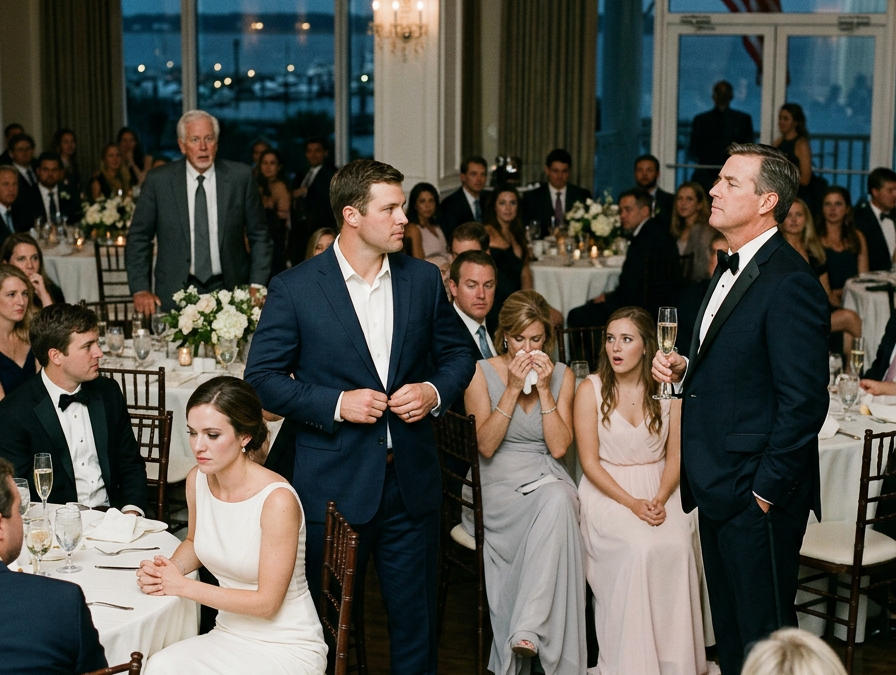
My Billionaire Father Stood Up at My Wedding and Announced That I Would Receive No Trust Fund, No Shares, and No Place in the Future He Had Planned for Me Because I Married an Aircraft Mechanic. My Husband Owen Simply Buttoned His Jacket, Looked Across the Room, and Answered With Four Calm Words: “We Don’t Need It.”
THE DAY MY BILLIONAIRE FATHER CUT ME OFF FOR MARRYING A MECHANIC—HE DIDN’T KNOW WHO MY HUSBAND REALLY WAS
My name is Fontaine Porter.
I’m thirty-three years old.
If you hear the words billionaire father, you probably imagine private jets, houses overlooking the water, schools with stone gates, and a childhood where nobody ever has to check the price of anything.
Some of that is true.
My father owns a collection of luxury resorts along the Carolina coast.
He has eaten dinner with governors.
He has hosted senators.
He wears a watch that costs more than the first house my grandfather ever bought.
When he walks into a hotel lobby, managers straighten their jackets before he reaches the front desk.
When he calls someone at ten at night, they answer.
Money can create that kind of gravity.
What money cannot guarantee is warmth.
My father understood investments.
Assets.
Leverage.
He understood people mostly through the same vocabulary.
Useful.
Strategic.
Promising.
Risky.
Expensive.
Replaceable.
For most of my childhood, I thought that was simply how powerful adults spoke.
Then I grew up and realized it was how my father thought.
Even about family.
Especially about family.
The afternoon I married Owen Hale, my father stood in front of nearly two hundred guests and announced that I would receive no inheritance, no trust distribution, no family shares, and no future position inside Porter Resorts.
He said it calmly.
Almost pleasantly.
Like a chairman announcing a restructuring.
Then he looked at Owen—the aircraft mechanic he believed I had chosen over the Porter name—and waited for him to understand what he was losing.
Owen smiled.
Then he gave my father four words.
“We don’t need it.”
The room went silent.
My mother immediately reached for a tissue.
My sister Brooke stared at us over the top of her phone.
My father laughed because he thought Owen was pretending.
What none of them knew was that Owen was not financially dependent on me.
I was not financially dependent on my father.
And six months later, at the opening of the most ambitious resort project Porter Resorts had ever attempted, my father would finally discover exactly who he had seated beside the emergency exit at my wedding.
But that was not the most important revelation.
The most important one concerned me.
Because by the time my father learned who Owen really was, I had already learned something much harder.
I had never needed to inherit my father’s life.
I only needed to stop letting him convince me that his was the only life worth building.
It started over oysters.
My father liked oysters because they gave him something slow to do while making other people wait for him.
We were seated at the long dining table in my parents’ oceanfront home.
The windows looked across water my father sometimes jokingly called “his Atlantic.”
He did not own the ocean.
He owned the resort beyond it, the marina, several neighboring parcels, and enough coastline that the joke sounded almost believable.
A bottle of Krug sat near his elbow.
Mother wore pearls.
My sister Brooke was scrolling through something on her phone between courses.
I knew there was a reason I had been invited.
Family dinners in our house were rarely casual.
My father reached for another oyster.
“I’ve arranged for you to meet Preston Vance on Saturday.”
I stopped cutting my fish.
“No.”
He kept eating.
“You haven’t heard the details.”
“I don’t need them.”
“The Vance group is close to finalizing the investment partnership.”
“That’s your business.”
“It could be our business.”
I looked at him.
There it was.
My father did not believe marriage and business were identical.
He believed marriage was one more useful business instrument.
Preston Vance was the son of a wealthy development family.
Educated.
Connected.
Polished.
The type of man who knew which fork to pick up and which donor to remember at a gala.
I had met him twice.
He had spent both conversations telling me what resorts he planned to acquire someday.
“I’m seeing someone.”
Dad stopped.
That got his attention.
Mother’s smile became very still.
Brooke looked up from her phone.
“Who?” Dad asked.
“Someone you don’t know.”
“What family?”
I almost laughed.
Not what does he do?
Not what is his name?
Not are you happy?
What family?
“None you care about.”
My mother inhaled sharply.
“Fontaine.”
“I’m serious.”
Dad placed his fork beside his plate.
“How serious?”
“Very.”
“Marriage?”
“Yes.”
Brooke actually lowered her phone.
My father leaned back.
Then smiled in a way I had learned to recognize.
Not amusement.
Calculation.
“In this family,” he said, “marriage is a merger.”
I looked at him.
“Sentiment is for people who can’t afford strategy.”
Mother nodded almost imperceptibly.
That was the Porter doctrine.
My grandfather Walter would have hated it.
That thought came instantly.
I reached into my bag beneath the table and touched the worn brass calipers I carried almost everywhere.
Grandfather’s old measuring tool.
He had given them to me when I was nineteen.
“Measurements don’t care about family names,” he told me.
“Good steel doesn’t care what you paid for dinner.”
Grandfather Walter had built the foundation of the Porter fortune with his hands.
My father spent his life trying to make everyone forget that.
I looked back at Dad.
“I’m marrying the man I choose.”
His smile vanished.
“We’ll discuss that when I know who he is.”
“We just did.”
Three days later, I was summoned to the top floor of Porter Resorts’ flagship property.
Dad’s office.
Floor-to-ceiling glass.
Ocean below.
Furniture selected to make visitors feel like they were being interviewed for access to his life.
A thin folder lay on the desk.
Dad tapped it.
“Owen Hale.”
I sat down.
“So you found his name.”
“Aircraft mechanic.”
“Yes.”
“Works out of a regional field.”
“Yes.”
“Rents hangar space.”
“As far as I know.”
“No significant real estate.”
“I never asked.”
“No family connections worth discussing.”
“I didn’t ask that either.”
My father stared at me.
“You intend to throw away the Vance alliance for a man who repairs other people’s aircraft.”
“He’s good at it.”
Dad laughed.
“Good men don’t build legacies, Fontaine.”
“They get hired by the men who do.”
I looked around his office.
Sometimes irony takes decades to become visible.
Sometimes it sits directly in front of you.
My grandfather had started in a machine shop.
He machined brackets.
Repaired pumps.
Modified motel equipment because he could not afford replacements.
He bought one motel, then another.
My father inherited the company after Walter spent decades building it.
And now Dad was telling me mechanics did not build legacies.
He walked toward the windows.
“Porters do not marry mechanics.”
I heard something old in that sentence.
The same tone he had used when I told him I wanted to study structural engineering.
I had been eighteen.
Dad had expected economics.
Hospitality management.
Perhaps finance.
Something that could eventually place me on a Porter Resorts board with an impressive title.
Engineering confused him.
“You want to inspect concrete?”
“I want to design structures.”
“You’re a Porter.”
“I know my last name.”
“You have access to one of the largest hospitality businesses in the region.”
“I don’t want to learn hotel acquisitions.”
He looked genuinely offended.
“You want to stand on construction sites?”
“Yes.”
He called engineering “an expensive hobby.”
Then refused to finance most of my degree.
So I worked.
Scholarships.
Internships.
Paid drafting.
Weekend site work.
Summer jobs.
Grandfather Walter quietly covered a few books when he realized what Dad was doing.
But I earned most of it myself.
The first professional license with my name on it mattered more to me than every family trust document combined.
Now Dad looked at me.
“This is your final chance to behave like an adult.”
“I am.”
“End it.”
“No.”
“Meet Preston.”
“No.”
“If you marry Hale, do not expect Porter money.”
There it was.
I almost felt relieved.
Not because losing access meant nothing.
At that point, several parts of my life were still financially connected to the family.
A credit card Dad had insisted I keep.
A small advisory stipend from the family foundation.
Certain investment accounts I knew were technically controlled through trusts.
Those things made life easier.
But ease and freedom are different.
I stood.
“You taught me something useful.”
Dad frowned.
“What?”
“To build assets.”
“That isn’t what we’re discussing.”
“It is exactly what we’re discussing.”
Then I left.
I met Owen four months earlier inside an aging aircraft hangar.
The regional airport had hired the engineering firm I consulted with to evaluate an expansion.
Nothing glamorous.
Corroded steel.
Old trusses.
Connection plates that had survived decades of coastal air.
I was standing on a lift with a flashlight between my teeth when someone below said:
“That plate has been lying to inspectors for ten years.”
I removed the flashlight.
“What?”
A man in work coveralls stood beneath me.
Dark hair.
Hands marked from actual work.
A stitched company patch over his chest.
TIDEWATER AVIATION SERVICES.
“Everybody photographs the face,” he said. “Nobody looks behind it.”
I climbed down.
“You saying there’s hidden section loss?”
“I’m saying measure the back edge.”
I did.
He was right.
Not dramatically.
But enough.
“Good catch.”
He shrugged.
“You would’ve found it.”
“Eventually.”
“Eventually costs money.”
I looked at him.
“You always introduce yourself by criticizing structural inspections?”
“Only to engineers standing under questionable steel.”
“Owen?”
He looked surprised.
“You know me?”
“It’s on your shirt.”
He laughed.
“Fontaine.”
“How do you know mine?”
“Clipboard.”
My name was printed across the inspection sheet.
We spent the next two hours arguing about load paths.
He challenged one of my assumptions.
I challenged his.
He was right twice.
Wrong once.
The important part was that when he was wrong, he said:
“You’re right.”
No performance.
No wounded pride.
No reminder that I was somebody’s daughter.
He simply changed his position because the facts changed.
That was unbelievably attractive to me.
We got coffee afterward.
Not the expensive café near the airport.
Owen suggested a diner with cracked vinyl seats and coffee strong enough to repair pavement.
He paid cash.
I noticed that.
I also noticed pilots greeted him differently than they greeted the other mechanics.
Not dramatically.
A small nod.
A pause.
One older pilot actually stepped aside to let Owen pass before realizing I was watching.
I filed that away.
Then forgot it.
At the diner, Owen asked:
“What would you build if nobody was paying you?”
I laughed.
“Why would I build something nobody paid for?”
“Okay. What would you build if money didn’t matter?”
No one had ever asked me that.
My father asked about returns.
Clients asked about budgets.
Colleagues asked about schedules.
Owen asked what I wanted to build.
I thought about it.
“Small structures.”
“That’s specific.”
“Useful structures.”
“Less helpful.”
“Things where engineering actually matters to normal people.”
“Community buildings.”
“Docks.”
“Small bridges.”
“Old structures people think they need to replace but could save.”
Owen smiled.
“That sounds like you already know.”
“What about you?”
“Engines.”
“You already work on engines.”
“Exactly.”
“No secret dream?”
“No yacht?”
“No.”
“Private island?”
“Seems inconvenient.”
I laughed.
When he walked me to my car, he said:
“I don’t care whose daughter you are.”
He meant it kindly.
It was still one of the most romantic things anyone had ever said to me.
We started dating.
Quietly.
Owen did not like fashionable restaurants.
I didn’t care.
We spent Saturdays near the field.
I watched him work.
He came to some of my site visits.
He understood when I stared too long at structural details.
He never told me I was overthinking because engineers are professionally compensated for overthinking the right things.
He proposed inside the hangar.
No photographers.
No family.
No elaborate arrangement.
He had machined the ring himself from titanium.
The seam was not perfectly invisible.
I loved that.
He held it between two fingers.
“I can’t give you the life they planned for you.”
I started crying before he finished.
“But I will never make you small.”
“Yes.”
He blinked.
“I have more.”
“I know.”
“You should hear it.”
“I’ll hear it after.”
He laughed.
Then he finished asking.
I said yes again.
Telling my family was less pleasant.
Brooke learned first.
Within an hour, she posted a photo of a wrench to her social account.
BOLD CHOICE.
HOPE LOVE KEEPS THE LIGHTS ON.
Laughing emoji.
Brooke had more than two hundred thousand followers.
Her life was a permanent public performance.
She had built an audience around luxury style, travel, and the Porter family brand without ever using the word inheritance.
Preston Vance heard.
Apparently told mutual friends he had “avoided a complicated situation.”
Mother called.
She breathed silently for so long I eventually asked:
“Are you still there?”
“What will people say?”
That was her first question.
“I’m getting married.”
“I heard.”
“Are you happy for me?”
“Fontaine.”
That was answer enough.
Dad called later.
His voice was calm.
“You want a wedding?”
“Yes.”
“Fine.”
“I’ll give you a wedding you never forget.”
I should have understood the sentence better.
I was happy.
Happiness makes you optimistic about people who have given you very little evidence.
Two days later, Mother came to my apartment carrying bridal magazines.
She sat on my couch like attending a memorial.
“Do you understand what this does to us?”
“It gives you a son-in-law.”
“Your father spent thirty years building the Porter name.”
“Grandfather built the company.”
“Don’t start.”
“He did.”
“You’re tying that name to a man who comes home smelling like engine oil.”
“I like the smell.”
Mother looked offended.
“Do not make me choose.”
The sentence was familiar.
She had used versions of it all my life.
Do not make me choose between your happiness and your father’s expectations.
Do not make me choose between protecting you and protecting the family image.
Do not make me choose.
But the choice was always already made.
“You chose a long time ago.”
Something flickered in her face.
Then she said:
“Your grandfather asked me before he passed to make sure you—”
She stopped.
“What?”
“Nothing.”
“Make sure I what?”
“It doesn’t matter.”
“Mom.”
She stood.
“I said it doesn’t matter.”
Then left.
That unfinished sentence bothered me.
But other things happened quickly.
The first family card stopped working at a fabric store.
Declined.
I assumed fraud protection.
Tried another.
Declined.
The family-foundation advisory stipend I had received for several years simply disappeared.
One society friend texted:
So sorry. Daddy does business with your father. You understand.
Another:
Nothing personal. Things are complicated.
It was almost impressive.
Dad did not yell.
He removed infrastructure.
Credit.
Social access.
Family money.
Contacts.
He thought dependence was a system.
He had built enough of it around me that I had never fully noticed.
I went home.
Opened a spreadsheet.
Rent.
Insurance.
Food.
Transportation.
Professional income.
Savings.
Consulting work unrelated to Porter Resorts.
The numbers were tighter than before.
But they worked.
That surprised me.
Then embarrassed me.
I had spent years assuming Dad’s money was structural.
It turned out to be decorative.
Owen came home and found me at the kitchen table.
“What happened?”
“He cut everything.”
“How much do you need?”
“No.”
“Fawn.”
“No.”
He sat across from me.
“I can cover—”
“No.”
I looked at him.
“I need to know I can do this.”
He stopped.
Then nodded.
“Okay.”
“You’re not offended?”
“Why would I be?”
“Because I’m refusing help.”
“You didn’t refuse me.”
“You said you need to stand.”
He reached across the table.
“I can stand next to you.”
That was the difference.
My father thought helping someone meant owning the direction they walked.
Owen knew proximity was not control.
I expanded my consulting.
Took small engineering projects.
Marina assessments.
Roof-load evaluations.
Renovation reviews.
Small developers.
Nothing glamorous.
But the work was mine.
And work done well travels through industries faster than family names.
One client referred two.
Two became four.
I began discussing starting my own small structural-engineering practice.
Owen encouraged it.
Dad never knew.
Meanwhile, I started noticing that Owen’s life did not make mathematical sense.
We moved into a modest clapboard house near the regional airfield.
I loved it.
Good windows.
Small porch.
Kitchen that forced us to coordinate every time we opened the refrigerator.
Owen claimed to be a mechanic.
That part was true.
He did work on engines.
Frequently.
But mechanics do not usually take late-night calls saying:
“Push the maintenance window.”
Or:
“I’ll handle the board.”
Or:
“Don’t involve legal until we know the actual exposure.”
One evening I heard:
“Move the Gulfstream maintenance slot and give Phoenix priority.”
I waited until he ended the call.
“Your boss asks you to move aircraft scheduling at ten thirty at night?”
Owen looked at me.
“Something like that.”
“Are you secretly management?”
He smiled.
“I have responsibilities.”
“That is politician language.”
“I’m sorry.”
I let it go.
We had made an agreement early.
Truth would come voluntarily.
Neither of us wanted a relationship built on investigations.
Ironic, considering Dad had already paid someone to investigate Owen.
A trade magazine appeared on our table one morning.
One of Owen’s colleagues had left it.
The cover story concerned Meridian Aviation Group.
A private aviation company known for luxury charter operations, maintenance facilities, airport partnerships, and aircraft management.
The headline mentioned its famously private founder.
THE BILLIONAIRE WHO STILL TURNS HIS OWN WRENCHES.
There was no photograph of his face.
Only gloved hands on a turbine assembly.
I looked at it.
“Interesting.”
Owen stood in the kitchen doorway.
“What?”
“Imagine being worth that much and still fixing engines.”
“Maybe he likes engines.”
“I would hire someone.”
“He probably does.”
Then Owen said:
“Money’s a tool, Fawn.”
I looked at him.
“What?”
“Nothing.”
“You sound like a fortune cookie.”
He smiled.
I poured coffee.
I did not put the pieces together.
Not yet.
The wedding was supposed to be small.
Fifty chairs.
A chapel near the water.
Friends.
A few relatives.
People who actually wished us well.
We arrived and found the parking lot full of luxury cars.
Dad had expanded the guest list to almost two hundred.
Business partners.
Politicians.
Society friends.
Executives.
People I barely knew.
It was not a wedding anymore.
It was a demonstration.
Inside, I found the seating chart.
My father had placed Owen near the back.
Beside an emergency exit.
The card did not even say groom.
GUEST — OWEN HALE.
I stared at it.
Owen appeared behind me.
“Your father likes theater.”
“I’m sorry.”
“Why?”
“This is our wedding.”
He looked around.
“No.”
Then at me.
“This part is his event.”
“The wedding is still ours.”
We married anyway.
Our vows were simple.
Owen promised he would never ask me to become less complicated for his convenience.
I promised I would tell him the truth even when the truth was expensive.
For about ninety seconds, my father disappeared.
So did the guests.
Just Owen.
Me.
Water beyond the windows.
Then my father tapped a spoon gently against his champagne glass.
The room quieted immediately.
“A toast.”
Of course.
Dad stood at the head table.
“To my daughter.”
He looked at me.
“And her husband.”
The pause was deliberate.
“I built Porter Resorts from one property into what it is today.”
Grandfather had built the first properties, but facts were flexible inside Dad’s speeches.
“I always believed Fontaine would carry that legacy forward with someone who understood what responsibility means.”
He walked slowly between tables.
“I imagined a partner who could add to the family.”
Then he stopped near Owen.
“Instead, she chose someone with engine grease on his hands.”
Several people laughed.
Brooke’s phone rose.
Preston Vance smiled from another table.
My mother looked downward with a tissue already prepared.
Dad continued.
“So I want to make one thing clear.”
He turned to the room.
“As of today, Fontaine will receive no inheritance from me.”
A murmur.
“No future trust distributions.”
“Nothing from Porter Resorts.”
“No family shares.”
“No board position.”
He looked at me.
“She has chosen her life.”
“Now she may live it.”
The room became silent.
Dad expected tears.
I know because he watched my face.
He wanted proof that the money mattered more than I had admitted.
I felt something.
Sadness.
But not about the money.
About realizing how badly he needed me to be frightened.
Then Owen stood.
He buttoned his jacket.
Looked at my father.
“Thank you for the toast, Mr. Porter.”
Dad waited.
“And thank you for clarifying the inheritance.”
Another pause.
“We don’t need it.”
My father laughed.
Too loudly.
“You don’t need it?”
“No.”
“You rent hangar space.”
“I do.”
“What exactly do you believe you bring to my daughter?”
Owen considered that.
“Respect.”
Then:
“And the truth when she’s ready for it.”
At a table near the windows, an older man in a beautifully cut suit rose slightly and nodded toward Owen.
Not dramatically.
But with unmistakable deference.
My father noticed.
His expression shifted.
Only for a second.
Then he returned to the line he trusted.
“Porters don’t marry mechanics.”
Owen nodded.
“You’ll understand my work eventually, sir.”
Then he sat.
I stood.
Not because I had planned to.
Because Dad had already turned the wedding into a public statement.
I was finished leaving only his version on record.
“My father believes people are worth what they inherit.”
The room went still.
“For a long time, I believed something close to that too.”
I looked at him.
“I went to the schools he wanted.”
“Learned the manners.”
“Learned how to sit at tables like this.”
“The only major thing I chose entirely for myself was engineering.”
“He called it a hobby.”
I felt the old calipers inside my bag.
“So I paid for the degree myself.”
“I learned how structures carry real loads.”
“Not family names.”
“Not reputation.”
“Actual weight.”
I looked toward Mother.
“Today I did not lose a family.”
“I stopped auditioning for one.”
Someone began clapping.
One person.
Then another.
Not everyone.
Enough.
Dad looked around.
He had built a room expecting my embarrassment.
The room was declining the invitation.
I smiled at the guests.
“This is still a wedding.”
“If you came to celebrate with us, stay.”
“If you came for something else, the door is available.”
Several dozen people eventually left.
Most stayed.
Dad left.
Mother followed.
Brooke paused long enough to film the centerpiece.
Then disappeared too.
And the instant those doors closed, the entire room changed.
Music.
Laughter.
Someone brought out a sheet cake from a local bakery.
The icing was slightly uneven.
It tasted better than anything served at a Porter gala.
Owen and I danced badly.
“Any regrets?” he asked.
“About marrying you?”
“About refusing a trust fund in front of two hundred witnesses.”
“That part was surprisingly refreshing.”
He laughed.
Then became serious.
“I need to tell you about work.”
“I know.”
“No, you don’t.”
I looked up at him.
“When?”
“Soon.”
“Why not now?”
“Because right now you would hear it as another number.”
I frowned.
He continued.
“I want you to see the truth standing up.”
“Not hear me claim it.”
I trusted him.
So I waited.
Two weeks after the wedding, attorney Ruth Maddox called.
She had represented Grandfather Walter for decades.
Her office smelled like paper and lemon furniture polish.
She placed a file on her desk.
“Walter left instructions.”
My throat tightened.
“What kind?”
“Conditional bequests.”
“What condition?”
She looked almost amused.
“That you marry someone of your own choosing without seeking your father’s approval.”
I stared.
“That is an actual condition?”
“Your grandfather had a sense of humor.”
She opened the file.
“He believed your father would attempt to use family assets to influence your marriage.”
“He also believed you needed to choose once without being paid to choose.”
I laughed through sudden tears.
“That sounds like Walter.”
Inside was a second set of brass calipers.
The good pair.
Wrapped in cloth.
Then a letter.
Ruth watched me open it.
Fontaine,
If you are reading this, you finally chose a life nobody arranged for you.
Good.
I wish I had taught your father the same lesson.
The machine shop behind the original motel belongs to you.
Use it.
Sell it.
Turn it into something else.
But do not let anyone call the work that happens inside it small.
There is also a twelve-percent ownership interest in Atlantic Structural Components.
You may remember the damping bracket you sketched as a teenager because the motel balcony railing vibrated in high wind.
I thought it was clever.
I filed the patent with you.
You forgot.
I didn’t.
They licensed the design.
Your shares and accumulated distributions are yours.
Build things.
Walter.
I read the letter again.
Then looked at Ruth.
“This company has been paying distributions?”
“For several years.”
“How much?”
She gave me the figures.
Not billionaire money.
Still a large amount.
Enough to finance my own engineering practice comfortably.
Enough to remove the remaining financial fear Dad had counted on.
Enough to make me laugh.
My father had spent years describing my engineering work as decorative.
One of my earliest engineering ideas had quietly been earning money the entire time.
Then Ruth said something harder.
“There’s another issue.”
I looked at her.
“Your grandfather originally asked your mother to give you this letter after his passing.”
My smile disappeared.
“What?”
“She returned it unopened last year.”
“Why?”
“She said the timing was inappropriate.”
I sat very still.
Mother had almost told me.
Your grandfather asked me to make sure you—
Then stopped.
She knew.
I drove to Walter’s old machine shop that afternoon.
Cinder block.
Dusty windows.
Heavy doors.
The smell of cutting oil still in the walls.
His tools remained exactly where I remembered.
I stood at his old bench.
Ran my hand over the worn wood.
For the first time since the wedding, I cried.
Not because I had been given property.
Because Walter had believed I would need somewhere no Porter board could remove me from.
I called Atlantic Structural Components.
Introduced myself.
The executive on the other end knew my name immediately.
“Ms. Porter.”
“You know me?”
“You own twelve percent of my company.”
“That still sounds strange.”
He laughed.
Then explained where my old bracket design had ended up.
Parking structures.
Pedestrian bridges.
Coastal buildings.
Retrofit systems.
An engineering sketch I had made as a teenager because a railing irritated me had become part of a profitable product line.
I called Owen afterward.
“Turns out the hobby earns money.”
He smiled.
“Sounds inconvenient for your father’s theory.”
“You knew about this?”
“No.”
“Good.”
“What are you doing with it?”
“I’m starting my firm.”
His smile widened.
“There she is.”
I registered the company.
Small at first.
Fontaine Structural.
No Porter branding.
No family introduction.
I took real jobs.
A marina.
A community college gym roof.
A coastal restaurant renovation.
Small developers.
Then larger ones.
My work moved by referral.
I was happier than I had been inside any Porter boardroom.
And that matters because what happened later with Owen could otherwise make this story sound like a billionaire husband rescued a disowned daughter.
He did not.
By the time I learned Owen’s numbers, I already had my own.
Different scale.
Still mine.
A few months later, business publications began discussing Porter Resorts’ new flagship.
Dad called it the crown jewel of his career.
A massive coastal development.
Luxury suites.
Private villas.
Overwater event pavilion.
Marina.
And one selling point repeated in every brochure:
PRIVATE AVIATION FROM RUNWAY TO RESORT.
No public terminal.
No delays.
No ordinary airport experience.
The promise depended on an exclusive aviation operator.
Meridian Aviation Group.
The name bothered me.
I had seen it somewhere.
Trade magazine?
Hangar sign?
I could not remember.
Articles said Dad had spent nearly two years trying to secure Meridian.
The chairman was famously private.
Rarely photographed.
Never publicly attended negotiations.
Most dealings occurred through executive teams.
Dad hated that.
He liked looking decision-makers in the eye.
One evening, I mentioned it to Owen.
“Dad’s still trying to land Meridian.”
Owen poured water.
“Is that right?”
“You know them?”
“A little.”
“What does that mean?”
He smiled.
“Aviation is small.”
Then changed the subject.
I let him.
Two nights later, he sat beside me on our porch.
Two coffees.
Long silence.
“I need to tell you something badly.”
“That’s a promising opening.”
“The mechanic part is true.”
“I know.”
“I work on aircraft because I like it.”
“Also true.”
“I rent the hangar because I want that hangar.”
“Very compelling so far.”
He almost smiled.
Then his face changed.
“I own more than the hangar.”
“How much more?”
“A company.”
“What company?”
He looked down at his coffee.
“I built it from one aircraft.”
“Then another.”
“Then maintenance.”
“Management.”
“Charter.”
“Airfield operations.”
“It got large.”
“How large?”
He exhaled.
“Large enough that the number changes how people behave.”
I stopped smiling.
“How large?”
“I’m not poor, Fawn.”
“I gathered.”
“I’m very much the opposite.”
Everything began arranging itself in my mind.
The calls.
The board.
Pilots straightening.
Tidewater Aviation Services.
The trade magazine.
The private founder.
The gloved hand.
I looked at him.
“What company?”
He reached into his jacket.
Set an envelope on the small porch table.
Heavy cream paper.
Gold embossing.
Inside was an invitation.
PORTER RESORTS FLAGSHIP GRAND OPENING
AVIATION PRESENTED IN PARTNERSHIP DISCUSSIONS WITH:
MERIDIAN AVIATION GROUP.
My fingers stopped.
I looked at Owen.
“No.”
He did not answer.
“No.”
“I founded Meridian.”
I stood.
Not dramatically.
I genuinely needed to stand.
“You’re Meridian.”
“Yes.”
“My father has been trying to meet you for two years.”
“Yes.”
“You let him call you a grease stain at our wedding.”
“I did.”
“Why?”
“Because revealing myself there would have made the wedding about money.”
“It became about money anyway.”
“I know.”
“You should have told me.”
“Yes.”
That answer slowed me.
No defense.
No clever explanation.
“Yes.”
I walked to the edge of the porch.
Owen stayed seated.
Finally he said:
“I stopped letting people know what I’m worth years ago.”
“Why?”
“Because they changed.”
“Friends.”
“Dates.”
“Business connections.”
“People became agreeable.”
“Interested.”
“Perfect.”
“I stopped knowing whether anyone actually liked me.”
He looked at me.
“The day we met, you argued with me about a gusset plate.”
“You were wrong.”
“Once.”
“Twice.”
“One and a half.”
Despite myself, I smiled.
He continued.
“You knew me as a mechanic.”
“You liked me anyway.”
“Not anyway.”
I turned.
“That word is exactly the problem.”
“I liked you because you were a mechanic.”
“Because you knew what you were doing.”
“You respected the work.”
He nodded.
“That is why I waited.”
I folded my arms.
“That does not make waiting automatically okay.”
“I know.”
“You protected yourself.”
“Yes.”
“You also kept your wife uninformed.”
“Yes.”
I breathed.
“Why now?”
“Because your father’s flagship opening is six weeks away.”
“And Meridian?”
“I declined his partnership months ago.”
My stomach dropped.
“What?”
“Why?”
Owen looked at me.
“Because of how his organization operates.”
“That decision existed before our wedding.”
“You didn’t reject him because of me?”
“No.”
“I did not even know you were his daughter when Meridian’s team first reviewed the proposal.”
That mattered.
“What was wrong with the deal?”
“Control.”
“Exclusivity terms.”
“Treatment of crews.”
“Liability allocation.”
“Operational promises he had already marketed before final agreement.”
That sounded like Dad.
Owen continued.
“After the wedding, his character confirmed what the contract had already suggested.”
I looked down.
“So what happens at the opening?”
“Meridian has an industry presentation nearby.”
“Our board wants me to appear publicly for the first time.”
“At Dad’s resort?”
“In a shared industry event attached to the opening.”
I stared.
“You’re going to reveal yourself there.”
“Yes.”
“And Dad doesn’t know.”
“No.”
I started laughing.
Not because it was funny exactly.
Because the architecture of the situation had become too absurd.
My father had spent two years trying to meet the chairman of Meridian Aviation.
Then seated him beside the emergency exit at my wedding under a card labeled guest.
I laughed until I had tears.
Owen eventually laughed too.
Then I pointed at him.
“I’m still mad.”
“Understood.”
“Very.”
“Also understood.”
“You do not get to solve this by being secretly rich.”
“I wouldn’t try.”
“Good.”
He reached for my hand.
I let him hold it.
A few days later, something happened that mattered far more to me than Owen’s company.
My engineering firm received a referral.
Porter Resorts’ general contractor needed a structural engineer of record to review part of the flagship’s overwater pavilion.
The irony was almost offensive.
I considered declining.
Then looked at the plans.
Cantilevered steel.
Coastal exposure.
Glass enclosure.
Interesting loads.
I wanted the work.
So I accepted.
Not as Porter’s daughter.
As Fontaine Structural.
The contractor knew my name but did not care about my family.
He cared whether I could certify the building.
I inspected the pavilion.
Found two connection details I would not approve as drawn.
Nothing dramatic.
No imminent danger.
Just details that did not meet the performance requirements I was willing to sign.
The contractor corrected them.
I reviewed the changes.
Then stamped the final drawings.
The most photographed room in Dad’s new billion-dollar resort opened with my professional certification attached to it.
That made me prouder than learning Owen was wealthy.
Because Dad had refused to help pay for my engineering education.
Yet the daughter he considered ornamental had become part of the professional team completing his most important project.
I told Owen:
“I’m going to the opening as the engineer.”
He looked confused.
“You’re also my wife.”
“Yes.”
“But if anyone asks why I belong in that pavilion, your bank account is answer number three.”
He smiled slowly.
“What’s number two?”
“My shoes are comfortable.”
“Reasonable.”
“And number one?”
“My stamp is on the drawings.”
He nodded.
“I married well.”
The night before the event, Owen and I argued again.
Quietly.
“You should have told me earlier.”
“I know.”
“I keep coming back to it.”
“I know.”
“You had information that affected my life.”
“Yes.”
“I don’t want a marriage where somebody decides what truth I’m ready for.”
“I understand.”
I waited for him to defend himself.
He didn’t.
Finally he said:
“I hid what I owned.”
“I did not hide what I felt.”
“That distinction mattered to me.”
“But it does not have to be enough for you.”
I looked at him.
It was enough to continue.
Not enough to erase the problem.
That was healthier.
“Tomorrow,” I said, “we don’t humiliate him.”
Owen raised an eyebrow.
“I’m serious.”
“I know.”
“No speeches about the wedding.”
“Agreed.”
“No revenge performance.”
“Agreed.”
“We stop hiding.”
“That’s it?”
“That’s enough.”
He touched Walter’s old calipers on my bedside table.
“Your grandfather would like that.”
“He would have liked you.”
“How do you know?”
“He started as a mechanic.”
Owen smiled.
The flagship opening was enormous.
Five hundred guests.
Government officials.
Investors.
Reporters.
Luxury-travel executives.
People who had private foundations named after themselves.
The resort glowed against the water.
And the overwater pavilion I had certified looked beautiful.
I allowed myself one moment of professional pride before the family drama started.
Of course Dad had a seating chart.
Of course.
He assigned social rank even when guests were standing most of the evening.
Near the center:
MERIDIAN AVIATION GROUP
CHAIRMAN’S PARTY — FOUR SEATS.
Empty.
Dad had finally convinced himself Meridian’s chairman would appear.
He just did not know he had already met him.
Owen and I arrived together.
My father spotted us.
His entire expression changed.
He thought Mother’s recent phone calls had worked.
Mother had called me several times before the opening.
“Your father hasn’t finalized the will.”
As if that were bait.
“If you come back before the press arrives, there is still time to put this behind us.”
“What does come back mean?”
“You know.”
“Leave my husband?”
She did not answer.
“There it is.”
“Fontaine, people are talking.”
Not:
I’m sorry.
Not:
Are you happy?
People are talking.
“I’ll be at the opening.”
She sounded relieved.
She misunderstood.
Now Dad crossed the room toward us.
“Fontaine.”
Warm voice.
Witnesses nearby.
“I’m glad you came to your senses.”
I looked at Owen.
Then back at Dad.
“I came to an opening.”
His eyes moved toward Owen.
“Surprised the valet found a place for the work truck.”
Owen smiled.
The lights dimmed.
A recording of a jet engine beginning its spool-up filled the pavilion.
That low rising sound I had loved since the day we met.
The master of ceremonies stepped toward the microphone.
“Tonight, Meridian Aviation Group will introduce its founder and chairman publicly for the first time.”
Dad turned toward the stage.
His face changed into pure ambition.
He had waited two years for this.
The screens lit.
MERIDIAN AVIATION GROUP
FOUNDER & CHAIRMAN
Owen squeezed my hand.
Then released it.
He looked at me.
One private question.
Ready?
I nodded.
He walked toward the stage.
My father watched.
At first he did not understand.
Then the Meridian executives near the stage stood.
Several nodded toward Owen.
The applause began.
The screen changed.
OWEN HALE
FOUNDER & CHAIRMAN
MERIDIAN AVIATION GROUP.
My father stopped moving.
Mother’s hand went to her mouth.
Brooke actually lowered her phone.
I had never seen that happen before.
Five hundred people stood.
Owen walked onto the stage wearing the same calm expression he wore when working on an engine.
No expensive performance.
No announcement about wealth.
No mention of my father.
He thanked Meridian’s mechanics first.
Then pilots.
Operations teams.
Maintenance crews.
Engineers.
People who kept aircraft safe when no customer ever knew their names.
He spoke for less than ten minutes.
Not one word about my family.
That was exactly right.
Because my father’s humiliation was not Owen’s purpose.
The truth was enough.
When Owen stepped down, the room moved toward him.
Investors.
Journalists.
Industry executives.
My father reached him first.
Of course he did.
“Owen.”
Suddenly first names.
Suddenly warmth.
Dad extended his hand.
“This is incredible.”
Owen looked at the hand.
Then Dad.
“Good evening, Mr. Porter.”
“About Meridian and the flagship.”
Dad smiled.
“We have been trying to finalize this relationship for almost two years.”
“I know.”
“Now that we’re…”
He gestured toward me.
“Family.”
The word sounded strange coming from him.
“We can resolve the remaining terms tonight.”
Owen answered calmly.
“I already declined the proposal.”
Dad’s smile faltered.
“There must be some misunderstanding.”
“No.”
“But this is the obvious partnership.”
“Not for Meridian.”
“Why?”
Owen paused.
Then answered honestly.
“The operational terms were not right for us.”
Dad’s face tightened.
“And after meeting me?”
Owen looked toward me briefly.
Then back at Dad.
“After meeting you personally, I became more comfortable with the decision.”
A few nearby conversations stopped.
Dad understood the implication.
“You’re refusing a major partnership over a private family disagreement?”
“No.”
“The business reasons came first.”
“The family experience simply reinforced my view of how you treat relationships when you believe you hold all the leverage.”
Dad’s face darkened.
“You did this.”
He looked at me.
“You planned this.”
Heads turned.
“No.”
“You let me stand here in front of everybody.”
I stayed calm.
“I came to your resort opening.”
“With him.”
“He is my husband.”
“You knew.”
“Yes.”
“You knew who he was.”
“Only recently.”
Dad laughed bitterly.
“You expect me to believe you married him without knowing?”
“I married a mechanic.”
“He still is one.”
“You think this is funny?”
“No.”
Dad’s voice rose.
“You humiliated your own father in front of five hundred people.”
I remembered the promise I had made.
The loudest person in the room would not be me.
I opened my small bag.
Removed Grandfather Walter’s brass calipers.
Held them in my palm.
“Do you know what these are?”
Dad stared.
“No.”
“They were your father’s.”
His expression changed.
“Walter’s?”
“Yes.”
“He used them in the original machine shop.”
I turned them gently.
“You stood at my wedding and said Porters don’t marry mechanics.”
Dad said nothing.
“Walter was a mechanic.”
“He worked with his hands.”
“He fixed what he couldn’t afford to replace.”
“He built the foundation of everything you spend your life calling a legacy.”
My father’s jaw tightened.
“You spent your entire adult life polishing the grease off the family story because you thought it made the money look smaller.”
The crowd nearby had become quiet.
I did not care.
I continued only because Dad had made the conversation public.
“You disowned me.”
“Fine.”
“I’m not asking back in.”
“You said no inheritance.”
“Fine.”
“I already own a piece of Walter’s company.”
That surprised him.
Mother went completely pale.
I looked toward her.
“Ruth Maddox gave me the letter.”
Dad turned toward Mother.
“What letter?”
She said nothing.
I continued.
“Walter left me his shop.”
“Twelve percent of Atlantic Structural Components.”
“And the rights connected to the damping-bracket work I designed when I was a teenager.”
Dad stared.
Then I gave him the last fact.
Not to embarrass him.
Because it was mine.
“And this pavilion?”
I gestured around us.
“The structure everybody is standing in tonight?”
Dad looked confused.
“I was the engineer of record for the final overwater structural review.”
His face changed again.
“My stamp is on the final drawings.”
I slipped the calipers back into my bag.
“I do good work, Dad.”
“I always did.”
That was the entire speech.
No cheering needed.
No victory line.
I walked away.
Owen followed a few minutes later.
He found me near the glass wall overlooking the water.
“You okay?”
I watched the surf beneath the pavilion.
“Yes.”
“Real yes?”
“Yes.”
Behind us, Porter executives were already discussing Meridian’s refusal.
Dad’s public-relations team had begun trying to keep reporters focused on the resort.
Brooke’s old wedding clip was circulating again because people had recognized Owen.
A video of my father calling his new son-in-law a “grease stain” looked very different now.
I did not share it.
Did not comment.
Did not need to.
I leaned against Owen.
Then repeated the four words he had given Dad at our wedding.
“We don’t need it.”
This time they did not sound defensive.
They were simply true.
My independence existed before Owen’s wealth.
Grandfather’s company share.
My engineering firm.
My license.
My clients.
My work.
I had spent years believing the Porter fortune was security.
Now I understood security felt much more like knowing exactly what you could build without it.
Mother found me near the coat check.
“Fontaine.”
Her voice was soft.
Almost sweet.
“I hope you know I was always on your side.”
I looked at her.
“Were you?”
“I wanted to speak at the wedding.”
“You didn’t.”
“Your father is difficult.”
“Yes.”
“I had to protect—”
“Yourself?”
She stopped.
I reached into my bag.
Not for the calipers.
For Walter’s copied letter.
“I know you had this.”
Mother’s face changed.
“Ruth told you?”
“She gave it to me.”
“I was waiting for the right time.”
“A year?”
“You were making emotional decisions.”
“I was getting married.”
“Exactly.”
“To someone you didn’t approve of.”
Mother looked around, worried someone might overhear.
That small movement told me everything.
“You always said, ‘Don’t make me choose.’”
Her eyes filled.
“You already chose.”
“When?”
“The day you decided Dad’s approval mattered more than Grandfather’s instructions.”
She had no answer.
For once, no prepared grief.
No elegant sentence.
Nothing.
Then Brooke approached.
Her mascara was genuinely smudged.
Her phone remained down.
That alone made me listen.
“I didn’t know about Walter’s letter.”
“I know.”
“I’m tired, Fawn.”
“Of what?”
“Being the good daughter.”
I almost laughed, but she was serious.
“I don’t know what I am if I’m not the one who stayed.”
“The one Dad approves.”
“The one Mom posts.”
I looked at her.
There was my sister beneath the influencer account.
Maybe.
“I believe you’re tired.”
She nodded.
“I’m sorry about the wedding video.”
I waited.
“And the wrench post.”
Another pause.
“And the years of making you the joke because it made me look better.”
That was new.
Honesty without the phrase but you.
I nodded.
“Thank you.”
“Can we fix it?”
“Not tonight.”
Her face fell.
“But maybe eventually.”
She nodded.
That was all I could offer.
The flagship opened.
But not the way Dad had marketed it.
Without Meridian, the immediate private-aviation partnership he had promoted had to be redesigned.
Porter Resorts found alternatives.
My father is too experienced and too wealthy to allow one failed partnership to end the company.
The resort survived.
The aviation promise was delayed.
Some luxury packages had to be revised.
Several investors asked questions about projections Dad had marketed before contracts were finalized.
The board pushed for tighter oversight.
Nothing dramatic enough to make Porter Resorts disappear.
Reality is usually less theatrical than that.
But Dad’s invincibility cracked.
Not because his daughter embarrassed him.
Because people discovered he sometimes announced certainty before he had secured the underlying structure.
An engineer understands that problem.
Never advertise the load capacity before you finish the calculations.
My own firm grew.
One employee.
Then two.
Then three engineers besides me.
Walter’s machine shop became our workshop and testing space.
I kept the old bench.
The original vise.
Both sets of calipers hung above it.
His and mine.
Owen continued going to the hangar.
Even after I knew his net worth.
Especially after.
On Saturday mornings, he still came home with dark marks on his hands and an expression that meant some engine had behaved badly.
I once asked:
“You employ thousands of people.”
“Yes.”
“Why are you personally replacing a component?”
“Because I know how.”
“That is not an answer.”
“It makes me happy.”
That was an answer.
I understood.
My father came to our house one evening months later.
Alone.
No driver.
No assistant.
No expensive watch.
At least I didn’t notice one.
He stood on the porch.
For several seconds, neither of us spoke.
Then:
“Can I apologize?”
I looked at him.
“You can.”
He swallowed.
“I don’t know where to start.”
“That’s probably because there’s a lot.”
He almost smiled.
Then stopped.
“I was wrong about Owen.”
“Yes.”
“I was wrong about your engineering.”
“Yes.”
“I was wrong about Walter.”
I looked at him more carefully.
“What about Walter?”
Dad looked toward the field.
“My whole life I tried to make Porter Resorts look like it came from vision.”
“It came from him fixing motel equipment because we couldn’t afford replacements.”
“I know.”
“I hated that story.”
“Why?”
“Because I wanted the company to feel inevitable.”
That was surprisingly honest.
He continued.
“I thought respectability meant distance from the beginning.”
“From work.”
“From grease.”
“From people knowing how difficult it was.”
I leaned against the doorway.
“And when I wanted engineering…”
“You reminded me of him.”
That had never occurred to me.
Dad looked at the ground.
“You liked the part of the family I spent my life trying to outgrow.”
“So you tried to outgrow me too.”
He closed his eyes.
“Yes.”
That was the first apology.
Not the words I’m sorry.
The truth underneath them.
Then he said:
“I am sorry.”
I waited.
He asked:
“What do I do?”
I thought about Walter.
Measurements.
Work.
Slow repairs.
“You mean to fix this?”
“Yes.”
“You don’t.”
Dad looked up.
“Not in one night.”
“Oh.”
“You spend the next ten years meaning something different.”
His face tightened.
“I don’t know how.”
That was the most honest sentence he had ever given me.
“Then learn.”
I stepped aside.
Not fully.
Enough.
“Coffee?”
Dad nodded.
“No oysters.”
He actually laughed.
Our relationship did not magically repair itself.
My father began visiting Walter’s machine shop occasionally.
At first he stood awkwardly near the door in expensive shoes.
Then he started asking questions.
“What does that do?”
“Mill.”
“And that?”
“Lathe.”
“Your grandfather used one like that.”
“I know.”
One Sunday I found Dad holding Walter’s old measuring calipers.
He turned them over carefully.
“I remember these.”
“You said you didn’t.”
“At the opening, I was overwhelmed.”
Fair.
He rubbed the metal.
“When I was ten, he made me measure the same bracket six times because I kept rushing.”
“What happened?”
“I told him the measurement was close enough.”
I laughed.
“Oh no.”
“He said, ‘Close enough is something people say before someone else has to repair their mistake.’”
“That sounds like Walter.”
Dad smiled.
Then:
“I stopped coming here after business school.”
“Why?”
“I thought it made me look backward.”
“That’s sad.”
“Yes.”
He placed the calipers down.
“Very.”
Mother took longer.
She sent letters.
Not texts.
Actual notes.
At first, they contained too much explanation.
Your father was under pressure.
I thought Walter’s timing was wrong.
I was afraid you would misunderstand.
I did not answer.
Then one arrived six months later.
No explanations.
Fontaine,
I kept Walter’s letter because I was afraid that if you had something of your own, you would stop needing us.
I told myself I was protecting the family.
Really, I was protecting my place inside it.
That was wrong.
I’m sorry.
Mom.
I read that one three times.
Then called.
Not reconciliation.
A beginning.
Brooke and I rebuilt more awkwardly.
Without social media.
That was one boundary.
Nothing private became content.
The first time she visited my workshop, she left her phone in the car voluntarily.
“I’m trying.”
“I noticed.”
She looked at Walter’s tools.
“You actually like this?”
“Yes.”
“Even if you didn’t make money?”
“Yes.”
She was quiet.
“I don’t know what I like when nobody is watching.”
That sentence hurt.
“Then find out.”
“How?”
“The same way everyone does.”
“Try things.”
“Be bad at some.”
“Keep the ones that feel right.”
She nodded.
Brooke eventually reduced how much of her life she posted.
Not because I asked.
Because she got tired of living for an audience.
Preston Vance disappeared from my life entirely.
I heard his family’s merger with Porter Resorts eventually closed under different terms.
Fine.
He was never the point.
The most surprising part of this entire story was Owen.
Not the billionaire reveal.
What came after.
Knowing his net worth created problems we had never needed to address while I thought he was merely comfortable.
Security.
Privacy.
Travel.
People approaching me because they wanted access.
My father suddenly treating Owen’s opinion differently.
I hated that.
Owen did too.
One evening after dinner, I said:
“I liked it better when nobody knew.”
“So did I.”
“Can we go back?”
“No.”
“That’s annoying.”
“Very.”
“Do you regret telling me?”
“No.”
“Do you regret everyone else knowing?”
“Yes.”
Then he smiled.
“But I married an engineer.”
“She’ll find a system.”
I did.
Our house stayed.
We did not move into something larger just because we could.
Owen still rented the hangar.
I kept my firm separate from Meridian.
No Meridian contracts for the first two years.
Deliberately.
I needed my company’s reputation to exist independently.
When Meridian eventually hired Fontaine Structural for a small facility review, another engineering firm performed the procurement review to avoid any appearance of favoritism.
Dad found that hilarious.
“You make your billionaire husband bid.”
“Yes.”
“Walter would love that.”
“Yes.”
The first major project my firm completed without any family connection was a public library addition.
Nothing glamorous.
Two-story community building.
Children’s room.
Reading terrace.
Local materials.
I went to the opening.
Forty people.
No governor.
No champagne tower.
A little boy sat on the floor reading underneath a beam I had helped design.
I stood there smiling like an idiot.
Owen asked:
“This better than the resort pavilion?”
“Yes.”
“Really?”
“Nobody in this building cares who my father is.”
He nodded.
“Good answer.”
Later that year, my father asked me to review a small renovation at one of Porter Resorts’ older properties.
I almost refused.
Then Dad said:
“I’ll pay your standard rate.”
That made me smile.
“No daughter discount?”
“No.”
“No family vote?”
“No.”
“No inheritance leverage?”
He sighed.
“Fontaine.”
“I need to enjoy this.”
“I know.”
We took the project.
Professionally.
Contract.
Scope.
Invoices.
Dad signed.
Walter would have loved the paperwork.
Years passed.
Not enough to erase anything.
Enough for behavior to become more important than one dramatic moment.
Dad learned to ask.
Mother learned that silence is not loyalty.
Brooke learned that a sister is not content.
I learned something too.
Boundaries are easier to announce than to live.
The first time Dad asked for something after our reconciliation began, my instinct was still to say yes immediately.
The first time Mother cried, I still felt guilty.
The first time Brooke sounded lonely, I almost abandoned my own plans to fix it.
Old training does not disappear because you deliver one good speech.
You practice something new.
Again.
Again.
Again.
That is real change.
Years after our wedding, Porter Resorts held an anniversary event at the flagship.
Dad invited Owen and me.
Not as leverage.
No business pitch.
No Meridian discussion.
I asked Owen:
“You want to go?”
“Do you?”
I thought about it.
“Yes.”
So we went.
The same overwater pavilion.
Same ocean.
Different atmosphere.
Dad had retired from day-to-day management.
A professional CEO now ran most operations.
He looked lighter.
Older.
More like Walter around the eyes than I had ever noticed.
At dinner, Dad stood.
I immediately looked at Owen.
“Oh no.”
Owen whispered:
“Maybe he likes speeches.”
“He loves speeches.”
Dad raised his glass.
“I promised my daughter years ago that I would give her a wedding she wouldn’t forget.”
A few people who knew the story laughed softly.
“I succeeded for entirely the wrong reasons.”
More laughter.
Dad looked at me.
“I also told her she would receive nothing from me.”
He paused.
“I was trying to make money sound like love.”
The room became quiet.
“She taught me they are not the same thing.”
He lifted the glass.
“To Fontaine.”
“Who built without permission.”
Then to Owen.
“And to the mechanic.”
Owen raised his glass.
“Still a mechanic.”
Dad smiled.
“Thank God.”
That was enough.
After dinner, I stood near the glass wall.
The surf below.
Owen beside me.
Dad approached.
No audience.
He held out a small box.
“What’s this?”
“Not inheritance.”
“Good start.”
“Open it.”
Inside was an old photograph.
Walter.
Young.
Standing in front of the original motel machine shop.
Grease on his hands.
My father beside him at maybe twelve years old.
Dad looked terrified of the camera.
Walter looked proud.
On the back, in Walter’s handwriting:
BUILD FIRST.
POLISH LATER.
I laughed.
“Where did you find this?”
“Storage.”
Dad looked at me.
“I think it belongs in the shop.”
“It does.”
Then he walked away.
I kept that photograph.
It hangs beneath Walter’s calipers now.
Both pairs.
His old set.
Mine.
Some evenings, when work runs late, I stand in that machine shop alone.
The cinder-block walls are cleaner now.
The wiring is new.
The machines have been serviced.
My team occupies offices where Walter once stored spare motel furniture.
Across the field, Meridian aircraft come and go.
Sometimes I hear Owen’s voice before I see him.
Sometimes he comes home smelling exactly the way my father once described with contempt.
Oil.
Metal.
Aircraft fuel.
Work.
It smells like my husband.
It smells like the day I met him.
And when a jet begins to spool up outside, that low rising sound no longer feels like a countdown.
It is simply part of home.
People still occasionally tell the story as if the central joke is that my father mocked a mechanic who turned out to be a billionaire.
That is the easy version.
I understand why people like it.
It is satisfying.
But it is not the lesson I kept.
If Owen had actually been an ordinary mechanic earning an ordinary salary, my father still would have been wrong.
If Walter’s company shares had been worth nothing, my father still would have been wrong.
If my engineering firm had remained one woman and a laptop, he still would have been wrong.
A person does not become worthy because a hidden bank account appears.
A profession does not become honorable only when someone wealthy performs it.
Owen was worthy when he stood in that hangar in coveralls and admitted he had been wrong about a connection plate.
I was worthy when my father thought engineering was a hobby.
Walter was worthy before there was a Porter Resorts.
That is what my father eventually had to learn.
And it is what I had to learn too.
For years I wanted to prove that choosing my own life would not make me poor.
That was still accepting his measurement.
The better question was:
Would it make me mine?
Yes.
That was enough.
My name is Fontaine Porter Hale.
I’m an engineer.
I run my own structural firm.
My husband works on aircraft because he loves the work.
He also chairs a company large enough that financial magazines care about his breakfast habits.
Neither fact makes me love him more than the other.
My grandfather left me a machine shop, a company stake, two sets of calipers, and one final lesson hidden inside all of it:
Inheritance is what somebody chooses to hand you.
Worth is what remains when they don’t.
My father once believed he could erase my future by removing my name from a trust.
He could not.
Because the most important things I own were never his to give.
My license.
My hands.
My judgment.
My marriage.
My work.
My peace.
Those were built.
And no one can take back something they never built for you in the first place.
