At our anniversary dinner, with eighty guests seated beneath the ballro
The Anniversary He Thought Would End Me
“I’ve regretted marrying you since our very first night,” my husband announced at our anniversary dinner, but I simply smiled, nodded to the host, and when the video began playing across the ballroom, he went completely still at the table.
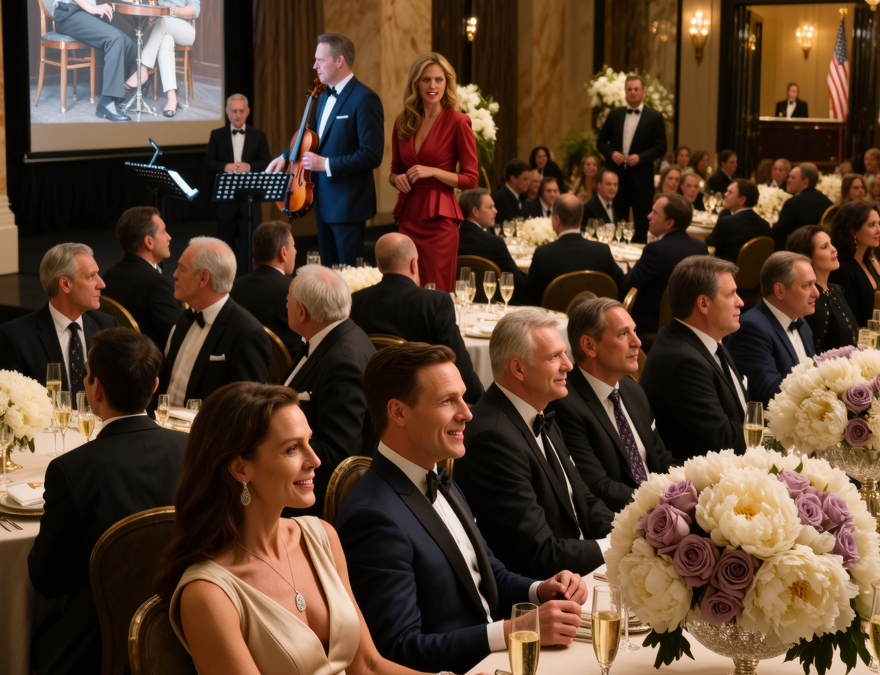
Eighty guests sat beneath the golden chandeliers of the Plaza ballroom, their faces reflected in mirrored walls and polished silver. A string quartet had been playing near the tall windows. White peonies and lavender roses filled crystal bowls on every table. Each place card had been embossed with the Langford crest, the same discreet gold emblem my father had placed on company stationery for nearly forty years.
Everything looked perfect.
That was important to Daniel.
Perfection was not something he appreciated. It was something he collected, displayed, and used as proof that he had won.
He stood at the head table in a tailored midnight-blue tuxedo, holding his champagne glass by the stem. His smile remained steady while the final echo of his statement moved through the room.
A server near the doorway stopped walking.
My mother’s hand rose slowly toward her mouth.
At the next table, Henry Ashcroft, chairman of Langford Industries and one of my late father’s closest friends, lowered his reading glasses and stared at Daniel as though he had begun speaking in a language no reasonable person would choose to understand.
Daniel seemed pleased with the silence.
He had mistaken shock for admiration throughout most of his life.
“For ten years,” he continued, “I have played the role everyone expected me to play. The devoted husband. The grateful son-in-law. The man lucky enough to marry Victoria Langford.”
He said my name with the same polished contempt he used when discussing an employee he planned to replace.
A nervous laugh escaped from somewhere near the back of the room, then died almost immediately.
Daniel glanced toward Ashley Monroe, his executive assistant, who sat two tables away in a red satin dress. She lowered her eyes, but not before I saw the faint curve at the corner of her mouth.
They thought this was their moment.
Three nights earlier, I had read the message in which Daniel promised her it would be.
After Saturday, no more pretending.
I had not slept properly since.
Yet as I sat beneath the chandeliers in a champagne-colored gown, wearing the same perfume I had worn on our wedding day, my hands were perfectly still.
Daniel lifted his glass a little higher.
“Tonight,” he said, “I am finally choosing honesty.”
That was when I looked toward the ballroom host.
He had been standing beside the stage, waiting for my signal.
I gave him a small nod.
The chandeliers dimmed.
The quartet stopped so abruptly that the final note seemed to remain suspended above us. A projection screen descended behind the musicians, covering the wall of white flowers Daniel had insisted on ordering.
His expression changed for the first time.
“What is this?” he asked.
I folded my hands in my lap.
The screen turned black.
A title appeared in simple gold letters.
Ten Years of Happiness.
A few guests shifted in their chairs. Someone whispered that it must be an anniversary film. Daniel looked toward the production booth, then back at me.
I smiled.
Our first dance song began playing softly through the speakers.
The opening image showed me at twenty-nine, standing beneath an arch of ivory roses in my wedding dress. I was laughing at something my father had whispered before walking me down the aisle. My face looked open and hopeful, almost painfully so.
Daniel appeared beside me in the next frame, younger and leaner, his hand resting at my waist.
For several seconds, the film looked exactly like the tribute he had expected.
Then the music stopped.
The image dissolved into a grainy recording from eleven years earlier. Daniel was sitting in the back room of a Brooklyn bar with two former college friends. His jacket hung over the chair beside him, and a half-finished drink sat near his elbow.
One of the men behind the camera asked, “So you’re really serious about the Langford girl?”
Daniel laughed.
“Of course I’m serious. You think I’m going to walk away from that family?”
The ballroom became completely silent.
On the screen, the younger Daniel leaned closer to the camera.
“Her father opens doors most people don’t even know exist. Victoria is sweet, sheltered, and loyal. Once she believes in someone, she stops asking questions.”
At the head table, Daniel’s hand tightened around his glass.
“Turn that off,” he said.
I did not move.
The video continued.
His younger self smiled into the camera.
“I’m not just marrying a woman. I’m marrying access.”
A fork slipped from someone’s hand and struck a plate.
Ashley stared at the screen, her face no longer confident.
Daniel turned toward me.
“Where did you get this?”
I raised my glass but did not drink.
“This is your moment, Daniel,” I said quietly. “You wanted honesty.”
Three days earlier, I had believed I was planning an anniversary celebration.
By Saturday night, I understood that I had actually been preparing a farewell.
The discovery began on Wednesday morning with a headache.
It was not unusual. Langford Industries had been preparing for a major restructuring, and I had spent the previous month moving between board meetings, school conferences, charity lunches, and the endless small responsibilities that Daniel considered too ordinary to notice.
Our daughter, Chloe, had left for school wearing one yellow sock and one white one because she had decided matching socks were “too serious for third grade.”
Daniel had been standing at the kitchen island in our Manhattan penthouse, speaking into his wireless headset while scrolling through his phone.
I placed a cup of coffee beside him.
He did not look up.
“I may come home early,” I said. “My head is starting to hurt.”
“Do whatever you need,” he replied.
His tone was not cruel. Cruelty would have required attention.
He had become skilled at making indifference sound reasonable.
Before leaving, I reminded him that Chloe’s school performance was Thursday evening.
“She has been practicing for weeks,” I said.
“I know.”
“It starts at six-thirty.”
“I said I know, Victoria.”
He raised one finger, signaling that I was interrupting his call, although no one on the other end had spoken for nearly a minute.
I left without answering.
At noon, the headache became sharp enough that I canceled my remaining meetings and returned home.
The penthouse was unusually quiet. Sunlight fell across the pale oak floors. The dishwasher hummed in the kitchen, and somewhere beyond the windows, traffic moved down Fifth Avenue in a steady silver line.
I went directly to our bedroom, removed my shoes, and reached for the curtains.
That was when I noticed Daniel’s phone on the nightstand.
He never left it behind.
He carried it from room to room, even when he took a shower. He once drove twenty minutes back from the airport after realizing it was charging in his study.
The screen lit up before I touched it.
A message preview appeared.
After Saturday, no more pretending. I already packed the red dress.
The sender was Ashley.
For several seconds, I stood without breathing.
Then another message appeared.
Did you tell her you’re announcing it at dinner?
I did not unlock the phone.
I did not need to.
The two previews were enough to make the room feel unfamiliar.
Daniel had not forgotten the phone accidentally. He had left it charging because he was using a company-issued device that morning. He returned for it twenty minutes later, calling my name from the hallway.
I was lying beneath the covers by then, pretending to sleep.
He entered the room, picked up the phone, and paused.
I could feel him looking at me.
“Victoria?”
I kept my breathing slow.
After a moment, he walked out.
The front door closed.
Only then did I sit up.
My headache was gone.
In its place was a strange clarity, cold and precise.
I went into Daniel’s study, not to search through his drawers, but to find the anniversary seating chart he had insisted on approving. Ashley’s name had been added two days earlier.
Table three.
Direct view of the head table.
I stared at the page until the intention behind it became obvious.
Daniel was not planning to leave me privately. He wanted an audience. He intended to control the story before I had time to understand it.
For ten years, he had relied on my instinct to protect the family from embarrassment.
He assumed I would sit quietly while he spoke, leave through a side entrance, and allow him to explain the evening afterward in whatever way benefited him most.
That afternoon, I called my attorney, Claire Bennett.
Claire had represented the Langford family for twelve years. She was calm in the way only highly prepared people can be calm. When I told her about the messages, she did not interrupt.
“Do not confront him yet,” she said. “Do not move money. Do not sign anything. Send me the seating chart and any recent financial notices you have received.”
“What financial notices?”
There was a pause.
“Victoria, has Daniel asked you to sign any transfer documents during the past month?”
I thought of the folder he had placed beside my breakfast plate the previous Friday.
Routine governance updates, he had called them.
I had not signed because Chloe spilled orange juice across the first page, and Daniel had taken the folder away in frustration.
“Yes,” I said slowly. “But I didn’t sign them.”
Claire exhaled.
“Good.”
“Why?”
“Because two weeks ago, Daniel’s office requested expanded signature authority over three Langford investment accounts. The request was unusual enough that the bank sent it to us for confirmation.”
My fingers tightened around the phone.
“Did you approve it?”
“No. Your father’s trust requires your written consent and independent review. Daniel should know that.”
“He does know that.”
“Yes,” Claire said. “Which means we need to understand why he tried.”
She recommended Miles Grayson.
Miles was not a private detective in the dramatic sense Daniel later claimed. He was an independent corporate-risk consultant who specialized in tracing conflicts of interest, undisclosed financial relationships, and internal policy violations. My father had hired him years earlier during a difficult company audit.
I remembered Miles as a quiet man with thoughtful eyes who listened longer than most people could tolerate.
We met the following morning at a coffee shop near Bryant Park.
He arrived in a charcoal coat carrying a narrow leather notebook. I told him about the messages, the transfer request, the anniversary, and the speech I suspected Daniel intended to make.
Miles wrote down only three words.
Saturday. Ashley. Authority.
“What do you want to know?” he asked.
“The truth.”
“That can mean many things.”
“I want to know whether this began recently or whether I have spent ten years living inside someone else’s plan.”
He studied me for a moment.
“And when you know?”
“I’ll decide what deserves to remain standing.”
He closed the notebook.
“You have access to company records?”
“I do.”
“Your attorney is involved?”
“Yes.”
“Then we do this lawfully. No shortcuts. No private passwords. No tricks that can be used against you later.”
I nodded.
“That is exactly what I want.”
Miles began with public filings, authorized company records, archived correspondence, travel reimbursements, and interviews with people who were willing to speak on the record.
By that evening, Claire had placed a temporary review hold on Daniel’s requests for expanded authority. The company’s audit committee was notified. Daniel’s corporate card activity was preserved, along with internal promotion records connected to Ashley.
The next morning, Miles delivered the first folder.
Its cover contained only Daniel’s full name.
Daniel Mercer.
I had known the basic outline of his life. He grew up outside Albany. His mother taught high school English. His father owned a small construction company. Daniel attended business school, launched a technology firm with two friends, and left after what he called “a difference in vision.”
The folder told a less flattering version.
His company had not merely struggled. It had collapsed beneath debt and poor decisions. Three months before we met, Daniel had personally guaranteed a lease he could no longer afford. Two investors were preparing to walk away.
Two weeks later, he attended a gallery opening sponsored by my father.
Daniel had always described our meeting as fate.
He said he noticed me from across the room while I was standing beside a blue abstract painting, laughing with my cousin.
According to the event records, Daniel had requested an invitation four times.
He had also downloaded my public biography from the Langford Foundation website and attended two charity events where he knew I would be speaking.
“He studied the room before he entered it,” Miles said.
I turned the page.
There were copies of old emails voluntarily provided by Daniel’s former college roommate, Nolan Pierce. Nolan had stopped speaking to Daniel years earlier after a business disagreement. When Miles contacted him, Nolan sent a box of old files and recordings.
One email had been written six months before Daniel proposed.
Victoria is the safest path forward. Her father likes me, and she believes loyalty matters more than ambition. Once I am inside the company, I can build from there.
I read the sentence twice.
Then a third time.
It did not describe love.
It described acquisition.
The next section concerned Ashley.
She had joined Langford Industries four years earlier as a scheduling coordinator. Within eighteen months, Daniel promoted her twice. Her salary increased by nearly seventy percent. A bonus approved directly by him exceeded the range allowed for her position.
More troubling were the expenses.
Hotel rooms booked during conferences she had not officially attended. Restaurant charges on evenings when Daniel told me he was meeting investors. Car services from his office to her apartment and then to hotels downtown.
The records alone did not prove everything.
The photographs did.
They came from public event photographers, hotel lobby cameras released through proper legal channels, and social-media posts uploaded by people who had not realized Daniel and Ashley were standing together in the background.
There they were at a resort in California while Daniel told me he was visiting a supplier in Seattle.
There they were entering a hotel near Central Park three hours after Chloe’s spring recital.
There was Ashley wearing a scarf I had given Daniel for Christmas.
I closed the folder.
For a long time, neither Miles nor Claire spoke.
The conference room windows overlooked Madison Avenue. Below us, yellow cabs moved through the rain. People hurried beneath umbrellas, each one carrying a private problem no stranger could see.
“How long?” I asked.
“At least eighteen months,” Miles said.
“And the transfer documents?”
Claire opened another folder.
“If you had signed them, Daniel would not have owned your inherited shares. Your father’s trust prevents that. But Daniel would have gained temporary operating authority over certain investment accounts.”
“How temporary?”
“Long enough to create complications.”
I thought about the anniversary dinner.
The guest list included board members, major clients, family friends, and reporters who covered social events. Daniel did not simply intend to end our marriage. He intended to make me appear emotionally unstable in front of the people whose confidence mattered most.
Then, while I was distracted, he planned to present the transfer documents again.
A public humiliation followed by a private signature.
That was his strategy.
He believed pain would make me careless.
“What can we do before Saturday?” I asked.
Claire looked at Miles.
Miles looked at me.
“Enough,” he said.
That afternoon, I called Daniel.
“I have an idea for the anniversary,” I told him.
He sounded distracted. “What kind of idea?”
“A short film about our marriage. Something Chloe can watch when she is older.”
There was a silence.
Then his voice softened with interest.
“A documentary?”
“More like a family portrait. We can talk about how we met, what marriage means to us, what we built together.”
Daniel loved cameras when he believed they existed to admire him.
“That could be nice,” he said.
“I hired a professional crew. They can come tomorrow morning.”
“You move quickly.”
“I want everything to be perfect.”
He laughed.
“That is why I married you.”
The next day, two camera operators arrived at the penthouse. Miles remained out of sight while a producer named Elena conducted the interview.
Daniel sat in the library beneath my father’s collection of first-edition books. He wore a gray suit and no tie, aiming for a relaxed, thoughtful appearance.
Elena began with easy questions.
How did you meet?
What first attracted you to Victoria?
What is your proudest family memory?
Daniel answered smoothly.
He described our meeting as destiny. He said he admired my compassion. He spoke about Chloe’s birth with enough practiced emotion that, for a moment, I almost wondered whether the evidence had been wrong.
Then Elena asked, “What do you think you brought into Victoria’s life?”
Daniel leaned back.
“Direction,” he said.
I sat off-camera near the window.
Elena smiled politely. “What do you mean?”
“Victoria grew up protected. Her father built a world around her. She had heart, but she did not understand how difficult business could be. I taught her how to be practical.”
I watched him speak about my life as though I had been an unfinished project he had generously repaired.
“And what did she bring into yours?” Elena asked.
Daniel’s smile widened.
“Opportunity.”
The word remained in the room.
He must have sensed its weight because he added, “The opportunity to become part of a family, of course.”
Elena continued.
“Do you believe marriage is an equal partnership?”
“Not always,” he said. “Usually one person has the clearer vision. The other person has to trust it.”
“Which person are you?”
Daniel laughed.
“I think we all know the answer.”
He glanced toward me.
I smiled exactly as I had practiced.
The final interview lasted fifty-two minutes.
By midnight, Elena, Miles, Claire, and I were working in my mother’s Connecticut library, assembling the film.
We used only materials obtained through authorized records or voluntary sources. We included Daniel’s old barroom recording, his recent interview, approved travel documents, signed conflict-of-interest forms, and photographs that placed him with Ashley on dates he had lied about.
The most painful item was not romantic or financial.
It was a school program.
Chloe had played a small part in a spring performance two months earlier. She had spent a week making a paper moon for the stage. Daniel promised he would attend.
The program listed two reserved seats under our family name.
One remained empty.
A photograph taken by another parent showed Chloe looking toward it during the final song.
That image lasted only four seconds in the film.
It was enough.
I did not include Chloe’s voice, her tears, or any private moment she had not chosen to share. Daniel had already treated our daughter as part of his public image. I would not do the same.
After we completed the final edit, I drove back to the city shortly before dawn.
Daniel was asleep.
His phone rested on the nightstand, face down.
I stood in the doorway and looked at the man I had married.
I remembered our wedding night, not because anything dramatic had happened, but because he had sat at the edge of the bed answering business emails while I removed the pins from my hair alone.
I had told myself he was overwhelmed.
I had spent ten years translating his absence into ambition, his coldness into stress, and his control into responsibility.
Love had not made me foolish.
It had made me generous with explanations.
There is a difference.
Saturday morning, I packed a small suitcase for Chloe.
I told her she would be spending the weekend with her grandmother.
“Will Dad come Sunday?” she asked while placing her stuffed fox inside the bag.
“I don’t know.”
She looked up at me.
Usually, I softened difficult truths before giving them to her. That morning, I understood that children often trust uncertainty more than false comfort.
“Things may change at home,” I said. “But you are safe, you are loved, and none of it is because of you.”
She watched my face carefully.
“Are you coming back?”
“Yes.”
“Promise?”
I knelt and held out my little finger.
“I promise.”
My mother arrived at noon.
Evelyn Langford had spent most of her life believing composure could protect a family from almost anything. She wore camel coats, sent handwritten thank-you notes, and never raised her voice in restaurants.
When I told her the basic truth about Daniel, she sat at my kitchen table without speaking.
Finally, she asked, “Does your father’s board know?”
“They will.”
“Does Daniel know that you know?”
“Not yet.”
She studied me.
“You look like Edward.”
It was the first time since my father’s passing that hearing his name did not weaken me.
“How did he look?” I asked.
“Quiet,” she said. “Right before he made a decision no one could change.”
She took Chloe’s suitcase and reached for my hand.
“Come with us.”
“I can’t.”
“You do not owe those people a performance.”
“No,” I said. “But Daniel has depended on my silence for ten years. I owe myself an ending.”
By six o’clock, the Plaza ballroom was filled.
Daniel greeted guests near the entrance as if the building belonged to him. Ashley stood at his side holding a tablet and pretending to manage last-minute details.
I had insisted she attend.
“She has worked so hard on the company transition,” I told Daniel earlier that week. “She deserves to celebrate with us.”
He had looked at me carefully.
For a moment, I wondered whether he suspected something.
Then his pride answered for him.
“You are being very gracious,” he said.
“I have had years of practice.”
When I entered the ballroom, conversations softened.
Daniel looked at me from across the room.
The expression on his face was not admiration. It was calculation.
“You look different,” he said when I reached him.
“Do I?”
“Lighter.”
I glanced toward the chandeliers.
“It must be the lighting.”
Ashley forced a smile.
“Happy anniversary, Victoria.”
“Thank you for coming.”
Her eyes moved across my face, searching for anger, suspicion, or fear.
I gave her nothing.
Dinner began at seven-thirty.
Daniel barely ate. He checked his watch three times and exchanged one glance with Ashley before dessert.
At eight-fifteen, the host announced the anniversary toast.
Daniel stood.
I knew his speech had been rehearsed because he placed one hand on the back of my chair at precisely the moment he wanted the photographers to capture.
He began with gratitude.
He thanked our guests, praised the hotel staff, mentioned my father’s legacy, and spoke about marriage as a “journey of difficult truths.”
Then he turned toward me.
“I’ve regretted marrying you since our very first night.”
He expected me to break.
Instead, I nodded to the host.
Now, as the first section of the film ended, the ballroom remained silent.
Daniel placed his glass on the table.
“This is a private matter,” he said.
“You made it public,” I replied.
The next image appeared.
It showed Daniel during the interview in our library.
Marriage works best when one person has the clearer vision.
The film cut immediately to the unsigned transfer request.
A line of text highlighted the authority Daniel had attempted to obtain.
Several board members leaned forward.
Henry Ashcroft removed his glasses.
The screen changed again.
Daniel’s signed conflict-of-interest disclosure appeared beside photographs of him and Ashley entering the same hotel lobby during a company conference.
The document stated that no personal relationship existed between a senior executive and any direct subordinate.
Ashley’s chair scraped softly against the floor.
She looked toward the nearest exit.
Daniel noticed.
“Stay where you are,” he said under his breath.
She stared at him.
It was the first time I had seen her look uncertain in his presence.
On the screen, a calendar appeared.
Thursday, March 14: Chloe’s school performance.
Beside it was a company expense receipt from a restaurant forty blocks away.
The photograph of Chloe looking toward the empty seat filled the ballroom.
My mother lowered her eyes.
Daniel’s face lost its color.
I reached for the remote and paused the film.
“This,” I said, “was the part I had the most trouble understanding.”
Daniel looked at me.
“You can lie to me. You can convince yourself that a marriage is a transaction. But you made promises to a child who waited for you.”
“Do not bring Chloe into this.”
The sharpness of his tone moved through the room.
I stood.
“Do not use her name as though you protected it.”
He opened his mouth, but I continued.
“She is not part of tonight’s spectacle. She is somewhere peaceful, surrounded by people who love her. The only thing shown here is an empty chair you created.”
No one looked at Daniel now.
I pressed play.
The final segment began with Daniel’s old email.
Victoria is the safest path forward.
Then came his recent interview.
What did she bring into your life?
Opportunity.
The two statements remained side by side.
Daniel stepped away from the table.
“This has been edited to misrepresent me.”
Claire Bennett rose from a table near the stage.
“It has been reviewed,” she said. “Every document displayed tonight is authentic. The complete materials have been preserved.”
Daniel stared at her.
“You are her attorney.”
“I represent Victoria. I also represent the Langford family trust, whose protections you attempted to bypass.”
A low murmur moved through the guests.
I reached into my clutch and removed a cream-colored envelope.
Daniel’s name was written across the front.
I placed it on the table between us.
“These are the divorce papers,” I said. “My filing was submitted this morning.”
He did not touch the envelope.
“You cannot decide this alone.”
“I am not deciding the outcome alone. I am deciding that I will no longer remain in the marriage.”
His jaw tightened.
“You need me.”
The words were quiet, almost intimate.
They were also the most honest words he had spoken all evening.
Daniel believed need was the foundation of power.
I looked at him for several seconds.
“The penthouse is held by my family trust,” I said. “The inherited shares are protected by the agreement we both signed before our wedding. Your company credentials were suspended this afternoon pending a full review. The bank has been notified that you do not have authority to move trust assets.”
He finally picked up the envelope.
His hand trembled.
“This is temporary.”
“Some parts are,” I said. “My decision is not.”
Ashley stood.
Daniel turned toward her.
“Sit down.”
She did not.
Her red dress, which had seemed chosen for victory, now made her look painfully visible.
“You told me the transfer had been approved,” she said.
Daniel glanced toward the guests.
“Not here.”
“You told me she had no control over the company.”
A few people turned in their seats.
He lowered his voice.
“Ashley.”
She stepped backward.
“You said this was already handled.”
I felt no satisfaction watching her realize Daniel had lied to her too.
Only recognition.
He had built every relationship around a different version of the same promise: trust me, and I will make you secure.
Security was the one thing he never intended to share.
Before Daniel could answer, Henry Ashcroft rose.
He carried a blue leather folio embossed with the Langford seal.
Henry was seventy-one, silver-haired, deliberate, and rarely dramatic. He had flown from Geneva that morning for what Daniel believed was a routine anniversary appearance.
The board review had actually taken place at three that afternoon.
Henry walked toward the head table.
“I had not planned to speak tonight,” he said. “But since Daniel chose to discuss honesty, the board should respond in the same spirit.”
Daniel’s expression hardened.
“Henry, this is a family dispute.”
“No,” Henry said. “Your marriage is a family matter. Your actions at Langford Industries are not.”
He placed the folio on the table.
“The audit committee reviewed promotion records, executive bonuses, travel reimbursements, disclosure forms, and attempted changes to account authority. You approved financial benefits for a direct subordinate while denying the relationship in writing.”
Daniel looked around the ballroom, as though searching for someone who might interrupt Henry.
No one did.
“You have no authority to remove me without a board vote,” he said.
Henry’s face remained calm.
“The vote occurred this afternoon.”
Daniel went still.
“The board voted to suspend you from every executive function, effective immediately. Your office access, company devices, and signing authority have been revoked pending the completion of the review.”
“That company would not have survived the last five years without me.”
Henry did not raise his voice.
“Langford Industries existed for fifty-two years before you entered the building.”
A few guests looked down to hide their reactions.
Daniel turned toward me.
“You arranged this.”
“I answered questions,” I said. “Your records did the rest.”
Henry opened the folio and removed a second document.
“The board also voted to appoint an interim chief executive.”
He placed the document in front of me.
My name appeared beneath the title.
Victoria Langford.
For a moment, the ballroom disappeared.
I remembered being sixteen years old, sitting in my father’s office after school while he explained balance sheets I pretended to find boring. I remembered working summers in the company archives, attending meetings, managing foundation programs, and quietly correcting Daniel’s proposals before he presented them as his own.
I had spent years allowing people to describe me as the gentle Langford.
The charitable one.
The wife.
The mother.
All of those things were true.
None of them made me incapable.
Henry handed me a pen.
“Your father often said you had the rare ability to protect both people and institutions,” he said. “The company needs that now.”
I signed.
My hand did not shake.
The sound of the pen moving across the paper seemed louder than the applause that followed.
It began with my mother.
Then Claire.
Then several board members.
The rest of the room joined slowly, not with celebration, but with recognition.
Daniel remained standing beside the chair he had occupied all evening.
He looked smaller than he had ten minutes earlier.
Power had not left him because I shouted louder.
It left because the facts had finally entered the room.
Two legal representatives from the company waited near the side entrance. When Henry signaled, they approached and handed Daniel a document-preservation notice, instructions for returning company property, and confirmation of his suspension.
There were no dramatic gestures.
No raised voices.
No one needed to escort him anywhere.
The envelope in his hand and the silence around him were enough.
Ashley left first.
She did not look at me.
Daniel watched her disappear through the ballroom doors.
Then he looked toward the guests who had once sought his attention at every company dinner.
Most avoided his eyes.
He turned back to me.
“What do you expect me to do now?”
The question carried none of his earlier certainty.
For ten years, I had solved his problems before he admitted they existed. I edited speeches, repaired relationships, prepared introductions, remembered birthdays, protected his image, and accepted the explanation that marriage required compromise.
He did not know who he was without my invisible labor supporting him.
“That is no longer my responsibility,” I said.
I lifted my glass.
“To the truth,” I said.
Then I drank.
The anniversary dinner ended before ten.
Guests left in clusters, speaking quietly near the elevators. The quartet packed their instruments without resuming the music. Meltwater from the ice sculpture gathered in a silver tray beneath the Langford crest.
My mother approached me after the ballroom had nearly emptied.
For several seconds, she simply looked at me.
Then she placed both hands around mine.
“Your father would have been proud.”
“I wish he were here.”
“So do I.”
Her voice softened.
“But perhaps he was, in every part of you that finally remembered who you are.”
I did not cry until I reached the hotel suite upstairs.
Not because I wanted Daniel back.
I cried for the woman in the wedding footage, the woman who had mistaken being chosen for being loved.
I cried for the years I spent defending him to my mother, my friends, and myself.
I cried because relief can hurt when it arrives after a long period of pressure.
Claire sat beside me on the sofa without speaking. She handed me a glass of water and waited.
When I could finally breathe evenly, she said, “Chloe is asleep. Your mother called. Everything is quiet there.”
“Good.”
“Do you want to go tonight?”
I looked around the suite at the flowers, unopened gifts, and garment bags. Every object had been selected for a celebration that no longer existed.
“No,” I said. “I want to stay until morning.”
“Why?”
“Because I am tired of being the person who leaves rooms to make other people comfortable.”
The following morning was louder than the ballroom.
My phone filled with calls from board members, distant relatives, employees, journalists, and friends who had not known what to say the night before.
The company communications team issued a brief statement confirming Daniel’s suspension and my interim appointment. Claire released nothing about the divorce beyond the fact that the matter was private.
By noon, photographs from the anniversary had appeared across social pages and business publications. Most showed Daniel standing beside the projection screen while I sat calmly at the table.
I turned off my phone.
At my mother’s townhouse in Greenwich, Chloe was sitting on the kitchen floor building a cardboard house for her stuffed fox.
She ran toward me when I entered.
“You came back.”
“I promised.”
She wrapped both arms around my waist.
Over her head, my mother met my eyes.
The truth would eventually need to be explained in language Chloe could understand. But not that morning.
We made pancakes.
Chloe poured too much syrup over hers and asked whether we could live somewhere with a window seat.
“Why a window seat?” I asked.
“So the fox can watch the rain.”
“I think we can find one.”
Later, while Chloe played upstairs, Miles arrived carrying a plain manila envelope.
“The final report,” he said.
We sat in my mother’s living room. Autumn sunlight moved through the trees outside, laying gold patterns across the carpet.
“The board already has the financial section,” he explained. “Claire has the material connected to the divorce. This copy is for you.”
I placed the envelope on my lap.
“Is there anything in it that changes what happened?”
“Not what happened.”
His tone made me look up.
“What does it change?”
“How early it began.”
He directed me to page forty-two.
I waited until Chloe was asleep that evening before opening the report.
The first sections contained familiar names, expense records, and timelines. Page forty-two held a scanned letter dated nearly two years before my wedding.
It was addressed to Lillian Carter.
I knew the name immediately.
Lillian had worked in Langford Industries’ legal division when my father was alive. She was poised, intelligent, and careful. She rarely attended social events, but when she did, senior executives moved closer when she spoke.
She had helped coordinate the legal review of my prenuptial agreement.
The letter was written by Daniel.
Dear Lily,
The introduction went better than expected. Edward is cautious, but Victoria trusts quickly once she believes someone shares her values. The board access will take time. Marriage creates the most stable path, provided the trust structure can be managed.
I stopped reading.
The room felt suddenly too warm.
At the bottom of the page, Daniel had signed only one initial.
D.
The next document was Lillian’s response.
Do not underestimate Edward. He will protect the voting shares. Focus first on proximity, reputation, and influence. Control does not always require ownership.
My hands became cold.
Daniel’s relationship with Lillian had not been romantic. It was strategic.
She had advised him before he met me.
She understood the Langford trust, the board structure, and my father’s concerns. She had shown Daniel how to enter our lives without appearing to ask for anything.
The final page connected her to Ashley.
Three years earlier, after leaving Langford Industries, Lillian had recommended Ashley for a position in Daniel’s office. Later, she advised on the bonus structure Daniel used to reward her.
Ashley may not have known the original plan.
But Lillian had known all of it.
The next morning, I met Miles at a cafe on the Upper East Side.
He read the copies without expression.
“Do you think my father knew?” I asked.
“He suspected Daniel.”
“That is not what I asked.”
Miles looked through the window toward Lexington Avenue.
“I do not believe your father knew about Lillian’s involvement when you married. If he had, she would not have remained in the legal division for another six months.”
“But he changed the trust.”
“Yes.”
“He strengthened the spousal protections.”
“Yes.”
“Because he did not trust Daniel.”
Miles folded his hands.
“Your father hoped he was wrong.”
The answer hurt more than I expected.
My father and I had argued about Daniel twice before the wedding. He said Daniel was moving too quickly. I accused him of trying to control my life.
Eventually, my father stopped objecting.
I had always believed he accepted my choice.
Now I understood that he had done something more loving and more difficult.
He allowed me to choose while quietly building protections around the consequences.
“Where is Lillian?” I asked.
Miles had already checked.
She remained on the boards of two investment firms and was scheduled to speak at the Women’s Executive Alliance autumn dinner the following week.
Her topic was ethical leadership.
I almost laughed.
“What are you thinking?” Miles asked.
“I am thinking that Daniel believed public rooms belonged to him.”
“And Lillian?”
“She believes private knowledge makes her untouchable.”
I closed the folder.
“I want her to understand that neither belief is true.”
The Women’s Executive Alliance dinner was held at a conservatory overlooking Central Park. The room was smaller than the Plaza ballroom but equally formal, with glass ceilings, marble floors, and round tables arranged beneath tall indoor palms.
In previous years, I had declined invitations to speak. I preferred foundation work, where results mattered more than recognition.
That year, I accepted.
I did not ask the organizers to remove Lillian.
I asked them to keep her on the program.
When I entered the conservatory in a simple navy gown, the main course was being cleared. Conversations quieted as people recognized me from the anniversary photographs.
I did not look toward the cameras near the entrance.
I looked toward the table beside the stage.
Lillian sat alone, reading something on her phone.
Her hair was still cut in the same precise style. A glass of white wine rested near her hand, untouched.
When she looked up and saw me, her expression did not change.
Only her posture did.
She sat straighter.
That was enough.
The event chair introduced me as the interim chief executive of Langford Industries.
The title still felt new.
I walked to the podium.
For several seconds, I looked across the room without speaking.
“When I was asked to attend this dinner,” I began, “I wondered whether I had anything useful to say about leadership.”
Lillian watched me.
“For many years, I believed leadership belonged to the loudest person in the room. I believed strength looked like certainty, and that kindness was valuable only when it made other people comfortable.”
The room remained still.
“I was wrong.”
I rested my hands on the podium.
“Leadership is not control. It is responsibility. It is telling the truth before the lie becomes convenient. It is protecting people who trusted the institution before they knew they needed protection.”
Lillian reached for her glass.
Her fingers tightened around the stem.
“Sometimes,” I continued, “the greatest damage is not done by the person standing in front of us. It is done by the person beside us, the person who understands the rules and quietly teaches someone else how to bend them.”
A murmur moved through the audience.
I did not say her name.
I did not display her letter.
I did not need to.
“To anyone who believes private knowledge will remain private forever,” I said, looking directly at her, “I offer one reminder. Paper remembers. Signatures remember. And the people you underestimate may eventually learn where to look.”
Lillian’s face became pale.
I finished with a message about reform, transparency, and the responsibility of companies to protect employees from conflicts of interest.
The applause was not explosive.
It was controlled and sustained.
It sounded like a room reaching a conclusion.
Lillian left before dessert.
Two days later, she resigned from both boards.
Her attorney contacted Claire and offered full cooperation with the Langford review.
I never spoke to Lillian directly.
Closure does not always require a confrontation across a table.
Sometimes it arrives when the person who once controlled the secret is forced to live without it.
A week later, James Whitmore, my father’s former attorney, called.
“There is something Edward left for you,” he said.
“My father has been gone for five years.”
“I know.”
“Why am I hearing about it now?”
“Because his instructions were specific. The materials were to remain sealed unless you became chief executive or requested an independent investigation into Daniel.”
My throat tightened.
“Where are they?”
“In the private archive beneath his old office.”
I had not entered my father’s office since the week after his funeral.
Daniel began using it soon afterward, saying the chief operating officer needed a larger space. I had agreed because I could not bear to see anyone else behind my father’s desk.
Now the office belonged to me.
The following morning, James met me at Langford headquarters on Park Avenue.
Employees nodded as I passed. Some looked curious. Others looked relieved.
My father’s office remained almost exactly as I remembered it. The same walnut shelves. The same brass clock. The same faded photograph of my mother holding me as a baby.
James unlocked a narrow door behind the bookcase.
The archive below was cool and dry. Rows of shelves held company ledgers, trust records, and sealed family documents.
At the back stood a small steel cabinet.
James opened the top drawer and removed a leather box marked with a single letter.
V.
Inside was an envelope in my father’s handwriting.
Victoria,
If you are reading this, then a concern I hoped would prove unnecessary has become real.
I sat down on the wooden bench beside the cabinet.
James moved several steps away, giving me privacy.
My father’s letter continued.
I never had enough evidence to ask you to abandon the man you loved. Suspicion is not proof, and a father’s fear should not become a daughter’s prison. But I saw Daniel’s interest in the company grow faster than his interest in understanding you.
I took precautions.
The prenuptial agreement you both signed protects your separate property. The family trust prevents any spouse from controlling inherited voting shares. Daniel also signed a spousal consent acknowledging that protection. He received independent advice and cannot reasonably claim he misunderstood it.
Attached is the name of the consultant I retained to preserve certain records should you ever need them.
I unfolded the final page.
A business card was clipped to the corner.
Miles Grayson.
I laughed once, though tears had already filled my eyes.
“You knew,” I whispered.
My father had not sent Miles to watch me. He had asked him to preserve public records and contact information, then wait unless I independently requested help.
Miles had not appeared because my father controlled events from beyond his life.
He appeared because my father had prepared a door, and I finally chose to open it.
The final paragraph of the letter was shorter.
You may believe gentleness requires you to endure more than others. It does not. Kindness without boundaries becomes permission. Protect your heart, your child, and the work you were born capable of leading.
Love,
Dad
I pressed the page against my chest.
For years, I had thought my father’s final gift to me was the trust.
It was not.
His final gift was the knowledge that he had seen my strength before I did.
The months that followed were difficult, but they were no longer confusing.
Daniel challenged the divorce filing, then softened his position when Claire produced the agreements bearing his signature. The company review documented improper expenses, inaccurate disclosures, and unauthorized attempts to expand his authority.
He returned the funds connected to the disputed bonuses and agreed to leave the company permanently.
Ashley resigned.
Through her attorney, she acknowledged that Daniel had misrepresented his position, his marriage, and his ability to transfer company assets. She cooperated with the review and disappeared from public attention.
I did not pursue her beyond what was necessary to protect the company.
Daniel had been the person who owed me loyalty.
Blaming another woman for promises my husband chose to break would have been easier than facing the truth, but it would not have been honest.
At home, Chloe adjusted slowly.
We moved into an apartment downtown with wide windows, warm wood floors, and a deep window seat in her bedroom.
The stuffed fox had a permanent place there.
On rainy mornings, Chloe sat beside it and watched drops move down the glass.
She asked about Daniel carefully.
“Does Dad still love me?”
“Yes,” I said. “But loving someone and knowing how to take care of that love are not always the same thing.”
“Will he come back here?”
“No.”
She looked down at the fox.
“Is that because of me?”
I moved closer.
“Nothing between your father and me happened because of you.”
“Even the dinner?”
“Especially the dinner.”
She thought about that for a moment.
“Grandma says grown-ups make choices and then have to carry them.”
I smiled.
“That sounds like Grandma.”
Daniel began seeing Chloe through a carefully arranged schedule.
I did not speak badly about him in front of her. I did not rewrite the past to make myself look perfect. One day, when she was old enough, she would know the fuller truth.
Until then, my responsibility was not to teach her to hate her father.
It was to teach her that love should never require surrendering her sense of self.
At Langford Industries, I removed Daniel’s portrait from the executive hallway.
Not out of revenge.
He had served as chief operating officer, and erasing the record would have been dishonest.
Instead, I moved all executive portraits into the company archive and replaced the hallway with photographs of employees, factories, community projects, and families whose work had built the company.
The first time Henry saw the new display, he stood beneath a photograph of a machinist teaching his daughter how to use a measuring tool.
“Your father would approve,” he said.
“My father liked portraits.”
“Your father liked progress more.”
The board made my appointment permanent six months later.
I did not celebrate with a ballroom dinner.
I took Chloe, my mother, Claire, Miles, Henry, and James to a small Italian restaurant in Greenwich Village. We sat at a wooden table near the kitchen and shared pasta, bread, and a chocolate cake Chloe chose because it had too many strawberries.
No speeches were planned.
Near the end of dinner, my mother tapped her water glass with a spoon.
Everyone looked at her.
“I know Victoria dislikes public praise,” she said. “So I will keep this brief.”
“You have never kept anything brief,” I told her.
Chloe giggled.
My mother smiled.
“Victoria spent years believing that protecting her family meant absorbing every difficult thing quietly. I may have helped teach her that.”
The table became still.
She looked at me.
“I am sorry.”
My mother rarely apologized.
Not because she lacked love, but because she had grown up believing regret should be corrected through action rather than spoken aloud.
I reached for her hand.
“You were trying to teach me dignity.”
“I forgot that dignity sometimes needs a voice.”
“Then we both learned.”
She squeezed my fingers.
“Yes,” she said. “We did.”
Miles raised his glass.
“To women who stop asking permission to understand their own lives.”
Claire lifted hers.
“To signed documents.”
Even Henry laughed.
Chloe held up her glass of apple juice.
“To window seats.”
That became our toast.
Nearly a year after the anniversary, Claire sent me the final settlement documents.
Daniel had signed them without requesting another meeting.
The agreement protected Chloe, confirmed the division of property, and ended his remaining claims against the Langford trust. He kept his personal savings and a small apartment he had owned before our marriage.
I kept the home, the shares, and the life I had rebuilt.
The last page included a short statement from his formal deposition.
I believed Victoria would avoid conflict to protect the family’s reputation. I did not expect her to challenge me publicly or assume control of the company.
I read the sentence in my office.
It was less dramatic than the line Miles later quoted from memory.
I thought I could outsmart her.
But its meaning was the same.
Daniel had not misunderstood my intelligence.
He had misunderstood my limits.
That evening, I placed the settlement in the archive beside my father’s letter.
I kept neither document in my home.
I did not want Daniel’s choices occupying space in the rooms where Chloe and I were learning to live differently.
On Saturday morning, Chloe and I painted a mural on her bedroom wall.
It showed a forest beneath a dark blue sky. Small gold stars appeared between the branches, and two foxes stood near a river.
“One is me,” she said, pointing to the smaller fox.
“Who is the other one?”
“You.”
“Why am I a fox?”
“Because foxes notice things.”
I laughed.
“Do they?”
“Yes. And they know how to find a new way home.”
Her answer stayed with me.
That afternoon, rain touched the windows while Chloe sat in the window seat reading aloud to her stuffed fox.
I stood in the hallway and listened.
For most of my marriage, silence had meant waiting for Daniel to come home, wondering what mood he would bring through the door, and preparing myself to make the evening easier.
Now silence meant safety.
It meant a child reading in the next room.
It meant my own keys resting on the kitchen counter.
It meant no one asking me to become smaller so they could feel larger.
A few weeks later, I returned to the conservatory for a foundation dinner.
One of the organizers approached me near the entrance.
“People still talk about your speech,” she said. “The one about paper remembering.”
“I hope they remember the part about responsibility.”
“They do.”
She hesitated.
“Did speaking that night give you closure?”
I looked across the room.
The same lights reflected in the glass ceiling. The same marble floor held the sound of moving chairs and quiet conversations.
For years, I had imagined closure as a final conversation in which the person who hurt you admitted everything and finally understood the damage.
Life rarely offers that kind of ending.
“Closure was not something Lillian or Daniel could give me,” I said. “It began when I stopped waiting for them to.”
Outside, the city had just been washed by rain. Headlights moved across the wet streets, and the towers along Central Park South appeared softened by mist.
I walked home instead of calling for a car.
At an intersection, I caught my reflection in a dark shop window.
I no longer looked like the woman in the wedding video.
I did not look harder.
I looked awake.
The anniversary Daniel intended to use as my public ending became the evening I returned to my own life.
Yet the most satisfying part was not watching his confidence disappear beneath the evidence. It was not receiving the company title, signing the settlement, or seeing the truth acknowledged by people who had once admired him.
It was waking the next morning and keeping my promise to Chloe.
It was finding the window seat.
It was hearing my mother apologize.
It was reading my father’s letter and understanding that being loved well did not require becoming dependent.
Daniel believed my softness made me easy to control.
He never understood that softness had been a choice.
So was patience.
So was forgiveness.
And when those choices were no longer deserved, I was free to make different ones.
I did not win because Daniel lost his position.
I won because his behavior no longer determined the shape of my days.
I no longer needed to prove that I had been a good wife, a loyal partner, or a patient woman. I knew what I had given.
I also knew when to stop giving.
Sometimes betrayal arrives loudly, through a sentence spoken beneath a ballroom chandelier.
More often, it arrives slowly.
An empty chair at a school performance.
A document placed beside a breakfast plate.
A message glowing briefly on a forgotten phone.
A husband who speaks about your life as though he built it.
The details seem small until they form a pattern.
Then one day, you see the whole design.
Seeing it can break your heart.
It can also give you the information you need to leave.
I once believed strength meant remaining composed while other people decided what I should tolerate. I believed dignity meant keeping private pain behind closed doors.
Now I understand dignity differently.
Dignity is the moment you stop helping someone hide what they have done to you.
It is the boundary spoken calmly.
The paper signed with a steady hand.
The door closed without a scene.
The new home chosen with care.
The child who learns that love and self-respect belong in the same room.
One evening, several months after the divorce became final, Chloe climbed into my bed carrying the stuffed fox and an old photograph.
It was a picture from our wedding.
Daniel and I stood beneath the flower arch. My father was beside me, smiling.
“Were you happy?” she asked.
“I thought I was.”
“Does that mean you were wrong?”
I considered the question.
“No,” I said. “It means I understood less than I understand now.”
She traced one finger across my father’s face.
“Grandpa looks happy.”
“He loved me very much.”
“Did he know Dad was going to be mean?”
I chose my words carefully.
“He worried your father might make choices that would hurt me.”
“Why didn’t he stop the wedding?”
“Because it was my choice.”
Chloe frowned.
“But he helped you later.”
“Yes.”
She rested her head against my shoulder.
“That is confusing.”
“It is.”
After a moment, she said, “I think Grandpa trusted you to figure it out.”
Tears rose before I could stop them.
“I think he did too.”
She placed the photograph on the nightstand and pulled the blanket higher.
“Mom?”
“Yes?”
“When I get married, you can tell me if you’re worried.”
I kissed the top of her head.
“I will.”
“But I still get to choose.”
“Yes.”
“And you’ll help me if I’m wrong?”
“Always.”
She fell asleep a few minutes later.
I remained awake, listening to the rain touch the windows.
That was the legacy I wanted to leave her.
Not a perfect life.
Not a life without mistakes.
A life in which she knew she could make choices without losing the right to change them.
A life in which love did not demand blindness.
A life in which coming home never meant abandoning herself at the door.
The ballroom video remained locked in the company archive. I never watched it again.
I did not need to.
I remembered Daniel’s face when the first recording began. I remembered the exact moment he realized the room no longer belonged to him.
But what I remembered most clearly was my own hand giving the signal.
One small nod.
A quiet decision.
The beginning of everything that came after.
”If this story touched your heart or stayed with you after the final page, please consider supporting us by following our Facebook page, leaving a like, and sharing your thoughts in the comments below. Every reaction, every kind word, and every new follower helps us continue bringing meaningful stories like this to you. From the bottom of my heart, thank you for reading, for being here, and for becoming part of our storytelling community. Your support truly means more than words can express.”
