At our anniversary gala, my father-in-law took the microphone and mad
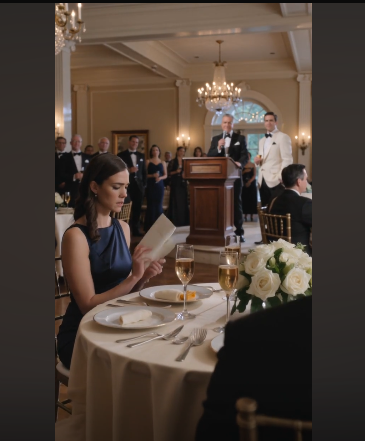
My Father-In-Law Mocked Me At Our Anniversary Gala, My Husband Struck Me Before 600 Guests, And One Missing Name On The Program Made My Quiet Phone Call Change The Whole Room Before Anyone Understood Who My Father Really Was That Night In Silence
The microphone trembled in my hand while my husband’s palm still burned on my cheek, and my father’s name stayed locked behind my teeth.
For three seconds, the ballroom did not know what to do with me.
Six hundred people sat beneath the crystal chandeliers at Oakridge Country Club, their silverware paused over bone china, their champagne glasses lifted halfway to their mouths, their faces turned toward the woman Preston Caldwell had just struck in front of them. I could feel the heat of the mark rising across my cheek. I could feel one strand of hair clinging to the corner of my mouth. I could feel, most clearly of all, the small folded program crushed inside my left hand.
My name was not in it.
That had been the first wrong thing I noticed when we arrived, though by then it was far from the first wrong thing in our marriage. The program had listed Richard Caldwell as founder, Preston Caldwell as vice president, Beatrice Caldwell as anniversary chair, and the Caldwell family as visionary stewards of the historic ballroom restoration. It thanked donors, trustees, architects, caterers, florists, and one harpist by name.
It did not thank me.
Now Richard, my father-in-law, stood behind the podium with a smile that belonged in a portrait over a fireplace, not on a living man. He looked satisfied, almost refreshed, as if insulting me had cleared the air for him. My husband stood five feet away from me, his hand lowered at his side, his white dinner jacket still neat, his expression caught somewhere between panic and anger that I had made him look bad.
Not that he had hurt me.
That I had made him look bad.
A laugh had moved through the room after the strike, nervous at first, then louder as people decided which side held the power. The sound had rolled over me like something spilled and cold. Some guests laughed because Richard laughed. Some because Preston’s friends laughed. Some because silence would have required courage.
I kept standing.
Preston leaned toward me, his voice low enough that the front tables could pretend they had not heard.
“Put that microphone down, Naomi.”
Behind him, Beatrice pressed two fingers to her pearl necklace and gave me the same little smile she used when a server brought the wrong salad fork. Richard’s eyes flicked to the program in my hand. For the first time all night, he seemed to notice what I was holding.
I looked at the glossy page again.
One missing name.
Not only mine, though mine hurt enough. Another name was missing, too, buried under the words anonymous preservation partner, as if a person’s work could be used without carrying the weight of that person’s truth.
Preston stepped closer.
“Don’t make me ask twice,” he said.
I almost laughed then, though not because anything was funny. My cheek ached. My throat felt tight. My marriage, which I had kept alive for ten years through compromise and careful silence, had finally shown me its plainest face in front of everyone it had spent years trying to impress.
I lowered the microphone.
The ballroom exhaled.
Then I walked away from the podium, past Preston, past Richard, past the long tables of guests who had decided my humiliation was easier to applaud than interrupt. I kept the program in my hand. I did not run. I did not sob. I walked through the side doors and into the empty corridor where the music from the ballroom became a muffled, expensive hum.
Only then did I take out my phone.
My thumb hovered over a number I had not called in months and had not asked for help from in years.
When he answered, I did not explain the slap or the laughter or the name missing from the program.
I said, “Dad, please come.”
He was silent for one breath.
Then he said, “Stay where you are.”
To understand why that single call changed the room, I have to go back to a quieter night, long before Richard Caldwell lifted his glass and turned me into a punchline.
Ten years earlier, I married Preston at the county courthouse on a rainy Thursday in March. We did not have flowers, music, or a reception. We had two witnesses from his office, a parking meter that expired halfway through the vows, and a dinner afterward at a little Italian place where the waitress brought tiramisu with one candle because she had overheard us say the word wedding.
I loved that dinner more than any gala I later attended.
Preston was different then, or maybe I was more willing to believe the soft version of him was the true one. He had expensive habits even before he had the income to support them, but he also had charm. He knew how to listen when he wanted something. He knew how to tilt his head as if my thoughts surprised him in the best possible way. He asked questions about old houses, about the smell of plaster dust after a wall was opened, about why I could stand in a sagging Victorian and see promise where other people saw rot.
I was thirty-three the night of the gala. Back when I met Preston, I was twenty-three and newly certified in historic real estate consulting. I spent my days crawling through attics, reading old permits, checking beams, and convincing developers that not every weathered building needed to be flattened for glass condos. I liked work that required patience. I liked things that could be saved if you understood where the damage began.
Preston liked things that gleamed.
He wore cuff links to casual dinners. He drove leased cars that were always a little beyond his means. He spoke of “legacy” before he had built anything of his own. His father, Richard Caldwell, owned Caldwell Capital, a regional wealth management firm that had turned family money into local influence. Preston worked there after business school and treated every title like a stepping-stone to a throne.
The first time he brought me to meet his parents, Beatrice Caldwell looked me over from my shoes to my earrings and said, “How wonderfully unfussy.”
I was wearing a black dress I had bought on sale.
“Thank you,” I said, because I was still young enough to mistake insult for manners if it wore enough perfume.
Richard asked about my family halfway through dinner. Preston had told him I was from Maine, which was true in the way a postcard is true if you never turn it over. My mother, Elaine Lane, had raised me mostly on the coast, in a house that smelled of salt, cedar, and damp wool. I used her last name professionally after my parents separated, because Lane felt like a life I had earned by hand.
My father’s last name was Whitaker.
That name meant something in certain rooms. Not everywhere. Not like a celebrity name. But in preservation circles, in charitable boards, in old New England foundations, in the quiet networks where crumbling theaters and schools and libraries were saved from becoming parking lots, Daniel Whitaker was treated with a kind of respect people usually reserved for judges, doctors, or men whose signatures could keep a roof over a community.
He had built the Whitaker Heritage Trust after making money in responsible redevelopment. He was not flashy. He did not buy yachts or pose for magazine spreads. He restored courthouses. He funded trade apprenticeships. He gave old buildings second lives and expected no applause unless applause helped the next project survive.
He was also stubborn, exacting, and deeply disappointed when I married Preston without asking him to walk me down any aisle.
“You are marrying a man who loves how you make him feel,” my father told me the week before the courthouse ceremony. “That is not the same as loving you.”
I did not speak to him for six months after that.
Pride is quieter than anger, but it can build thicker walls.
Preston knew my father existed. He knew I had a complicated relationship with him. He knew my father worked in historic preservation and philanthropy. He never asked much more because, in his mind, anything connected to me had already been categorized as modest. He heard Maine and pictured thrift. He heard old buildings and pictured dust. He heard father and assumed one more person he would not need to impress.
I let him assume.
At first, I told myself I was protecting something pure. I wanted Preston to love me without the Whitaker name opening doors ahead of me. I wanted to build a marriage out of ordinary trust, not family influence. When my father called, I often let it go to voicemail. When he sent articles about restoration projects, I replied days later. When he invited us to a trustees’ dinner in Boston, Preston said he had a client event, and I did not argue.
“Your father’s people can survive without us,” Preston said, kissing my forehead while scrolling through his phone.
My father noticed.
“He has never once been curious about where you come from,” he said during one of our stiff holiday phone calls.
“He’s busy,” I said.
My father sighed.
“So are men who care.”
I hated how often he was right.
Still, marriage has a way of training you to defend the very thing hurting you. Preston was not cruel every day. That would have made leaving simple. He could be attentive when no one important was watching. He remembered my coffee order. He sent flowers after arguments. He told me my work made him proud when we were alone in the kitchen and his father was not nearby.
But around the Caldwells, I became smaller.
At family dinners, Richard called my work “house doctoring” and laughed as if he had invented wit. Beatrice introduced me as “Preston’s sweet little preservation hobby.” Preston would squeeze my knee under the table, a warning disguised as affection.
“Dad’s old-fashioned,” he would say afterward. “Don’t take every little thing personally.”
Every little thing became a room I had to carry inside myself.
The first wrong detail in the ladder that led to the gala arrived six months before the anniversary night.
Preston came home late with a leather portfolio tucked under his arm and the bright, restless energy he got when Richard had praised him. I was at the kitchen island, cleaning mortar dust from under my fingernails with an orange stick. We were restoring the Oakridge ballroom then, though nobody in Preston’s family talked about it that way.
Oakridge Country Club had been built in 1912, when wealthy families still believed permanence could be carved into white stone. The ballroom had a coffered ceiling, arched windows, and a sprung maple floor worn dull by a century of dances, fundraisers, and whispered deals. The club wanted to modernize it without destroying it. Caldwell Capital wanted to host its tenth anniversary fund gala there and attach its name to the restoration as proof that the family did more than manage money.
My firm had been hired through a committee, not through Richard. I had spent months documenting the plasterwork, locating original plans, and arguing against cheap shortcuts. The Whitaker Heritage Trust, through a quiet grant, had covered the most expensive structural repairs. My father did not tell me at first. He never used gifts as hooks. I found out when I recognized the trust’s language in a funding memo and called him, irritated and moved in equal measure.
“I did not do it for you,” he said.
“You did,” I said.
“I did it because the building deserved better than bad taste and worse beams.”
That was my father’s love language. Care disguised as standards.
The night Preston brought home the leather portfolio, he tossed it onto the counter and opened it to a draft of the gala invitation. Thick cream paper. Raised navy lettering. A gold crest that had never existed in the Caldwell family until a branding agency invented it.
“You like?” Preston asked.
I wiped my hands on a towel and leaned closer.
Caldwell Capital Celebrates Ten Years Of Legacy And Vision At The Restored Oakridge Ballroom.
Under honorary hosts, the invitation listed Richard and Beatrice Caldwell. Under anniversary chair, Preston Caldwell. Under family guests, it listed Camille Caldwell Mercer and her husband, and several cousins I had met twice.
My line read: Preston Caldwell And Guest.
I stared at it until the letters blurred.
“Guest?” I asked.
Preston glanced over as if the word had wandered there by accident.
“It’s just a draft.”
“It says guest.”
“Naomi, nobody studies invitations.”
“I do,” I said. “It’s part of my job to notice what people try to make permanent on paper.”
He smiled, but it did not reach his eyes.
“Don’t turn this into one of your meaning things.”
One of my meaning things. That was what he called my habit of noticing tone, placement, omissions, the way a chair set six inches too far from a table could tell you exactly who was welcome.
I pushed the invitation back toward him.
“Tell them to use my name.”
“Of course,” he said quickly. Too quickly. “I’ll handle it.”
He closed the portfolio before I could look at the rest.
The consequence of that small omission was not immediate. It settled into me like grit. The next morning, I emailed the event coordinator directly with the correct wording. She replied within ten minutes, polite and relieved.
Thank you, Mrs. Caldwell. I was instructed to use the family-approved list, but I will make the correction.
Family-approved.
I read that phrase three times.
Then I forwarded it to Preston with no comment.
He did not respond until lunch.
Dad’s team is drowning in details. Please don’t make this awkward.
I did not answer. Instead, I drove to Oakridge and spent four hours on a scaffold checking repaired plaster medallions with a flashlight while the ballroom below filled with rental staff measuring for tables. It was easier to trust old ceilings than living people. Old ceilings at least told you where the cracks were if you looked long enough.
The second wrong detail appeared at Beatrice’s spring luncheon.
She hosted it on the terrace behind their house, where clipped hedges framed a pool nobody swam in because the water was more decorative than inviting. I arrived in a linen dress with my hair twisted low. Before leaving home, I had clipped the blue enamel hairpin above my right ear, partly because it had belonged to my mother and partly because Preston once said navy suited me better than black.
Beatrice greeted me with air beside my cheek.
“Naomi, darling. How practical you look.”
On the terrace, six women from Oakridge sat beneath striped umbrellas, talking about floral budgets and donor seating. A sample gala program lay open beside the place settings. I reached for one while Beatrice poured iced tea from a silver pitcher.
The cover was beautiful. The inside copy was not.
It thanked Caldwell Capital for “leading the restoration vision.” It thanked Richard for “his dedication to preserving community heritage.” It thanked Preston for “coordinating local expertise.” It thanked the Oakridge board, the floral committee, and the lighting designer.
My firm was listed nowhere.
Neither was the Whitaker Heritage Trust. The grant was described as “anonymous preservation support.”
I looked up.
Beatrice was watching me.
“Something wrong?” she asked.
“My company is missing.”
She blinked with theatrical confusion.
“Is it? Oh, I’m sure that was just space. Programs are so limited.”
“There’s an entire paragraph about the ice sculpture.”
One of the women looked down into her tea.
Beatrice smiled.
“Well, ice sculptures photograph beautifully.”
A few women laughed. Not loudly. Just enough to choose safety.
I could have said my father’s trust had paid to repair the beams above their heads. I could have said Richard had never once walked the ballroom with a flashlight while rain came through the old roof. I could have said preservation was not decoration for wealthy people to wear like a borrowed shawl.
Instead, I closed the program.
“Please add my firm.”
“Of course,” Beatrice said.
She did not write it down.
In the car afterward, I told Preston what happened.
He exhaled through his nose. “Mom is managing a hundred details.”
“This isn’t a detail.”
“It’s a gala program, Naomi.”
“It’s my work.”
“It’s my family’s night.”
That sentence sat between us at a red light.
He reached over and squeezed my hand.
“I didn’t mean it like that.”
But he had. We both knew he had. He meant the night belonged to the Caldwells, and I could be included only if inclusion did not interfere with the portrait they preferred.
That was the first time I almost called my father.
I did not. Pride again. Or maybe habit.
The third wrong detail came at Oakridge itself.
Three weeks before the gala, the club held a rehearsal luncheon for the planning committee in the newly restored ballroom. Sunlight poured through the arched windows and landed on the maple floor in pale rectangles. The ceiling medallions looked clean but not new, which was exactly the point. Good restoration should feel like respect, not erasure.
I arrived early with a folder of final notes. A young event assistant was placing cards along the front table. I found Richard’s name at the center, Beatrice to his right, Preston to his left. Camille and her husband were next. Then two major donors. Then a blank space where a chair had been pulled slightly back, as if someone had changed their mind about whether a person belonged there.
“Excuse me,” I said to the assistant. “Where am I seated?”
She flushed.
“I’m so sorry. Let me check.”
She hurried to a clipboard, ran her finger down the chart, and became even more uncomfortable.
“It says Mrs. Preston Caldwell at table nineteen.”
Table nineteen was behind a column.
I looked toward the front table again.
There was room for me. There had been room all along. The blank space was not an accident. It was a choice waiting to see if I would accept it.
Richard entered with Preston at his side, both men laughing about something on Richard’s phone. Richard wore a summer blazer and the expression of a man who believed every room improved when he entered it.
“Naomi,” he said. “There you are. We tucked you near the preservation people so you’d have someone to talk to.”
“I am the preservation person responsible for this room.”
He laughed.
“Exactly. You’ll be among your tribe.”
Preston gave me a look. Not sympathy. Warning.
I kept my voice calm.
“I’ll sit beside my husband.”
Richard’s smile thinned.
“This is a formal seating arrangement.”
“Then formally arrange it.”
The assistant stared at the floor. Preston stepped closer and lowered his voice.
“Can we not do this in front of staff?”
That phrase followed me home. In front of staff. Not in front of my wife. Not in front of the person being excluded. His concern was always the audience, never the wound.
That night, Preston apologized with takeout sushi and a bottle of wine I did not drink.
“I talked to Dad,” he said. “You’ll be at the front table.”
“Because you told him I belong there?”
“Because I told him it mattered to you.”
Those were not the same thing.
I picked up a piece of ginger with my chopsticks and set it back down.
“Do you think I belong there?”
He leaned back, tired of being asked to choose words carefully.
“You’re my wife. Of course you belong with me.”
“With you,” I said. “Not beside me. Not in your family. With you.”
He rubbed his forehead.
“You always make language so exhausting.”
“No,” I said. “I listen when people reveal themselves.”
He did not like that.
The fourth wrong detail arrived as a promise.
One week before the gala, I found Preston standing in our bedroom in front of the mirror, practicing a toast. He had written notes on index cards and lined them along the dresser. His voice had the smooth, polished sound he used for client presentations.
“To my father, whose discipline gave us our foundation. To my mother, whose grace gave us our home. To the Caldwell family, whose legacy—”
I waited.
He noticed me in the mirror and stopped.
“What?”
“Is there a part where you mention me?”
His shoulders tightened.
“I wasn’t finished.”
“Then finish.”
He looked at the cards.
I saw his eyes move over them. I saw him decide not to lie because the lie would be too easy to check.
“I was going to thank you privately.”
“For restoring the ballroom where six hundred people will be sitting?”
“For supporting me,” he said.
“Supporting you is not the same as doing the work.”
He turned around.
“This night is important to my father.”
“It is our anniversary, too.”
His expression softened, because that part still had power. Our tenth wedding anniversary had become folded into Caldwell Capital’s tenth gala because Richard liked symbolism when it centered him. Preston had promised we would celebrate privately after the event. A weekend away, he said. A quiet place with no family.
“I know,” he said. “And I’m grateful for you.”
“Say it there.”
He stared at me.
“Naomi.”
“Say my name in that room.”
“You want a public thank-you?”
“I want not to be erased.”
He came toward me and took my hands.
“Fine,” he said. “I’ll say your name.”
I studied his face.
“No. Not fine. Promise me.”
He closed his eyes for one second, as if my need for basic respect caused him physical fatigue.
“I promise.”
I held on to that promise longer than it deserved.
The day of the gala arrived bright and hot, with that polished late-summer sunlight that makes every window look expensive. I spent the morning at Oakridge checking final details. Florists carried white roses through the service entrance. Lighting technicians adjusted uplights along the columns. A chef shouted about timing from the kitchen corridor. The ballroom smelled faintly of wax, lilies, and the old maple floor after its final buffing.
For a moment, before anyone else arrived, I stood in the center of the room and looked up.
We had saved it.
Not perfectly. Buildings never return to what they were. People don’t either. But we had given it strength without stripping its age. We had repaired the beams, cleaned the plaster, restored the windows, and let the room breathe again.
My phone buzzed.
A text from my father.
Thinking Of The Ballroom Today. Remember, A Restored Room Still Needs Honest People Inside It.
I almost smiled.
Then another message came in from Preston.
Please Don’t Wear Anything Too Plain Tonight. Dad Has Photographers.
The smile left me.
At home, I chose a navy gown off the rack from a boutique that did not serve champagne while you shopped. It fit well and moved easily. I wore small pearl earrings, my wedding ring, and no necklace. I did not want to look like I was competing with Beatrice’s diamonds or Camille’s taste for sparkle. I wanted to look like myself.
Preston walked into the bedroom wearing a white dinner jacket and a black bow tie. He stopped when he saw me.
“You look beautiful,” he said.
For a second, I believed him without bracing.
“Thank you.”
His eyes moved to my hair, my dress, my shoes.
“Maybe the emerald earrings instead?”
“They’re heavy.”
“They photograph well.”
I looked at him in the mirror.
“I’m not a centerpiece.”
He kissed the back of my shoulder.
“Tonight, can we please not make everything a statement?”
I should have heard the warning in that. Instead, I put on the emerald earrings because peace often begins with small surrenders, and small surrenders become the architecture of a life.
The car ride to Oakridge was quiet. Preston answered messages, his face lit blue by his phone. I watched the city pass outside the window and thought about my father’s text. Honest people inside it. I wondered whether a room could reject dishonesty the way old wood rejected cheap stain.
At Oakridge, valet attendants moved with crisp urgency beneath a white canopy. Guests arrived in gowns, tuxedos, and the satisfied laughter of people accustomed to being welcomed. A photographer asked Preston and me to stand near the entrance. Preston placed his hand on my waist with practiced ease.
“Closer,” the photographer said.
Preston pulled me in.
His fingers pressed harder than they needed to.
“Smile,” he murmured.
“I am.”
“Like you mean it.”
Flash.
Inside, the ballroom glowed. Crystal chandeliers scattered light across the restored ceiling. Tall arrangements of white roses stood on every table. The string quartet played near the windows. Waiters moved through the crowd with trays of champagne and sparkling water.
A woman at the registration table handed Preston two programs.
He took both.
I reached for mine.
He hesitated, then handed it over.
That was when I saw it again.
The final printed program had not been corrected. My firm was missing. My father’s trust was missing. Richard’s name appeared six times. Preston’s appeared four. Beatrice’s appeared three. Mine appeared nowhere, not even as wife, guest, consultant, or human being attached to the man whose ring I wore.
I ran my thumb over the page.
Paper can feel heavy when it carries an insult.
Preston leaned close.
“Please don’t start.”
“You promised.”
“I promised to mention you.”
“That is not the same as fixing this.”
His jaw tightened.
“Naomi, there are six hundred people here.”
“I know. That’s why they printed six hundred lies.”
His eyes hardened.
“Lower your voice.”
There it was again. Not, You are right. Not, I’m sorry. Lower your voice.
We moved toward the front table. A place card with my name sat beside Preston’s, at least. Someone had fixed that much. But the card read Mrs. Preston Caldwell.
Not Naomi.
Not Naomi Lane.
Not even Naomi Caldwell.
Mrs. Preston Caldwell.
I touched the folded card with two fingers.
Preston saw.
“It’s traditional.”
“So is erasure.”
“God, Naomi.”
Beatrice appeared before he could say more. She wore silver silk and enough diamonds to light a hallway during a power outage.
“Isn’t the room magnificent?” she said.
“It is,” I replied. “The plaster medallions held beautifully.”
Her smile flickered.
“Yes, well, the committee did wonders.”
“The restoration crew did wonders.”
“Of course, dear.”
Richard approached with a glass already in hand. He kissed Beatrice’s cheek, clapped Preston on the shoulder, and looked at me as if I were a chair he had not ordered.
“Naomi,” he said. “Try to enjoy yourself tonight. These events can be overwhelming for people outside the usual circles.”
“I’ll manage.”
“I’m sure you will.” He leaned closer, smiling. “Just remember, tonight is not one of your dusty job sites. No lectures about beams.”
I looked at Preston.
He laughed under his breath, not because it was funny, but because Richard expected it.
I set my program beside my plate and folded my hands in my lap.
That was my restraint. Not silence, exactly. Restraint. Silence would have meant surrender. Restraint meant I was choosing the hour.
Dinner began. Toasts followed. Richard spoke first about market discipline and family vision. Beatrice thanked the floral committee and the club staff. Preston rose next, holding his index cards.
I felt my body prepare itself for a crumb.
He thanked his father. His mother. The partners at Caldwell Capital. The Oakridge board. The donors. The event team. The caterer. The musicians. His sister for “bringing joy to every table.”
Then he looked down at the final card.
For one heartbeat, I saw my name sitting there between us like a small animal waiting to be spared.
He slipped the card behind the others.
“And most of all,” he said, lifting his glass, “to the Caldwell legacy, which is only beginning.”
Applause filled the ballroom.
I did not move.
Something in me did not break. It aligned.
The program in my hand. The guest line. The luncheon page. The chair behind the column. The promise skipped at the podium. The place card that made me an attachment instead of a person.
A pattern is just a truth repeating itself until you stop pretending it is an accident.
Richard returned to the podium after dessert, flushed with praise and wine. The string quartet quieted. Waiters stepped back. Six hundred guests turned toward him.
“My friends,” he began, “tonight has been a celebration of vision.”
His voice filled the room, warm and practiced.
“Ten years ago, Caldwell Capital was built on a simple principle. Families of quality have a responsibility to preserve what matters. Wealth, property, reputation, heritage. These are not accidents. They are cultivated through discipline, taste, and, if I may be old-fashioned, breeding.”
A murmur moved through the crowd. Some approved. Some were too comfortable to object.
Richard smiled toward Preston.
“My son understood that principle early. Preston could have married into any number of families represented in this room tonight.”
My stomach went cold.
Preston shifted in his chair.
Richard looked directly at me.
“And yet, in a gesture of astonishing generosity, he chose a different sort of project.”
A few people chuckled.
Beatrice lowered her eyes to hide her smile.
Richard continued.
“He saw potential where others might have seen dust. He brought refinement to a woman who spent her days poking around rotten houses and calling it expertise.”
The laughter widened.
I kept my hands folded, but my thumb pressed into the program so hard the paper bent.
“He gave her a place at our table,” Richard said. “And if that is not charity in its purest form, I do not know what is.”
The room laughed.
Not everyone, perhaps. I know that now. Memory is cruel when it gathers a crowd into one sound. But enough laughed that it felt like everyone. Enough that the chandeliers seemed to shake with it. Enough that the women at the next table looked away instead of looking at me. Enough that the old man who had praised the restored ceiling earlier tapped his glass with amusement.
I turned to Preston.
He did not look ashamed. He looked strained, embarrassed by the wrong thing.
He lifted his glass.
Richard lifted his back.
They clinked across the small space between them.
The sound was almost delicate.
That was when I stood.
My chair legs whispered against the restored floor. The laughter thinned, surprised by movement. I picked up the microphone from the small stand near the musicians before anyone thought to stop me. The metal was cool in my hand. My voice, when it came, was steady enough to frighten me.
“Richard,” I said, “you keep talking about foundations.”
The room quieted.
Preston’s head snapped toward me.
I looked at my father-in-law.
“I spend my days studying them. I know the difference between a house that has settled honestly and one that has been decorated to hide rot.”
A rustle moved through the tables.
Richard’s smile hardened.
“That’s enough,” Preston said.
I did not look at him.
“You called me charity,” I continued. “But charity is not taking credit for work you did not do. Charity is not using anonymous generosity while mocking the hands that made the room safe enough for your speech.”
Richard’s face changed by one degree. Not fear yet. Recognition.
Preston stood.
“Naomi.”
I held up the program.
“My name is missing from this program.”
A few heads bent over their own copies.
“So is another name,” I said. “A name you were happy to accept on grant papers and private letters but apparently too proud to say aloud in front of your friends.”
Preston moved fast.
He reached me before I finished the next sentence. I saw his eyes, bright with rage and panic, not because I was wrong, but because I was disobeying him publicly.
“Put it down,” he said.
“No.”
The word was small. It traveled.
His hand struck my cheek before the room had time to understand the motion.
I staggered one step. The microphone squealed. A sharp, shocked sound rose and fell across the ballroom. Then came the laughter, scattered and ugly, from people who mistook cruelty for control because control was what they had always rewarded.
The blue enamel hairpin loosened and dropped against my shoulder, tugging a strand of hair down with it.
Preston breathed hard.
“You don’t get to embarrass this family.”
I looked at him then, really looked. At the man I had defended to my father. At the man I had cooked for, listened to, believed, excused. At the man who had just shown six hundred people that he thought my dignity was negotiable if his status was at risk.
I lowered the microphone.
Not because he told me to.
Because I knew exactly what I needed to do next.
The corridor outside the ballroom felt too bright after the amber glow inside. My heels sank into the carpet runner. Behind the closed doors, voices rose in a confused wash. Someone laughed again, shorter this time. Someone else shushed them. The party was trying to decide whether it had witnessed an awkward marital moment or the first crack in the Caldwell wall.
I kept walking until I reached the alcove near the old cloakroom.
There was a mirror there, framed in dark wood, original to the club. I had argued for keeping it when the design team wanted something sleeker. Its glass was slightly wavy with age. My reflection looked bent but not broken.
My cheek reddened under the makeup. My hair had loosened. One emerald earring had twisted sideways. I set the program on the narrow table beneath the mirror and smoothed it flat.
My name was still missing.
The calm that came over me was not peace. It was the mind’s last mercy before a decision.
I took out my phone.
My father answered on the second ring.
“Naomi?”
His voice was deep, quiet, and instantly alert. He had always answered my calls like he was already standing.
“Dad,” I said.
My throat tightened for the first time.
I swallowed it down.
“Please come.”
A silence.
Then, “Where are you?”
“Oakridge.”
Another silence, sharper.
“The gala?”
“Yes.”
“What happened?”
I looked at the program. I looked at my cheek in the old mirror.
“I need you to come as Daniel Whitaker,” I said. “Not as my rescue. As yourself.”
His breathing changed.
“Is Preston with you?”
“In the ballroom.”
“Did he touch you?”
I closed my eyes.
“Please come.”
His voice went flat in the way it did when anger became discipline.
“Stay visible. Do not leave with him. I am twelve minutes away.”
The line ended.
I stood in the alcove holding the silent phone, and for the first time that night I let my shoulders drop. Not in defeat. In release. I had spent ten years trying to prove I did not need my father’s name to be worthy of love. I still believed that. What I no longer believed was that hiding the truth made anyone love me better.
A door opened down the corridor.
Preston stepped out.
He had fixed his face into concern. That was almost the worst part. In the ballroom, he had been anger. In the corridor, he became performance.
“Naomi,” he said softly.
I slid my phone into my clutch.
He approached with both hands slightly raised, as if calming a skittish animal.
“Come on. Let’s not do this here.”
“Do what?”
“Turn a family misunderstanding into a spectacle.”
My cheek pulsed.
“You struck me in front of six hundred people.”
His eyes flicked toward the closed ballroom doors.
“Lower your voice.”
There it was again. The old command in new clothes.
I picked up the program from the table.
“No.”
He stared at me.
“I know you’re upset.”
“Do you?”
“You embarrassed me.”
I almost smiled.
“That is what you think happened?”
“You grabbed a microphone during my father’s anniversary gala and implied he stole credit from you.”
“He did steal credit from me.”
“It was one program.”
“It was six months of programs.”
He looked confused for half a second, then irritated that I had remembered.
“That’s what this is about? Your little name issue?”
I held the program between us.
“This is about every time you asked me to become smaller so you could stand taller.”
His face hardened.
“Don’t talk like that.”
“Why? Because it sounds true?”
He stepped closer.
“You need to apologize to my father.”
The absurdity of it landed so cleanly I felt almost grateful.
“No.”
“You will.”
“No, Preston.”
His mouth tightened. He was not used to hearing the second no. The first could be dismissed as emotion. The second required recognition.
“You have no idea what you’re risking,” he said.
“I know exactly what I’m done protecting.”
For a moment, he looked genuinely afraid. Then pride came to cover it.
“You think anybody in there cares about your feelings? Those people are my father’s investors, friends, partners. They know who matters.”
I looked past him toward the corridor windows, where headlights moved along the curved drive.
“So will he.”
“Who?”
I did not answer.
The first black sedan pulled up beneath the canopy. Not a motorcade. Not a spectacle. My father hated spectacle. Just a plain black car with rain dust from the road along its doors. He stepped out before the driver could open his umbrella, tall and silver-haired in a dark suit, moving with the steady weight of a man who had spent his life entering rooms that thought they were too important for him.
Preston turned.
He frowned, searching his memory for a category.
My father walked through the entrance with Eleanor Brooks beside him, the president of the Oakridge board. Behind them came two trustees I recognized from preservation meetings, both dressed for the gala but not smiling. Eleanor’s eyes found my cheek. Her face tightened.
My father’s eyes found it next.
I saw the fury pass through him like weather across stone. He did not shout. He did not touch Preston. He did not perform outrage for the corridor.
He came to me and stopped.
“Naomi,” he said.
I had not heard my name spoken with such care all night.
“I’m all right.”
“No,” he said quietly. “You are standing.”
That was different.
He looked at Preston.
Preston’s polite face returned too late.
“Mr.—”
“Whitaker,” my father said.
Preston blinked.
“Daniel Whitaker.”
The name worked through him slowly, then all at once. I saw it happen. The letters connected to the grant applications. To the preservation trust. To the anonymous donor. To the man Richard had been trying to court for the Caldwell Renewal Partnership for more than a year.
Preston’s color shifted.
Eleanor Brooks stepped forward.
“Mrs. Caldwell,” she said to me, ignoring him. “Would you like a private room?”
“No,” I said.
My father watched me.
“What do you want?”
It was the question he had asked me in different forms my whole life, though I had often mistaken it for pressure. What do you want to build? What do you want your name attached to? What do you want to tolerate?
I looked toward the ballroom doors.
“My name back.”
He nodded once.
“Then take it.”
Preston stepped between us.
“Wait. This is getting completely out of hand.”
My father looked at him with a stillness that made Preston falter.
“You should move.”
Preston did.
Not far. But enough.
We entered the ballroom together.
The sound changed before the people understood why. Conversations faded from the corridor side first, then table by table as guests turned to see who had come in. Richard was back at the podium, trying to mend the evening with a joke about high spirits and family passion. He stopped mid-sentence.
Eleanor Brooks walked ahead of us. My father did not take my arm. He walked beside me, not in front of me. That mattered. He could have made himself the center of the room. Instead, he let the room watch me return.
The program was still in my hand.
Richard’s eyes locked on my father and widened.
“Daniel,” he said, too warmly. “I didn’t realize you had arrived.”
My father did not answer.
Richard tried again.
“What an honor. We were just celebrating the very room your trust so generously—”
“Were you?” my father asked.
The question was mild. The silence after it was not.
Eleanor reached the podium and gently removed the microphone from Richard’s hand. He looked offended, then uncertain, then alarmed as she turned to me.
“Naomi,” she said.
She knew my name. She had always known my name.
I took the microphone.
This time, my hand did not tremble.
“I apologize for interrupting dinner,” I said.
A few people shifted in their chairs, embarrassed now that power had changed shape.
“I know this evening was meant to celebrate Caldwell Capital’s tenth anniversary, my father-in-law’s legacy, and my husband’s role in the family firm. I also know many of you were told this ballroom was restored because of Caldwell vision.”
Richard opened his mouth.
Eleanor looked at him.
He closed it.
I lifted the program.
“This program is missing two names.”
No one laughed.
“The first is mine. I am Naomi Lane Caldwell. Professionally, Naomi Lane. I spent the past year consulting on the restoration of this room. I reviewed the original plans, argued for the maple floor beneath your chairs, fought to preserve the plaster above your heads, and warned the committee when decorative shortcuts threatened the structure.”
I paused.
The chandeliers glowed over six hundred lifted faces.
“The second name is Daniel Whitaker.”
A murmur moved through the crowd.
“My father,” I said.
Preston, still near the side doors, looked as if the floor had tilted.
“The Whitaker Heritage Trust funded the structural repairs that allowed this room to reopen safely. My father chose not to be listed as a donor because he believes work matters more than applause. Tonight, his anonymity was used by people who accepted his support, removed his name, removed mine, and then mocked the very work that made this celebration possible.”
Richard’s face had gone gray around the mouth.
I looked at him.
“You called me charity.”
The room tightened.
“You were right about one thing. Charity was present tonight. It was in the beams your family could not afford to repair without help. It was in the grant letters you signed. It was in the quiet confidence of people who trusted you to honor a building honestly.”
My voice stayed level.
“It was not in my marriage.”
Preston flinched.
That gave me no satisfaction. It simply confirmed he had heard me.
Richard tried to laugh. The sound died quickly.
“Naomi, surely this could have been handled privately.”
I turned toward him fully.
“You made my humiliation public. I am making the correction public.”
No one moved.
My father stepped to the side of the podium then, not taking the microphone, only standing where people could see him clearly.
“The Whitaker Heritage Trust will not continue any partnership with an organization that uses preservation as a costume for vanity,” he said. “Our commitment to Oakridge remains. Our confidence in the Caldwell Renewal Partnership does not.”
A low ripple moved through the ballroom. Investors leaned toward one another. Board members exchanged looks. Beatrice sat frozen, her diamonds bright against her throat. The social structure Richard had built for the evening did not collapse dramatically. It did something worse for him.
It withdrew permission.
Eleanor Brooks took the microphone from me with both hands, as if receiving something breakable.
“On behalf of the Oakridge board,” she said, “I want to acknowledge Ms. Lane’s work and Mr. Whitaker’s support. We will issue a corrected statement tomorrow morning. Tonight’s partnership announcement is postponed.”
Postponed was a polite word. Everyone in that room understood it meant dead.
Richard gripped the podium.
Preston crossed the room toward me, suddenly pale with urgency.
“Naomi,” he said. “Can we talk?”
I looked at him, and for once I did not search for the man I wanted him to be.
“No.”
“Please. I didn’t know.”
“That’s not a defense. It’s the whole problem.”
He swallowed.
“I didn’t know he was your father.”
“You knew I was your wife.”
The line landed harder than I expected. Not because it was clever. Because it was plain.
He looked around, aware of the watching room, and his voice dropped.
“Don’t end us like this.”
I thought of the courthouse tiramisu, the candle, the rain, the years I had spent arranging my hurt into explanations that made him easier to love.
“You ended us when you chose applause over my face.”
His eyes filled, though whether from remorse or fear I could not tell. It no longer mattered.
My father came beside me.
“Are you ready to leave?”
I looked at the restored ceiling one last time.
The room was still beautiful. That comforted me. Their ugliness had not ruined the work.
“Yes,” I said.
We walked out through the same side doors I had used earlier, but the second time was different. Guests stood as we passed. Some out of respect, some out of discomfort, some because they did not know what else to do when a woman they had laughed at returned with her name in her own mouth.
In the corridor, my legs began to shake.
My father noticed but did not make a show of it. He offered his arm. I took it.
Outside, the air smelled of summer rain on pavement. The storm had not begun yet, but clouds had gathered low over the trees. My father’s car waited at the curb. Before I got in, I turned back toward Oakridge.
Preston stood under the canopy, alone now, his white jacket bright and ridiculous in the darkening evening. He looked like a man who had misplaced the script to his own life.
He did not call after me.
Maybe he finally understood that my silence was no longer something he owned.
At my father’s house, the kitchen lights were warm.
He lived in a restored brick carriage house at the edge of the city, not the grand estate people imagined when they heard the Whitaker name. There were books stacked on chairs, rolled drawings on the long table, and an old copper kettle that whistled whether you wanted drama or not. He made tea without asking because grief, in our family, had always been handled first through hot water.
I sat at the kitchen table while he filled a dish towel with ice and handed it to me.
“Hold that gently,” he said.
I pressed it to my cheek.
For several minutes, neither of us spoke.
The silence between us was different from the ballroom silence. It did not demand performance. It gave me a place to land.
Finally, he sat across from me.
“I should have insisted on meeting him properly.”
I shook my head.
“I would have hated you for it.”
“You did hate me for less.”
I almost smiled.
“Yes.”
His face softened.
“I am sorry I made it difficult to come home.”
My throat tightened again.
“I thought coming home meant admitting I failed.”
“No,” he said. “Coming home means the door still works.”
That broke something in me, but quietly. No dramatic sobbing. No collapse. Just tears sliding down my face while I kept the towel against my cheek and tried not to make a sound.
My father reached across the table and covered my free hand with his.
“You built your life with your own hands,” he said. “That was never the mistake.”
“What was?”
“You mistook endurance for proof of love.”
I looked at our hands.
He had work scars on his knuckles, old ones from before the trust, before the meetings, before people started calling him a philanthropist. He had built things before he funded them. Maybe that was why he knew the difference between structure and decoration better than anyone I had ever met.
“I kept thinking if I didn’t use the Whitaker name, the marriage would be honest.”
“Was it?”
“No.”
The answer came easily. That hurt more than doubt.
The next morning, I woke in the guest room under a quilt my mother had made before she died. Sunlight pressed through linen curtains. My cheek had faded from hot red to a deep ache. My phone held thirty-seven missed calls from Preston, fourteen from Beatrice, five from Richard, and one text from a number I did not recognize.
You Need To Fix What You Did.
No signature. It did not need one.
I deleted it.
Preston’s messages shifted in tone as the hours passed. The first was angry. The second defensive. The third wounded. By the seventh, he had discovered fear.
Naomi, Please Call Me. Dad Is Furious But He’ll Calm Down.
Naomi, The Club Is Making A Statement. You Need To Tell Them This Was A Misunderstanding.
Naomi, I Love You. Don’t Let Your Father Poison This.
That one made me sit very still.
For ten years, Preston had benefited from my distance from my father. He had called it independence. He had praised my refusal to “hide behind family.” Now that the distance no longer served him, my father became poison.
I did not reply.
Instead, I drove to our house with my father following in his own car. Not because I needed protection exactly, but because I was done performing bravery for men who mistook it for permission.
The house Preston and I shared was a 1920s Colonial Revival that had been badly renovated before we bought it. I had spent three years undoing careless work. I stripped paint from the staircase by hand. I found period-appropriate tile for the downstairs bath. I replaced hollow-core doors with salvaged wood. Preston liked to tell guests we had restored the house, but he usually said it while standing in rooms where he had complained about dust for months.
His car was in the driveway.
My father parked at the curb and stayed there.
“I’ll be here,” he said.
“I know.”
Inside, the house smelled like coffee and expensive panic. Preston stood in the foyer wearing yesterday’s dress shirt, sleeves rolled, bow tie gone. He looked exhausted. For a heartbeat, habit stirred. I wanted to ask if he had slept. I wanted to move toward the version of us where I took care of him after hard nights.
Then he spoke.
“Do you have any idea what you’ve done?”
The habit died.
“I came for my things.”
“We need to talk.”
“No. We needed to talk when the first invitation said guest. We needed to talk when your mother erased my company from the program. We needed to talk when your father mocked me in public and you lifted your glass.”
He flinched at that.
“I was in shock.”
“You were smiling.”
His face tightened.
“You humiliated my father.”
“He humiliated himself.”
“You don’t understand these circles.”
“I understand them better than you think.”
There it was again, the shadow of the truth he had not cared enough to learn.
I moved toward the stairs.
He blocked me.
“Don’t walk away from me.”
I stopped, not because he blocked the stairs, but because I no longer wanted to step around the obvious.
“Move.”
He stared at me.
For the first time, the word worked. He moved.
In the bedroom, I packed two suitcases. Practical clothes. Work files. My mother’s quilt. A framed photograph of an old schoolhouse restoration I had completed before meeting Preston. My wedding dress was not there because I had never had one. That felt suddenly merciful.
Preston stood in the doorway watching me.
“I didn’t know about your father,” he said again, weaker now.
I folded a sweater.
“That keeps sounding like an apology to yourself.”
“What do you want me to say?”
“The truth.”
He laughed once, harsh and tired.
“Fine. I was embarrassed.”
I looked up.
“By me?”
“By the way you made everything about respect.”
I waited.
He rubbed both hands over his face.
“You don’t get what it was like growing up with him. Nothing was ever enough. You think I wanted to disappoint him in front of that room?”
“No,” I said. “I think you were willing to sacrifice me so you wouldn’t have to.”
He looked away.
That was the closest he came to honesty.
I closed the suitcase.
“I can be sorry for the boy your father raised,” I said. “I cannot stay married to the man who chose to become him.”
His mouth opened. Closed.
Downstairs, my father carried one suitcase to the car. I carried the other myself. Preston followed us to the porch but did not step past the threshold.
“Naomi,” he said.
I turned.
For one wild second, I thought he might say my name like it belonged to me.
Instead, he said, “What am I supposed to tell people?”
I looked at him for a long time.
“Try the truth. It will be new for you.”
Then I left.
The weeks after the gala were not triumphant. People who like revenge stories often skip that part. They imagine the moment of reversal as an ending, but real endings have paperwork, toothbrushes in unfamiliar bathrooms, and mornings when your hand reaches across a bed before remembering no one worth reaching for is there.
I moved into the small apartment above my office. It had uneven floors, steam heat, and a view of a brick wall softened by ivy. I liked it immediately. The windows stuck in humid weather. The kitchen had one drawer that never closed all the way. The ceiling sloped near the bedroom because the building had settled over a century. It felt honest.
Work came back in waves.
Eleanor Brooks issued the corrected Oakridge statement the morning after the gala. It named my firm. It named the Whitaker Heritage Trust. It described the restoration accurately and thanked the craftspeople, engineers, and apprentices who had done the work. It did not mention the Caldwells beyond acknowledging Caldwell Capital had hosted the event.
That omission did more damage to Richard than any insult I could have written.
Two trustees resigned from the Caldwell Renewal Partnership within days. A donor lunch was quietly canceled. Oakridge paused its relationship with Caldwell Capital, citing “alignment concerns.” In the language of polite institutions, alignment concerns meant nobody wanted to stand close when the stain spread.
Richard sent one email.
Naomi, Emotions Were High. I Regret Any Words That May Have Been Misinterpreted.
I printed it, not because I needed it, but because some apologies deserve to be seen in their full cowardice. Then I wrote one line beneath it in pencil.
No.
I pinned it to the corkboard over my desk for one week, then threw it away.
Beatrice tried a different route. She mailed a handwritten note on thick stationery edged in silver.
My Dear Naomi, Surely We Can Agree That Family Matters More Than Public Embarrassment.
I turned the card over, hoping for more, maybe some accidental glimpse of humanity. There was none.
Family, to Beatrice, meant the people whose comfort mattered. Public embarrassment meant mine had become visible.
I did not respond.
Preston came by the office twice. The first time, I saw him through the front window and locked the door before he reached it. He stood outside in a navy suit, holding flowers wrapped in brown paper. For a moment, he looked like a man from the beginning of our story, the one who asked about old houses and listened with his whole face.
Then he checked his reflection in the glass.
I stepped back from the window.
The second time, my father happened to be there reviewing plans for an apprenticeship center we had begun discussing. Preston saw him through the glass and left without knocking.
My father said nothing.
He did not need to.
By October, the separation had become a fact instead of a fresh wound. I changed my professional name to Naomi Lane Whitaker, not because I needed the protection of both names, but because I was tired of cutting myself in half to make other people comfortable. The first time I typed it under a proposal, I sat there for a full minute looking at the signature.
It felt less like claiming power than telling the truth.
My father and I did not repair our relationship in one conversation. Repair is a craft. It requires scraping, patience, and the humility to discover damage you caused by trying to prevent other damage. We had coffee every Wednesday morning at my office. At first, we talked mostly about projects. Rooflines. Grant cycles. Window restoration. Safe topics with load-bearing walls.
Then one morning, he brought a cardboard box.
“What is that?”
“Your mother’s files.”
I went still.
He set the box on my worktable.
“She kept copies of your early sketches. Notes from college. Photographs from your first site visit. I should have given them to you years ago.”
I opened the flaps.
Inside were folders labeled in my mother’s handwriting. Naomi, Age Eleven, Courthouse Drawing. Naomi, Internship. Naomi, First Proposal. I touched the tabs carefully, as if they might dissolve.
“She knew what you were,” my father said.
“And what was that?”
“A builder with inconvenient feelings.”
I laughed before I cried.
That afternoon, after he left, I found a photograph at the bottom of the box. My mother stood beside me outside a weathered blue house in Maine. I was sixteen, sunburned and serious, holding a clipboard too large for my body. My mother’s hand rested on my shoulder. Her face said she trusted what I could see.
I placed the photograph on my desk.
Not hidden. Not in a drawer. On the desk.
The next project that changed me was not grand.
A women’s community organization called Harbor House reached out about an abandoned Victorian on Cedar Street. They wanted to turn it into transitional housing and job-training space for women rebuilding after controlling marriages, financial pressure, and family estrangement. The building had been vacant for seventeen years. Developers had written it off. The porch sagged. The roof leaked. The back staircase was unsafe.
I walked through it on a cold morning with dust in the air and a flashlight in my hand.
The director, a woman named Marla James, apologized every few minutes.
“I know it’s rough.”
“It’s standing,” I said.
“Barely.”
“Barely counts.”
In the front parlor, sunlight came through cracked shutters and landed on a mantel with chipped tile. Someone had painted the woodwork white decades earlier, badly. Underneath, I could see the outline of old oak.
Marla watched me touch the mantel.
“You see something here?”
“Yes.”
“What?”
I looked around the room.
“A place that was neglected but not finished.”
She smiled a little.
“That sounds like most of us.”
I took the job for a reduced fee. My father’s trust funded the structural work. Not anonymously this time. The grant plaque listed Whitaker Heritage Trust, Harbor House, and Naomi Lane Whitaker Preservation Consulting. It also listed the names of the apprentices, carpenters, plasterers, electricians, roofers, and volunteers who helped bring the house back.
No missing names.
I made sure of that.
The work steadied me. Each day had a task. Remove damaged plaster. Shore up the staircase. Document original trim. Meet with contractors. Drink bad coffee from paper cups while standing in rooms that slowly remembered themselves. My body began to trust mornings again.
One evening in December, I stayed late at Cedar Street after the crew left. Snow tapped lightly against the boarded front windows. I stood alone in the half-finished parlor and listened to the old house settle around me.
My phone buzzed.
Preston.
I had not blocked him. Not out of hope. Out of evidence. Sometimes it helps to watch a pattern continue until you no longer mistake it for possibility.
His message was short.
I Went Too Far. But You Let Your Father Destroy My Life.
I stared at the words.
Then I typed back for the first time since leaving.
You Destroyed My Trust. My Father Only Entered The Room After You Did.
I sent it and blocked him.
The quiet afterward felt clean.
The Cedar Street opening happened the following spring.
By then, the gossip had aged into fact. People spoke of the Caldwell gala in lowered voices at lunches, not because they cared deeply about my pain, but because society loves a fall when it can pretend to be a moral lesson. Richard resigned from two boards. Beatrice stopped appearing at Oakridge for several months, then returned with softer jewelry and a tighter smile. Preston left Caldwell Capital by “mutual agreement,” which was another polite phrase carrying an entire wreck beneath it.
I did not follow every detail. That restraint surprised me. At first, I thought dignity would require constant proof that they suffered consequences. Instead, dignity became the freedom not to keep checking.
On the morning Cedar Street opened, the sky was pale blue and sharp with spring wind. Volunteers tied ribbon across the porch. Marla cried twice before guests arrived and blamed pollen. My father wore a gray suit and stood near the back of the crowd, trying not to look proud and failing completely.
I wore a cream coat over a navy dress. My cheek had healed long ago, though sometimes, when I was tired, I imagined I could still feel the outline of that night. Memory is like an old repair. It holds, but you know where the break was.
Just before the ceremony began, I took the blue enamel hairpin from my pocket and fastened it into my hair. My hands were steady. My mother had worn it to meetings where men tried to speak over her. I had worn it once trying to be acceptable inside a family that did not want me. Now I wore it because I wanted every version of myself present: the daughter, the wife, the consultant, the woman who left, the woman who returned, the woman who built.
Marla handed me the scissors for the ribbon.
“You ready?”
I looked out at the people gathered on the sidewalk. Apprentices in work boots. Oakridge board members. Harbor House staff. My father. Women who would soon sleep upstairs in rooms with repaired windows and solid doors.
“Yes,” I said.
Before cutting the ribbon, I stepped to the small microphone.
“I used to think restoration meant bringing something back to what it was,” I said. “But that is not true. Restoration is not pretending damage never happened. It is learning what can be saved, removing what keeps harming the structure, and giving what remains a stronger way to stand.”
The wind lifted the ribbon slightly.
“This house will not erase anyone’s past. No house can do that. But it will offer locked doors that belong to the people inside them. It will offer training, rest, practical help, and the simple dignity of being called by your own name.”
My father looked down.
I knew why.
I cut the ribbon.
Applause rose, warm and human. Not the brittle laughter of the ballroom. Not the strategic applause of people measuring advantage. This sound had work in it. Sawdust. Volunteers. Donated hours. Repaired walls. Names printed correctly on the program.
After the ceremony, my father found me on the porch.
“You did well,” he said.
“You always say that like a building passed inspection.”
He smiled.
“Highest compliment I know.”
We stood together watching people enter the house.
“I’m sorry I stayed away so long,” I said.
His eyes remained on the doorway.
“I’m sorry I let pride sound like judgment.”
That was enough for the moment. Some repairs do not need speeches. They need use.
Later, when the crowd thinned, I walked through the upstairs hallway alone. Each bedroom door had a brass number. The floors no longer sagged. The windows opened smoothly. In one room, afternoon light fell across a simple bed, a wooden chair, and a quilt folded at the foot.
I thought of the night at Oakridge, the program in my hand, the strike, the laughter, the call.
Dad, please come.
For a long time, I had believed those words meant failure. They did not. They meant I finally understood the difference between being rescued and being witnessed. My father did not give me my worth that night. He stood beside me while I remembered it.
I looked at the empty room and imagined someone arriving with one suitcase, one bruised hope, and one small belief that maybe a door could still open.
Then I went downstairs to help carry in chairs.
When a room finally shows you how little your name matters to them, do you stay for the applause or walk toward the door that opens to your own life?
