At the airport, my husband handed me Jessica’s garment bag a
My Cheating Husband Said His Mistress Was Flying To England With Us, Then Handed Me The Cheap Seat By The Bathroom, But One Folded Page At The Airport Made His Confident Smile Disappear Before Boarding In Front Of Everyone Who Had Looked Away
Tom slid Jessica’s bronze garment bag into my arms beside the first-class counter, and the folded page in my coat pocket suddenly felt warmer than my hand.
“Be careful with that,” Jessica said, smoothing the sleeve of her satin blouse as if the fabric had suffered from touching me. “It cost more than your whole suitcase.”
The line behind us shifted. A man in a navy travel blazer looked down at his phone with too much concentration. A woman holding a toddler pulled the child closer to her hip. The check-in agent kept her polite smile fixed in place, but one of her hands stopped above the keyboard.
Tom leaned close enough for me to smell the sharp mint on his breath.
“Rachel, don’t stand here like a statue,” he said. “Take Jessica’s things to the economy line. You’re by the bathroom, remember? That’s where you’ll be useful.”
Jessica gave a tiny laugh and tucked herself against my husband’s side.
He had announced it three weeks earlier in our living room as if he were handing down weather.
“My mistress is flying to England with us, too.”
That night, I had smiled.
At the airport, I smiled again, but not because I was happy. I smiled because Tom still had not noticed the wrong detail printed at the bottom of the page he had mocked and folded twice. He had not noticed it in the kitchen. He had not noticed it in the office lobby. He had not noticed it when he bragged to his mother over speakerphone.
And now, while the departure board blinked above us and the morning light poured through the high glass walls of John F. Kennedy International Airport, he still did not understand whose name the London office had actually been waiting for.
The agent cleared her throat.
“Mr. Mercer,” she said carefully, “before I can continue, I’ll need the original host authorization page.”
Tom snapped his fingers at me without looking.
“Give her whatever paperwork she wants.”
I did not move.
The bronze garment bag hung across my forearms like a costume meant for someone else’s celebration. My own small suitcase stood by my ankle, scuffed at the corners, the old wheels turned slightly inward. I could feel Michael watching from a few feet away, his jaw tight, his hands still on the handles of the luggage cart he had insisted on pushing for me.
Tom’s smile twitched.
“Rachel,” he said, louder now, “don’t embarrass me in front of people.”
It was almost funny, that he could say that while making a public show of treating his wife like hired help.
Almost.
The agent’s eyes moved from Tom to me.
“Mrs. Mercer?”
Jessica lifted her chin. “She’s not the important traveler. Tom is the new London director.”
The wrong detail landed in the air.
New London director.
Tom had been saying that phrase for twenty-one days. He had said it to our neighbors, to his mother, to the dry cleaner, to the waiter at the restaurant where he forgot our anniversary but remembered Jessica’s favorite wine. He had said it until the lie sounded expensive.
I took one slow breath.
My hand slipped into my coat pocket and touched the folded page.
Then Tom reached for my wrist.
“Stop playing mysterious,” he hissed. “Hand it over and go stand where I told you.”
I looked at his fingers around my sleeve, then at Jessica’s reflection in the polished counter, then at the agent whose smile had finally disappeared.
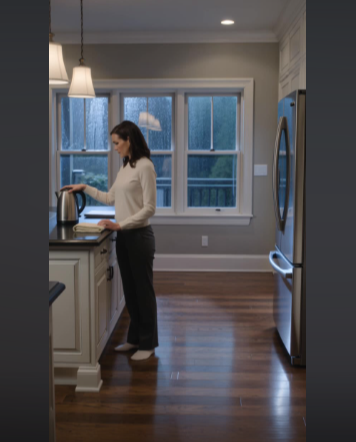
Three weeks earlier, I had been standing in our kitchen in socks, waiting for the kettle to boil while rain scratched down the windows of our house in Westchester.
Tom came home late, laughing before he opened the door.
I knew that laugh. He used to laugh like that when we were young and broke and he had found a way to make twenty dollars feel like two hundred. He would come through the door of our first apartment holding takeout in one hand and flowers from a corner store in the other, proud of himself for managing a small surprise.
This laugh was different. It was fuller, louder, sharpened by an audience.
He walked in with Jessica on his arm.
She was thirty-one, maybe thirty-two, with smooth black hair, a cream coat, and the practiced softness of someone who had learned that a lowered voice could cut just as cleanly as a raised one. She looked around my kitchen the way people look around hotel rooms before deciding whether the sheets are good enough.
“Rachel,” Tom said, “we need to talk like adults.”
I turned off the kettle.
Jessica did not let go of his arm.
Tom stood under the pendant light we had chosen together twelve years earlier when we refinanced the house and pretended we had finally become the kind of people who could buy light fixtures without checking every price tag twice.
“I got the London move,” he said.
“I know,” I said.
That annoyed him. I could see it in the small tightening near his left eye.
He liked announcements. He liked applause. He liked to be met with surprise.
He had worked for Parker Leigh Trading for almost twenty years, climbing from regional accounts to senior sales director with a mix of charm, stamina, and a talent for making other people’s work look like evidence of his instincts. For most of our marriage, I had admired the stamina and forgiven the rest.
London had been the word he slept beside. London meant history. London meant tailored suits and old buildings and someone else paying for the apartment. London meant he could finally be bigger than the suburbs that had never stopped making him feel provincial.
What he did not know was that London had come through my email before it ever came through his.
“Jessica is coming,” he said.
The kettle clicked softly as it cooled.
“She’s your assistant,” I said.
“She’s more than that.”
Jessica glanced at me, waiting.
Tom straightened his shoulders.
“She’s my partner now. Professionally and personally.”
The word personally sat between us, damp and ugly.
I looked at his face and searched for one trace of the man who had once cried quietly in a hospital hallway when our son, Sean, was born early and small and fighting to breathe. I searched for embarrassment, grief, hesitation, anything that might tell me he understood what he was breaking.
He only looked impatient.
“Rachel, don’t make that face.”
“I’m not making a face.”
“You always do this,” he said. “You go quiet and make me feel like a villain.”
Jessica touched his sleeve.
“You don’t have to defend yourself,” she murmured.
Tom’s mouth softened for her, then hardened again for me.
“The three of us are going to England,” he said. “Jessica and I will attend the receptions, the private dinners, the office events. You can help with the house, the bags, whatever needs handling. Your only job is to make the move easier.”
I folded the dish towel on the counter.
“You want your wife to fly with your mistress so I can carry luggage.”
He winced, not from shame, but from irritation at the plainness of the sentence.
“Don’t make it sound trashy.”
Jessica’s smile thinned.
“It’s not about humiliating you, Rachel. It’s about being realistic. Tom needs someone presentable beside him. London has standards.”
There it was.
Standards.
For years, I had let people underestimate me because it was easier than correcting them every time. I dressed simply. I kept the house. I made meals. I remembered birthdays. I clipped coupons, not because I had to, but because waste had always bothered me. I did not wear the name of my old life on my sleeve.
Tom had mistaken quiet for emptiness.
“Jessica understands how things work,” he said. “You’ve been out of the professional world too long.”
I had spent that morning on a video call with Eleanor West, the London transition chair for the Vance-Marlow Partnership, reviewing staff maps, housing blocks, travel holds, and the private onboarding schedule for a six-month operations overhaul that I had been asked to lead.
Tom had spent that morning telling his office he had been chosen to rescue Europe.
I had not corrected him yet.
“Is there anything else?” I asked.
Tom blinked.
“That’s it?”
“What response were you hoping for?”
“A normal wife would be upset.”
“I understand perfectly,” I said. “The three of us will go to England together.”
Jessica gave a delighted little laugh.
Tom looked relieved first, then triumphant.
“I knew you’d come around.”
I reached for my mug and set it on its coaster because my hand wanted to shake and I refused to give either of them the pleasure of seeing it.
“Of course,” I said. “I’ll organize everything.”
Tom put one arm around Jessica’s waist.
“That’s the Rachel I know. Practical.”
Practical.
He kissed Jessica’s temple in the middle of my kitchen.
I watched the rain slide down the window behind them and felt something inside me finish cooling.
The strange thing was, I did not hate him yet.
Hatred would have been clean. Hatred would have given me something hot to hold. What I felt was worse: the slow recognition that I had been living beside a man who needed me small, and now that he believed his life was expanding, he wanted to reduce me into a convenience.
After they left for dinner, I stayed in the kitchen and opened the second drawer by the pantry.
Inside was a folder of travel printouts, appointment notes, and the one folded page Tom had thrown aside two nights earlier after glancing only at the letterhead. It was the host authorization page for the London transition package.
Primary traveler: Rachel Mercer.
Authorized companion: one.
Additional guests subject to written approval by host.
Tom had circled the word London in blue ink and ignored everything else.
I had been Rachel Abbott when I built my first professional life. Before marriage, before motherhood, before Tom’s career became the larger room we all had to arrange ourselves around, I had worked in operations recovery for companies that were good at looking successful while quietly collapsing from their own disorder. I could walk into a warehouse, hotel, office, or airport lounge and tell where the real power sat by watching who checked their watch before speaking.
Then Sean was born early. Then Tom’s father had a stroke. Then Tom got his first real chance at Parker Leigh. One emergency became a season, one season became a role, and eventually everybody learned to call me “lucky I didn’t have to work.”
I did work.
I just stopped correcting people about where.
For twelve years, I took private consulting contracts under my maiden name. I flew out for two-day audits and told the neighbors I was visiting college friends. I wrote restructuring plans after midnight while Tom slept. I rebuilt broken systems quietly, partly because I loved the work and partly because I needed one place in my life where competence was not punished as disloyalty.
Eleanor West had been my mentor when I was twenty-seven and stubborn enough to believe efficiency could heal every human problem. She knew better. She taught me that systems never failed by themselves. People failed each other first, then built systems that protected the failure.
When she called about London, she had not asked whether Tom was ready.
She had asked whether I was.
“We need you in person,” she told me. “Not a report. Not a remote advisory arrangement. You, Rachel.”
I had said I needed time to discuss it with my husband.
Eleanor had laughed softly. “You still say that as if he discusses things with you.”
I had not answered.
Tom found the relocation packet two days later and saw only what he wanted: London office, travel hold, executive reception, temporary housing, guest accommodations. He assumed Parker Leigh had finally recognized him. He assumed my name appeared because wives were supposed to be listed under their husbands.
He did not ask why the emails came to my personal account.
He did not ask why Eleanor wrote Dear Rachel.
He did not ask why the bottom line required my signature.
A week before his announcement, I had tied a blue luggage tag to my old duffel while checking the zipper in the guest room, and Tom had wandered in holding his phone.
“What’s that for?” he asked.
“London,” I said.
He laughed. “You and that sad little bag. Rachel, if I’m going to be running a branch, we can’t have you looking like you’re going on a church retreat.”
“It still works.”
“That’s your whole problem,” he said. “You think working is the same as being worth looking at.”
I let the zipper close.
At the time, I thought it was a bad mood. I told myself men who were afraid of change sometimes kicked at the nearest safe thing. I had spent too many years making myself safe for him.
After Jessica stood in my kitchen, I stopped making excuses.
The next morning, I did not call a lawyer. I did not call his boss. I did not throw his shirts onto the driveway the way my sister, Nora, later told me I should have done with great enthusiasm.
I made oatmeal.
Tom came downstairs humming, already dressed in the navy suit he wore when he wanted mirrors to approve of him. He kissed the air near my cheek.
“Big day,” he said.
“For whom?”
He frowned. “For us, Rachel. Don’t be petty.”
Jessica texted him while he sat at the table. He smiled at the screen with his whole face, a version of himself I had not seen directed at me in years.
“She’s nervous,” he said.
“About England?”
“About you making things difficult.”
I spooned oatmeal into a bowl.
“You brought her into my kitchen.”
“Because I respect you enough not to sneak around.”
That was the second wrong detail in the ladder he was building for me without realizing it.
Respect, he called it.
For twenty-five years, Tom had defined respect as my willingness to absorb whatever he wanted without changing the temperature of the room. If I stayed calm, I was mature. If I questioned him, I was bitter. If I knew something he did not know, I was making him feel small.
“You’ll need to help Jessica pack,” he said. “She has better clothes than you. Some of it can’t be folded wrong.”
“I’m not packing for Jessica.”
He stared at me.
I stirred cinnamon into my bowl.
Tom looked almost amused. “Let’s not start the day with attitude.”
“It isn’t attitude.”
“Then what is it?”
“A sentence.”
He pushed back his chair.
“Fine. We’ll discuss it later.”
We did not discuss it later. Tom stopped discussing things when conversation no longer guaranteed his preferred answer.
Instead, he began staging decisions in front of witnesses.
At dinner with our neighbors, he lifted his glass and announced, “Rachel is being incredibly supportive about the London transition. She understands that appearances matter in my new position.”
Our neighbor Linda’s smile faltered. She was a kindergarten teacher with kind eyes and a blunt streak she usually kept wrapped in politeness.
“Will you be working over there too, Rachel?” she asked.
Tom answered before I could.
“She’ll help me settle in.”
Linda looked at me.
I lifted my water glass. “I’ll be busy.”
Tom chuckled. “She means busy finding the grocery store.”
Jessica joined us for dessert that night. Tom had invited her without telling me.
Linda’s husband, Phil, dropped his spoon when Jessica slid into the chair Tom had pulled out beside him. Nobody knew where to look. Jessica thanked me for “being so evolved,” and Tom beamed as if my dignity were a compliment to him.
I did not argue.
I watched.
The pattern clarified itself when given an audience. Alone, Tom could still pretend he was being practical. In public, he became generous with cruelty because he believed cruelty toward me made him look important to Jessica. He mistook everyone else’s discomfort for admiration.
That was when I began keeping a small notebook.
Not evidence. Not ammunition in the dramatic sense. Just observations.
Sunday dinner: answered for me three times.
Linda’s table: called me support staff.
Kitchen: said Jessica deserved the first impression I never gave him.
Office lobby: pending.
The office lobby came sooner than I expected.
Tom called me at ten on a Wednesday morning.
“Bring the London packet,” he said.
“I’m in the middle of something.”
“Rachel, don’t start. I need the relocation summary and my passport copy. Jessica and I are meeting with the regional people at noon.”
“The regional people?”
“Some consultants Eleanor is sending. They want to brief me.”
I closed the spreadsheet on my laptop.
Eleanor had already told me the noon meeting was an informal screening. She wanted to see how Tom treated support staff before deciding whether to recommend him for a modest local liaison role. It was not branch leadership. It was not executive authority. It was, at most, a door I had left cracked open because some loyal part of me wanted to believe he might still walk through it humbly.
“Bring the folder,” he said. “And don’t wear that gray sweater. You look tired in it.”
I wore the gray sweater.
Parker Leigh’s Manhattan office occupied three floors of a glass building near Bryant Park, full of polished concrete, chrome fixtures, and the particular smell of expensive coffee people pretend tastes better because it is bitter. I had been there only twice in twenty years. Once for a holiday party, once to bring Tom his blood pressure medication after he forgot it.
The receptionist glanced up.
“Can I help you?”
“I’m here for Tom Mercer.”
Her expression changed in a way I knew too well. Not rude, exactly. Pre-informed.
“Oh,” she said. “Mrs. Mercer.”
Jessica appeared from behind a frosted glass wall wearing a fitted white dress and Tom’s confidence like an accessory.
“You came,” she said, looking me up and down. “Tom was worried you’d get lost downtown.”
A young man at a nearby workstation looked up sharply. He was pale, sandy-haired, maybe thirty, with tired eyes and a tie that had been loosened before noon. Michael. I had seen his name copied on one of Tom’s forwarded messages.
Tom came out behind Jessica.
“There you are,” he said. “Did you bring it?”
I held out the folder.
He took it without thanking me.
Jessica reached in and pulled out the top sheet. Not the folded page. A general itinerary.
“Look,” she said loudly enough for the nearby staff to hear. “Temporary housing, reception, private transport. This is going to be incredible.”
Tom tapped the paper.
“First class across the Atlantic. Finally.”
Michael stood up halfway, then seemed to think better of it.
One of the regional consultants, a woman named Priya Desai whom I knew professionally and Tom had never met, walked into the lobby with a leather portfolio under one arm. Her gaze found me immediately, and for half a second her face warmed.
I gave the smallest shake of my head.
Not here.
Not yet.
Priya understood. Good consultants can read a room before they read a file.
Tom turned toward her with a broad smile.
“You must be here for me,” he said. “Thomas Mercer. Future London lead.”
Priya’s eyebrow moved just enough to show me she had heard the wrong detail.
Future London lead.
“Mr. Mercer,” she said. “We’re looking forward to understanding your role in the transition.”
“My role is simple,” he said. “I’ll be modernizing that office.”
Jessica touched his arm.
“He’s being modest. Everyone knows he’s the reason this move is happening.”
Priya glanced at me.
I folded my hands in front of me.
Tom noticed the glance and misread it.
“Rachel is here because she’s good with paper,” he said. “Every successful man needs someone handling the dull pieces.”
Michael’s chair scraped softly.
Tom looked at him. “Problem?”
Michael swallowed.
“No.”
I could have ended it there. I could have said my name, my role, my history with Eleanor, the terms of the London package. I could have watched his face change in the lobby under those expensive lights.
But I had learned something in the kitchen.
If I corrected Tom too early, he would blame surprise. He would say he was confused, stressed, misinformed. He would recover his dignity by borrowing mine. I needed him to keep choosing with full sight of what he believed me to be.
So I said, “I hope the meeting is useful.”
Tom smirked.
“Useful is what I do.”
That afternoon, Eleanor called me.
“Well,” she said, “he is worse than I expected.”
I sat in my car in the parking garage with my hands resting on the steering wheel.
“I know.”
“Do you want me to pull the whole arrangement now?”
I looked through the windshield at the concrete wall ahead of me. Someone had scraped paint against it, a long white wound across gray.
“No,” I said. “Not yet.”
“Rachel.”
“I need to know whether he will stop when nobody rewards him.”
Eleanor sighed. “That sounds like a painful experiment.”
“It’s a marriage,” I said.
“Sometimes those are the same thing.”
I laughed because if I did not, I might have made a sound I could not take back.
Eleanor softened.
“The offer is yours whether you come alone or not. You know that.”
“I know.”
“And the companion line?”
“I’ll decide at check-in.”
“That late?”
“If he finds decency before then, I need to see it.”
She went quiet.
“You’re still leaving room for mercy.”
“I’m leaving room for the truth.”
The truth took up more space each day.
Tom moved Jessica into the center of our life with the entitlement of a man rearranging furniture. He asked me to make dinner for the three of us because “Jessica wants to understand the home she’ll be leaving behind.” He corrected my cooking in front of her. He told her I used to be “pretty in a quiet way.” He laughed when Jessica asked whether I owned heels.
Once, while he was in the shower, she stood at our bedroom doorway and watched me fold laundry.
“You must be relieved,” she said.
I looked up.
“Relieved?”
“That he’s found someone who can keep up. That’s a lot of pressure off you.”
I placed a shirt into the suitcase.
“Is that what he told you?”
“He doesn’t need to tell me everything.”
“No,” I said. “He probably doesn’t.”
She leaned against the frame.
“I know you think I’m the villain.”
“I think you’re young enough to believe being chosen by a married man means you won.”
Her face flushed.
“At least I’m chosen.”
I looked at her for a long moment.
“There are worse things than not being chosen, Jessica.”
“Like what?”
“Being chosen by someone who needs an audience.”
She laughed too quickly.
“You’re just trying to sound wise because you lost.”
Maybe she believed that. Maybe she had to. If Tom was not a prize, then what had she taken?
That night, Tom told me he had booked my seat.
“Economy,” he said, dropping the printed itinerary beside my plate.
I was washing lettuce at the sink. The water ran cold over my fingers.
“Why?”
He shrugged.
“Jessica gets nervous flying. She needs me beside her. Also, this is my professional entrance. I can’t have you sitting up front looking miserable.”
I dried my hands.
The paper showed a seat near the rear lavatory. He had highlighted it in yellow.
“You highlighted it.”
“So you wouldn’t get confused.”
I looked at the bottom of the page. There it was again, in small print, the line he still refused to read.
Host confirmation pending.
Tom tapped the page.
“You’re lucky I’m bringing you at all.”
“Am I?”
His eyes narrowed.
“Don’t do the quiet thing.”
“What quiet thing?”
“The thing where you act like you know more than everyone.”
I folded the itinerary once.
“I do know how to read the bottom of a page.”
He stared at me.
For one second, the room shifted.
Then Jessica called from the living room, “Tom, does Rachel have garment bags or only plastic dry-cleaner covers?”
He turned away.
“Only plastic,” he called. “We’ll buy real ones.”
I slipped the paper into the drawer.
The next day, Catherine came over.
Tom’s mother had always entered our house as if she were disappointed the door did not open by itself. At seventy-six, she remained elegant in the hard, preserved way of women who treat softness as surrender. She had never forgiven me for marrying her son without making him richer faster.
She arrived carrying a hat box and wearing perfume that reminded me of department store carpets.
“Thomas tells me you are going to London,” she said.
“Good morning, Catherine.”
“Don’t be cute.”
I took her coat.
She looked past me. “Where is Jessica? I wanted to meet the girl.”
“The girl?”
“The woman helping my son become what he was always meant to be.”
I hung her coat carefully.
Catherine walked into the living room and sat where she always sat, beneath the framed black-and-white photograph of Tom holding Sean at three months old. Tom was so young in that photo, his face astonished by love. Sometimes I wondered whether photographs were cruel because they kept proof of people we could no longer find.
“I’ll say this plainly,” Catherine said. “Do not embarrass him overseas.”
“I’ll try not to embarrass anyone.”
“You know what I mean. Tom is moving in a refined circle now. Jessica understands that world.”
I sat across from her.
“Do you?”
Her mouth tightened.
“I understand men. A man with opportunity needs peace, admiration, and a woman who doesn’t remind him of bills and aging.”
“You think I made him feel old.”
“I think you became comfortable.”
The word landed carefully. Comfortable, the respectable cousin of useless.
She leaned forward.
“You should be grateful he still includes you. Many men would leave cleanly.”
“Is that what you advised?”
“I advised him to be practical.”
Jessica arrived twenty minutes later with Tom, both of them flushed from shopping. Catherine brightened in a way she never had for me.
“Oh,” she said, taking Jessica’s hands. “Aren’t you lovely.”
Jessica glanced at me.
“Thank you. I’ve heard so much about you.”
“All good, I hope.”
“Tom says you’re very loyal to family.”
Catherine looked pleased. “Loyalty is everything.”
I almost laughed.
Tom dropped two shopping bags on the sofa.
“Rachel, don’t just sit there. Take these upstairs.”
Catherine watched me.
This was a test, of course. Not of my obedience. Of whether the story they had built about me would hold while witnessed.
I picked up the bags.
One of them was heavy.
Jessica said, “Careful. That dress is for the welcome reception.”
Catherine smiled over her teacup.
“Rachel has always been sturdy.”
I carried the bags upstairs and set them in the guest room.
For a moment, I stayed there with my hand on the doorknob.
The room had been Sean’s before college. The walls were painted a calm green. Tom had once spent an entire Saturday assembling a bookshelf in that room, cursing at the instructions while toddler Sean handed him screws like solemn treasures. I remembered sitting on the carpet laughing until Tom laughed too, and the memory cut through me with unexpected force.
How does a man travel from that room to this one?
Not quickly.
Not all at once.
He does it by being forgiven too efficiently.
I called Sean that evening.
He was twenty-seven, living in Boston, working as a conservation architect for a firm that restored old public buildings. Tom called it “decorating ruins.” Sean let the insult pass because he had inherited my talent for calm and my father’s talent for walking away before anger became performance.
“Mom,” he said, “tell me you’re not actually flying with them.”
“I am flying to London.”
“With them?”
“On the same day.”
He was quiet.
I could hear traffic on his end, then the soft click of a door closing.
“What did he do?”
I told him enough. Not everything. A son does not need every splinter of his father’s failure in his hands.
Sean listened without interrupting.
When I finished, he said, “Do you want me to come home?”
“No.”
“Do you want me to call him?”
“No.”
“Do you want me to hate him?”
That made my eyes burn.
“I want you to keep your heart clean.”
He exhaled. “That’s a very mother answer.”
“It’s the only one I have.”
“Mom, you know you don’t owe him a gentle exit.”
“I know.”
“Do you?”
I looked toward the living room, where Tom was laughing at something Jessica had said. Catherine’s voice rose over theirs, delighted and approving.
“I’m learning.”
Sean lowered his voice.
“Then learn faster.”
A few days later, Tom took Jessica shopping on Fifth Avenue and told me to come along because “someone has to manage the packages.”
Spring had arrived in name only. The wind still carried teeth. Tourists moved in bright clusters along the sidewalk, scarves lifting, shopping bags knocking against knees. Jessica walked ahead of me, turning her face toward window displays as if each mannequin had been arranged for her personally.
Tom carried nothing.
I carried four bags.
“Keep up,” he called over his shoulder.
Jessica looked back. “Maybe she needs a cart.”
“Rachel is stronger than she looks,” Tom said. “Built for errands.”
A woman passing us slowed, then kept walking.
At a boutique near 57th Street, Jessica tried on a pale gold dress while Tom sat outside the fitting room scrolling through messages. I stood beside a velvet bench holding her coat.
A sales associate asked, softly, “Ma’am, would you like me to take those for you?”
Tom answered without looking up.
“She’s fine.”
The associate’s eyes moved to me.
I smiled because kindness from strangers can be unbearable when you are trying not to break.
“I’m fine.”
Jessica came out turning before the mirror.
Tom looked up, and his face opened.
“That’s the one,” he said.
Jessica’s eyes found mine in the reflection.
“Do you think it’s too young for London?”
I answered honestly.
“No.”
Her smile sharpened. “That must be hard to say.”
Tom laughed.
“Rachel doesn’t care about clothes. Do you, Rach?”
Rach.
He used to call me that with warmth, in grocery aisles, in bed, across parking lots when Sean ran ahead of us. Hearing it now felt like finding an old song played badly in a cheap commercial.
“I care about fit,” I said.
Jessica turned sideways.
“It fits perfectly.”
“Then you should be comfortable.”
Tom stood.
“She’ll be more than comfortable. She’ll look like she belongs.”
That was the third wrong detail.
Belonging.
Tom believed belonging could be purchased, displayed, performed. He had never understood that rooms open differently when you enter without begging them to prove your worth.
Outside the boutique, an older woman dropped a glove near the curb. Jessica stepped over it. Tom did not notice. I stopped, shifted the bags to one hand, and picked it up.
“Excuse me,” I called.
The woman turned. She had silver hair tucked beneath a wool hat and eyes the clear gray of winter mornings.
“Thank you,” she said.
Our fingers touched briefly over the glove.
Then she looked at my face, really looked, and smiled.
“Rachel Abbott,” she said.
Tom turned at the sound of my maiden name.
I felt the world narrow.
“Eleanor,” I said.
Tom walked back, irritated. “You know her?”
Eleanor West stood on the sidewalk in a navy coat that cost less visibly than Jessica’s dress and more in every way that mattered.
“We worked together a long time ago,” Eleanor said.
Jessica gave a polite little nod that dismissed the older woman instantly.
Tom extended his hand with executive confidence.
“Thomas Mercer. Parker Leigh Trading. I’m heading to London to take on a leadership role.”
Eleanor’s hand remained around her glove.
“Are you?”
“Yes,” he said, laughing. “Rachel will be coming along to help with domestic things. You know how moves are.”
Eleanor looked at me.
I gave another small shake of my head.
Not yet.
She turned back to Tom.
“I do know how moves are,” she said. “They reveal what people think they can carry and what they expect others to carry for them.”
Tom’s smile faltered.
Jessica slid her arm through his.
“We’re late,” she said.
“Right,” Tom said. “Nice meeting you.”
Eleanor touched my elbow as I passed.
“Airport?” she asked quietly.
I nodded.
Her eyes softened, but her voice stayed practical.
“Then I’ll make sure they follow procedure exactly.”
Procedure.
There are words that sound dull until they become doors.
Two nights before the flight, Tom came into the guest room while I was packing.
He had been drinking, but not enough to slur. Just enough to mistake cruelty for clarity.
He watched me place folded sweaters into my suitcase.
“You’re really taking that old thing?”
“It holds enough.”
He noticed the blue luggage tag and laughed under his breath.
“You know, Jessica said something funny. She said your bag looks like it belongs to someone moving into a dorm after a divorce.”
I zipped the side pocket.
“Jessica thinks about my luggage?”
“She notices presentation.”
“She notices what you reward.”
That angered him.
“Don’t talk like you’re above this. You agreed to come.”
“I agreed to go to London.”
“With us.”
“With you,” I said, “in whatever form you chose to be.”
He stepped closer.
“What is that supposed to mean?”
“It means I’ve been watching.”
He laughed, but his eyes did not.
“Watching what? Me succeeding?”
“Among other things.”
He reached down and lifted my printed itinerary from the bed.
“What are you going to do, Rachel? Wave a schedule at me?”
I held out my hand.
He folded the page sharply and pressed it against my palm.
“There,” he said. “Your little papers.”
He did not know he had just handed back the only page that mattered.
“Listen to me,” he said. “When we get to the airport, don’t make a scene. Jessica and I check in first. You wait until we’re done. You don’t talk to the agents unless they ask you something simple. You don’t mention being my wife unless I introduce you that way.”
I looked at him.
He kept going because control, once spoken aloud, often grows drunk on itself.
“At the reception, you’ll stay at the apartment. Jessica will come with me. If anyone asks, you’re tired from traveling. Nobody needs the awkward domestic version of my life hanging around my new start.”
I thought of our first apartment, the one with a radiator that hissed all night and a kitchen window facing a brick wall. I thought of Tom standing there in a borrowed tie after his first Parker Leigh interview, asking me whether he looked like someone worth hiring. I had adjusted the knot and said, “You look like someone who will learn.”
He had.
Just not what I hoped.
“Do you hear me?” he asked.
“Yes.”
“Good.”
He left the guest room door open behind him, as if even closing it for me was more courtesy than I deserved.
I sat on the bed for a long time after that.
The house settled around me. Pipes clicked. A car passed outside, tires hissing over wet pavement. Downstairs, Jessica laughed at something on television, high and bright, and Tom joined her.
My hands finally shook.
Not because I was afraid of London. Not because I was afraid of being alone. I was afraid of what it meant that I could still remember loving him so clearly while watching him become someone I would never again trust with my suitcase, my silence, or my name.
The next morning, Michael came to the house.
Tom had sent him with revised travel labels and a luggage scale because Tom had become obsessed with weight limits the way insecure men become obsessed with rules they can use on other people.
Michael stood on the porch in the rain, holding a cardboard sleeve and looking deeply uncomfortable.
“I’m sorry to bother you, Mrs. Mercer.”
“Come in before you drown.”
He wiped his shoes carefully on the mat.
Tom was upstairs with Jessica, arguing about whether one of her bags counted as personal or carry-on. Their voices drifted down the hall.
Michael lowered his voice.
“I wanted to apologize for the office lobby.”
“You didn’t do anything.”
“I didn’t do enough.”
I studied him.
His hands were red from the cold. He had the exhausted decency of a person who had been trying to survive a bad boss without becoming bad himself.
“You stood up halfway,” I said.
He looked startled.
“I saw you.”
“I should’ve said something.”
“You might still have to work there after I leave.”
He gave a humorless smile.
“Maybe. Maybe not.”
He handed me the cardboard sleeve.
“Your travel documents. The real ones, I think.”
I did not reach for it right away.
“What makes you say that?”
He glanced toward the stairs.
“Mr. Mercer keeps telling everyone the London office sent him a director’s packet. But the internal memo says the transition lead is external, and his name isn’t attached to that role. I thought maybe there was a mistake.”
“There isn’t.”
Michael’s eyes widened slightly.
I took the sleeve.
“Thank you for bringing this.”
He leaned closer.
“Mrs. Mercer, forgive me, but whatever he thinks is happening at the airport, I don’t think it’s what’s actually happening.”
“No,” I said. “It isn’t.”
Relief crossed his face, then worry.
“Are you safe?”
The question undid me more than Tom’s insults had.
I looked toward the stairs again.
Safe.
What a strange word inside a marriage.
“I will be.”
Michael nodded, as if he wanted to believe me.
“I can come to the airport,” he said.
“That isn’t necessary.”
“I know. But I’d like to. Just to help with the bags.”
I almost said no. Pride rose in me automatically, the old habit of refusing help before anyone could withdraw it.
Then I remembered Eleanor’s words about what people expect others to carry.
“You can come,” I said. “But not to rescue me.”
He understood.
“To witness,” he said.
“Yes.”
On the morning of the flight, the house felt staged.
Tom moved through the rooms issuing instructions. Jessica filmed short videos of the suitcases lined near the entryway, careful not to include me in the frame unless I appeared in the background carrying something. Catherine arrived in a cream pantsuit and pearls, emotional with pride for a son whose triumph she had not bothered to understand.
“My boy,” she said, cupping Tom’s face. “London.”
Tom smiled like a prince in an old story.
“First stop, JFK. Next stop, the world.”
Jessica kissed his cheek.
Catherine dabbed her eyes.
Then she looked at me.
“Rachel, try not to make the goodbye depressing.”
“I’ll do my best.”
She reached into her handbag and pulled out a small packet of tissues.
“For the plane,” she said. “Women like you tend to cry when life changes.”
I took them.
“Thank you.”
Tom laughed.
“See? Practical.”
The car service arrived at eight.
There were too many bags because Jessica had packed for the fantasy version of herself. Tom packed for the fantasy version of himself. I packed for the person I was becoming again.
At the curb, Tom pointed.
“Rachel, you take those two. Jessica’s nails are fresh.”
Michael appeared at the end of the driveway before I could answer, stepping out of a rideshare with coffee in one hand and his coat collar raised against the wind.
Tom frowned.
“What are you doing here?”
Michael looked at me, not him.
“I came to help Mrs. Mercer.”
Catherine made a small disapproving sound.
Tom’s face reddened.
“You came to see me off, you mean.”
“No,” Michael said.
The driveway seemed to tighten.
Jessica looked amused. “Careful, Michael. Tom is about to be very important in London.”
Michael’s gaze moved to her.
“I know what Mr. Mercer is about to be.”
Tom took a step toward him.
I stepped between them before anger could become contact.
“Enough,” I said.
It was not loud.
That was why everyone heard it.
Tom stared at me.
For the first time in days, he looked uncertain.
Then Jessica laughed softly.
“Oh, Rachel found a voice.”
I turned and lifted one of the bags into the trunk.
Not yet.
The ride to JFK took nearly an hour. Tom and Jessica sat in the back row of the black SUV, discussing the reception as if they had already been photographed there. I sat in the middle row beside two garment bags and my coat. Michael rode up front with the driver, quiet except when he asked if I needed the heat adjusted.
Tom noticed every courtesy and hated each one.
“Michael,” he said, “when we land, make sure the London office understands I expect a proper welcome. I don’t want some junior assistant holding a cardboard sign.”
Michael did not turn around.
“I’m not traveling to London.”
Tom laughed. “No, of course you aren’t. I meant by email.”
Jessica touched Tom’s knee.
“Don’t waste energy. We’ll be in the lounge soon.”
Tom smiled again.
“Yes. Champagne before takeoff.”
I watched Queens pass by the window: laundromats, brick row houses, schoolyards, gas stations, the unglamorous morning life of the city moving around us with more honesty than anything inside the car.
I thought about all the years I had protected Tom from feeling ordinary.
I had complimented every promotion. I had edited every speech. I had entertained clients when he forgot names and smoothed over jokes that landed wrong. I had made our home look stable when his moods weren’t. I had taught Sean not to argue with his father after ten at night. I had called it love because sometimes love and labor wore the same coat.
But somewhere, without my consent, Tom had stopped seeing the labor and kept expecting the coat.
At Terminal 1, the car pulled to the curb.
The departure hall roared around us, bright and busy, full of rolling suitcases, overhead announcements, perfume from duty-free displays, coffee steam, and the hollow clatter of wheels over tile.
Tom inhaled as if the airport had been built for his entrance.
“This is it,” he said.
Jessica slipped on sunglasses though we were indoors.
Michael unloaded bags.
I reached for my suitcase.
Tom caught my wrist lightly, not enough to hurt, enough to remind me he still believed touch was a command.
“Remember,” he said. “You wait behind us.”
I looked at his hand.
He let go.
We moved toward the first-class check-in area. Tom walked ahead with Jessica, shoulders back, coat open, passport ready. Michael pushed the cart. I followed beside him, my small suitcase rolling quietly over the floor.
Above the counters, screens listed flights to London. Families clustered near ropes. Business travelers shifted impatiently. A little boy pressed his face to the glass wall to watch planes taxi in the distance.
For a moment, I felt the strange ache of being at the edge of two lives.
Then Tom turned and performed for the room.
He pulled Jessica’s bronze garment bag from the top of the luggage cart and placed it across my arms.
“Here,” he said. “Make yourself useful.”
The weight was not heavy.
The insult was.
Jessica adjusted the collar of my coat where the hanger had bumped it.
“Careful,” she said. “That dress matters tonight.”
An older man in line behind us stared at the floor. The check-in agent’s mouth tightened. Michael’s hand clenched around the cart handle.
Tom pointed toward the economy counters.
“Once I’m done here, you can take your little seat in the back. Near the bathroom, remember?”
I kept the garment bag in my arms.
My body wanted to drop it. My throat wanted to say his name in the old way, the warning way, the way that used to make him stop before he became unforgivable.
Instead, I looked at the departure board.
London. On time.
The agent called, “Next guest, please.”
Tom stepped forward.
“Thomas Mercer,” he said. “Parker Leigh Trading. First class to London. My partner Jessica Vale is with me.”
Jessica smiled at the agent.
The agent typed.
“May I see the host authorization page?”
Tom waved a hand at me.
“My wife has the paperwork.”
“Mrs. Mercer?” the agent asked.
Her tone had changed. Not much. Enough.
Jessica noticed and narrowed her eyes.
Tom did not.
“Rachel,” he snapped. “The folded page.”
I stood still.
Tom looked back, irritated.
“Do not do this now.”
“Do what?”
“Act helpless.”
“I’m holding Jessica’s dress.”
A ripple moved through the line. Not laughter. Something closer to embarrassment finally finding a shape.
Jessica’s cheeks pinkened.
Tom’s smile thinned.
“Hand the page to the agent.”
I shifted the garment bag carefully into one arm and reached into my coat pocket.
The folded page came out soft at the creases from weeks of being opened and closed.
Tom reached for it.
I pulled it back.
His face hardened.
“Rachel.”
The agent said, “The host needs to present it directly.”
Tom turned toward her.
“I am the host.”
The wrong detail stood between us now, fully visible.
The agent glanced at her screen.
“I’m sorry, sir. That is not what I have here.”
Jessica laughed, but it came out brittle.
“There must be a mistake. Tom is the London director.”
The agent’s eyes remained professional.
“I can only follow the travel record.”
Tom looked at me as if I had moved a wall while he was admiring himself in a mirror.
“What did you do?”
I did not answer him.
Not yet.
I set Jessica’s garment bag gently on top of the nearest suitcase. Not dropped. Not flung. Set down, as carefully as I had set down my mug three weeks earlier.
Then I smoothed the folded page on the counter.
The agent read the top line.
“Thank you, Mrs. Mercer.”
Tom’s mouth opened.
I watched him see my name where he had expected his.
Primary traveler: Rachel Mercer.
The airport did not go silent. Airports never do. Wheels kept rolling. Announcements kept echoing. A baby cried somewhere near security. But the few people close enough to understand held themselves very still.
Jessica leaned toward the page.
“What is that?”
Tom snatched at it, but the agent slid it back toward me.
“Sir, please don’t touch the host’s document.”
Host.
A small word.
A hinge.
Tom’s face changed by degrees, first annoyance, then confusion, then the first gray edge of fear.
“Rachel,” he said, softer. “Explain.”
I looked at the man I had married, at the woman who had mistaken proximity to him for victory, at Michael standing behind the luggage cart like a witness no one had planned for, at the agent waiting for my decision.
Then I said the line I had practiced only once because once was enough.
“You still haven’t read the bottom of the page.”
Tom looked down.
His eyes moved.
Additional guests subject to written approval by host.
Jessica whispered, “Tom?”
He did not answer her.
The agent asked, “Mrs. Mercer, would you like to confirm your authorized companion for today’s flight?”
There it was.
The door.
Not revenge. Not punishment in the cinematic sense. A door.
I had spent three weeks giving Tom chances to walk through it differently. In the kitchen. In the office lobby. In front of his mother. On Fifth Avenue. In the car. At this counter with witnesses and glass walls and his mistress’s dress lying between us like a gold-colored accusation.
He had chosen, every time, to make me smaller.
I placed my hand flat on the folded page.
“No,” I said.
Tom blinked.
“No what?”
“No additional companion.”
Jessica’s hand flew to his sleeve.
“Tom, fix this.”
He looked at the agent.
“Print my ticket.”
“I’m sorry,” she said. “Your seat was held as a companion under Mrs. Mercer’s host file. Without authorization, there is no active ticket for you in this booking.”
“That’s impossible.”
“It is the record.”
“I paid for first class.”
The agent looked at her screen.
“The hold was unpaid pending host approval.”
Jessica made a small, wounded sound.
Tom turned on me.
“You smiled,” he said.
“Yes.”
“You agreed.”
“I agreed we would all go to the airport.”
His face flushed dark red.
“You manipulative—”
“Choose your next word carefully,” I said.
The sentence was quiet, but it stopped him.
Michael stepped closer to the cart, not touching Tom, not threatening him, simply making himself present.
Tom saw him and seemed to remember there were witnesses.
He lowered his voice.
“Rachel, don’t be dramatic. Add us back.”
“No.”
“You cannot just abandon your husband at an airport.”
I looked at Jessica.
“I thought you didn’t need the domestic version of your life hanging around your new start.”
His eyes flickered.
He remembered saying it. That was worse for him than denial.
Jessica stepped away from him half an inch.
“Tom, what is happening?”
“What’s happening,” I said, “is that the London transition was never yours to claim.”
Tom laughed once, harshly.
“Of course it was. Parker Leigh—”
“Parker Leigh agreed to consider you for a liaison role because I asked Eleanor to give you a fair look.”
His mouth stopped moving.
“I kept the door open,” I said. “You decided it was a throne.”
Jessica stared at him.
“Liaison role?”
Tom shook his head.
“No. No, that’s not right.”
The agent looked from me to him, wisely silent.
I continued because after twenty-five years, I had earned complete sentences.
“The first-class seat, the temporary flat, the reception access, the private transfer, all of it belonged to the host package for my contract. You saw London and assumed it had to be yours.”
His face had gone pale around the mouth.
“You never told me.”
“You never asked.”
“That is not the same thing.”
“No,” I said. “It isn’t. Asking would have required believing I had a life you didn’t own.”
Jessica pulled off her sunglasses.
“Tom, you told me you were the director.”
“I am,” he snapped.
I looked at him.
He hated that most. Not anger. Not shouting. The calm of someone who had finally stopped helping him lie.
At that moment, Eleanor West stepped from the corridor beside the premium service office. She wore a charcoal coat, low heels, and the kind of expression that made senior managers sit straighter before they knew why.
“Rachel,” she said warmly.
Tom turned toward her, searching his memory.
“You,” he said. “The woman from the sidewalk.”
Eleanor smiled without softness.
“Yes. The woman you told about your leadership role while your wife carried four shopping bags.”
Jessica’s face tightened.
Eleanor looked at the agent.
“Is Mrs. Mercer ready?”
“Yes, Ms. West.”
Tom’s eyes moved between us.
“Rachel,” he said, almost whispering, “what is your contract?”
I picked up my suitcase handle.
“The one you called dull paperwork.”
Eleanor held out her hand.
“Welcome back, Rachel.”
Back.
The word touched something in me I had not realized was still waiting to answer.
Tom took one step toward me.
“You can’t leave me like this.”
“I’m not leaving you like anything,” I said. “I’m leaving as myself.”
His jaw trembled, though he tried to hide it.
Jessica spoke first.
“Tom, did you lie to me?”
He turned on her with desperate irritation.
“Not now.”
She looked at the garment bag on the suitcase, then at the economy counters, then at me.
The calculation moved across her face. I did not enjoy it. I only recognized it.
Tom had used me as proof of his power. Now my refusal made him look poor in the one currency he valued most.
Jessica’s voice dropped.
“You said there was a penthouse.”
“There is,” he said.
Eleanor said, “There is a modest temporary flat available for Mrs. Mercer as transition lead. One bedroom. No pool.”
Jessica stared.
Tom’s mouth opened again.
A loudspeaker announced pre-boarding for another international flight.
The airport carried on.
That was the cruelty and mercy of public places. Your life can split open under fluorescent lights while someone nearby buys a muffin.
Tom looked at me with sudden pleading.
“Rachel, come on. We can talk in the lounge.”
“We won’t be in the same lounge.”
“Then at the gate.”
“We won’t be at the same gate unless you buy a ticket.”
He swallowed.
“You know I moved funds around for this trip. I can’t just—”
“That is between you and Parker Leigh.”
His eyes widened.
I had not accused him. I had not needed to. He heard the weakness in his own sentence.
Michael looked away, pained.
Tom did too.
For all his cruelty, he was not stupid. He began to understand the practical consequences arriving behind the emotional ones. No confirmed seat. No London entrance. No director title. No Jessica beaming beside him at a reception. No wife carrying the cost of his delusion.
“Rachel,” he said again.
This time, my name sounded unfamiliar in his mouth.
I lifted the folded page and placed it back in my coat pocket.
“I hope you read things more carefully from now on.”
Eleanor gestured toward the premium corridor.
The agent handed me my boarding pass.
“Have a good flight, Mrs. Mercer.”
I turned to Michael.
“Thank you for coming.”
His eyes were bright.
“Thank you for letting me.”
Tom seemed to remember him then.
“You,” he said, grasping for someone lower in the old order. “Get the bags.”
Michael did not move.
Tom stared at him.
Michael’s voice shook only slightly.
“No.”
A single syllable can change the architecture of a room.
Tom recoiled as if Michael had shouted.
“You work for me.”
“I work for Parker Leigh,” Michael said. “And after what I’ve seen, I’ll be filing my report before lunch.”
Tom’s face drained.
Jessica stepped back another inch.
There it was, the beginning of the living hell he had built for himself: not flames, not spectacle, not the cartoon collapse he would later claim I orchestrated, but ordinary consequences arriving from every person he had treated as furniture.
A wife who stopped carrying him.
An employee who stopped fearing him.
A mistress who stopped admiring him the moment the stage lights failed.
Tom looked at the luggage cart. Seven bags, two garment cases, three carry-ons, none of them mine except the small suitcase by my hand.
He looked at Jessica.
“Help me,” he said.
She looked at her nails.
“I don’t even know what’s mine if there’s no flight.”
He stared at her.
For the first time that morning, I almost felt sorry for him.
Almost.
But pity is not the same as permission.
Eleanor touched my elbow lightly.
“Ready?”
I looked once more at Tom.
His shoulders had dropped. His suit, tailored and expensive, suddenly looked like a costume after the show. The man who had walked into the terminal expecting applause now stood surrounded by bags he had never planned to carry.
“I’m ready,” I said.
We walked toward the premium corridor.
Behind me, Tom called my name.
Not Rachel the assistant. Not Rachel the wife-who-understood. Not Rach, the old song played badly.
Rachel.
I did not turn around until we reached the glass door.
When I did, he was still standing by the counter, one hand on Jessica’s garment bag, the other gripping the edge of the luggage cart as if the cart were the only solid thing left in his life.
He looked smaller than I expected.
Not because I had made him small.
Because I had stopped making him larger.
On the other side of security, Eleanor ordered coffee, and we sat near a window facing the runway.
My hands trembled then.
Eleanor did not comment. She simply pushed a napkin toward me and let me fold it once, twice, three times until my breathing steadied.
“You did not enjoy that,” she said.
“No.”
“Good.”
I looked at her.
She stirred her tea.
“If you had enjoyed it too much, I’d worry about what he had made of you.”
Outside, a plane lifted into the morning, its wheels tucking beneath it like a decision made cleanly.
“I kept waiting for him to stop,” I said.
“I know.”
“Even at the counter.”
“I know.”
The coffee smelled burnt and familiar. Airport coffee always tastes like the hours people are trying to survive.
“Was I cruel?” I asked.
Eleanor’s eyes softened.
“You gave him information repeatedly. He chose fantasy repeatedly. At the end, you withdrew your labor, your name, and your approval. That is not cruelty. That is a boundary with paperwork.”
I laughed, and it came out broken.
She smiled.
“There you are.”
My phone vibrated.
A message from Sean: Did you board?
I typed: Soon.
Then another: Are you okay?
I stared at the question.
Okay was too smooth a word.
I wrote: I am not small.
His reply came almost immediately.
Never were.
I pressed the phone to my chest for a moment.
Our flight began boarding forty minutes later.
Eleanor walked beside me down the jet bridge. No brass band played. No crowd applauded. The sky beyond the narrow windows was pale and sharp, the kind of sky that makes everything look outlined.
My seat was near the front, but I barely noticed the leather or the glass of water waiting beside it. Luxury had never healed anyone by itself. Comfort was kind, but it was not freedom.
Freedom was hearing my own name spoken as mine.
Freedom was setting my bag in the overhead compartment without waiting for someone to criticize it.
Freedom was looking at the empty seat beside me and not rushing to fill it with a person who would punish me for having room.
Just before takeoff, my phone buzzed with a voicemail notification from Tom.
I did not play it.
Then a message.
Rachel, please. I was angry. Jessica is upset. I can explain. We can fix this before the flight leaves.
Another.
Do not humiliate me like this.
Another.
After everything I gave you.
I turned the phone off.
The engines deepened beneath us.
As the plane moved back from the gate, I looked through the oval window at the terminal. I could not see Tom from there, but I could imagine him at the counter, negotiating, blaming, bargaining, trying to restore the world in which someone else carried the weight.
A memory rose uninvited.
Tom at twenty-seven, standing in our first apartment with rain in his hair because he had walked six blocks without an umbrella to save cab fare. He had handed me a paper cup of soup and said, “One day I’ll take you somewhere better than this.”
I had believed him.
Maybe he had believed himself.
That was the sadness. Not that he had lied from the beginning. That would have been easier. The harder truth was that he had once loved me in the small apartment honestly, then spent years learning to worship the man he imagined he could become until there was no room left for the woman who had known him before the costume.
The plane turned toward the runway.
I let the memory pass.
Not erased.
Not obeyed.
Passed.
When we lifted off, New York fell away beneath a thin veil of cloud. The city became pattern, river, grid, shine. I watched until the coastline blurred and the Atlantic opened ahead of us.
Somewhere below, Tom was still at the airport.
For once, I was not.
London was gray when we landed, the kind of gray that feels architectural rather than gloomy. Eleanor’s driver met us with a small sign that read Rachel Abbott Mercer. Seeing both names together made my throat tighten.
“Which do you prefer professionally?” Eleanor asked.
“Abbott,” I said.
“Good.”
The temporary flat was in Bloomsbury, not grand, not flashy, not the penthouse Tom had described to Jessica with such confidence. It had tall windows, worn wood floors, a narrow kitchen, and a view of plane trees just beginning to leaf. It smelled faintly of lemon polish and rain.
I set my suitcase near the bedroom door.
The blue luggage tag swung once against the handle and settled.
For several minutes, I stood in the middle of the flat and listened.
No television blaring from another room.
No phone chime followed by a secret smile.
No footsteps that made my shoulders prepare for criticism.
Just London traffic, a distant siren, and the radiator clicking to life.
I cried then.
Not elegantly. Not cinematically. I sat on the floor beside the suitcase and cried with my coat still on because grief does not wait for better lighting.
I cried for the man Tom had been.
I cried for the woman I had made myself into to keep peace.
I cried for every time Sean had watched me swallow a sentence.
I cried for the kitchen, the photograph, the first apartment, the soup in the rain, the old hope that had taken so long to die.
Then I washed my face, made tea badly, and opened my laptop.
Work was waiting.
Real work, with real problems and people who expected me to speak.
The first week in London moved quickly.
The Vance-Marlow office occupied two floors of a renovated brick building near the river. There were old beams, glass meeting rooms, too many stairs, and staff who had been warned by Eleanor not to mistake warmth for weakness. On my first morning, she introduced me simply.
“This is Rachel Abbott. She knows where systems lie.”
A young analyst laughed nervously.
I smiled.
“Usually in the handoff.”
By noon, I had found three broken handoffs and one manager pretending confusion was the same as complexity. By Friday, the team had stopped treating me like a visiting consultant and started bringing me problems without polishing them first. That, to me, was trust.
Tom called every day for nine days.
I did not answer.
He emailed apologies that began with tenderness and ended with blame. He said Jessica had misunderstood him. He said I had embarrassed him professionally. He said I had manipulated the situation by not explaining my role earlier. He said marriage meant forgiveness. He said he had been under pressure. He said I owed him one conversation face-to-face.
I read the first few.
Then I created a folder and stopped reading them in real time.
Parker Leigh reached out through HR, not scandalously, not dramatically. There were no handcuffs, no headlines, no public ruin. There was an internal review into Tom’s conduct during the London transition process, including complaints from Michael and Priya and the check-in incident Eleanor documented as a witness. His proposed liaison opportunity was withdrawn. His current role was suspended pending review. That was all.
Ordinary consequences.
Adult consequences.
The kind no one can call revenge without admitting they expected immunity.
Jessica sent one message through social media.
I did not know he lied about the role. I’m sorry for my part.
I stared at it for a long time.
Then I wrote back: I hope you learn the difference between being chosen and being used as decoration.
She did not respond.
Catherine called Sean instead of me.
Sean called me afterward.
“She says you turned the family against her.”
“She never considered me family.”
“I told her that.”
“Sean.”
“What? Calmly.”
I pictured him standing in his Boston kitchen, phone to his ear, jaw set like mine.
“She asked if you were having a breakdown,” he said.
“That’s rich.”
“She also asked if you were coming back.”
“What did you say?”
“I said I hoped not.”
I smiled for the first time that day.
Two weeks later, Sean flew to London for a long weekend.
I met him at arrivals with coffee and no sign because I wanted to see whether he would recognize me before I performed motherhood. He did. He walked straight toward me, dropped his bag, and hugged me so hard I lost my breath.
“You look taller,” he said.
“I’m wearing boots.”
“No,” he said. “That’s not it.”
We took the train into the city. He watched out the window while I told him about the office, the flat, Eleanor’s frightening tea habits, the way London rain seemed to fall sideways. He told me about a library restoration project and a woman named Claire he insisted was “not a thing” in a tone that suggested she very much was.
On Sunday, we walked through a market where vendors sold flowers, old maps, bread, and chipped china. Sean bought me a small white cup with a blue rim.
“For the new kitchen,” he said.
“You don’t have to buy me things.”
“I know.”
That night, after dinner, he asked the question he had been carrying.
“Do you miss him?”
I looked across the table at my son, who deserved honesty more than drama.
“I miss who I thought we were.”
He nodded slowly.
“That makes sense.”
“I don’t miss being managed.”
“Also makes sense.”
“I’m sorry,” I said.
“For what?”
“For letting you grow up around so much tension and calling it normal.”
Sean leaned back.
“You also taught me what endurance looks like.”
“That isn’t always a gift.”
“No,” he said. “But now you’re teaching me what leaving looks like.”
I looked down at my hands.
They were older than they had been in the first apartment. Thinner at the knuckles. Stronger than I gave them credit for.
“I didn’t leave cleanly,” I said.
“You left when you could.”
Sometimes mercy arrives from your child and has nowhere to go but straight through you.
By the end of the month, Tom stopped calling.
Parker Leigh offered him a severance package tied to a resignation and a nondisparagement agreement. I knew because Michael, now reassigned under Priya, sent me a careful email that said only, “The office feels different.” He did not need to say more.
Tom moved out of the Westchester house while I was still in London. Nora supervised because she had been waiting twenty-five years for a chance to dislike him efficiently. She sent me photos of boxes stacked in the garage and one message: I did not set anything on fire. Please praise my restraint.
I praised it.
The house would be sold eventually. Not because Tom had ruined it, but because I no longer wanted to live inside rooms designed around the version of peace I had outgrown.
When I returned to New York six weeks later for meetings and signatures, the air had warmed. Trees along our street were fully green. Linda from next door saw me getting out of the car and came over with gardening gloves still on.
“You look good,” she said.
“Thank you.”
“I wanted to say something that night at dinner.”
“I know.”
“I should have.”
I touched her arm.
“We all learn late sometimes.”
She blinked hard.
“I’m glad you went.”
“So am I.”
Inside the house, everything sounded different without Tom in it. Some rooms were too empty; others felt relieved. In the bedroom, his closet door stood open, hangers bare. On the dresser he had left his old watch, the one I bought him after his first promotion because he said successful men wore weight on their wrists.
I picked it up.
For a second, memory asked me to be loyal to pain because pain had history.
Then I set the watch in a donation box.
Nora arrived with sandwiches and legal pads, though there was nothing legal for us to solve that day.
“You know,” she said, walking through the living room, “I always hated that sofa.”
“You told me every Thanksgiving.”
“It never listened.”
“Neither did Tom.”
She pointed at me.
“That. Keep that version.”
We ate sandwiches on the kitchen floor because the table had already been taken apart for storage. Sunlight moved across the tile. I told her about London, and she told me about her teenagers, and for the first time in years, my sister and I talked without Tom’s mood being the weather system around us.
Near evening, I found the folder with the travel packet in the kitchen drawer.
The folded page was still inside.
Soft at the creases.
I opened it one last time.
Primary traveler: Rachel Mercer.
Authorized companion: one.
Additional guests subject to written approval by host.
How small it looked now.
A piece of paper had not saved me. I needed to be clear about that. Paper does not create courage. It only records decisions already made.
The courage had been in letting Tom reveal himself without rushing to protect him from the mirror.
The courage had been in refusing to confuse endurance with virtue forever.
The courage had been in standing at the counter, humiliated, watched, tired, still grieving, and choosing not to carry one more thing that was never mine.
I folded the page and placed it in a box marked London.
Not evidence.
Not a trophy.
A reminder.
By summer, I had moved into a smaller apartment in Brooklyn with good light, uneven floors, and a fire escape where basil barely survived. I split my time between New York and London. I used Abbott professionally again. I bought clothes that fit the life I had instead of the life I apologized for wanting.
Sometimes, strangers still mistook me for less than I was.
Sometimes, I let them.
Sometimes, I corrected them.
The difference was choice.
Tom sent a letter in August. A real one, handwritten, forwarded from the Westchester address. I recognized the tilt of his T before I opened it.
He wrote that he was in a consulting role outside the city. He wrote that Jessica was gone. He wrote that his mother blamed me, then him, then everyone. He wrote that he had been thinking about the first apartment, the soup, the rain. He wrote that he did not know how to become that man again.
For the first time, he did not ask me to fix anything.
I folded the letter and set it aside.
I did not answer immediately. A week later, I wrote one page.
Tom,
I hope you become someone you can sit with honestly.
Rachel
That was all.
Not forgiveness.
Not punishment.
A door he would have to open without my hand on the knob.
In September, Eleanor and I hosted a transition dinner in London. It was not the glittering reception Tom had imagined. No cameras. No champagne tower. Just twenty people in a private room above a restaurant, eating roast chicken and arguing warmly about staffing timelines.
At one point, Eleanor tapped her glass.
“I want to acknowledge Rachel Abbott,” she said, “who came back to the work as if she had merely stepped out for air.”
Everyone laughed.
I looked around the table.
No one knew the whole story. They did not need to. Dignity does not require a full audience. Sometimes it requires the right room and the absence of anyone demanding that you shrink to fit beside them.
After dinner, I walked back to my flat under a soft rain.
London rain did not scratch the windows the way Westchester rain had that night. It blurred streetlights, softened brick, made strangers tuck their chins and hurry toward warm rooms. I carried my heels in one hand and walked in flats, laughing at myself when I stepped into a puddle.
At the flat, I made tea in the cup Sean bought me.
Then I opened the window slightly and let the city noise in.
For a long time, I had thought a marriage ended in one dramatic moment. A slammed door. A shouted confession. A public humiliation. A folded page placed on a counter at an airport.
But endings are slower than that.
They happen in every quiet minute afterward when you do not go back to being who someone trained you to be.
They happen when you sleep through the night without listening for a mood downstairs.
They happen when your son tells you a story and you do not brace for someone to interrupt.
They happen when you buy one suitcase because it suits you, not because it proves anything.
They happen when a woman who was told to stand by the bathrooms boards the flight under her own name.
The next morning, I walked to the office early. The city smelled like wet pavement and bread from a bakery on the corner. Buses sighed at the curb. A cyclist cursed cheerfully at a taxi. Ordinary life, unbothered by the private revolutions taking place inside it.
Eleanor met me at the door with two coffees.
“Ready?” she asked.
I took one.
“For what?”
She smiled.
“The next mess.”
I looked up at the old brick building, at the windows catching the pale sun, at my reflection in the glass. Older. Clearer. Not untouched, not victorious in the cheap sense, not reborn as if grief had never happened.
Just mine.
“Yes,” I said. “I’m ready.”
And this time, when I stepped through the door, I did not look back to see whether anyone approved of the space I took.
Would you have boarded quietly beside him after that airport counter, or would you have let the folded page speak first?
