During a family weekend at the lake, my brother bumped into m
My Brother Shoved Me As A Joke During A Lake Weekend, My Parents Called Me Dramatic On The Floor, But One Quiet Word In The Paramedic’s Report Made The MRI Impossible To Explain And Changed How Everyone Looked At Our Family
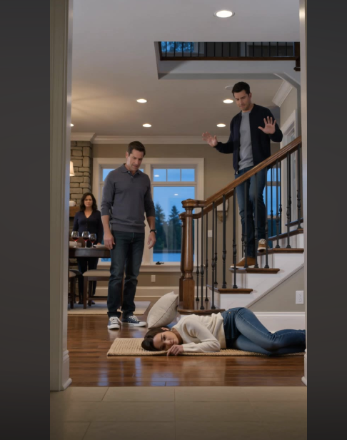
My father’s sneaker stopped two inches from my hand, and he told me not to ruin another peaceful weekend.
I was lying at the bottom of the lake house stairs with my cheek pressed against the braided rug, staring at a single crumb near the baseboard because looking at anything else made the pain worse. My right arm was tucked under me at an angle I couldn’t correct. My legs felt far away, as if they belonged to someone else in another room.
“Walk it off,” Dad said again, lower this time, because Uncle Mark had stepped into the hallway and Dad hated looking unreasonable in front of his older brother. “You’re fine.”
Tyler stood three stairs above me with his hands lifted like he was already defending himself from a question no one had asked.
“She does this for sympathy,” he said.
Mom appeared behind him in her linen sundress, one hand pressed to her chest, not from fear but from inconvenience. “Olivia, please. The kids are scared. You’ll do anything to ruin a peaceful weekend.”
Aunt Susan made a sound that wasn’t quite a gasp. One of my cousins shifted behind her, and a fork clattered against a plate in the dining room.
I wanted to tell them my back felt wrong. I wanted to tell them I hadn’t slipped. I wanted to tell them I had heard Tyler’s breath catch right after his hands left my shoulders.
But I had spent most of my life learning that pain only counted in my family when it happened to Tyler.
So I stayed still.
The staircase rose in a blur above me. Tyler’s face hovered between the spindles, pale beneath the porch-light tan everyone complimented. He looked less worried about me than about who had seen him.
“It was a joke,” he said. “I didn’t shove her that hard.”
That was the first thing that cut through the pain.
Not the word joke. I knew that word. Tyler had been hiding inside it since we were children. Not even shove, because I already knew what his hands had done.
It was that hard.
Dad turned sharply. “Tyler.”
Mom’s mouth tightened. Aunt Susan looked from him to me, and for one second her face did something I had never seen it do around our family.
It believed me before it was safe to believe me.
I tried to pull air into my lungs. The room tilted. Someone said my name, but I couldn’t tell who. The lake outside the windows kept shining like nothing in the world had changed.
Then Aunt Susan said, “I’m calling an ambulance.”
Dad snapped, “Don’t be ridiculous.”
And I used the last clear breath I had to say, “Ask him why he said that.”
Before that weekend, the lake house had seemed like one more thing I could survive if I kept my face pleasant and my expectations small.
It sat on the northern Michigan shoreline in a stand of birch trees, not grand enough to be called an estate but polished enough for my mother to use the word rustic without irony. The deck wrapped around the back, all cedar planks and black metal lanterns. The living room had stone around the fireplace, white cushions on furniture nobody was supposed to stain, and family photos lined up on the mantel like proof that we knew how to belong to one another.
My parents had rented it for Labor Day because Dad was turning fifty-six, Tyler had landed a new job offer, and Mom wanted “one weekend where everyone remembered what mattered.”
What mattered, in my family, usually meant everyone agreeing that Tyler was charming, Dad was generous, Mom was patient, and I was difficult.
I was twenty-two that summer, old enough to sign my own lease but not quite rich enough to do it without fear. I worked at the children’s desk of the public library during the week and at a coffee shop on Saturdays. I had finished community college in May, and I was taking two online classes toward a social work degree because I liked people better before they learned to hide their needs.
Children asked honest questions. Adults built houses around theirs.
I lived in my parents’ guest room because Mom said it was silly to waste money on rent when I could “get stable first,” and Dad said I wasn’t ready to manage a place alone. They never said it as an insult. They said it like weather. A fact already decided.
The guest room was painted a soft gray, the kind of color realtors call calming. I kept most of my things in plastic bins under the bed, not because I liked being temporary but because it was easier to leave quickly in my imagination if I never fully unpacked.
The Thursday before the trip, I stood beside those bins with my duffel open and counted out clothes for three days. Jeans, two T-shirts, a sweatshirt, pajamas, the blue sweater Mom liked because it made me look “less washed out.” I looped a green hair tie around my wrist while I folded everything into neat squares.
Downstairs, Tyler’s laugh burst through the ceiling.
He had come over for dinner even though he had his own apartment across town, because my parents still stocked his favorite beer, cooked his favorite steak, and let him talk about work as if the rest of us were sitting in a classroom built for him.
Tyler was twenty-four, tall in a careless way, with dark hair, easy teeth, and the kind of confidence people mistook for goodness when they had never been trapped in a hallway with him. He had been captain of things in high school, president of things in college, and newly hired by a commercial real estate firm Dad had spent years trying to impress.
My parents called him driven.
Teachers had called him charismatic.
Girls called him intense until they stopped calling.
I called him Tyler because anything more honest would have started a war I was not equipped to win.
“Liv,” Mom called from the bottom of the stairs. “Don’t overpack. We’re not moving in.”
“I’m almost done.”
“Also, bring something nice for Saturday night. Your dad wants pictures.”
Pictures were another family language. A good picture could erase a bad afternoon. A good picture could prove to relatives that we were healthy, close, grateful, normal. In pictures, Tyler put an arm around me just firmly enough for everyone to see affection and just tightly enough for me to feel a warning.
I packed the blue sweater.
My phone buzzed on the bed. Aunt Susan.
You coming up tomorrow with your parents?
Yes, I typed. Leaving after breakfast.
A pause. Then: I’ll be there by noon. Save me a porch chair?
I smiled despite myself. Aunt Susan was Dad’s younger sister and the only adult in our family who ever looked directly at the space between what was said and what was true. She had not saved me from anything, not really, but sometimes she placed herself near me in rooms where Tyler got loud. Sometimes she changed the subject at the exact moment I needed air. Sometimes she asked, “You okay?” and waited half a breath longer than everyone else.
I wrote back, Only if you save me from Mom’s photo schedule.
She sent a laughing face, then: Deal.
I wanted to believe that would be enough.
At dinner that night, Dad lifted his glass and said, “To family.”
Mom touched his arm. “To a calm weekend.”
Tyler looked at me across the table. “Hear that, Liv? Calm. Think you can manage?”
I set my fork down gently, because anything else would have looked dramatic.
“Probably,” I said.
Dad chuckled. “There she goes, taking everything personally.”
Mom sighed without looking at me. “Olivia, he’s joking.”
The steak knife in Tyler’s hand flashed under the pendant light as he cut another bite. He smiled down at his plate.
That was how it worked. Tyler threw a little blade into the room, and if I flinched, the wound belonged to me.
I had been clumsy before I knew the word for careful.
At least, that was the family story. I was the toddler who bumped into coffee tables, the little girl who tripped over nothing, the middle schooler who came home with bruises and apologies. There were jokes about bubble wrap. There were Christmas ornaments shaped like casts. My father once gave me a bike helmet with a bow on it when I turned sixteen, even though I hadn’t owned a bike in two years.
Everyone laughed.
I laughed too, because laughter was cheaper than explaining.
The first injury I remembered clearly happened when I was eight and Tyler was ten. We were in the basement playing a game he had invented called “castle guard,” which mostly meant he blocked the stairs and decided when I was allowed to pass. I had wanted to go upstairs because Mom was making cookies and I could smell butter and cinnamon through the vents.
“Password,” he said.
“I don’t want to play.”
“Then you can’t pass.”
“Move.”
He shoved the old laundry basket with his foot. It hit my knees. I fell backward into the storage shelves, and a box of Christmas lights came down on my shoulder. I cried hard enough that Mom came running.
Tyler said, “She tripped.”
Mom looked at the lights, the basket, my tears, his innocent face. “Olivia, honey, you need to watch where you’re going.”
Later, when the bruise turned dark, Dad kissed my forehead and said, “Our little disaster.”
He meant it sweetly. That was the problem. People could hurt you with affection and call it a family nickname.
By high school, the stories had multiplied. I fell during a pool party. I slipped at Tyler’s graduation barbecue. I twisted my wrist in the garage. I knocked into the hallway table. I hit my hip on the kitchen island. Each time, Tyler was nearby. Each time, the explanation arrived before I could stand upright.
“She lunged for the ball.”
“She wasn’t looking.”
“She panicked.”
“She does that.”
And each time, my parents accepted the version that kept the room comfortable.
When I tried to correct it, Mom’s face would close like a cabinet.
“Why do you always need someone to blame?” she asked once when I was fifteen and Tyler had yanked my backpack hard enough to make me fall on the front steps.
“Because someone did it,” I said.
Dad lowered his newspaper. “Your brother plays rough. You bruise easy. Those can both be true.”
But they were not both true in the way he wanted them to be.
The roughness was a choice.
The bruises were consequences.
The summer after I turned nineteen, I started keeping a private list in the notes app on my phone. Not because I planned to use it. I didn’t even know what using it would mean. I wrote things down because memory became slippery in my house. If three people told you that you had slipped, exaggerated, misunderstood, provoked, overreacted, then eventually the room where it happened began to change shape in your mind.
The list was plain and embarrassing.
June 14. Tyler grabbed my upper arm in Dad’s garage because I told him not to take my debit card. Mom said siblings fight.
August 2. Tyler stepped behind me in the pool and pulled me under. Dad said he used to do that with his brothers.
October 9. Tyler knocked my shoulder into the pantry door. Said I was in his way. Mom told me not to hover in the kitchen.
I never wrote emotional words. I did not write afraid or humiliated or why won’t anyone help me. I wrote the date, the place, the sentence used afterward.
Sentences mattered. In my family, they were how the truth was buried.
One sentence appeared more than once.
Not that hard.
The first time I noticed it, I was twenty, home from a late shift at the coffee shop. Tyler had been in the kitchen with two of his friends, eating leftovers from a dinner Mom had saved for him. I reached for a glass. He hip-checked me away from the sink, hard enough that my elbow hit the counter and pain shot down my arm.
I made a sound I hated, small and surprised.
One of his friends laughed uneasily. “Dude.”
Tyler rolled his eyes. “I didn’t hit her that hard.”
I had stood there with my palm pressed to my elbow, suddenly more interested in his wording than the pain.
Not that hard meant something had happened.
Not that hard meant he knew force had a measure.
Not that hard meant the argument was no longer whether he had done it, but whether I had the right to react.
After that, I heard it everywhere.
At Easter, when he grabbed my wrist during a card game and twisted until I dropped the cards. “I wasn’t holding you that hard.”
At Dad’s client picnic, when he shoulder-bumped me near the buffet table and my ribs struck the edge of a folding chair. “She acts like I hit her that hard.”
At Mom’s birthday dinner, when he blocked the hallway and pushed me back with two fingers to my forehead, smiling for our cousins. “Come on. I barely touched you that hard.”
Each time, the room accepted his sentence like a receipt for innocence.
Each time, I stored it away.
By the time Labor Day came, I had learned to measure danger by small shifts.
Tyler’s smile became dangerous when only one side of his mouth moved. Dad’s patience became dangerous when he rubbed two fingers along his eyebrow. Mom’s sweetness became dangerous when guests were nearby, because public embarrassment frightened her more than private cruelty.
That weekend had all three before we even reached the highway.
Mom sat in the passenger seat with a cooler at her feet and a garment bag across her lap. Dad drove too fast because traffic offended him. Tyler followed in his own car, though he had come to our house first so Mom could pack him a separate bag of snacks.
I sat behind Dad, where the seat belt rubbed my collarbone. The fields outside turned to pine, then to water glimpsed between trees. Mom played a playlist of James Taylor and Fleetwood Mac and kept turning around to ask whether my phone was away.
“You miss everything when you stare at a screen,” she said.
“I’m not staring.”
“You’re twenty-two. You should practice being present.”
Dad glanced at me in the rearview mirror. “Your mother wants one nice weekend.”
I knew the script. “I know.”
“No moods,” he said.
“I’m not in a mood.”
Mom reached back and patted my knee. Her nails were painted pale pink. “Then it’ll be lovely.”
The lake appeared after a bend in the road, broad and silver beneath late-afternoon light. For a moment, the beauty of it disarmed me. The water was calm enough to hold the sky. The dock creaked softly. Somewhere nearby, someone was grilling onions, and the smell drifted through the open car window.
Then Tyler pulled in behind us and honked twice.
Dad laughed. “There’s the man of the hour.”
The man of the hour stepped out wearing sunglasses and carrying nothing but his phone.
“Where’s your bag?” Mom asked.
“In the trunk,” he said. “Liv can grab it. She’s already standing there.”
I was standing there because Dad had opened the back of our SUV and handed me the cooler.
Mom made a small face. “Tyler, get your own bag.”
But she said it lightly, and he heard what all of us heard. There would be no consequence.
“I’ve got it,” I said.
Dad clapped once. “Teamwork.”
The weekend filled slowly, like a room taking on smoke.
Aunt Susan arrived with Uncle Mark and their daughter Emma around noon on Friday. Emma was fifteen, quiet, observant, with a sketchbook held to her chest like a shield. She hugged me carefully, as if she had somehow learned that I did not like being grabbed.
“Your hair’s longer,” she said.
“Yours too.”
She smiled. “Mom says we’re supposed to bond.”
“Sounds mandatory.”
“Very.”
We laughed, and for a few minutes I felt almost normal.
The lake house had six bedrooms, which meant the sleeping arrangements became a performance. Tyler got the room with the view because he had “such a stressful quarter coming up.” Mom and Dad took the primary bedroom. Aunt Susan’s family took the two rooms downstairs. I was given the small room at the end of the upstairs hallway, the one with twin beds and a slanted ceiling.
“It’s cozy,” Mom said.
“It’s fine.”
Tyler leaned in the doorway behind her. “Careful on the stairs at night, Liv. We all know how you are.”
Mom turned. “Tyler.”
“What? Safety first.”
He grinned at me over her shoulder.
That night, Dad grilled steaks on the deck while Mom arranged salads in white bowls and told everyone where to sit. The air smelled like charcoal and lake water. The adults drank wine. Tyler drank beer from the bottle and told a story about negotiating a deal at work, though from what I could gather, he had mostly been allowed to sit in a conference room while older men talked.
Dad listened like Tyler had personally saved the economy.
Uncle Mark asked me how the library was going.
“It’s good,” I said. “Summer reading ended last week, so it’s finally quiet.”
Tyler lifted his bottle. “Liv’s big with the eight-year-old demographic.”
Emma looked up from her plate. “That sounds nice, actually.”
“It is,” I said.
Tyler made his voice soft and fake. “Story time with Miss Olivia. Everybody sit crisscross and talk about feelings.”
Dad laughed through his nose.
I cut a piece of steak I did not want. “We do mostly books.”
“Books have feelings,” Aunt Susan said, and gave Tyler a look.
He shrugged. “I’m just saying, she found her level.”
Mom reached for the salad tongs. “Tyler, enough.”
But enough, in our family, meant continue more quietly.
After dinner, Mom insisted on pictures by the dock before the light disappeared. We lined up with the lake behind us, everyone rearranged according to her private geometry of pride. Dad in the center. Mom beside him. Tyler on Dad’s other side with his hand on Dad’s shoulder. Aunt Susan’s family angled pleasantly to the left.
I stood at the end.
“Olivia, smile with your teeth,” Mom called from behind the phone.
“I am smiling.”
“You look tense.”
Tyler leaned toward me without moving his smile. “Don’t ruin it.”
I smiled wider.
Later, when Mom reviewed the photos at the kitchen island, she sighed. “This one is almost good.”
“Almost?” I asked before I could stop myself.
“You’re hunched,” she said. “You do that when you want people to ask what’s wrong.”
Aunt Susan looked up from loading the dishwasher. “Maybe she was cold.”
“It’s August,” Mom said.
“People can be cold in August.”
Tyler stretched on a barstool. “Or dramatic year-round.”
I dried a plate until my fingers hurt.
That was how the first night ended: not with a fight, but with all the small rehearsals that make a fight possible.
Saturday morning, I woke early and walked down to the dock before anyone else was up. Mist hovered over the lake, and the water tapped against the posts with a patient sound. I sat with my feet tucked under me and watched a heron lift itself from the reeds.
For ten minutes, nobody needed me to be easy.
Then the screen door slid open.
I turned, expecting Aunt Susan.
Tyler stood on the deck with a mug in his hand.
“There you are,” he said. “I thought maybe you’d fallen in.”
I looked back at the lake. “Not yet.”
He came down the steps slowly. “You’ve been weird.”
“I’ve been quiet.”
“Same thing with you.”
The boards shifted under his weight. He stopped close enough that the sleeve of his sweatshirt brushed my shoulder. I moved an inch away. He noticed. He always noticed.
“You know Mom’s nervous, right?” he said.
“About what?”
“You. Making Dad’s birthday about your little wounded bird routine.”
The heron disappeared into the trees.
“I’m not doing anything,” I said.
“Exactly.” He took a sip of coffee. “You sit there looking like someone kicked you, and then everyone has to wonder what Tyler did this time.”
I turned to him. “Did you do something?”
His smile appeared. Half a mouth.
“See? That. That’s what I’m talking about.”
I stood. “I’m going inside.”
He stepped back, giving me room with exaggerated courtesy. “Careful. Wet dock.”
The dock was dry.
I looked down at the boards, then at him.
He lifted his brows. “What?”
“Nothing.”
But it was not nothing.
Wrong details had a texture. Once you learned it, you could feel them under your fingers. The dry dock. The warning before an accident. The sentence prepared before the event.
Inside, Aunt Susan was making coffee. She saw my face and lowered the pot.
“Morning,” she said.
“Morning.”
Tyler followed me in humming.
Aunt Susan’s eyes moved between us. “Everything okay?”
“Perfect,” Tyler said. “Liv didn’t fall in the lake. Big morning.”
I poured coffee into a mug. My hand trembled once, small enough that only Susan saw it.
She waited until Tyler wandered toward the living room. Then she said, “You don’t have to be alone with him.”
I kept my voice low. “I’m not alone. Everyone’s here.”
“That’s not what I meant.”
I stared at the coffee. Cream swirled and disappeared. “I know.”
“Olivia.”
I looked at her.
She seemed older in that kitchen light, or maybe just tired of herself. “If something happens this weekend, you tell me plainly. Not softened. Not made polite for your parents. Plainly.”
My throat tightened. “I’ve tried that before.”
“Try me.”
I wanted to believe her. I also wanted to ask where that sentence had been when I was eight, twelve, sixteen, twenty. Instead, I nodded because anger had never made anyone in my family safer.
By lunch, the house had filled with more relatives: Uncle Pete and his wife, two older cousins, a neighbor couple my parents had invited because Dad wanted to impress the husband. The kitchen grew loud. People moved through doorways with plates and drinks. Mom glowed under the attention, telling stories about the rental, the view, Tyler’s job, Dad’s discipline, her own ability to make a weekend happen.
I became useful. Useful was the safest shape I knew.
I carried napkins to the deck. I refilled the lemonade pitcher. I helped Emma find tape for a sketch that had torn. I took a trash bag to the side door and stood outside a little too long breathing in the smell of pine sap.
When I came back, Tyler was in the living room describing me.
Not talking to me. Describing me.
“She was the only kid I knew who could get injured reading,” he said, and several people laughed because they didn’t know yet what the joke cost.
Dad added, “We used to joke that Olivia needed hazard pay for existing.”
I stopped just inside the doorway with the empty trash bag twisted in my hand.
Mom saw me and smiled brightly. “Honey, we’re telling the bookshelf story.”
“There is no bookshelf story,” I said.
Tyler turned, delighted. “Oh, there is absolutely a bookshelf story.”
I had been thirteen. He had slammed his shoulder into mine while running past the hallway. I hit the bookshelf in the den. A framed photo fell and cut my foot. Mom told the urgent care nurse I had been dancing.
“It wasn’t the bookshelf,” I said.
The room shifted, not much, but enough. A few smiles paused.
Tyler’s eyes sharpened. “Here we go.”
Dad’s voice carried a warning. “Olivia.”
I looked at Aunt Susan. She was standing near the kitchen island, both hands still on a serving spoon.
My mouth went dry.
The truth stood in me, ready and shaking.
Then Mom laughed, too high. “She hates that story. Teenagers never like being reminded of their awkward phases.”
“I’m not a teenager,” I said.
“No,” Tyler said. “Now you’re an adult who still can’t take a joke.”
That was the moment I should have left.
I knew it even then. There are moments when the body understands the future before the mind negotiates it away. My shoulders tightened. My vision narrowed around the front door, the driveway, my car keys in my purse upstairs.
But Dad’s birthday dinner was that night. Aunt Susan had asked me to try her. Emma was sitting on the couch pretending not to listen. And part of me, the part that was still a child in the basement looking up at a blocked staircase, wanted one adult to finally watch the whole thing and say the right name for it.
So I stayed.
The afternoon turned hot and restless. People came in damp from swimming, tracking lake water across the kitchen floor. Mom complained about towels. Dad napped in a lounge chair with a hat over his face. Tyler started a cornhole game in the yard and shouted whenever his team scored.
I sat under the deck umbrella with Emma, helping her shade a drawing of the house.
“You make the windows look nicer than they are,” I said.
She smiled. “Windows are easier than people.”
“That’s true.”
She glanced toward the yard. Tyler had just thrown a bag and was bowing as if to applause. “He’s different around you.”
My hand paused.
“Who?”
She gave me a look that said fifteen was not as young as adults liked to pretend.
I watched Tyler slap a cousin on the back too hard. The cousin stumbled and laughed because everyone else did.
“He likes an audience,” I said.
Emma darkened the roofline with her pencil. “Mom says some people become worse when nobody stops clapping.”
Aunt Susan had never said that to me.
I looked across the deck at her where she stood near the lemonade, talking to Uncle Mark. She met my eyes for one second and looked away first.
Maybe she had been waiting for a safe moment too.
That realization made me sadder than anger would have.
Before dinner, Mom sent me upstairs to get the blue sweater because “the lake breeze photographs better than it feels.” I went to the small bedroom, closed the door, and sat on the edge of the twin bed. For a few minutes I let my face rest. Not cry. Not collapse. Just stop performing.
My phone was on the nightstand.
I opened the notes app.
Labor Day weekend. Dock dry. Tyler warned me about wet dock after standing too close. Living room bookshelf story. I corrected it. Dad warned me. Mom covered.
I stared at the sentences. They looked small. They looked like nothing.
Then I typed: If something happens, say it plainly.
I did not know if that was a promise or a prayer.
Downstairs, Mom called my name.
Dinner was served at the long table by the windows. The lake reflected sunset in strips of copper. Mom had placed candles down the center and written names on little cards because she believed seating could control mood. Dad sat at the head. Tyler sat at his right. I was placed near the middle between Aunt Susan and Uncle Pete, which might have been kindness or strategy.
The birthday toast happened before salad.
Mom stood with her wineglass and told everyone Dad was the kind of man who “held a family together.” Dad looked modest in the way powerful men look modest when they expect to be praised. Tyler added a speech about discipline and legacy and how Dad taught him to “never make excuses.”
People clapped.
Then Dad looked at me. “Livy? Anything to add?”
The nickname landed badly. He used Livy when he wanted me soft.
I stood because refusing would have become the story. My glass held sparkling water, bubbles rising and vanishing.
I looked at Dad’s expectant face. Mom’s encouraging smile. Tyler’s amused one.
“Happy birthday,” I said. “I hope this year is honest.”
The words came out before I approved them.
Aunt Susan’s fingers tightened around her napkin.
Dad’s smile barely moved. “Honest?”
“I mean good,” I said, too late.
Tyler leaned back. “No, no. Let her do the mysterious thing.”
Mom set her glass down. “Olivia meant good.”
“I did,” I said.
But I had meant honest.
Dad lifted his glass again, ending it. Conversation surged back with forced brightness. Forks touched plates. Someone asked Uncle Pete about fishing. Mom passed bread like her life depended on it.
Under the table, my knee bounced once.
Aunt Susan leaned close. “Plainly,” she whispered, so softly no one else heard.
After dessert, the board games came out.
Board games in my family were never games. They were little governments. Dad liked rules, Tyler liked winning, Mom liked everyone pretending not to care. I hated them because laughter made it easy for Tyler to lean over me, snatch cards, flick pieces, crowd my chair, turn my hesitation into entertainment.
That night, they chose a word game. The dining table was cleared except for bowls of chips and half-empty glasses. Rain began tapping the windows. The deck lights turned the glass black, so the room reflected itself: all of us bright and trapped.
I played carefully. I kept my answers mild. I laughed when expected. But the toast had changed something in Tyler. I could feel him waiting for an opening.
It came when I guessed a word before he did.
“Look at that,” Uncle Mark said. “Olivia with the steal.”
Emma grinned at me.
Tyler’s smile flattened. “She’s good at watching people. Comes from all that lurking.”
“I wasn’t lurking,” I said.
“Oh, sorry. Observing. That’s the sensitive-person word.”
Mom rubbed her temple. “Can we not?”
“I’m playing,” he said.
“You’re needling,” Aunt Susan said.
Everyone looked at her.
Tyler laughed once. “Needling?”
“Yes,” she said. “That’s the word.”
Dad put his cards down. “Susan, don’t start.”
“I didn’t.”
“No, but you’re about to.”
The table became careful. It was amazing how quickly my family could make the person naming the problem look like the problem.
Tyler used that opening.
“You know what?” he said, turning toward me. “This whole weekend, she’s been waiting for someone to rescue her from nothing.”
I stared at the score pad.
“She does this thing,” he went on. “She gets quiet, makes everyone uncomfortable, and then if you ask what’s wrong, suddenly you’re the bad guy.”
“Tyler,” Uncle Mark said.
“No, seriously. It’s exhausting.”
Dad leaned back, not stopping him. Mom looked at me like I had put the words in Tyler’s mouth just to embarrass her.
I set my cards on the table. “I’m going upstairs.”
Tyler’s chair scraped back immediately. “There it is.”
“I’m tired.”
“You’re losing.”
“I’m not losing.”
“You’re always losing, Liv.”
I walked away before my face could answer.
The staircase curved from the living room to the upstairs hallway. It was wide at the bottom and narrowed near the landing, with a polished wooden banister Mom had already warned everyone not to mark with wet towels. I put one foot on the first step, then another. My hands were steady, but everything inside me was moving too fast.
Behind me, Tyler said, “Running?”
I kept going.
“Olivia,” Dad called. “Don’t make a scene.”
That sentence followed me like a hand at my back.
I reached the landing where the stairs turned. The hallway above was dim. I could see the partly open door of my room, the corner of my duffel on the bed, the blue sweater folded over the chair.
Tyler’s footsteps came up fast behind me.
“Move,” I said without turning.
“Or what?”
He came around me on the narrow landing, blocking the rest of the stairs. He had done this since childhood, but he was not ten anymore. His shoulders filled the space. His face was flushed from beer and victory and the thrill of being watched.
Down below, I heard chairs moving.
“Tyler, knock it off,” Aunt Susan called.
He spread his arms, mock grand. “Castle guard.”
My stomach dropped so sharply I had to grip the banister.
“Don’t,” I said.
His smile flickered. For a second, he looked irritated that I had recognized the game too seriously.
“Don’t what?”
“Don’t put your hands on me.”
The living room below was angled just enough that I could see Dad standing near the foot of the stairs, Mom behind him, Aunt Susan near the dining table, Uncle Mark halfway out of his chair. Emma stood in the doorway with her sketchbook clutched against her shirt.
Tyler saw them too.
That should have protected me.
It didn’t.
“Oh my God,” he said loudly. “Listen to yourself.”
I tried to step around him.
He moved with me.
“Tyler,” Dad warned, but the warning was lazy, aimed at volume, not behavior.
I looked past my brother at the open hallway. “I’m done.”
Something changed in his face.
Not dramatically. Not like a movie. Just a small tightening near his eyes, the look he got when I had embarrassed him by refusing to play along.
His hands came up.
I remember the pressure more than the motion. Both palms at my shoulders. A shove disguised as a correction. A quick, hard instruction delivered through my body.
Then the staircase disappeared.
I grabbed for the banister and missed.
There was a flash of ceiling, faces, railing, light. My hip struck something. My back hit the edge of a step. My breath left before I reached the bottom.
When I landed, the house seemed to inhale.
For a few seconds, nobody moved.
The green hair tie had snapped loose from my braid and lay near the bottom stair like some small, useless circle.
Then Tyler said, “She slipped.”
It came too fast.
That was wrong detail number one.
I could not speak yet. Air was a locked door. Pain moved through me in bright sheets, and beneath it was a colder fear because my legs were there and not there at the same time.
Dad stepped forward, then stopped. His sneaker near my hand. His face was annoyed, embarrassed, almost bored.
“Walk it off,” he said. “You’re fine.”
The words were old. Basement words. Pool words. Kitchen words. Words that had been used like bandages over injuries no one wanted to see.
“Robert,” Aunt Susan said, “don’t move her.”
“She’s not made of glass.”
“I said don’t move her.”
Mom’s voice rose behind him. “Olivia, sweetheart, enough. You’re scaring Emma.”
I found a breath. “I can’t—”
“What?” Dad asked.
“I can’t move right.”
Tyler laughed, but there was no laughter in it. “Come on.”
I turned my eyes toward him. He was still on the stairs. He had not come down to help. One hand gripped the railing.
“You pushed me,” I said.
His face went blank, then hot. “I did not push you. You tried to duck around me.”
“You put your hands on me.”
“She’s confused,” Mom said quickly.
“I’m not.”
“You hit your head,” she said, though I had not said I had.
That was wrong detail number two.
Aunt Susan pulled out her phone.
Dad saw it. “Susan.”
“I’m calling.”
“No, you’re not.”
“She fell down stairs, Robert.”
“She’s having a panic episode.”
Uncle Mark stepped into the hallway. “Let her call.”
Mom pressed her fingers under her eyes, protecting her mascara. “This is exactly what I meant. One peaceful weekend.”
Tyler came down two steps. “It was a joke.”
I closed my eyes.
If I kept them open, I was afraid I would beg. And I had promised myself something upstairs in my phone. Plainly.
“It wasn’t,” I said.
He came closer. “I didn’t shove her that hard.”
The sentence hit the hallway harder than my body had hit the stairs.
Dad’s head turned.
Tyler’s mouth parted as if he could pull the words back with his teeth.
Aunt Susan, phone pressed to her ear now, stared at him.
I opened my eyes.
There it was. Not proof in the dramatic way people imagine proof. Not a recording, not a confession, not a miracle. Just a sentence shaped wrong. A sentence that showed the hand beneath the glove.
I breathed around pain and said, “Ask him why he said that.”
No one answered.
The operator must have picked up because Aunt Susan turned away and started speaking quickly. Address. Fall. Adult female. Back pain. Possible spinal injury. Family interference. Her voice shook on that last phrase, but she said it.
Dad’s face darkened. “Family interference?”
“Stay away from her,” Susan said to him.
“This is my daughter.”
“Then act like it.”
That landed. Not because it changed him, but because it named him in front of witnesses.
The waiting began.
It could not have been long, maybe twelve minutes, but pain stretches time until every second has corners. Someone brought a pillow, and Aunt Susan told them not to put it under me without instructions. Mom paced between the kitchen and hallway, whispering to Dad. Tyler sat on the third step with his elbows on his knees, staring at the floor like he was the one who had fallen.
Emma crouched near the dining room entrance. Her eyes were wet.
“I’m okay,” I whispered, though I was not.
She shook her head once, fiercely, like she refused to accept another lie from an adult.
When the paramedics arrived, the house changed. Not because they were dramatic. Because they were calm.
There were two of them, a woman named Rachel with silver-threaded hair pulled into a tight bun, and a younger man named Luis who moved with deliberate care. They carried bags and a stretcher, but no panic. They did not look at the candles, the wineglasses, the birthday cake cut unevenly on the counter. They looked at me.
“Hi,” Rachel said, kneeling where Dad’s sneaker had been. “I’m Rachel. Tell me your name.”
“Olivia.”
“Hi, Olivia. I’m going to ask you some questions. You answer only what you can.”
Mom came in fast. “She slipped. She’s very anxious. She has a history of overreacting to pain.”
Rachel did not look away from me. “Olivia, what happened?”
I swallowed. My mouth tasted like metal and salt.
“My brother shoved me.”
Tyler stood. “No, I didn’t. Not like that.”
Rachel lifted one hand without turning. “Sir, I need you to step back.”
Dad’s voice hardened. “This is getting out of hand.”
Luis was checking my feet, my hands, asking what I could feel. I answered as best I could. Some places were sharp. Some were dull. Some felt like they belonged under water.
Rachel asked, “Did you lose consciousness?”
“Not yet,” I said, then realized how frightening that sounded.
Her eyes changed, but her voice did not. “Okay.”
Tyler muttered, “This is insane.”
Aunt Susan said, “He said he didn’t shove her that hard.”
Rachel paused.
Not long. Not theatrically. But long enough.
She looked at Tyler. Then at Dad. Then back at me.
“Olivia,” she said, “did you hear him say that?”
“Yes.”
“Okay.”
Dad scoffed. “You can’t take a sentence out of context.”
Rachel finally looked up at him. Her face was professional, but it had cooled. “Sir, I’m not taking anything. I’m documenting what is said around a patient with a possible spinal injury.”
The word documenting moved through the hallway like a new authority.
Mom’s voice sharpened. “We don’t consent to that.”
“She’s twenty-two,” Rachel said. “She can speak for herself.”
I had heard those words before, in bank offices and doctor forms and rental applications. Legally, they had been true for years. In my family, they had never been allowed to matter.
Rachel leaned closer. “Olivia, do you want your parents answering for you?”
The question was simple.
That made it enormous.
Dad said, “Of course she—”
“No,” I said.
His mouth closed.
The house was not silent. Rain still tapped the windows. The refrigerator hummed. Somebody in the dining room breathed through their nose too hard. But something old and loud inside me went quiet.
Rachel nodded once. “Then they won’t.”
They stabilized me before moving me, slow and careful. Every instruction was given to me first. Luis explained where his hands would go. Rachel asked permission before checking places that hurt. I cried when they lifted me, not loudly, but enough for Mom to press her lips together as if my tears were another stain on the upholstery.
As they carried me toward the door, Tyler stepped close.
“Liv,” he said under his breath. “Don’t make this worse.”
I turned my head enough to see him.
For once, he looked small. Not sorry. Small.
“You did,” I said.
The ambulance smelled like antiseptic and rain. Aunt Susan rode with me because I asked for her and because Rachel did not ask my parents to approve it. Through the back windows, I saw Mom standing in the driveway with her arms wrapped around herself. Dad had one hand on his hip, the other holding his phone to his ear. Tyler stood under the porch light, face washed pale.
The lake house grew smaller until the trees took it.
Aunt Susan sat strapped on the bench beside me, her hands clasped so tightly her knuckles showed.
“I’m sorry,” she said.
I stared at the ceiling. A strip of light moved across it whenever the ambulance passed a streetlamp.
“Don’t,” I said.
“I should have—”
“Not now.”
She nodded, tears in her eyes, and took the correction without making me comfort her. That was the first useful apology anyone in my family had ever given me.
At the hospital, everything became bright.
The emergency department was busy but controlled, all wheels, curtains, monitors, clipped voices. Rachel gave the report while nurses moved around me. Adult female. Fall down stairs. Family reports slip. Patient reports shove by brother. Brother heard saying he did not shove her that hard. Back pain, numbness, possible spinal injury.
There it was in the world.
A sentence that had followed me through years of kitchens and hallways, finally written down by someone whose job was not to keep Tyler comfortable.
Dr. Meera Patel introduced herself with warm hands and tired eyes. She listened when I answered. She redirected Mom twice when my parents arrived and tried to enter the trauma bay.
“We’re her parents,” Dad said.
Dr. Patel glanced at me. “Olivia, do you want them here?”
Mom’s face folded into public hurt. “Honey.”
I was shaking. Pain medication had softened the edges of the room, but fear remained sharp. I looked at Aunt Susan behind the doctor. She did not nod or mouth instructions. She simply stood where I could see her.
“No,” I said.
Mom inhaled like I had slapped her.
Dr. Patel turned to a nurse. “Please ask them to wait outside.”
Dad stepped forward. “This is absurd.”
“Sir,” Dr. Patel said, “your daughter declined.”
Daughter. Not child. Not problem. Not dramatic girl. Daughter.
The nurse drew the curtain.
Behind it, Mom began crying in the hallway. I knew that cry. It was not grief. It was strategy wearing grief’s coat.
The MRI took place after X-rays and questions and more waiting. They gave me headphones, tucked blankets around me, and slid me into the machine. The sounds were loud and strange, knocking through my bones. I closed my eyes and counted backward from one hundred, then forward, then backward again.
I thought about staircases.
The basement stairs when I was eight. The school steps when Tyler tripped me at fourteen and everyone said I had grown too fast for my feet. The porch steps at eighteen when he blocked the door after a graduation party and told me to stop acting better than him. The lake house stairs shining under warm lights while my family watched the same old story try to happen one more time.
Except this time, I had said plainly.
When they pulled me out, the technician did not tell me anything, which somehow told me enough to be afraid. A nurse wheeled me back to a room. Aunt Susan was there with coffee she had not drunk. My parents were not.
“Hospital security asked them to stay in the waiting area,” she said.
I blinked. “Security?”
“Your dad got loud.”
Of course he had. Dad believed volume was evidence.
Dr. Patel came in a little after midnight with another doctor and a patient advocate named Marlene. Marlene had short gray hair, navy glasses, and a folder held against her chest, but she never opened it like a threat. She introduced herself as someone who helped patients when family dynamics made care complicated.
Family dynamics.
It was such a clean phrase for a dirty room.
Dr. Patel pulled a chair near my bed. “Olivia, you have a significant injury in your lower back. The good news is that your spinal cord is not severed. We are going to treat this carefully, and I expect improvement, though it will take time and therapy.”
I let out a breath that turned into a sob.
Aunt Susan covered her mouth.
“But,” Dr. Patel continued gently, “the scan showed more than tonight’s injury.”
My hand tightened around the blanket.
She watched my face. “There are signs of older injuries. Different stages. Some are healed. Some not fully. The pattern doesn’t match one fall.”
Aunt Susan whispered, “Oh, Olivia.”
I did not look at her. I looked at Dr. Patel.
“How many?” I asked.
She did not give me a dramatic number. She did not make it a television moment. She spoke carefully, like each word needed to be both truthful and kind.
“Enough that I am concerned this has been happening repeatedly.”
There are moments when being believed does not feel good.
It felt like freezing after years of fever. It felt like my body had been keeping minutes from meetings my mind had been forced to forget. It felt like the scan had walked into the room carrying a version of me no one had been able to interrupt.
Marlene stepped closer. “Because you are an adult, you decide what happens next. We can document your injuries. We can help you change your emergency contact. We can connect you with counseling, housing resources, and legal advice if you want it. No one gets to speak for you unless you say so.”
Legal advice.
The words were not revenge. They were a door.
I thought of the thumbnail version of life my parents preferred: smiling dock photos, birthday candles, Tyler’s hand on Dad’s shoulder, my body at the edge of the frame. Then I thought of Dad’s sneaker near my hand.
“What if I don’t want a public fight?” I asked.
“Then we don’t start one for you,” Marlene said. “Safety and care first. Choices after.”
Dr. Patel added, “But I need to be clear. If your family tries to explain this as simple clumsiness, the medical record will not support that.”
I closed my eyes.
Somewhere outside the room, Dad’s voice rose. “I want to see my daughter.”
Marlene looked toward the door. “Do you want him in here?”
My body answered before my manners could. It stiffened.
“No.”
“Then he stays out.”
A nurse entered a few minutes later to say my parents were refusing to leave unless someone explained the scans. Dr. Patel looked at me, not at the nurse.
“They don’t have a right to your medical information without your permission,” she said.
That sentence made me cry harder than the pain.
I had grown up in a house where privacy was treated like deceit. My mother read my texts in high school “for safety.” Dad opened bank statements because he was “helping me learn finances.” Tyler went through my backpack, my drawers, my room, then mocked whatever he found. The idea that information about my own body could belong to me felt almost unreal.
But if the reversal was going to hold, it could not only happen behind a curtain.
My parents would turn the hallway into a stage. Tyler would turn fear into confusion. Mom would cry. Dad would command. They would leave with a version of events already polished unless something interrupted the polishing.
I looked at Dr. Patel.
“I want them to hear one thing,” I said.
Aunt Susan sat forward. “Olivia, you don’t have to.”
“I know.”
That was why I had to choose it.
Not because they deserved access. Because I deserved to say it while someone who knew the truth stood beside me.
Marlene arranged it in a small family consultation room near the nurses’ station. Not my room. Not the waiting room where Dad could perform ownership. A neutral room with beige walls, six chairs, a box of tissues, and a window looking at the dark parking lot.
They wheeled me in first.
I hated being in the chair. I hated the blanket over my legs, the hospital bracelet, the way pain made my skin feel too small. But I kept my shoulders straight. Aunt Susan stood behind me. Dr. Patel sat to my left. Marlene sat near the door.
Mom and Dad entered like people arriving for a meeting they intended to win.
Mom had fixed her lipstick. Dad had changed from anger into restraint, which looked on him like a suit buttoned too tight. Tyler came last. His hair was damp from rain or sweat. He avoided my eyes.
“This has gone far enough,” Dad said before anyone sat.
Marlene said, “Mr. Harrison, you’ll sit or you’ll leave.”
His face went red.
Mom sat quickly. “Robert.”
He sat.
Tyler remained standing by the wall until Dr. Patel looked at him. Then he dropped into a chair with teenage resentment, though he was twenty-four years old.
Mom leaned toward me. “Honey, everyone is upset. Your father got scared. Tyler feels terrible. We just need to be careful not to say things we can’t take back.”
I looked at her hands. Her wedding ring flashed under the fluorescent lights.
“Like what?” I asked.
She blinked. “Like accusations.”
Dad cut in. “Your brother made a mistake. You made it sound intentional.”
Tyler said, “I was trying to stop her from storming off.”
I kept my eyes on him. “With both hands?”
His jaw moved.
Mom closed her eyes. “Olivia.”
Dad pointed at the table. “This is exactly the problem. You turn everything into an attack on you.”
Aunt Susan shifted behind me, but I lifted one finger, barely, and she stayed quiet.
That was my restraint. Not silence. Restraint.
There is a difference.
Silence is what you do when you have no safe words. Restraint is what you do when you have chosen the exact one.
I asked Tyler, “Why did you say that hard?”
He stared at me.
Dad frowned. “What?”
“In the hallway,” I said. My voice sounded thin but steady. “You said you didn’t shove me that hard. Why?”
Tyler looked at Mom.
That was the first crack.
Not in him, maybe. In the old arrangement. He had always looked to her for translation. She could turn pushed into played, scared into dramatic, hurt into sensitive. But this time, Rachel had heard him. Aunt Susan had heard him. I had heard him, and I was not smoothing it for him.
“It’s an expression,” Tyler said.
“No, it isn’t.”
Dad leaned back. “Olivia, don’t play word games.”
“I’m not.”
Mom reached for a tissue. “You’re on medication. Maybe you misheard.”
Dr. Patel spoke for the first time since they entered. “The paramedic documented the same phrase.”
Mom’s hand stopped halfway to the tissue box.
Dad turned to Dr. Patel. “And you think that proves something?”
“I think it is consistent with what Olivia reported,” she said.
Tyler laughed under his breath. “Consistent. Great.”
I looked at him. “The dock was dry.”
He blinked. “What?”
“You warned me it was wet this morning. It wasn’t.”
Mom whispered, “What does that have to do with anything?”
“Nothing by itself,” I said. “That’s how it always works. Nothing by itself. The dock was dry. I didn’t hit my head, but Mom said I did. Tyler said I slipped before anyone asked him. He said he didn’t shove me that hard after he said he didn’t shove me.”
Dad’s face tightened. “You’ve been collecting grievances all weekend?”
“I’ve been collecting sentences for years.”
That landed even harder.
Tyler sat forward. “That is creepy.”
“No,” Aunt Susan said, and her voice shook. “What’s creepy is that she had to.”
Mom turned on her. “Susan, stay out of this.”
Susan stepped beside my chair. “I stayed out of it too long.”
The room shifted again.
Dr. Patel folded her hands. “The MRI does not show a single clumsy fall. It shows a pattern of older injuries that need explanation. Not family jokes. Not personality labels. Explanation.”
Dad stood so fast his chair scraped the floor. “Are you accusing us of something?”
Marlene rose too. “Sit down, Mr. Harrison.”
He did not.
For the first time in my life, Dad looked like the room might not arrange itself around his anger.
Dr. Patel’s voice remained even. “I’m saying the medical findings are not consistent with the story that Olivia is simply dramatic or accident-prone.”
Mom’s face crumpled. “She has always been fragile.”
I turned to her. “No. I was always convenient to call fragile.”
Tyler stared at the floor.
Dad said, “You have no idea what you’re doing to this family.”
I almost laughed, but I was too tired.
“I know exactly what I’m doing,” I said. “I’m no longer helping you explain away what happens to me.”
The room held that.
Not silence. Consequence.
Mom’s tissue shook in her hand. Tyler’s knee bounced. Dad looked at Aunt Susan as if she had betrayed him by standing too close to me.
Marlene spoke softly. “Olivia has requested that Susan be listed as her support person. She has also requested that her parents not receive medical updates without her permission.”
Mom stared at me. “You can’t mean that.”
“I do.”
“I’m your mother.”
“I know.”
The sentence hurt because it was not an argument. It was the grief underneath one.
Dad’s voice went cold. “And how do you plan to pay for all this independence?”
There it was. The last door he trusted. Money.
Rent. Insurance. Tuition. Car repairs. The small practical ropes that kept me tied to a house where people called restraint moodiness and pain performance.
My hands were trembling under the blanket.
I let them tremble.
Then I said, “I’ll start by not paying for it with my body.”
Aunt Susan made a small sound behind me.
Dr. Patel looked down at the table, not because she was moved past professionalism but because she had the grace to give me a second of privacy inside a room full of people.
Dad had no sentence ready for that.
Tyler did. Of course he did.
“You’re acting like I tried to destroy your life.”
I looked at my brother. His face was pale now, all the easy charm stripped away, and beneath it was not a monster from a movie. It was something more ordinary and sadder. A man who had spent so long being excused that accountability felt like cruelty.
“No,” I said. “I’m acting like my life belongs to me.”
After that, the meeting ended because there was nowhere left for the old story to stand.
Marlene asked my parents to leave. Dad argued, but not well. Mom cried in the hallway. Tyler walked out first, shoulders hunched, phone already in his hand. Aunt Susan stayed until a nurse wheeled me back to my room.
I slept in pieces.
Pain woke me. Machines woke me. Memory woke me. Once, just before dawn, I woke because I thought I was at the bottom of the stairs again and Dad’s shoe was beside my hand. Aunt Susan was asleep in the chair, her cardigan wrapped around her, her face slack with exhaustion.
For a moment, I hated every adult who had ever been tired when I needed them brave.
Then I watched her wake with a start, see me, and sit forward.
“You need something?”
I could have said water. I could have said nurse. I could have said no.
Instead, I said, “Why didn’t you say anything before?”
She closed her eyes.
The question was not fair in the way people use fair to mean comfortable. It was fair in the way a bill is fair when it finally arrives.
“I was afraid of your father,” she said.
That surprised me.
Dad was difficult, yes. Loud. Proud. Skilled at making people feel smaller. But I had never imagined adults could be afraid of him because adults had always seemed like a country I was trying to reach.
“And,” she continued, “I told myself I didn’t know enough. I saw pieces. Bruises. Flinches. Your mother explaining too quickly. Tyler’s hand on your arm. I told myself pieces weren’t enough.”
“They were enough for me,” I said.
Tears slid down her face. “I know.”
I looked toward the window. Morning had not arrived yet, but the glass was lightening from black to gray.
“I don’t know if I can forgive that.”
“You don’t have to.”
That was the second useful apology.
The next three days were a lesson in how quickly control tries to return wearing new clothes.
Mom texted first.
Sweetheart, we are all exhausted. Please do not let strangers turn you against your family.
Then:
Your brother is devastated. He hasn’t slept.
Then:
Your father and I need access to your doctors so we can make responsible decisions.
I did not answer.
Dad called Aunt Susan six times. She silenced her phone and placed it face down. Uncle Mark came the second day with a duffel of clean clothes, my laptop, my wallet, and the stuffed bear I had kept since childhood but would never have asked for. He stood awkwardly by my bed and cleared his throat.
“I should have done better,” he said.
I looked at him. “Yes.”
He nodded. “I’m going to do better now.”
It was not enough. It was something.
Emma sent a drawing through her mother. It showed the lake house from the outside, but the windows were dark except one upstairs room with a yellow square of light. Underneath, she had written, You don’t have to go back inside.
I cried over that longer than I cried over the medical report.
The report itself was written in language that made my life sound both official and distant. Prior healed injuries. Pattern inconsistent with single incident. Patient reports repeated family minimization. Patient declines parental involvement in care. The words were careful, but they did what no family photo had ever done.
They showed the frame.
A physical therapist named Jamie came on Monday and helped me sit up. It hurt, but the fear hurt more. My legs worked, slowly and badly at first, as if they had forgotten my name. The spinal injury would require a brace, follow-ups, and months of strengthening. I would heal, they said, but healing would not be a straight line.
Nothing about me had ever been allowed a straight line.
On Tuesday, Marlene helped me make calls.
We removed my parents as emergency contacts. We added Aunt Susan. We found out my health insurance would last through the end of the year under Dad’s plan whether he liked it or not, and after that Marlene connected me with a patient navigator who knew words like marketplace and subsidy and qualifying event. She spoke practically, without pity.
Practical kindness felt luxurious.
Aunt Susan offered me her guest room before I asked.
“You can stay as long as you need,” she said.
“What about Dad?”
“What about him?”
“He’ll be angry.”
“He already is.”
“He’ll blame you.”
“He can try.”
I studied her face. “You mean it.”
“I do.”
The day I left the hospital, Mom came alone.
I had agreed to ten minutes in the patient lounge because Marlene said boundaries sometimes worked better when they had walls and clocks. Mom arrived in cream pants, pearl earrings, and the same pale-pink nails. She carried a tote bag with my favorite sweater folded on top, a peace offering arranged for maximum visibility.
She kissed the air near my cheek.
“You look thin,” she said.
“I’ve been in the hospital.”
Her eyes filled immediately. “Please don’t be cold to me.”
I almost apologized. The old reflex rose in me like a hand.
I folded my fingers together.
Mom sat across from me. “Your father is devastated.”
I waited.
“Tyler too. He keeps saying he wishes he could take it back.”
“He can’t.”
“I know that.” She leaned forward. “But Olivia, families survive terrible misunderstandings when people don’t harden themselves.”
“It wasn’t a misunderstanding.”
Her mouth tightened. “It was not the version you are making it, either.”
There she was.
Not the crying mother. Not the worried one. The editor.
I felt something in me sit back.
“What version am I making?”
“The kind where everyone meant harm. Your brother was careless. Your father was scared. I was trying to keep everyone calm.”
“You said I would do anything to ruin a peaceful weekend.”
She flinched. Good. She remembered.
“I was upset.”
“I was on the floor.”
“You have to understand how it looked.”
I stared at her. “Why is that always the first thing you protect?”
She looked confused.
“How it looked,” I said. “Not how I was. Not what happened. How it looked.”
For once, Mom had no immediate answer. She touched the sweater in the tote bag, smoothing the sleeve.
“You were always different,” she said softly.
There it was again, dressed in sadness.
“No,” I said. “I was always inconvenient.”
Her eyes sharpened. “That is unfair.”
“So was the floor.”
She stood.
The visit was not ten minutes. It was six.
At the door, she turned back. “If you leave with Susan, you are making a choice.”
“I know.”
“Choices have consequences.”
I thought of the stairs. The scan. The sentence in the paramedic’s report. The way my parents had believed Tyler when belief cost them nothing, and doubted me when doubt cost me everything.
“Yes,” I said. “They do.”
She left the sweater behind.
I did not take it.
Aunt Susan’s guest room had yellow curtains and a bookshelf filled with novels she kept meaning to read. The first night there, I slept with the lamp on. The house made unfamiliar noises: pipes settling, branches ticking against the window, Uncle Mark coughing once in the hallway. Every sound woke me because my body had been trained to prepare before my mind knew why.
But no one opened the door.
No one stood over me.
No one told me I was making things difficult.
In the morning, Aunt Susan knocked softly and waited until I answered.
That small courtesy nearly undid me.
Recovery became a series of humble tasks. Learning how to shower with a brace. Learning how to ask for help without paying for it in shame. Learning how to walk through a grocery store without scanning for Tyler’s shape at the end of every aisle. Learning how to say, “I’m not discussing that,” and let the sentence stand.
Dad sent one email.
It was long, formal, and somehow still angry. He wrote that he and Mom had always tried their best. He wrote that Tyler had apologized “in his own way.” He wrote that I was “mischaracterizing a complicated family dynamic.” He wrote that if I continued down this path, relationships might be damaged beyond repair.
I read it twice.
Then I replied with three sentences.
I am healing from injuries your explanations did not prevent. I am not available for conversations that call my pain a misunderstanding. I hope you choose honesty, but I will not wait inside the old story while you decide.
He did not answer.
Tyler sent nothing directly, probably because Aunt Susan had told him any contact would be documented. But messages came through cousins.
He’s really messed up about this.
He says he never meant to hurt you.
He says you know how he gets.
That last one almost made me laugh.
You know how he gets had been another family prayer. It meant step aside, soften, lower your voice, give him the win, absorb the weather. Nobody ever said, He knows how you hurt.
I stopped answering cousins too.
The extended family split in the quiet way families do when the truth threatens seating charts. Uncle Mark and Aunt Susan stayed close. Caroline called to apologize for every dinner she had watched with discomfort and politeness. Uncle Pete sent a card with a lighthouse on it and wrote, Thinking of you, which was both not enough and more than he had ever managed before.
Dad’s side became cautious. People used phrases like “both sides” until Aunt Susan started asking what the other side of a shove was. Then they used fewer phrases around her.
Mom posted no photos from the lake weekend.
That, more than anything, told me she understood something had changed.
A month later, Marlene called to ask if I wanted a copy of my records mailed to me or held for pickup. I chose pickup. I wanted to walk into the hospital on my own feet, even if those feet moved slowly.
Dr. Patel saw me in the hallway and smiled.
“Olivia.”
“Hi.”
“How are you doing?”
It was a question people asked casually, but she did not ask it casually.
“I’m learning the difference between better and fine,” I said.
Her smile softened. “That’s a good difference.”
I thanked her. Not with a dramatic speech. Just the words. Thank you for asking me. Thank you for writing it down. Thank you for not looking at my parents when you needed my answer.
She said, “You answered. That mattered most.”
I carried the envelope of records to Aunt Susan’s car and sat with it on my lap for a long time before opening it. The pages were full of terms I only partly understood, but certain sentences stood out.
Patient reports longstanding pattern of being labeled clumsy after injuries.
Patient requested family members not answer on her behalf.
Paramedic documented brother’s statement: “I didn’t shove her that hard.”
I touched that line.
It was strange, the power of one ugly sentence when placed in clean ink. It had not saved me by itself. Nothing had. Not the scan, not the doctor, not Susan, not the paramedic, not my private notes. The reversal came because all those things met the moment I stopped translating my pain for people who preferred it quiet.
I had wanted proof to arrive like rescue.
Instead, proof had needed me to open the door.
By winter, I had moved into a studio apartment above a bakery on Maple Street. It smelled like yeast at dawn and sugar by noon. The floors sloped. The radiator clanked. The kitchen had exactly two drawers, one of which stuck unless I pulled it from the left side. I loved it with a fierceness that surprised me.
On moving day, Aunt Susan helped me carry boxes while Uncle Mark assembled a small table badly, then correctly. Emma taped one of her drawings inside my closet door: a staircase with flowers growing between the steps.
I kept the green hair tie in the top drawer of my nightstand, not because I wanted a shrine to the worst night, but because I wanted to remember that small things can survive impact too.
My parents did not visit.
Mom mailed a check in December with a note that said, For expenses. I returned it because it came with no apology and too much invisible string.
Dad called once after New Year’s. I let it go to voicemail. His message was stiff.
“Olivia. Your mother would like to hear from you. Tyler is in counseling. We are all trying to move forward. I hope you’ll consider what forgiveness looks like.”
I listened twice.
Then I deleted it.
Forgiveness, I was learning, was not a door other people got to knock on whenever consequences made them cold.
Tyler in counseling might have mattered someday. It did not undo the stairs. It did not undo the years. It did not undo the fact that my parents still described his effort and my boundaries in the same breath, as if my healing were a family inconvenience he was bravely enduring.
Therapy helped me name things without drowning in them.
My therapist, June, had a plant-filled office and a way of asking questions that left room for answers I did not like.
“What do you miss?” she asked one day.
I almost said nothing.
Then I surprised myself.
“I miss who I thought they might become if I explained it well enough.”
June nodded. “That’s a hard person to grieve.”
It was.
I grieved the mother who might have touched my hair on the hospital bed and said, I should have protected you. I grieved the father who might have looked at his own shoe beside my hand and fallen apart from shame. I grieved the brother who might have been annoying, competitive, even selfish, without needing me afraid.
Those people had never fully existed, but I had loved them in outline.
Letting go of an outline still hurts.
Spring arrived with rain and thawed sidewalks. I walked better by then, though long stairs still made my back tighten. I took them anyway, slowly, one hand near the railing but not clutched around it. The bakery owner downstairs, Mrs. Alvarez, learned my schedule and sometimes left day-old rolls outside my door in a paper bag.
At the library, I moved from part-time aide to full-time youth programming assistant. The first program I planned on my own was called “Feelings In Stories,” which would have made Tyler mock me for a week. Twelve children came. We read a book about a rabbit who said no. Then we practiced saying small boundary sentences in big voices.
A little boy with a dinosaur sweatshirt stood on the rug and said, “Stop. I don’t like that.”
The room clapped.
I had to turn toward the craft table and pretend to organize crayons until I could breathe normally.
After the program, his grandmother thanked me.
“He’s got older cousins,” she said quietly. “They play rough.”
I looked at her.
She looked back, and I saw the moment she understood why my face had changed.
“Rough shouldn’t mean scared,” I said.
She nodded slowly. “No. It shouldn’t.”
That was the first time I heard my experience become useful without feeling used.
By summer, Aunt Susan hosted a small dinner for my birthday. Not at the lake. Never there. At her house, with paper lanterns in the backyard and tacos from a restaurant because she said nobody needed performative cooking. Emma made a cake that leaned slightly to one side. Uncle Mark gave me a toolkit and said every apartment deserved one.
Near the end of the night, Aunt Susan handed me an envelope.
I tensed before I could stop myself.
“It’s not from them,” she said quickly.
Inside was a photo. Not posed. Not polished. Emma had taken it without telling me. I was sitting at the patio table laughing at something Uncle Mark had said, head turned, shoulders loose, one hand lifted mid-gesture. No one was gripping me. No one was arranging me. No one was asking me to smile better.
I stared at it for a long time.
“I look different,” I said.
Aunt Susan sat beside me. “You look unbraced.”
That word stayed with me.
Unbraced.
For years, I had lived as if impact were seconds away. I braced before doorways. Before jokes. Before family photos. Before Tyler entered rooms. Before Dad’s sigh. Before Mom’s sweet voice in public. I had mistaken bracing for personality.
Maybe I was not naturally tense.
Maybe I had been rehearsing survival.
In August, almost a year after the fall, I drove north alone. Not to the lake house. I was not ready for that, and I did not owe readiness to anyone. I drove to a public beach twenty miles south of it, where families spread towels across the sand and children shrieked at cold water.
I sat on a bench near the parking lot and watched waves fold over themselves.
My phone buzzed.
A message from Mom.
I waited before opening it. Waiting was one of the ways I reminded myself I owned my hands.
Olivia, I found the hospital discharge papers while cleaning. I don’t know how to say this well. I keep thinking about what Dr. Patel said. About the pattern. I should have asked different questions. I am not asking you for anything. I just wanted to say I am sorry I protected the wrong peace.
I read it until the screen dimmed.
Then I read it again.
It was not enough to rebuild a bridge. It was the first plank she had ever carried without asking me to hold the other end.
I did not answer that day.
The old me would have rushed to reward her, to keep the apology alive by making it easy. The new me let it stand alone and prove whether it could.
Two weeks later, I wrote back.
Thank you for saying that. I need time. Please keep asking yourself what peace cost me.
She replied only, I will.
Maybe she meant it. Maybe she meant it for that hour. I was learning not to build a home inside maybe.
Dad did not apologize. Tyler did not either, not in words that reached me. Aunt Susan heard from Uncle Pete that Tyler had left the real estate firm after “performance issues” and was working somewhere smaller. He had stopped drinking for a while, then started again, then stopped. His life was not ruined. That mattered to say. Consequences are not the same as ruin, though people who have never had them often confuse the two.
He was alive. Employed. Loved by some. Excused by fewer.
That was enough distance for me.
On the anniversary of the lake weekend, I worked a closing shift at the library. Rain tapped the high windows. A girl around eleven lingered by the desk after everyone else had left the craft room. She had a book tucked against her chest and a purple mark near her wrist that could have been anything.
“My brother plays rough,” she said suddenly.
The words moved through me like a door opening onto stairs.
I kept my voice calm. “Do you feel safe at home?”
She looked at the floor.
I did not rush her. I did not fill the silence with comfort that would help me more than her. I did not ask why she had not said anything before.
Finally, she whispered, “Not when he’s mad.”
I followed every protocol. I got my supervisor. We called the right people. We kept our voices steady. We gave her water. We told her she had done the right thing. No one promised a perfect ending. No one called her dramatic. No one asked whether she had misunderstood being hurt.
After she left with someone safe, I went into the staff bathroom and cried with one hand over my mouth.
Not because I was back at the bottom of the stairs.
Because I wasn’t.
I was standing.
That night, I climbed the stairs to my apartment slowly. The bakery smell had faded to flour and warm metal. My back ached. My legs were tired. The railing was cool under my palm.
At the top, I paused and looked down.
Stairs were not villains. They were only stairs. Wood, nails, angles, gravity. The terror had never belonged to them. It had belonged to hands, excuses, and the people who watched the fall and debated whether the floor was really hard enough to hurt.
Inside my apartment, I turned on one lamp. The room glowed small and golden. There were dishes in the sink, books stacked by the bed, a half-dead basil plant on the windowsill, bills held to the fridge by a magnet shaped like a strawberry. Ordinary evidence of a life no one else curated.
I opened my laptop and looked at the first line of an essay I had been trying to write for weeks.
They called me clumsy until the scan showed I had been telling the truth in a language they refused to learn.
I sat with that sentence.
Then I kept writing.
I wrote about jokes that are not jokes when only one person laughs. I wrote about families that protect peace by feeding someone else’s pain to it. I wrote about doctors who ask the patient. I wrote about a paramedic writing down an ugly little phrase because ugly little phrases can be doors. I wrote about Aunt Susan’s late courage and my late anger and the difference between being rescued and being believed.
I did not write to destroy anyone.
I wrote because the truth had lived in my body long enough.
When I finished, dawn had begun to pale the sky over Maple Street. The bakery ovens downstairs started up, and the first warm breath of bread rose through the floorboards.
My phone rested beside the laptop. No missed calls. No family emergency. No demand dressed as concern.
Just quiet.
I stood, stretched carefully, and walked to the window. A delivery truck rolled past. A woman in running shoes crossed the street with a dog that kept stopping to sniff rainwater in the curb. Somewhere, a child laughed on the way to school.
The world had not become gentle.
But it had become larger than my family’s version of me.
For years, I thought the best I could hope for was to be believed after I was hurt badly enough. Now I wanted more. I wanted to believe myself before the fall. I wanted other people to learn the dry dock, the quick explanation, the warning disguised as a joke, the sentence with that hard hiding inside it. I wanted someone, somewhere, to stop laughing one second earlier.
A month later, the library asked me to help train teen volunteers. We sat in a circle after closing, all metal chairs and carpet squares, and talked about what to do when someone says they are unsafe. I gave them simple words.
Ask.
Listen.
Do not argue with the person in pain.
Get help from someone whose job is help, not comfort.
A boy raised his hand. “What if they’re exaggerating?”
I thought about Dad’s sneaker. Mom’s lipstick. Tyler’s hands. The MRI light on Dr. Patel’s face.
“Then listening will not hurt them,” I said. “But refusing to listen might.”
No one clapped. Good. It was not that kind of lesson.
Afterward, I walked home under a sky full of low clouds. My back ached in the damp, but my steps were steady. At the bakery door, Mrs. Alvarez waved me in and handed me a paper bag.
“Too many cinnamon rolls,” she said.
“You always say that.”
“And it is always true enough.”
Upstairs, I ate one over the sink because plates are sometimes too much ceremony. Sugar stuck to my fingers. Rain tapped the fire escape. My apartment was small, imperfect, and mine.
There was a photo on my fridge now, the one Emma had taken at my birthday dinner. In it, I was laughing with my shoulders loose.
Next to it was a blank postcard Mom had sent from a weekend trip she and Dad had taken without Tyler. On the back, she had written, Still asking. I had not answered yet, but I had not thrown it away.
Healing, I was learning, did not always look like a clean break. Sometimes it looked like choosing which doors stayed locked, which windows opened an inch, and which rooms you no longer entered alone.
I still had bad dreams. I still hated sudden hands near my shoulders. I still stepped carefully on stairs when I was tired. Sometimes a family laughing too loudly in a restaurant made my chest tighten. Sometimes someone said “just a joke,” and I had to remind myself that I was not required to smile.
But I was not curled at the bottom of anyone’s story anymore.
I had names for what happened.
I had records.
I had people who asked me directly and waited.
Most of all, I had the memory of my own voice in that hallway, thin and shaking but clear enough to change the air.
Ask him why he said that.
One quiet word did not save me by magic. The MRI did not heal me by being true. Aunt Susan’s call did not undo the years. Dr. Patel’s report did not make my parents different overnight.
But all of it together made a wall the old lie could not pass through.
And on the other side of that wall, I found a life where pain did not have to perform to be real, where peace did not require my silence, and where the person I had spent years protecting from my family was finally allowed to be me.
How many people are still being called dramatic because the truth has not yet found a safe room to be spoken?
