During boarding, a flight attendant leaned toward me and quietly said, “You shou
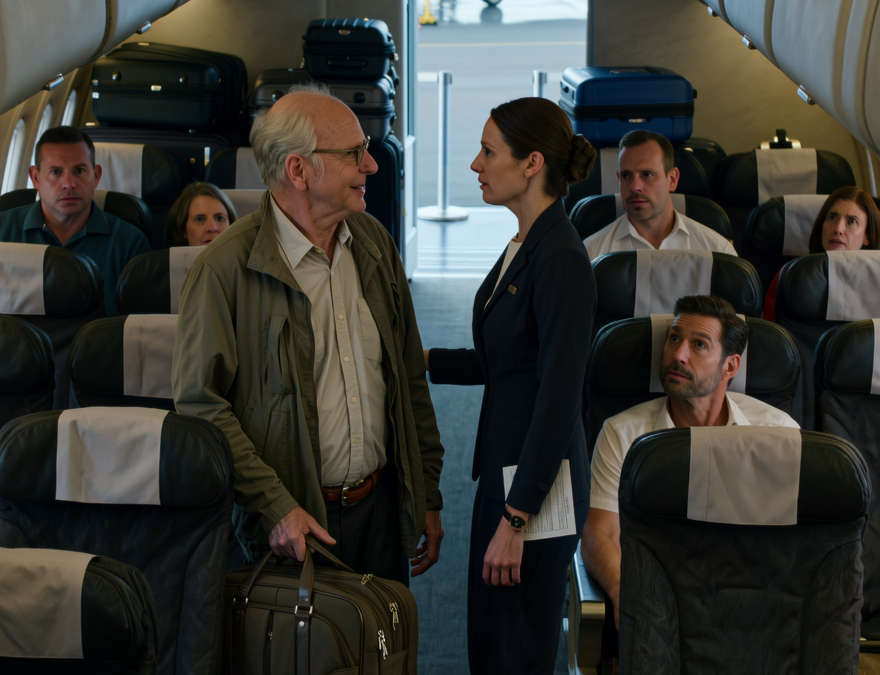
The Seat I Left Behind
During boarding, a flight attendant leaned close and whispered, “Pretend you’re not feeling well and get off the plane,” and when I laughed because I thought she was joking, she returned moments later with a serious look and said, “Please, trust me and leave now,” but I didn’t understand why until twenty minutes later…
My name is Francis Wilson, and before that Tuesday morning at Orlando International Airport, I had spent most of my seventy-two years believing that if you raised a child with enough patience, decency, and love, some portion of those things would remain inside him no matter how complicated life became.
I taught history for forty years.
Patterns were my profession.
I taught teenagers that wars rarely began with the dramatic moment printed in textbooks. They began with small concessions, quiet resentments, unpaid debts, changed alliances, ignored warnings, and documents nobody thought mattered until years later.
I taught them to look for what came before.
That morning, sitting inside a crowded airplane with my carry-on still in my hand, I finally understood that I had failed to use my own lesson on my own family.
The signs had been there for months.
My son Christopher and his wife Edith had moved into my home eight months earlier after Christopher lost his regional sales position.
“At most, three months,” he had promised.
I lived in the same two-story house outside Orlando where I had raised him. My wife, Margaret, and I bought it in 1989, when Christopher was still young enough to believe putting a sheet over the dining table created a castle.
Margaret had been gone four years.
After she passed, I left her side of the bedroom mostly unchanged for nearly a year.
Her reading lamp remained angled toward the chair.
Her gardening gloves still sat beside the back door.
Eventually, I learned to move through the house without expecting to hear her humming in the kitchen.
I did not learn how to stop missing her.
When Christopher called asking whether he and Edith could stay temporarily, I said yes before he finished explaining.
That is what fathers do, or at least what I believed fathers were supposed to do.
Their temporary stay stretched from autumn into spring.
Christopher spent most mornings at the kitchen island applying for jobs, taking phone calls, and promising me each week that something promising was about to happen.
Edith still worked in medical administration at a private clinic across town.
She was organized in a way that had once impressed me.
Bills arranged by date.
Shoes lined precisely beside the front door.
Appointments entered into three calendars.
She disliked uncertainty.
Margaret used to say people reveal themselves in what they cannot tolerate.
Edith could not tolerate anything she did not control.
At first, life under one roof was manageable.
Then conversations grew shorter.
Christopher stopped joining me for Sunday breakfast.
Edith began opening my mail if she thought it looked financial.
The first time I noticed, she smiled and said, “I thought it might be something urgent.”
I took the envelope from her.
“Then I’ll open it.”
Her smile stayed in place half a second too long.
A month later, Christopher asked whether I had ever considered putting him on my checking account.
“Just in case,” he said.
“In case of what?”
“You know. Emergencies.”
“I have an attorney for emergencies.”
He looked embarrassed.
“I’m your son.”
“I know.”
I had meant the answer gently.
He did not receive it that way.
The subject disappeared.
Then came the insurance conversation.
Edith cooked dinner one Thursday, something she rarely did. She made chicken, green beans, and potatoes and set the table with the good dishes Margaret used to reserve for company.
Halfway through the meal, she put down her fork.
“Francis, do you still have that life insurance policy?”
I looked at her.
“Yes.”
“Christopher told me you’ve had it for years.”
I turned to my son.
He stared at his plate.
Edith continued.
“Five hundred thousand?”
My fork stopped.
“How do you know the amount?”
Christopher looked up quickly.
“I might’ve mentioned it.”
“When?”
He shrugged.
“I don’t remember.”
Edith smiled.
“It was just conversation.”
There are phrases people use when they want you to stop examining something.
Just conversation.
Just curious.
No big deal.
Don’t overthink it.
I had heard all of them from students who had copied answers from the person beside them.
I continued eating.
Later that evening, I found Christopher in the den.
“Why were you discussing my insurance?”
He looked genuinely uncomfortable.
“Dad, come on.”
“That isn’t an answer.”
“We’re family.”
“Still not an answer.”
He ran one hand through his hair.
“Edith worries about planning. That’s all.”
“For my planning?”
“For everyone’s.”
I studied him.
Christopher was thirty-nine then.
Tall like me.
Margaret’s brown eyes.
When he was seven, he once waited outside my classroom for forty minutes because he wanted to surprise me with a construction-paper Father’s Day card.
He had drawn us holding hands under an enormous yellow sun.
I still had it in my study.
Looking at the man standing in front of me, I tried to find that boy.
“Is there something you need to tell me?” I asked.
“No.”
“Money trouble?”
“No.”
That answer came too fast.
Three days later, Christopher and Edith appeared in my study.
I was reviewing old student essays because retired teachers are not entirely rational about throwing away things written by seventeen-year-olds in 2008.
Edith stood in the doorway.
“Francis, we have a surprise.”
Christopher stayed behind her with both hands in his pockets.
“What kind?”
“A family trip.”
I removed my reading glasses.
“To where?”
“Miami,” Christopher said.
That made me laugh.
“You hated Miami.”
“I was twelve.”
“You complained about the humidity for six straight days.”
“I’ve matured.”
“That remains under review.”
He laughed, but Edith did not.
She stepped farther into the room.
“A full week. Hotel near the water. Everything paid.”
I looked from one to the other.
“Why?”
Christopher’s smile faltered.
“Because we want to spend time with you.”
For eight months, we had lived under the same roof.
Most evenings they ate in front of the television downstairs while I ate at the kitchen table.
They had declined my last four invitations to breakfast.
Now they wanted seven uninterrupted days of family togetherness.
“When?”
“Next Tuesday,” Edith said immediately.
“So you already booked it.”
“It was a good deal.”
“Before asking me?”
“We wanted it to be a surprise.”
There it was again.
A phrase designed to make a decision sound like a gift.
I leaned back in my chair.
Christopher looked nervous.
Edith looked prepared.
I should have said no.
Instead, curiosity overcame discomfort.
“I’ll go.”
Relief crossed my son’s face so quickly he could not hide it.
Edith touched his arm.
A tiny gesture.
Almost nothing.
But historians build conclusions from almost nothing all the time.
That night, I found the printed reservation on the kitchen counter.
Three airline tickets.
Hotel suite.
Rental car.
My seat assignment was three rows behind theirs.
Another detail.
Small.
Meaningless, perhaps.
I folded the printout and returned it exactly where I had found it.
The next morning, I began paying attention.
Not accusing.
Not imagining.
Observing.
Christopher received a call and walked into the backyard to answer it.
Edith asked whether I still carried my medications in my weekly pill organizer when traveling.
“Usually.”
“You should let me handle them,” she said. “Less chance of forgetting.”
“I’ve managed so far.”
She smiled.
“Of course.”
Later that day, I deliberately mentioned feeling tired.
Christopher’s head lifted.
“How tired?”
“Normal tired.”
“Any confusion?”
I looked at him.
“Do I seem confused?”
“No. I’m just asking.”
By Sunday, I had almost convinced myself I was being unfair.
Money questions and awkward conversations did not make people guilty of anything.
Margaret used to remind me that suspicion was easy and trust was brave.
But Margaret also believed trust was not blindness.
On Monday evening, I opened my desk drawer and took out a small notebook.
I wrote down the dates.
Insurance conversation.
Miami invitation.
Medication question.
Christopher asking about confusion.
Then I closed the notebook.
If nothing happened, I would destroy the page and feel ashamed of myself.
If something did, I wanted a record.
Tuesday morning arrived clear and hot.
Christopher drove.
The car smelled of stale coffee and the citrus air freshener Edith clipped to the vent.
My suitcase sat on my lap for the first ten minutes because Christopher claimed the trunk was packed.
At a traffic light, I glanced backward.
The trunk cover was visible through the rear window.
Nothing pressed against it.
“Forgot to clean it out,” Christopher said after noticing me look.
“I didn’t ask.”
His hands tightened around the steering wheel.
Edith spent almost the entire drive texting.
At one point, her screen reflected faintly in the passenger window.
I could not read the messages.
I only saw how quickly she deleted one thread afterward.
At the airport, Christopher parked in the short-term garage.
“We’re gone a week,” I said.
“I know.”
“This will cost a fortune.”
“It’s easier.”
Another detail.
We moved through the terminal with the strange efficiency of people traveling together while emotionally separated.
At security, Edith asked for my medication pouch.
“I’ll put it in my carry-on,” she said.
“No.”
She blinked.
“I’m trying to help.”
“I’ll keep it.”
For a fraction of a second, frustration showed.
Then the pleasant expression returned.
“Fine.”
At the gate, Christopher and Edith boarded before me.
Neither looked back.
I stood in line with retirees in golf shirts, parents folding strollers, a businessman arguing quietly into a headset, and a little girl hugging a stuffed flamingo.
Ordinary people.
Ordinary morning.
My boarding group was called.
I walked down the jet bridge.
The airplane door stood open.
Cool recycled air washed over me.
A flight attendant in her late forties greeted passengers with the practiced smile of someone who had already said good morning two hundred times.
Her name tag read MILDRED HAYES.
“Good morning, sir.”
“Morning.”
I handed her my boarding pass.
Her eyes moved from the screen to my face.
The smile changed.
Only slightly.
She leaned close as if clarifying my seat number.
“Pretend you’re not feeling well and get off the plane.”
I stared at her.
“I’m sorry?”
“Keep moving.”
She stepped away immediately.
A family behind me was waiting.
I moved into the cabin.
Christopher and Edith were already seated three rows ahead.
Christopher looked back.
“You good, Dad?”
“Fine.”
I took another step.
Maybe I had misheard.
Maybe Mildred had mistaken me for someone else.
I actually smiled at the absurdity of it.
Then she came back.
This time, she touched my elbow.
Her face remained professional for everyone else.
Her eyes did not.
“Sir,” she whispered, “please trust me and leave now.”
“You’re serious.”
“I am.”
“Why?”
“I can explain outside.”
My stomach tightened.
Christopher called from ahead.
“Dad?”
Mildred’s hand left my arm.
I had spent my career telling students that courage rarely feels heroic when you are doing it.
Mostly, it feels embarrassing.
You make a choice before you know whether it is the right one.
I pressed a hand lightly against my stomach.
“I don’t feel right.”
Christopher stood halfway.
“What?”
“I’m dizzy.”
The word drew immediate attention.
Another crew member approached.
Mildred moved smoothly into procedure.
“Sir, let’s get you back to the gate.”
“I can walk.”
“We’ll help you.”
Edith stood.
“We should come.”
Mildred’s colleague raised a hand.
“Please remain seated while we assist him.”
For one second, Edith forgot to arrange her face.
I saw it.
Not worry.
Irritation.
Christopher showed something similar.
Then concern snapped into place.
“Dad, call me.”
“I will.”
As Mildred guided me toward the door, Edith leaned toward Christopher.
Her voice was low.
“This complicates everything.”
Christopher whispered something I couldn’t hear.
The cabin swallowed the rest.
Twenty minutes later, I sat in a small airport medical room with a paper cup of water in my hand.
My blood pressure was fine.
Pulse slightly elevated.
No surprise there.
A medical technician had left after confirming I was stable.
My flight had already pushed away from the gate.
Christopher had texted twice.
Dad, are you okay?
Then:
We didn’t want to miss the flight. Call when you can.
I stared at that message.
My son had flown to Miami while his seventy-two-year-old father sat in an airport medical room claiming dizziness.
Maybe that alone should have told me everything.
The door opened.
Mildred entered.
She had removed her jacket, and the neat professionalism from the airplane had disappeared.
She looked exhausted.
“I’m sorry,” she said.
“For what?”
“For frightening you.”
“You succeeded.”
“I didn’t know another way.”
She closed the door.
Then she held out her phone.
“I heard your daughter-in-law in the restroom before boarding.”
I said nothing.
Mildred continued.
“She was on a call. I wasn’t trying to listen. She was in the next stall, and she wasn’t being quiet.”
“What did she say?”
Mildred swallowed.
“She talked about you appearing confused during the flight.”
My fingers tightened around the paper cup.
“She said the trip needed to create a record. Something witnesses could remember later.”
“What kind of record?”
“A health episode.”
The room suddenly felt smaller.
Mildred unlocked her phone.
“I recorded part of it because I knew nobody would believe me if I just repeated it.”
She pressed play.
The audio was imperfect.
Airport restroom echoes.
Water running.
A hand dryer in the background.
Then Edith’s voice.
Clear enough.
“Once he looks disoriented in public, the paperwork gets easier.”
A pause.
“No, Christopher has the forms.”
Another pause.
“The bank wants recent documentation. After that, we can handle the house and the accounts without him fighting every step.”
My mouth went dry.
The recording continued.
“He still thinks Miami is a family trip.”
Then a soft laugh.
Mildred stopped it.
I stared at her phone.
For several seconds, neither of us spoke.
“What else?”
“She mentioned your medication.”
My eyes lifted.
“What about it?”
“That she planned to control when you had access to it so any confusion would look natural.”
Mildred’s voice hardened.
“I don’t know what she meant exactly. I didn’t wait to find out.”
I remembered Edith asking for my medication pouch at security.
A cold line traveled down my back.
Mildred sat beside me.
“I may have misunderstood some of it, but I knew you shouldn’t get on that plane.”
“You didn’t misunderstand enough.”
My voice sounded strangely calm.
Forty years in classrooms had trained me not to react while information was still arriving.
“What made you intervene?”
She looked down.
“My father signed away control of almost everything he had during the last year of his life.”
I waited.
“My cousin convinced him he couldn’t manage money anymore. By the time the family understood what had happened, accounts had changed, papers had been signed, and everyone was arguing over what my father really wanted.”
Her eyes filled.
“I kept thinking somebody should have asked better questions earlier.”
She looked at me.
“When I heard your daughter-in-law, I decided I wasn’t staying quiet again.”
I took out my notebook.
“What’s your full name?”
A surprised smile touched her face.
“Mildred Hayes.”
“Phone number?”
“You’re taking notes?”
“I’m a retired history teacher.”
That almost made her laugh.
“Of course you are.”
I wrote everything down.
Then I asked her to send me a copy of the recording.
She hesitated.
“I can send what I captured, but please get professional advice about how it can be used.”
“I will.”
She sent it.
I watched the file appear on my phone.
A tiny icon.
Twenty-eight seconds.
Nothing about it looked powerful.
Evidence rarely does.
I took a taxi home.
The driver asked whether I had missed my flight.
“No,” I said.
“I think I missed something worse.”
He glanced at me in the mirror and decided not to ask.
My house looked exactly the same when we turned onto my street.
Stucco walls.
Oak tree by the driveway.
Margaret’s rose bushes along the front walk.
Christopher’s car was gone.
Of course it was.
They were in Miami.
I unlocked the door.
The quiet inside felt different.
Until that morning, Christopher and Edith had been family staying in my home.
Now every drawer they had opened seemed questionable.
Every conversation gained another meaning.
I carried my suitcase directly to my study.
My filing cabinet stood beneath the window.
Insurance.
Banking.
Property.
Tax records.
I opened the insurance folder first.
The original policy showed my niece, Rebecca, as beneficiary.
Rebecca was Margaret’s sister’s daughter, a nurse in Atlanta who had taken care of Margaret during the hardest months of her illness.
Five years earlier, I had decided she should receive the policy.
Then I found a second document behind it.
Beneficiary Change Confirmation.
Primary beneficiary:
Christopher Wilson.
Effective date:
Six months earlier.
My signature appeared at the bottom.
Except it wasn’t my signature.
It was close.
Someone had studied it.
But whoever copied it added a loop to the F in Francis.
I had never written my F that way.
My heart began beating harder.
I photographed the document.
Then I opened my bank statements.
At first, nothing jumped out.
That was probably the point.
$900.
$1,200.
$750.
$2,000.
Transfers to an account I did not recognize.
Spread across months.
Always around days when I had routine payments coming out, making the balances look busy enough that I had not noticed.
I found a calculator.
Thirty-eight thousand dollars.
I checked again.
Same number.
Thirty-eight thousand dollars had left my accounts in six months.
I opened the property folder.
There was a copy of a power-of-attorney form.
Christopher’s name.
My name.
Another imitation of my signature.
Then I found something that made me sit down.
A medical summary.
Patient reports increasing confusion.
Difficulty tracking finances.
Forgetfulness.
Episodes of disorientation.
Concern regarding independent decision-making.
I read it three times.
None of it was true.
The clinic listed on the page was Edith’s workplace.
My own daughter-in-law had been helping create a paper version of me that did not exist.
A confused old man.
A man who could not manage his money.
A man who needed his son to take over.
The trip to Miami was not about a beach.
It was about creating witnesses.
I looked toward the bookshelf.
Christopher’s construction-paper Father’s Day card sat inside a small frame.
The enormous yellow sun.
His seven-year-old handwriting:
MY DAD KNOWS EVERYTHING.
I took off my glasses.
For the first time that day, grief reached me.
Not fear.
Grief.
There is something especially painful about discovering that someone you love has not merely lied to you.
He has built a different version of you for his own benefit.
I remained at that desk until sunset.
At 6:14, Christopher called.
I let it ring twice before answering.
“Dad?”
“Hello.”
“You okay?”
“I’m tired.”
“Did they figure out what happened?”
“No.”
Edith spoke in the background.
Christopher lowered his voice.
“Maybe you shouldn’t be alone.”
I almost laughed.
“What do you suggest?”
“We could come back.”
“From Miami?”
“If you need us.”
I looked at the forged document.
“No. Enjoy your family trip.”
Silence.
“Dad, are you upset?”
“I missed the flight.”
“That’s not what I asked.”
“I’m tired, Christopher.”
He hesitated.
“We’ll talk when we get home.”
“Yes.”
“We probably need to talk about your health anyway.”
I looked at Edith’s false medical summary.
“I think you’re right.”
His relief was almost audible.
“Good.”
We hung up.
The next morning, I called an attorney named Nicholas Clark.
He had helped a former colleague of mine with estate planning.
His receptionist offered an appointment the following week.
“I need today,” I said.
“Is this an emergency?”
“I believe someone has changed my financial documents without my permission.”
I heard typing.
“Can you be here at two?”
“Yes.”
Nicholas was fifty-six, with dark hair turning silver around the temples and the patient expression of a man who had learned that clients tell the most important part of a story only after believing they have finished.
I placed four folders on his desk.
Insurance.
Bank.
Property.
Medical.
He read silently.
When he reached the beneficiary form, he asked for samples of my genuine signature.
I handed him my driver’s license and two signed letters.
He compared them.
“This needs a professional examination,” he said, “but visually, I see what concerns you.”
He moved to the bank records.
“How much is missing?”
“Thirty-eight thousand.”
“Did your son ever have permission to transfer money?”
“No.”
“Online banking access?”
“He helped me set up the account years ago.”
“Did you change the password?”
“No.”
Nicholas looked at me.
“That needs to happen today.”
Then he read the medical records.
His expression became more serious.
“You were never evaluated for cognitive decline?”
“No.”
“Never diagnosed with memory problems?”
“No.”
“Have you signed any document giving your son authority over your medical or financial decisions?”
“No.”
I placed Mildred’s recording on the table.
“There’s more.”
After he listened, Nicholas leaned back.
“Do not confront them.”
“I wasn’t planning to.”
“Good.”
He folded his hands.
“The worst thing you can do now is turn this into a family shouting match. We preserve records. We notify the financial institutions. We correct the estate documents. We establish your capacity independently. And we do everything through proper channels.”
“Can I recover the money?”
“Possibly.”
“Can they take my house?”
“Not if we act quickly.”
For the first time since the airport, I breathed normally.
Nicholas looked at me.
“Francis, are you safe staying in the house with them when they return?”
I thought about the question.
“I don’t know.”
“That answer bothers me.”
“It bothers me too.”
He advised me to change financial passwords, move important records off-site, notify my bank, and arrange a full independent assessment of my decision-making capacity.
Not because he believed I needed one.
Because proof mattered.
“People can argue with your opinion,” he said. “They have a harder time arguing with independent documentation.”
I smiled faintly.
“You sound like a history teacher.”
“I charge more.”
Two days later, Christopher and Edith returned.
They walked in carrying matching luggage and a box of pastries from the airport.
Edith kissed my cheek.
“How are you feeling?”
“Better.”
Christopher hugged me.
Too long.
“We were worried.”
“I’m sure.”
Edith looked at my face.
“You seem tired.”
“I’m seventy-two.”
She laughed softly.
“We should schedule you for a proper evaluation.”
There it was.
I pretended not to understand.
“Evaluation?”
“Just routine.”
Christopher set the pastry box on the counter.
“Dad, don’t make this into something. We just want to help.”
“I know.”
They exchanged a glance.
I let them see what they wanted to see.
An old man grateful for attention.
The next week became the strangest performance of my life.
I did not pretend to be helpless.
That would have been too obvious.
I simply stopped correcting them.
When Edith reminded me twice about an appointment, I thanked her.
When Christopher asked whether I had paid the electric bill, I said, “I think so,” even though the receipt sat in my desk.
When I misplaced my reading glasses because they were on top of my head, Edith smiled at Christopher as if she had witnessed a medical event.
I saw the satisfaction.
I remembered it.
Meanwhile, Nicholas worked.
My bank restricted outside access and began reviewing the disputed transfers.
The insurance company opened an internal review on the beneficiary change.
A document specialist examined the signatures.
The preliminary conclusion was exactly what I expected.
Not mine.
My independent assessment took nearly three hours.
Dr. Patricia Chen was a calm woman in her early sixties with rimless glasses and no patience for vague answers.
She tested memory.
Reasoning.
Pattern recognition.
Financial understanding.
Judgment.
At the end, she closed the file.
“Mr. Wilson, you show no meaningful evidence of cognitive impairment.”
“Meaningful?”
“You occasionally forget where you leave your glasses.”
“They’re usually on my head.”
“I’m aware.”
She almost smiled.
“Your analytical reasoning is exceptionally strong.”
“I spent forty years grading essays.”
“That may qualify as endurance training.”
Her report arrived three days later.
FULL CAPACITY FOR PERSONAL, MEDICAL, AND FINANCIAL DECISION-MAKING.
I placed it in a blue folder.
That folder became the first thing I saw every morning when I opened my desk drawer.
Not because I needed reassurance.
Because I knew a moment was coming when someone else would.
Christopher became increasingly tense.
He had applied for several jobs without success.
Bills arrived in his name.
He began taking calls outside.
One afternoon, I passed the guest room and heard him speaking sharply.
“I said I’m working on it.”
Pause.
“No. Don’t call here again.”
When he opened the door and saw me, his face changed.
“Everything okay?” I asked.
“Fine.”
“Money?”
“No.”
Again, too fast.
At dinner that night, Edith changed strategy.
“Francis, have you thought about simplifying things?”
“In what way?”
“Your finances.”
Christopher pushed food around his plate.
Edith continued.
“You have multiple accounts. Insurance. The house. Investments. It’s a lot for anyone.”
“I manage.”
“For now.”
I looked at her.
“For now?”
She smiled.
“None of us stays young forever.”
“I’ve noticed.”
“What if there were an emergency?”
“My attorney has instructions.”
Her fork paused.
“You spoke to an attorney?”
I took a sip of water.
“I’m seventy-two. Old people are allowed attorneys.”
Christopher laughed weakly.
Edith did not.
The next morning, my phone lit up with a bank notification.
Third-party access suspended pending review.
I knew before breakfast that Christopher would receive his own version.
At 8:17, I heard him upstairs.
“Edith!”
Fast footsteps.
A door shut.
Then whispering.
I made coffee.
One cup.
Two slices of toast.
At 8:24, Christopher entered the kitchen.
“Dad, did you call the bank?”
“Yes.”
“Why?”
“They noticed unusual transfers.”
His face tightened.
“What kind?”
“The kind involving money leaving my account.”
Edith appeared behind him.
“Francis, we explained those.”
“No.”
She blinked.
“What?”
“You never explained any transfers.”
Christopher stepped forward.
“I was helping manage expenses.”
“With whose permission?”
“Dad.”
“No. That’s a simple question.”
He looked at Edith.
She answered for him.
“You’ve become increasingly uncertain about financial details. Christopher stepped in because somebody had to.”
The room became very quiet.
I buttered my toast.
“Interesting.”
“What is?”
“The timing.”
Edith’s eyes narrowed.
“Timing of what?”
“The bank starts reviewing my accounts, and suddenly you remember I’m confused.”
Christopher’s face changed.
For the first time, he wondered how much I knew.
I saw it happen.
I kept eating.
That night, they asked for a family meeting on Sunday.
“Edith’s parents are coming,” Christopher said.
“Why?”
“We think everyone should be part of the conversation.”
“What conversation?”
“Your future.”
I almost admired the phrasing.
Not your money.
Not your house.
Your future.
People become very careful with language when they want control to sound like concern.
Sunday arrived warm and bright.
Edith’s parents, Robert and Diane, arrived at eleven.
Robert had spent thirty-five years in commercial real estate. He was a decent man, confident and direct, the type who believed family problems could be solved with firm handshakes and clearly labeled folders.
Diane brought banana bread.
She hugged me.
“You look wonderful, Francis.”
“Apparently appearances can be misleading.”
She laughed, unaware of what I meant.
We sat around the dining table.
Christopher.
Edith.
Robert.
Diane.
Me.
An empty chair beside mine where Margaret used to sit.
I noticed Edith had placed a manila envelope in front of herself.
A second envelope sat beside Christopher.
Robert cleared his throat.
“Francis, the kids asked us here because they’re concerned.”
“About?”
“Your health.”
I nodded.
“What about it?”
Edith opened the envelope.
“We’ve documented several incidents.”
She removed a sheet of paper.
“Forgetfulness. Financial confusion. The airport situation.”
“The airport situation?”
“You became ill during boarding.”
“I felt better once I got off.”
Christopher shifted.
Edith continued.
“You’ve also become suspicious.”
“Of what?”
“Us.”
Robert looked uncomfortable.
“Francis, nobody is accusing you of anything.”
“I’m the one being accused of being unable to manage my life.”
Diane touched Robert’s wrist.
Edith pulled out another document.
“We have a care plan.”
I almost smiled.
“A care plan.”
“Temporary,” Christopher said quickly.
“Until we understand what’s going on.”
I looked at the papers.
“What does temporary mean?”
Edith slid them toward me.
“It would give Christopher authority to help manage major financial decisions and allow me to coordinate your medical care.”
There it was.
On my own dining table.
The same table where Christopher had done fifth-grade math homework.
The same place Margaret had rolled pie crust every Thanksgiving.
Now my son sat across from me waiting for me to sign away control of my own life.
I picked up the first page.
My hands did not shake.
“Did an attorney prepare this?”
Edith hesitated.
“A consultant.”
“What consultant?”
“Someone familiar with family care planning.”
Nicholas had taught me something in the previous week.
When somebody answers a specific question with a category instead of a name, ask again.
“What is the person’s name?”
Edith’s jaw tightened.
“That isn’t relevant.”
I placed the page down.
“It is if you want my signature.”
Christopher leaned forward.
“Dad, nobody is taking anything from you.”
I looked at him.
“You’re asking for access to my accounts.”
“To help.”
“My medical decisions.”
“If necessary.”
“My property.”
“Only if something happens.”
Robert frowned.
He had not seen all of this before.
“Christopher, you told me this was mostly about scheduling doctors.”
Edith looked at her father.
“It’s broader than that.”
“How broad?”
No one answered.
The room changed slightly.
Not dramatically.
Just enough.
Diane stopped touching the banana bread knife.
Robert leaned back.
Christopher began tapping one finger against his leg.
I opened the drawer of the sideboard beside me.
Inside was my blue folder.
I placed it on the table.
Edith stared at it.
“What’s that?”
“My turn.”
Christopher stopped tapping his leg.
I opened the folder.
First document.
Dr. Chen’s assessment.
I slid it toward Robert.
He adjusted his glasses.
Read.
Then read the conclusion again.
Diane leaned closer.
Edith’s face became still.
“She doesn’t know your full history,” Edith said.
“She spent three hours evaluating me.”
“One evaluation doesn’t prove everything.”
“No.”
I removed another document.
“The forged beneficiary form does.”
Christopher looked down.
Robert looked up sharply.
“What forged form?”
I placed copies in front of everyone.
“My life insurance beneficiary was changed six months ago.”
Diane read the page.
“To Christopher?”
“Yes.”
Christopher spoke.
“Dad, I can explain.”
“I hope so.”
Edith interrupted.
“You probably signed it and forgot.”
I opened the document specialist’s report.
“No.”
I placed it beside the first page.
“The signature is not mine.”
Robert’s face changed.
He looked at Christopher.
“Did you know about this?”
Christopher said nothing.
Diane whispered his name.
“Christopher?”
I continued.
“Thirty-eight thousand dollars also left my accounts without authorization.”
Robert sat back.
Edith folded her arms.
“You gave Christopher access years ago.”
“I gave him a password while he helped me set up online banking. I did not give him permission to move thirty-eight thousand dollars.”
Christopher looked at me.
His face had gone pale.
“Dad.”
I reached into the folder again.
The medical summary came next.
“This document says I’ve been confused for months.”
Edith’s expression finally cracked.
“Where did you get that?”
“My filing cabinet.”
“It’s incomplete.”
“It’s false.”
“You don’t know that.”
“It describes appointments I never attended.”
No one moved.
I looked at Robert.
“The clinic listed here is Edith’s employer.”
His eyes shifted slowly toward his daughter.
“Edith?”
She straightened.
“I didn’t create it.”
“Did you access his records?” Robert asked.
She didn’t answer.
That answer was loud enough.
Christopher stood.
“This has gotten completely out of hand.”
“No,” I said.
My voice remained quiet.
“It has finally gotten into hand.”
He stared at me.
Then I placed my phone on the table.
Edith’s face changed before I even unlocked it.
I opened Mildred’s recording.
Christopher whispered, “Dad, don’t.”
I looked at him.
“Why?”
His eyes filled with panic.
“Because this is family.”
I felt something inside me settle.
For months, family had been their explanation for access.
For control.
For secrecy.
For silence.
Now it was supposed to become protection from consequences.
I pressed play.
Edith’s voice filled the dining room.
“Once he looks disoriented in public, the paperwork gets easier.”
Diane’s hand went to her mouth.
Robert looked at his daughter.
The recording continued.
“The bank wants recent documentation. After that, we can handle the house and the accounts without him fighting every step.”
I stopped it.
No one spoke.
The ceiling fan turned slowly overhead.
Outside, a lawn mower started somewhere down the block.
An ordinary Sunday continued beyond our windows while five people sat around my dining table watching one family story collapse.
Robert spoke first.
“Christopher.”
My son looked at him.
“How much debt are you in?”
Christopher’s face folded.
Edith closed her eyes.
I had not expected that question.
Robert apparently had.
“How much?” he repeated.
Christopher sat down again.
“About seventy thousand.”
Diane whispered, “Oh my God.”
“From what?” Robert asked.
Christopher looked at me.
Then away.
“Cards. Online betting. Loans.”
My chest tightened.
Not because of the number.
Because suddenly the last eight months made sense.
The job loss.
The money transfers.
The desperation.
The insurance.
The house.
Edith spoke sharply.
“We were going to pay everything back.”
I looked at her.
“With what?”
Silence.
She glanced at Christopher.
He rubbed both hands over his face.
“I thought if we could get control temporarily, I could move money around, clear the worst debt, find another job, then fix it.”
“Fix it,” I repeated.
“I know how it sounds.”
“No. I don’t think you do.”
He looked at me.
“I was scared.”
“So was I at the airport.”
He flinched.
That landed.
Edith pushed back from the table.
“You’re making it sound worse than it was.”
Robert turned toward her.
“You planned to make him look incapable.”
“We needed documentation.”
“You created documentation.”
“We were trying to keep the family from collapsing.”
Diane stared at her daughter.
“You were willing to collapse him instead.”
Edith’s mouth opened.
Nothing came out.
The room became absolutely still.
For months, Edith had controlled nearly every conversation by speaking first, speaking confidently, and speaking as though certainty made her correct.
Now her father had said the one sentence she could not organize around.
I looked at Christopher.
“Did you know about the airport plan?”
He swallowed.
“I knew she wanted people to see you struggling.”
“That wasn’t my question.”
His eyes closed.
“Yes.”
The word was barely audible.
Diane began crying quietly.
Not loudly.
She simply turned her face away and pressed a napkin beneath her eyes.
Robert looked older than he had an hour earlier.
I felt no victory.
Power can change sides without feeling good.
Nicholas had prepared me for that too.
Winning back your own life is not the same as enjoying the moment someone else loses control.
I closed the blue folder.
Christopher looked at it.
“What happens now?”
“You and Edith move out.”
He stared at me.
“Dad.”
“You have thirty days. Nicholas has prepared the paperwork properly.”
Edith stood.
“You already planned this.”
“Yes.”
“So this meeting was a setup.”
“No.”
I looked at her.
“This meeting was your idea.”
She had no answer.
I continued.
“The bank is reviewing the transfers. The insurance company has restored my original beneficiary while it completes its review. The power-of-attorney document has been formally rejected. My medical records are being corrected. My estate plan has been replaced.”
Christopher looked up.
“Replaced?”
“Yes.”
“What does that mean?”
“It means neither of you has authority over my money, medical care, home, or estate.”
His face tightened.
“You’re cutting me out?”
“I’m removing the incentive for anyone to think my future is a financial opportunity.”
“That’s not fair.”
The words escaped him before he could stop them.
Robert closed his eyes.
Diane stared at him.
Even Edith turned toward him.
Christopher heard himself.
His face changed.
“I didn’t mean—”
“Yes,” I said quietly.
“You did.”
He looked down.
For perhaps the first time in months, nobody rescued him from his own sentence.
I stood.
The family meeting was over.
Not because I announced it.
Because there was nothing left to disguise.
Robert asked whether he and Diane could speak to me outside.
We went to the back porch.
Margaret’s wind chime moved softly in the warm air.
Robert rested both hands on the railing.
“I owe you an apology.”
“For what?”
“For coming here prepared to help convince you that you needed supervision.”
“You believed your daughter.”
“I should have asked questions.”
“Yes.”
He accepted that without defending himself.
Diane stood beside him.
“I’m ashamed.”
“You don’t need to be ashamed for something they did.”
“I’m ashamed I was ready to believe you were confused because they said it gently enough.”
That sentence stayed with me.
People imagine deception looks aggressive.
Often it arrives wearing concern.
I looked through the glass door.
Christopher sat alone at the dining table.
Edith had disappeared upstairs.
“You raised your daughter,” I said to Robert. “I raised my son. Neither of us gets to pretend adults don’t make choices beyond what we taught them.”
He nodded.
“What will you do?”
“Protect what’s mine.”
“After that?”
I looked toward Margaret’s roses.
“I haven’t decided.”
The next thirty days were uncomfortable.
Christopher and Edith rarely spoke to me.
Boxes began appearing in the hallway.
Their marriage changed under pressure.
I heard arguments behind closed doors, mostly about money.
Once, Christopher knocked on my study door.
“Can I come in?”
“Yes.”
He stood beside the bookshelf.
His eyes landed on the framed Father’s Day card.
The enormous yellow sun.
He looked away immediately.
“I’m sorry.”
I waited.
“I know that doesn’t fix anything.”
“No.”
“I don’t know what happened to me.”
I removed my glasses.
“That’s a dangerous sentence.”
“Why?”
“Because it makes it sound like you were standing still while something happened around you.”
He looked at me.
“You made decisions, Christopher.”
“I know.”
“Say that instead.”
His throat moved.
“I made terrible decisions.”
“That’s more honest.”
He sat in the reading chair.
For a while, neither of us spoke.
Then he said, “The debt started after I lost the job.”
“Before.”
He looked surprised.
I had spoken to Nicholas.
Financial records told their own story.
“Six months before.”
Christopher nodded slowly.
“I thought I could win it back.”
I almost smiled at the terrible familiarity of the phrase.
Every gambler in history probably believed he was one good decision away from correcting the previous bad one.
“I kept losing.”
“Then you borrowed.”
“Yes.”
“Then you moved my money.”
“Yes.”
“Then you let Edith build a story that I was incapable.”
His eyes filled.
“Yes.”
“Why didn’t you ask me for help?”
He laughed once.
There was no humor in it.
“Because you would have been disappointed.”
“I’m disappointed now.”
“I know.”
“And poorer.”
He nodded.
That finally made me angry.
Not loudly.
Not dramatically.
But enough.
“You were willing to risk our entire relationship rather than let me see you had failed.”
“I know.”
“No. Listen to me.”
He did.
“Failure can be repaired. Shame can be survived. Debt can be negotiated. Pride can recover.”
I pointed toward the blue folder on my desk.
“But once you start changing another person’s life to hide your own mistakes, you become the problem you were trying to escape.”
Christopher stared at the carpet.
“I don’t know how to fix this.”
“You don’t start with me.”
He looked up.
“You start with yourself.”
A week later, he found work.
Not the executive position he wanted.
A mid-level sales job with less money and a longer commute.
He took it.
Edith resigned from her clinic while its internal review of the false records was underway.
She never discussed the details with me.
I didn’t ask.
Some consequences belonged to them, not to my curiosity.
They moved into a two-bedroom apartment twenty minutes away.
On the final morning, Christopher carried the last box to the car.
He stood in the driveway.
I joined him.
The Florida sun was already warming the pavement.
“Can I call you?” he asked.
“You can.”
“Will you answer?”
“Sometimes.”
He nodded.
“That’s fair.”
He looked toward the house.
“I really did love growing up here.”
“So did I.”
“I ruined that.”
“No.”
He looked at me.
“You damaged our relationship. The house is fine.”
A faint smile appeared.
“That sounds like something Mom would say.”
“It’s exactly something your mother would say.”
He wiped one eye quickly.
Then he got into the car.
I watched him leave.
I did not feel free immediately.
That would make a cleaner story.
Real life is less cooperative.
The first week after they moved out, I woke several times at night convinced I had heard someone downstairs.
The house felt too quiet.
Then too loud.
I kept checking the locks.
I reread bank statements unnecessarily.
I opened the blue folder so often that Nicholas finally told me to put it somewhere inconvenient.
“You’ve already won the argument,” he said.
“I’m not arguing.”
“You’re replaying.”
There was a difference.
He was right.
I moved the folder into a safe-deposit box along with copies of every important document.
Then I did something I had not expected.
I changed my will.
Not out of revenge.
That distinction mattered.
I left Christopher a modest amount, enough that the document could never be described as an accidental omission.
The rest went into a scholarship fund administered through the community foundation where Margaret had once volunteered.
The fund would support students studying history, education, nursing, or social work.
Rebecca remained beneficiary of my insurance policy.
When Nicholas reviewed everything, he looked at me.
“You’re leaving your son something.”
“Yes.”
“After all this.”
“He’s still my son.”
Nicholas waited.
“But he no longer gets to confuse being my son with owning my future.”
He nodded.
“That may be the healthiest sentence you’ve said in this office.”
A month after the Miami flight, Mildred came to my house for lunch.
I had invited her three times before she finally accepted.
She arrived carrying a grocery-store pie.
“You saved my life,” I told her at the door. “You didn’t need to bring dessert.”
“My mother raised me correctly.”
We sat on the porch.
I told her most of what had happened.
The forged papers.
The transfers.
The false health records.
Christopher’s debt.
The blue folder.
She listened without interrupting.
When I finished, she looked toward Margaret’s rose bushes.
“Do you hate them?”
“No.”
That answer surprised even me.
“Are you sure?”
“I’m angry.”
“Different.”
“Yes.”
I thought about it.
“Hate would require me to keep them at the center of my life.”
Mildred nodded slowly.
“My therapist keeps telling me something similar about my cousin.”
“Therapists steal all the good lines.”
She laughed.
Then her expression softened.
“I still think about my father.”
“You should.”
“I think I failed him.”
“No.”
She looked at me.
“You heard a stranger in trouble and acted because of what you learned from your father.”
I pointed toward her.
“That means the lesson is still moving.”
Her eyes filled.
For a retired teacher, I considered that a good day.
By late summer, I began volunteering at a local high school two afternoons a week.
The principal, a former student of mine named Daniel Ruiz, laughed when I walked into his office.
“You couldn’t stay retired?”
“I tried.”
“How long?”
“Long enough to organize my garage.”
“So three days?”
“Four.”
I worked with seniors on research projects.
No grades.
No administrative meetings.
No parent conferences.
Just students and questions.
One afternoon, a seventeen-year-old named Marcus showed me two articles making opposite claims about the same historical event.
“How do I know which one is true?”
“You don’t.”
He looked horrified.
“That’s not helpful.”
“It’s the most helpful thing I can tell you.”
I pulled a chair beside him.
“You compare sources. Check who wrote them. Find original documents. Look for motives. Notice what each side leaves out.”
He frowned.
“So basically don’t trust anything?”
“No.”
I smiled.
“Trust carefully.”
The words stopped me.
Trust carefully.
I wished I had understood them years earlier.
Christopher called occasionally.
At first, every conversation felt fragile.
He would ask about my day.
I would answer.
I would ask about work.
He would answer.
Neither of us moved toward the wound.
Then, one rainy evening in October, he called and said, “I started counseling.”
I sat down.
“Why?”
“Because I keep trying to explain what I did by saying I was desperate.”
“That explains pressure.”
“Not choices.”
I smiled despite myself.
“Someone’s learning.”
He laughed softly.
“I’ve been thinking about what you said.”
“Which thing?”
“That I was willing to change your life to hide my mistakes.”
I waited.
“That’s exactly what I did.”
“Yes.”
“I don’t expect forgiveness.”
“Good.”
He was silent.
“Why is that good?”
“Because forgiveness demanded isn’t forgiveness.”
“Do you forgive me?”
I looked through the living room toward Margaret’s empty chair.
“I’m working toward it.”
He breathed out.
“Okay.”
That was enough for that night.
At Thanksgiving, I did not invite Christopher and Edith.
I invited Rebecca.
Robert and Diane.
Mildred.
Nicholas and his wife.
Daniel Ruiz.
Two retired teachers who had nowhere else to go.
The dining room filled again.
Margaret’s chair did not feel empty.
Not because anyone replaced her.
Nobody could.
But grief had finally stopped insisting that love could only arrive in one form.
Halfway through dinner, my phone buzzed.
A message from Christopher.
Happy Thanksgiving, Dad. I hope you’re surrounded by people who love you. No need to answer. I just wanted to say I’m thinking of you.
I read it twice.
Then I placed the phone beside my plate.
Rebecca noticed.
“You okay?”
“Yes.”
I picked up the phone again.
Typed:
Happy Thanksgiving, son.
Sent.
Nothing more.
That was the first time I called him son after Miami.
Maybe he understood what it meant.
Maybe he didn’t.
I did.
Christmas passed.
Then spring.
Christopher continued working.
The disputed money was repaid through a formal agreement, a little each month.
He sold his expensive car.
Stopped online betting.
Joined a financial recovery program.
I knew only what he chose to tell me.
I did not monitor him.
That was important.
A boundary should not become another form of control simply because you are the person who was hurt.
Edith never apologized in the way I once imagined she should.
She sent one letter.
Three pages.
Carefully written.
She acknowledged altering records, pressuring Christopher, and convincing herself that gaining control of my finances was necessary because he was drowning in debt.
One paragraph stayed with me.
I kept telling myself I was protecting Christopher from collapse. Somewhere along the way, I stopped seeing you as a person and started seeing you as a solution.
I read that sentence several times.
Then folded the letter.
I never replied.
Not every truth requires correspondence.
Two years after the flight, I finally returned to Miami.
Alone.
I almost chose another destination.
Then I decided I did not want one city to belong forever to the worst plan anyone had ever made for me.
I booked my own ticket.
My own seat.
My own hotel.
I carried my own medication.
At Orlando International, I arrived too early because retired teachers and fathers share the same irrational fear of being late.
I bought coffee.
Walked to the gate.
And there, at the counter, checking paperwork before boarding, stood Mildred Hayes.
She looked up.
For a second, neither of us moved.
Then she smiled.
“Mr. Wilson.”
“Ms. Hayes.”
“You going to Miami?”
“I hear it’s lovely.”
She laughed.
“Feeling okay today?”
“Never better.”
Boarding began.
I joined the line.
When I reached the airplane door, Mildred glanced at my boarding pass.
“Seat 8A.”
“Window.”
“Good choice.”
I stepped inside.
Then stopped.
“Mildred.”
“Yes?”
“Thank you.”
Her eyes softened.
“You already thanked me.”
“Not enough.”
She looked toward the passengers waiting behind me.
“Then go enjoy your flight.”
I did.
Twenty minutes later, the plane climbed over Florida.
Sunlight filled the cabin.
The Atlantic appeared beyond the wing, bright and enormous.
I thought about the first flight.
The fear.
Christopher’s face.
Edith’s recording.
The forged signature.
The blue folder.
Then I thought about my classroom.
Marcus comparing sources.
Rebecca at Thanksgiving.
Mildred laughing on my porch.
Christopher saying he had stopped making excuses.
I opened the notebook I still carried.
On a blank page, I wrote:
History is not only what happened to you.
History is what you decide to do after you understand what happened.
I looked at the sentence.
Then added:
Trust carefully.
Love honestly.
Keep your own signature.
I laughed quietly at the last line.
The woman beside me glanced over.
“Something funny?”
“Teacher joke.”
“Are those ever funny?”
“Rarely.”
She returned to her book.
When I arrived in Miami, I checked into a modest hotel near the water.
That evening, I walked along the beach.
Families passed me.
Couples.
Children running toward waves and retreating when the water reached their feet.
I took off my shoes.
The sand was still warm.
Margaret would have loved the sunset.
I could hear her voice complaining that I had waited too long to come.
I stood there until the sky turned orange and pink.
Then my phone buzzed.
Christopher.
I answered.
“Dad.”
“Hello.”
“Where are you?”
“Miami.”
There was a long silence.
“You went back.”
“I did.”
“Why?”
“Because it’s a city, Christopher.”
He breathed out.
“I’m sorry.”
“I know.”
Another pause.
“Dad?”
“Yes?”
“I’ve wanted to ask you something.”
“Go ahead.”
“Why didn’t you destroy me?”
The question surprised me.
“What do you mean?”
“You could have made everything public. You could have spent the rest of your life telling everyone what we did. You could’ve cut me off completely.”
I watched the waves.
“For a while, I thought consequences had to be as painful as possible to count.”
“And now?”
“Now I think consequences need to be truthful.”
He stayed quiet.
“You lost access to my money because it wasn’t yours. You left my house because you couldn’t live there while trying to control it. You repaid what you took. You lost my trust because you broke it.”
I watched a child build a wall of wet sand near the shoreline.
“That was enough.”
“Do you trust me now?”
“More than I did.”
“That’s not exactly comforting.”
“It’s not supposed to be.”
He laughed softly.
I continued.
“Trust isn’t a light switch, Christopher. It’s a bank account.”
“That sounds like a dad joke.”
“Unfortunately, it’s accurate.”
“So I make deposits.”
“You stop making withdrawals.”
He laughed again.
For the first time in years, the sound reminded me of the boy in the construction-paper card.
Not because he had become that boy again.
Adults do not get to return to innocence.
But perhaps he had finally become a man willing to look at what he had done without hiding behind desperation.
That mattered.
We spoke for twenty minutes.
About his work.
My trip.
A baseball game.
Nothing dramatic.
When we hung up, I remained beside the water until darkness settled.
I used to think survival meant avoiding the worst thing that might happen to you.
Age has changed my mind.
Sometimes survival means refusing to let the worst thing define everything that happens afterward.
Christopher’s betrayal is part of my life.
So is Mildred’s courage.
Edith’s manipulation is part of my life.
So is Rebecca’s loyalty.
The forged papers are part of my life.
So are the scholarship letters I receive every spring from students Margaret never met.
One young woman wrote that the fund allowed her to finish her final semester in nursing school.
Another became a history teacher.
I keep those letters in the same filing cabinet where I once discovered the documents that almost took control of my life away from me.
That seems appropriate.
One drawer holds the evidence of what trust can cost when given blindly.
Another holds evidence of what trust can build when given wisely.
Christopher visits now.
Never unannounced.
The first time he returned to my house after everything, he stood at the front door instead of walking in.
That detail almost broke my heart.
“Come in,” I told him.
“Are you sure?”
“Yes.”
We sat at the dining table.
No paperwork.
No folders.
Just coffee.
His eyes kept drifting toward Margaret’s empty chair.
“I miss Mom.”
“So do I.”
“She’d be ashamed of me.”
“Probably.”
He looked wounded.
Then I added, “She’d also tell you shame is useless unless you turn it into something better.”
He smiled.
“That sounds like her.”
“She was exhausting.”
“She was.”
We laughed.
That laughter did not erase anything.
It was not forgiveness wrapped in a bow.
It was simply proof that some relationships, when both people stop lying about the damage, can grow around the scar.
Not back into what they were.
Into something different.
Sometimes different is the only honest form of healing.
I still teach two afternoons a week.
Students still test my patience.
I still keep too many papers.
I still arrive early.
Mildred sends a Christmas card every year.
Nicholas insists he is retired and then takes “one final case” every three months.
Rebecca visits whenever she can.
Robert and Diane remain part of my life, though Edith does not.
I wish her well from a distance.
That is the most peace I can offer both of us.
My house remains mine.
I have no intention of selling it yet.
Margaret’s roses continue blooming badly because I still have no idea what I’m doing.
The dining table still bears the faint scratch Christopher made with a fork when he was ten.
His Father’s Day card still sits in my study.
I considered throwing it away once.
I’m glad I didn’t.
That child existed.
So did the man who betrayed me.
So does the man trying, however imperfectly, to live differently now.
History becomes dishonest when we erase the chapters that make us uncomfortable.
I taught that for forty years.
Eventually, I had to learn it myself.
And sometimes, when I hear an airplane overhead, I think of the seat I never occupied.
Three rows behind my son.
Beside a window.
A perfectly ordinary seat on a perfectly ordinary flight.
For months, I thought of that empty seat as proof that I had narrowly escaped losing control of my life.
Now I think of it differently.
It was the first thing I chose to leave behind.
The old Francis would have boarded because he hated making a scene.
He would have trusted family because admitting suspicion felt disloyal.
He would have signed papers to keep peace.
He would have given access because saying no made him feel selfish.
That man stepped onto the jet bridge.
He never reached Seat 14A.
The man who walked back into the terminal learned that love does not require surrendering judgment.
That age does not cancel authority over your own future.
That family can deserve compassion without being entitled to control.
And that sometimes the most important person in your story is not the one who shares your name.
Sometimes it is a stranger in a uniform who looks you directly in the eyes and says, quietly but firmly:
Trust me.
Leave now.
Mildred thought she was getting one frightened passenger off an airplane.
What she actually gave me was something much larger.
The chance to return to my own life before someone else finished rewriting it.
I have spent decades telling students that history leaves evidence.
Documents.
Photographs.
Letters.
Signatures.
Witnesses.
Patterns.
I was right.
But I know something now that I did not understand when I stood in front of my first classroom at thirty-two years old.
Evidence does more than explain the past.
Sometimes it gives you the courage to choose a different future.
And that, after everything, may be the most important lesson I ever learned.
If this story touched your heart or stayed with you after the final page, please consider supporting us by following our Facebook page, leaving a like, and sharing your thoughts in the comments below. Every reaction, every kind word, and every new follower helps us continue bringing meaningful stories like this to you. From the bottom of my heart, thank you for reading, for being here, and for becoming part of our storytelling community. Your support truly means more than words can express.
