I was eighteen when I told my mother I was pregnant. She did not ask
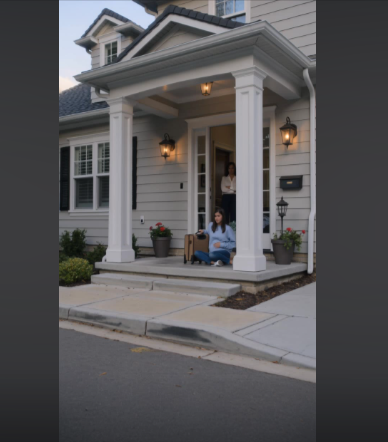
My mom kicked me out for being pregnant—now she wants in after meeting the dad.
I was eighteen years old when I told my mother I was pregnant.
She gave me two hours to pack.
That was it.
No shouting at first.
No questions about whether I was scared.
No asking who the father was.
She simply stood in the kitchen, crossed her arms, and looked at me like I had become something dirty.
“You made an adult choice,” she said.
“Now you can live with adult consequences.”
By the time the sun went down, I was sitting on the front steps with two garbage bags full of clothes.
She had already changed the locks.
I had nowhere to go.
Five years later, she would stand in the living room of a house I never imagined owning, holding flowers and crying about family.
But only after she discovered who my daughter’s father was.
Back then, I barely knew myself.
The pregnancy happened during freshman orientation.
One night.
One stupid, impulsive night with a boy who introduced himself as Alex.
He was visiting from Switzerland.
That was almost everything I knew.
Alex.
Swiss.
Dark hair.
Beautiful accent.
The kind of smile that makes eighteen-year-old girls make terrible decisions and then remember them for years.
We talked until almost sunrise.
I quoted Shakespeare while drunk.
He laughed at jokes that were objectively terrible.
Then morning came.
We said goodbye.
I never saw him again.
No number.
No last name.
No university.
Nothing.
When I found out I was pregnant, I tried searching.
There was no realistic way.
“Alex from Switzerland” is not exactly useful information.
So when my mother threw me out, there was no father to call.
No boyfriend.
No safety net.
Just me.
And a baby I had not even met yet.
I dropped out of school.
Spent my first month in a youth shelter.
At eight months pregnant, I was filling out emergency housing forms while my mother told relatives I had run off to Las Vegas to become a stripper.
I did not know that part until years later.
At the time, I simply wondered why no one called.
Why no aunt.
No cousin.
No family friend.
Nothing.
My sister Denise was the exception.
She was younger and still dependent on our mother financially.
Mom threatened to cut off her tuition if she helped me.
So Denise helped in secret.
We met at parks.
Bus stops.
Once behind a grocery store.
She brought secondhand baby clothes.
Diapers.
A blanket.
Twenty dollars folded inside a birthday card when it wasn’t my birthday.
It wasn’t enough to fix anything.
But it was enough to remind me that someone still knew I existed.
I gave birth to Janna in a county hospital.
Alone.
My chart listed me as indigent.
There was no mother holding my hand.
No father pacing outside.
No excited grandparents waiting to meet the baby.
Just a tired nurse who stayed twenty minutes past her shift because she did not want me to cry alone.
When they placed Janna against my chest, she opened her eyes.
That changed everything.
Not magically.
Life did not become easier because I loved her.
In some ways, it became harder.
Because now failure had a face.
Tiny.
Warm.
Depending entirely on me.
For the next five years, life was brutal.
I waited tables.
Sometimes customers grabbed me and left two-dollar tips.
Sometimes I smiled anyway because rent was due.
Janna slept in a dresser drawer for months because I could not afford a crib.
We lived in a studio apartment with black mold behind the bathroom wall and roaches that appeared no matter how often I cleaned.
I used food stamps.
WIC.
Community assistance.
I walked four miles to an early shift because the bus did not run before dawn.
I learned which bill could be late without something being shut off immediately.
Electricity.
Water.
Phone.
Rent.
Everything became arithmetic.
My mother lived twenty minutes away.
Four bedrooms.
Two-car garage.
Large kitchen.
She never came.
Never called.
Never saw Janna.
She told the family I was dead to her.
So I learned how not to need her.
Or at least I learned how to function while needing her.
There is a difference.
I earned my GED online while Janna slept.
When she turned three, I enrolled in community college.
One class at first.
Then two.
I found better restaurant jobs.
Saved every possible dollar.
Eventually, I moved us into a safer apartment.
No mold.
No roaches.
Heat that worked.
The first night there, Janna ran around touching the walls.
“Is this ours?”
I laughed.
“For now.”
She smiled.
“I like ours.”
She was brilliant.
Funny.
Reading before kindergarten.
Doing basic math while other children were still learning numbers.
Every exhausted shift made sense because of her.
Every blister.
Every humiliation.
Every night studying after midnight.
I did not think my life was tragic.
It was simply ours.
Then one afternoon, a man walked into the restaurant where I worked.
Expensive suit.
Tailored.
The kind that makes you immediately aware of the stain on your apron.
He had a Swiss accent.
And he kept staring at me.
At first, I thought he was one of those customers.
So I avoided his table.
Then, finally, he stood when I walked past.
“Excuse me.”
I stopped.
“Were you at State University five years ago?”
Everything inside me went still.
He looked older.
Sharper.
More controlled.
But the eyes were the same.
“Alex?”
His expression broke.
“Kendra?”
That was when I learned his full name.
Alessandro Moretti.
His family owned a luxury hotel group across Europe.
Switzerland.
France.
Italy.
Austria.
The kind of company whose name appeared on buildings I had only seen in travel magazines.
He had been looking for me for two years.
One of his cousins had found an old orientation photo online.
I was standing in the background.
Alessandro recognized me immediately.
He hired investigators.
Searched university records.
Social media.
Employment databases.
He spent thousands trying to find the American girl he had never forgotten.
I almost laughed when he told me.
“You spent thousands looking for me?”
“Yes.”
“I spent five years wondering whether Alex was even your real name.”
“It is my middle name.”
“That would have been useful information.”
He smiled.
Then I told him about Janna.
His smile disappeared.
I showed him a picture.
Purple coat.
Missing front tooth.
Holding a library book.
Alessandro sat down.
Stared at my phone.
Then cried.
Not politely.
Not one tear.
He covered his face.
“That’s my daughter?”
“I believe so.”
He looked again.
“I didn’t know.”
“I know.”
“I swear to you—”
“I know.”
He had spent years refusing pressure from his father to marry.
His family had suitable women in mind.
He had refused all of them.
He told me that whenever someone asked why, he thought about the drunk American girl who quoted Shakespeare and laughed at him during freshman orientation.
It sounded ridiculous.
Yet somehow, looking at his face, I believed him.
I did not immediately let him meet Janna.
That surprised him.
Possibly offended him.
I did not care.
Money did not automatically make someone safe.
Neither did regret.
I had spent five years learning that lesson.
Still, Alessandro moved quickly on practical matters.
He wanted to establish support.
A trust for Janna.
A house in my name.
Back child support.
He calculated five years at ten thousand dollars a month.
I nearly choked.
“That’s six hundred thousand dollars.”
“Yes.”
“That’s insane.”
“That is five years I was not there.”
“You didn’t know.”
“It does not change what you paid alone.”
I didn’t agree immediately.
I trusted legal paperwork more than grand gestures.
By then, so did he.
His family came from Switzerland.
Parents.
A sister.
An aunt.
They met Janna cautiously.
No dramatic claims.
No trying to take her away.
Mostly, they cried.
His mother knelt so she was eye level with Janna and asked whether she liked horses.
His father gave her a book in three languages.
His sister brought nothing expensive at all.
Just crayons.
It was almost too much.
Not the money.
The affection.
Watching strangers accept my daughter instantly while my own mother had ignored her for five years did something ugly inside me.
Then my mother came back.
Of course she did.
The neighbors noticed the Mercedes.
Foreign plates.
Delivery vans.
People talk.
My mother did research.
By the time she arrived, she knew exactly who Alessandro was.
Exactly what his family owned.
Exactly what Janna might inherit.
She appeared at my new house carrying flowers.
Tears already prepared.
“I was wrong.”
I let her inside.
That was mistake number one.
Or maybe not.
Sometimes you need to hear people out just once to know you never need to hear them again.
“I’ve missed you.”
She touched her chest.
“I’ve missed Janna.”
I nearly laughed.
“You’ve never met Janna.”
“You know what I mean.”
“No.”
I sat opposite her.
“I really don’t.”
She talked about fear.
About how young I had been.
About tough love.
About how she only wanted me to learn responsibility.
Then she saw a photograph on the shelf.
Janna standing with Alessandro’s parents at their family estate in Switzerland.
My mother leaned closer.
Her entire face changed.
“Oh.”
She smiled.
“That’s beautiful.”
I said nothing.
“We should plan her sixth birthday together.”
My shoulders tightened.
“Maybe in Switzerland.”
She laughed lightly.
“I’ve always wanted to see Geneva.”
That was when Alessandro entered from the kitchen.
He had heard enough.
My mother stood immediately.
Her smile became radiant.
“You must be Alessandro.”
She extended her hand.
“I’m Janna’s grandmother.”
He looked at her hand.
Did not take it.
“You are the woman who threw out your pregnant daughter?”
My mother’s smile collapsed.
“I—well, that’s complicated.”
“Is it?”
“She needed responsibility.”
“She was eighteen.”
“She made choices.”
“So did you.”
His voice remained quiet.
That made it worse.
My mother began explaining tough love.
Alessandro pulled out his phone.
“This is a shelter report.”
Her face changed.
He turned the screen toward her.
My name.
Age eighteen.
Pregnant.
A red check beside:
**Abandoned minor.**
“This is the social-services file.”
He swiped.
“She applied for emergency housing while eight months pregnant.”
Another swipe.
“This is the hospital record.”
My mother went pale.
“She gave birth alone.”
Her mouth opened.
Alessandro looked directly at her.
“Would you like me to continue?”
He could have.
The investigators he hired while searching for me had reconstructed five years of my life.
Shelter records.
Housing applications.
Medical files.
Employment history.
Everything I had survived while my mother lived twenty minutes away.
She began crying.
“I didn’t know it was that bad.”
“Yes, you did.”
I surprised myself by saying it.
She turned toward me.
“I thought you would figure it out.”
“I did.”
“Kendra—”
“You were angry.”
“Yes.”
“You were scared.”
“Yes.”
“And you chose to punish me.”
She reached toward me.
I stepped back.
“I thought about you every day.”
“Please don’t.”
Her hand stopped.
I stood.
“You need to leave.”
She stared.
“I came here to apologize.”
“You came here after learning who Janna’s father is.”
“That’s not fair.”
“It’s exactly fair.”
Alessandro moved beside me.
He said nothing.
He did not need to.
I opened the front door.
My mother remained in the middle of the living room.
“Can we just talk?”
“We did.”
“I can explain properly.”
“You had five years.”
She gathered her purse.
Then the flowers.
Her mascara had begun running.
She walked outside.
I watched her car disappear before closing the door.
Then my knees almost gave out.
Alessandro caught my elbow.
“I’m sorry.”
I leaned against the door.
“For what?”
“The documents.”
He looked uncomfortable.
“I should have asked before showing them.”
I appreciated that.
Not because I was angry.
Because he understood they were mine.
My story.
My evidence.
Not a weapon he automatically had the right to use.
After checking that Janna was asleep, we sat at the kitchen table.
My tea went cold between my hands.
The investigators had kept all the records in case I ever needed them.
I did.
More than either of us realized.
I expected Alessandro to begin talking about Switzerland.
Family estates.
Private schools.
International travel.
Instead, he said:
“We should establish paternity legally.”
I looked up.
“You mean DNA?”
“Yes.”
“Before everything else?”
“Yes.”
His voice softened.
“You and Janna spent five years with no security.”
He glanced toward the stairs.
“I don’t want your next chapter based on promises.”
That was the first thing he said that made me trust him.
Not the house.
Not the money.
The fact that he understood promises were no longer enough.
Two days later, we met attorney Leah Mercer.
Downtown office.
Thick carpeting.
Law degrees covering the walls.
Mid-thirties.
Practical suit.
No nonsense.
Her first sentence mattered.
“I represent you.”
I looked at Alessandro.
“He pays my fees.”
Leah nodded.
“But I do not work for him.”
She pointed at me.
“My duty is to you.”
That felt strange.
Powerful.
Almost frightening.
She explained the DNA process.
Court-admissible.
Chain of custody.
No private at-home test that someone could later question.
Then she went through financial boundaries.
Alessandro’s proposed back child support would sit in escrow until paternity was confirmed.
The house would be titled to me with protections preventing him from reclaiming it if our relationship deteriorated.
Every arrangement had safeguards.
I read everything.
Slowly.
Five years earlier, I would have been embarrassed asking legal questions.
Now I asked about every paragraph I didn’t understand.
Leah answered every one.
That afternoon, Denise texted.
*Mom is calling everybody.*
Apparently, I had hidden Janna from her.
Apparently, I was punishing her.
Apparently, she only wanted to be a grandmother.
The old terror returned.
Being isolated.
Being the family disgrace.
Then I remembered something.
Those relatives believed I was stripping in Vegas.
Not one had bothered to verify whether I was alive.
I put the phone down.
That evening, I sat on Janna’s bed.
Her stuffed rabbit was under one arm.
“There’s someone I want you to meet.”
“Who?”
“A friend from Europe.”
“Is he nice?”
“I think so.”
She looked suspicious.
“You think?”
“We’re going to find out together.”
I did not call him her father.
Not yet.
I would not build promises on assumptions.
“Does he like cartoons?”
“I have no idea.”
She thought about that seriously.
“We should ask.”
So we did.
Their first meeting happened in a public park.
Saturday morning.
Sunshine.
Children shouting.
Wood chips beneath the swings.
Alessandro brought one thing.
A soccer ball.
No jewelry.
No ridiculous toys.
No private driver carrying boxes.
Just a ball.
Janna stood half behind my leg.
Alessandro crouched.
“What’s your favorite color?”
“Purple.”
“Excellent choice.”
“Do you like swings?”
She nodded.
Then looked at him.
“Why do you talk funny?”
I covered my face.
Alessandro laughed.
A real laugh.
“I’m from Switzerland.”
“Do they have McDonald’s?”
“Yes.”
Her eyes widened.
“The menus can be in French or German.”
“That’s weird.”
“They probably think ours are weird too.”
That was how it started.
A soccer ball.
Questions.
No promises.
Every few minutes Janna looked back at me.
I stayed close.
But not too close.
She needed room to decide who he was for herself.
A week later, my mother left a voicemail.
“I forgive you.”
I replayed that part twice.
She forgave me.
For keeping Janna away.
For five years.
The woman who threw me onto the street had managed to position herself as the injured party.
I deleted the message.
Something surprising happened afterward.
I felt better.
Not responding felt better than explaining.
For years, I believed that if I could just explain pain clearly enough, my mother would eventually understand.
I finally understood that she understood perfectly.
She simply preferred her version.
So I began learning the law.
Grandparents’ rights.
Visitation.
Standing.
Existing relationship requirements.
Potential court petitions.
I spent lunch breaks at the same public library where I had studied for my GED when Janna was a baby.
This time, I took notes on statutes.
Knowledge made fear smaller.
Leah agreed.
“We build the paper trail now.”
“What if she never files?”
“Then you lose nothing.”
“And if she does?”
“We’re prepared.”
We established boundaries.
No contact.
No showing up at Janna’s school.
No contacting teachers.
No family gossip campaigns.
Everything documented.
My mother tested it almost immediately.
She went to Janna’s kindergarten office.
Claimed to be her grandmother.
Asked about pickup procedures.
The school called me.
I left work in the middle of a shift.
My hands shook the entire drive.
The office had given her nothing.
I signed a formal restriction before leaving.
The following day, Leah sent a letter.
No contact.
Any attempt to access Janna without permission would result in legal action.
Signing it made me feel guilty.
That bothered me.
Why did protecting my daughter from the woman who abandoned me feel cruel?
Because I had been trained to believe my mother’s comfort was everyone else’s responsibility.
I began a journal.
Dates.
Voicemails.
Incidents.
Screenshots.
Facts.
Not only because Leah said it might matter legally.
Because writing reality down prevented me from rewriting it later.
That had always been one of my weaknesses.
I remembered pain.
Then softened it.
Excused it.
Questioned myself.
Ink does not do that.
Around then, Alessandro arrived at my apartment with a catalog.
European furniture.
Sticky notes everywhere.
He opened it enthusiastically.
“I found something for Janna.”
A dollhouse.
Hand-carved.
Working lights.
Miniature chandeliers.
Three thousand dollars.
I stared at the price.
“That costs more than two months of my old rent.”
He looked confused.
“She deserves nice things.”
“She’s five.”
He frowned.
“She’d be happier with a thirty-dollar plastic house.”
“That makes no sense.”
“It does if you stop trying to repair five years with money.”
He went quiet.
That was our first real disagreement.
I explained.
A children’s museum.
Zoo.
Science center.
Those mattered.
Time.
Consistency.
Showing up.
Not expensive things she would outgrow.
Alessandro listened.
Then closed the catalog.
“All right.”
No sulking.
No argument.
“What about the science center?”
I looked at him.
“She loves that place.”
“Then we do that.”
That mattered more to me than any three-thousand-dollar toy.
Three days later, the DNA results arrived.
Official envelope.
Lab seals.
Probability numbers so high the conclusion was unquestionable.
Alessandro was Janna’s father.
We sat her between us.
She had crayons in her hand.
He spoke first.
“Janna, remember when I told you I came from Switzerland?”
“Yes.”
“And that I knew your mom before you were born?”
“Yes.”
He looked at me.
I nodded.
“I’m your dad.”
She stared at him.
Then at me.
“Like Maya’s dad?”
“Yes.”
“Why weren’t you here before?”
His face tightened.
“I didn’t know about you.”
She thought.
“I looked for your mom for a long time.”
Another pause.
“Do I have grandparents in Switzerland?”
We both laughed through tears.
“Yes.”
“A whole family.”
“Can I meet them?”
“When you’re ready.”
She nodded.
Then returned to coloring.
Children sometimes process life-changing information with a purple crayon and absolutely no regard for adult drama.
We arranged therapy for her.
Child specialist.
Phyllis Mercer.
She explained something I desperately needed to hear.
“Getting help doesn’t mean you’re failing.”
She smiled.
“It means the adults understand this is bigger than a five-year-old should have to process alone.”
So Janna got her own safe place.
Toys.
Art.
Questions she could answer or ignore.
Meanwhile, gossip spread.
A reporter called the restaurant.
Wanted confirmation about the Swiss hotel heir and his secret American daughter.
I panicked.
Leah didn’t.
“Say nothing.”
“What if they print lies?”
“Silence is boring.”
She was right.
We activated a privacy plan.
No interviews.
No social-media posts.
No correcting strangers.
My mother sent a five-page letter.
Apology.
Excuses.
Plans.
She missed us terribly.
Family should forgive.
She had already imagined trips.
Birthdays.
Switzerland.
Every paragraph offered regret with a demand attached.
I filed it with the other documentation.
Then came therapy sessions.
Parenting plans.
Legal schedules.
Co-parenting drafts.
Alessandro and I agreed on gradual contact.
Supervised initially.
Regular video calls.
No sudden international travel.
No dramatic custody changes.
Janna’s comfort controlled the pace.
Alessandro sometimes struggled with that.
He had lost five years.
Now he wanted five years back immediately.
That was impossible.
At one park meeting, he asked to extend a three-day visit to a week.
“No.”
“She’s doing great.”
“That does not mean she is ready.”
“She likes being with me.”
“I know.”
“Then why—”
“Because liking you is not the same thing as being emotionally prepared for seven days away from me.”
He stopped.
Looked toward Janna on the swings.
Then nodded.
“You’re right.”
Not reluctantly.
Not angrily.
Simply:
“You’re right.”
We agreed to add one day the following month if Janna handled the transitions well.
That was what our relationship became.
Not romance.
Not a fairy tale.
Negotiation.
Listening.
Course correction.
Parenthood.
His family sometimes pushed.
His father Daniel wanted everything made respectable.
Marriage.
A united family.
A cleaner story.
Alessandro told him no.
He confessed this to me over coffee.
“My father believes marriage would solve everything.”
My stomach dropped.
“And?”
“I told him romance is not the priority.”
He stirred his espresso.
“Maybe never.”
I exhaled.
“Good.”
He looked relieved.
“We need to learn how to raise Janna together.”
“Yes.”
“If anything else ever exists, it cannot be because our families think the story would look prettier.”
That was possibly the healthiest thing anyone had ever said to me.
No rescue romance.
No billionaire fairy tale.
No instant family.
Just two people who had made one reckless decision at eighteen and were now trying to make responsible ones at twenty-three.
My mother remained the more complicated problem.
At first, she fought every boundary.
Then something changed.
Maybe the legal letter.
Maybe realizing money would not open the door.
Maybe therapy.
Maybe fear of losing Denise too.
I don’t know.
What mattered was behavior.
We agreed to mediation.
The rules were strict.
Specific accountability.
Therapy.
No guaranteed access to Janna.
No excuses.
During the first session, my mother cried almost immediately.
“I was scared.”
I waited.
“You were so young.”
“I know.”
“I thought tough love—”
“No.”
She stopped.
I looked at the mediator, Waverly, then back at my mother.
“You need to say what you did without telling me why you were entitled to do it.”
Her face crumpled.
“I was trying to—”
“That’s an explanation.”
Silence.
So I listed it.
“You gave me two hours to leave.”
She nodded.
“You changed the locks.”
“Yes.”
“You refused contact for five years.”
Tears rolled down her face.
“Yes.”
“You told our relatives I was dead to you.”
“Yes.”
“You knew I was homeless.”
She tried to speak.
Waverly stopped her.
“Just acknowledge it.”
My mother closed her eyes.
“Yes.”
It was the first time in my life I watched her sit with consequences instead of explaining them away.
She was assigned homework.
Write every specific action.
No justification.
At the next session, she brought three handwritten pages.
Her hands shook while she read.
Kicking me out.
Changing locks.
Ignoring Denise’s calls.
Telling family I was stripping.
Knowing which hospital I gave birth in and choosing not to come.
Living twenty minutes away.
Never checking whether Janna and I were safe.
She cried.
But she read everything.
Then apologized.
Not perfectly.
I could still hear the explanations she wanted to add.
But she didn’t.
When she finished, the room was quiet.
I did not rush across to hug her.
Did not say:
It’s okay.
It was not okay.
“I hear you.”
Her eyes lifted.
“This is a first step.”
She nodded.
“Not forgiveness.”
“I understand.”
Maybe she finally did.
Phyllis and I created requirements before Janna could have contact.
Six months of therapy.
Proof of attendance.
Written accountability.
Respect for boundaries.
Only then would we consider supervised visits.
My mother began showing up to therapy.
Every week.
No missed appointments.
No demands for rewards.
That did not erase five years.
But consistency is the only language broken trust understands.
Eventually, Phyllis approved a short supervised visit.
Family center.
One hour.
No gifts.
No promises.
No asking Janna to keep secrets.
No emotional dumping.
I waited outside.
Couldn’t read the book in my lap.
When the door opened, Janna came out carrying a picture of a butterfly.
My mother followed at the proper distance.
She did not rush toward me.
Did not hug Janna without permission.
Simply thanked the staff and left through the side exit.
In the car, I waited.
Finally:
“How did it feel?”
Janna shrugged.
“She’s nice.”
Then:
“She’s sad.”
“Did that bother you?”
“A little.”
“Do you want to see her again?”
Janna thought.
“Maybe.”
“When?”
“Not next week.”
I smiled.
“Then not next week.”
It was her relationship too.
She deserved a voice.
Alessandro learned the same lesson.
We created a calendar for his trips.
Purple hearts for video calls.
Gold stars for in-person visits.
Janna placed the stickers herself.
Crooked.
Overlapping.
Perfect.
For the first time, she could see when he was leaving and when he was coming back.
That mattered because one day in therapy she admitted what frightened her most.
“What if Daddy disappears again?”
She knew rationally that he had not chosen to abandon her.
Emotion does not care about rational explanations.
So we gave her predictability.
Schedules.
Rituals.
Three hugs before leaving.
Three kisses.
Stuffed rabbit in the backpack.
Same song while shoes went on.
Reverse the ritual when she returned.
Security built out of repetition.
I knew something about that.
When Alessandro asked whether his parents could have pictures, my instinct was no.
Immediate.
Protective.
Then I stopped.
Asked Leah.
Set rules.
Three photographs.
Chosen by me.
No social media.
Immediate family only.
Alessandro agreed.
No argument.
So I sent three.
Janna reading.
Janna at the park.
Janna smiling at the camera.
It felt like handing pieces of my daughter across an ocean.
But trust has to be practiced too.
My mother tested her own progress differently.
She posted old family photographs online.
An album called *My Precious Girls*.
Pictures of Denise and me as children.
Birthday parties.
Christmas.
Vacations.
Captions about unbreakable family bonds.
Nothing from the previous five years.
Obviously.
She had not been there.
Relatives commented about what a wonderful mother she was.
For several minutes, I felt eighteen again.
Doubted myself.
Then Denise sent screenshots.
“All saved.”
Evidence.
I laughed.
My little sister, who once smuggled diapers into parks, had become frighteningly good at documentation.
She also began setting her own boundaries.
When Mom called to complain about me, Denise said:
“Talk to your therapist.”
That may have been the proudest I had ever been of her.
Mom did not like it.
Denise did it anyway.
The reporter eventually published her story.
It was surprisingly respectful.
Mostly about family privacy and legal boundaries.
Because I had given no interview, there was almost nothing sensational to print.
Within days, people stopped talking.
Not everyone.
A regular customer at my restaurant looked up at me one night and smirked.
“So you landed yourself a rich Swiss guy.”
My hand tightened around the plate.
“Excuse me?”
“You sure you didn’t trap him?”
Nearby tables went quiet.
Five years earlier, I might have laughed nervously.
Maybe pretended not to hear.
Instead, I set down his plate.
“That’s inappropriate.”
He laughed.
“Come on.”
“No.”
My manager heard.
She walked over.
“You need to pay and leave.”
The man protested.
She didn’t care.
He threw cash on the table and left.
My manager squeezed my shoulder.
“Take five.”
I stood in the kitchen shaking.
Not only from anger.
From the unfamiliar experience of someone openly backing me up.
Piece by piece, life stopped feeling like something I had to survive alone.
The legal parenting plan became official.
Every other weekend.
Saturday visits.
Wednesday video calls.
Joint agreement for major education and medical decisions.
Financial support through structured accounts.
Nothing dependent on mood.
Nothing verbal.
Nothing assumed.
Paperwork made some people feel trapped.
It made me breathe.
For Janna’s sixth birthday, I planned a park party.
Grocery-store cake.
Balloons.
Tag.
Musical chairs.
Alessandro suggested an event company.
Princesses.
Private venue.
I stared at him.
“No.”
He sighed.
“Too much?”
“Way too much.”
“What can I do?”
That answer was better.
“Decorations.”
I handed him fifty dollars.
“Dollar store.”
He looked horrified.
I smiled.
“You’ll survive.”
The next afternoon, he sent me photos of streamers.
*Purple and gold?*
I laughed out loud.
That felt more meaningful than any luxury party.
My mother received a thirty-minute supervised window at the birthday.
She arrived without gifts.
Exactly as agreed.
Stood at the edge of the pavilion.
Janna waved.
My mother waved back.
When her time ended, she left.
No tears.
No guilt.
No attempt to extend the visit.
I watched her walk toward her car.
And for the first time, I felt something besides anger.
Not forgiveness.
Not yet.
Hope, maybe.
Very small.
Very cautious.
Like lighting a match in a dark room and keeping your hand ready to put it out.
Around the same time, I received another acceptance letter.
Community college.
Spring semester.
Business fundamentals.
English composition.
Accounting.
Three courses.
The schedule fit Janna’s kindergarten hours.
And now, because financial support existed, I could buy textbooks without deciding which grocery bill to sacrifice.
I sat at my kitchen table holding the letter.
Five years earlier, I had studied for a GED beside a baby sleeping in a drawer.
Now I had a daughter with two parents.
A safe home.
Legal protection.
College ahead.
I had not been rescued.
That distinction mattered to me.
Money helped.
Alessandro helped.
Leah helped.
Phyllis helped.
Denise helped.
But I had already done the hardest part.
I had kept us alive.
One afternoon, I drove back to the apartment building where Janna and I used to live.
Same peeling paint.
Same potholes.
Same dirty water collected along the curb.
I didn’t get out.
Just sat there.
The smell came back in memory.
Mildew.
Bleach.
Cheap formula.
The nights Janna cried because I was stretching food until payday.
Four-mile walks to work in darkness.
Coins counted beside the laundromat.
Constant fear.
Which bill do I skip?
Can we eat until Friday?
Will the landlord notice?
For years, I believed those experiences had made me difficult.
Suspicious.
Too controlling.
Too careful.
Sitting outside that building, I finally understood.
No.
They made me wise.
My caution was earned.
My need for documentation was earned.
My boundaries were earned.
I drove away.
Back to an apartment with working heat.
No roaches.
Food in the refrigerator.
Janna had a difficult night soon afterward.
She cried into her pillow.
“What’s wrong?”
“I don’t know where home is.”
My heart broke a little.
“What do you mean?”
“When I’m with Daddy at the hotel, is that home?”
She sniffed.
“And this is home?”
“This is always home.”
“But he’s my dad.”
“Yes.”
“Why doesn’t he live here?”
Because life is complicated, I thought.
Because we were strangers who made a child.
Because not every family begins with romance.
Because being your father does not automatically make him my partner.
Instead, I said:
“Families can have more than one place where people love them.”
She frowned.
“That’s confusing.”
“Yes.”
I smiled sadly.
“It is.”
So we created routines.
One home did not have to cancel the other.
Neither parent had to win.
That became the foundation of everything.
Alessandro eventually returned to Switzerland.
Janna stood at the window watching his car leave.
Before he went, we marked the calendar.
Calls.
Trips.
Dates.
When he video-called at bedtime, she showed him her room.
Her toys.
Kindergarten drawings.
She counted the stickers until he returned.
Distance became measurable.
Measurable things are less frightening.
My mother continued therapy.
Week after week.
We reviewed visitation every three months.
Slowly.
No rushing.
Denise and I started getting coffee without talking about Mom.
That might sound small.
It wasn’t.
For most of our lives, our relationship had existed inside our mother’s gravity.
Now we were learning how to simply be sisters.
Talk about school.
Work.
Dating.
Books.
Stupid things.
Normal things.
One evening after Janna went to bed, I sat alone in the living room.
Lights off.
Quiet.
Safe.
And I thought about the shelter.
About the county hospital.
About the dresser drawer.
About my mother twenty minutes away pretending I was dead.
Then I thought about the strange family we had now.
A Swiss father learning not to solve every problem with money.
A grandmother doing therapy because access was no longer automatic.
An aunt finally learning to say no.
A lawyer who answered to me.
A therapist who gave my daughter language for fear.
And me.
Still here.
Still cautious.
Still angry sometimes.
Still learning.
Our family did not become perfect.
Thank God.
Perfect families often exist only in stories people tell strangers.
Ours became structured.
Messy.
Intentional.
Janna had two parents who spoke respectfully.
Who coordinated schedules.
Who did not use her as a weapon.
She had a grandmother earning access instead of demanding it.
She had an aunt becoming brave.
And she had me.
A mother who knew exactly what it cost to reach stability.
Sometimes I think about the girl sitting on those front steps at eighteen.
Two garbage bags.
Pregnant.
Locked out.
If I could sit beside her now, I would not tell her a wealthy Swiss man was going to show up someday.
That would make this sound like a rescue story.
It isn’t.
I would tell her something else.
“You are going to become the person you keep waiting for.”
You will fill out the forms.
Find the shelter.
Walk to work.
Finish school.
Feed the baby.
Move apartments.
Ask questions.
Read contracts.
Set boundaries.
You will make mistakes.
You will accept help.
You will learn that accepting help is not the same thing as surrendering control.
And one day, the woman who threw you away will ask for a place in the life you built without her.
You will not have to say yes.
You will not have to say no forever either.
You will get to decide.
That was the real change.
For most of my life, other people decided what happened to me.
My mother decided I was a disgrace.
My relatives decided which story to believe.
Poverty decided where I lived.
Work schedules decided when I slept.
Fear decided what I tolerated.
Now, for the first time, I had choices.
Alessandro did too.
So did my mother.
That is what boundaries really are.
Not punishment.
Choice.
My mother could choose therapy.
Choose accountability.
Choose patience.
If she did, maybe she would earn something back.
If she didn’t, the door stayed closed.
Alessandro could choose consistency.
Choose to listen.
Choose to be Janna’s father even when fatherhood was inconvenient and unglamorous.
If he did, their relationship would grow.
If he didn’t, legal paperwork existed to protect her.
And I could choose not to let anyone’s money, guilt, blood relation, or expectations override what I knew was best for my child.
That part belonged to me.
Months later, our lives settled into something almost ordinary.
Janna still woke too early on Saturdays.
Still hated peas.
Still loved purple.
Still asked Alessandro questions about Switzerland that no adult could predict.
“Do Swiss dogs bark in German?”
“Do mountains get cold?”
“Does Grandma Moretti know how to make pancakes?”
Alessandro answered every one seriously.
My mother continued supervised visits.
Sometimes Janna wanted to see her.
Sometimes she didn’t.
We respected both answers.
There were no dramatic family reunions.
No moment where I suddenly ran into my mother’s arms and announced that everything was forgiven.
Real trust does not return that way.
It returns Tuesday by Tuesday.
Therapy appointment by therapy appointment.
Boundary respected.
Visit ended on time.
Promise kept.
Maybe someday I will forgive her completely.
Maybe I won’t.
I no longer believe forgiveness is the admission price for a healthy life.
What matters is that I stopped allowing the past to decide everything.
The girl my mother threw out believed family was something you were either allowed to belong to or not.
I know better now.
Family can be built.
Protected.
Defined.
Sometimes rebuilt.
Sometimes kept at a safe distance.
And sometimes the person who shares your blood has to earn the same privilege you would require from a stranger.
Janna will know what happened eventually.
Not yet.
She deserves childhood before history.
Someday, when she is old enough, I will tell her about the shelter.
The dresser drawer.
The four-mile walks.
Her aunt sneaking baby clothes into parks.
The father who spent years searching for a woman whose last name he never knew.
The grandmother who failed us terribly and then, at least for a while, began doing the work to become someone safer.
I will not turn any of them into heroes or monsters.
I will tell her the truth.
People are what they repeatedly choose.
That includes me.
My mother chose abandonment.
For five years.
Then she began choosing accountability.
Whether she keeps making that choice will determine the relationship she gets.
Alessandro missed five years through ignorance.
Now he chooses to show up.
That is what matters.
Denise spent years afraid.
Now she chooses boundaries.
And I spent years surviving.
Now I choose to live.
The ground beneath me finally feels solid.
Not because somebody rich arrived.
Not because my mother apologized.
Not because every problem disappeared.
It feels solid because I know where I stand.
I know what I will accept.
I know what I won’t.
I know Janna is safe.
I know help can be welcomed without giving away control.
And I know that if everything changes again tomorrow, I can survive that too.
I already proved it.
At eighteen, my mother locked the door behind me.
At twenty-three, I realized something she never taught me.
A locked door is not always the end of a home.
Sometimes it is the moment you begin building your own.
