My daughter-in-law stood in my kitchen, looke
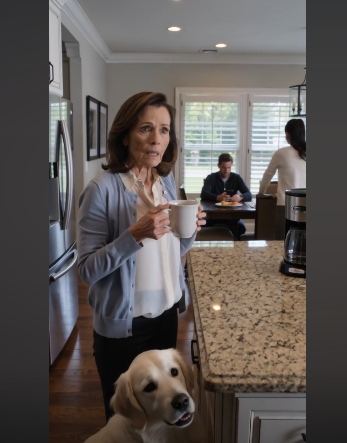
My daughter-in-law shouted, “You and your dog are living here for free,” even though she was staying in my house without paying rent. I looked at her calmly and said, “Then you have twenty-four hours to find somewhere else to live.” Her confidence disappeared instantly.
THE KEYS ON MY KITCHEN COUNTER
“You and that dog are nothing but freeloaders.”
Jessica said it in my kitchen, inside the New Jersey house I had owned free and clear for eleven years.
My hand remained wrapped around a half-filled coffee mug. Beside me, Buster lowered his golden head and pressed his shoulder against my leg. He was ten years old, gentle with children, afraid of thunderstorms, and smart enough to understand when anger entered a room.
Jessica stood near the kitchen island with both hands planted on her hips. Her blond hair was tied into a sharp ponytail, and the expensive cream sweater she wore had come from a shopping bag she once claimed she could not afford.
My son, Tyler, sat at the dining table scrolling through his phone.
For several seconds, he did not look up.
That silence hurt more than her words.
“Tyler,” I said.
He finally raised his eyes.
“Did you hear what your wife just called me?”
His expression carried the exhausted discomfort of a man who had spent years avoiding difficult choices and now resented anyone who forced him to make one.
“Mom, she’s stressed.”
Jessica gave a short laugh.
“I’m stressed because we’re trying to rebuild our lives while tiptoeing around her schedule and vacuuming up after that dog.”
Buster leaned harder against me.
I placed my mug on the counter.
The ceramic touched the granite with a quiet click.
“Then you’ll both be more comfortable somewhere else.”
Tyler frowned.
“What does that mean?”
“It means you have twenty-four hours to pack your belongings and leave my house.”
The room went still.
A lawn mower started somewhere down the block. Sunlight moved through the maple tree outside the kitchen window and cast shifting shadows across the floor my late husband had installed by hand.
Jessica stared at me for half a second.
Then she laughed.
It was not a nervous laugh. It was the confident sound of someone who believed she had already researched every possible consequence and found herself protected from all of them.
“Oh, please, Lillian. You’re not putting your own son out because I said something honest.”
“You called me a freeloader in my home.”
“We keep this place from feeling like a retirement museum.”
Tyler winced.
“Jess.”
“What? It’s true. We help her.”
I looked around the kitchen.
A cereal bowl crusted with dried milk sat beside the sink. Two of their takeout containers were stacked near the trash. Jessica’s unopened packages occupied half the breakfast nook. Tyler’s shoes rested in the hallway even though I had asked him dozens of times not to leave them there.
“You have lived here without paying rent for fourteen months,” I said. “You stopped buying groceries six months ago. You have not contributed to utilities since February.”
Jessica crossed her arms.
“We are saving for our future.”
“In my present.”
Tyler stood.
“Mom, everyone needs to calm down.”
“I am calm.”
“Then don’t say things you’ll regret.”
I met his eyes.
“I’ve spent fourteen months regretting what I didn’t say.”
His face changed.
For the first time that morning, he seemed to understand that the argument had not begun when Jessica opened her mouth. It had begun with every plate I washed after them, every grocery bill I quietly covered, every household rule they treated as an inconvenience, and every time my son watched his wife diminish me because confronting her would disturb his own comfort.
Jessica stepped closer to the island.
“You can’t legally throw us out in twenty-four hours. We receive mail here. We’ve established residency. New Jersey has tenant protections.”
She smiled.
The smile told me she had looked into this long before insulting me.
“You would have to serve formal notice,” she continued. “You can’t just decide we’re gone because your feelings were hurt.”
“My feelings are not the legal issue.”
Her smile weakened slightly.
“What is that supposed to mean?”
“You’ll find out.”
I reached down and stroked Buster’s head.
“Tomorrow morning at nine, I want your belongings out and your keys on this counter.”
Tyler rubbed both hands over his face.
“This is ridiculous.”
“No,” I said. “It’s late.”
I took my coffee and walked upstairs.
Behind me, Jessica began telling Tyler that I was bluffing.
I did not stop to correct her.
The office at the end of the upstairs hallway had once belonged to my husband, George. He was a building inspector for nearly thirty years and saved every permit, warranty, household receipt, and repair invoice in labeled folders.
When he passed seven years earlier, I left most of the room unchanged.
His brass desk lamp still leaned slightly to the left. His old reading glasses remained inside the top drawer. A framed photograph of us at Cape May stood on the bookshelf, both of us sunburned and laughing beside a crooked beach umbrella.
I closed the office door and locked it.
For a moment, I stood with my back against the wood.
My hands were steady.
My chest was not.
Tyler had always been my soft spot.
He was our only child, born after two difficult pregnancies and years of being told parenthood might not happen for us. George used to say that Tyler arrived already convinced the world had been waiting for him.
As a child, he was affectionate and bright. He left notes in my lunch bag when I worked late. He once spent an entire Saturday building a wooden ramp so an injured squirrel could reach a low tree branch.
But he disliked discomfort.
If a teacher criticized him, he changed classes. If a friendship became complicated, he stopped answering calls. When he was twenty-three and missed three car payments, George paid the balance because Tyler promised he had learned his lesson.
When he left a steady job to start a logistics consulting business, I invested twenty thousand dollars.
When that business lost its largest client and the commercial lease became impossible to carry, Tyler called me.
“Mom, we only need six months,” he said.
Jessica cried quietly beside him during the conversation.
They were thirty-six years old.
They had nearly exhausted their savings, damaged their credit, and faced the possibility of losing their apartment.
I told them they could move into my guest rooms.
But after two decades working as a property manager, I knew kindness did not require carelessness.
Before they brought in a single box, I had an attorney prepare a short-term occupancy agreement.
It did not create a traditional rental arrangement. They paid no rent. It described them as temporary family occupants permitted to remain in the home for no more than six months unless I approved an extension in writing.
It also contained household rules.
They would purchase their own groceries.
They would contribute a modest amount toward increased utilities once Tyler found work.
They would help maintain shared spaces.
They would not alter the house without permission.
Most importantly, the agreement permitted me to revoke their occupancy license for property damage, deliberate intimidation, or serious harassment of the homeowner.
Jessica signed without reading beyond the first page.
Tyler skimmed it and said, “Mom, we’re family. We don’t need all this.”
“Then signing should not be a problem,” I replied.
Six months became eight.
Eight became ten.
By the fourteenth month, the agreement had been extended twice in writing, each time under the same conditions.
Their gratitude changed gradually.
At first, Jessica cooked dinner twice a week. Tyler repaired the loose gate in the backyard. They bought their own coffee and insisted I let them pay for takeout on Fridays.
Then Tyler found contract work that paid less than his former business.
Jessica decided the money needed to go directly into savings.
They stopped contributing to utilities.
Jessica began placing my grocery receipts beside the fruit bowl and circling items she considered unnecessary.
One evening, she held up a package of salmon.
“Do you really need to buy this? Chicken is half the price.”
“I wanted salmon.”
“We’re all trying to recover financially.”
“You and Tyler are recovering financially. I am buying my own dinner.”
She stared at me as though I had missed the larger point.
Tyler later told me she was only trying to create a household budget.
I reminded him that she had not paid for the household.
He asked me not to “turn everything into a conflict.”
The guest bathroom was the next boundary to disappear.
I returned from lunch with a friend and found my blue towels stuffed into a trash bag. Jessica had replaced them with white linen towels and changed the shower curtain.
“The blue made the room feel dated,” she said.
“It is my bathroom.”
“No one uses it except us.”
“I use it when I choose.”
She rolled her eyes.
That evening, Tyler told me the new towels made Jessica happy and suggested I let it go.
I did.
That became my mistake.
Each time I surrendered something small to preserve peace, they interpreted the peace as permission.
I crossed the office and opened the bottom drawer of the filing cabinet.
The occupancy agreement was inside a folder labeled TYLER AND JESSICA—TEMPORARY USE.
George would have smiled at the label.
He believed any folder worth keeping deserved a title no one could misunderstand.
I placed the agreement on the desk and turned on my laptop.
Two years earlier, after a series of package thefts in our neighborhood, I installed exterior cameras and two cameras in the common areas of the house. One covered the front entry. The other covered the kitchen and back door.
Tyler and Jessica knew the cameras existed. The occupancy agreement acknowledged them.
I opened the morning’s recording.
There I was beside the coffee maker.
Buster stood near my leg.
Jessica’s voice came through clearly.
“You and that dog are nothing but freeloaders.”
I watched Tyler remain focused on his phone.
I heard myself ask whether he had heard her.
Then came his answer.
“Mom, she’s just stressed.”
I paused the video.
For several seconds, I stared at my son’s face on the screen.
He looked irritated with me.
Not with the woman who had insulted his mother.
With me, because I had asked him to acknowledge it.
I saved the clip to a secure folder and emailed a copy to myself.
Then I called Andrea Morgan.
Andrea had been my attorney during my final eight years in property management. She was practical, direct, and allergic to dramatic legal claims.
She answered from what sounded like a busy restaurant.
“Lillian?”
“I need you to review the occupancy agreement you drafted for Tyler and Jessica.”
“What happened?”
I told her.
She did not interrupt.
When I finished, she said, “Do you feel unsafe?”
“No. I feel disrespected.”
“That is not always the same legal standard.”
“I know.”
“Send me the recording and the most recent extension.”
I did.
She called back twenty minutes later.
“The agreement supports revocation of their permission to occupy, but I want this handled carefully. They may still attempt to claim tenant protections based on the duration of their stay.”
“So I cannot remove them tomorrow.”
“You cannot physically remove them or change the locks while they remain inside. Do not touch their belongings. Do not shut off utilities. Do not create a confrontation.”
“I wouldn’t.”
“What you can do is serve written revocation immediately, demand voluntary departure by tomorrow, and state that if they refuse, you will file the appropriate court action Monday morning.”
“Will the agreement matter?”
“Yes. So will the absence of rent, the original six-month limitation, the signed extensions, and the recorded breach. But a judge decides legal possession if they refuse.”
I looked at George’s photograph.
“I want them to leave voluntarily.”
“Then give them a clear choice. Leave quietly within the deadline, and no case is filed. Stay, and the matter becomes formal.”
“Can we serve notice today?”
“I’ll prepare it now.”
Andrea emailed the document before eleven.
It was not filled with angry language.
It simply stated that Tyler and Jessica’s permission to occupy the property was revoked due to breach of the signed agreement. They were requested to vacate voluntarily by nine the following morning.
If they did not, I would begin legal proceedings without further negotiation.
Attached were the signed agreement, the current extension, and a written summary of the recorded incident.
I printed three copies.
Then I called Frank DeLuca, a licensed process server I had worked with years earlier.
“I can be there by noon,” he said.
At twelve exactly, the doorbell rang.
I remained in the office, watching through the upstairs window.
Frank stood on the front porch wearing a dark jacket and holding a manila envelope.
Tyler opened the door.
Frank verified his name, handed him the notice, and gave the required statement.
Then he walked back to his car.
Tyler stared at the envelope as if it had appeared from another life.
Thirty seconds later, footsteps thundered up the stairs.
My office door opened so quickly that it struck the wall.
Tyler entered holding the papers.
Jessica stood behind him.
“Mom, what is this?”
“A written revocation notice.”
“You served your own son?”
“I documented a decision.”
He placed the papers on my desk.
“You called a process server over a family argument.”
“I called a professional because your wife announced that she understood residency law and intended to use it against me.”
Jessica stepped into the room.
“This does not mean anything. We live here. You cannot make us disappear overnight.”
“I am not making you disappear.”
“You’re demanding that we leave.”
“Yes.”
“You said twenty-four hours.”
“That is the voluntary deadline.”
“And if we don’t?”
“I file Monday morning.”
She lifted the agreement.
“This guest contract won’t override state law.”
“Perhaps not by itself. That is why Andrea will present the complete record to the court.”
I turned the laptop toward them.
The kitchen video was paused on Jessica’s face.
Her confidence shifted.
“You recorded me?”
“The common areas have had cameras for two years. You signed an acknowledgment.”
“That recording has no context.”
I pressed play.
Her own voice filled the office.
“You and that dog are nothing but freeloaders.”
Buster’s soft whine followed.
Then Tyler’s response.
“She’s just stressed.”
I stopped the recording.
No one spoke.
Jessica recovered first.
“So I lost my temper.”
“You made your position clear.”
“You’re going to start a court case over one sentence?”
“No. I’m ending an arrangement after fourteen months of broken promises. The sentence simply ended my willingness to keep pretending.”
Tyler sat in the small armchair near the bookshelf.
“You’re going to ruin our chances of getting another apartment.”
“You can avoid a filing by leaving voluntarily.”
“We have nowhere to go.”
“You have savings.”
“Not enough.”
“You told me for months that you could not contribute because every available dollar was going into savings.”
Jessica’s eyes narrowed.
“That money is for a house.”
“Then use part of it for an apartment.”
“That will destroy our plan.”
“Your plan depended on free housing from someone you no longer respected.”
Tyler buried his face in his hands.
“Why are you doing this to me?”
The question brought a strange calm over me.
Not because it was reasonable.
Because it was familiar.
When Tyler was sixteen and damaged George’s truck after taking it without permission, he asked why his father was ruining his summer by making him work to pay for repairs.
When he was twenty-five and spent his emergency fund on a vacation, he asked why we would let him struggle with rent.
The consequences of his choices always became something another person was doing to him.
“Look at me,” I said.
He raised his head.
“This is not happening because I stopped loving you.”
“It feels like it.”
“It is happening because love has become your excuse for expecting me to accept anything.”
Jessica scoffed.
“You are acting like we have done nothing for you.”
“You replaced towels I did not want replaced. You criticized the food I bought. You complained about my porch light while refusing to help with the electric bill. You left dishes for me and treated Buster like an obstacle.”
“He sheds everywhere.”
“He lives here.”
“So do we.”
“Not after tomorrow morning.”
Tyler stood.
“Mom, stop.”
“No. I have stopped too many times.”
His eyes were red.
“Jessica is under pressure.”
“Then she can process that pressure somewhere else.”
“She was venting.”
“She can vent in a hotel.”
Jessica looked at Tyler, waiting for him to defend her.
He did.
“You know she didn’t mean it literally.”
“What possible meaning makes it acceptable?”
He had no answer.
I folded my hands on the desk.
“You both have twenty-one hours. If the keys are on my kitchen counter by nine tomorrow, the notice ends there. If they are not, Andrea files.”
Jessica picked up the papers.
“You will regret this when you are alone.”
“I have been alone in this house for months. The difference is that tomorrow, I may finally have peace.”
They left the office.
Tyler closed the door more carefully than he had opened it.
I sat without moving for a long time.
Then Buster scratched lightly at the other side.
I opened the door.
He walked in, placed his chin on my knee, and looked at me with worried brown eyes.
“I’m all right,” I told him.
He did not believe me.
Neither did I.
The house remained tense throughout the afternoon.
Cabinet doors opened and closed downstairs. Jessica made phone calls in a low, urgent voice. Tyler walked repeatedly between the guest room and the garage.
At six, I heated soup.
Neither of them joined me.
At seven thirty, Jessica entered the kitchen carrying a glass of water.
“You know Tyler will never forgive you.”
I kept stirring the soup.
“That is his decision.”
“He will choose his wife.”
“He should honor his marriage.”
She seemed surprised by the answer.
“But honoring you does not require allowing you to mistreat me.”
“I apologized to him.”
“You have not apologized to me.”
Her mouth tightened.
“Fine. I’m sorry you were offended.”
“That is not an apology.”
“What do you want me to say?”
“The truth would be a beginning.”
“The truth is that living here has been difficult.”
“For you?”
“Yes, for me. I am thirty-five years old and living in my mother-in-law’s guest room.”
“You asked to come.”
“Because we had no choice.”
“You had choices. They were simply expensive.”
She stared at me.
“You have no idea what it feels like to lose everything.”
I lowered the spoon.
“My husband died in this house.”
Her expression changed.
“You lost a business contract and an apartment. Do not explain loss to me as if I have never met it.”
She looked away.
For one second, something resembling shame passed across her face.
Then pride returned.
“We’ll be gone tomorrow.”
“I know.”
She left the kitchen.
I ate alone.
That night, I slept badly.
Every sound traveled through the house. Closet doors. Packing tape. Boxes dragged across carpet. Jessica’s voice rising and falling behind the guest-room door.
At two in the morning, I heard Tyler walk into the hallway.
His footsteps stopped outside my room.
He remained there for nearly a minute.
Then he walked away without knocking.
I lay in the dark remembering the night he came home from college after a breakup. He was twenty-one and heartbroken, trying not to cry in front of George.
I sat with him at the kitchen table until sunrise.
At four, he said, “You always make things feel survivable.”
I wondered when he had begun interpreting that as a promise that I would survive everything for him.
By six thirty, I was awake.
I dressed, made coffee, and took Buster for a long walk through the neighborhood.
The October air was crisp, carrying the smell of damp leaves and chimney smoke. Buster moved slowly at first, then brightened when we reached the park.
Mrs. Ramirez from two houses down was walking her terrier.
“You’re out early,” she said.
“Busy morning.”
She studied my face.
“Everything okay?”
“It will be.”
She nodded as if she understood more than I had said.
When Buster and I returned, the driveway was filled with plastic bins, suitcases, and cardboard boxes.
Jessica stood beside the leased SUV arranging bags with sharp, efficient movements.
Tyler carried a box of books down the front steps.
He looked tired.
Inside, the guest rooms were nearly empty.
The absence of their belongings revealed marks I had forgotten were there: the pale rectangle on the wall where George’s framed map once hung, the dent in the baseboard from Tyler’s desk, the scratches Jessica’s storage cabinet left on the floor.
I poured another cup of coffee and sat at the kitchen island.
Tyler came downstairs carrying two duffel bags.
He stopped beside the coffee maker.
“Can I have a cup?”
The question was so quiet that he sounded twelve years old.
Before I could answer, Jessica called from the hallway.
“Don’t touch her coffee, Tyler. We don’t want to take advantage of her precious beans.”
I looked at my son.
This was his moment.
A small one.
He could say, “Enough.”
He could tell his wife not to speak to me that way.
He could acknowledge the cruelty without ending his marriage or choosing sides.
Instead, he looked down.
Then he carried the bags outside.
I took a slow drink.
That silence was the last confirmation I needed.
At eight forty-five, the SUV was packed to the roof.
Jessica stood near the front door searching for extended-stay hotels on her phone.
Tyler entered the kitchen with their keys in his palm.
He looked around.
Perhaps he remembered the first night they moved in, when I made pot roast because it was his favorite. Perhaps he remembered George sitting at that same island teaching him how to calculate the cost of replacing a roof.
He placed the keys on the granite.
The metal clinked once.
“We’re leaving.”
“I see that.”
“Are you happy now?”
“No.”
His eyes lifted.
“I’m not happy, Tyler. I’m at peace. There is a difference.”
Jessica walked into the kitchen.
“You care more about your pride and your dog than your family.”
I kept my voice even.
“I care about living in my home without being diminished.”
“This house will feel empty when we’re gone.”
I looked at Buster, sitting beside the pantry with his tail resting across the floor.
“It will feel like mine.”
“You are going to grow old alone.”
“Loneliness is not the absence of people. Sometimes it is living with people who make you disappear.”
Tyler’s face tightened.
“Mom—”
Jessica took his arm.
“Don’t waste your breath.”
She pulled him toward the door.
He resisted for half a step.
Then he followed her.
The front door closed behind them.
Not violently.
Just firmly.
Their SUV backed out of the driveway and disappeared around the corner.
I remained in the kitchen.
The keys rested on the counter.
The house became completely quiet.
Buster walked over, sat on my foot, and released a deep sigh.
I lowered myself to the floor beside him.
For several minutes, I held his neck and cried into his fur.
Relief and grief can exist together.
That was the part no one had prepared me for.
I had protected myself.
I had also sent my only child away.
Both things were true.
Afterward, I opened every window in the downstairs rooms.
Cold air moved through the house.
I washed the abandoned mugs, cleared the breakfast nook, and placed my blue towels back in the guest bathroom.
The house did not become joyful immediately.
It became breathable.
That was enough.
During the first week, I kept finding evidence of their presence.
An empty granola box behind the cereal.
Jessica’s hair clip beneath the couch.
A receipt from a high-end restaurant dated two nights after they told me they could not afford groceries.
Tyler’s old college sweatshirt remained behind the dryer.
I folded it and placed it inside a box in the garage.
I did not throw anything away.
Boundaries did not require cruelty.
Andrea filed a notice confirming that they had vacated voluntarily and returned the keys. No court case was necessary.
I changed the locks anyway.
Not because I expected Tyler to return without permission.
Because I needed the physical act of closing one chapter.
A locksmith arrived Tuesday morning.
When he handed me the new keys, the brass felt cool and unfamiliar in my palm.
“Want four copies?” he asked.
“Two.”
I kept one.
The other went to Mrs. Ramirez for emergencies.
Tyler called on Thursday night.
I watched his name appear on my screen through three rings before answering.
“Hello.”
“Mom.”
His voice sounded smaller without Jessica speaking behind him.
“How are you?”
“I’m well.”
“How’s Buster?”
“He’s asleep beside me.”
A pause followed.
“We found an apartment.”
“I heard.”
The information had come from my cousin Elaine, who believed family news should move faster than weather.
“It’s over a laundromat,” Tyler said. “The machines run until midnight.”
“That sounds difficult.”
“Jessica hates it.”
“I imagine she does.”
“The rent is higher than we expected.”
I remained silent.
He seemed to notice.
“I’m not asking for money.”
“Good.”
“Mom.”
“What?”
“Could you not say it like that?”
“How should I say it?”
“I don’t know.”
He exhaled.
“Everything feels like a test now.”
“It isn’t.”
“It feels like you’re waiting for me to fail.”
“I spent years preventing you from feeling failure. That was part of the problem.”
“I didn’t ask you to fix everything.”
“Not always with words.”
He went quiet.
Then he said, “Jessica blames me.”
“For what?”
“For not challenging the notice. She thinks we should have stayed and forced you to take it to court.”
“What do you think?”
Another silence.
“I think I couldn’t stand living there after what she said.”
“But you could stand there while she said it.”
His breathing changed.
“I know.”
The apology arrived slowly.
“I should have said something.”
“Yes.”
“I was tired of fighting with her.”
“So you allowed me to absorb the conflict you were avoiding.”
“I didn’t think of it that way.”
“I did.”
“I’m sorry.”
The words were quiet and unpolished.
They sounded real.
I closed my eyes.
The kitchen where the argument began was dark except for the light above the stove. Buster slept near the back door.
“I appreciate the apology.”
“Can we come for dinner Sunday?”
“We?”
“Jessica and me.”
“No.”
His response came quickly.
“Mom.”
“You may come alone.”
“She’s my wife.”
“Yes.”
“You can’t ask me to choose.”
“I’m not asking you to choose. I’m deciding who enters my home.”
“She apologized.”
“To you.”
“She said she was sorry the situation got out of control.”
“That is not the same as taking responsibility.”
“What would be enough?”
“I don’t know yet.”
“That’s not fair.”
“Fairness does not require immediate access after someone violates a boundary.”
He breathed into the phone.
“So she’s banned forever?”
“I did not say forever.”
“Then how long?”
“Until I believe she understands what happened and can enter this house without treating my dignity as negotiable.”
“And if that never happens?”
“Then we will meet elsewhere.”
Tyler seemed stunned.
“You would really keep that boundary permanently?”
“Yes.”
“Even if it makes our relationship harder?”
“A relationship that requires me to abandon self-respect is already broken.”
He did not answer.
“Come Sunday if you want,” I said. “Alone.”
He arrived just after noon.
No Jessica.
No overnight bag.
No laundry basket.
Nothing that suggested he expected the visit to become another rescue.
We sat on the back porch with iced tea even though the afternoon had turned cool.
Buster chased a squirrel halfway across the yard, forgot why he was running, and returned to lie beneath Tyler’s chair.
For a while, we discussed ordinary things.
The Jets had lost again.
Mrs. Ramirez’s grandson had backed into her mailbox.
Tyler had an interview with a regional shipping company on Tuesday.
“Operations coordinator,” he said.
“Steady work.”
“Less money than I used to make.”
“Steady money is better than imagined money.”
He nodded.
“I know that now.”
After an hour, he looked toward the yard.
“Did Dad ever disappoint you?”
The question surprised me.
“Of course.”
“How?”
“He avoided conversations about money when he was worried. He believed silence made him strong.”
Tyler rubbed his hands together.
“What did you do?”
“I confronted him.”
“And if he didn’t listen?”
“I confronted him again.”
“That sounds exhausting.”
“Marriage can be.”
“Did you ever think about leaving?”
“Once.”
He looked at me.
“Really?”
“Yes.”
“What stopped you?”
“Your father listened before the decision became final.”
Tyler lowered his head.
“I don’t know whether Jessica can listen.”
“That is something you need to learn.”
“She’s angry all the time.”
“Anger is information. It is not permission.”
“She says I let you control me.”
“I removed you from my house. I have not told you how to live.”
“She thinks those are the same.”
“Then she is wrong.”
He looked tired.
“What if the marriage fails?”
“You will survive.”
“What if it’s my fault?”
“Then you learn.”
“What if it’s hers?”
“You still learn.”
He gave a faint smile.
“You always make things sound simple.”
“They are rarely simple. They can still be clear.”
Before leaving, Tyler placed an envelope on the porch table.
“What is this?”
“Two hundred dollars.”
“For what?”
“Utilities. Fourteen months is too much to calculate right now. I thought I could start somewhere.”
I pushed it back.
“You need it.”
“I know.”
“Then keep it.”
His face tightened.
“Mom, please.”
I studied him.
This was not repayment.
It was an attempt to take responsibility.
I accepted the envelope.
“Thank you.”
His eyes became wet.
He stood and hugged me.
For the first time in years, the embrace did not come before a request.
Over the next three months, Tyler visited most Sundays.
Sometimes he brought groceries.
Sometimes he repaired something.
When the porch step loosened, he arrived with lumber and tools rather than asking me to hire someone.
I gave advice about his interviews but did not call anyone on his behalf.
He accepted a position with the shipping company and began paying down the business debt.
Jessica did not come.
At first, she sent messages through Tyler.
Tell your mother she overreacted.
Tell your mother we expect Christmas to be normal.
Tell your mother she is turning you against your wife.
I told Tyler I would not communicate through him.
“If she wants to speak to me,” I said, “she can speak directly and respectfully.”
Jessica finally called in January.
“I don’t want to fight,” she began.
“Neither do I.”
“Tyler is miserable.”
“He seems more stable.”
“He spends every Sunday with you.”
“Usually three hours.”
“That is our only full day together.”
“Then he can visit another day.”
“That’s not the point.”
“What is the point?”
She became quiet.
“The point is that you made him feel like he had to prove himself to you.”
“He is proving himself to himself.”
“He gives you money now.”
“He contributed twice toward expenses he once promised to help cover.”
“You took it?”
“He asked me to.”
Her voice sharpened.
“So this was always about money.”
“No. Money is measurable. Respect takes longer.”
“I said something in anger.”
“You said it after fourteen months of behavior that supported it.”
“That’s your interpretation.”
“Yes.”
“What do you want from me, Lillian?”
“I want you to understand that living in my home was help, not humiliation. I want you to understand that criticizing my spending while using my groceries was disrespectful. I want you to understand that Buster is part of my home, and frightening him in my kitchen was unacceptable.”
“He’s a dog.”
“He is also a living creature that trusts me.”
She sighed.
“I’m sorry I yelled.”
I waited.
“And?”
“And I’m sorry I called you a freeloader.”
“Do you understand why it was especially cruel?”
“Because it was your house.”
“Yes.”
A long pause followed.
“I was embarrassed,” she said.
“About living here?”
“Yes. Every day I felt like everyone knew we had failed.”
“I never told anyone.”
“I knew.”
“Then the judgment was coming from you.”
Her breathing became uneven.
“I hated needing you.”
“So you made me feel as if I needed you.”
She did not answer.
The silence felt different from Tyler’s old avoidance.
It felt like recognition.
“I’m not ready for you to come back into the house,” I said.
Her voice cooled.
“Then why did I apologize?”
“An apology is not a ticket.”
“What does that mean?”
“It means I heard you. It means I appreciate the beginning. It does not mean the consequence disappears immediately.”
“You really know how to hold a grudge.”
“I am learning how not to abandon myself.”
She ended the call without saying goodbye.
Two weeks later, Tyler arrived alone and told me Jessica had begun counseling.
“Her idea?” I asked.
“Not exactly.”
“Yours?”
“I told her I couldn’t continue the way we were.”
“That must have been difficult.”
“She said I sounded like you.”
“How terrible.”
He laughed.
The laugh surprised both of us.
Their marriage did not heal quickly.
Some months were better than others.
Jessica struggled with accountability. Tyler struggled to say what he meant before resentment built.
But they stopped using my house as the place where their problems could hide.
That mattered.
By spring, Tyler and Jessica moved from the apartment over the laundromat into a modest two-bedroom rental farther inland. They used their savings for the security deposit and sold the leased SUV.
Tyler bought a used sedan.
Jessica returned to full-time work at the dental office she had left when Tyler’s business was doing well.
They were not suddenly poor.
They were simply living inside the consequences of their own budget.
On Mother’s Day, Tyler came for brunch.
He carried flowers and a small wrapped box.
Inside was a new brass hook for the porch light.
The old one had rusted.
“Dad used to say he’d replace it,” Tyler said.
“He said many things about that light.”
“Can I do it today?”
“Yes.”
He stood on a ladder while I held it.
Buster watched from the porch.
When the hook was secure, Tyler climbed down and tested it with both hands.
“That should hold.”
“Your father would inspect it twice.”
“So should you.”
I did.
It was straight.
At the end of the afternoon, he sat beside me on the porch step.
“I used to think you would always fix things.”
“I know.”
“I think I resented you when you stopped.”
“I know that too.”
“Now I understand why.”
“Do you?”
He looked at the new hook.
“You couldn’t fix me without keeping me broken.”
The sentence entered my chest slowly.
I placed my hand over his.
“That is exactly right.”
Jessica came to my house again eleven months after she left.
She did not arrive carrying luggage.
She brought a pie from a bakery and waited on the porch after ringing the bell.
Tyler stood beside her but did not speak for her.
I opened the door.
Jessica looked nervous.
“I know I’m not entitled to come in.”
“No.”
“I wanted to ask.”
I looked at Tyler.
He remained silent.
That was new.
“What has changed?” I asked her.
She swallowed.
“I have.”
“That is a large answer.”
“I know.”
She held the pie with both hands.
“I spent a long time believing your help proved we were failures. Then I punished you for seeing us at our lowest.”
“I did not see you as failures.”
“I see that now.”
“Why?”
“Because when you removed the free housing, you still encouraged Tyler to work. You didn’t ask him to leave me. You didn’t try to control him.”
“I wanted him to grow.”
“And I wanted him comfortable enough that he never challenged me.”
Tyler looked down but did not interrupt.
Jessica continued.
“I was wrong in your home. I was wrong before that morning too. I treated your kindness like something I deserved.”
Buster appeared beside me.
Jessica crouched slightly but did not reach toward him.
“I frightened him,” she said.
“Yes.”
“I’m sorry.”
Buster sniffed the air in her direction.
Then he sat.
I stepped back from the doorway.
“You may come in for coffee.”
Her eyes filled.
“Thank you.”
“Coffee,” I repeated. “Not a return to how things were.”
“I understand.”
She entered.
The visit lasted forty-five minutes.
No one discussed moving back.
No one asked for money.
When they left, Jessica carried the empty pie box and Tyler hugged me at the door.
Progress did not erase history.
It made history less powerful.
The following summer, I revised my estate plan.
Tyler remained my beneficiary, but the house would not pass directly to him. It would be sold, with a portion placed into a trust for any future grandchildren and another portion donated to a local senior housing program.
When I told Tyler, he nodded.
“That makes sense.”
Years earlier, he would have asked how much.
Now he asked which organization I had chosen.
“George would like that,” he said.
“I think so too.”
Buster grew slower.
His golden face turned nearly white around the eyes. He slept more and preferred short walks to long ones.
Tyler began coming over on Wednesday evenings to walk him around the block.
Sometimes Jessica joined them.
She never complained about the fur.
One evening, I stood at the kitchen window and watched the three of them move down the sidewalk. Tyler held the leash loosely. Jessica carried a bag of treats. Buster stopped every few feet to investigate something invisible in the grass.
The house behind me was quiet.
Not empty.
Quiet.
There is a difference.
I once believed the hardest part of motherhood was sacrifice.
I was wrong.
Sacrifice came naturally to me.
I could work more, spend less, give up space, and absorb discomfort without being asked twice.
The harder lesson was knowing when sacrifice stopped helping and started teaching the wrong thing.
For fourteen months, I called my silence patience.
I called my exhaustion generosity.
I called Tyler’s avoidance stress.
I called Jessica’s disrespect embarrassment.
The morning she called me a freeloader, she did not create the problem.
She named the arrangement they had come to believe in.
My house was theirs to use.
My money was theirs to preserve.
My dog was an inconvenience.
My feelings were the cost of keeping the family comfortable.
The keys on the counter changed that.
They did not end my relationship with my son.
They ended the version of that relationship in which I had to disappear for him to feel secure.
A year after they moved out, Tyler invited me to dinner at their apartment.
Jessica cooked.
The place was small but clean. Bills were organized in a folder near the refrigerator. A budget calendar hung beside the pantry.
Their used sedan was parked outside.
Tyler served coffee after dinner.
“We paid off the last commercial lease balance this month,” he said.
“That is good news.”
Jessica smiled.
“It took longer without a free hotel.”
The joke was cautious.
I looked at her.
She held my gaze.
Then we both laughed.
Not because the past was unimportant.
Because it no longer controlled the room.
When I returned home, the porch light glowed above the front door.
Buster waited on the other side, tail moving slowly against the floor.
I entered, locked the door, and placed my keys in the ceramic bowl beside George’s photograph.
The house still carried memories of conflict.
The scratched baseboard remained in the guest room. One white linen towel Jessica bought still hung in the upstairs bathroom. Tyler’s college sweatshirt remained folded in the garage.
I did not need to erase those things.
They reminded me that peace was not something another person gave me.
It was something I became willing to protect.
Jessica had told me I would regret being alone in a large house.
She misunderstood.
I was never afraid of living alone.
I was afraid of losing my son.
That fear kept me silent far longer than it should have.
But keeping someone close by abandoning every boundary does not preserve a relationship.
It preserves dependence.
The day I gave Tyler twenty-four hours to leave, I thought I was closing a door.
In truth, I was giving him the first real opportunity to return as an adult.
He eventually did.
Not carrying suitcases.
Not asking for money.
Not expecting rescue.
He returned with apologies, consistent effort, a repaired porch light, and the humility to knock before entering.
That was the son I had been waiting to meet.
And when he finally arrived, the keys on my kitchen counter no longer looked like the end of our family.
They looked like the beginning of an honest one.
