My husband invited twenty relatives to stay in the house I ha
My Husband Invited Twenty Relatives Into the House I Bought and Told His Sister, “Clare Will Handle It.” When She Ordered Me to Cook and Clean for Ten Days, I Smiled, Picked Up My Charleston Suitcase, and Said, “You’re the Hostess.” They Thought I Was Abandoning Them—Until I Brought the Deed Downstairs and Asked for the Spare Key Back.
Twenty relatives were already inside my house. My sister-in-law held up a garment bag and smiled. “You don’t mind cooking and cleaning for ten days, do you?” My husband had promised her I would handle everything—but he had forgotten that the deed carried only one name, and my Charleston suitcase was already packed.
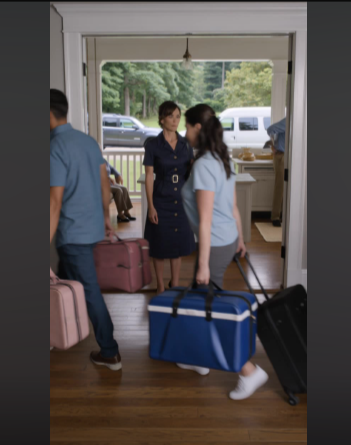
Behind Tessa, my front lawn had disappeared beneath luggage. Rolling suitcases stood in crooked rows beside duffel bags, coolers, sleeping bags, folding chairs, grocery cartons, and three plastic tubs labeled REUNION SUPPLIES in thick black marker. Three SUVs crowded the curb, and a rented passenger van sat half across my neighbor’s driveway.
One of David’s cousins was already carrying bottled water through the side gate as though check-in had begun without me. Two children ran through my flower bed, flattening the edge of a rosebush I had nursed through the previous winter.
My mother-in-law, Margaret, sat on the porch swing with her purse in her lap and the satisfied expression of someone watching a plan unfold exactly as expected. And Tessa stood in the middle of it all, dark hair smooth, cream blouse unwrinkled, smiling as if she had arranged a pleasant surprise instead of occupying my home.
“The whole family will be staying here for ten days,” she said. “You don’t mind cooking and cleaning, do you? It’s only twenty people.” For one stunned second, I thought I had misunderstood her. I had just come home from work on a Friday afternoon, still wearing the navy dress and low black heels I used for long days at the claims office.
My shoulders ached from ten hours beneath fluorescent lights, and all I wanted was to finish packing for Charleston, drink a cup of tea, and go to bed early. My younger sister, Nora, had completed treatment for breast cancer that spring.
We had planned five quiet days by the coast together—slow breakfasts, walks near the water, meals neither of us had to prepare, and enough silence for hope to stop feeling fragile. The flights had been booked for months. David knew that.
When I looked past Tessa, I found my husband standing in the kitchen doorway with a dish towel over one shoulder. He wore the expression of a man who had hoped a problem would solve itself before it reached him.
That was when I understood this was not Tessa’s surprise alone. “You knew,” I said. David looked at the floor.
“Tessa mentioned the reunion a couple of weeks ago.” “A reunion,” I repeated. “Or twenty people moving into our house for ten days?”
“It wasn’t supposed to sound like that.” Tessa gave a light laugh, the kind she used when she wanted another person’s objection to seem childish.
“Clare, it’s family. We’ll all pitch in.” I looked at the luggage, the coolers, the folding chairs, and the children racing toward the backyard. Nothing about that lawn suggested a group prepared to pitch in. It suggested a free resort whose staff had not been informed they were working.
For years, I had been the person David’s family called when something needed to happen smoothly. I made Thanksgiving appear on the table at exactly two o’clock. I kept spare towels folded in the hall closet, remembered who avoided shellfish, who did not eat pork, which child needed a night-light, and which cousin became offended if there was no decaf coffee after dinner.
I did those things because I believed love lived in small acts of care. Somewhere along the way, David’s family had decided care was not something I offered. It was simply my assignment. David had let them believe that because correcting them would have required him to disappoint someone.
I drew one slow breath and looked directly at Tessa. “Of course,” I said. “But I’ve already booked a vacation. You go ahead and enjoy your role as the hostess.” Her smile vanished.
“What?” “I leave tomorrow morning. The tickets are nonrefundable, and my sister is waiting for me.” Margaret rose from the porch swing.
“But we came all this way.” “I can see that.” David stepped toward me and lowered his voice, although everyone close enough to hear Tessa’s announcement could hear him too.
“Clare, please don’t make this into a problem. Mom is already here. Everyone is already here.” “You made it a problem when you told them they could come before you asked me.”
“It’s not like I planned all of this.” “No,” I said. “You just promised them I would handle it.” His silence answered me before he ever admitted the details. Two weeks earlier, Tessa had called him because she wanted a family reunion without spending thousands of dollars on a rental house.
David had not told her he needed to ask me. He had said, “Clare will handle it. The house has plenty of room.” He had spoken about my time the way people spoke about a reliable appliance—available, useful, and too familiar to require permission.
Tessa crossed her arms. “So you’re really going to leave us here with nothing?” “You have twenty adults, cars, phones, money, groceries, and a rented van. I’m sure you can manage.” Her face hardened.
“That’s incredibly selfish.” Maybe leaving looked selfish to people who had built their comfort on my refusal to say no. Or maybe selfish was arriving at someone else’s home with twenty suitcases and expecting her to abandon a recovering sister so everyone else could enjoy a free vacation.
I did not say all of that aloud. I was too tired to debate what should have been obvious. Instead, I walked through the crowded entry hall, climbed the stairs, and entered the small office at the end of the hallway.
It was the only room in the house that still felt entirely mine. I closed the door, turned the lock, and rested my hand on the old oak file cabinet beneath the window. The noise downstairs continued as if my absence had already been absorbed into their plans.
Someone called for extra blankets. A cooler lid slammed shut. A child shouted that he wanted the room with the television. Tessa’s voice carried above the others, assigning places to people she had not asked me to host. I opened the bottom drawer.
The folder labeled PROPERTY RECORDS sat exactly where it had been for years. I had bought the house when I was thirty-one, long before I met David. I bought it after a first marriage taught me how lonely a home could feel when peace depended on another person’s mood.
I worked overtime, paid down debt, saved every raise, and learned that security was not cold or unromantic. Security was the ability to close a door and know the quiet behind it belonged to me.
The four-bedroom colonial was modest, set near the edge of suburban Columbus with a narrow porch and a backyard just large enough for tomatoes, roses, and a wooden swing Nora and I found at a yard sale. The day I signed the papers, I sat alone on the empty living-room floor and cried because no one could order me out of that silence.
Three years later, I married David. He had lived there for twelve years. I had never used ownership to make him feel temporary. I cleared half the closet before he asked, added his name to the utility accounts, gave him space in every cabinet, and spoke of the house as ours because I wanted our marriage to feel like a partnership.
But I had never added his name to the deed. I lifted the folder and removed the original document. The paper was cream-colored, ordinary, official, and quiet. My name appeared alone on the ownership line. The recording date matched the year I had bought it.
The county seal sat at the bottom beside the signature I had made with a trembling hand fifteen years earlier. Downstairs, Tessa called for more pillows. I held the deed and realized something that should have come to me much sooner.
For twelve years, David’s family had called it David’s house. By the end of that weekend, they were going to understand that living somewhere did not give them the right to offer it, enter it, or assign its owner a job.
I stayed in the office a little longer, not because I was afraid to go downstairs, but because the truth arriving inside me was heavier than the paper in my hands. For twelve years, I had mistaken being needed for being valued.
I had made myself indispensable and then wondered why no one asked whether I was tired. I had called my exhaustion generosity because that sounded kinder than admitting people I loved had learned to spend me. I returned the deed to its folder and carried it downstairs.
I did not wave it in anyone’s face. I did not make an announcement. Not yet. The kitchen was already crowded when I reached the bottom of the stairs. Tessa had opened my refrigerator and was inspecting its shelves with the disappointment of a guest reviewing a hotel buffet.
“Do you have more breakfast food?” she asked. “The kids will need things they recognize.” “There’s a grocery store ten minutes away.” She blinked.
“You’re not going?” “No.” Her mouth tightened as though I had failed a test she had never told me I was taking. From the living room, Margaret directed two teenage grandsons toward the hallway.
“You boys can take the blue room,” she said. “Clare can sleep on the sofa if she needs to.” I stopped in the doorway. The blue room served as both my office guest room and the place where I went when I needed an hour alone.
It held a daybed, a small bookshelf, and the quilt my mother had made before she died. I had planned to sleep there that night after packing because Nora and I had an early flight and I did not want to wake David.
“Those boys will need another arrangement,” I said. Margaret turned slowly. “It’s one night.” “It is my room, Margaret.” Her expression shifted into the particular kind of offense she reserved for moments when I failed to perform the version of kindness she expected.
“David has lived here for twelve years,” she said. “This is his home.” David stood at the kitchen counter with both hands flat against the granite. He could have corrected her. He could have said I bought the house before our marriage.
He could have said we had never agreed to host anyone. Instead, he looked away. That small movement hurt more than Tessa’s entitlement. Tessa had always treated boundaries as obstacles placed by oversensitive people. David was the person I had trusted to protect mine when I was too tired to defend them alone.
“David lives here because I invited him to build a life with me,” I said. “That does not mean anyone gets to make decisions for this house without asking.” The room went still enough for me to hear furniture scraping across the floor upstairs.
David let out a long breath. “Clare, can we please not do this in front of everybody?” I almost laughed, but there was nothing funny in it.
“You mean the way you chose not to discuss bringing everybody here in front of me?” Tessa threw up both hands.
“Nobody was trying to hurt you. We thought you’d be happy to have the family together.” “No,” I said. “You thought I would do the work.” For a moment, no one answered. Then a cousin I barely knew opened my pantry and asked whether there was coffee.
The ordinary question broke the silence without changing the truth beneath it. That was how the pattern had grown over the years—one favor covered by another, one holiday becoming a tradition, one emergency key becoming permanent access, one act of care turning into a job description.
By the time I noticed the weight, everyone had already decided I was the person who would carry it. I set the property folder on the small console near the dining room where I could reach it quickly. Tessa did not seem to notice.
She was busy asking whether the upstairs bathroom had enough towels for six people. David followed me into the hallway.
“You can’t leave twenty people with nowhere to go,” he said quietly. “They are not stranded. They have vehicles, phones, money, food, and a van.”
“But Mom is seventy.” “And Nora is recovering from cancer,” I said. “Yet you expected me to cancel on her.”
“I didn’t expect you to cancel.” “Yes, you did. You told Tessa I would handle it.” His eyes lifted to mine.
“It’s my house too, Clare.” The words landed softly, which made them cut deeper. “No, David,” I said. “It isn’t.” He stared at me as if I had become cold in the space of one sentence. I had not changed.
I had simply stopped pretending that generosity meant surrender. For several seconds, he stood with one hand against the wall, looking less angry than wounded. I understood why. I had stripped away a comfortable belief he had carried for years: because he lived in the house, loved me in the house, and paid some bills in the house, he could speak for it as freely as I could.
But I had not spoken to humiliate him. The truth had waited long enough. “I’m not trying to throw you out,” I said. “I’m telling you that you do not get to offer this house, my time, or my labor to your family as though none of it requires my consent.”
His jaw tightened. “They’re not strangers.” “That is exactly why this matters,” I said. “Strangers usually know they need an invitation.” From the kitchen, Tessa called, “David, where do you keep the extra toilet paper?” He closed his eyes for a moment.
I saw the first crack in his denial—not understanding yet, but discomfort sharp enough that he could no longer pretend this was only my mood. I went upstairs and finished packing. I folded linen pants, two light sweaters, my comfortable walking shoes, and the pale blue blouse Nora had once told me made my eyes look brighter.
I packed slowly, refusing to let the noise below turn me into a frantic woman rushing through her own life. Every few minutes, someone called my name.
“Clare, do you have more pillows?” “Clare, is there another bathroom?” “Clare, where are the trash bags?” At first, I answered from the top of the stairs. Then I stopped answering. There were twenty adults in the house. Surely one of them could find a trash bag.
Around six, the smell of delivered pizza rose through the hallway. David brought a paper plate upstairs and stood awkwardly in the bedroom doorway.
“I got you vegetable,” he said. “Thank you.” He remained there, holding the edge of the doorframe. “Mom thinks you’re making a scene.” I looked at him.
“Your mother arrived with twenty people and told me to cook and clean for them. I booked this trip to support my sister after cancer treatment. Which part is the scene, David?” He stared at the plate in his hands.
I softened my voice, although I was tired of being the person who made difficult truths easier for everyone else to hear.
“You had two weeks to tell me. You could have said no to Tessa. You could have asked whether I wanted to host. Instead, you decided I would give up what mattered to me because disappointing me felt easier than disappointing them.”
“I didn’t think it would be this big a deal.” That sentence hurt differently because I believed he meant it. David was not cruel by nature. He was weak in the places where kindness required courage. His family pushed, he gave in, and then he expected me to absorb the consequences because I had always been the stronger one.
“That is the problem,” I said. “You never think it’s a big deal because I always make it work.” He had no answer. He left the plate on the dresser and went downstairs. I sat on the edge of the bed listening to voices move through the house I had once bought for peace.
The noise itself was not the deepest violation. Families could be noisy. The wound was that every person downstairs had arrived believing my consent was unnecessary because my husband had volunteered it for me. Later that evening, after the children stopped running through the upstairs hall, I called an attorney whose number I had saved years earlier.
Her name was Linda Harper. I had spoken with her once after David and I married because I wanted to understand how to protect a premarital home without making my new husband feel unwelcome. Linda had been direct and kind.
A house purchased before marriage and kept solely in one spouse’s name mattered, she had explained, but marriage and property could become complicated. She had also warned me never to use paperwork as a weapon during an argument. That was not what I wanted now.
When she answered, I gave her the short version. Twenty relatives had arrived without my permission. My husband had apparently given his sister a key years earlier. I was leaving on a planned trip the next morning.
“Are you concerned they’ll damage the home or refuse to leave?” Linda asked. “I’m concerned everyone thinks they have a right to be here.”
“That is enough reason to put your boundary in writing,” she said. “Do not lock your husband out or remove his belongings. For the guests, state what you approved, what you did not approve, and when the overnight stay ends. Keep it factual.”
“What if they refuse?” “If anyone refuses to leave or becomes threatening, call local law enforcement. But you do not need to argue about ownership with every relative tonight.” Her calmness steadied me. She was not telling me to explode the marriage or punish anyone.
She was reminding me that clarity did not become cruelty merely because other people disliked it. Before bed, I opened the family group chat. My thumb hovered over the screen. Once I sent the message, no one would be able to call the visit a misunderstanding without ignoring a written boundary.
I typed carefully. “I was not consulted before this visit was arranged. I am leaving tomorrow morning as planned for my trip with Nora. I have not approved a ten-day stay, a large gathering, or overnight guests beyond tonight. David will need to arrange alternate accommodations for anyone remaining after noon tomorrow.”
I read it twice. There was no anger in the message, no threat, and no explanation long enough to be twisted into a separate argument. I pressed send. The replies came quickly. Margaret wrote, “Family should not need permission to stay with family.”
Tessa followed with, “Wow. This is cold, even for you.” A cousin I barely knew wrote, “I thought David and Clare invited everyone.” Then the screen went still. David said nothing. His silence was not neutrality. It was one more choice to leave me alone with the consequences of what he had promised.
I placed my phone on the nightstand and turned off the lamp. Below me, twenty people settled into rooms, sofas, air mattresses, and corners they had assigned themselves. I lay awake beside my packed suitcase and listened to the house groan under a burden it had never agreed to carry either.
At six the next morning, I came downstairs wearing cream linen trousers, the pale blue blouse, and the light tan cardigan I had planned for the flight. My suitcase rolled behind me, its wheels thudding softly over each stair. Tessa waited beside the front door.
She held a small silver key between two fingers. A faded blue plastic ring hung from it. “Oh, good,” she said. “Before you go, can you tell me if this still opens the back door? Mine has always been a little sticky.”
I stopped halfway across the entry hall. Then I looked past her toward David, who stood in the kitchen with a coffee mug in his hand. For the first time since I arrived home, he looked genuinely afraid. I knew every authorized key to that house.
The front door, back door, shed, and mailbox keys hung on labeled hooks inside the pantry. I had never seen the one in Tessa’s hand.
“Where did you get that?” I asked. Tessa glanced at David before answering. “He gave it to me years ago when Mom had surgery. Remember? In case somebody needed to check on the house.” David’s face had gone pale.
“I forgot she still had it.” Tessa shrugged. “I’ve used it a couple of times since then. Just to drop things off.” The word just did a remarkable amount of work in that family. It turned access into harmless convenience, assumption into affection, and violation into something too small to challenge.
“And when we were planning the reunion,” Tessa continued, “David said the family could use the house. He said you’d do what you always do.” The silence that followed was different from the uneasy silence of the night before. This one had weight.
Margaret stood near the dining table with both hands around a coffee mug. Two cousins lingered behind her, pretending to look for sugar. The children were still asleep upstairs. Through the front window, I could see the rented van, the line of luggage, and the rosebush bent beneath yesterday’s footprints.
David looked at his sister. “That isn’t what I said.” “You said there was room,” she replied. “You said Clare would take care of it.” He opened his mouth, then closed it. I did not need the exact wording anymore.
The meaning was complete. David had given his sister access to my home and then let her believe that access included authority. He had avoided one difficult conversation and handed me the cost in twenty people, ten days, and a house full of expectations.
I set my suitcase beside the stairs. “David, please ask the adults to come into the dining room.” Margaret lifted her chin.
“Clare, this is getting ridiculous.” “No,” I said. “It is finally becoming clear.” Within minutes, most of the adults gathered around the oak table. Some were dressed for the day. Others wore yesterday’s clothes and carried the stale, irritated look of people who had expected hospitality and found themselves summoned to a meeting.
Tessa sat with her arms crossed. The silver key rested in her right hand. David remained near the doorway as if he had not yet decided whether he belonged beside me or among the people whose discomfort he had spent years managing.
Uncle Raymond stood at the end of the table, quiet and watchful. I went upstairs one final time, retrieved the property folder, and returned. Then I placed the original deed in the center of the table. Beside it, I set a printed county property record and the short written guidance Linda had emailed after our call.
I did not read legal language aloud. I did not threaten anyone. I placed my index finger beside the ownership line bearing my name and gave the facts the room they had been denied for years.
“This house was mine before I married David,” I said. “It has remained in my name. David lives here because I welcomed him into my home and wanted us to build a life together.” No one moved.
“But no one gets to schedule ten days here, distribute keys, or assign me the work of hosting without asking me first.” Tessa gave a humorless laugh.
“So now you’re showing off paperwork to embarrass everybody.” “I am showing everyone why this decision was never yours to make.” Margaret looked at David.
“You told us this was your house.” His eyes stayed on the floor. Raymond picked up the county record and read it carefully. The printed ownership line, recording date, and parcel information did not care who had hosted Christmas or whose last name the family used when describing the place.
Paper could be cold, but it could also be precise. Raymond lowered the page. “Did you know Tessa was inviting people here without Clare agreeing?” David swallowed.
“I knew she wanted the reunion here.” “That wasn’t my question.” For the first time that morning, David looked directly at him.
“Yes,” he said. “I knew.” No one raised a voice. No one needed to. The truth sat in the center of the table like a cracked plate everyone could see and no one could repair by pretending it remained whole.
I turned to the group. “I am leaving for Charleston this morning. I will be with my sister. I am not canceling that trip. As I wrote last night, the overnight stay ends at noon.” Margaret’s voice trembled.
“You would really put your own family in a hotel?” I met her eyes. “No, Margaret. David will arrange hotel rooms for the relatives he invited without my consent.” David looked at me sharply, perhaps waiting for the familiar softening that usually followed my boundaries.
I did not rescue him from the cost of his own decision. He took out his phone. “There’s a hotel near the interstate,” he said. “I’ll make the reservations.” Tessa scoffed.
“For all of us? That’s expensive.” “It is,” David said. It was the first useful thing he had said all weekend. I watched him call the hotel. I watched him ask how many rooms were available, count adults, confirm checkout dates, and give the reservation clerk his card number.
The practical cost of his promise finally reached him—not as an accusation from me, but as confirmation emails appearing one after another on his screen. People began leaving the table in small embarrassed groups. Some avoided my eyes. A few apologized quietly for assuming the invitation had come from both of us.
Others muttered about the inconvenience as though inconvenience were the worst thing that had happened in my house. Tessa stayed seated. Her hand remained closed around the silver key. Before I picked up my suitcase, I held out my palm.
“The key.” She stared at me. “This is so dramatic.” “No,” I said softly. “What was dramatic was arriving with twenty people and assuming I would disappear into the background.” For several seconds, she did not move. Then her fingers opened.
The key dropped into my palm with a small metallic click. The faded blue ring felt warm from her hand. I put it in my pocket.
“I’ll have the exterior locks changed after the house is empty,” I told David. “You and I will discuss access and boundaries when I return.” He nodded. He looked stunned by how much had changed before breakfast, although none of it had changed suddenly.
The only sudden thing was my decision to stop hiding the truth from everyone, including myself. I rolled my suitcase toward the door. Margaret stood near the porch holding her coffee. For once, she did not tell me what a good wife should do.
Raymond stepped aside and opened the door. “Take care of your sister,” he said. “I intend to.” The morning air felt cool against my face. I walked past the luggage, the van, and the damaged rosebush without stopping to fix any of them.
David followed me to the driveway. “Clare.” I turned. He had put his phone away, but the strain of the reservation call remained around his eyes.
“I’m sorry,” he said. It was too early for those words to carry what he wanted them to carry. “I need you to manage what you created,” I said. “Not apologize until I make it easier.” His shoulders lowered.
“I will.” I placed my suitcase in the trunk of the car service waiting at the curb. For twelve years, leaving had felt like the cruelest possible response whenever David’s family needed something. That morning, leaving was the first honest thing I had done.
At the airport, after I passed through security, my phone buzzed. Tessa had posted online. “Clare threw Grandma out of her own son’s house.” My chest tightened. The sentence was simple and carefully built. It transformed twenty adults arriving without permission into an elderly woman being abandoned.
It erased Nora, the planned trip, the spare key, the deed, the county record, and every person who had watched David reserve hotel rooms because he had promised something that was never his to promise. For one hot second, I wanted to post everything.
I wanted photographs of the luggage on my lawn. I wanted a close image of the ownership line. I wanted to list every time Tessa had called my labor a family tradition while treating my consent as a technicality. Then I saw the first response beneath her post.
Raymond had written, “That is not what happened, and you know it.” I stared at his sentence until the anger in my hands eased enough for me to set down the phone. Nora waited near the gate in a wide-brimmed straw hat and soft green cardigan, even though Charleston would be warmer than Ohio.
Her hair had grown back short, silver at the temples, and still finer than it had been before treatment. She saw my face and lowered her voice.
“Did something happen?” I showed her the post. She read it, handed the phone back, and studied me rather than the screen.
“Do you want to go home?” The question tightened my throat. Much of my life had taught me, mostly by example, that a good woman came back. She came back when people needed dinner. She came back when someone was angry.
She came back whenever a family member made a mess and expected her to clean it. But Nora had spent the previous year learning that a body had limits and that ignoring them did not make a person brave. It only made the damage easier for others to overlook.
I slipped the phone into my purse. “No,” I said. “I’m going with you.” Nora nodded once. “Then we go.” By the time our flight landed, messages had arrived from relatives I had not heard from in years. A few asked what had happened.
Two wrote some version of, “I’m sorry they treated you that way.” One cousin said, “I honestly thought you and David planned this together.” That sentence stayed with me because it revealed the machinery beneath the entire weekend. Everyone had assumed David asked me because he behaved as though he had the right to answer for me.
And because I had spent years smoothing over his decisions, no one had needed to examine the assumption. Nora and I checked into a small hotel near the water. Our rooms faced an interior courtyard shaded by palmettos, and the air carried enough salt to make Columbus feel farther away than one flight.
We ate shrimp and grits at a quiet restaurant, then walked along the harbor while evening light turned the water copper. I tried to remain present. I watched sailboats shift in their slips and listened while Nora described a mystery novel she had read during her last round of treatment.
Still, Tessa’s post followed me like grit inside a shoe. That night, after Nora went to her room, I sat beside the window with a cup of tea and opened the family group chat. I did not want a public war.
I also refused to let silence become permission for a lie. I wrote slowly.
“I am not going to argue about this online. No one was thrown out. Twenty people arrived without my permission for a ten-day stay while I had a preplanned trip with my sister, who is recovering from cancer treatment. David arranged alternate accommodations after noon. The home was mine before our marriage and remains in my name. I will not discuss this further online.”
I read the message three times. It did not call Tessa names. It did not ask anyone to take my side. It was simply true. I pressed send. Raymond replied first.
“Clare is correct. I was there. We should have asked before coming.” His wife, also named Linda, added, “I’m sorry, Clare. We should never have put this on you.” Other messages followed. Some sounded embarrassed. A few began defensively and softened as people remembered the deed lying on the table and David admitting he had known.
Tessa’s version could not survive contact with witnesses. She did not reply. David called just after ten. I let the phone ring twice before answering.
“Are you okay?” he asked. The question was so ordinary that I almost ended the call. “I’m in Charleston with Nora,” I said. “I’m trying to be.”
“I talked to Tessa.” I waited. “She admitted she picked our house because it was free. She thought you wouldn’t say no.”
“Our house?” Silence returned. Then he corrected himself. “Your house.” I closed my eyes. I did not feel victorious. I felt tired enough that even being right seemed like another task.
“She also admitted she posted because she was embarrassed,” he continued. “People asked why they had to leave, and she wanted them to think it was your fault.”
“Did she take it down?” “Yes. Raymond told her to.” That mattered, but not as much as what David said next.
“I should have stopped this before it started.” I stayed quiet. “I knew your trip was planned. I knew Nora needed you. I just didn’t want to deal with Tessa or Mom being upset.”
“So you decided I could be upset instead.” “Yes,” he said quietly. “That’s what I did.” For the first time since Friday afternoon, he did not defend himself. He did not explain that his intentions were good, tell me I was overreacting, or ask me to forgive him because the consequences had become uncomfortable.
He simply admitted the trade he had made. His family’s approval had been purchased with my peace. I had paid the price for a bargain I never agreed to.
“What happens now?” he asked. “You handle the guests. You repair whatever was damaged. You make sure no one keeps a key. And you give me the five days I came here to have with Nora.”
“I will.” “I’m not discussing our marriage tonight.” “I understand.” The next morning, he sent an itemized list. Hotel rooms. Food. Transportation. A replacement lamp broken in the guest room. A locksmith appointment scheduled for the day after the relatives left.
He had also spoken with Tessa. “She is paying me back for the rooms connected to the people she invited,” he wrote. A second message followed.
“She argued about the lock change. Mom told her she needed to pay for that too.” I sat on the balcony outside my room and watched Nora below in the courtyard, laughing softly with a woman she had met at breakfast.
The ocean was beyond the buildings, close enough that I could smell salt in the morning air. Tessa had not been defeated by a speech or public humiliation. She had lost what she expected to receive for free: access, convenience, my labor, and the family’s automatic belief in her version of events.
A few minutes later, David sent a photograph. The deed still lay on the dining-room table at home. The county record was beside it, corners slightly curled. Under the photograph, he wrote, “I spent twelve years acting like that house was mine.”
Another message appeared. “But the worst truth is that I acted like your time was mine too.” I looked at the photograph for a long time. The deed proved the house belonged to me. Leaving had shown me something more important.
I belonged to myself. Nora and I spent five days walking near the water, eating food neither of us cooked, and speaking about everything except cancer until she was ready to speak about cancer again. We browsed a bookstore with uneven wooden floors.
We sat beneath a striped umbrella while she told me how frightened she had been during the weeks she tried to sound brave for everyone else. She admitted she sometimes hated being praised for strength because the praise seemed to require her never to need anything.
I understood that more than I wanted to. One afternoon, we bought pastries and carried them to a bench facing the harbor. Nora broke hers in half and watched gulls turn above the water.
“You know,” she said, “people get very attached to the version of you that costs them nothing.” I smiled without humor.
“That sounds familiar.” “You don’t have to decide everything while you’re here.” “I know.” “Do you?” I looked at the boats. For years, urgency had been another way people controlled me. Fix it now. Answer now. Forgive now. Make everyone comfortable before the next meal.
“I’m learning,” I said. On the flight home, Nora fell asleep against the window with a paperback open in her lap. I watched clouds pass beneath us and thought about all the years I had treated exhaustion as evidence that I was loved.
It was not. Being needed was not the same as being respected. David waited near baggage claim holding a small paper cup of coffee. He used to bring me coffee when he wanted to make peace after a hard day.
For a moment, I saw the man I had married—the man who once drove across town at nine at night because I mentioned I had a cold and no orange juice. Then I remembered him standing in the kitchen while his family turned my home into a hotel.
Both versions were real. That was what made the decision before me harder than simple anger. “Thank you for coming,” I said as I took the cup. He nodded but did not try to hug me. I appreciated that more than I expected.
The drive home was quiet. David told me all the relatives had left by Sunday afternoon. Tessa had deleted her post. The locksmith had rekeyed every exterior door that morning.
“No one else received a new key,” he said. “You have yours. I have mine. That’s it.” I looked through the passenger window at traffic sliding along the highway.
“Good.” He waited before continuing. “The broken lamp was replaced. I paid for the hotel rooms, food, and transportation myself. Tessa is reimbursing me for the rooms connected to the people she invited.”
“That is between you and Tessa.” “I know,” he said. “It should have been between me and Tessa from the beginning.” When we reached the house, it looked almost exactly as it had before Friday. The suitcases were gone. The rented van was gone.
The front lawn was clear. But something in me had changed too much for the house to feel unchanged. Inside, the floors had been cleaned. Fresh towels sat folded in the laundry room. The guest room had been restored, and my mother’s quilt lay carefully across the daybed.
David had replaced the rosebush one of the children crushed. A new lamp stood where the broken one had been. Chicken soup simmered on the stove. It was a small, ordinary meal—not flowers, candles, or a grand display designed to make me feel guilty for remaining hurt.
I sat at the kitchen table across from him and let the silence settle. Finally, David said, “I’m sorry.” I waited.
“I’m sorry I gave Tessa a key. I’m sorry I told her you would handle the reunion. I’m sorry I let my family call this my house when I knew it wasn’t.” His hands rested open on the table.
“But more than that, I’m sorry I treated your patience like something I could spend.” His eyes filled, but he did not look away. For years, I had wanted him to understand that every time he stayed silent, I carried the cost of keeping peace.
Now he was saying the words. Words mattered. They were not enough. “I believe you are sorry,” I said. “But I am not ready to tell you what that means for us.” His face tightened, though he nodded.
“That’s fair.” “No,” I said gently. “It is necessary.” The next morning, I called Linda Harper again. I asked what steps I could take to organize my premarital property records and understand my options. I was not filing for divorce.
I was not trying to frighten David. I was done being uninformed about the life I had worked so hard to build. Linda explained which records to keep together, what household contributions could complicate future questions, and why knowledge was not the same as threat.
When I told David about the call, he did not accuse me of planning an exit. He asked whether I wanted to stay somewhere else for a while.
“I don’t know yet,” I said. That was the truth. For once, I allowed uncertainty to remain mine instead of rushing toward the answer that would calm him. Over the following weeks, David began doing what he should have done years earlier.
When Margaret called and asked whether the family could gather at the house for Labor Day, he did not answer for me. He said, “I need to ask Clare whether she wants that.” When Tessa complained that I had embarrassed her, David told her, “You embarrassed yourself by inviting people into a home that was never offered.”
He started individual counseling without asking me to praise him for it. He admitted he did not understand why disappointing his mother and sister had always frightened him more than disappointing his wife. He asked whether I would consider couples counseling.
“Only when I’m ready,” I said. “Only when you’re ready,” he repeated. The difference was small enough to miss if a person listened only for dramatic apologies. I was listening for whether he could hear a boundary without trying to negotiate it away.
Tessa called two weeks after Charleston. I almost let the call go unanswered. Then I accepted it and stood beside the kitchen window, looking at the newly planted rosebush. At first, her apology sounded familiar.
“I didn’t think it would become such a big deal.” I closed my eyes. “It became a big deal when you decided I was supposed to serve twenty people in my own home.”
“I thought everybody would help.” “You asked me to cook and clean before I had even put down my work bag.” She was quiet.
“And you had a key I did not know you still possessed,” I added. “You used it after the reason David gave it to you had passed.”
“I only dropped things off.” “Without asking.” Another long silence followed. When Tessa spoke again, her voice was smaller. “I kept counting on you because you never made me face the cost of what I asked for.” It was not a perfect apology.
It did not erase the post, the key, or the way she had looked inside my refrigerator as if I were failing her. But it was the first honest thing she had said.
“I will not give you another key,” I told her. “And you will not make plans for this house again. Not for holidays, visits, or anything else.”
“I understand.” “If you want to come over someday, you ask me directly.” “All right.” “And you accept my answer.” She exhaled slowly.
“I understand.” I did not forgive her that day. Forgiveness was not a door someone could unlock simply because she finally admitted she had been wrong. But I heard the beginning of accountability, and I chose not to turn it into more than it was.
One evening about a month after Charleston, David stood beside me while I rinsed dinner plates. The kitchen was quiet except for water striking porcelain.
“You do not get our marriage back because you are sorry,” I said. He nodded. “You get a chance to build something different, but only if you keep showing up when it stops being convenient.” He took the plate from my hands and dried it carefully.
“I will.” For the first time, I did not rush to reassure him. I let the silence hold the weight of what he had to prove. Four months passed before I agreed to host anyone from David’s family again. During that time, he did not ask me to move on.
He did not bring up forgiveness when I was tired or repeat language from counseling to make himself sound changed before his behavior had changed. He simply began doing things differently. When his mother called, he stopped answering for both of us.
When Tessa asked whether she could bring her children by, he asked me first. If I said no, he told Tessa no without adding, “Clare is having a hard time,” as though my boundary needed an illness to be respectable.
He attended counseling every week. He learned how often he had called himself a peacemaker when he was really avoiding conflict until it landed on someone else’s shoulders. Usually mine. I attended several couples sessions when I felt ready. I did not go because I had promised to save the marriage.
I went because I wanted to know whether anything remained worth saving. The counselor asked David what he feared would happen if he told Margaret or Tessa no. He said they would call him disloyal. Then she asked what happened when he avoided telling them no.
David looked at me. “My wife pays for it,” he said. Hearing him say that in a quiet office did not erase the years before it. It did show me he was beginning to recognize the pattern before the damage became invisible again.
Slowly, he gave me reasons to believe there might be something left to rebuild. He began noticing work before it became an emergency. He changed the sheets in the guest room without being reminded. He scheduled the annual furnace inspection.
He called the plumber when the upstairs sink began dripping. He kept track of groceries, returned family calls, and handled the invisible tasks he had once benefited from without seeing. These were not heroic acts. They were normal responsibilities. After years of remembering everything, normal felt almost unfamiliar.
Some days I trusted the change. Other days a small sound—a key turning in the back door, luggage wheels on television, Tessa’s name lighting up David’s phone—brought the old anger back before I could reason with it. David learned not to tell me the reaction was unfair because he was behaving better now.
He learned that repair included living beside the damage without demanding that I stop noticing it. By November, the air in Columbus had turned sharp and gray. Maples along our street dropped the last of their leaves, and grocery stores filled their front displays with canned pumpkin, cranberries, and towers of boxed stuffing.
Thanksgiving had always been the largest gathering of the year for David’s family. For me, it used to mean three days of preparation. Shopping. Cooking. Cleaning. Finding folding chairs. Making beds. Remembering dietary restrictions. Smiling when someone inevitably said, “Clare, you always make everything so nice,” while leaving me alone beside the sink after dessert.
I expected Margaret to call David. She did. I was in the backyard one afternoon cutting back the rosebushes before the first hard freeze when David stepped onto the porch with his phone in his hand.
“Mom called,” he said. I looked up from the garden shears. “I assumed she would.” He came down the two steps and stopped several feet away, giving me space.
“She asked whether the family could come here for Thanksgiving.” I waited. His face was calm, but I saw the nervousness around his mouth. Saying no to his family was still difficult for him. I respected that he no longer disguised difficulty as helplessness.
“And what did you tell her?” “I told her I needed to ask whether you wanted that.” For a moment, neither of us spoke. It was such a small sentence. It should have been ordinary. But hearing it felt like being handed something I had been missing for years: the simple dignity of being included in decisions about my own life.
“What do you want?” he asked. “Not what you think you should want. What do you actually want?” I set the shears on the porch rail. Part of me wanted to say no immediately. Not to punish anyone, but because peace had become precious to me.
I had learned a quiet afternoon was not empty. It was a gift. But I also did not want fear and resentment to become the only things governing my home.
“I can do one afternoon,” I said at last. “Not a weekend, not overnight guests, and not if I am expected to carry it alone.” David nodded before I finished.
“Tell me the conditions.” So I did. Everyone would bring food. David would coordinate the entire day. No one would arrive uninvited. No one would assume they could stay overnight. Tessa would ring the bell and ask before entering, offering help, changing plans, or treating the house as though it belonged to her brother.
The gathering would begin at one and end at six. David wrote everything down. Then he called Margaret while I stood in the kitchen doorway. His voice remained respectful, but it did not bend.
“Mom, Clare and I are willing to host Thanksgiving from one to six. Everyone brings a dish. We are not having overnight guests, and I’m coordinating it, not Clare.” He paused as she answered.
“No,” he said. “She is not being difficult. We are making plans together.” That sentence stayed with me for the rest of the day. On Thanksgiving morning, David woke before I did. I found him in the kitchen at seven wearing an old apron and studying the coffee maker as it clicked in protest.
“You’re up early,” I said. “I have a schedule.” “You made a schedule?” “I made a spreadsheet.” I laughed before I could stop myself. It was the first real laugh I had given him in a long time, and neither of us tried to make it mean more than it did.
By noon, the house smelled of roasted turkey, sweet potatoes, sage, and the apple pie Margaret had ordered from a bakery near her apartment. David cleared the tables, labeled serving dishes, checked the oven, and walked outside twice to make sure no one blocked the neighbors’ driveways.
He had assigned himself the work he once assumed would become mine. At one, the doorbell rang. Margaret stood on the porch holding a casserole dish. Without the certainty she had carried in August, she looked smaller and older.
“Thank you for having us,” she said. Not David invited us. Not It is good to be back. Thank you for having us.
“You’re welcome,” I said, and I meant it carefully. She waited until I stepped aside before entering. Tessa arrived twenty minutes later with her children and two covered dishes. She did not use a key. She rang the bell. When I opened the door, she lifted the dishes slightly.
“I made green beans and cornbread,” she said. “Where would you like them?” The exchange was awkward. It was not warm yet. It was respectful.
“In the kitchen, please.” She nodded and walked where I directed instead of moving through the house as though permission were implied. Throughout the afternoon, David remained involved. He refilled drinks, cleared plates, handled the children when the noise rose, and made sure no one left me alone with cleanup.
When a cousin asked whether everyone could return the next day for leftovers, David answered before I could. “No,” he said pleasantly. “Today is the gathering. We’ll make other plans another time.” No one argued. I watched that small moment more closely than any apology.
He had disappointed someone, and the room had not collapsed. His mother still loved him. His cousin accepted the answer. The feared disaster had been nothing more than another adult hearing no. After dinner, Margaret spoke quietly with Raymond near the windows while Tessa wrapped leftovers at the counter.
David stood beside the dining table holding a glass of iced tea. He cleared his throat. “I want to say something.” The room settled. He looked first at his family and then at me.
“Clare’s patience was never permission,” he said. “I let all of you treat her generosity like something you were entitled to. I did it too.” No one moved.
“I called this my house when I had no right to speak for her. I let her carry the work because I did not want to disappoint anyone else.” His voice shook once, then steadied.
“I was wrong.” Margaret’s eyes filled. “I was wrong too,” she said. “I should have asked. I should have seen what was happening.” Tessa looked down at her hands.
“I’m sorry, Clare.” I nodded. I did not need a perfect scene. I did not need everyone to become different people in one afternoon or expect a few honest sentences to erase years of habit. I needed honesty followed by behavior that could be trusted over time.
That was harder than a dramatic apology and far more valuable. At six, people began carrying dishes toward their cars. No one asked for a bed. No one left luggage on the porch. No one handed me a list of things to wash, store, or remember.
Tessa paused at the front door. “Thank you for today,” she said. “You’re welcome.” She waited a moment, perhaps hoping for absolution, then seemed to understand I was offering courtesy, not pretending the past had vanished. She stepped outside and pulled the door closed behind her.
The last car disappeared around the corner. The house became quiet again. Not the brittle silence that follows an argument. Not the exhausted silence of a woman left alone with everyone’s dishes. This quiet felt shared. David and I sat on the porch beneath a thick blanket while wind moved through the bare branches.
The replacement rosebush stood below us, cut back for winter but rooted. “Do you regret taking that trip?” he asked. I looked toward the dark street and then back at the home I had fought to feel safe in again.
“No,” I said. “I regret believing that being loved meant being available to everyone.” David reached for my hand, then stopped before touching it. He waited. I turned my palm upward and let him hold it. The gesture did not erase the key Tessa had carried or the promise David had made in my name.
It did not guarantee our marriage would survive every old instinct. It meant that, in that moment, he had asked without words and waited for my answer. When the cold deepened, we stood together. I gathered the blanket while David carried the empty tea glasses inside.
Before following him, I looked once across the clear lawn where twenty suitcases had stood months earlier. Then I switched off the porch light, tested the new lock, and closed the door behind me.
