My parents told me it would be better if I found somewhere else to
My Parents Told Me To Live In The Streets So My Sister Could Have My Room, But The Quiet Place Card At Their Backyard Celebration Proved They Had No Idea I Had Already Bought The House And That One Wrong Detail Changed How Everyone Looked At Me
My mother slid my place card beside the garage door while everyone watched, and I kept the signed closing letter folded inside my coat.
The card was small, ivory, and edged in gold because Patricia Sterling believed even cruelty should look expensive. She pinched it between two manicured fingers and carried it past the long patio table where my aunts, cousins, neighbors, and my father’s golf friends were already seated under strings of white lights.
At the end of that table, beside my sister Brittany and her husband Gavin, there had been one empty chair.
My mother removed it before I reached the patio.
She did it slowly, too, like she wanted the movement to be understood. Chair legs scraped across the stone. Conversations thinned. Someone’s fork paused halfway through a bite of pasta salad. My cousin Elise looked down so fast her hair fell forward like a curtain.
Patricia set the chair near the garage wall, beside a cooler of melted ice and bottled water. Then she placed my card on the seat as if she were finishing a centerpiece.
“There,” she said, bright enough for everyone to hear. “Ivy can sit where she doesn’t interrupt the family announcement.”
Brittany pressed a napkin to her mouth, hiding a smile badly. Gavin leaned back with one ankle over his knee, wearing the smug expression of a man who believed the room, the house, and everyone’s opinion had already been purchased for him.
My father stood at the head of the table with a glass of lemonade in his hand. He looked at me the way he had looked at me my whole life, like I was a smudge on a polished window.
“Don’t start,” Richard said. “Not today. This is my house, and I decide who sits where.”
That was the wrong detail.
It landed softly, almost politely, under the patio lights. No one else noticed it. Or maybe they did and chose safety over truth. I felt the folded letter against my ribs, the official seal pressing through the lining of my coat every time I breathed.
I had spent twenty-nine years training myself not to react in front of my family. I knew the rules. If I cried, I was dramatic. If I defended myself, I was jealous. If I went still, they called me cold. There was no acceptable way to be wounded by people who had already decided you deserved it.
So I did the one thing they had never learned how to handle.
I stayed calm.
I walked to the chair by the garage and stood beside it without sitting down. The afternoon air smelled like charcoal, cut grass, and Patricia’s gardenias. Somewhere behind me, one of the neighbors cleared his throat. The sound was small but embarrassed, the kind people make when they have witnessed something ugly and do not want their own name attached to it.
Brittany lifted her glass. “You look overdressed for someone who supposedly needed a place to sleep two weeks ago.”
A few people shifted. Nobody laughed with their whole body.
I looked at my sister, at the pale pink dress she had probably charged to one of my parents’ tired credit cards, and remembered her standing in my childhood bedroom while my sweaters lay across the hallway floor.
Two weeks earlier, she had watched our mother throw my life into boxes.
Two weeks earlier, my father had tossed my car keys at my chest and told me to take whatever fit in the trunk.
Two weeks earlier, Patricia had pointed toward the front door and said, “Go live in the streets if you’re so independent.”
She had shouted it as if I were a stray animal scratching at her paint.
And now she was smiling at a backyard full of witnesses, pretending this was a celebration.
“Are you going to sit?” Patricia asked, still performing sweetness. “Or are you going to stand there making everyone uncomfortable?”
I touched the back of the chair by the garage. It was warm from the sun. I noticed the ivory place card trembling slightly in the breeze.
Richard’s mouth tightened. “Ivy, for once in your life, don’t make someone else’s success about your feelings.”
Gavin gave a little laugh through his nose.
That laugh almost did it.
Not because it was loud. It was not. It was the easy confidence of a man who had moved into my room, repeated lies about his career, and still believed I was the embarrassing one.
I could have pulled the letter from my coat right then. I could have ended the performance with one clean motion. But a good boundary did not need to be thrown like a plate. It could be placed carefully, where everyone had to see it.
So I smiled.
It was not warm. It was not cruel. It was the expression I used in negotiations when someone had mistaken my silence for ignorance.
“Of course,” I said. “Let’s not interrupt the announcement.”
Patricia blinked.
For the first time that afternoon, her smile weakened.
The house behind her was a white colonial with black shutters, a wide porch, and a red maple tree leaning over the driveway. From the street, it looked steady, old, and proud. People in our town had always treated that house like proof of the Sterlings’ good taste. My parents treated it like proof of their importance.
To me, it had always been more complicated.
I had learned to walk quietly in that house before I learned long division. I knew which floorboards creaked outside my father’s study. I knew which cabinet door stuck in the kitchen. I knew how Patricia’s perfume collected in the upstairs hallway after she had been angry, because she sprayed more of it when she wanted to feel composed.
When I was small, I thought every family had invisible seating charts.
Brittany sat beside my mother. I sat where there was room.
Brittany’s school photos went on the mantel. Mine went on the side table near the coat closet.
Brittany could interrupt adults and be called spirited. I could answer a direct question and be told not to use that tone.
The first time I understood the pattern, I was nine. My grandmother had given both of us birthday gifts early because she was moving to Arizona and did not want to miss the celebration. Brittany received a pearl bracelet in a velvet box. I received a set of watercolor pencils and a tiny brass keychain shaped like a house, because I was always drawing floor plans in the margins of my homework.
“Every thoughtful girl needs a little place of her own,” Grandma Louise had whispered.
I carried that thing everywhere for years. It hung from my backpack, then my dorm keys, then from the drawer pull of my desk when I moved back home after college fell apart.
College did not collapse because I lacked discipline, despite the family version. I had a partial scholarship to Rutgers and a plan to study supply-chain management. I liked systems. I liked finding the shortest distance between a problem and a solution. My grandfather had left money for my education, not a fortune, but enough to cover what the scholarship did not.
Then Brittany got engaged.
She did not want a wedding. She wanted a production. She wanted oceanfront photos, imported flowers, a hand-calligraphed seating chart, and a string quartet in the Bahamas because one of her friends had done Mexico and Brittany refused to look copied.
I found out about the money after the tuition office called.
The account was empty.
My parents sat me down at the kitchen table as if they were doing something generous by explaining after the fact. Richard said family resources had to be used where they would “create the most meaningful launch.” Patricia said Brittany’s marriage was a once-in-a-lifetime event. Brittany cried because I was “ruining the bridal season with a guilt trip.”
I left school before the next semester started.
For years after, they called me a dropout.
At first, I corrected them. Then I learned correction only gave them another place to press. So I stopped. I took warehouse shifts. I packed orders for an online storage company. I learned freight schedules, vendor delays, inventory forecasting, ad spend, customer returns, packaging psychology, and the strange emotional power of helping people organize their homes.
At twenty-three, I started Northstar Home Supply from a folding table in the basement.
At twenty-four, I moved operations into a rented corner of a fulfillment warehouse.
At twenty-five, I had six employees and a backordered line of modular pantry containers.
At twenty-six, a national organizing influencer posted one of our laundry-room systems, and we sold out in forty-eight hours.
At twenty-seven, my company cleared seven figures in profit for the first time.
At twenty-eight, we crossed eight figures in revenue.
My parents still thought I sold “plastic bins on the internet.”
I let them think it.
That was the part people never understood when I told the story later. I was not ashamed of my success. I was protecting it. In my family, anything useful became communal the moment they wanted it. My college fund had taught me that. If Patricia knew I had real money, it would become Brittany’s down payment, Richard’s emergency, Gavin’s investment opportunity, or proof that I owed the family for letting me breathe under their roof.
So I stayed in my old room and paid rent.
It sounded absurd from the outside. A grown woman with a thriving company living in her parents’ house. But I had reasons that made sense at the time. The house was fifteen minutes from our New Jersey warehouse. My team worked late. I traveled often. I did not need a showy apartment to prove something to people who would never clap anyway.
Every month, on the first, I transferred $1,500 to Patricia with the memo: rent and utilities.
She accepted it without thanks.
She still told relatives I was “finding myself.”
My bedroom became half bedroom, half command center. One wall held sample shelves. Another held a whiteboard covered in shipping lanes and product notes. I took calls at dawn with suppliers in Portugal and calls at midnight with customer service leads in California. I learned to speak softly when my father passed the door because he hated hearing business terms from me. It unsettled the story he preferred.
Brittany preferred the story, too.
She was two years older and had never met a room she did not expect to enter first. She married Gavin Holt, a smooth man with clean shoes, good hair, and a talent for making vague work sound expensive. He called himself a “capital strategist.” Nobody in my family could explain what that meant, but Richard repeated it with reverence, as if the phrase itself had a stock price.
Gavin loved to say he was between ventures.
He had been between ventures for six years.
When he and Brittany visited, he made little comments about my boxes near the stairs.
“Still doing the label thing, Ivy?”
“Is there money in selling baskets?”
“Cute that you get to work from home.”
He did not know that my “label thing” paid for the new HVAC unit Patricia bragged about to the neighbors, because I had covered it after Richard claimed he was waiting on a delayed bonus. He did not know my company paid the property tax installment the year my father’s consulting contracts dried up, because I wired the money quietly after hearing Patricia cry in the laundry room.
I thought I was protecting my parents from embarrassment.
Really, I was helping them keep the mask in place.
The first wrong detail arrived in March.
Brittany told everyone at Sunday dinner that she and Gavin were “refreshing” their Manhattan loft and would be staying with our parents for a few days while the contractors handled dust. She said it with a laugh, stirring iced tea with one finger raised so her bracelet would show.
But when Gavin carried their bags inside, they were not weekend bags.
They had trash bags tucked between designer suitcases. Brittany’s makeup case was cracked. Gavin kept checking his phone and stepping outside. Their car had a dent along the passenger door that had not been there at Christmas.
I watched Patricia watch them.
Not with concern. With calculation.
By dessert, she had already decided the problem was me.
“Ivy, your room has the best light,” Patricia said, cutting pound cake into thin slices. “Brittany needs a peaceful place to regroup.”
“I pay rent for that room,” I said.
Richard frowned as if I had mentioned something vulgar. “You contribute a token amount.”
“It’s the amount you asked for.”
Gavin leaned back. “Family shouldn’t nickel-and-dime family.”
I looked at him. “Does that apply to everyone?”
Brittany’s fork touched her plate too hard.
The second wrong detail came the next morning when Patricia said the contractors needed “at least three weeks.” I had walked past Brittany and Gavin’s car before breakfast. The back seat was packed tight with clothes still on hangers, a framed wedding photo wrapped in a towel, and a blender with the cord dangling out of a shopping bag.
People renovating do not move blenders.
The third wrong detail arrived in the mail.
I was coming in from the warehouse when I noticed a thick envelope tucked under the brass slot. It had the serious look of something financial. Patricia snatched it from the entry table before I could read the return address.
“Catalog,” she said.
My mother did not receive catalogs in plain white envelopes marked urgent.
That night, I heard Richard in his study speaking in a low, tight voice.
“I understand the deadline,” he said. “We’re handling it privately.”
The old version of me would have knocked. She would have offered to help. She would have asked what was wrong and hoped honesty might finally create closeness.
The newer version stood in the hallway with a glass of water in her hand and understood that people who used you rarely told you the truth before they had finished using you.
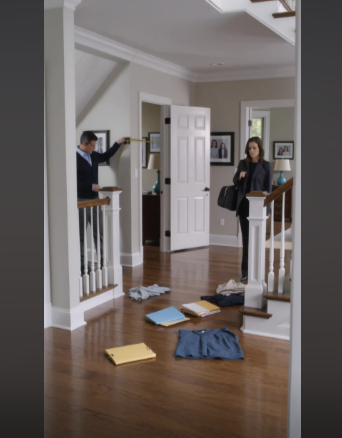
Two days later, Patricia emptied my dresser into the hallway.
It was a Thursday afternoon. I had just come home from touring a new warehouse space in Edison, still wearing black slacks and a navy sweater under my coat. I heard the crash before I reached the stairs. Then I saw my jeans, sweaters, socks, and invoice folders scattered across the upstairs floor.
Patricia stood in my doorway holding a cardboard box.
Brittany sat cross-legged on my bed, scrolling through paint colors on her phone.
Gavin was measuring my wall with a retractable tape measure.
For a second, my mind refused to organize the picture. My bed. My desk. My whiteboard. My sample shelves. My life, transformed into an inconvenience in someone else’s plan.
“What are you doing?” I asked.
Patricia did not turn. “Making room.”
“For what?”
“For your sister.”
Brittany looked up and smiled without softness. “Gavin needs a proper office. Mom says the basement is too damp for his equipment.”
“What equipment?”
Gavin snapped the tape measure closed. “Podcasting. Consulting. Investor calls. You wouldn’t understand the setup.”
I stared at my mother. “I transferred rent yesterday.”
Patricia dropped another armful of clothes into the box. “Your rent barely covers the groceries you eat.”
“I buy my own groceries.”
“Don’t argue details.”
Details were dangerous in my family. Details made lies uneven.
Richard came up the stairs while I was still standing there. He had his phone in one hand and my spare car keys in the other. His jaw had that set look I recognized from childhood, the one that meant the verdict had been reached before the hearing began.
“Ivy, don’t make this ugly,” he said.
“It’s already ugly.”
He tossed the keys toward me. I caught them against my chest. The metal bit into my palm, and for a moment I remembered being sixteen, begging him not to make me apologize to Brittany for a fight she had started because he said peace mattered more than fairness.
“Pack what fits,” he said. “You’re almost thirty. It’s time you learned how the real world works.”
Brittany laughed softly. “Maybe the real world will buy some of your little containers.”
I looked at her.
Not because the insult hurt. It did, but old bruises hurt in a dull way. I looked because she had no idea. None of them did. They were standing in a house I had helped keep running, mocking the business that had quietly outgrown their entire idea of success.
Patricia straightened with my gray winter coat in her hands. She shook it once, as if dusting off something distasteful.
“I won’t have negativity under my roof,” she said. “You sulk around here judging your sister, judging Gavin, making everyone uncomfortable with that superior little face.”
“I have worked since I was twenty,” I said.
“At a hobby.”
“I paid you rent.”
“Not enough to buy entitlement.”
“I paid for the HVAC last summer.”
Richard’s eyes flashed. “That was a family matter.”
“No,” I said. “It was an invoice you could not cover.”
The hallway tightened.
Gavin stopped smiling.
Brittany’s face changed first. Not guilt. Alarm. She did not like hearing anything that made the family story wobble.
Patricia’s cheeks went red. “How dare you keep score.”
“I learned from everyone here.”
That was when she said it.
“Go live in the streets, then.”
Her voice cracked through the hallway, sharp enough to make the air feel split. She pointed toward the stairs. My mother, who had once made me write thank-you notes for birthday checks before I could cash them, looked at me as though I had become something dirty in her house.
“Go live in the streets if you think you’re so independent,” she said. “I am done making room for your resentment.”
Brittany turned her face away, but I saw the smile.
Gavin bent over my desk and started unplugging my monitor.
Something inside me went very still.
I did not cry. I did not beg. I did not list the payments, the covered bills, the late-night repairs, the years of swallowing insults to keep access to a room I no longer needed. I picked up the black duffel from my closet and filled it with the things that mattered: laptop, passport, two sweaters, medication, hard drive, chargers, the small framed photo of Grandma Louise.
The brass keychain slipped from my desk drawer when I pulled out the hard drive. I picked it up and closed my fist around it before anyone saw.
Patricia watched as though my calm offended her more than tears would have.
“Don’t expect to crawl back next week,” she said.
I zipped the duffel.
“I won’t.”
Richard gave a short laugh. “Pride is expensive.”
I looked at him, then at the house around us. The crown molding. The polished banister. The walls Patricia had painted cream because she said white looked “too rental.” The staircase lined with framed photos where Brittany always stood in the center.
“Yes,” I said. “It is.”
I walked down the stairs with my bag on my shoulder. Behind me, Gavin asked Brittany whether he could take down my shelves. Patricia told him to do whatever he needed. My father said something about finally restoring order.
At the front door, I paused.
Not because I wanted one of them to stop me. That wish had been beaten out of me long before. I paused because the entryway smelled like lemon polish and old wood, and I understood I was leaving behind the last version of myself that still hoped they might choose me if I became useful enough.
Then I stepped outside.
The air was cold for April. My sedan sat in the driveway between Gavin’s leased sports car and Brittany’s overpacked SUV. I put my duffel in the passenger seat and got in.
For ten seconds, I did nothing.
Then I called Maya.
She answered on the second ring. “You never call during business hours. Who died?”
“Possibly my last illusion.”
Her voice changed. “Where are you?”
“In my parents’ driveway.”
“What happened?”
“They kicked me out.”
Maya did not gasp. That was one of the reasons I loved her. She had listened to enough stories about my family to know shock would waste time.
“Come here,” she said.
“I don’t want to impose.”
“Ivy.”
“I can get a hotel.”
“You can get a hotel next week. Today you come here.”
I looked back at the house. Through the upstairs window, I could see Gavin carrying my sample shelf into the hall.
“Okay,” I said.
On the drive to Maya’s condo, my phone lit up with messages.
Patricia: When you calm down, you may apologize.
Brittany: You made Mom cry. Nice job.
Gavin: Bad energy blocks abundance. Think about that.
Richard: Do not embarrass this family by telling outsiders a twisted version.
I turned the phone face down.
Maya lived in a two-bedroom condo above a bakery in Montclair. By the time I arrived, she had made tea, cleared her office couch, and put clean sheets on it. She stood in the doorway wearing paint-splattered jeans and an expression so careful it nearly broke me.
“Do you need me to say comforting things or furious things?” she asked.
“Practical things.”
“Good. Shower. Eat. Then we decide what matters.”
In the bathroom, I looked at myself under bright vanity lights. My face seemed unfamiliar, not shattered, just unoccupied. Like the person who had spent years bracing for the next family blow had stepped out and left the body standing there.
After the shower, I opened my laptop at Maya’s kitchen island.
Work steadied me. Purchase orders. Freight delays. A supplier issue in Ohio. A customer-service escalation from a woman who had received the wrong cabinet inserts. All of it was solvable. Problems with edges. Problems that improved when named.
At nine that night, my operations director, Jonah, called.
“Warehouse lease came through,” he said. “But you sound like you’re underwater.”
“I was displaced.”
“From where?”
“My parents’ house.”
He paused. “Do we need security involved?”
“No.”
“Do we need lawyers involved?”
“Not for the kickout.”
“That answer has a hallway behind it.”
Jonah had worked with me for four years. He knew when I was avoiding the real subject.
I opened a blank document and typed my parents’ address. For months, I had been pretending not to notice the envelopes, the hushed phone calls, the sudden canceled vacations. I told myself their finances were not my responsibility. That was true. But truth and strategy were not the same thing.
“Can you pull the property file we discussed last quarter?” I asked.
Jonah went quiet. “You sure?”
“No. Pull it anyway.”
The property file existed because of the HVAC invoice.
When I paid it, the contractor had mentioned two liens while trying to confirm billing information. He thought I knew. I did not. I hired a real-estate attorney, not to attack my parents, but to understand how exposed my name might be if their financial mess touched payments I had made for the house.
The attorney found enough to advise distance.
My parents had borrowed against the house again and again. Some of it went to keep up appearances: club dues, renovations never finished, vacations they called “networking.” A lot of it went to Brittany and Gavin. Wedding debt. Luxury leases. A business seminar in Miami. A failed subscription app Gavin had described as “pre-revenue.”
The house was in trouble.
Not someday trouble. Imminent trouble.
Three months before Patricia threw my clothes into the hallway, the lender had already started pushing toward a forced sale. My parents had signed paperwork agreeing that if they could not cure the default, the bank could accept a qualified private buyer to satisfy the debt and prevent a public auction.
They had signed it because they believed Gavin would fix everything before it mattered.
Gavin had fixed nothing.
The private-buyer option had been sitting there like a door nobody in my family understood.
I had not planned to walk through it.
That night, on Maya’s kitchen stool, still smelling faintly like borrowed shampoo, I called my attorney, Ellen Park.
She answered with the calm of a woman who charged in six-minute increments and was worth every one.
“Ivy,” she said, “this sounds like the kind of call that starts with you telling me not to worry.”
“I won’t insult you.”
“Good.”
I told her what happened.
She let me finish without interrupting. Then she said, “You want to make an offer.”
“I want to know if I can make an offer.”
“You can. Whether you should is another question.”
“I know.”
“Do you want the house because it is a sound asset, or because you’re angry?”
I looked around Maya’s kitchen. A magnet shaped like a lemon held a grocery list to the fridge. Rain tapped the window over the sink. My duffel sat by the couch like evidence.
“Both,” I said. “But anger is not the only reason.”
“What is the other reason?”
“I am tired of them using the word home like a weapon.”
Ellen exhaled. “Then we do it cleanly. No theatrics. No shortcuts. If the lender accepts your company’s offer, closing must be ordinary. Boring, ideally. Boring is defensible.”
“Boring sounds perfect.”
It was not perfect. It was painful.
The next week became a strange double life.
By day, I toured warehouse space, negotiated shipping terms, approved packaging revisions, and led meetings where nobody knew I slept on my best friend’s couch. By night, I sat with Ellen and Jonah reviewing numbers that told the story my parents had hidden under floral arrangements and polished silver.
The fourth wrong detail arrived from Patricia herself.
She sent a family group text announcing a “temporary household rearrangement” and requesting that everyone support Brittany and Gavin while Gavin finalized “a private financial partnership that would secure the future of the family property.”
Gavin responded with a flexed-arm emoji and wrote, Big moves happen behind closed doors.
I stared at those words while sitting in a conference room where my company’s quarterly revenue report glowed on a screen behind me.
Jonah read over my shoulder and said, “He’s taking credit for a deal he doesn’t know exists.”
“He takes credit for oxygen.”
“Are you going to respond?”
“No.”
Responding would have given them friction. I wanted gravity.
The lender accepted Northstar’s offer twelve days after I was kicked out. The terms were simple: my company would purchase the property through an affiliate, satisfy the outstanding debt at closing, and honor a short occupancy period after transfer. My parents would not be tossed out overnight. They would have notice. They would have time. They would have more courtesy than they had given me.
Ellen said that mattered.
I agreed, even though some part of me resented it.
Mercy did not feel holy when you were the only one expected to practice it. Sometimes mercy felt like being asked to fold a clean towel for someone who had set fire to your bed. Still, I refused to become a mirror of Patricia. Boundaries were not cruelty. Consequences were not revenge. Taking ownership of the house was not the same as taking pleasure in making them afraid.
I repeated that to myself often.
Then I would remember my place card by the garage, though it had not happened yet. Some wounds seem to wait for their proper stage.
The closing happened on a Friday morning in a glass-walled conference room at Ellen’s office.
There was no thunder. No music. No gasp from the universe. Just signatures, wire confirmations, identification checks, and an efficient woman from the title company offering stale coffee.
When the final page was signed, Ellen slid the packet into a blue folder.
“It’s done,” she said. “Northstar affiliate owns the property. Your parents will receive formal notice this afternoon that the sale closed and that the new owner will contact them regarding occupancy.”
“Will they see my name?”
“Not immediately. The holding company is listed. They could find you if they cared enough to look past their assumptions.”
I almost laughed.
My family had never looked past their assumptions.
I took the closing letter because Ellen said I should have a personal copy. I folded it once and tucked it into the inner pocket of my coat.
For the rest of the day, my phone stayed quiet.
Then, at 6:42 p.m., Patricia sent a message to the family group.
A MIRACLE HAS HAPPENED.
She wrote it exactly like that, with too many exclamation points afterward. The bank situation, which she had never admitted existed, had apparently been resolved by “private intervention.” She said an investment group had purchased the debt and granted them an occupancy period. She described it as evidence that God protected good families.
Gavin replied before anyone else.
You’re welcome.
Then he sent a voice memo.
I played it once.
His voice filled Maya’s living room, broad and confident. He said he had been “working channels” and “leveraging private lender relationships.” He referred to “my people at Northstar” as if he had ever spoken to anyone in my company. He said Richard had always recognized his value as a son-in-law, and now the family could move forward with the right people leading.
Brittany wrote, My husband saved this house.
Patricia wrote, We always knew Gavin was meant for great things.
Richard wrote, This is why I invest in serious people.
Maya sat beside me on the couch with a bowl of popcorn untouched in her lap.
“Are you going to tell them?” she asked.
“Not in a group chat.”
“Where, then?”
I looked at Patricia’s next message as it appeared.
We are hosting Sunday dinner outside to celebrate. Family only, plus a few close friends. Ivy may attend if she behaves and remembers this is not about her.
A second message came privately from my mother.
Come at four. Wear something appropriate. You owe your sister a peaceful evening after the stress you caused. I will make sure there is a place for you, but do not expect special treatment.
I read it twice.
There is a kind of insult that becomes useful because it removes doubt. Until that moment, I had wondered if I should tell them privately. Let the truth land in a controlled room. Give Richard a chance to absorb it away from his friends. Spare Patricia the audience she had always used against me.
Then she promised me a place.
I wrote back: I’ll be there.
Maya lifted her eyebrows. “That sounded ominous.”
“It was punctuation.”
Sunday arrived clear and mild, one of those late spring afternoons New Jersey uses to convince people they deserve every winter they survived. I spent the morning at the warehouse because ordinary work kept me from turning into a storm. We finalized a shipment schedule. I approved a new hire. I walked the floor and watched my employees move with the healthy urgency of people solving real problems in a place where competence mattered more than bloodline.
At noon, I drove to my apartment.
I had signed the lease months earlier and rarely used it. It was a quiet place in Hoboken with high windows, clean lines, and no family photos. My clothes hung in a closet organized by color because control sometimes begins with being able to find a shirt when your mother has thrown your dresser into the hallway.
I chose a cream silk blouse, a charcoal blazer, dark trousers, and low heels. Not flashy. Not apologetic. I pinned my hair at the nape of my neck and put on small gold hoops.
In the mirror, I looked like the person my employees already knew.
That felt better than looking rich.
Before leaving, I picked up the brass keychain from my nightstand. It no longer held the old bedroom key. Ellen had given me a new set after closing, plain and practical, tagged with the property address. I attached them and let the small weight settle in my hand.
Then I drove to the house.
Cars lined the street when I arrived. Patricia had expanded “family only” into half the neighborhood, my father’s golfing circle, Brittany’s college friends who liked drama from a safe distance, and two women from Patricia’s charity committee. The front porch had planters of white hydrangeas. The patio lights were already on even though the sun had not dropped.
I parked on the street because Gavin’s car sat diagonally across the driveway, occupying two spaces like an announcement.
As I walked up the path, I heard his voice carrying from the backyard.
“The thing about distressed assets,” he was saying, “is you need relationships. People can read books, sure, but high-level finance is about access.”
A few men murmured approval.
I stepped through the side gate.
The backyard looked staged for a magazine about people pretending not to be in trouble. White tablecloth. Floral runners. Glass pitchers of lemonade with sliced citrus. A buffet line near the grill. Patricia had even set out framed photos on a side table: Brittany’s wedding, Richard receiving an award from a business group, Gavin and Brittany on a balcony in Manhattan.
There were no photos of me.
Brittany spotted me first. Her smile sharpened.
“Well,” she said, loud enough to turn heads. “The internet store made it.”
Patricia came toward me with a hostess smile and eyes like locked doors.
“Ivy,” she said, air-kissing near my cheek without touching me. “You came.”
“You invited me.”
“I did.” She looked me up and down. “This is a bit much for a backyard dinner, but it’s nice that you tried.”
Gavin approached with a beer in his hand. “Careful, Pat. She’s a big entrepreneur now. Might invoice you for the compliment.”
Some people laughed because they did not yet know which side was safer.
Richard stood at the far end of the patio table, glowing with ownership. He had always looked most alive when he had an audience. His shirt was pressed. His watch was polished. He raised his glass when he saw me.
“Good,” he said. “Everyone’s here.”
Not everyone. Just everyone he counted.
Patricia turned to the table as if remembering something charming.
“Oh, seating,” she said.
The long table had place cards. Brittany and Gavin beside Richard. Patricia opposite. Aunts, uncles, neighbors, friends arranged by usefulness. I saw my name at the end beside an empty chair, not in a good spot, but at least attached to the table.
Then Brittany leaned toward my mother and whispered.
Patricia’s expression changed.
She picked up my card.
“I almost forgot,” she said, carrying it away.
That was how the scene began.
She removed the chair. She dragged it to the garage. She set the place card there. She told everyone I could sit where I would not interrupt the family announcement.
And my father said, “This is my house.”
The wrong detail breathed under every sound that followed.
Richard tapped his spoon against his glass. The bright little chime made people straighten. Patricia moved back to her chair, pleased with herself. Brittany slipped her arm through Gavin’s. Gavin adjusted his cuff like a man preparing to accept a lifetime achievement award in a field nobody had named.
“I want to thank everyone for coming,” Richard began. “This family has endured a stressful season.”
His eyes flicked toward me, because in his version I was part of the stress, not the throwing out, not the debt, not the lies.
“But stressful seasons reveal character,” he continued. “They reveal who complains and who contributes. They reveal who tears down and who builds.”
Gavin nodded solemnly.
I stood beside the garage chair with my hands relaxed at my sides. Elise watched me from halfway down the table. Her face was pale with secondhand discomfort. She had always been kind in private and quiet in public. That day, her fingers worried the edge of her napkin until it curled.
Richard lifted his glass toward Gavin.
“This man,” he said, “stepped forward when it mattered.”
Gavin lowered his head with rehearsed humility.
“He used his relationships, his intelligence, and his understanding of serious finance to protect this house from a temporary misunderstanding with the bank.”
A murmur went through the guests. Patricia pressed her hand to her chest. Brittany looked near tears, but the kind she enjoyed showing.
“And because he has proven his loyalty,” Richard said, “Patricia and I have decided that Brittany and Gavin will take the lead in this home going forward.”
I heard someone whisper, “Take the lead?”
Richard smiled. “In time, we intend for this house to pass to them. They understand legacy. They understand responsibility. They understand family.”
Brittany looked directly at me on that last word.
The closing letter seemed to grow heavier in my coat.
Gavin stepped in, smooth as butter left near heat.
“I just want to say,” he began, “I don’t do things for applause.”
Maya would have choked if she had been there.
“I do them because family matters,” Gavin continued. “When Richard told me the bank was being aggressive, I made calls. I put my reputation on the line. I can’t share every detail because of confidentiality, but when you’re operating at certain levels, people pick up the phone.”
I watched his face. The perfect confidence. The faint lift of his chin. The absolute safety he felt inside a story no one had challenged.
He did not know Northstar’s general counsel was Ellen Park.
He did not know the title company had never heard his name.
He did not know the house behind him had stopped belonging to Richard Sterling at 10:14 on Friday morning.
Patricia dabbed her eyes with a linen napkin.
“My daughter and son-in-law have given us such peace,” she said. “After some people brought negativity into this home, Gavin reminded us what true support looks like.”
The patio shifted around me.
A few guests looked at the chair by the garage, then at me. A man from Richard’s golf club studied his lemonade as if citrus had suddenly become fascinating. One of Brittany’s friends took a tiny step back from the table.
I did not move.
Brittany tilted her head. “Ivy, you’re awfully quiet.”
“I’m listening.”
“For once.”
Richard’s eyes hardened. “If you have something to say, say it respectfully. Otherwise, let grateful people enjoy a good moment.”
There it was again. The demand that I make my own humiliation polite.
I took one step away from the garage chair.
Patricia’s spine straightened. “Ivy.”
I ignored her and walked toward the table.
The movement was not dramatic. No gasp. No music. Just my heels clicking against stone, steady and clean. I stopped near the head of the table, leaving enough space between Richard and me that he could not accuse me of crowding him.
“Gavin,” I said, “that sounds impressive.”
His smile returned. “It was.”
“I’m curious about one thing.”
He spread his hands. “I’ll simplify if I can.”
A few people chuckled weakly.
I nodded as if he had been generous. “When you spoke with the people who handled the purchase, did they explain the structure to you directly?”
His eyes flickered.
Only once.
“Yes,” he said. “Of course.”
“What name did they use for the acquiring entity?”
The question was soft. That made it worse.
Gavin blinked. “The what?”
“The buyer.”
He recovered with a laugh. “You wouldn’t know them.”
“I might.”
Brittany scoffed. “Ivy, stop pretending.”
Richard set his glass down. “Enough. This is not one of your little online meetings. You don’t get to interrogate my guests at my table.”
My table.
My guests.
My house.
The wrong detail had become a drumbeat.
I turned to him. “You keep saying that.”
Richard frowned. “Saying what?”
“My.”
He stared.
I reached toward the table, not for the folder in my coat, not yet, but for the ivory place card Patricia had carried away. It still sat on the garage chair, so I turned and walked back for it. The whole patio watched me retrieve that tiny piece of paper.
When I returned, I placed the card on the table in front of Richard.
My name faced up.
Ivy.
Just Ivy. No daughter. No family. No place.
Patricia’s lips thinned. “That card is not the issue.”
“No,” I said. “It’s the perfect issue.”
Brittany rolled her eyes. “Here we go.”
I looked at her. “Do you know why place cards matter to Mom?”
“Because she has taste.”
“Because they tell people where they belong before they can choose for themselves.”
Patricia flushed.
I turned back to Richard. “You moved me to the garage because you thought the house still gave you the right to place me anywhere you wanted.”
Richard’s voice went low. “Careful.”
“I have been careful my whole life.”
His face darkened.
Gavin laughed again, but it was thinner now. “This is a lot of drama over a chair.”
“It was never about the chair.”
“No,” Richard snapped. “It is about your jealousy. Your sister is moving forward. Gavin saved this family. You could not stand being irrelevant for one afternoon.”
I let that sit.
Then I asked, “If Gavin saved the house, why is the buyer listed as Northstar Elm Holdings?”
Gavin’s smile stopped.
It did not vanish. It froze, which was better. A living expression trapped on a face that no longer knew how to operate it.
Patricia looked from Gavin to Richard. “What is she talking about?”
Richard’s nostrils flared. “She read something online.”
“County records are online,” I said. “That part is true.”
Gavin set his beer down too carefully. “A lot of holding companies have similar names.”
“Only one bought this property Friday.”
The patio was no longer pretending to eat.
Brittany’s hand tightened around Gavin’s arm. “Gav?”
He patted her hand. “She’s throwing out terms. It’s a tactic.”
“Then answer her,” Elise said.
Every head turned.
My cousin looked startled by her own voice. Color rose in her cheeks, but she did not take it back. She stared at her curled napkin and said, quieter, “If it’s nothing, answer her.”
For the first time all afternoon, someone had stepped one inch toward me in public.
I would remember that.
Richard pointed at Elise. “Stay out of this.”
“No,” I said.
My voice did not rise. It did not need to.
Richard slowly turned back to me.
I reached into my coat and removed the folded closing letter.
Patricia’s eyes locked onto it. She knew the shape of serious paper. She had spent a lifetime sorting invitations, statements, notices, and bills by the level of threat they carried. Her face changed before I said another word.
“I was not going to do this in front of everyone,” I said.
“That is a lie,” Brittany hissed.
“No. This is me adjusting to the room you built.”
Gavin stepped back half a pace.
I unfolded the letter, but I did not pass it around. This was not a magic trick. I did not need anyone squinting at seals to understand the emotional truth.
“Friday morning,” I said, “the sale closed. The buyer was Northstar Elm Holdings. That company is mine.”
No one moved.
Not dramatically. Not at first. Shock often arrives without volume. Patricia’s hand drifted to the back of her chair. Richard’s mouth opened, but no language came out. Brittany looked at Gavin as if he had misplaced gravity.
Gavin recovered first because frauds often rehearse recovery.
“That’s ridiculous,” he said. “You run a warehouse website.”
“Yes.”
“You sell containers.”
“Yes.”
“You don’t buy houses in Somerset County.”
“I do when the house is for sale.”
Richard found his voice. “This house was not for sale.”
“It was,” I said. “You signed the contingency paperwork when you failed to cure the default.”
Patricia whispered, “Richard.”
He ignored her. “You have no idea what you’re talking about.”
“I know you refinanced twice. I know you took a private advance to cover the club dues. I know you accepted rent from me while telling people I contributed nothing. And I know the lender had the right to accept a qualified buyer because you gave them that right.”
The words were factual. That made them less satisfying and more final.
Brittany shook her head. “Mom, tell her to stop.”
Patricia did not tell me to stop.
She was looking at the folded letter.
Gavin pointed at me. “She’s trying to embarrass us.”
I almost smiled. “No, Gavin. You handled that part.”
A sound moved through the patio. Not laughter exactly. Not yet. More like recognition rubbing against discomfort.
Richard stepped toward me. “You went behind our backs.”
“I went through the front door you were too proud to notice.”
“This is family property.”
“It was debt secured by a house.”
“You ungrateful girl.”
There was my mother’s voice, sharp and familiar. It pulled every year behind it. Every dinner, every hallway, every apology I had been forced to make to keep peace with people who mistook peace for obedience.
I looked at her.
“What should I be grateful for, Patricia?”
She flinched at her name.
“For shelter?” she demanded. “For food? For a family?”
“I paid rent. I bought my own food. And family does not put your name on a chair by the garage for sport.”
Her eyes filled, but the tears did not soften me. They were not sorrow. They were panic in costume.
“You planned this,” she said. “You came here to punish us.”
“I came here because you invited me.”
Brittany’s voice cracked. “You stole our home.”
“You cannot steal what the owners already lost.”
Richard slammed his palm on the table. Glasses jumped. Lemonade sloshed over the rim of a pitcher. Several guests recoiled.
“This is my house,” he roared.
The wrong detail finally stood naked in the middle of the patio.
“No,” I said. “It isn’t.”
The three words did what anger had never done. They crossed the space and changed the weather.
Richard stared at me. His face seemed to loosen, feature by feature, as if age had found him all at once. Gavin looked toward the side gate. Brittany noticed and grabbed his sleeve. Patricia sat down without meaning to, her knees folding under the weight of a truth she could not hostess her way around.
I placed the closing letter on the table beside the place card.
Not on top of it. Beside it.
The card said where they thought I belonged. The letter said what they had missed while arranging the insult.
“I am honoring the thirty-day occupancy period,” I said. “Because that is what the agreement provides, and because I will not throw people into the street just because they taught me the phrase.”
Patricia made a small sound.
I kept going.
“You will receive written instructions from Ellen Park on Monday. You may stay until the date listed. You may remove personal belongings. You may not remove fixtures, appliances, company property, or anything purchased with Northstar funds after Friday’s closing. If you want help locating an apartment, I will give Ellen permission to send three options within a reasonable range.”
Richard’s voice came out hoarse. “You expect us to rent.”
“I expect you to live within your means.”
Brittany looked at me with naked hatred. “You did this because you were jealous of me.”
“No,” I said. “I did this because I finally stopped financing the story that made you feel superior.”
Gavin tried to laugh. It failed halfway. “Babe, don’t listen to this. There are ways to challenge sales. There are mistakes. People make mistakes.”
I looked at him. “Yes. For example, telling a backyard full of witnesses that you arranged a purchase you did not know existed.”
His face tightened.
Richard turned on him slowly. “Gavin.”
Gavin lifted both hands. “I was speaking broadly.”
Brittany’s grip on his sleeve became a claw. “You said you called people.”
“I did call people.”
“Who?”
He looked at the table. At Richard. At me. At the neighbors.
The silence answered for him.
Patricia began to cry in earnest then, but quietly. I had never heard her cry without performing before. It was not moving. It was strange, like hearing a chandelier crack.
The guests understood they had become witnesses to something that would outlive the meal. Chairs shifted back. Someone set down a plate. Brittany’s friend Ashley whispered, “We should go,” and then seemed to realize everyone had heard her.
Richard looked around and saw the audience no longer admiring him. That hurt him more than losing the house. I saw it land. He could survive debt, maybe. He could not survive being seen as foolish.
His voice dropped. “Ivy, let’s go inside.”
“No.”
“We will discuss this privately.”
“We had privacy two weeks ago.”
His jaw moved.
“I begged for five minutes to pack my work files,” I said. “Mom told me to stop being dramatic. You told me whatever fit in my trunk was enough. Brittany laughed. Gavin unplugged my monitor. That was the private version of this family.”
Patricia covered her mouth.
I picked up the place card.
The ivory paper had bent slightly from the humidity. My name looked elegant in Patricia’s handwriting, all loops and control.
I held it for a moment, then set it in the center of the table.
“You wanted everyone to see where you put me,” I said. “So let them also see that I am done standing there.”
For once, no one corrected my tone.
I turned to Elise. “Thank you.”
She swallowed and nodded.
Then I looked at the rest of the table. My aunt Linda wiped her eyes. A neighbor I barely knew stared at his plate. One of Richard’s golf friends stood up and said, “We should give the family space,” though what he meant was that he wanted distance from embarrassment.
People began leaving in clusters.
Patricia tried to stop them with hostess reflex. “There’s dessert.”
No one reached for dessert.
Gavin pulled Brittany aside near the hydrangeas. Their whispers grew sharp. He gestured toward the driveway, she toward my father, both of them suddenly understanding that fantasy did not survive contact with paperwork or accountability. Brittany’s face crumpled when he said something I could not hear. I did not need to. Her life with him had been built from the same material as his résumé: shine over air.
Richard remained at the table, staring at the letter.
After a while, he said, “You humiliated me.”
I almost laughed, but it would have been too easy.
“No,” I said. “I stopped helping you humiliate me.”
He looked up.
There was anger in his face, but underneath it was something smaller. Fear, perhaps. Or the first raw edge of understanding that authority disappears when nobody believes in the performance.
“You could have told me,” he said.
“I tried. For years. Not about the house. About me.”
He looked away.
Patricia stood and approached me with both hands clasped, the way she did when she wanted to seem fragile.
“Ivy,” she said, “whatever mistakes were made, I am still your mother.”
Mistakes.
Not choices. Not cruelty. Not theft dressed as sacrifice. Mistakes.
I breathed once.
“You are my mother,” I said. “That is why this took me so long.”
Her lips trembled.
“But being my mother does not give you unlimited access to my life, my money, or my forgiveness.”
She recoiled as if I had raised a hand.
I had not. I never would.
That was the point.
The next thirty days were not clean. Consequences rarely are. My parents hired a lawyer who told them the same facts Ellen had already explained. Richard tried to argue that the sale should not count because he did not know the buyer was me. The lawyer apparently responded, according to Ellen, that sellers do not get to invalidate a sale because the truth bruises their ego.
Gavin disappeared for four days after the dinner. Brittany called me seventeen times. I answered none of them. On the eighteenth, she left a voicemail so raw and furious I almost deleted it before the end.
“You think you’re better than us,” she said. “You always did. You sat there judging while Mom and Dad loved me because I was easier to love.”
That line stayed with me.
Not because it was true, but because it was the closest Brittany had ever come to admitting love in our family had been assigned like seating.
I did not call her back.
Instead, I sent one message.
I hope you learn who you are without a table arranged around you.
She responded with three paragraphs. I did not read them.
During the occupancy period, Ellen handled communication. That protected me from Patricia’s alternating strategies: apology-shaped texts, guilt, rage, childhood photos, Bible verses, accusations that I had destroyed the family, and once, a recipe for lemon chicken with the note, You always liked this.
I had liked it.
That was what made boundaries hard. People who hurt you are rarely made only of harm. Patricia had packed my school lunches. Richard had taught me to ride a bike. Brittany had painted my nails once before a middle-school dance. There were real memories mixed into the wreckage, and the existence of tenderness did not erase the pattern.
Maya reminded me of that whenever I looked tired.
“A good moment is not a contract for lifelong access,” she said.
I wrote that on a sticky note and kept it on my office monitor.
On the twenty-ninth day, my parents moved into a two-bedroom rental in a smaller town twenty minutes away. It was not the street. It was not luxury either. It was ordinary, which to them felt like punishment. Brittany moved in with a friend after she and Gavin separated. Gavin found another investor circle in another city, because men like him often travel light when consequences grow heavy.
I did not celebrate any of it.
There was relief, yes. There was satisfaction, too, though quieter than people expect. Mostly there was grief arriving late, once my body understood it was safe enough to feel.
The first time I walked through the empty house after they left, I cried in the entryway.
Not dramatic tears. No collapse. Just silent water coming down my face while sunlight moved across the floor. The house sounded different without them. Larger. Less important. It was strange to own the place that had once made me feel temporary.
Room by room, I found what they had left behind.
A cracked vase in the dining room.
A box of Brittany’s wedding favors in the basement.
Richard’s old golf trophies wrapped in newspaper.
Patricia’s place cards in a drawer near the china cabinet, bundled with ribbon by event and year. Christmas. Easter. Anniversary. Fundraiser. Brittany Shower. Gavin Welcome Home.
There was no bundle with my name on it.
I stood there holding all that elegant paper and felt the last thread snap.
Not loudly. Not with rage. Just a small, clean release.
I threw the cards away.
Then I called a contractor.
Over the next six months, the white colonial became something else. I did not turn it into a monument to victory. I had no interest in living inside revenge. I turned it into a hybrid office and retreat space for Northstar employees who needed quiet workdays away from the warehouse. The formal dining room became a long collaborative table. Richard’s study became a library with glass doors and no lock. Patricia’s sitting room became a wellness room with soft chairs, plants, and actual sunlight.
My old bedroom was the last room I touched.
For a while, I kept the door closed.
Then one Saturday morning, I opened it with coffee in one hand and a box of paint samples in the other. The walls were still marked where Gavin had removed my shelves badly. Tape scars. Nail holes. A faded square where my whiteboard had hung.
I stood in the center of the room and waited for pain to rise.
It did, but not as much as before.
I painted the room a clear warm white and turned it into a small studio for product photography. Not because I needed the space. Because I liked the idea of light entering that room and being used to make something honest.
Months later, we hosted a Northstar dinner on the patio.
No assigned seating.
People took plates and sat wherever conversation pulled them. Jonah argued with Maya about the correct way to load a dishwasher. Ellen brought her wife and a peach tart. Elise came, too, nervous at first, then easier after I hugged her at the gate and told her I was glad she had spoken that day.
At dusk, I walked to the garage wall where Patricia had placed my chair.
The stone was warm under my shoes. The cooler was gone. The gardenias had been pruned back. Laughter rose from the table, loose and unarranged.
The brass keychain rested in my palm, attached now to the new front-door key.
I thought about Grandma Louise saying every thoughtful girl needed a place of her own. I wished she could have seen me there. Not because I had won the house. Because I had finally stopped begging to belong inside someone else’s version of it.
My phone buzzed.
A message from Patricia.
I stared at her name for a long moment before opening it.
I found your old watercolor pencils in a box. Do you want them?
No apology. No accountability. Just an object extended across a canyon, as if a childhood gift could bridge what she refused to name.
I typed three different answers and deleted them all.
Finally, I wrote: You can donate them.
Then I muted the thread again.
At the patio table, Maya waved me over. Someone had opened another bottle of sparkling water. Elise was laughing with Jonah. The house glowed behind them, not proud anymore, not watchful, just lit.
I took the empty chair between my best friend and my cousin.
No one had saved it for status. No one had assigned it as a lesson. It was simply open, and when I sat down, the conversation made room without asking me to shrink.
For the first time in my life, I understood that making room and being erased can look similar from a distance.
The difference is whether you are allowed to stay whole.
How long would you keep making room for people who only noticed you when your absence finally cost them something?
