My son left me at the airport with an empty suitcase and a retirement
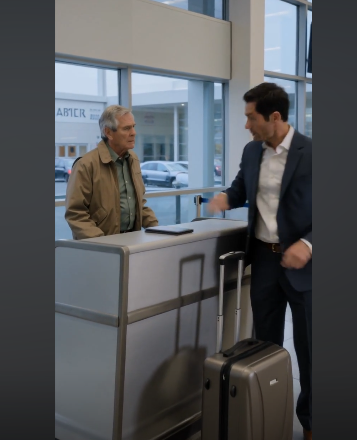
My Son Abandoned Me At The Airport—Then A Wealthy Woman Whispered, “I Need A Husband. Come With Me.”
MY SON ABANDONED ME AT THE AIRPORT. AS I SAT STUNNED, A WOMAN WITH BODYGUARDS CAME OVER AND WHISPERED, “I NEED A HUSBAND RIGHT NOW. COME WITH ME.” WITH NO OTHER CHOICE, I FOLLOWED HER. HOURS LATER, MY SON CALLED NONSTOP, YELLING, “DAD, WHAT ARE YOU DOING? NO WAY!”
My son left me at the airport with an empty suitcase and thirty eight thousand five hundred dollars missing from my retirement account.
Then a woman I had not seen in thirty years sat beside me and said:
“I need a husband.”
That was the morning my old life ended.
My name is Gerald Larkin.
I was sixty eight years old, retired, widowed, and until that day still foolish enough to believe that if you loved your child long enough, eventually he would remember what you had been to him.
I had spent forty one years repairing engines.
Cars.
Trucks.
Farm equipment.
Anything with parts that moved and people who had already made the problem worse by pretending they understood it.
I liked machines because they were honest.
A bearing did not flatter you before failing.
A cracked head gasket did not send birthday cards and then empty your bank account.
Metal broke for reasons.
People were more creative.
My wife Elaine died five years before the airport.
Pancreatic cancer.
Six months from diagnosis to funeral.
Thirty two years of marriage reduced to pill bottles, appointment calendars, and a shopping list still pinned to the corkboard because I could not make myself throw away her handwriting.
Our son Connor was thirty nine.
He had once followed me through the garage carrying a plastic wrench and asking questions until I thought my head would split.
At twelve he could change oil.
At sixteen he rebuilt a carburetor badly enough that we had to do it again together.
At twenty two he graduated college.
I cried in the parking lot where no one could see me.
Then adulthood happened.
Connor started an equipment company.
Married Naomi.
Borrowed money.
Expanded too fast.
Stopped calling unless something was wrong.
After Elaine died, that distance became easier for him.
Harder for me.
So when Connor called one Tuesday evening and said:
“Dad, Naomi and I want to take you on a trip.”
I thought maybe something had changed.
“A trip?”
“International.”
“Where?”
“Let it be a surprise.”
I laughed.
“At my age, surprises should come with a cardiologist.”
He sounded almost like the boy I remembered.
“Three weeks from Saturday. Pack light. We’ll handle everything.”
That sentence alone should have warned me.
Instead, it gave me hope.
The night before we left, I packed carefully.
Two good shirts.
Three pairs of trousers.
Medication.
Toiletries.
A photograph of Elaine and me in Gatlinburg on our twenty fifth anniversary.
My passport went into the side compartment where I always kept it.
I barely slept.
Connor and Naomi arrived at seven.
He honked from the driveway.
Did not come to the door.
I carried my own suitcase outside.
Naomi sat in the passenger seat looking at her phone.
“Morning.”
She barely turned.
“Morning.”
Connor backed out before I had my seat belt fastened.
At the airport, they unloaded their own luggage.
Mine remained in the trunk until I pulled it out myself.
I remember one wheel catching on the curb.
A small thing.
But forty one years fixing machines teaches you to notice small things.
Small things are often where the failure begins.
Inside the terminal, Connor moved quickly.
At the check in counter he handed the agent two passports.
Not three.
I said:
“Connor, do you have mine?”
He looked over his shoulder.
“Go sit down for a few minutes. I need to make a call.”
“Where’s my boarding pass?”
“I’ll bring it.”
Naomi would not look at me.
That was when I should have stopped them.
Instead, I sat.
Ten minutes passed.
Then twenty.
Then thirty.
I called Connor.
Voicemail.
Again.
Voicemail.
At forty five minutes, I knew.
I opened my suitcase.
One old pair of trousers.
One faded shirt.
One pair of socks.
No toiletries.
No medicine.
No passport.
At the bottom lay one sheet of paper.
Maplecrest Senior Living.
An address.
Underneath, in Naomi’s handwriting:
“Ask for the front desk. They are expecting you.”
My phone buzzed.
Connor.
For one ridiculous second, I thought he had come to his senses.
Instead, the message said:
“Take the bus to the nursing home yourself, old man. You have used up your value. Stop clinging to us like scrap metal.”
I read it three times.
Some injuries hurt because they are unexpected.
Others hurt because they finally confirm something you spent years refusing to believe.
I folded the paper.
Then I tried buying a bottle of water.
My debit card was declined.
I opened my banking app.
Thirty eight thousand five hundred dollars had been withdrawn from my retirement account at 6:47 that morning.
I stared at the transaction.
Then another message came.
“Call it payment for raising me for thirty nine years.”
I sat down.
Around me, families rushed toward gates.
Children complained about snacks.
Couples argued about boarding groups.
A grandfather tied a little boy’s shoe ten feet away.
The airport continued functioning perfectly while something inside me stopped.
I did not cry.
Not because crying would have been weak.
Because I knew if I started, I might not stop.
Then I heard several footsteps approaching together.
Four men in dark suits.
Security.
At the center of them walked a woman with silver hair.
Early sixties.
Simple clothes.
No obvious jewelry.
But people moved around her in the unconscious way they move around authority.
She stopped in front of me.
Her eyes settled on my face.
Then she looked at my right forearm.
The burn scar.
Her left hand hung beside her.
Across her palm was another scar.
A shape I knew.
She said:
“Were you working at the Meridian machine shop fire thirty years ago?”
My throat tightened.
“Yes.”
Her expression changed.
“You pulled me out.”
Memory arrived all at once.
Smoke.
Heat.
A collapsed shelving unit.
A woman pinned beside a lathe.
My hands under hot steel.
Dragging her through a side door while the main entrance disappeared behind flame.
I stood.
“Vivian?”
She nodded.
“Vivian Hayes.”
I knew the name then.
Beckford Technology.
Industrial diagnostics.
Automation systems.
Billions in market value.
She had become the kind of person newspapers described with words like founder and visionary.
To me she had remained a frightened young woman with a burned hand in a machine shop.
Vivian looked at the suitcase.
Then at me.
“What happened?”
“Long story.”
“I have time.”
“I’m fairly sure you don’t.”
For the first time, something almost like humor touched her face.
“Sit down, Gerald.”
“How do you know my name?”
“I spent years trying to find you after the fire.”
That stopped me.
She sat beside me on the cold airport bench.
Her security team moved several steps away.
She said:
“I need to ask you something unusual.”
“I’ve already had an unusual morning.”
“I need a husband.”
I stared at her.
She continued before I could answer.
“Not a romance. Not today. A legal marriage.”
“That’s supposed to make it less strange?”
“No.”
That almost made me laugh.
Vivian explained.
Her family still controlled a large voting block in Beckford Technology through an old private family trust.
The trust had been created decades earlier by her grandfather.
It contained a succession provision written in another era and never properly modernized.
If Vivian reached sixty five without designating a spouse as her permitted co-trustee, part of the voting authority she controlled would pass to the next eligible family trustee.
Her nephew, Clifton Beckford.
“Can’t you challenge it?”
“I am.”
“And?”
“My lawyers believe we have arguments. They do not believe litigation will finish before my birthday.”
“How long?”
“Forty seven days.”
“So you want to marry a stranger because your grandfather wrote a bad trust.”
“You are not a stranger.”
“We spent four hours together thirty years ago.”
“You saved my life.”
“That’s not the same as knowing me.”
“No.”
She met my eyes.
“But I know one thing about you that matters.”
“What?”
“When a building was burning, you ran toward someone who could do nothing for you.”
I looked down at my hands.
Vivian said:
“I need enough legal stability to keep control while my attorneys finish challenging the succession clause.”
“And what do you think I need?”
“Based on what I saw when I walked over here?”
Her gaze moved to the empty suitcase.
“A choice.”
That nearly undid me.
Not money.
Not rescue.
A choice.
I told her what Connor had done.
The account.
The nursing home.
The messages.
I expected outrage.
Vivian gave me something better.
Procedure.
She called one of her attorneys.
Then she said:
“First, your bank.”
The bank froze further transfers and opened a fraud investigation.
I learned Connor had used online access I had once given him while Elaine was sick.
I had forgotten the authorization still existed.
The money had moved through a transaction tied to travel purchases and another account.
The bank could not promise immediate recovery.
Good.
No miracles.
They could document.
Restrict access.
Investigate.
I changed credentials.
Reported the transfer.
Then Vivian had her attorney explain her proposal.
His name was Caden Farlow.
He met us in a private airport conference room.
Before he placed a document in front of me, I said:
“Explain every page.”
He did.
The marriage itself would be real.
Public record.
No fake ceremony.
No secret contract pretending marriage did not exist.
Separate from that was a prenuptial agreement and a private services agreement dealing with housing, expenses, medical insurance, confidentiality concerning proprietary business information, and a clear understanding that neither of us automatically acquired the other’s premarital assets beyond whatever the law required and the agreements validly provided.
The arrangement was intended to last at least one year.
After that, either of us could seek divorce normally.
Vivian offered generous financial terms.
I pushed most of them back.
Caden frowned.
“Mr. Larkin, you should have independent counsel before declining anything substantial.”
“Good.”
I looked at Vivian.
“I want my own lawyer.”
“Of course.”
That answer mattered.
A lawyer unaffiliated with Vivian reviewed everything with me that afternoon.
Her name was Linda Perez.
She said:
“This is unusual.”
“I noticed.”
“You are not required to marry this woman because she helped you today.”
“I know.”
“She has enormous resources.”
“I noticed that too.”
“You are emotionally vulnerable.”
“Yes.”
Linda watched me for a long moment.
Then:
“Why do you want to do it?”
I thought about the airport bench.
Vivian’s scar.
The woman I had pulled through smoke before either of us knew what the other might become.
“I don’t know if I want to yet.”
“Good answer.”
So I did not marry Vivian that afternoon.
That is important.
Instead, I stayed in a hotel suite her company maintained near the airport.
We met twice over the next three days.
No cameras.
No boardrooms.
No grand speeches.
We talked.
About Elaine.
About Vivian’s first marriage, which had ended twenty years earlier.
About Connor.
About Clifton.
About why she had never remarried.
About why I still kept Elaine’s shopping list.
On the second night, Vivian asked:
“If there were no trust problem, would you ever have spoken to me again after the airport?”
“I probably would have asked for your number.”
She smiled.
“That is more flattering than the truth usually is.”
On the third morning, I called Linda.
“I’m ready.”
“Are you certain?”
“No.”
“That’s different from not understanding.”
“I understand.”
“Then let’s do this carefully.”
We married at the county clerk’s office with proper witnesses.
Nothing glamorous.
Vivian wore a navy suit.
I wore the gray shirt she had bought me because my luggage contained almost nothing useful.
Afterward, we ate lunch at a diner.
I ordered meatloaf.
She ordered tea.
I asked:
“Does a billionaire really eat grilled cheese?”
She said:
“I own shares, Gerald. I did not stop having a stomach.”
That was the first time I heard her laugh.
The news became public that evening because Beckford Technology had disclosure obligations around control of the family voting trust.
No giant ballroom announcement was necessary.
The company issued a short filing confirming that Vivian had married and designated her spouse as permitted co-trustee under the existing family trust, subject to pending legal review.
My phone exploded.
Connor called eleven times.
I finally answered.
“Dad.”
His voice was raw.
“What did you do?”
“I got married.”
“To Vivian Hayes?”
“Yes.”
“Do you know who she is?”
“Better than you do.”
“This is insane.”
“So was leaving me at an airport.”
Silence.
Then:
“Dad, about that.”
“Did you take thirty eight thousand five hundred dollars from my account?”
“There is context.”
“Yes or no.”
Another silence.
“Yes.”
My grip tightened.
“Did you pack the suitcase?”
“Naomi did.”
“Did you know what was inside?”
He breathed heavily.
“Yes.”
“Did you know where you were leaving me?”
“Naomi said Maplecrest was good.”
I closed my eyes.
“And you believed that made it acceptable.”
“Dad, the business was collapsing.”
“So you stole from me.”
“We were going to repay it.”
“You left me with no money and no passport.”
He began crying.
“I know.”
“No. You know now because you need something.”
That quieted him.
I said:
“I am reporting the transfer.”
“What?”
“The bank already has it.”
“Dad.”
“If they determine it was unauthorized, you answer for it.”
“You would do that to your own son?”
“No.”
My voice broke.
“You did it to your own father.”
I ended the call.
For the next month, I learned how little I understood about Vivian’s world.
Board meetings.
Voting trusts.
Proxy fights.
Regulatory filings.
Lawyers who used sentences with enough commas to require structural reinforcement.
I stayed mostly out of it.
That was deliberate.
I was her husband, not suddenly a corporate genius.
But I did understand machines.
Beckford Technology made industrial diagnostic systems descended from designs I had worked around for decades.
One morning, Vivian showed me a pressure sensor schematic.
I stared at it.
“I know this geometry.”
She looked at me.
“From where?”
“The fire.”
Thirty years earlier, after the ambulance released Vivian, I had visited her motel because I wanted to know she was all right.
She had been shaken and unable to sleep.
To distract herself, she told me about a sensor problem she had been trying to solve.
I picked up a legal pad.
We talked for hours.
I sketched an idea.
Then I went home.
I had forgotten the drawing almost completely.
Vivian had not.
Caden later located copies in Beckford’s archived technical files.
That discovery did not magically make me a fifteen percent owner.
A sketch does not create equity by itself.
But it raised a real intellectual property question.
My name and dated drawing appeared in early development records associated with Beckford’s first patent family.
The company brought in independent patent counsel.
So did I.
The lawyers concluded that while there was evidence I had contributed to an early concept, ownership rights were far from automatic after three decades.
Statutes of limitation.
Assignment questions.
Patent prosecution history.
Employment status.
Inventorship standards.
Plenty to fight about.
I did not suddenly become a billionaire.
Instead, Beckford’s board authorized an independent review.
That suited me.
Truth did not need to become fantasy to matter.
Then Connor’s name appeared inside Beckford’s financial records.
Larkin Equipment Solutions.
Twelve million dollars in venture debt.
Creditor:
Pinnacle Capital Group.
A financing subsidiary controlled through entities associated with Clifton.
I stared at the file.
“My son’s company owes Clifton twelve million dollars?”
Caden answered:
“Technically it owes Pinnacle.”
“Which Clifton influences.”
“Yes.”
“Does Connor know?”
“We don’t know.”
Vivian looked grim.
I remembered envelopes at Connor’s house months earlier.
Pinnacle.
Red wrench logo.
I had almost asked him about them.
Had decided it was none of my business.
Now suddenly it was connected to everything.
The more Beckford’s outside investigators examined Clifton’s conduct, the uglier the pattern became.
But this time, there was no private surveillance fantasy.
The board had already commissioned an independent investigation into conflicts of interest involving affiliated financing companies.
Outside counsel handled it.
Forensic accountants obtained records through authorized corporate channels.
When they discovered suspicious consulting payments involving a company tied to Naomi, the matter went to counsel.
Not to me.
Not to Vivian.
Evidence was preserved.
Interviews were conducted.
No one declared Naomi a spy because of one photograph.
The investigation eventually showed that a consulting company associated with Naomi had received payments from an entity connected to Pinnacle.
There were also emails suggesting she had passed nonpublic financial information about Connor’s company to people working with Clifton.
Enough to raise serious concerns.
Not enough for me to decide guilt from a conference room.
Vivian told me:
“Gerald, let counsel handle this.”
“I know.”
“You look like you want a wrench.”
“I always look like that.”
Two months after the airport, Connor and Naomi requested a meeting with Beckford’s investment committee.
Larkin Equipment needed debt restructuring.
Vivian asked whether I wanted to attend.
“Yes.”
“Why?”
“Because my son will be there.”
“That is not a corporate reason.”
“No.”
She waited.
I added:
“But I have learned enough about the equipment business and the debt documents that I can sit as an observer.”
“Better.”
She smiled slightly.
I attended.
Not as chairman.
Not as the man secretly controlling the company.
As Vivian’s spouse, a technical adviser to her office, and someone with a disclosed family conflict.
Caden made sure everyone knew about that conflict.
A committee member chaired the meeting.
Connor entered.
Saw me.
Stopped.
“Dad.”
“Hello, Connor.”
Naomi followed.
Her face changed less.
That worried me more.
The meeting began formally.
Connor explained the company’s cash problems.
Missed performance covenants.
Inventory expansion.
Customer delays.
He had borrowed too aggressively.
Pinnacle had increased pressure as permitted under the loan documents.
Then one committee member asked:
“When did you first become aware that Clifton Beckford had influence over Pinnacle?”
Connor stared at the table.
Naomi looked at him.
He said:
“About four months ago.”
She turned sharply.
“Connor.”
He ignored her.
“I found emails.”
Naomi said:
“We should have counsel present.”
The committee chair nodded.
“That is your right. We can pause.”
Connor surprised everyone.
“No.”
He looked at Naomi.
“I want to answer.”
Then he looked at me.
“I found payments.”
My stomach tightened.
“To whom?”
“Clearview Consulting.”
Naomi’s face hardened.
Connor continued.
“I asked her about them.”
“And?”
“She told me they were old consulting fees.”
“Did you believe her?”
He looked down.
“I wanted to.”
That answer sounded like my son.
Not the man at the airport.
My son.
The meeting stopped there.
Counsel took over.
Naomi requested representation.
Good.
That was appropriate.
Connor provided the emails he had found to outside investigators.
He did not receive debt relief in exchange.
That distinction mattered.
Cooperation was not a bribe.
The restructuring request went through ordinary review.
The committee eventually offered Larkin Equipment a survival plan.
Extended maturity.
Reduced immediate cash requirements.
Mandatory financial controls.
Independent board oversight.
Sale of noncore assets.
Connor had to contribute personal equity.
No free rescue.
No debt erased because I was married to Vivian.
When he asked me privately:
“Did you do this?”
I answered:
“No.”
“You could have made them forgive the debt.”
“No, I couldn’t.”
“Vivian could.”
“Not without hurting the company and possibly violating duties to shareholders.”
He stared at me.
I said:
“That is the difference between help and rescue.”
He nodded.
Slowly.
Naomi’s situation became more serious.
Outside investigators found evidence that confidential company information had been transferred without authorization.
Property documents also showed she had initiated an attempt to transfer my house from the family property trust into Connor’s name.
It had failed because the trust required co-trustee approval.
Elaine and I had created that trust during her illness.
Not because we expected betrayal.
Because we wanted the surviving spouse protected.
When Vivian told me the attempted transfer had failed, I had to look away.
“Elaine did that.”
“Yes.”
My eyes burned.
“She protected me after she died.”
Vivian said nothing.
She simply sat with me.
That became one of the reasons our marriage stopped feeling entirely contractual.
The most frightening moment came at a Beckford board dinner.
Vivian took several prescription medications.
Her assistant managed them.
Security had already been tightened because of the investigation.
During dinner, I noticed Naomi in a restricted service corridor.
She was not supposed to be there.
I saw her reach toward a tray that contained Vivian’s medication case.
I stood.
“Vivian, don’t take anything from that tray.”
The room went silent.
Vivian did not argue.
That trust saved time.
Security secured the tray.
Naomi was located in the corridor.
Building access records showed she had entered under vendor credentials associated with Clifton’s assistant.
No one arrested her on the spot because I pointed a finger.
Security preserved the medication case and access logs.
Police were called because unauthorized entry and possible tampering had been reported.
The medication went to a laboratory.
Naomi retained counsel.
Clifton retained counsel.
The board recessed.
That was how adults handle something serious.
Slowly.
Carefully.
Without turning suspicion into fact.
The lab later found that one compartment had been altered.
The substitute medication would not likely have killed Vivian, but could have caused a dangerous reaction given her medical history.
That changed the investigation completely.
Police and prosecutors took over the criminal part.
Company counsel handled governance.
The board suspended Clifton from certain internal roles pending investigation.
Not convicted.
Suspended.
Naomi eventually cooperated.
Records and communications produced through lawful process showed she had been involved in a plan to create a health incident that could be blamed on confusion around Vivian’s medication management.
Investigators also found communications linking Clifton’s associates to parts of the plan.
The criminal case took months.
There was no dramatic confession in a boardroom.
No instant prison.
No one declared victory.
Connor helped by providing records.
He was not charged in the medication matter.
He was, however, still responsible for taking my retirement money.
The bank investigation established that he had used access he knew I had not authorized for that purpose.
He admitted it.
Through counsel, we reached an agreement requiring full restitution.
He sold his car.
Reduced his salary.
Entered a repayment schedule.
I refused Vivian’s offer to replace the money.
She said:
“You could have it back tomorrow.”
“No.”
“Why?”
“Because Connor took it.”
“So?”
“So Connor returns it.”
She studied me.
“You’re stubborn.”
“I fix engines.”
“Same profession.”
Our marriage reached the one year mark without either of us noticing the date until Caden reminded us.
The succession dispute had also changed.
The outdated family trust clause was under active court challenge.
Vivian’s marriage had prevented the automatic transfer Clifton expected, buying time.
Her legal team ultimately obtained a settlement restructuring the family voting trust and removing the discriminatory succession mechanism.
No woman at Beckford would ever again be told she needed a spouse to retain authority over shares already entrusted to her.
On the anniversary evening, Vivian placed our original private agreement on the kitchen table.
By then I had moved into her house.
Not because the contract required it.
Because somehow we had become used to waking up in the same place.
She said:
“Our one year is complete.”
“I know.”
“The agreement allows either of us to end this now.”
“I know.”
She took off her ring.
Placed it on the table.
My stomach dropped before I could stop it.
Then she reached into her pocket and placed another ring beside it.
Plain gold.
No stone.
“This one is not part of any agreement.”
I looked at her.
She said:
“If you want it.”
I picked it up.
“You planned that line.”
“For three weeks.”
“Needs work.”
“Gerald.”
I put on the ring.
She laughed.
Then cried.
I kissed her.
No cameras.
No lawyers.
No business reason left.
Months later, Vivian drove me to Indianapolis International Airport.
I did not know why until we entered the terminal.
Connor sat on the same style of metal bench where Vivian had found me.
He stood when he saw us.
He looked thinner.
Older.
Not destroyed.
Changed.
“Dad.”
“Connor.”
Vivian said:
“I’ll get coffee.”
She walked away.
He and I sat.
For a while, neither of us spoke.
Then Connor said:
“I’ve written this apology four times.”
“Why four?”
“Because the first three sounded like excuses.”
“Good reason.”
He looked down.
“I drove you here.”
“Yes.”
“I knew the suitcase was empty.”
“Yes.”
“I knew about Maplecrest.”
“Yes.”
“I took the money.”
“Yes.”
His eyes filled.
“And while all of that was already done, you sat behind me in the car asking Naomi whether she remembered her motion sickness pills.”
My throat tightened.
Connor pressed his hands together.
“I keep coming back to that.”
“So do I.”
“I don’t expect forgiveness.”
“Good.”
He looked up.
“I just need you to know I understand what I did.”
I studied my son.
Thirty nine years.
First steps.
Baseball games.
Broken carburetors.
Graduation.
Arguments.
Loan requests.
The airport.
Restitution checks arriving every month.
A relationship is not erased by one act.
Neither is it restored by one apology.
I said:
“Stand up.”
He did.
I put my hands on his shoulders.
The same shoulders I once lifted onto mine so he could see a parade.
“I forgive you.”
He broke.
Not elegantly.
Not the clean tears of a man in a commercial.
He folded against me and sobbed.
I held him.
Then I said quietly:
“Forgiveness does not mean we go back.”
“I know.”
“You still finish repayment.”
“I know.”
“You still rebuild trust.”
“I know.”
“And Naomi?”
“They’re divorcing.”
“I’m sorry.”
“I’m not.”
“You might be later.”
He gave a tired laugh.
“Probably.”
When we stepped apart, Vivian had returned with coffee.
Connor looked at her.
“Thank you for helping him.”
Vivian answered:
“He never needed me to save him.”
She handed me my coffee.
“He needed somebody to sit down.”
That was Vivian.
She could run a company worth billions and still understand the value of sitting beside someone on a bad bench.
The old intellectual property question surrounding my sketch was eventually settled too.
No hidden fifteen percent ownership.
No magical lost fortune.
Beckford acknowledged my documented technical contribution to early development history.
After independent review and negotiation, the company created a formal inventor recognition award and compensated me for certain historical rights its counsel believed carried legitimate value.
It was a good amount.
More money than I expected.
Far less than fantasy.
I donated most of it to trade school scholarships.
Vivian asked:
“Why?”
I said:
“Because somewhere there is a kid who can see how a machine works but does not know anyone considers that intelligence.”
She smiled.
“You mean someone like you.”
“No.”
“Exactly like you.”
I let her win.
Today, Connor and I speak once a week.
Sometimes ten minutes.
Sometimes an hour.
He still runs Larkin Equipment.
Smaller now.
Healthier.
No fantasy growth.
No twelve million dollar expansion plans.
He has outside financial oversight because that was part of the restructuring.
He hates it.
That probably means it is working.
I do not give him business advice unless he asks.
That is harder for me than it sounds.
Vivian and I remain married.
For real.
She still runs Beckford.
I keep a small workbench in the garage of her house.
My old wrench hangs above it.
The fifteen millimeter one I carried the night of the fire.
One evening she found me cleaning it.
“You know you could buy a new one.”
“I have new ones.”
“Then why keep that?”
I turned it in my hand.
The chrome was worn away.
Dark metal exposed beneath.
Forty years of pressure.
Still useful.
“Because worn out and worthless are not the same thing.”
Vivian became quiet.
She knew exactly what I meant.
The morning Connor left me at the airport, he called me scrap metal.
Something used up.
Something to be discarded after the value had been extracted.
For months, I thought the lesson was that he had been wrong about me.
He was.
But that was not the important part.
The important part was realizing I had been wrong too.
I had believed my value came from usefulness.
Fix the car.
Pay the bill.
Save the business.
Raise the child.
Protect the wife.
Solve the problem.
Be needed.
Then one morning I sat in an airport with nothing useful left to offer anyone.
No money.
No luggage.
No destination.
And a woman sat beside me anyway.
Not because I could fix her company.
Not because I owned shares.
Not because she knew about an old drawing.
She sat because thirty years earlier I had pulled her out of a fire.
And because that morning, I was the one who needed someone to stop.
That is what I carried out of all of it.
Not revenge.
Not billions.
Not some fantasy where everyone who hurts you ends up poor and you become powerful.
Just this.
A person can betray you and still be someone you once loved.
You can forgive them without giving them back the weapon.
You can accept help without surrendering your dignity.
You can discover that your usefulness was never the same thing as your worth.
And sometimes the thing that looks most like the end is only a cold metal bench where the next part of your life happens to sit down beside you.
