My son was smiling when the lawyer began reading my ex-wife’s $28 milli
My Son Said That I Would Get NOTHING From My Ex-wife’s $28M Will, But The Lawyer Laughed And Said…
MY SON TOLD ME I WOULD NOT GET ANYTHING FROM MY EX-WIFE’S 28 MILLION WILL. HE SAT THERE ALL HAPPY DURING THE READING OF THE WILL, BUT THEN THE LAWYER READ ONE SENTENCE AND HE SMILED
My son was smiling when the lawyer began explaining my ex-wife’s estate.
Not a nervous smile.
Not grief.
The smile of a man who had already spent money he did not yet possess.
Brandon leaned toward me and whispered loudly enough for his wife to hear:
“You’re getting nothing, Dad.”
Tiffany covered a laugh with her hand.
Brandon continued.
“Not one dollar. You can go back to your little apartment.”
He was correct about one thing.
Catherine had left me nothing in her will.
What he did not understand was that the will contained only a fraction of the story.
Arthur Prescott, Catherine’s attorney of nearly thirty years, waited until Brandon had finished congratulating himself.
Then he turned a page.
“However,” he said.
Brandon’s smile stopped.
Prescott continued.
“The majority of Catherine Blackwood’s assets were transferred during her lifetime into the Catherine Blackwood Family Trust.”
Brandon frowned.
“What trust?”
“The trust established four years ago.”
“I’m her son.”
“Yes.”
“So I get it.”
“You are a beneficiary.”
Brandon relaxed.
“Fine. Same thing.”
“No,” Prescott said. “It is not the same thing.”
Tiffany lowered her phone.
Prescott looked directly at Brandon.
“You do not own the trust assets. You cannot sell the properties, borrow against them, liquidate the investment accounts, or demand principal distributions.”
Brandon stared at him.
“Then who can?”
Prescott looked toward me.
For the first time that morning, my son stopped seeing a broke retired engineer in an old suit.
“The individual trustee,” Prescott said, “is your father.”
The room became very quiet.
My name is Thomas Blackwood.
I was sixty-eight years old when my son discovered that underestimating someone and understanding them are very different things.
The story began the day before, at his mother’s funeral.
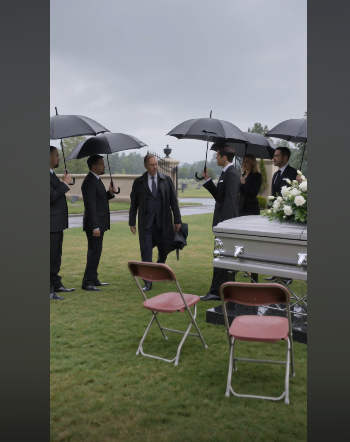
It was raining.
Catherine would have hated that.
She disliked umbrellas, wet shoes, and funerals in approximately that order.
We had been divorced for ten years.
A real divorce.
No secret scheme to hide assets.
No fictional separation designed to fool creditors.
Our marriage had simply reached a point where being good friends became easier than being good spouses.
We divided property.
Moved into separate homes.
Built separate lives.
And then, strangely, became kinder to each other than we had been during the last five years of marriage.
Every Sunday Catherine came to my apartment for coffee.
Sometimes she brought pastries.
Usually terrible ones because she chose bakeries based entirely on architecture.
She would spread financial reports across my kitchen table and say:
“Tell me where I’m being stupid.”
I would.
She would ignore half my advice.
Then call three days later and admit I had been right about one quarter of it.
That was us.
Forty years of history.
Ten years divorced.
Still family in a way neither of us knew how to explain.
Brandon never understood that.
He had not called me Dad in five years.
To him, the divorce had created winners and losers.
Catherine had become one of the most successful real estate developers in the region.
I retired from structural engineering and moved into a two-bedroom apartment in a small building she owned through an LLC.
I drove a ten-year-old truck.
I clipped coupons because I had always clipped coupons.
Brandon looked at those facts and built a story.
His mother was rich.
His father had failed.
He preferred the story to the truth.
At the cemetery, I approached the front row.
Brandon stepped in front of me.
“The front is for family, Thomas.”
Thomas.
Not Dad.
I looked at him.
“I was married to your mother for thirty years.”
“And then she divorced you.”
Behind him, Tiffany was holding an umbrella in one hand and her phone in the other.
She was filming pieces of the funeral for her social media account.
I said:
“Put the phone away.”
Tiffany looked offended.
“I’m documenting the memorial.”
“You’re filming a burial.”
“My followers cared about Catherine.”
“You never called her Catherine when she was alive.”
Tiffany’s mouth tightened.
Brandon pointed toward the back.
“Don’t start anything today.”
“I wasn’t planning to.”
“Then stand by the gate.”
I did.
Not because he had the right to order me there.
Because Catherine was being buried, and I refused to make her funeral about my son’s cruelty.
When the service ended, Tiffany approached me with an envelope.
“This is for you.”
I opened it beneath the oak trees.
Inside was a notice demanding that I vacate my apartment within seventy-two hours.
I read it twice.
Then looked at Brandon.
He smiled.
“The building belongs to Mom’s estate.”
“No, it doesn’t.”
“Of course it does.”
“You should speak to the attorney.”
“I am the heir.”
“That is not the same thing.”
Tiffany laughed.
“Tom, don’t make this humiliating.”
I looked at her.
“You handed an eviction notice to a grieving man at a cemetery.”
She rolled her eyes.
“It is business.”
Brandon stepped closer.
“The apartment is in a good neighborhood. We’re selling the building.”
“You don’t own it.”
“Mom owned it.”
“An LLC owns it.”
“Same difference.”
There was his problem in two words.
Same difference.
Ownership.
Control.
Access.
Inheritance.
Debt.
Brandon had spent most of his adult life treating different concepts as interchangeable whenever doing so benefited him.
He placed one hand on my shoulder.
“You have three days.”
I removed his hand.
“No.”
His expression changed.
“No?”
“No touching me.”
Tiffany laughed again.
Brandon said:
“Don’t come to the estate meeting tomorrow. It will only embarrass you.”
I folded the notice and placed it in my pocket.
“I’ll see you at ten.”
Then I called Arthur Prescott.
He answered almost immediately.
“Thomas.”
“They tried to evict me.”
Silence.
“At the cemetery?”
“At the cemetery.”
Prescott exhaled.
“Catherine predicted he might try something with the apartment.”
“I’m beginning to think she underestimated him.”
“Do you still have the recorded occupancy agreement?”
“Yes.”
Years earlier, Catherine had given me a long-term lease with a nominal rent and specific termination provisions.
Not because we were secretly married.
Because the apartment was where we had raised Brandon during the first lean years of our marriage, before the money arrived.
Catherine owned the building later through Oak Street Holdings.
She wanted me to remain there if I chose.
Prescott said:
“The notice is not effective as written.”
“I assumed.”
“Do nothing tonight.”
“I wasn’t planning anything.”
“Good.”
“And Thomas?”
“Yes?”
“Come tomorrow.”
I looked across the cemetery toward Brandon and Tiffany climbing into a leased Porsche.
“I wouldn’t miss it.”
The next morning, the estate conference took place at Prescott’s office.
There was no theatrical line of relatives waiting while a lawyer dramatically read a document aloud.
Prescott had called a meeting because Brandon was both a beneficiary and named personal representative of a small portion of the probate estate, and because the trust administration required explanation.
Brandon treated it like a coronation.
Tiffany had already called two realtors.
I knew because she announced it before Prescott sat down.
“We need valuations on Highland Drive and Aspen immediately.”
Prescott removed his glasses.
“No.”
Tiffany blinked.
“No?”
“The Highland property is trust property.”
“Okay. Then value the trust property.”
“That isn’t your decision.”
Brandon poured Scotch from the credenza at ten in the morning.
Prescott watched him.
I watched Prescott watching him.
Then the meeting began.
Catherine’s probate estate was modest compared with what Brandon expected.
Personal accounts.
Some vehicles.
Household items.
A few smaller holdings.
The major properties and investments had already been transferred to the family trust years before.
Prescott explained it slowly.
Brandon still did not understand.
“So I inherit twenty-eight million.”
“You are a beneficiary of a trust currently valued at approximately that amount.”
“Meaning I inherit it.”
“Meaning the trust owns it.”
“And the trust exists for me.”
“Primarily for you during your lifetime, subject to its terms. There are also remainder beneficiaries.”
“Who?”
“Your children, if you have any. Certain charities if you do not.”
Tiffany’s face changed slightly at the charity reference.
Brandon asked:
“How do I get the money?”
Prescott replied:
“You request distributions.”
“From whom?”
That was when he learned my role.
Catherine had named me individual trustee because I knew the properties, understood her investment philosophy, and had never needed her money.
A corporate trust company handled custody, accounting, tax reporting, and certain large transactions.
I could not wake up one morning and decide to give the entire trust to myself.
I could not use it to punish Brandon.
I could not make distributions based on whether I liked his attitude.
I had fiduciary duties.
The trust allowed distributions for health, education, reasonable support, and other purposes consistent with Catherine’s written standards.
Large extraordinary payments required review with the corporate trustee.
Brandon heard only one sentence.
“Dad has to approve my money.”
He stood.
“This is insane.”
I remained seated.
Prescott said:
“Sit down.”
“You work for me.”
“No.”
“I’m Catherine’s son.”
“I represented your mother. I now represent the estate where appropriate. The trust has separate counsel.”
Brandon pointed at me.
“He’s broke.”
That almost made me smile.
Tiffany said:
“He lives in a rental.”
I answered:
“I like my rental.”
Brandon stared at me.
“You knew about this.”
“Yes.”
“For how long?”
“Four years.”
“And you didn’t tell me?”
“It wasn’t my trust to announce.”
“Mom trusted you over me?”
I looked at him.
“Catherine loved you.”
“That’s not what I asked.”
“No.”
I let the silence remain.
Then Prescott continued explaining the documents.
Brandon barely listened.
The moment the meeting ended, he cornered me near the elevators.
“I need two point four million.”
I thought I had heard him incorrectly.
“For what?”
He lowered his voice.
“Debts.”
“What debts?”
“Private.”
“If you are asking the trust to pay them, they are no longer private.”
Tiffany stepped beside him.
“It’s temporary.”
“Who is owed?”
Brandon’s jaw tightened.
“Casinos.”
I stared at him.
“How much?”
“Some.”
“How much?”
“About one point six.”
“And the rest?”
“Loans.”
“What kind of loans?”
His silence answered enough.
I said:
“Send the documents to trust counsel.”
“Dad.”
“No.”
“You haven’t even reviewed them.”
“Correct.”
“So why are you saying no?”
“I’m saying no to handing you two point four million dollars in a hallway.”
His face reddened.
“It’s my inheritance.”
“It is not.”
“Stop saying that.”
“I will stop saying it when it stops being true.”
He stepped closer.
I did not move.
“People are expecting payment.”
“Then your lawyer should communicate with your creditors.”
“You could fix this today.”
“Possibly.”
“Then do it.”
“No.”
He looked as though I had struck him.
I realized something then.
Brandon was thirty-seven years old.
And I could not remember the last time either Catherine or I had allowed a serious consequence to reach him.
Bad investment.
Catherine helped.
Credit card problem.
I helped.
Business failure.
Catherine refinanced something.
Gambling rumor.
We treated it as stress.
Every rescue had contained the same sentence.
“Just this once.”
We had taught him that rock bottom came with an elevator.
Catherine’s trust was her final attempt to stop pressing the button.
The apartment issue became simple.
Prescott sent Brandon’s lawyer the recorded lease and ownership documents.
Oak Street Holdings had not passed through the probate estate.
It was trust property.
My occupancy agreement remained valid.
The seventy-two-hour notice had no legal effect.
I did not throw it back in Brandon’s face.
I framed nothing.
Posted nothing.
Said nothing.
I stayed in a hotel for several nights anyway.
Not because he had removed me.
Because I did not want him knowing exactly where I slept while he was angry and desperate.
Prescott approved.
“Finally,” he said, “you are behaving like a retired engineer instead of someone’s father.”
“I am both.”
“That is the problem.”
The next attack came through court.
Brandon petitioned to remove me as trustee.
Conflict of interest.
Hostility.
Age.
Alleged cognitive decline.
He claimed I had become irrational since Catherine’s death.
His lawyer requested temporary restrictions on large trust transactions until the court could evaluate the situation.
That part was not absurd.
Courts exist for exactly this reason.
A beneficiary has the right to challenge a trustee he believes is acting improperly.
Prescott called me.
“Do not take this personally.”
“My son has filed papers claiming I have dementia.”
“Take it a little personally.”
I almost laughed.
“What do we do?”
“Independent evaluation.”
“Good.”
“Full trust accounting.”
“Good.”
“Corporate trustee review of every decision.”
“Good.”
“And you stop calling Brandon an idiot in emails.”
“I called his financial decisions idiotic.”
“Judges dislike adjectives.”
“Engineers love them.”
“Stop.”
I stopped.
The evaluation found no cognitive impairment.
The corporate trustee confirmed that no distribution had been denied without review.
In fact, there had been only one formal request.
Two point four million dollars to satisfy undocumented debts.
The request remained pending because Brandon had failed to provide complete creditor information.
His removal petition did not disappear overnight.
There were filings.
Responses.
Affidavits.
A hearing date.
Real law moved more slowly than rage.
That irritated Brandon.
Desperate men often confuse delay with conspiracy.
Then came Highland Drive.
Catherine’s mansion.
Brandon and Tiffany had been staying there during the final months of Catherine’s illness.
There had never been a formal lease.
After her death, the house became trust property.
I could not simply arrive with a locksmith and throw their belongings onto the lawn.
Trust counsel served proper written notice and proposed a temporary occupancy agreement.
It allowed them to remain while the trustee litigation proceeded, provided they paid utilities, maintained insurance requirements, allowed an inventory of trust property, and did not sell or remove estate assets.
Brandon refused to sign.
Two days later, a property manager called me.
“Mr. Blackwood, there are strangers at Highland.”
“What kind of strangers?”
“People carrying furniture.”
I called counsel.
Counsel called security.
The trust’s inventory company met us there.
When I arrived, cars lined the driveway.
Tiffany had posted what she called a private estate preview.
Paintings had handwritten prices.
Crystal.
Silver.
Furniture.
Catherine’s belongings.
Brandon stood near the entry taking cash deposits.
I felt something in me go cold.
Not because of the money.
Because one of the paintings had hung above Catherine’s desk for thirty years.
She had bought it in Paris on our twentieth anniversary.
It was not particularly valuable.
It was simply hers.
I asked:
“What are you doing?”
Brandon turned.
His face changed.
“You can’t be here.”
“The trust owns the house.”
“I live here.”
“And you have been told not to dispose of trust property.”
“This stuff is mine.”
“No.”
“My mother owned it.”
“Yes.”
“She died.”
“Yes.”
“So I inherit it.”
I looked around the room.
Same difference.
Again.
Trust counsel stepped forward.
He carried copies of the inventory notice and pending emergency motion.
“We are asking everyone to stop transactions until ownership can be verified.”
One potential buyer placed a vase back on the table.
Another asked:
“Are these items disputed?”
“Yes.”
The room began emptying.
No police raid.
No dramatic arrests.
People simply stopped wanting to buy property involved in litigation.
Brandon watched thousands of dollars walk out the front door.
He turned on me.
“You did this.”
“No.”
“You called them.”
“My lawyer told people the ownership is disputed.”
“You’re ruining me.”
“You’re trying to sell things that may not belong to you.”
“They’re my mother’s.”
“That does not make them yours.”
He grabbed a porcelain vase from a table.
For one second I thought he might throw it.
Then his hand started shaking.
“Do you know what they will do to me if I don’t pay?”
I looked at him.
That was the first time fear outweighed entitlement.
“Who?”
He lowered the vase.
“People I borrowed from.”
“Are they threatening you?”
He looked away.
“Brandon.”
“Yes.”
“Have you told your lawyer?”
“No.”
“Why not?”
“Because they’ll tell me to go to police.”
“That sounds sensible.”
“You don’t understand.”
“Then explain it.”
He began crying.
Actual crying.
No performance.
“I owe people money.”
“I know.”
“A lot.”
“I know.”
“They know about Mom.”
I understood.
“You told them you were inheriting the estate.”
He nodded.
“And now they expect payment.”
Another nod.
I said:
“Then we need your attorney.”
“No.”
“Brandon.”
“You’ll use it against me.”
There was the tragedy.
Even when I offered the correct kind of help, he could see only leverage.
He put the vase down.
Then shouted:
“Get out of my house.”
I did.
Counsel filed for an emergency order preserving the trust assets.
The court granted limited relief.
No sales.
No transfers.
No borrowing against trust property.
A professional inventory.
Access rules.
Brandon and Tiffany could remain temporarily under conditions while the occupancy dispute proceeded.
That was less satisfying than changing the locks.
It was also legal.
Catherine’s letter appeared during the inventory.
Not hidden beneath a magical desk panel.
Prescott had held it under written instructions to deliver after the first trust dispute, if one arose.
He gave it to me in his office.
The envelope said:
“Tom.”
I waited until I was alone.
Then opened it.
“Tom,
If you’re reading this, Brandon has probably asked for more than the trust should give him.
I know we failed him in ways that looked like generosity.
We made consequences disappear because we were busy, guilty, and financially able.
Please don’t repeat that mistake for me after I’m gone.
Do not punish him.
Do not humiliate him.
Do not try to break him.
Just follow the trust.
If he needs treatment, pay for treatment if the terms allow it.
If he needs education, help him get it.
If he needs food and safe housing, make sure he has a path.
But gambling debt is not health.
Luxury is not support.
And fear is not a reason to turn twenty-eight million dollars into another rescue.
You were always better at saying no than I was.
I hated you for that sometimes.
I also trusted you for it.
Love him.
But don’t save him from every consequence.
Cat.”
I read it twice.
Then again.
I cried for the first time since the funeral.
Not because Catherine had given me control.
Because she had left me responsibility.
There is a difference.
Tiffany began posting videos.
At first they were vague.
“Some people use grief to control inheritance.”
Then less vague.
“My husband’s father is abusing his authority.”
Then direct.
“Thomas Blackwood is withholding money from his own son.”
I did not respond.
Her audience did.
Some supported her.
Others asked why a healthy thirty-seven-year-old man required millions from a trust immediately.
She deleted those comments.
Then she posted what appeared to be a letter from me demanding half of Brandon’s future salary in exchange for trust distributions.
I had never written it.
Prescott called.
“Did you send this?”
“No.”
“We need to preserve it.”
“Fine.”
“Do not post.”
“I wasn’t planning to.”
“Do not call Tiffany.”
“I wasn’t planning to.”
“Do not threaten litigation online.”
“Arthur.”
“Yes?”
“I am not Brandon.”
“Thank God.”
Trust counsel sent a formal notice demanding preservation of the original document and stating that I disputed its authenticity.
No social media war.
No threats.
No attempt to destroy her career.
Just paper.
Meanwhile Brandon’s debt situation worsened.
His attorney finally obtained a list.
Casino markers.
Credit cards.
Unsecured private loans.
Business obligations.
More than two million dollars in total.
Not all debts were immediately enforceable.
Not all were connected to gambling.
Some claims were disputed.
The trust did not simply pay.
The corporate trustee brought in outside counsel.
They separated legitimate obligations from questionable ones.
Brandon was advised to hire insolvency counsel.
He refused.
“What I need is money.”
I said:
“What you need is a plan.”
“The trust has money.”
“The trust is not a checking account.”
“You control it.”
“I administer it.”
“Same thing.”
“No.”
Always the same misunderstanding.
He believed authority meant ownership.
Maybe Catherine and I had taught him that too.
The competency case became his next strategy.
He amended his petition and submitted an affidavit from a physician named Dr. Aris.
The affidavit implied I had shown signs of memory loss and paranoia.
Problem.
I had never been Dr. Aris’s patient.
My lawyer immediately obtained my medical records from my actual physician and the independent evaluator.
The court ordered Dr. Aris to clarify the basis of his opinions.
His affidavit became much less impressive once he admitted he had never personally examined me.
The judge was not amused.
The court denied emergency removal.
The broader trustee case remained pending.
Prescott later said:
“Dr. Aris may have licensing problems.”
“Not my department.”
“Good.”
I meant it.
I did not want every person who opposed me destroyed.
I wanted the trust administered correctly.
That distinction was becoming more important the uglier things became.
Then the court learned about the attempted sale at Highland Drive.
That changed the occupancy question.
The trust requested tighter restrictions.
Brandon’s lawyer argued he had misunderstood what property belonged to the trust.
The inventory records contradicted part of that claim.
Eventually, the court approved a written occupancy arrangement.
Brandon and Tiffany could stay temporarily.
They had to cover ordinary utilities.
The trust covered structural preservation, insurance, taxes, and major capital repairs because the trust owned the asset.
No absurd seventy-thousand-dollar tax bill dumped onto Brandon as punishment.
No broken boiler intentionally left unrepaired to make them freeze.
Trust property had to be maintained.
That was my duty.
I did not get to neglect a four-million-dollar asset because I was angry at the beneficiary living inside it.
Brandon hated the agreement.
“It feels like I’m renting my inheritance.”
I answered:
“You’re living in property you do not own.”
He threw the pen.
His attorney picked it up.
“Sign it.”
He did.
What I did not know then was how frightened he had become.
One of his private lenders had begun calling constantly.
No men with baseball bats arrived at the mansion.
No whispered threats about broken legs.
Reality was quieter.
A collection lawyer.
Demand letters.
A civil complaint.
A creditor examining whether Brandon had assets outside the trust.
Because the trust contained discretionary provisions and spendthrift protections, creditors could not simply seize the trust principal.
That did not make Brandon safe from his own debts.
It simply meant Catherine had prevented his creditors from inheriting with him.
Brandon blamed me.
“They’d leave me alone if you paid.”
“Maybe.”
“So pay.”
“No.”
“They’re suing me.”
“Then defend the lawsuit.”
“I can’t afford lawyers.”
“Your trust request for legal fees related to legitimate debt restructuring is under review.”
His expression changed.
“You’d pay a lawyer but not pay the debt?”
“Possibly.”
“That makes no sense.”
“It makes perfect sense.”
“How?”
“Paying a lawyer can help you understand your obligations and negotiate them.”
“Paying the debt makes it disappear.”
“Until you create another.”
He hung up.
For the first time, I understood why Catherine had built the trust the way she had.
Not to make Brandon beg.
To change what help looked like.
Tiffany’s online campaign intensified when money did not arrive.
One video reached enough people that reporters began calling Prescott.
He advised a short statement.
Nothing more.
The trust issued it.
“The Catherine Blackwood Family Trust is being administered according to its governing documents and applicable law. Pending litigation will be addressed in court. The trustees will not discuss private beneficiary information publicly.”
That was it.
No attack.
No financial disclosures.
No gambling details.
I wanted to tell the world everything.
The debts.
The cemetery eviction.
The attempted sale.
The false medical affidavit.
I did not.
Public humiliation would have felt like justice for about fifteen minutes.
After that it would still have been my son’s life on the internet forever.
Then Tiffany contacted me privately.
“Can we meet?”
“Why?”
“I need to tell you something about Brandon.”
“Tell your lawyer.”
“I can’t.”
“Then tell Prescott.”
“No.”
“Why me?”
“Because you can help me.”
That sentence told me enough.
Still, I agreed to a meeting, but only after Prescott advised me to meet in a public place and not discuss criminal matters or offer anything in exchange for information.
We met at a diner.
Tiffany wore jeans and a sweatshirt.
Without expensive clothes and professional lighting, she looked younger.
And more frightened.
“Brandon is blaming everything on me.”
I drank coffee.
“He says the estate sale was my idea.”
“Was it?”
She looked away.
“Partly.”
“The social media posts?”
“Mine.”
“The fake letter?”
Her face tightened.
“I didn’t forge anything.”
“Then who did?”
Silence.
I did not fill it.
Eventually she said:
“Brandon gave it to me.”
“Did you know it wasn’t real?”
Another silence.
That was enough.
She leaned forward.
“I can help you.”
“With what?”
“The court case.”
“How?”
“I know things.”
“Then tell your attorney.”
“I need something first.”
There it was.
“What?”
“Money.”
“How much?”
“Fifty thousand.”
I almost laughed.
Not because the number was funny.
Because after everything, we were still in the same room.
Different furniture.
Same transaction.
“What would the money buy?”
“A fresh start.”
“And what do I receive?”
“Everything I know about Brandon.”
I put down my cup.
“No.”
Her eyes widened.
“You haven’t even heard it.”
“I don’t buy testimony.”
“You’re twisting it.”
“No.”
I looked directly at her.
“If you know about fraud, theft, false documents, threats, or anything relevant to litigation, speak to your lawyer or the proper authorities.”
“You could help me.”
“I could.”
“Then why won’t you?”
“Because giving you fifty thousand dollars in exchange for information about my son would make me part of the same sickness I’m trying to stop.”
She stared at me.
“You really are cold.”
“Maybe.”
I stood.
“But I’m not buying my family anymore.”
I left five dollars for the coffee.
Her information eventually reached the lawyers without my payment.
Once Brandon and Tiffany hired separate counsel, their interests diverged quickly.
Each blamed the other.
The trustee litigation became more complicated.
So did their marriage.
I did not help that process.
I did not send recordings from one spouse to the other.
I did not provoke jealousy.
They managed the destruction themselves.
Weeks passed.
Then Prescott called me into his office.
He looked worse than usual.
“Sit down.”
“I am sitting.”
“Thomas.”
Something in his voice made my stomach tighten.
“What happened?”
“Brandon and Tiffany had a fight.”
“How bad?”
“Bad.”
“Is she alive?”
“Yes.”
I felt air return to my lungs.
“Hospital?”
“Yes.”
“What happened?”
“He assaulted her at a motel.”
I closed my eyes.
No satisfaction.
None.
Whatever Tiffany had done to me, whatever lies she had posted, whatever property she had tried to sell, she did not deserve violence.
Prescott continued.
“Police are looking for Brandon.”
“Did he run?”
“They don’t know.”
I looked through the glass wall of Prescott’s office at the city below.
Bridges.
Buildings.
Traffic.
Everything appeared orderly from forty floors up.
People moving in predictable lines.
Structures obeying loads.
Engineering had always comforted me because forces were measurable.
Steel bent at known tolerances.
Concrete failed for identifiable reasons.
Families did not.
Prescott said:
“Thomas, the police think he may contact you.”
I looked at him.
“He will.”
“How do you know?”
“Because right now he needs someone responsible for what happened.”
“That doesn’t mean you.”
“To Brandon it does.”
Prescott picked up his phone.
“We need security.”
“No traps.”
“I’m not suggesting one.”
“No private confrontation.”
“Agreed.”
“No trying to talk him down because I’m his father.”
Prescott studied me.
“That was exactly what you were going to do.”
I looked away.
He said:
“Thomas.”
“I know.”
“Your son may be armed.”
“I know.”
“This stopped being about the trust.”
“I know.”
“Then act like you know.”
I looked down at my hands.
Hands that had designed bridges.
Fixed bicycles.
Built furniture.
Held Catherine when her father died.
Held Brandon on the day he was born.
For months, I had told myself my responsibility was to stop rescuing him.
Now there was a different responsibility.
To stop pretending love made me qualified to handle danger alone.
I said:
“Call the police.”
Prescott did.
While he spoke, my phone vibrated on the conference table.
Unknown number.
One message.
“Dad. We need to talk.”
I stared at it.
Then another appeared.
“I’m coming to you.”
Prescott saw my face.
“What?”
I turned the phone toward him.
He stopped speaking.
For a long moment, neither of us moved.
Then Prescott repeated my office address to the dispatcher.
I looked out across the city.
Somewhere below us was my son.
A beneficiary of twenty-eight million dollars he did not own.
A man drowning in debt.
A husband whose wife was in a hospital.
A child I had spent decades saving from consequences.
And for the first time in his life, I could not rescue him.
I could only decide whether I would survive what came next.
