My wife had been buried less than two hours when her employer called and
On The Day Of My Wife’s Funeral, Her Boss Called Me “You Need To See This!”
WHEN MY WIFE PASSED AWAY, HER WEALTHY BOSS CALLED ME AND SAID: “I FOUND SOMETHING. COME TO MY OFFICE RIGHT NOW.” THEN HE ADDED: “AND DON’T TELL YOUR SON OR YOUR DAUGHTER-IN-LAW. YOU COULD BE IN DANGER.” WHEN I GOT THERE AND SAW WHO WAS STANDING… AT THE DOOR, I FROZE
My wife had been buried less than two hours when her employer called me and said:
“Booker, do not go home.”
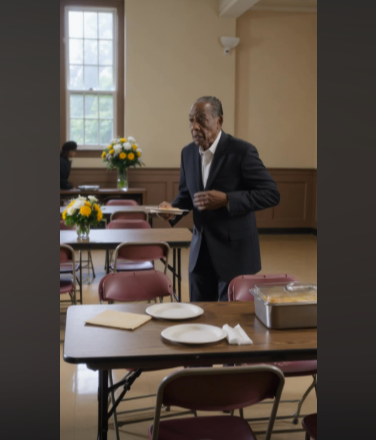
I stood alone in the fellowship hall of St. Jude’s Baptist Church with a paper plate of untouched food in my hand.
“What?”
“Listen carefully.”
Alistair Thorne was eighty years old and rarely raised his voice.
That afternoon, he did not need to.
“I found something Esther left in my office.”
A pause.
“Do not tell Terrence. Do not tell Tiffany. And please, Booker—do not confront anyone.”
My chest tightened.
“What did she leave?”
Another pause.
Then:
“Something that makes me question how your wife died.”
I looked toward the church exit.
My son had disappeared ten minutes earlier after demanding the key to Esther’s safe.
His wife had spent the funeral complaining about the food.
And suddenly, for the first time since the hospital called to say Esther’s heart had stopped, grief made room for something else.
Fear.
—
My name is Booker King.
I was seventy-two years old when my wife died.
Esther and I had been married forty-five years.
That number sounds impressive until you understand that most marriages are not lived in years.
They are lived in repetitions.
The coffee cup she always put on the left side of my plate.
The way she folded towels incorrectly according to me and correctly according to every other person on earth.
The small sound she made when reading something ridiculous.
The argument we had every winter about whether sixty-nine degrees was warm enough for a house.
Forty-five years is thousands of ordinary things repeated until they become another person’s shape inside your life.
Then one morning they stop.
And everyone tells you time will help.
Time is a cruel thing to discuss at a funeral.
—
Esther had suffered from a heart condition for several years.
Managed.
Stable.
Not harmless.
But controlled.
She took medication.
Saw her cardiologist.
Watched her diet when she remembered and ignored it when sweet-potato pie appeared.
The morning she died, I found her collapsed in our kitchen.
I called 911.
Paramedics came.
The hospital tried.
She was pronounced dead before noon.
Given her history and the circumstances, the initial conclusion was a sudden cardiac event.
I accepted that.
Why wouldn’t I?
I was her husband.
Not a detective.
—
Our son Terrence arrived at the funeral forty minutes late.
His wife Tiffany came with him.
They had been staying with us off and on for several months after what Terrence described as “temporary financial pressure.”
That phrase covered a great deal.
Failed business ideas.
Credit-card debt.
Sports betting he swore was recreational.
A leased car he could not comfortably afford.
Tiffany’s talent for treating shopping as emotional first aid.
Esther helped them repeatedly.
So did I.
Rent once.
Car payment twice.
Groceries more times than I could count.
Every rescue came with a promise.
“This is the last time, Dad.”
People say that sentence when they mean:
Until next time.
—
At the funeral, Terrence barely looked at his mother’s casket.
He checked his phone constantly.
Tiffany complained about the heat.
During the meal afterward, I heard her whisper:
“At least the medication expense is gone now.”
Terrence told her to be quiet.
That was all.
No defense of his mother.
No disgust.
Just:
“Be quiet.”
I felt something inside me harden.
Still, I said nothing.
Esther deserved one day that did not become a family spectacle.
—
When the last guests were leaving, Terrence approached me.
“Dad.”
I looked up.
“Where’s Mom’s safe key?”
Not:
How are you?
Not:
Do you need anything?
The key.
“What safe?”
He looked irritated.
“The one in your bedroom.”
“What do you need from it?”
“Insurance papers.”
“You can wait.”
His jaw tightened.
“Tiffany says there may be financial documents we need for probate.”
“Tiffany is not the executor of anything.”
“She’s trying to help.”
I stood.
My knees objected.
The rest of me did not.
“Your mother has been dead for less than a day.”
Terrence lowered his voice.
“We have bills.”
“So do I.”
“She had money.”
“So?”
His expression changed.
Not grief.
Panic.
That was the first moment I saw it clearly.
My son was afraid of something.
—
Then he said:
“You don’t understand what’s happening.”
“No.”
“I don’t.”
“If we don’t get things sorted out quickly, this gets ugly.”
“What gets ugly?”
He stared at me.
Then looked away.
Tiffany stepped closer.
“Booker, you’re overwhelmed. Nobody blames you.”
I disliked the way she said my name.
Like she was practicing for the day she would use it in front of a social worker.
“We can help manage things.”
“My things?”
“Family things.”
“There is no family asset meeting today.”
Terrence stepped toward me.
“Don’t make this difficult.”
There are sentences children should never say to parents at the funeral of the person who raised them.
That is one.
—
Then my phone rang.
Alistair Thorne.
And everything changed.
—
Esther had worked for Thorne for thirty-one years.
People called her his housekeeper.
That description was technically true and completely inadequate.
She started cleaning his home.
Over time, she became household manager.
Then personal assistant.
She handled staff schedules.
Travel.
Medical appointments.
Household vendors.
Records.
Eventually basic administrative work for several investment properties.
Esther was good with numbers.
Better than I was.
Better than she ever admitted.
Thorne trusted her.
She trusted him.
I never felt threatened by it.
He treated her with a respect many wealthy people never learn to show anyone who receives a paycheck from them.
—
I drove to his estate because he told me detectives were already on their way there.
That mattered.
There was no private revenge council.
No plan to lure my son into a confession.
No billionaire promising to “handle” the police.
Thorne had found something alarming.
He had called his attorney.
His attorney told him to call law enforcement.
That is how grown people respond when evidence may involve a death.
They preserve it.
They report it.
They get out of the way.
—
Thorne met me in his study.
He looked older than he had at the funeral.
Esther’s absence had reached him too.
Beside him sat a woman named Detective Marianne Ellis and a man I recognized only after he introduced himself.
David Vance.
Licensed private investigator.
I stared at him.
“What does a private investigator have to do with my wife?”
Vance looked at Thorne.
Thorne answered.
“Esther hired him.”
I sat down.
“What?”
“About two months before she died.”
I felt the room tilt.
“Why?”
Thorne reached toward his desk.
There was Esther’s black journal.
The one she called her prayer book even though half of it contained grocery lists.
Beside it was a sealed envelope.
“She left these in my office safe.”
I looked at Detective Ellis.
“Have you read them?”
“With Mr. Thorne’s permission and after confirming the circumstances.”
She leaned forward.
“Mr. King, I need you to understand something before we continue.”
I nodded.
“We do not know yet that your wife was murdered.”
The word hit me anyway.
“What we have are concerns that justify reopening questions about her death.”
That distinction probably saved me from doing something stupid.
Suspicion.
Not certainty.
Evidence first.
—
Esther’s last journal entries were shaky.
Not theatrical.
That made them worse.
**Terrence asked for money again.**
Another:
**There is another withdrawal I didn’t make.**
And later:
**I found him in the kitchen near my medication. He said he was looking for aspirin. I don’t believe him anymore.**
Then:
**I am afraid of my own child and ashamed to write that sentence.**
I stopped reading.
Forty-five years with a woman.
And she had been afraid inside our house without telling me.
That hurt differently than death.
“Why didn’t she tell me?”
Thorne answered softly.
“Because she thought you would confront him.”
I looked at him.
“She was right.”
“Yes.”
I hated him for saying it.
He was still right.
—
Vance explained why Esther had hired him.
Money had been disappearing.
Not millions.
Smaller amounts.
Enough to notice.
Several checks appeared to carry her signature.
Online transfers had been initiated from devices she did not recognize.
Terrence denied involvement.
Esther feared that confronting him directly would cause him to destroy records or pressure Booker.
So she asked Vance to document what he legally could.
Public records.
Business information.
Surveillance from public locations.
No hacking.
No secret bank access.
No breaking into phones.
He had photographed Terrence meeting repeatedly with people connected to his betting activity.
Documented late-night visits to the King house on occasions when Booker was working occasional shifts helping a former colleague.
And three nights before Esther died, Vance had seen Terrence arrive at the house after midnight.
That alone proved nothing.
But Esther’s door camera showed him entering.
The kitchen camera Esther had installed after becoming frightened showed him opening a cabinet where her medication was stored.
The angle did not clearly show what he did next.
Enough to be concerning.
Not enough to convict anyone.
—
Detective Ellis asked:
“Did your son have permission to access the house?”
“He was staying there.”
“So yes.”
“Yes.”
“Did he ever handle Esther’s medications?”
“Not that I know of.”
“Did she ever mention pills looking different?”
I thought.
Then remembered.
Three days before she died, Esther held one tablet in her palm.
She said:
“These look lighter.”
I told her pharmacies change manufacturers.
She said:
“Probably.”
Then took it.
The memory hit so hard I had to put both hands over my face.
I had been standing six feet away from something I did not understand.
—
Detective Ellis did not let me turn that into guilt.
“At the time, you had no reason to interpret that as a crime.”
“I should have.”
“You had no reason.”
“I was her husband.”
“That does not make you a toxicologist or a homicide detective.”
I looked at her.
The bluntness helped.
—
Then Thorne told me about the money.
Esther had accumulated far more than I knew.
Not because she secretly controlled a billionaire’s fortune.
Nothing ridiculous.
Thorne had paid her well.
Over three decades, her compensation increased substantially as her responsibilities grew.
She participated in an employee investment program connected to several of his private ventures.
She received bonuses.
Invested consistently.
Reinvested dividends.
Bought index funds.
Held onto property interests that appreciated.
Booker and Esther had always maintained some separate accounts in addition to household finances.
I knew she saved.
I did not know the total.
Approximately three million dollars.
I stared at Thorne.
“Three million?”
He nodded.
“She was very disciplined.”
I laughed once.
“My wife made me reuse aluminum foil.”
Thorne almost smiled.
“That may explain part of the three million.”
—
Then Detective Ellis asked the only question that mattered.
“Did Terrence know?”
I looked at the journal.
Apparently he did.
Not the exact number.
Enough.
Esther had written:
**Terrence found one statement. He thinks I am hiding money from him. I told him it is not his money. He said it will be someday.**
My stomach turned.
It will be someday.
The most dangerous inheritance is the one someone begins spending before you die.
—
Detective Ellis advised me not to return home that night.
Not because Thorne declared me “in grave danger.”
Because my son had threatened me at the church and there were unresolved concerns involving my wife’s death.
I stayed at a hotel under my own name with the location kept private.
Police arranged to photograph and secure relevant items from the house.
I handed them Esther’s medication containers when they requested them.
The medical examiner’s office was contacted.
Her case was reopened for review.
The process began.
Slowly.
Properly.
Painfully.
—
Terrence called nineteen times.
I answered once.
“Where are you?”
“Safe.”
“What does that mean?”
“It means I’m not coming home tonight.”
“Dad, this is crazy.”
“Maybe.”
“Tiffany says you threatened us.”
I almost laughed.
“When?”
“At the church.”
“I told you no.”
“You got aggressive.”
“I slapped your hand away when you reached toward my pocket.”
Silence.
Then:
“Where is Mom’s money?”
There it was again.
Not:
Are you okay?
Money.
“What money?”
“Don’t do this.”
“What money, Terrence?”
“You know what I mean.”
I said:
“No.”
Then hung up.
—
The police obtained legal authority to search certain financial and digital records.
Estate counsel froze nothing magically.
But suspicious transfers from Esther’s accounts were flagged.
Banks preserved records.
A forensic accountant began tracing activity.
The results took weeks.
Some withdrawals were Esther’s.
Some payments were ordinary.
Several were not.
Approximately fifty thousand dollars over two years had been moved through transactions bearing questionable authorizations.
Some funds eventually reached accounts controlled by Terrence.
That was fraud evidence.
Still not murder evidence.
One crime does not automatically prove another.
That was a lesson I would learn repeatedly.
—
The medical examiner reviewed Esther’s preserved hospital samples first.
Then, because questions remained and the prosecutor sought additional testing, the court authorized further forensic examination.
Her remains were eventually exhumed.
Nobody asked me to stand beside a backhoe while dramatic rain fell.
I chose not to be there.
That was one boundary I allowed myself.
I had already buried my wife once.
I did not need to witness the state disturb her grave to prove my love.
Thorne sat with me in his study that morning.
Neither of us spoke much.
At one point he said:
“She was proud of you.”
I looked at him.
“She complained about me constantly.”
“She complained about everyone she loved.”
That made me laugh.
Then cry.
—
The toxicology results came back nearly three weeks later.
Detective Ellis and an assistant district attorney met me in person.
They did not describe the chemistry in gruesome detail.
I did not need it.
The conclusion was enough.
Esther had a significant concentration of a medication she had not been prescribed.
In someone with her cardiac history, it could have caused a fatal rhythm disturbance.
The medical examiner amended the manner of death from natural to homicide.
Homicide.
One word.
A whole marriage on the other side of it.
—
Then came the stronger evidence.
Search warrants and digital records.
Texts between Terrence and Tiffany.
Not a perfect written confession.
Criminals are rarely that generous.
But there were messages about Esther “cutting them off.”
About needing “access before she changes everything.”
About one bottle needing to “look the same.”
A search recovered some of Esther’s actual prescribed medication from property linked to Terrence.
Financial records showed his debt was worse than I knew.
Sports betting.
High-interest loans.
Collections.
Credit cards.
He had been trying to keep a lifestyle alive with money he did not have.
He had reached the point where his mother’s savings stopped looking like hers.
They looked like rescue.
Entitlement becomes frightening when desperation joins it.
—
Tiffany cooperated first.
Not immediately.
Her lawyer negotiated.
She admitted helping with forged transactions.
She admitted knowing Terrence had interfered with Esther’s medication.
She insisted she did not understand at first that he intended to cause death.
Prosecutors did not simply accept her version because she offered it.
They compared it with messages.
Records.
Video.
Financial evidence.
Parts were corroborated.
Parts were not.
She eventually entered a plea to charges reflecting what prosecutors believed they could prove.
That did not make her innocent.
It made criminal law criminal law.
—
Terrence was arrested later.
Not at my house.
Not after pointing a shotgun at me.
Police waited until probable cause was sufficient.
They arrested him leaving his attorney’s office after an arranged meeting.
No tactical spectacle.
No cameras invited for my benefit.
I found out by phone.
Detective Ellis said:
“He’s in custody.”
I sat at the small hotel desk.
“Did he resist?”
“No.”
“Did he say anything?”
“He has counsel. We’re going to respect that.”
Good answer.
I hung up.
Then cried harder than I had since Esther’s funeral.
Because justice begins by confirming the thing you prayed was impossible.
—
The house became evidence for a period.
After law enforcement released it, I returned with my attorney and a friend.
Not alone.
Terrence and Tiffany had searched through drawers before the warrants.
Nothing like the destruction I had imagined in my angriest moments.
But enough.
Papers disturbed.
Safe opened.
Furniture moved.
Esther’s bedroom closet partially emptied.
I stood in the kitchen.
Same table.
Same medication cabinet.
I could not breathe properly.
My friend said:
“Booker?”
“I’m fine.”
“No.”
He shook his head.
“You’re not.”
For once, I allowed another man to be correct.
I left.
—
Esther’s estate took months to administer.
There was no theatrical reading of a secret will.
Her attorney met with me privately.
She had updated her estate documents several months before her death.
I was the principal beneficiary.
Terrence had previously been a contingent beneficiary of part of the estate.
Esther had removed that provision after discovering the suspected theft.
She left a smaller charitable gift and the remainder to me.
Her adult son was not automatically entitled to a percentage simply because he was her son.
The exact legal consequences of his alleged conduct were left to counsel and the court.
No magical one-dollar clause.
No offshore fortune outside the law.
Just properly titled investments, estate documents, beneficiary designations, and probate where required.
Ordinary legal structures.
Extraordinary family circumstances.
—
Her attorney also gave me a letter.
Handwritten.
Esther’s handwriting.
I held it for several minutes before opening it.
**My dearest Booker,**
**If you are reading this, I am gone, and I am sorry for the things I did not tell you.**
I stopped there.
Started again.
She wrote about Terrence.
The gambling.
The money.
Her fear.
Her shame.
She said she had kept it from me because she knew I would confront him.
She apologized for making that decision for me.
That line mattered.
Even Esther, trying to protect me, had taken away my choice.
Love does that sometimes.
It convinces us secrecy is kindness.
It usually isn’t.
—
Then:
**I do not know what Terrence is capable of. I only know I no longer recognize what fear and money have made of him.**
And later:
**If something happens to me, do not become the thing anger will ask you to become.**
I read that sentence three times.
**You spent your life protecting people. Protect yourself too. Let the law do what the law is supposed to do.**
I put the letter down.
Covered my face.
And understood, finally, why she had gone to Thorne.
Why she had hired Vance.
Why she had documented instead of confronting.
She had been afraid.
Not weak.
Afraid.
Those are different.
—
Terrence’s case lasted more than a year.
There were motions.
Experts.
Arguments about toxicology.
Arguments about digital evidence.
Challenges to searches.
Negotiations.
I attended only what I needed to attend.
At first I wanted every detail.
Then I realized obsession was another way of letting my son control my life.
The state did not need my rage.
It needed truthful testimony.
So when called, I testified.
I described Esther’s health.
Her routines.
The medication conversation.
Terrence’s financial demands.
The argument after the funeral.
Then I went home.
—
Eventually, Terrence entered a guilty plea after significant pretrial litigation.
Not because one secret recording destroyed him.
Because the evidence accumulated.
Financial motive.
Fraud.
Digital communications.
Surveillance footage.
Forensic results.
Physical evidence.
Tiffany’s corroborated cooperation.
The prosecution agreed to reduce some charges in exchange for his plea.
His sentence was long.
I will not pretend I felt satisfied when the judge pronounced it.
I felt old.
That was all.
My wife was dead.
My son would spend much of his remaining life inside institutions.
Nobody won.
Consequences are not the same thing as victory.
—
I visited Terrence once.
Almost two years later.
He requested it.
I ignored the first letter.
Then the second.
The third said:
**I don’t need money. I just want to see you once.**
That was why I went.
We sat across thick glass.
He looked smaller.
Gray beginning at his temples.
No expensive watch.
No suit.
Just my son.
And not my son.
Both at once.
“Dad.”
I picked up the receiver.
“Terrence.”
He began crying immediately.
I did not.
“I’m sorry.”
I waited.
“I know that doesn’t mean anything.”
“It means something.”
He looked up hopefully.
“It doesn’t undo anything.”
Hope disappeared.
“I know.”
That was better than arguing.
—
He said:
“I kept thinking Mom had enough.”
I closed my eyes.
“Enough for what?”
“To save me.”
“From your debts?”
He nodded.
“I thought she was choosing money over me.”
“No.”
I leaned closer.
“She was refusing to let her money continue financing what was destroying you.”
He cried harder.
“I know that now.”
“Do you?”
“I think so.”
Silence.
Then:
“I hated her for saying no.”
I looked at him.
“And now?”
“I hate myself for what I did after she said it.”
There are sentences fathers want to hear.
There are others they pray never become necessary.
That was both.
—
“Do you love me?” he asked.
I nearly put down the phone.
Instead:
“Yes.”
His face broke.
“But I will not rescue you.”
He nodded.
“I know.”
“I will not pay lawyers to invent excuses.”
Another nod.
“I will not turn what you did into something Esther caused.”
“I know.”
“You are my son.”
His shoulders shook.
“And you killed your mother.”
He closed his eyes.
Both truths remained.
That was the punishment neither prison nor money could simplify.
—
I did not bring him a one-dollar bill.
I did not tell him his mother thought he was worth a dollar.
Esther would have hated that kind of performance.
She had removed him from most of her estate because she no longer trusted him with it.
Not because she wanted one last joke.
Her final letter contained no cruelty.
Only fear.
Love.
Grief.
And one sentence:
**I hope our boy remembers who he was before he began believing the world owed him something.**
I told Terrence that.
He cried silently for almost a minute.
Then the guard told us time was up.
I stood.
Terrence pressed his hand against the glass.
I did not mirror it.
Not yet.
Maybe never.
I walked out.
—
The money sat untouched for almost a year.
I had my pension.
Savings.
The house.
More than enough.
Esther’s portfolio felt contaminated at first.
Three million dollars.
The number Terrence had seen as salvation.
The number I began to see as motive.
My financial adviser corrected me gently.
“Booker, the money did not kill Esther.”
I looked at him.
“No.”
“Your son made choices.”
I hated that sentence.
Because it was true.
Money does not commit murder.
People decide what money permits them to justify.
—
I did not give everything away overnight.
That would have been grief pretending to be generosity.
Instead, I built a plan.
Kept enough for my long-term care and retirement.
Created updated estate documents.
Set aside an emergency reserve.
Then worked with an existing elder-law nonprofit to establish a fund in Esther’s name.
Not a grand private foundation with me playing hero.
A restricted fund administered by professionals who already knew the work.
Legal assistance for older adults experiencing financial exploitation.
Emergency relocation support.
Independent financial reviews.
Help obtaining protective orders or replacing compromised powers of attorney.
Real needs.
Real professionals.
I attended the first advisory meeting.
Said almost nothing.
That felt right.
—
Someone asked why I did it.
I said:
“Because Esther was afraid in her own home.”
That was enough explanation.
—
I waited before selling our house.
Every instinct told me to get rid of it.
My lawyer told me:
“Do not make a permanent decision simply because the walls are painful today.”
So I waited.
Six months.
Then nine.
I repaired what needed repairing.
Packed Esther’s clothes slowly.
Gave some to family.
Donated some.
Kept one yellow cardigan she wore every Sunday in winter.
Eventually, I sold the house to a young couple with two children.
Not at a discount.
Not because I needed to erase it.
Because I was ready.
Before closing, the new owner asked:
“Were you happy here?”
I looked at the kitchen.
The hallway.
The porch.
“Yes.”
He seemed surprised.
I continued.
“For a very long time.”
That was still true.
Terrence’s crime did not get to rewrite thirty years of Sunday dinners.
—
Thorne died three years after Esther.
We became friends during that time.
Not brothers in some revenge war.
Two widowed old men who missed the same stubborn woman for different reasons.
We ate breakfast twice a month.
Argued about baseball.
He showed me investments Esther had once questioned.
“She told me this one was stupid.”
“Was it?”
“Yes.”
I laughed.
That sounded like her.
Before Thorne died, he told me:
“Esther made everyone around her more careful.”
I said:
“She made me reuse freezer bags.”
“That too.”
—
A year after the criminal case ended, I went to Paris.
Esther had wanted to go for decades.
She kept magazine photographs of the Eiffel Tower inside a kitchen drawer.
Every few years we talked about it.
Every few years something happened.
Tuition.
House repair.
Terrence needing help.
Work.
Health.
Later became later.
Then later became never.
So I went.
Not on a private yacht.
Not dressed like a billionaire.
I flew economy plus because my knees are seventy-three years old and dignity has limits.
I stayed in a good hotel.
Walked too much.
Complained about coffee being too small.
Loved every minute.
—
One evening I stood beside the Seine with Esther’s photograph in my coat pocket.
Not her ashes.
I had buried them where we had agreed years before.
Paris did not need to become another funeral.
It needed to become what she had wanted it to be.
A place we finally saw.
I watched boats move under the bridge.
Couples walking.
Traffic.
The city continuing exactly as cities do, indifferent to individual grief.
I took out the photograph.
Esther was forty-eight in it.
Laughing at something outside the frame.
I said:
“You would have complained about all these stairs.”
A man nearby looked at me.
I smiled.
“My wife.”
He nodded as though that explained everything.
Maybe it did.
—
I did not feel her magically in the wind.
I did not receive closure.
Closure is another word people use when they want grief to behave.
I simply stood there.
And missed her.
But missing her no longer felt like drowning.
That was enough.
—
I sometimes think about the call Thorne made after the funeral.
**Do not tell your son.**
At the time, I thought that was the worst sentence a father could hear.
It wasn’t.
The worst was learning why.
For months afterward, I asked myself the wrong question.
How did I fail to see what Terrence had become?
Eventually, a therapist helped me replace it.
When did Terrence stop being responsible for what Terrence chose?
The answer was never.
Parents influence children.
We shape them.
Hurt them.
Help them.
Fail them.
Love them.
But adult children eventually become authors of choices their parents did not write.
That does not remove grief.
It removes false guilt.
—
I still love my son.
People dislike that answer.
They prefer clean morality.
If Terrence murdered Esther, how can I love him?
Because I loved him before he knew his own name.
Because love is not a verdict.
I also believe he belongs exactly where the law put him.
Both statements fit inside the same chest.
Mine.
—
I do not visit often.
Once a year, sometimes less.
He attends addiction and gambling treatment.
Takes classes.
Writes letters.
Some sound remorseful.
Some still contain excuses.
When they do, I stop reading.
My boundary is simple.
I will listen to responsibility.
I will not participate in revision.
That is the relationship available to him now.
He may accept it.
Or not.
—
Esther’s fund has helped people.
I know numbers because the nonprofit sends reports.
But I stopped counting them as victories.
People are not trophies.
A woman moved safely out of a house controlled by her nephew.
A widower recovered access to a bank account after a fraudulent power of attorney was challenged.
A retired teacher received legal help before signing away her home.
Those are not slaps in Terrence’s face.
They have nothing to do with him.
That matters to me.
If every good thing I do remains organized around punishing my son, then he still controls too much of my life.
The fund is for Esther.
And for people who need it.
That is enough.
—
I am seventy-five now.
Still drive an old Ford.
Different one.
The original finally surrendered after more than three hundred thousand miles.
I kept the steering-wheel cover.
Don’t ask why.
Old men become sentimental about machinery.
I live in a small townhouse.
Good neighbors.
One guest room.
No hidden safe.
I cook badly.
Attend church.
Sometimes fall asleep watching television before nine.
Esther would consider that evidence I am finally becoming civilized.
—
On my desk sits her black journal.
Not the investigation pages.
Those are preserved elsewhere.
I keep it open to something she wrote years before any of this happened.
It has nothing to do with Terrence.
Nothing to do with money.
Just:
**Booker forgot our anniversary flowers but remembered to put gas in my car. This is marriage.**
I laugh every time.
That is the Esther I want most.
Not the frightened woman documenting her son.
Not the victim in a criminal case.
My wife.
Sharp.
Funny.
Annoyingly accurate.
Alive in ordinary sentences.
—
The day of her funeral, I believed my life had divided into two parts.
Before Esther.
After Esther.
I was wrong.
Grief creates many divisions.
Before I knew.
After I knew.
Before my son’s arrest.
After.
Before I understood love could remain without access.
After.
The line keeps moving.
Maybe that is what survival actually is.
Not becoming someone new overnight.
Just continuing far enough that yesterday stops being the only point on the map.
—
Thorne once told me Esther had been the most trustworthy person he ever employed.
I corrected him.
“She wasn’t trustworthy because she worked for you.”
He looked at me.
“She was trustworthy because that’s who she decided to be.”
The same is true in reverse.
Blood did not make Terrence loyal.
Need did not make him entitled.
Fear did not make him innocent.
And loving him did not require me to lie about any of that.
—
I buried my wife believing her heart had simply stopped.
Months later, I learned someone had helped it stop.
For a while, rage convinced me justice meant making my son suffer as much as I did.
I know better now.
Justice was evidence being tested.
Defense lawyers challenging it.
Prosecutors proving what they could prove.
A judge imposing consequences.
Esther’s name staying hers.
My son being held responsible without me becoming his executioner.
That was harder than revenge.
It also left more of me alive.
—
When I finally left Paris, I stood at the airport with Esther’s photograph tucked inside my passport.
I almost said goodbye.
Then laughed at myself.
Forty-five years of marriage does not end because a plane boards.
So instead I whispered:
“Come on, girl.”
Then walked toward the gate.
Not free from grief.
Not free from history.
Just free from the belief that love requires me to follow either of them into the grave.
