My wife had never told anyone in the family that she spoke fluent French. O
The Language Behind the Door
My wife never let anyone know she spoke fluent French, but one evening, she overheard a private conversation behind closed doors—and what she understood changed the way she saw everything…
I know how strange that sounds coming from her husband.
A man should know what languages his own wife speaks.
A man should know where she studied, what books she loves, what makes her go quiet at a dinner table, and why she sometimes pauses before answering a question she understood perfectly the first time.
I should have known all of those things.
The truth is that Stella never exactly lied to me.
I simply stopped asking questions.
That distinction took me years to understand.
My name is Grant Ashford. At the time, I was thirty-nine years old and worked for Ashford Wine Group, the import company my grandfather started after opening a tiny storefront in Manhattan in the early 1970s. By the time my father retired, the company represented vineyards in France, Italy, Spain, and California, with distribution agreements in more than a dozen markets.
My mother, Vivian, treated the company less like a business than a hereditary title.
She was seventy-one and still arrived at the office before half the executives who actually worked there.
She wore pearls on weekday mornings.
She knew which Bordeaux families had married into which Burgundian families.
She could remember the year of a vintage after tasting a single glass.
And she spoke French beautifully.
In our family, that mattered.
French was the language my mother used when she wanted a conversation to feel private even if the room was full.
My sister Colette spoke it.
I spoke it.
Most of our oldest business partners spoke it.
And from the first month Stella entered our lives, everyone assumed she did not.
Stella and I met at a museum fundraiser in Midtown.
She was thirty-one then, standing beside a table of auction catalogs in a dark green dress, talking to an older woman about a painting neither of them intended to buy.
I noticed her because she was listening.
That may sound like a small thing.
It wasn’t.
Most people at those events waited for their turn to speak.
Stella actually listened.
When the older woman finished, Stella asked a question that made her smile.
Then Stella turned and caught me staring.
“You’re either interested in the painting,” she said, “or you’ve forgotten how not to stare.”
I laughed.
“The second one.”
“Good. The painting is overpriced.”
That was Stella.
Direct without being loud.
Warm without performing warmth.
I knew she had grown up in New Orleans with her grandmother. I knew she had studied literature at Howard University. I knew she had spent time in Europe after graduation.
What I did not know was that her grandmother had spoken French and Louisiana Creole at home from the time Stella was small.
I did not know Stella had completed advanced work in French literature.
I did not know she had spent nearly two years in Lyon after college.
I did not know she spoke Italian well and Spanish comfortably.
None of that was hidden in some elaborate way.
I simply heard “literature degree,” “New Orleans,” and “a couple of years abroad,” and filled in the rest myself.
People do that constantly.
The dangerous part is how rarely we notice.
Three months after we started dating, I brought Stella to Sunday brunch at my mother’s townhouse.
That was when the secret began.
I learned the full story much later.
Vivian served fourteen people that morning.
There were white linen napkins, silver coffee pots, baskets of croissants, fresh flowers, and enough china on the table to make breakfast feel like a diplomatic event.
Stella sat beside me.
My mother watched her pour coffee.
Then Vivian turned toward Colette and spoke in French.
“She is prettier in natural light than in photographs.”
Colette smiled.
“That sounds almost like approval.”
“It isn’t.”
I heard them.
So did Stella.
I know that now.
At the time, Stella kept spreading orange marmalade across her toast.
Vivian continued.
“At least she has manners.”
Colette glanced at Stella.
“Does she understand anything?”
“Not a word.”
My mother said it with absolute confidence.
Stella looked at me.
I should have objected.
Instead, I gave her a small smile and reached for the coffee.
I told myself my mother was being my mother.
That sentence excused too much in our family.
Later, in the cab home, Stella asked, “Does your mother always speak French when she doesn’t want someone included?”
I remember laughing.
“Pretty much.”
“And that doesn’t bother you?”
“She does it to everyone.”
Stella looked out the window.
That should have been the moment I asked what she understood.
Instead I said, “Don’t take her personally.”
I can still see Stella’s reflection in the glass.
Calm face.
Dark eyes.
City lights moving across them.
“All right,” she said.
Years later, she told me that was the exact moment she decided not to reveal that she understood every word.
Not because she was planning revenge.
Not because she enjoyed secretly listening.
Because she wanted to know whether the people around me behaved differently when they believed she could not understand them.
More importantly, she wanted to know whether I did.
We married the following year.
Our daughter, Lily, came eighteen months later.
For the first three years of our marriage, Stella lived inside two versions of the same family.
There was the English-speaking version.
That family called her beautiful.
Poised.
Refreshing.
Grounding.
My mother liked telling people Stella brought “warmth” to our formal family.
At charity events, Vivian would place a hand on Stella’s arm and introduce her with polished affection.
“This is my wonderful daughter-in-law.”
Then there was the French-speaking version.
That family called her naïve.
Unsophisticated.
Convenient.
My mother once described Stella’s silence at business dinners as “useful.”
Another time she told Colette that Stella had “the good sense not to pretend she understood worlds above her experience.”
I was present for some of those comments.
Not all.
Enough.
I rarely joined in.
For years I told myself that mattered.
It didn’t matter nearly as much as I wanted it to.
Silence can be participation when the person beside you is the one paying for it.
Stella endured Sunday lunches with a composure I mistook for indifference.
My mother might comment in French that Stella’s dress was too simple.
Stella would pass the bread.
Colette might wonder aloud how long it took Stella to learn which fork belonged to which course.
Stella would ask whether anyone wanted more coffee.
My mother once said, “You can teach presentation. You cannot teach background.”
Stella looked directly at her and said in English, “Dinner is lovely tonight, Vivian.”
My mother did not even realize she had been answered.
The fact that Stella could sit through those meals without revealing herself became, in my mind, evidence that she was comfortable.
It was actually evidence of extraordinary control.
There were signs.
I just did not look closely enough.
A French novel appeared on Stella’s nightstand one afternoon.
I picked it up.
The pages were full of notes in the margins.
I did not study the handwriting.
I barely looked.
“Trying to learn French?” I asked.
She glanced at the book.
“A little.”
I grinned.
“Starting with Balzac seems ambitious.”
“I like a challenge.”
“You should try one of those language apps first.”
She smiled.
“Maybe.”
I put the book down.
If I had spent ten more seconds with it, I would have seen that the notes were written in fluent French.
But people rarely inspect evidence that contradicts an assumption they enjoy.
I enjoyed thinking I was the sophisticated one in our marriage.
That is not easy to admit.
It is true.
Stella’s real life came out when she was alone.
She called her grandmother, Claudette, every Tuesday afternoon.
They spoke for nearly an hour, sometimes in English, often in French.
Claudette was eighty-four by then and still lived in the same shotgun house outside New Orleans where Stella had spent much of her childhood.
She had books stacked beside every chair.
Stella told me that much.
She never told me about the language.
When Lily began talking, Stella taught her little French phrases privately.
Nothing complicated.
Good morning.
Thank you.
Little bird.
My love.
She sang to Lily in French when she thought the house was empty.
She kept French poetry in a drawer beneath sweaters.
She also kept a small leather journal.
I learned about that journal much later.
Every time my mother or sister made a comment in French, Stella wrote it down afterward.
Not every sarcastic remark.
Not every minor slight.
Only the ones that revealed something important.
Dates.
Places.
Who was present.
Exact wording when she could remember it.
At the time, she did not know why she was keeping the record.
She told herself she needed proof that she was not imagining the pattern.
That matters too.
When people are dismissed often enough, they can begin editing their own memory on behalf of those who hurt them.
Stella refused to do that.
The first person in my family’s world to realize the truth was Philippe Renault.
Philippe owned a vineyard outside Bordeaux that had worked with Ashford Wine Group since before I graduated college.
He was sixty-three, quiet, precise, and almost impossible to impress.
He came to New York for a private dinner in Midtown.
My mother attended.
So did I.
Stella came because Vivian believed spouses softened business dinners.
That sentence alone should tell you something about how we thought then.
The restaurant gave us a private room.
Six seats.
Soft lighting.
No prices on the menu.
Philippe sat across from Stella.
Vivian spoke mostly French.
At one point, she turned toward Philippe and said, “You needn’t worry about including Stella in the technical discussion. She doesn’t follow it.”
Philippe’s eyes moved briefly toward my wife.
Stella was buttering bread.
My mother continued.
“She is much happier when we keep things simple.”
I gave a small laugh.
I wish I could take that laugh back.
Philippe did not laugh.
Later, he asked Stella in English whether she liked wine.
I remember her answer.
“I like the red ones.”
My mother smiled.
I smiled.
Philippe watched Stella for another second.
Something in his expression changed.
I did not understand why.
Six weeks later, Philippe came to our home for dinner.
Afterward, Stella excused herself to put Lily to bed.
Philippe left the sitting room a few minutes later.
He said he was looking for the restroom.
Instead, he passed Lily’s nursery and heard Stella singing.
The lullaby was French.
Old.
Her grandmother’s.
Philippe stood in the hallway until she finished.
Then he knocked softly on the open door.
Stella turned.
Philippe asked, in English, “How long have you spoken French?”
Stella went still.
She could have lied.
She didn’t.
“Since before I could read.”
Philippe stared at her.
Then, very quietly, he said in French, “So you have understood us.”
Stella answered him in the same language.
“Every word.”
Philippe later told me he felt ashamed even though he had never personally mocked her.
That is the difference between decent people and the rest of us.
Decent people do not require personal guilt to recognize another person’s humiliation.
Philippe asked why she had kept it hidden.
Stella looked down at Lily.
“My grandmother taught me that people reveal themselves when they believe you cannot understand them.”
Philippe nodded.
Then he said, “You should know something else.”
“What?”
“You are not nearly as invisible as they think.”
That evening, Philippe returned to the sitting room.
He said nothing.
But after that, whenever he visited, he treated Stella differently.
Not dramatically.
He asked her opinion.
He waited for her answer.
He included her in eye contact.
My mother noticed.
“What has gotten into Philippe?” she asked me once.
“I don’t know.”
Stella knew.
For the first time in three years, somebody inside our business world had looked at her and seen more than what my family had decided she was.
That small recognition gave her something she had been losing.
Perspective.
Then came the business call that should have exposed everything.
Ashford Wine Group had spent more than a year negotiating a distribution agreement with a company based in Abidjan.
The agreement involved several French-speaking executives and a complicated revenue-sharing structure.
Our translator called in sick the morning of the final video conference.
I panicked.
My mother called three agencies.
Nobody could send someone quickly enough.
The meeting started anyway.
I understood conversational French well.
Business French under pressure was different.
The other side’s chief executive began discussing a clause I thought I understood.
He became increasingly irritated.
I kept nodding.
That was a mistake.
He believed one version of the translated draft gave Ashford fifty percent of a certain distribution margin.
The actual agreement said fifteen.
One misplaced digit in an English translation had turned a normal clause into something that looked unreasonable.
I did not catch it.
Stella did.
She was in the kitchen with Lily.
The office door was open.
She heard the entire conversation.
A few minutes into the argument, a piece of paper slid beneath the office door.
I picked it up.
It said:
Page 14. Section 4.2. Original French says 15%, not 50%. Translation error. Ask him to compare drafts.
I stared at the note.
Then at the closed door.
My mother whispered, “What is it?”
I read the note aloud.
“Who wrote that?”
“Stella.”
Vivian frowned.
“How would she know?”
I did not answer.
I asked the executive to compare the French draft.
There was a pause.
Pages turned.
Then his expression changed.
He laughed.
The tension disappeared.
The deal survived.
After the call, I found Stella cutting strawberries for Lily.
“How did you know?”
She did not look up.
“I saw the draft on your desk last week.”
“You read it?”
“A little.”
“In French?”
“I looked up some of it.”
That answer should not have satisfied me.
It did.
I kissed her forehead.
“My wife, the detective.”
She smiled.
I walked away.
That night, I told my mother what had happened.
In French.
Stella was folding laundry in the adjoining room.
Vivian said, “A lucky guess.”
I agreed.
Stella folded another towel.
She wrote both sentences in the journal before bed.
For a long time, the disrespect came slowly enough that no single moment forced her to leave.
That is how bad arrangements often survive.
Not through one enormous event.
Through repetition.
A joke at brunch.
A look at dinner.
A conversation switched into another language.
A contract slid across a desk with the assumption that Stella would sign where indicated.
A decision about Lily made before anyone asked Stella.
A family photograph scheduled around Vivian’s preferences.
A charity event where Stella was told what color to wear because it photographed well beside the foundation banner.
Each thing was small enough to excuse.
Together, they became a life.
My mother’s birthday finally pushed Stella close to the edge.
Vivian hosted sixty people in a private ballroom.
During her toast, she switched into French.
She thanked business partners.
Praised family.
Praised me.
Then she looked at Stella.
“And my daughter-in-law, who reminds us that people can learn to adapt beautifully when given the right environment.”
A few guests laughed politely.
Vivian continued.
“We opened our family to someone from a very different background, and she has grown tremendously.”
More polite applause.
Stella clapped too.
I remember watching her.
Perfect posture.
Small smile.
No visible reaction.
That night, she locked herself in our bathroom and cried.
I know because she told me later.
I was downstairs drinking with guests.
She called Claudette.
Her grandmother listened.
Stella said, “I don’t know how much longer I can do this.”
Claudette replied, “Then stop asking yourself how long you can endure it. Ask what you are waiting to learn.”
Stella wrote that sentence in the journal.
It changed her.
Soon afterward, something happened in Lily’s nursery.
Stella was singing the same French lullaby Philippe had heard.
My mother had stopped by unexpectedly to pick up a scarf.
She heard Stella singing.
Vivian stood in the hallway.
I happened to arrive home a few minutes later.
My mother spoke to me in French.
“She is teaching Lily that?”
“It’s just a song.”
“It sounds provincial.”
“Mother.”
“I don’t want Lily confused. English is enough at this age.”
Stella was still in the nursery.
We assumed she could not understand us.
Then I went inside.
“Maybe sing in English around Mom,” I said gently.
Stella looked at me.
There are expressions a man remembers because he understands them only years later.
That was one.
No anger.
No tears.
Just recognition.
“Of course,” she said.
She laid Lily in the crib.
She smoothed the blanket.
Then she walked past me.
That night, she searched for a family-law attorney.
Her name was Eleanor Hayes.
Stella did not file anything.
Not yet.
She simply scheduled a consultation.
She wanted to understand what she had signed when we married.
She wanted to know what was hers.
What was joint.
What arrangements existed around Lily.
What the prenup actually said.
That consultation became important three weeks later.
It was a Wednesday evening.
The house was unusually quiet.
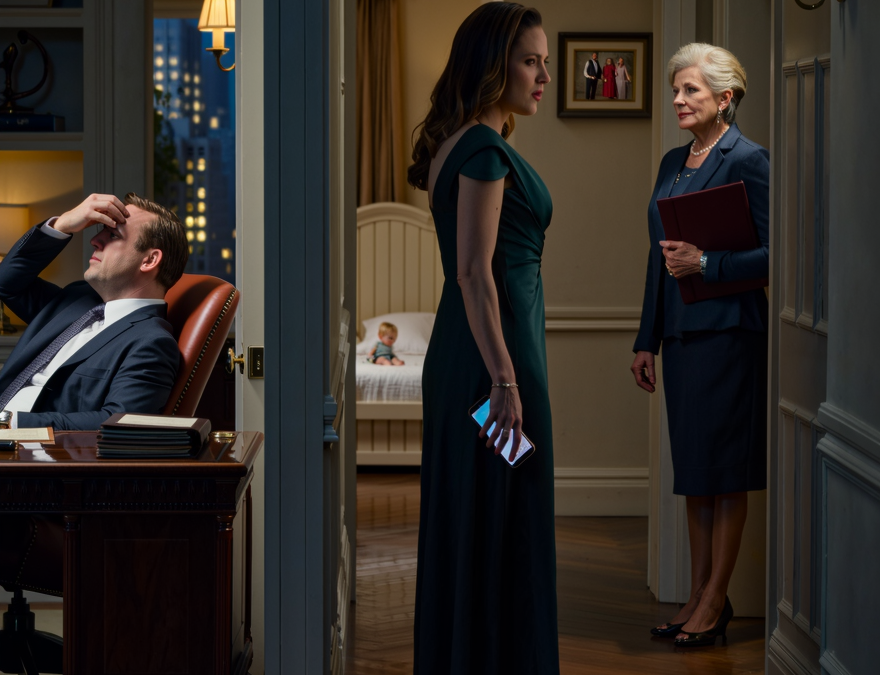
Stella was walking toward Lily’s room when she heard my mother’s voice coming from my office.
The door was closed almost entirely.
Almost.
A narrow gap remained.
Light fell across the hallway carpet.
Stella stopped.
Inside, Vivian and I were speaking French.
I remember that conversation better than almost anything else from that year.
My mother had brought a draft prepared by our family’s financial adviser.
The Abidjan distribution agreement was scheduled to close the following month.
It was worth a great deal to the company.
Vivian wanted all personal uncertainties settled immediately afterward.
By “personal uncertainty,” she meant my marriage.
My mother had disliked Stella from the beginning.
I wish I could tell you I defended my wife.
I did not.
At the time, Stella and I had been distant for months.
Instead of asking why, I had convinced myself distance was the problem rather than the symptom.
Vivian said, “Once the contract closes, you need to move forward.”
“I know.”
“No hesitation this time.”
“I said I know.”
“The proposed separation agreement is ready.”
I stared at the folder on my desk.
My mother continued.
“She will sign.”
“You don’t know that.”
“Grant, she signs anything you put in front of her.”
There was a pause.
I remember looking at the door.
Not because I knew Stella was there.
Because some small part of me already hated the conversation.
Vivian leaned closer.
“The company stays protected. Your trust stays protected. The townhouse stays outside the marital division under the original agreement. She receives what the prenup provides.”
“And Lily?”
“You ask for the primary residence schedule.”
I rubbed my forehead.
“She’s Lily’s mother.”
“And you are Lily’s father.”
“That isn’t what I mean.”
My mother sighed.
“Stella has no independent career right now. No meaningful income. Her professional network is minimal. You have stability.”
Behind the door, Stella stood completely still.
I know because she later described the moment to me.
She had her phone in one hand.
She did not record immediately.
She simply listened.
Then Vivian said something that changed everything.
“We brought her into this family because she was good for you and good for the image of the company. She served that purpose.”
I said nothing.
That silence became one of the hardest things I have ever had to live with.
My mother continued.
“She photographs beautifully beside you. She softened you. She softened the company. But that does not mean she belongs in every part of your future.”
I should have stopped her.
Instead I said, “The board did like the family image.”
Stella closed her eyes.
Then Vivian said, “Exactly. And now the expansion is finished. You don’t need the presentation anymore.”
That was when Stella touched the record button on her phone.
Not because she was plotting.
Because she suddenly understood that memory would not be enough.
I spoke next.
“She won’t fight the financial structure. She hates conflict.”
My mother smiled.
“That is the useful thing about quiet people.”
Stella recorded the rest.
We discussed the separation draft.
The timing.
The prenup.
Company interests.
Nothing dramatic in tone.
That was perhaps the ugliest part.
I discussed the end of my marriage like a calendar problem.
When the conversation ended, my mother and I moved on to discussing inventory forecasts.
Stella remained in the hallway long enough to hear that too.
Then she walked to our bedroom.
She closed the door.
She sat on the edge of the bed.
And she called Eleanor Hayes.
“I need another appointment.”
“What changed?”
“I heard my husband and his mother discussing a separation plan.”
Eleanor was quiet.
“Do you have documentation?”
“I have a recording of part of the conversation. I also have my prenup, old emails, and three years of notes.”
“Bring everything.”
Stella looked at the leather journal on the nightstand.
For three years, Vivian had thought my wife’s silence meant emptiness.
I had thought it meant agreement.
Neither of us understood that Stella had been building a record simply by paying attention.
The next morning she behaved normally.
That fact still amazes me.
She made Lily oatmeal.
Asked whether I wanted coffee.
Reminded me that the dry cleaning was ready.
I kissed her cheek before work.
She looked straight into my eyes.
“Big day?”
“Board meeting.”
“Good luck.”
“Thanks.”
I left.
By noon, Stella was sitting in Eleanor Hayes’s office with a red folder on the table.
Inside were the prenup.
Joint account statements.
Correspondence that had been sent directly to her.
The journal.
A copy of the voice recording.
Several company event agreements showing she had performed unpaid public-facing work on behalf of the foundation.
Nothing stolen.
Nothing accessed through passwords.
Nothing she did not already lawfully possess.
Eleanor went through it slowly.
“This is not about destroying anyone,” Stella said.
“What is it about?”
“My daughter.”
Eleanor nodded.
“And after your daughter?”
“My dignity.”
“That is a good order.”
They worked quietly for the next three weeks.
Stella opened an account in her own name using money that was already hers.
She moved personal documents to a secure location.
She updated emergency contacts.
She arranged temporary housing.
She spoke to Lily’s pediatrician about records.
She did not empty joint accounts.
She did not create scenes.
She did not post anything online.
She did not confront me.
She simply prepared to stop being dependent on people who had mistaken dependence for inability.
Then Philippe called.
He had heard through business contacts that Ashford was preparing its annual foundation gala.
Three hundred guests.
International partners.
Major distributors.
Board members.
My mother planned to make the gala a celebration of the company’s global expansion.
Philippe asked Stella one question.
“Will you be there?”
“Yes.”
“Are you ready?”
Stella looked at the red folder on her desk.
“Yes.”
The gala took place in a Midtown ballroom three weeks later.
My mother wore white.
I wore navy.
Stella wore red.
That alone surprised Vivian.
My mother had suggested silver.
Something “quiet.”
Stella smiled when she heard that.
“I already bought the red.”
When she entered the ballroom, people noticed.
Not because the dress was dramatic.
Because Stella had stopped trying to disappear.
There is a difference.
Philippe crossed the room and greeted her first.
“Madame Foster.”
“Philippe.”
He spoke in English.
She answered in English.
But the look between them told me there was a conversation I did not understand.
For the first time, I was the one outside the language.
The evening proceeded normally.
Dinner.
Toasts.
Photographs.
The foundation presentation.
Then my mother walked to the podium.
She spoke first in English.
Then, as always, she switched to French when addressing international guests.
She talked about legacy.
Culture.
Family.
The company’s ability to bridge worlds.
Then she looked toward Stella.
I felt something tighten in my chest before Vivian even spoke.
“And our Stella,” she said in French, smiling toward the crowd, “who has become quite polished after several years with us.”
A few people smiled.
My mother continued.
“She proves that with enough patience, almost anyone can learn the customs of a new world.”
Philippe did not smile.
I looked at Stella.
She was standing.
At first I thought she was leaving.
Instead she walked toward the stage.
Vivian’s expression froze.
Stella reached the podium.
“May I?”
My mother looked toward me.
I did not know what to do.
Stella took the microphone.
Then she spoke in French.
Perfectly.
Not hesitant.
Not rehearsed syllables.
Fluent French.
Warm, precise, effortless.
“Thank you, Vivian. That was a generous introduction.”
The room went silent.
My mother’s face changed so quickly I almost did not recognize her.
Stella continued.
“I should probably clarify one thing before the evening goes any further.”
She looked at me.
Then at Vivian.
“I have spoken French since childhood.”
Someone near the front set down a wine glass.
The small click against the table carried farther than it should have.
“I studied French literature at Howard. I lived in Lyon. My grandmother raised me partly in French. And for three years, I have understood every French conversation held in my presence.”
Vivian’s lips parted.
No sound came out.
Stella did not raise her voice.
That made it stronger.
“I understood the comments about my clothes.”
She paused.
“My education.”
Another pause.
“My background.”
She looked toward Colette.
“The jokes at Sunday brunch.”
Then at me.
“The conversations where people assumed my silence meant I had nothing to contribute.”
My face felt hot.
Stella turned back toward the audience.
“I stayed quiet because I wanted to know whether people spoke differently when they believed the person beside them could not understand.”
She smiled sadly.
“They did.”
Nobody moved.
Then Stella surprised everyone again.
She switched to Italian and greeted one of our partner families from Piedmont.
A short sentence.
Natural.
Elegant.
Then Spanish to a distributor from Madrid.
The room shifted.
Not into applause.
Into attention.
The kind Stella had been denied for three years.
She returned to English.
“I do not say any of this because speaking several languages makes someone more valuable. It doesn’t.”
She looked at Vivian.
“I say it because assuming another person has nothing to offer simply because you never bothered to ask is a very expensive way to misunderstand people.”
Philippe lowered his eyes with the smallest smile.
My mother stepped toward the microphone.
“Stella, perhaps this is not the appropriate—”
Stella lifted one hand.
Not aggressively.
Just enough.
“I’m almost finished.”
Vivian stopped.
That was the first reversal.
My mother, who had controlled every room I had ever seen her enter, stopped because Stella asked her to.
Stella looked directly at me.
“There is also a private family matter being handled privately. It will remain that way.”
My stomach dropped.
She knew.
I knew she knew.
The red folder was under her arm.
She did not open it.
She did not expose our marriage to three hundred guests.
She didn’t need to.
“My only reason for saying that publicly,” Stella continued, “is that nobody should mistake my silence tonight for confusion tomorrow.”
Then she looked toward Philippe.
“Thank you to the people in this room who took the time to speak to me rather than about me.”
Philippe stood.
He applauded once.
Then again.
Others joined.
Stella stepped away from the podium before the room had fully decided how to react.
She walked past me.
I whispered, “Stella.”
She stopped.
For one second, she looked at me.
No hatred.
That would have been easier.
Only disappointment.
“You understood everything?” I asked.
“Yes.”
“How long?”
“From the beginning.”
Then she walked away.
That night, I came home to a house that looked normal.
That was the cruelest part.
Lily’s toys were still beside the sofa.
Stella’s mug sat in the dishwasher.
Her shoes were gone from the entry closet.
Upstairs, half her clothes were missing.
On my desk sat an envelope.
My name was written on the front.
Inside was a letter.
Grant,
Lily and I are safe. Eleanor Hayes will contact you tomorrow regarding temporary arrangements and next steps.
Please do not come looking for a confrontation. I do not want one.
I have spent three years listening to what your family says when you believe I cannot understand you.
Tonight was the first time you heard me.
I hope someday you understand the difference.
Stella
Beneath the letter was a copy of one page from her journal.
The date was the Sunday brunch three months after we started dating.
My mother’s first comment.
My laugh.
Stella’s question in the taxi afterward.
My answer.
Don’t take her personally.
Underneath, Stella had written:
I wonder how many things people ask us to ignore simply because acknowledging them would require the person who loves us to act.
I sat at my desk until morning.
My mother called six times.
I did not answer.
For the first time in my life, I understood why Stella had needed silence.
Not the silence imposed on her.
The silence required to hear yourself clearly after years of other people explaining your own experience back to you.
The next weeks were difficult.
Not explosive.
Difficult.
There is a difference.
Eleanor contacted my attorney.
Financial documents were exchanged.
Parenting arrangements were discussed.
The separation agreement my mother had prepared was never used.
Stella’s own attorney reviewed everything.
Questions I had assumed she would never ask were asked.
Assets I had treated as too complicated to explain were explained.
The prenup remained one document among many, not the magical shield my mother believed it was.
More importantly, Stella did not negotiate from fear.
She knew what existed.
She understood the numbers.
She understood the agreements.
And she had something my mother and I never thought she possessed.
Options.
Philippe offered her the first one.
He called Stella several days after the gala.
His vineyard group was expanding its American partnerships.
He needed someone who understood language, culture, and business communication across markets.
Not a translator.
An adviser.
He told her something she later repeated to me.
“I have spent thirty years watching companies hire people who speak languages and ignore people who understand people. Those are not the same skill.”
Stella accepted a short consulting project.
It became another.
Then another.
Within six months, she formed Foster Global Advisory.
The company started at a kitchen table in a Brooklyn apartment.
A laptop.
A printer.
One client.
Then three.
Then six.
Stella hired two other multilingual consultants during the first year.
One had spent years being told her accent made clients uncomfortable.
Another had been passed over repeatedly for international assignments despite speaking three languages.
Stella did not build her company to prove my family wrong.
That is important.
She built it because once she stopped shrinking, she finally had room to use everything she already knew.
Lily adapted faster than any of us.
Children often do.
She spent weekdays primarily with Stella and regular time with me under the schedule we worked out.
At Stella’s apartment, Lily spoke English and French.
At my place, she began teaching me.
One afternoon she held up a red block.
“Rouge.”
“Rooge.”
She frowned.
“No, Daddy.”
“I’m trying.”
“Rouge.”
“Rouge.”
She smiled.
“Better.”
That small correction nearly broke me.
My daughter was teaching me the language I had once used to exclude her mother.
The irony was not subtle.
My relationship with Vivian changed too.
My mother believed Stella had embarrassed the family.
I told her the family had embarrassed itself.
She did not speak to me for eleven days.
When she finally did, she arrived at my office without an appointment.
“She planned that gala.”
“She responded to you.”
“She made me look foolish.”
“You made a joke about her in front of three hundred people because you thought she couldn’t understand you.”
Vivian’s mouth tightened.
“It was harmless.”
“No.”
“Grant.”
“No, Mother.”
I had never spoken to her that way.
She stared at me.
I continued.
“It was harmless to you because you were never the person paying for it.”
Vivian stood.
“You are taking her side.”
“I should have done that years ago.”
My mother left.
We did not speak normally for months.
That was another cost.
A necessary one.
Colette surprised me.
She sent Stella an email.
Not an excuse.
An apology.
I know because Stella showed it to me much later.
Colette wrote:
I spoke carelessly because I believed there was no consequence. That says more about me than it ever did about you. I am sorry for every time I used a language to create a room inside the room and then used that room to make you smaller.
Stella replied with two sentences.
Thank you for saying it plainly. I hope you mean it long enough for it to change how you behave when nobody is watching.
That was Stella.
No performance.
No easy absolution.
Behavior.
Months passed.
Our divorce moved forward.
I hated that word.
Divorce.
For a long time, I tried to blame the word rather than the decisions that created it.
I told myself Stella had been secretive.
She had hidden a major part of herself.
She had allowed me to embarrass myself.
Those thoughts were comforting because they gave me somewhere to place responsibility.
Then one afternoon, my attorney asked me a question.
“Grant, if Stella had told you at that first brunch that she understood French, what would have happened?”
I started answering immediately.
Then stopped.
I knew.
My mother would have changed languages.
The comments would have disappeared.
The contempt would not have disappeared with them.
Stella would simply have lost the ability to hear it.
Her silence had not created our family’s behavior.
It had revealed it.
That distinction changed me.
The divorce was finalized quietly.
No reporters.
No dramatic courthouse scene.
No public destruction.
We reached a financial settlement both sides could live with.
Stella kept her company.
I kept mine.
We created a stable parenting plan for Lily.
My mother hated nearly every compromise.
That was no longer my deciding factor.
The hardest moment came afterward.
Stella and I stood in the hallway outside our attorneys’ offices.
Everything was signed.
She held a blue folder.
I held nothing.
For years, I had assumed the person holding the paperwork was the person with power.
That day, I understood power differently.
Power was being able to walk away from an arrangement that required you to become smaller in order to remain inside it.
“Stella.”
She turned.
“I owe you an apology.”
“You’ve apologized.”
“Not for the right thing.”
She waited.
I took a breath.
“I’m sorry I thought not participating was the same as defending you.”
Her expression softened slightly.
“I’m sorry I let my mother say things because I was used to them.”
She said nothing.
“I’m sorry I enjoyed being the person who knew more. I’m sorry I stopped being curious about my own wife.”
That one landed.
Stella looked away.
When she looked back, her eyes were wet.
“I did love you, Grant.”
“I know.”
“I think that was what made it hurt so much.”
“I know that now.”
“No.”
She shook her head.
“You know the sentence now. It will take longer to know what it means.”
She was right.
Again.
I asked one last question.
“Why didn’t you tell me sooner?”
Stella considered it.
“Because every week I thought maybe this would be the week you spoke up without needing to know I understood.”
I could not answer.
She adjusted the folder under her arm.
“I kept waiting to see who you were when you thought there was no consequence.”
Then she walked away.
I stood in that hallway for a long time.
A year after the gala, Stella invited me to Lily’s preschool language day.
Not as her guest.
As Lily’s father.
That distinction mattered.
The classroom was full of construction-paper flags, children’s drawings, snacks from different families, and parents trying to sit in chairs designed for people three feet tall.
Lily stood at the front beside Stella.
She wore a yellow dress.
Stella wore navy.
No red dress.
No ballroom.
No microphone.
No need.
The teacher asked Lily what she wanted to share.
“My mommy’s song.”
Stella looked surprised.
“What song?”
“The French one.”
Stella laughed softly.
Then they sang together.
The same lullaby Vivian had once called inappropriate for Lily.
The same lullaby Philippe heard in the nursery.
The same melody Stella’s grandmother had carried into her childhood.
Lily knew every word.
I understood almost none of them.
But this time I did not need translation to know what the room was witnessing.
A child receiving something that belonged to her family.
A mother passing down a language nobody had the right to make her hide.
When the song ended, parents applauded.
Lily ran to me.
“Did you understand?”
“Not all of it.”
She looked disappointed.
“I’m learning.”
That satisfied her.
She climbed into my lap.
Across the classroom, Stella was talking to another parent.
She laughed.
Not the small controlled laugh she used at my mother’s table.
Her real one.
I realized I had not heard it enough during our marriage.
That was another thing I had missed by failing to listen.
Foster Global Advisory grew steadily.
Not spectacularly.
Not magically.
Steadily.
Stella worked.
Made mistakes.
Lost one client.
Won two others.
Hired carefully.
Built systems.
Philippe remained a client and a friend.
Her grandmother lived long enough to see the company move into a modest office in Brooklyn.
When Claudette visited, Stella put a small brass plaque on the conference-room door.
Claudette Room.
Her grandmother cried.
Then complained that the lettering was too small.
Stella told me that story during a parent-teacher meeting.
We both laughed.
That was how our relationship changed.
We did not become friends immediately.
We became respectful first.
That was more important.
I stopped calling unless it involved Lily.
Stella stopped expecting every conversation to contain pressure.
Over time, we learned how to stand in the same room without reopening the old one.
Vivian saw Lily regularly, but only after agreeing to one boundary Stella insisted on.
No disrespect toward Lily’s mother in Lily’s presence.
Not in English.
Not in French.
Not disguised as humor.
My mother initially called the rule unnecessary.
I told her the alternative was less time with her granddaughter.
She called it unfair.
I said, “Then choose.”
Vivian chose.
People can learn boundaries when the boundary has a door attached.
Two years later, I was invited to an industry dinner in Manhattan.
Philippe was there.
So was Stella.
She had been asked to moderate a panel on cross-cultural business relationships.
I sat near the back.
Nobody introduced her as my former wife.
Nobody introduced her as an Ashford.
The program simply said:
Stella Foster
Founder, Foster Global Advisory
She walked onstage.
Spoke English first.
Then French.
Then answered a question from an Italian executive in Italian.
No surprise reveal.
No stunned ballroom.
This room already knew who she was.
That struck me harder than the gala had.
At the gala, Stella’s fluency was powerful because people thought she did not have it.
Now it was ordinary.
Part of her work.
Part of her life.
The extraordinary thing was not that she spoke French.
The extraordinary thing was how many years we had spent acting as though the ability existed only after we discovered it.
After the panel, Philippe found me near the bar.
“You look thoughtful.”
“I am.”
He handed me sparkling water.
“You know, Grant, I was angry with you for a long time.”
“I don’t blame you.”
“I do not anymore.”
“That’s generous.”
“No.”
He shook his head.
“It is practical. Anger is expensive when kept too long.”
I smiled.
“Stella would probably agree.”
“Stella learned something you are still learning.”
“What?”
Philippe looked toward the room.
“Being underestimated can become useful for a while. But eventually a person has to stop building a life around proving other people wrong.”
I watched Stella laugh with two colleagues.
“She did.”
“Yes.”
“And me?”
Philippe considered that.
“You are learning to build a life without requiring forgiveness to be the proof that you changed.”
I looked at him.
“That sounds very French.”
“It is actually just old.”
We laughed.
Years have passed since then.
Lily is older now.
Her French is better than mine.
That is not saying much, but she takes great pride in correcting me.
Stella’s company has grown.
My family company changed too.
Not because of a public collapse.
Because embarrassment forced us to examine habits we had mistaken for culture.
Our board adopted clearer policies around family participation and professional conduct.
That sounds corporate and boring.
Sometimes boring changes are the ones that last.
Colette became the person who pushed hardest for them.
Vivian eventually stepped back from daily foundation work.
She never became sentimental about Stella.
That would have been false.
But she became careful.
Then, slowly, respectful.
One Christmas afternoon, several years after the gala, Lily came home from Vivian’s apartment carrying an old French cookbook.
“Grandma Viv gave me this.”
I looked at the inscription.
It was written in French.
I asked Lily what it said.
She translated.
For Lily, so you will always know that language belongs to the person who speaks it with love.
I stared at the sentence.
My mother had a long way to go.
But that was movement.
I took a photograph and sent it to Stella.
She replied ten minutes later.
That’s better.
Nothing more.
Nothing needed.
I still think about the night behind the closed office door.
Stella standing in the hallway.
My mother and I talking.
The thin line of light under the door.
A phone in Stella’s hand.
I used to remember that scene and think the recording ended my marriage.
It didn’t.
The marriage had been ending one unchallenged sentence at a time.
One brunch.
One joke.
One assumption.
One moment when I could have asked my mother to stop and instead asked my wife not to take it personally.
The closed door did not create the truth.
It simply gave the truth a clear enough voice that Stella could no longer explain it away.
That lesson changed the way I understand people now.
Silence is not ignorance.
Quiet is not agreement.
A person who does not display every skill they have is not empty.
And when someone you love tells you a room feels different to them than it does to you, the loving response is not to explain the room.
It is to listen.
I wish I had learned that before I lost my marriage.
I did not.
But I learned it in time to become a better father.
A better colleague.
Maybe, eventually, a better man.
The last time Stella and I spoke about those years directly, we were standing outside Lily’s middle-school auditorium.
Lily had just finished a French-language performance.
Stella was holding flowers.
I was holding Lily’s coat because she had decided coats were incompatible with celebration.
“Do you ever regret not telling us sooner?” I asked.
Stella smiled.
“Sometimes.”
That surprised me.
“Really?”
“I was younger. Hurt people can become very attached to being proven right.”
She looked through the glass doors toward Lily.
“If I had told you sooner, maybe some things would have changed.”
“Would you have stayed?”
She thought about it.
“I don’t know.”
Fair answer.
Then she added, “But I don’t regret learning who people were when they thought I couldn’t hear them.”
I nodded.
“I regret who I was.”
“I know.”
There was no accusation in it.
That was almost harder.
Then Stella smiled slightly.
“Your French is better.”
“Lily says it’s terrible.”
“Lily is correct.”
“I knew there was a reason I preferred English.”
Stella laughed.
That real laugh again.
Then Lily burst through the auditorium doors, talking before she reached us.
We both turned toward her.
Together.
That is the part of the story I am most grateful for.
Not that Stella exposed my family.
Not that she proved how intelligent she was.
She had never needed proof.
Not the business success.
Not the red dress.
Not the moment my mother realized three years of private comments had never been private at all.
I am grateful that Stella did not let our failure become Lily’s inheritance.
She passed down the language.
The songs.
The confidence.
The boundaries.
She taught our daughter that being quiet can be a choice, but being silenced never should be.
And I learned to listen before assuming I knew what the person beside me understood.
My wife never let us know she spoke fluent French.
For years, I thought that was the secret.
It wasn’t.
The real secret was how little we knew about a woman who had been sitting at our table the entire time.
We thought she was silent because she had nothing to say.
She was silent because she was listening.
And by the time she finally spoke, she understood all of us better than we had ever bothered to understand her.
If this story touched your heart or stayed with you after the final page, please consider supporting us by following our Facebook page, leaving a like, and sharing your thoughts in the comments below. Every reaction, every kind word, and every new follower helps us continue bringing meaningful stories like this to you. From the bottom of my heart, thank you for reading, for being here, and for becoming part of our storytelling community. Your support truly means more than words can express.
