On a cold morning in Chicago, CEO Ethan Blackwood noticed a woman sitting
“Marry Me for One Year,” the CEO Told the Homeless Woman — Then He Saw the Name She Signed
At a red light on Michigan Avenue on the coldest morning of October, Ethan Blackwood looked through the passenger window of his car and saw a homeless woman drawing his building.
Not a building like his.
His.
The Meridian.
Sixty floors of steel and glass rising over Chicago, the most ambitious project Blackwood & Sons had completed in decades.
The tower was scheduled to open in less than three months.
It was supposed to be the crown of his family’s company.
His legacy.
His proof.
The woman sat on a flattened cardboard box against the stone wall of a bank, a thin gray blanket around her shoulders and a pencil stub between fingers reddened by the cold.
Her dark hair was pulled into a loose knot.
Beside one worn boot sat a paper cup containing perhaps three dollars in change.
But Ethan barely noticed any of that.
He noticed the drawing.
It was extraordinary.
The Meridian rose from a torn piece of brown cardboard in clean, exact perspective.
Every setback.
Every shift in the curtain wall.
The slight rotation of the upper floors.
Even the irregular spacing where the building stepped inward above the fortieth level.
It was good enough to frame.
Good enough to reproduce in a brochure.
Except near the forty-first floor, the woman had drawn a thin diagonal line.
A crack.
And circled it in red.
The light changed.
A horn sounded behind him.
Ethan drove forward.
Four blocks later, he pulled over.
For almost a minute, he sat with both hands on the steering wheel.
Ethan Blackwood did not turn around for strangers.
At thirty-nine, he was chief executive of Blackwood & Sons, the architecture and construction firm his grandfather had founded seventy years earlier.
He was disciplined.
Exact.
Difficult to impress.
He did not make impulsive decisions.
Then he looked into the rearview mirror, swore once under his breath, and made a U-turn.
The woman was still there.
She had shifted the cardboard so the morning light struck it better.
She was shading one of the glass facades.
Ethan pulled to the curb and lowered his window.
“Hey.”
She looked up.
Green eyes.
Tired, but very alert.
“You.”
She looked behind herself as though checking whether another homeless woman had appeared.
“Yes, you.”
He gestured.
“Come here.”
Her expression flattened.
“No, thank you.”
Then she returned to her drawing.
Ethan blinked.
Few people said no thank you to Ethan Blackwood.
Even fewer managed to make it sound like a complete dismissal.
“I wasn’t asking.”
“That makes me even less interested.”
She kept shading.
“If you want to buy a sketch, it’s five dollars.”
“I don’t want to buy your sketch.”
“Then have a nice morning.”
“I want to know why you put a crack in my building.”
The pencil stopped.
She looked up.
Slowly this time.
“Your building?”
“The Meridian.”
“I know what it is.”
“My company built it.”
She studied his face.
Recognition arrived.
“Ethan Blackwood.”
“Yes.”
“That explains the car.”
He ignored that.
He pointed toward the cardboard.
“What is that?”
“A line.”
“I can see that.”
“Then we’re making progress.”
He almost smiled.
Almost.
“Why is it there?”
The woman looked toward the tower itself, four blocks south.
Then back at him.
“You really want to know?”
“Yes.”
“Buy me breakfast.”
He opened his mouth.
She added:
“Public place.”
“Of course.”
“I don’t get into cars with men I meet on sidewalks.”
“Fair.”
She folded the cardboard beneath one arm.
“There’s a coffee shop across the street.”
“The eggs are terrible.”
“Good.”
She stood.
“At least we agree on something.”
Her name was Rose Mercer.
She was thirty-four.
She ate two plates of eggs, four pieces of toast, and a bowl of oatmeal slowly, not greedily.
That distinction mattered.
Greedy people ate like someone might take food away.
Rose ate like someone had learned to ration the certainty that more would come.
Ethan drank black coffee and waited.
When she finally pushed the plate aside, he tapped the folded cardboard.
“The crack.”
Rose wiped her fingers on a napkin.
Then opened the drawing between them.
She touched the red circle.
“Your transfer structure.”
“Which one?”
“Forty-first floor.”
Her tone changed.
Not dramatically.
But instantly.
The teasing disappeared.
What remained sounded professional.
“The tower steps back here.”
She traced the facade.
“Your exterior column grid shifts.”
“Yes.”
“So the vertical loads above have to move laterally before they continue down.”
Ethan leaned closer.
“The transfer beam.”
Rose nodded.
“It’s undersized.”
His eyes narrowed.
“You know the specifications?”
“No.”
“Then how could you possibly—”
“I can see the deflection.”
“From Michigan Avenue.”
“Yes.”
“That is impossible.”
“It’s not.”
She pointed toward the upper glazing.
“Look at how the curtain-wall panels sit above the transfer level.”
Ethan stared at the drawing.
“Your eye reads glass as vertical because that’s what you expect. Stop looking at the mullions. Look at the horizontal joints.”
He said nothing.
“There’s a slight dip.”
“How slight?”
“Maybe half an inch.”
Ethan gave her a skeptical look.
Rose shrugged.
“Maybe three-eighths.”
“You’re estimating structural deflection from the sidewalk.”
“Yes.”
“You expect me to believe that.”
“No.”
She folded the cardboard.
“You asked why I drew it.”
She pushed the drawing toward him.
“Five dollars.”
He did not reach for it.
“How do you know what a transfer beam looks like?”
Rose’s face closed.
“I used to draw buildings.”
“Architect?”
“Once.”
“Where?”
“It doesn’t matter.”
“It matters if you’re telling me my sixty-story tower has a structural problem.”
She looked at him for several seconds.
Then quietly:
“I know what I’m looking at.”
That answer irritated him.
It also convinced him more than credentials might have.
There was no performance in it.
No attempt to impress.
Just exhaustion.
And certainty.
Ethan sat back.
For months, he had been facing another problem.
A personal one.
One that was becoming urgent.
He should have let Rose walk away.
Instead, he said:
“Miss Mercer, I want to make you an offer.”
Her eyes narrowed immediately.
“If this is the kind of offer I think it is, I’m throwing your coffee in your face.”
“It isn’t.”
“Good.”
He folded his hands.
“I want you to marry me.”
At the next table, an elderly man lowered his newspaper.
Rose stared.
Then laughed.
Loudly.
“You’re insane.”
“I’m serious.”
“That’s worse.”
“My grandfather left controlling shares of Blackwood & Sons in a trust.”
Rose’s laughter faded.
“Under the terms, I cannot assume the chairmanship unless I’m married by my fortieth birthday and remain married through the board vote on New Year’s Eve.”
Rose blinked.
“That is the stupidest estate plan I have ever heard.”
“I agree.”
“When do you turn forty?”
“Three weeks.”
She stared at him.
“So find a wife.”
“I’m trying.”
“Men like you have lists.”
“Yes.”
“Use one.”
“The women on that list want to become Mrs. Ethan Blackwood.”
Rose raised an eyebrow.
“And I wouldn’t?”
“You asked five dollars for the drawing.”
She looked down.
“I was engaged once.”
Ethan continued.
“She left me for one of our competitors shortly before the wedding.”
Rose’s expression changed very slightly.
“I am not looking for romance.”
He said.
“I am looking for a contract.”
“One year.”
“Separate rooms.”
“You attend several dinners.”
“Board events.”
“Public appearances.”
“At the end of twelve months, we divorce quietly.”
Rose said nothing.
“And you receive five hundred thousand dollars.”
Her eyes moved toward him.
Not greed.
Calculation.
Five hundred thousand dollars meant an apartment.
Food.
A lawyer.
A future.
Ethan saw her doing the arithmetic.
“What do you get?”
“Control of my company.”
“Besides that.”
He paused.
“A wife who knows exactly why she’s there.”
“That’s bleak.”
“It’s honest.”
Rose laughed without humor.
“Honest.”
Something in the word bothered her.
She folded her drawing.
“No.”
Ethan stared.
“No?”
“No.”
She stood.
“Thank you for breakfast.”
“Miss Mercer.”
She wrapped the gray blanket around herself.
“I said no.”
Then she walked out.
That night Chicago dropped to nineteen degrees.
The women’s shelter on Wabash had forty beds and more than sixty women waiting.
Rose arrived too late.
She spent the night in a twenty-four-hour laundromat on Clark Street.
Dryers turned behind glass.
Machines thumped.
Someone’s socks spun in endless circles.
Rose sat beneath fluorescent lights with the blanket around her shoulders and the Meridian drawing across her knees.
Five years earlier, Rosalyn Mercer had been considered one of the most promising young architects in the Midwest.
She had not started with money.
Her father repaired elevators.
Her mother taught music in a public school.
Rose earned scholarships.
Worked nights.
Graduated near the top of her class.
By twenty-nine, she had opened a small architecture studio with Victor Crane.
Mercer & Crane.
The partnership seemed perfect.
Rose designed.
Victor sold.
Rose hated cocktail parties.
Victor could charm a room before finding the restroom.
She trusted him.
Completely.
That was why she never saw the Meridian coming.
The tower had begun as Rose’s competition concept.
She spent nine months on it.
A vertical city.
Light captured differently on each face.
Transfer levels allowing larger public spaces above the lower commercial floors.
She named it Meridian because she had designed the upper geometry around the path of midday light.
It was the best thing she had ever done.
Then Victor entered it into a major design competition under his own name.
Not their firm’s.
His.
When Rose discovered what he had done, she threatened to expose him.
Victor responded first.
He filed a complaint with the state licensing board accusing Rose of falsifying structural calculations on three earlier projects.
He had documents.
Emails.
Signed calculations.
All forged.
Rose knew that.
Victor knew that.
The board did not.
By the time she understood how much evidence he had manufactured, the accusation had already become the story.
Her license was suspended and eventually revoked.
Clients disappeared.
Legal bills consumed her savings.
Friends became uncomfortable.
The lawsuit dragged on.
Then her apartment went.
Then storage.
Then the couch of a friend who eventually stopped answering.
Victor Crane went on to become chief architect at Blackwood & Sons.
And Rose watched photographs of her tower rise over Chicago with his name attached to it.
The Meridian.
Her Meridian.
Worse, Victor had altered the transfer beam she had designed.
Rose knew because the built geometry did not match hers.
He had made it thinner.
Cheaper.
And from the sidewalk, she could see the consequence.
At three in the morning in the laundromat, Rose opened Ethan’s business card.
He had left it beneath the check when she walked out.
She stared at his number.
Five hundred thousand dollars could finance the legal fight to clear her name.
More importantly, access to Blackwood & Sons might allow her to prevent whatever Victor had done from hurting people.
A year of her life.
In exchange for the rest of it.
There was one other reason.
She barely admitted it.
Ethan Blackwood had looked at her drawing before he looked at her clothes.
Nobody had done that in years.
The next morning, Rose walked into Blackwood & Sons headquarters on Wacker Drive wearing the gray blanket around her shoulders.
The receptionist stared.
“Can I help you?”
“I’m here to see Ethan Blackwood.”
“Do you have an appointment?”
“Tell him the woman with the crack is here.”
Four minutes later, Rose stood on the fifty-second floor.
Ethan looked up from his desk.
She spoke before he could.
“I accept.”
He leaned back.
“Changed your mind.”
“Three conditions.”
His mouth moved slightly.
“Go on.”
“One.”
She lifted a finger.
“Separate rooms.”
“Agreed.”
“Lock on mine.”
“Agreed.”
“Two.”
Her eyes held his.
“You never lie to me.”
Something about the way she said it made him stop.
“If there is something I should know, you tell me.”
“Agreed.”
“Not eventually.”
“No.”
“Not when it becomes convenient.”
“No.”
“Immediately.”
Ethan nodded.
“Agreed.”
“Three.”
She took a breath.
“I want an office.”
He frowned.
“A real one.”
“With a drafting table.”
He studied her.
“That’s all?”
“That’s all.”
He opened a drawer.
Pulled out a contract his attorneys had prepared overnight.
Rose looked at it.
Then at him.
“You expected me back.”
“I hoped.”
“That sounds suspiciously like optimism.”
“Don’t tell anyone.”
She read every page.
Forty minutes.
Ethan did not rush her.
At the end, she signed.
Rose Mercer.
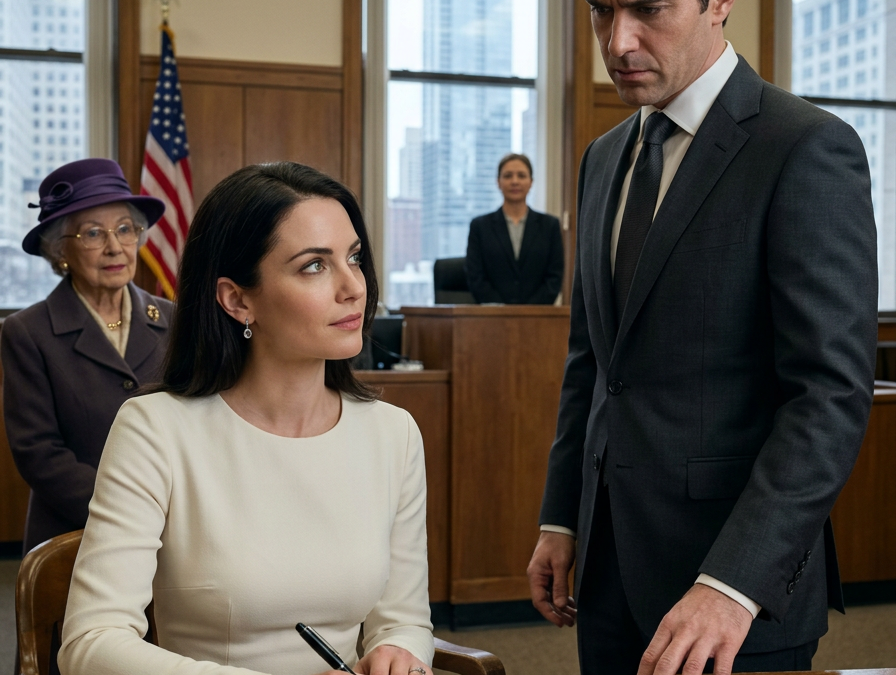
Three days later, they married at Chicago City Hall.
Small courtroom.
Gray Thursday.
Ethan sent a stylist to the shelter with several dresses.
Rose chose the simplest.
Ivory.
Long sleeves.
No jewelry except small silver earrings.
Her hair was down.
Ethan was checking his phone when she entered.
Then he looked up.
For one second, he forgot whatever he had been reading.
His only witness was his great-aunt Lillian.
Eighty-two.
Purple hat.
Feather.
Gold glasses.
“So this is the bride.”
Lillian looked Rose over.
Not critically.
Curiously.
“Where did you meet?”
“Coffee shop.”
Ethan answered.
“In a manner of speaking.”
Rose added.
Lillian smiled.
“Best marriages start with eggs.”
“Aunt Lillian.”
“Don’t bully her, Ethan.”
“I don’t bully people.”
Rose said:
“He does.”
Lillian clapped her hands.
“Oh, I like her.”
The ceremony lasted eleven minutes.
Ethan said “I do” like approving a budget.
Rose’s voice shook slightly when she answered.
Then came the awkward moment.
“You may kiss the bride.”
Ethan hesitated.
Rose noticed.
The hesitation irritated her.
So she stepped forward.
Placed one hand against his chest.
Kissed him first.
Short.
Firm.
A declaration more than romance.
When she stepped back, Ethan stared.
Lillian whispered:
“Well.”
Then came the license.
Ethan signed.
Rose took the pen.
She wrote slowly.
Rosalyn Mercer.
And without thinking, she made the mark she had placed beside her name since architecture school.
A tiny compass rose.
Four points inside a circle.
Ethan saw it.
Stopped breathing.
He knew that mark.
Every original competition sheet Victor had presented for the Meridian had contained a tiny compass rose in the bottom corner.
Ethan once asked Victor about it.
Victor laughed.
“My signature.”
But in five years, Ethan had never seen Victor draw it.
Not once.
Now the woman he had found on a sidewalk had drawn it unconsciously.
Exactly.
Ethan looked at Rose.
Then the signature.
The structural crack.
Her knowledge.
The mark.
Something cold moved through him.
“Ethan?”
Lillian asked.
“You look like you’ve seen a ghost.”
Rose held the pen.
“What?”
“I’m fine.”
He closed the book.
“Let’s go home.”
He said nothing in the car.
Rose assumed he regretted everything.
He did not.
He was wondering whether he had married the actual designer of the Meridian.
If he was right, Victor Crane was not merely an architect with questionable judgment.
He was a thief.
Ethan should have told Rose his suspicion immediately.
Condition number two.
Never lie to me.
Instead, he convinced himself suspicion was not yet information.
He needed proof.
That rationalization became the first breach in their marriage less than an hour after it began.
Ethan’s apartment occupied the top floor of a tower overlooking Lake Michigan.
White marble.
Glass walls.
Minimal furniture.
Rose stood in the living room.
“This looks like a very expensive waiting room.”
Ethan almost smiled.
“Your bedroom is down the hall.”
“Lock?”
“Installed this morning.”
“And my office?”
“Next door.”
“The drafting table?”
“Tomorrow.”
Rose looked at him.
“Thank you.”
He nodded.
“Kitchen is stocked.”
“Housekeeper Monday and Thursday.”
“My assistant can handle anything else.”
Rose looked around.
“Do you ever just talk to people?”
“Excuse me?”
“Or does your assistant do that too?”
A pause.
Then:
“Good night, Mrs. Blackwood.”
That night, Rose learned the shelter had discarded her other bag after she failed to return.
Everything she owned was gone except what she had worn to City Hall and the gray blanket.
At eleven, she knocked on Ethan’s door.
He opened it wearing a white T-shirt.
Gray sweatpants.
Reading glasses.
Rose stared.
“What?”
“You look normal.”
“I am normal.”
“That remains unproven.”
He waited.
“I don’t have anything to sleep in.”
Ethan looked at her dress.
Then disappeared.
He returned holding a white cotton shirt.
“This is probably the only thing I own that won’t swallow you completely.”
She took it.
Their fingers touched.
Both noticed.
Neither commented.
At two in the morning, Rose woke thirsty.
She unlocked her bedroom and went to the kitchen.
Ethan stood at the counter in darkness eating cereal directly from the box.
He turned.
Then stopped.
Rose stood barefoot on white marble wearing his shirt.
Dark hair loose.
The shirt reached nearly to her knees.
For several seconds, the city hummed below them.
“Couldn’t sleep?”
She asked.
“Apparently neither could you.”
“Is cereal your dinner?”
“Family tradition.”
“At two in the morning?”
“My grandfather did it.”
Ethan held out the box.
“He said it was the only hour he ever remembered being a boy.”
Rose took a handful.
Their shoulders almost touched.
“Why me?”
She asked.
He looked down.
“Out of every woman in Chicago.”
The truth came close.
Because I think you designed my building.
Because I think someone destroyed you.
Instead, Ethan said:
“Because of the beam.”
Rose frowned.
“My engineers checked it.”
Her eyes widened.
“When?”
“Yesterday.”
“And?”
“You were right.”
She went completely still.
“Half an inch low.”
“Maybe slightly more.”
“We’re already reinforcing it.”
Rose stared at him.
“You listened.”
“Of course.”
“You didn’t know me.”
“You knew what you were looking at.”
He paused.
“Thank you, Rose.”
First name.
No Miss Mercer.
No Mrs. Blackwood.
Rose felt it unexpectedly.
“Good night, Ethan.”
She left before she did something foolish.
The next morning, Ethan hired a private investigator.
He told himself it was about Victor.
It was.
Mostly.
Married life became strange.
Quiet.
Almost domestic.
Ethan left at six.
Returned around nine.
Rose drew during the day.
The drafting table arrived Friday.
Oak.
Adjustable.
Brass lamp.
Old-fashioned.
Beautiful.
Rose ran her hand over the wood and had to sit down.
Later, Ethan’s assistant told her:
“He picked it himself.”
Rose pretended that meant nothing.
On the first Sunday, Aunt Lillian arrived at ten with pastries.
“I’ve come to inspect the bride.”
She marched into the apartment.
Ethan sighed.
“Coffee?”
“Obviously.”
Lillian sat Rose down.
“How is my great-nephew?”
“Grumpy.”
“Accurate.”
“He eats cereal standing up.”
Lillian laughed.
“Just like his grandfather.”
Ethan gave Rose a warning look.
She ignored it.
Lillian leaned closer.
“I helped write that ridiculous trust clause.”
“The marriage requirement?”
“Yes.”
“Why?”
“Ethan thinks his grandfather wanted heirs.”
She looked toward him.
“Not really.”
“Aunt Lillian.”
“What?”
“You’ve been wrong about your own grandfather for twenty years.”
She looked at Rose.
“My brother said Ethan was turning into a building.”
Rose smiled.
“Steel and glass?”
“Exactly.”
“No furniture?”
“Precisely.”
Lillian lowered her voice.
“He thought marriage might give the boy something he couldn’t own through paperwork.”
Then she looked at Ethan.
“Something to come home to.”
Rose did not answer.
When she looked across the room, Ethan looked away first.
Three weeks after the wedding, Victor Crane came to the apartment.
Rose opened the door before checking who was there.
Victor stood in a camel-colored coat holding rolled blueprints.
Fifty.
Silver hair.
Handsome.
Polished.
The same smile that had persuaded clients, licensing officials, and half of Chicago.
Then he saw her.
The smile died.
“Rosalyn.”
Rose’s entire body went cold.
“Ethan isn’t home.”
“I know.”
“He asked me to leave revisions.”
Victor stepped inside without permission.
Set the plans on the table.
Then looked around.
“Interesting.”
“What?”
“Your recovery.”
Rose closed the door.
“I saw the wedding announcement.”
Victor smiled faintly.
“Ethan Blackwood and Rose Mercer.”
He shook his head.
“I assumed it was another Rose Mercer.”
“I’m sure you hoped.”
“I thought you were sleeping under a bridge.”
“Sometimes.”
Victor’s eyes sharpened.
“And now you’re Mrs. Blackwood.”
He stepped closer.
“Clever.”
“What do you want?”
“To understand the plan.”
“There is no plan.”
“Of course there is.”
His voice dropped.
“Wait a few months.”
“Whisper in Ethan’s ear.”
“Tell him I stole your drawings.”
“You did.”
“Prove it.”
Rose’s jaw tightened.
Victor leaned closer.
“You are a disgraced architect.”
“License revoked.”
“Official record showing falsified calculations.”
“I’m chief architect of Blackwood & Sons.”
He smiled.
“If you tell him your story, who does he believe?”
Rose said nothing.
“The homeless woman he married three weeks ago?”
“Or the man he has worked with for five years?”
Victor adjusted his coat.
“That’s what I thought.”
He turned.
“Congratulations.”
At the door, he added:
“I’d hate for anything to spoil it.”
After he left, Rose locked every lock.
Then stood with her back against the door shaking.
She should tell Ethan.
Condition number two applied to both of them in spirit, even if she had only demanded the promise from him.
But Victor’s words reopened an old wound.
Rose had told the truth once.
Nobody believed her.
She could not survive losing everything twice.
So she said nothing.
And without either knowing it, husband and wife began keeping the same secret.
Thanksgiving came.
Aunt Lillian hosted dinner in her Gold Coast brownstone.
Two senior Blackwood board members attended.
Harold Pike.
Margaret Chen.
They would vote on Ethan’s chairmanship on New Year’s Eve.
“They think the marriage is fake.”
Lillian told Ethan loudly over the phone.
“It is fake.”
Ethan answered.
Rose looked up.
Lillian continued.
“Try not to look so delighted about it.”
“I am not delighted.”
“You sound delighted.”
“I’m hanging up.”
The week before dinner, Ethan and Rose practiced being married.
“What’s my favorite color?”
Ethan asked.
“Green.”
“How do you know?”
“You always pick the green pencil first.”
Rose tossed popcorn into her mouth.
“And you wore green socks four times last week.”
Ethan stared.
“You notice my socks?”
She grinned.
“My turn.”
“Favorite song.”
“You don’t have one.”
“Wrong.”
“You listen to market reports in the car.”
“That does not mean I have no favorite song.”
Rose leaned forward.
“You hum Moon River in the shower.”
Ethan went red.
“Badly.”
He looked horrified.
She laughed so hard she fell sideways on the sofa.
At Thanksgiving, they were convincing.
Too convincing.
Ethan held Rose’s chair.
Rose knew how he took his coffee.
Harold asked about their meeting.
Ethan told the story of the sidewalk.
The cardboard.
The red circle.
“And you checked the beam?”
Harold asked.
“The same day.”
Ethan looked at Rose.
“She saved us millions.”
Then:
“My wife is the most brilliant person I’ve ever met.”
It was meant for the board.
But Ethan looked only at Rose.
After dinner, Lillian pulled her aside.
“He’s in love with you.”
Rose nearly dropped a serving spoon.
“No.”
“I’ve known him since he was born.”
“It’s for the board.”
Lillian raised an eyebrow.
“Is it?”
Rose could not answer.
In the car home, Ethan handed her a long box wrapped in brown paper.
“Happy Thanksgiving.”
Inside was a set of professional technical drawing pens.
German steel.
Leather case.
Initials engraved.
R.M.
Rose stared.
“You’ve been using that pencil stub since we met.”
Ethan looked out the window.
“You deserve better tools.”
Rose turned her face away so he would not see tears.
That was the week she began visiting the Meridian at night.
The reinforcement work on the forty-first floor was going badly.
Rose overheard Ethan discussing it with engineers.
The beam had been compromised more than expected.
She knew the structure.
Not approximately.
Intimately.
Because Victor had changed her design.
Three nights a week, after Ethan slept, Rose took the train downtown.
The night security guard was Gus.
Older man.
Grandchildren he talked about endlessly.
Rose brought coffee.
He let her onto the construction level because he assumed Ethan knew.
Rose measured.
Sketched.
Calculated.
Then returned home and worked until dawn.
On the eighth night, she completed a full repair concept.
Cleaner.
Stronger.
Less expensive.
She could not sign it.
The name Rosalyn Mercer still meant fraud in professional databases.
So she placed the plans in an envelope.
Left them on chief site engineer Dolores Ruiz’s desk.
Unsigned.
Except for one unconscious mark.
Tiny compass rose.
More revisions followed.
Always anonymous.
Always marked.
Early in December, Dolores showed Ethan the drawings.
“They’ve appeared three times.”
“Who?”
“No idea.”
He bent over them.
The repair geometry was elegant.
Calculations clear.
Every solution addressed problems Victor’s revisions had not.
Then Ethan saw the mark.
Compass rose.
His pulse jumped.
The office door opened.
Victor entered.
“Problem?”
“No.”
Ethan said.
“Dolores is showing me some alternatives.”
Victor glanced down.
His gaze landed on the compass rose.
For less than a second, color left his face.
Then returned.
“Amateur work.”
He pushed the plans aside.
“Some retired engineer playing games.”
Dolores said quietly:
“Your solution hasn’t worked.”
Victor turned.
“I said throw them out.”
“No.”
Ethan spoke.
Victor stared.
“Keep them.”
Ethan told Dolores.
“If the numbers hold, use them.”
Then he looked directly at Victor.
“I don’t care who drew them.”
A pause.
“Do you?”
Victor smiled.
“Of course not.”
Then left.
Ethan watched the door close.
Now he knew.
Victor recognized the mark.
And feared it.
The private investigator’s report arrived days later.
Victor had forged complaint records.
Manufactured structural documents.
There were financial records connecting him to cost reductions on the Meridian.
He had altered the original transfer design to save roughly six hundred thousand dollars in materials and labor, with questionable payments routed through vendors associated with him.
The report was not yet a final legal determination.
But it was enough for lawyers to begin formal action.
Enough to reopen Rose’s licensing matter.
Enough for Ethan to know that her story was true.
He locked the report inside his office desk.
And still did not tell her.
He wanted to fix everything first.
That was his mistake.
Ethan believed love could be delivered finished.
Like a building.
Like a contract.
Like a gift wrapped after every risk had been removed.
Two days after the report arrived, he found Rose asleep at her drafting table at five in the morning.
The office light glowed beneath the door.
He knocked.
No answer.
He entered.
Rose’s cheek rested against one arm.
One of the pens he gave her remained in her fingers.
Across the table lay a new drawing.
Forty-first floor transfer repair.
Ethan stopped.
Clean lines.
Detailed notes.
Then the compass rose.
Everything inside him aligned at once.
She had drawn the anonymous repairs.
His wife.
The woman he had found freezing on cardboard.
She had been taking trains downtown at night to save the building stolen from her.
Without credit.
Without pay.
Without even signing her name.
Rose stirred.
Opened her eyes.
Then saw him staring.
Her face drained.
“Ethan.”
She sat up.
“I can explain.”
“You don’t have to.”
“I only wanted to help.”
“I know.”
“The engineers were stuck.”
“I know.”
“I wasn’t trying to interfere.”
“Rose.”
He crossed the room.
Kneeled beside her chair until they were eye level.
“You saved my building again.”
She looked down.
“Why didn’t you sign these?”
Her hands tightened.
“My name isn’t worth anything.”
Ethan stared.
“Not anymore.”
Something in him broke.
He touched her cheek.
Ink smudged near her jaw.
He brushed it away with his thumb.
Rose stopped breathing.
“Your name.”
Ethan said.
“Is worth more than mine.”
Then he kissed her.
Not like City Hall.
That kiss had been challenge.
This one was a question.
Slow.
Careful.
Rose answered.
Her fingers closed around his shirt.
The pen fell.
Rolled across the floor.
Neither noticed.
He pulled her up.
She stepped into him.
The city glowed blue behind the glass.
When they finally separated, Rose rested her forehead against his chest.
“This isn’t in the contract.”
Ethan almost laughed.
“I know.”
Then:
“I think I’d like to renegotiate.”
She laughed against him.
He should have told her then.
Everything.
The investigation.
Victor.
The forged documents.
The licensing board.
Instead, Ethan decided he wanted to give her the truth as a completed gift.
New Year’s Eve first.
Board vote.
Then January second, when he already had meetings scheduled with lawyers and licensing officials.
He imagined walking Rose into the board room and placing her restored professional future into her hands.
He thought that was love.
He did not understand that withholding truth remained withholding truth even when the motive felt noble.
December became the happiest month either had known in years.
Rose moved her drafting table near the glass wall.
Ethan started coming home at six.
Dinner at the kitchen island.
Walks by the frozen lake.
Ice skating at Millennium Park.
Ethan fell eleven times.
Rose counted each one.
Christmas morning, Ethan gave Rose a framed version of her original cardboard Meridian sketch.
He had preserved it.
Red circle and all.
Rose stared.
“You kept this?”
“Of course.”
She gave him a drawing of his grandfather’s first hardware store based on an old photograph Lillian found.
Ethan stared at it for a long time.
“Nobody has ever given me something I couldn’t buy.”
Rose smiled.
“Now somebody has.”
They still maintained separate bedrooms.
But Rose stopped locking her door.
Neither mentioned it.
December twenty-eighth, Dolores reported that the repair was complete.
Independent inspector signed off.
“Whoever drew those plans deserves credit.”
Dolores said.
“They’ll get it.”
Ethan promised.
That afternoon, he put Victor’s investigative file into his briefcase.
He would tell Rose everything on New Year’s Day.
Three more days.
Then he left his office unlocked while he went to lunch.
Victor Crane still had executive-floor access.
When Ethan returned, nothing appeared disturbed.
He did not check the file.
The Blackwood Foundation New Year’s Eve gala filled the Drake Hotel ballroom.
Six hundred guests.
White roses.
Crystal chandeliers.
Twelve-piece orchestra.
At eleven, the board would announce its chairmanship vote.
At midnight, fireworks.
Rose wore emerald green.
When she emerged from her room, Ethan looked at her.
“Rose.”
Only her name.
Nothing else.
It was enough.
At the gala, everyone wanted to meet Mrs. Blackwood.
Rose smiled.
Shook hands.
Ethan stayed close.
Lillian danced with three board members and probably influenced two votes while doing so.
Around ten-thirty, the mayor pulled Ethan away.
Rose slipped onto the terrace for cold air.
Victor was waiting.
“Beautiful dress.”
“Go away.”
“Ethan chose it?”
Rose said nothing.
Victor smiled.
“He does like choosing things.”
“What do you want?”
“One minute.”
He removed folded papers from his coat.
“I thought you deserved to see what your husband apparently did not.”
Rose’s stomach tightened.
She did not want the pages.
She took them.
PRIVATE INVESTIGATIVE REPORT.
Subject:
Rosalyn Mercer.
Commissioned by:
Ethan Blackwood.
Date:
The day after their wedding.
Rose read the first page.
Then again.
Victor watched.
“He knew.”
“No.”
“City Hall.”
Victor leaned closer.
“He saw your little compass mark.”
“He recognized it.”
“He hired investigators immediately.”
Rose’s fingers started trembling.
“That isn’t—”
“He knew exactly who you were.”
Victor’s voice softened.
Poison delivered gently.
“Ask yourself why Ethan Blackwood married a homeless woman three days after meeting her.”
Rose stared.
“He discovered the disgraced architect of his billion-dollar tower sitting on a sidewalk.”
Victor continued.
“Opening day approaching.”
“Board vote approaching.”
“Scandal capable of destroying both.”
“So he married you.”
“No.”
“He contained you.”
“He gave you an office.”
“Pens.”
“A beautiful apartment.”
“A contract.”
Victor smiled.
“And a reason not to expose his company.”
“That isn’t true.”
“Then why didn’t he tell you?”
Rose could not answer.
Condition two.
Never lie.
If there is something I need to know, tell me.
He had promised.
And for weeks he had known.
Every dinner.
Every kiss.
Every night she left secretly to repair the building he already knew was hers.
Inside, music stopped.
A voice announced the board vote.
Rose barely heard it.
Ethan found her ten minutes later.
Snow gathering on her shoulders.
Green dress.
Report in her hands.
One look told him everything.
“Rose.”
“Is it true?”
Her voice was almost calm.
“Did you know on our wedding day?”
Ethan stopped.
This time, he did not lie.
“I suspected.”
“When?”
“When you signed the license.”
“The compass rose.”
“Yes.”
“And when did you know?”
“For certain?”
“Yes.”
“Two weeks ago.”
Rose lifted the report.
“You had proof.”
“Yes.”
“When you kissed me.”
“Yes.”
“Christmas.”
“Yes.”
Her voice cracked.
“You let me keep sneaking into the Meridian.”
“I didn’t know that until I found you at the drafting table.”
“But you knew Victor ruined me.”
“Yes.”
“And you said nothing.”
“I was preparing everything.”
“For after the vote.”
“That wasn’t why.”
“Wasn’t it?”
“No.”
“You promised me one thing.”
Rose’s eyes filled.
“No lies.”
“I know.”
“That was the only thing I asked.”
“I know.”
“I was going to take the evidence to the licensing board on January second.”
“You wanted to give my life back like a present.”
Ethan said nothing.
“Yes.”
Rose laughed once.
Broken.
“You really do think everything is a transaction.”
“Rose.”
“I wanted to make it right.”
“You don’t get to decide when I’m entitled to my own truth.”
That sentence hit him harder than anything Victor could have said.
“I didn’t marry you because of the Meridian.”
“Then why?”
Ethan opened his mouth.
The answer was there.
Because I could not stop thinking about you.
Because you were the first person in years who treated me like a man instead of a position.
Because I loved you before I knew what to call it.
He hesitated one second too long.
Rose took off the ring.
Placed it on the stone railing.
Beside the report.
“I trusted someone once.”
Her voice softened.
“He used it to destroy me.”
“Rose.”
“I promised myself I would never be that stupid again.”
“You weren’t stupid.”
Her eyes met his.
“Congratulations on your chairmanship, Mr. Blackwood.”
Then she walked through the ballroom.
Past six hundred guests.
Champagne.
Music.
Board members.
Out through the Drake’s front doors.
Into the snow.
At midnight, fireworks opened above the frozen lake.
Rose Mercer sat in the back of a taxi in an emerald dress with nothing in her hands.
No ring.
No drafting pens.
No contract.
No five hundred thousand dollars.
She left the agreement untouched in Ethan’s desk.
She had come into his life with nothing.
She intended to leave that way.
Ethan spent New Year’s night sitting in his glass apartment holding her ring.
The drafting table stood empty.
At seven in the morning, Aunt Lillian let herself in.
One look.
“Victor Crane.”
Ethan nodded.
“And you didn’t tell her.”
“No.”
Lillian sat.
“I meant to.”
“Men have built entire disasters out of that sentence.”
“I wanted proof.”
“You had proof.”
“I wanted her license restored.”
“You wanted control.”
Ethan looked up.
“No.”
“Yes.”
She rested both hands on her cane.
“You wanted the truth to arrive in the shape you designed.”
He looked away.
“I’ve spent my life making deals.”
“I know.”
“You don’t show your hand until the documents are complete.”
“I know.”
“I didn’t know how else to do it.”
Lillian’s face softened.
“Do you know why your grandfather wrote the marriage condition?”
“To force me to build a family.”
“Half right.”
She sighed.
“He watched what happened after Victoria left you.”
Ethan’s jaw tightened.
“You turned yourself into a vault.”
“He told me once, ‘Lily, the boy thinks love is a contract. He thinks the only safe thing to offer is something he can survive losing.’”
Ethan stared.
“He thought if he forced you to let one person close enough, you might learn something.”
“What?”
“The only things worth having are exactly the things you cannot guarantee with paper.”
Silence.
Then Lillian smiled faintly.
“You won the chairmanship.”
Ethan did not move.
“Unanimously.”
Nothing.
“Congratulations.”
He looked at Rose’s empty office.
“Was it worth it?”
“No.”
“Good.”
Lillian stood.
“Then stop admiring the wreckage and do something.”
The Meridian was scheduled to open January fifteenth.
Bright winter morning.
Crowds filled the plaza.
Mayor.
Governor.
Reporters.
Cameras.
Victor Crane stood onstage wearing a camel coat.
His name appeared on the bronze plaque near the entrance.
THE MERIDIAN
DESIGNED BY VICTOR CRANE
CHIEF ARCHITECT
At ten, Ethan walked to the microphone.
He did not touch the ceremonial scissors.
“Thank you for coming.”
The crowd quieted.
“This was supposed to be the proudest morning in the history of Blackwood & Sons.”
Victor smiled.
“And before anyone enters this building, I owe Chicago the truth.”
Victor stopped smiling.
Ethan continued.
“Three months ago, a woman sitting on Michigan Avenue told me there was a structural flaw on the forty-first floor.”
Behind Ethan, the large presentation screen showed Rose’s first cardboard sketch.
Red circle.
“She was right.”
Whispers.
“Our internal review found unacceptable deflection in a transfer structure.”
“We repaired it.”
Then a new drawing filled the screen.
Technical.
Precise.
Tiny compass rose at the bottom.
“Over the following weeks, anonymous plans arrived showing our engineers how to correct the problem safely.”
“They were brilliant.”
Another image.
Original Meridian drawings.
Same compass mark.
“Five years ago, the original Meridian concept was entered into competition under Victor Crane’s name.”
Victor stepped forward.
“Ethan.”
Ethan did not look at him.
“It was not his design.”
Gasps.
“The Meridian was designed by Rosalyn Mercer.”
Her name traveled through the crowd.
Ethan held up the investigative file.
“Evidence gathered by independent investigators and counsel indicates that Ms. Mercer’s professional work was misappropriated, and fabricated materials were later used against her in licensing proceedings.”
Victor’s face emptied.
“There is also evidence that material changes were made to the Meridian transfer structure without proper justification.”
Ethan looked at him now.
“Those changes reduced costs.”
Then:
“And created the defect Ms. Mercer identified from the sidewalk.”
Two officials moved toward the stage.
Ethan faced the crowd again.
“Relevant materials have been provided to the appropriate licensing authorities and public agencies for review.”
He paused.
“So the Meridian will not open today.”
The plaza erupted.
Questions.
Shouts.
Board members whispering.
Ethan raised one hand.
“Not until a full independent review is complete.”
“I know what delay will cost.”
“Millions.”
“Contracts.”
“Reputation.”
He looked at the tower.
“And possibly my chairmanship.”
Then:
“That is the cost of putting the correct name on the work.”
Ethan stepped away from the podium.
Went to the plaque.
Removed a screwdriver from his coat.
Unscrewed the bronze plate himself.
One screw.
Two.
Three.
Four.
Victor’s name came away from the building.
Ethan placed the plaque facedown on the frozen stone.
Cameras flashed.
Rose watched from Union Station.
Gray blanket on her knees.
Milwaukee ticket in hand.
A small engineering firm had offered her drafting work.
No license required.
Honest.
Anonymous.
Her train left at 11:15.
On the television above a coffee counter, Ethan Blackwood was saying her name.
Rosalyn Mercer.
Again.
And again.
The camera showed Victor’s plaque face down.
Rose began crying.
Quietly.
For the first time in five years, she was crying because something had gone right.
“Mind if I sit?”
She looked up.
Ethan stood in front of her.
No coat.
No tie.
Hair disordered from the wind.
Breathing hard.
In one hand was her framed cardboard drawing.
In the other, the marriage contract.
“How did you find me?”
“Aunt Lillian.”
Rose looked around suspiciously.
“She has spies.”
“Apparently most of them play bridge.”
He sat.
“You left these.”
Rose looked at the framed drawing.
“The contract is yours.”
“No.”
Ethan unfolded it.
“One year.”
He read.
“Five hundred thousand dollars.”
“Separate rooms.”
He looked at her signature.
Then the compass rose.
“I broke condition two the first day.”
Rose said nothing.
“You asked for truth.”
“I gave you strategy.”
He looked down.
“I was afraid if I told you what I suspected, you would think I married you to contain the scandal.”
“You were right.”
“Yes.”
He nodded.
“Then I stayed quiet.”
“And created exactly the thing I was afraid of.”
Rose looked at him.
“I didn’t marry you because of the Meridian.”
“Why?”
This time, Ethan answered immediately.
“Because you told me no.”
Rose blinked.
“I had offered you half a million dollars.”
“You were hungry.”
“Freezing.”
“Sleeping on cardboard.”
“And you stood up and walked away from me.”
He shook his head.
“Nobody had ever done that.”
“That is not a good reason to marry someone.”
“No.”
“I had worse ones.”
She nearly smiled.
“I wanted to see you again.”
He continued.
“I knew how to make contracts.”
“I did not know how to ask someone to stay.”
Rose’s eyes filled.
“I still barely do.”
Then Ethan took the contract in both hands.
Tore it in half.
Rose stared.
He tore it again.
Then again.
White paper fell between their shoes.
“That was five hundred thousand dollars.”
“It’s already yours.”
“What?”
“Transferred.”
She stared.
“And your licensing matter has been reopened.”
He swallowed.
“The board issued an interim restoration this morning pending final review.”
Rose stopped breathing.
“I was there.”
He added.
“You didn’t—”
“I submitted evidence.”
“They made the decision.”
Rose covered her mouth.
“You don’t need anything from me now.”
Ethan said.
“Not money.”
“Not an apartment.”
“Not my name.”
“Not the contract.”
He reached into his pocket.
Her wedding ring rested in his palm.
He did not hold it toward her.
Simply showed it.
“No more deals.”
His voice dropped.
“Just a question.”
Rose looked at the ring.
Then at him.
“Will you come home?”
“You gave up the opening.”
“Yes.”
“Your board may remove you as chairman.”
“Yes.”
“Victor may drag this through court for years.”
“Yes.”
“You hum Moon River terribly.”
“Every morning.”
A laugh escaped her.
Wet.
Shaky.
Alive.
Ethan smiled.
Rose took the ring from his palm.
Placed it on her finger herself.
“Yes.”
Ethan closed his eyes.
Then she added:
“But if you lie to me again, I keep the five hundred thousand and the apartment.”
“Fair.”
“And the cereal.”
“That is unreasonable.”
She laughed.
Then he kissed her on a wooden bench in the middle of Union Station.
Above them, departure boards clicked.
The 11:15 to Milwaukee was announced.
Once.
Twice.
Final boarding.
Rose did not move.
Across the hall, an eighty-two-year-old woman in a purple coat lowered a pair of opera glasses.
Lillian smiled.
The Meridian opened six weeks later.
No brass band.
No giant scissors.
Independent engineers had reviewed the structure.
Repairs were verified.
A smaller group gathered.
Dolores Ruiz wore a hard hat.
Gus the night watchman wore his best tie.
Lillian wore a purple hat with two feathers because one, apparently, was insufficient for a structural reopening.
Beside the glass doors was a new bronze plaque.
THE MERIDIAN
DESIGNED BY ROSALYN MERCER
In the lower corner:
A tiny compass rose.
Victor Crane faced formal professional and legal proceedings based on the evidence uncovered.
Rose did not attend them unless required.
She had spent five years allowing Victor to define her life.
She was done giving him more time.
Within months, Mercer Studio opened on the North Side.
Small office.
Large drafting table.
Four clients in the first month.
More afterward.
Dolores sent her referrals.
So did people who had seen the Meridian story.
Ethan lost the chairmanship.
Margaret Chen took the seat.
She was excellent at it.
Ethan remained chief executive.
The first time Rose asked whether he regretted losing the chair, he said:
“No.”
Too quickly.
She looked at him.
“Truth.”
He sighed.
“Sometimes.”
“Better.”
“I wanted it for twenty years.”
“I know.”
“Losing it hurt.”
“I know.”
Then he smiled.
“But I like coming home.”
A year later, they married again.
No contract.
No deadline.
No trust condition.
On the roof of the Meridian.
Sixty floors over Chicago.
Bright October morning.
Lake silver beneath them.
Aunt Lillian gave Rose away.
Dolores stood beside her.
Gus cried from the opening sentence.
Rose wore the same simple ivory dress she had worn at City Hall.
When the marriage license came around, she signed:
Rosalyn Mercer Blackwood.
Then drew her compass rose.
Ethan took the pen.
He tried to draw one beside his name.
It was lopsided.
Rose stared.
“That is terrible.”
“I run a construction company.”
“You should understand geometry.”
“I understand enough to hire you.”
Lillian laughed loudly.
The next morning, Rose sat on a folding stool near Michigan Avenue.
Sketchbook on her knees.
German drafting pen in hand.
Drawing the Meridian simply because she wanted to.
No one owned the drawing.
No competition.
No client.
No stolen name.
Just her.
At a red light, a black car stopped.
The window lowered.
“Hey.”
Rose looked up.
Ethan Blackwood leaned across the passenger seat.
“You.”
She smiled.
“Come here.”
“No thank you.”
He groaned.
“Are we still doing this?”
“If you want a sketch, they’re five dollars.”
“I want breakfast.”
“The eggs are terrible.”
“There are a lot of them.”
Rose closed the sketchbook.
Walked to the car.
Before getting in, she looked back at the tower.
Her tower.
Not because she owned the steel.
Because her name was finally attached to what her hands and mind had created.
Then she climbed inside.
“Where are we going?”
“You already know.”
The light turned green.
Someone behind them honked.
For once in his life, Ethan Blackwood did not care.
He looked at Rose.
Rose looked at him.
And the car stayed still for one extra second.
Just long enough for both of them to laugh.
Rose had spent five years believing one man could make her name worthless.
Ethan had spent almost forty years believing every important thing could be protected by contracts.
They were both wrong.
A name can be stolen.
Credit can be stolen.
Work can be stolen.
Truth can be buried long enough for a city to believe the wrong story.
But the thing itself remains.
The ability.
The hand.
The eye capable of seeing a half-inch sag from four blocks away.
The mark someone makes without thinking because it belongs more deeply to them than any signature.
And love?
Love turned out to be the opposite of Ethan’s contracts.
No guarantees.
No protected downside.
No clause ensuring nobody leaves.
It required telling the truth before the outcome was safe.
That was what he had failed to understand.
And what Rose eventually made him learn.
Years later, the first cardboard drawing remained framed in Ethan’s office.
Not the polished architectural rendering.
The torn brown cardboard.
Pencil.
Red circle.
Near the bottom corner, after their second wedding, Rose added one small thing.
A compass rose.
Ethan asked why.
She said:
“So you remember where you found me.”
He shook his head.
“I didn’t find you.”
“No?”
“You found the crack.”
Rose smiled.
“In the building?”
Ethan looked at her.
“No.”
“In me.”
She rolled her eyes.
“That was terrible.”
“You married me twice.”
“That doesn’t make you poetic.”
“Moon River.”
“Still terrible.”
He kissed her anyway.
And through the glass wall behind them, the Meridian caught the noon sun exactly the way Rosalyn Mercer had designed it all those years before.
No crack.
No borrowed name.
Nothing hidden.
Just sixty floors of light.
And, beside the doors far below, a bronze plaque telling the truth.
