One gray afternoon, I had an accident on my farm and realized I needed help
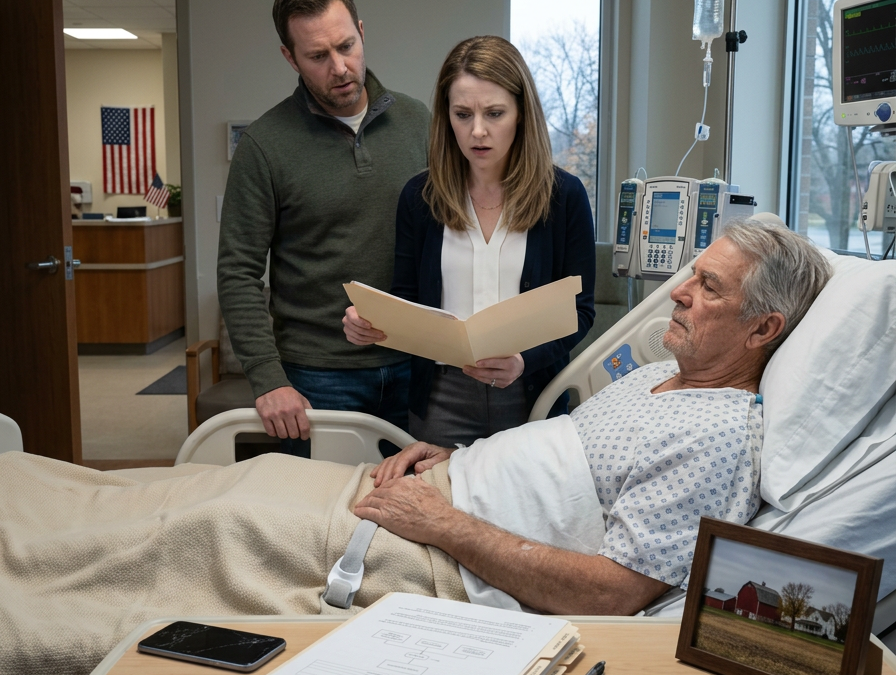
My Daughter Said, “Call Someone Who Cares” After I Broke My Hip—So I Made One More Call. Six…
ON A GRAY AFTERNOON, A LADDER FELL AND BROKE MY HIP. I CALLED MY DAUGHTER. SHE SAID, “CALL SOMEONE WHO CARES, DAD. I’M BUSY.” HER HUSBAND SAID, “STOP DOING THIS EVERY TIME.” I CALLED 911, THEN MADE ANOTHER CALL. 6 DAYS LATER, MY DAUGHTER STORMED INTO MY HOSPITAL ROOM, PALE WHEN SHE FOUND OUT…
On a Thursday afternoon in late October, an extension ladder slid out from under me on the north side of my barn, and I broke my hip on frozen Wisconsin ground before I ever heard my daughter tell me she did not have time for me.
My name is Harold Voss.
I was sixty-eight years old.
I had farmed the same one hundred forty acres outside Willow Creek, Wisconsin, since I was twenty-three.
I knew that land better than I knew most people.
I knew where the frost stayed longest in spring.
Where deer crossed the south fence.
Which low section near the creek turned soft after three straight days of rain.
I knew which barn board would groan in January.
Which stall latch needed lifting before it would close.
Which roof seam had been patched in 1998, again in 2009, and badly in 2017 when I rushed because a storm was coming.
I thought I knew every piece of that farm.
I was wrong about the ladder.
And I was wrong about my family.
The sky that afternoon was the color of dirty wool.
I had climbed up to inspect a section of shingles that had started letting water through after a storm.
I came down with a bundle tucked beneath one arm.
That was stupid.
I know it.
A younger man can do something stupid and call it experience.
An older man sometimes has to call it an ambulance.
The bottom of the ladder had settled into mud that froze overnight and softened under the weak afternoon sun.
I put my weight on the rung.
The feet shifted.
The whole ladder kicked sideways.
I do not remember the fall clearly.
I remember the landing.
A hard, deep crack that seemed to travel from my hip into my teeth.
Then cold.
Not weather cold.
Shock.
The kind that starts inside.
I landed on my back.
The shingles scattered.
My phone flew several feet away.
For a moment, I stared at the low gray sky.
Then tried to move.
My right leg answered with pain so violent I nearly blacked out.
I knew immediately something had broken.
The phone lay perhaps six feet away.
Close enough to see.
Too far to reach without moving.
So I dragged myself.
Elbows through mud.
One inch at a time.
Swearing at the ground.
Swearing at the ladder.
Swearing at my own age.
Finally, my fingers closed around the phone.
Every man has one person he assumes he can call when life goes sideways.
Mine was my daughter.
Carrie.
Thirty-six.
My only child.
She lived twenty-five minutes away in Oaklair with her husband, Kyle.
When Carrie was little, she followed me everywhere.
Sat on the tractor step.
Held fence staples in her coat pockets.
Named calves I specifically told her not to name because named calves are harder to sell.
For years, even after she married, she called every Sunday evening.
Nothing important.
Weather.
Recipes.
Work.
The Packers.
Sometimes forty-five minutes of nothing.
Those calls had become shorter over the years.
Then less frequent.
Still, lying in the mud behind my barn with a broken hip, I did not think twice.
I pressed her name.
Five rings.
“Dad.”
Not:
What’s wrong?
Just Dad.
Flat.
Busy.
“Carrie.”
My voice sounded weak.
That frightened me.
“I fell off the ladder.”
Silence.
“I think my hip is broken.”
Another silence.
“I need you to—”
She cut me off.
“Dad, I can’t do this right now.”
I stared at the barn roof.
“What?”
“I have people over.”
Her voice lowered.
“Can you call somebody who actually has time?”
Then I heard Kyle in the background.
His words were slightly blurred around the edges.
Drinking.
A party.
“Tell him we’re not doing this every time he trips over something out there.”
Carrie spoke again.
More firmly this time.
“Call somebody who cares, Dad.”
Then:
“We’re kind of in the middle of something.”
The line went dead.
I kept the phone against my ear.
Listening to nothing.
What I felt was not anger.
Not yet.
It was quieter.
Like a barn door swinging closed on its own.
One hard wooden thump.
Latch catching.
Then silence.
I dialed 911.
Told the dispatcher where I was.
Blue mailbox.
Long gravel drive.
Barn half a mile back.
She told me not to move.
An ambulance was coming.
I promised.
Then I heard gravel.
A vehicle.
Door slamming.
Boots.
“Mr. Voss?”
A man appeared around the barn corner.
Dale Anders.
My rural mail carrier.
Fifty-something.
He had delivered everything from tax notices to Christmas cards to my place for fifteen years.
He was early that day.
Later, he told me he saw the barn door open from the county road.
That was unusual.
Something made him turn in.
He found me in the mud.
Did not hesitate.
He knelt beside me.
Took off his jacket.
Covered my chest.
“You hurt bad?”
“Hip.”
“Ambulance coming?”
“Yes.”
“Good.”
Then he stayed.
Talked.
Weather.
His granddaughter’s school play.
The Bucks.
Anything except pain.
A man with no obligation to me sat in frozen mud until paramedics arrived.
My own daughter had hung up.
The contrast was so clear I did not have to think about it.
The ambulance ride to Sacred Heart Hospital took less than half an hour.
Pain came in waves.
Sirens rose and fell.
I kept holding my phone.
Not because I expected Carrie to call back.
She did not.
There was one more person I wanted to reach.
Neil Sabo.
Branch manager at Chippewa Valley Bank.
Twenty-two years of doing business together.
Farm loans.
Refinancing.
Equipment.
A line of credit during the bad milk-price years.
Neil still gave certain longtime customers his cell number.
He answered.
“Harold?”
“I need something done.”
“What happened?”
“I’m headed to Sacred Heart.”
“Why?”
“Broke my hip.”
“Good Lord.”
“I’m all right.”
“You don’t sound all right.”
“Neil.”
He stopped.
“I need you to review every account tied to me.”
A pause.
“Tonight if you can.”
“What are we looking for?”
“Anything where Carrie or Kyle has access.”
Authorized cards.
Standing transfers.
Account permissions.
Anything I had added over the years because it had seemed easier than saying no.
“I want whatever can legally be suspended or restricted without harming my own access flagged immediately.”
Neil was quiet.
“Harold, this is a big move.”
I looked through the ambulance windows.
Gray farmland passed.
“I know.”
“Are you sure?”
Carrie’s words were still in my ear.
Call somebody who cares.
“Yes.”
I said.
“I’m sure.”
Surgery took nearly three hours.
Dr. Anita Reyes repaired the fracture.
She said I was fortunate it had not displaced worse.
At sixty-eight, hip injuries can change the rest of a life.
“Lucky.”
She said.
I did not feel lucky.
The woman assigned to my floor was a nurse named Patricia Kowalchek.
Fifty, maybe.
Steady.
No fuss.
She adjusted things before I asked.
Made a resident redo an IV when she did not like how it was placed.
Never raised her voice.
I trusted her almost immediately.
The next morning, she placed my cracked phone on the bedside tray.
“Found this in your coat.”
Two missed calls from Neil.
One text from Dale:
Heard you made it. Glad you’re alive, old-timer. No need to reply.
I smiled.
Then Patricia placed a printed photograph beneath my water cup.
“What’s this?”
“Your phone lit up last night.”
She looked uncomfortable.
“There was a notification.”
“From who?”
“Family group chat.”
“I didn’t think it was my business.”
She paused.
“But then it disappeared.”
“Somebody deleted it?”
“Looked that way.”
“So you took a photo.”
“Yes.”
I picked up the print.
A dining table.
Steaks.
Good bourbon.
Six or eight people.
A sheet cake in the center.
Blue icing.
CONGRATULATIONS ON THE PROMOTION, FUTURE FARM OWNER.
I stared.
Future farm owner.
Kyle worked in agricultural real-estate development.
I did not need help understanding whose farm they meant.
While I was being wheeled into surgery twenty-five minutes away, my daughter and son-in-law had been raising glasses to land they believed would soon be theirs.
Then my phone buzzed.
Unknown number.
Mr. Voss, this is Angela Reyes. I used to work with Kyle at county planning. I saw something last night that I think you should know. I’m sending a video.
Forty seconds.
Kitchen party.
Kyle in the center.
Drink in his hand.
Talking loudly.
“Here’s the thing about my father-in-law.”
Somebody laughed.
“Guy’s sixty-eight.”
Kyle smiled.
“Will probably never update his will.”
Another laugh.
“Carrie’s the only kid.”
Then:
“The farm is basically ours.”
My thumb stopped the video.
I forced myself to continue.
Someone asked:
“Does Harold know what you’re planning?”
Kyle replied:
“Not yet.”
Then Carrie’s voice.
Amused.
“Don’t forget he still pays our health insurance.”
Laughter.
“Saves us eleven grand a year.”
I watched twice.
Then put the phone down.
Thirty-eight years.
Before sunrise.
Cows.
Frozen water lines.
Milk prices collapsing.
Mortgage.
Equipment payments.
Roof repairs.
A tractor transmission that nearly broke me financially when Carrie was nine.
I had built that farm one paid bill at a time.
My plan had always been to leave it to Carrie.
Free and clear if possible.
Not because she was entitled.
Because she was my child.
There is a difference.
That morning, for the first time, I realized I had stopped noticing when that difference disappeared.
I called Neil.
“Pull everything.”
“I’m already working on it.”
“Five years.”
“Harold—”
“Every transfer.”
“Every authorized card.”
“Every loan.”
He called back later.
His tone told me before the numbers did.
Health coverage.
I had been paying premiums for Carrie and Kyle.
Around eight hundred dollars monthly.
Years.
Then an authorized business card used for household spending.
Roughly eleven hundred dollars a month paid from funds tied to me.
I had granted Kyle access years earlier for legitimate farm purchases.
Never removed it.
Then came the largest item.
A draw against a farm-backed equity line.
Sixty-two thousand dollars.
Paperwork described home improvements.
Carrie and Kyle’s house had not been improved.
Neil continued.
I listened.
By the time we totaled four years of transfers, cards, insurance, loan payments, and other support, the number was above two hundred thousand dollars.
Some of it I knew about.
Some I had simply stopped tracking.
Some I had never understood clearly enough before agreeing.
That distinction mattered legally.
It also mattered morally.
“Everything frozen where you can?”
“Yes.”
“For any debt or credit facility, we’ll need to follow the actual agreements.”
“I know.”
“I’m getting counsel involved.”
“Good.”
“And Kyle?”
“Removed as authorized user where your ownership permits it.”
“Good.”
The next call came from my farmhouse landline.
Carrie.
Warm voice.
“Dad.”
I stared at the screen.
She still did not know.
“Just checking.”
“On what?”
“You.”
She laughed lightly.
“Kyle said you weren’t feeling well.”
I looked down at my hip brace.
“Some kind of flu.”
She believed I was at home sick.
Not hospitalized.
Nobody had bothered to check.
“I’m managing.”
“Good.”
Pause.
There it was.
Real reason.
“When you’re feeling better, could you come look at our water heater?”
I closed my eyes.
“Kyle’s swamped.”
She continued.
“And the garage gutters are full.”
“Anything else?”
“That’s probably enough.”
Then:
“Staying busy is good for you.”
I heard her turn.
Her hand imperfectly covering the receiver.
“He’s managing.”
She told someone.
Then laughed.
“Gives him something to do.”
A second voice.
Kyle, probably.
Carrie said:
“Saves us two hundred for a plumber.”
I ended the call.
No goodbye.
I asked Patricia for help sending a message.
My neighbor Walt Brennan farmed the property next to mine.
Thirty years.
“Tell him to watch my place.”
“For what?”
“Anything unusual.”
Patricia typed.
Before leaving, she paused.
“Mr. Voss?”
“Yes?”
“You don’t have the flu.”
“No.”
“I didn’t think so.”
Carrie first visited on day three.
Eleven in the morning.
Dress shoes clicking down the hall.
Container of soup.
Hair done.
Blouse pressed.
“I came as soon as I heard.”
She had not called once.
I did not correct her.
“That’s kind.”
She looked at my face.
Bruising.
IV.
Brace.
Calculation passed across her features faster than concern.
“You look rough.”
“Broken bones do that.”
She handed me soup.
Cold.
Straight from the refrigerator.
I replaced the lid.
“Thank you.”
Then she began circling the real subject.
“Dad.”
“Yes?”
“Kyle and I have been talking.”
I waited.
“After something like this, maybe you need changes.”
“What kind?”
“The farm is a lot.”
“Yes.”
“You shouldn’t be alone out there.”
I looked at her.
“We have room.”
They did not.
They had an unfinished basement that flooded in spring.
I knew because I had helped waterproof it.
“You could stay with us.”
“My own space.”
“Privacy.”
“We’d be there if anything happened.”
My phone rang.
Walt.
I raised one finger.
“Excuse me.”
“Harold.”
His voice was low.
“You need to hear this.”
“What?”
“There are two people walking your property.”
My chest tightened.
“Who?”
“Man with clipboard.”
“Woman taking pictures.”
“Vehicle?”
“Realty company.”
I said nothing.
“Kyle showed up too.”
Of course.
“He’s walking the south fence with them.”
I looked at Carrie.
She was reading something on her own phone.
Tiny smile at the corner of her mouth.
Closer to family.
Too much work at your age.
Shouldn’t be alone.
Every sentence rearranged.
Not concern.
Preparation.
“Carrie.”
She looked up.
“Yes?”
I pushed the soup toward her.
“Take that home.”
“What?”
“I’m not hungry.”
Her expression changed.
“Dad.”
“It was nice of you to stop by.”
The sentence was polite.
Final.
My phone buzzed again.
Photo from Walt.
Kyle pointing across my south field.
Real-estate agent beside him.
Smiling.
Carrie left.
Patricia returned.
“That soup is cold.”
“Yes.”
She replaced it with my hospital meatloaf.
“This is awful.”
I looked at the tray.
“At least it’s warm.”
That afternoon, I spent hours on calls.
Neil.
Then an estate attorney named Curtis Bole.
I wanted everything cleaned up properly.
No improvised revenge.
No illegal account games.
No ambiguity.
Kyle removed from cards where I had sole authority.
Voluntary transfers stopped.
Insurance support ended with proper notice.
The disputed farm-equity borrowing moved into formal review with the lender and counsel.
If balances could be accelerated under the written agreement, the bank would handle that legally.
If not, we would pursue the appropriate remedy.
Then my will.
That mattered most.
“The farm.”
Curtis said.
“What do you want?”
“Not a simple inheritance.”
“Trust?”
“Yes.”
“What conditions?”
I stared at the hospital window.
Gray October.
“The land stays agricultural.”
Curtis made notes.
“No immediate sale to a developer.”
“Good.”
“Whoever benefits should have actually shown up for the place.”
“That needs objective language.”
“I know.”
“Use requirements tied to management, farming, conservation, leasing, whatever makes sense.”
“Something enforceable.”
“Yes.”
Then:
“And if Carrie never does any of that?”
I asked.
Curtis looked through the screen of our video conference.
“Then you choose another remainder beneficiary.”
I already had ideas.
Land trust.
Agricultural foundation.
Someone who would protect it.
Maybe not blood.
The farm would outlive me either way.
For the first time since the fall, I felt solid ground beneath me.
Two days later, Walt called.
“Kyle tried using that card at the feed store.”
I said nothing.
“Declined.”
He sounded almost embarrassed telling me.
“Four hundred dollars of supplies.”
“Did he have another card?”
“Apparently not.”
Then:
“Carrie’s insurance agent called them.”
I closed my eyes.
That afternoon, Kyle came to the hospital.
He did not knock.
He stormed in.
Untucked shirt.
Pale face.
Sweating.
“What did you do?”
Patricia appeared behind him.
Stayed in the doorway.
“My cards don’t work.”
I took a drink of water.
“Our insurance is canceled.”
I waited.
“The bank is calling.”
Still waited.
“What did you do?”
I looked at my son-in-law.
Then remembered mud.
Gray sky.
Phone pressed to my ear.
Carrie:
Call somebody who cares.
“Sit down.”
“I don’t want to sit.”
“Then stand.”
He stared.
“Do you remember what Carrie told me six days ago?”
His face shifted.
“What?”
“I called from behind the barn.”
Silence.
“I said I fell.”
Kyle looked away.
“I told her I thought my hip was broken.”
“Harold—”
“She told me to call someone who cared.”
I kept my voice level.
“And you were behind her.”
His face drained.
“I heard you.”
“That night was—”
“What?”
“A party?”
He said nothing.
“I followed her advice.”
I leaned back.
“I called someone who cared.”
Then:
“My banker.”
“And my lawyer.”
Kyle stared.
“The insurance—”
“Was a gift.”
“Four years.”
“No one thanked me.”
“The card—”
“Mine.”
“The loan—”
“Secured by my property.”
He opened his mouth.
I continued.
“And the farm?”
That stopped him.
“What about the farm?”
“I saw your cake.”
He blinked.
“What cake?”
“Future farm owner.”
Silence.
“I also saw the video.”
Now real fear.
“Kyle.”
I looked straight at him.
“If you are planning to develop my land after I die, you need a new plan.”
He swallowed.
“This isn’t what family does.”
For the first time, he sounded hurt.
I nodded.
“No.”
“It isn’t.”
And for one second, there was a chance for something honest.
Then the door opened again.
Carrie.
Furious.
“You did this.”
Not:
Dad, are you okay?
Not:
Why didn’t you tell me you were in surgery?
Just accusation.
“The insurance.”
“Kyle’s card.”
“The bank.”
“What is wrong with you?”
I watched my daughter.
Thirty-six years old.
The little girl who once slept in the cab of my tractor during harvest.
The teenager whose first used car I repaired three weekends in a row.
The woman standing in front of me now.
“I sent you notice.”
She stopped.
“Three days ago.”
“I explained that I was restructuring my finances and needed a response.”
“You never answered.”
Her eyes narrowed.
“I’ve been busy.”
“Yes.”
I nodded.
“I remember.”
She understood the reference.
Her face changed.
Then an associate from Curtis’s office arrived with trust documents.
Folder.
Tabs.
Signature pages.
“Mr. Voss.”
He smiled politely.
“Everything we discussed is ready for review.”
Carrie looked at him.
Then at me.
“What is that?”
“Estate planning.”
Her face went white.
“Dad.”
I said nothing.
“The farm?”
“Yes.”
“Dad, don’t do this because you’re angry.”
“I’m not.”
That surprised her.
“I was angry yesterday.”
I looked at the papers.
“Today I’m organized.”
Her eyes filled.
“We’re family.”
I looked at her.
For thirty-six years, that word had meant almost anything she needed it to mean.
I did not tell her we were no longer family.
That would have been crueler than true.
Instead, I said:
“Family should have meant more before money got involved.”
She stared.
Kyle looked down.
Neither had anything useful left to say.
They left.
The hallway argument began minutes later.
Her voice sharp.
His low.
Then farther away.
I leaned against the pillow.
Nothing about that felt like victory.
People imagine boundaries feel triumphant.
Sometimes they feel like grief with paperwork.
Kyle returned the next morning.
This time he knocked.
That mattered.
“Come in.”
He sat.
Same clothes.
Dark circles.
“The farm really goes into a trust?”
“Yes.”
“No sale?”
“Not if the trust terms are triggered the way we’re drafting them.”
“Carrie gets nothing?”
“I didn’t say that.”
He looked up.
“She doesn’t automatically get control just because she’s my daughter.”
That distinction landed.
“Who does?”
“Whoever proves capable of caring for it.”
He stared at the floor.
Then:
“Is there any way back?”
I thought he meant the money.
Then he added:
“You and me.”
I looked at him.
First summer he dated Carrie, Kyle stacked hay with me.
Complained for hours.
Came back the next day anyway.
I had liked him then.
Maybe part of me still did.
“There is a version.”
He looked up.
“Not today.”
I continued.
“And not by restoring things to what they were.”
“What then?”
“You build something different.”
“Honest.”
“With your own money.”
“Your own work.”
“Your own consequences.”
He nodded.
“If that happens?”
“Then maybe we talk.”
He did not argue.
I was discharged on day eight.
Walt picked me up.
First snow of the season drifted across the hospital parking lot.
As we pulled away, I saw Carrie beneath the entrance awning.
Hands in coat pockets.
Watching.
Walt slowed.
I looked at her.
Her mouth moved.
Two words.
I’m sorry.
No performance.
No approach.
Just words through snow.
For a moment, I thought about lowering the window.
Then I put my hand on Walt’s arm.
“Keep going.”
He did.
That did not mean never.
It meant not yet.
The farmhouse smelled like wood smoke when I returned.
Old wool.
Coffee.
Home.
Recovery was slow.
Walker.
Cane.
Physical therapy.
Humility.
Neil called weekly.
Walt stopped by most mornings.
Dale, the mail carrier, sent a Christmas card.
In spring, I tracked him down.
His youngest son was struggling to afford community college.
I set up a small tuition fund through proper channels.
Dale protested.
Twice.
“You don’t owe me.”
“I know.”
“Then why?”
“Some debts aren’t debts.”
He did not understand.
That was all right.
Carrie and Kyle separated that spring.
I did not ask why.
I had learned that information you are entitled to will arrive.
Everything else can wait.
The financial matters took months.
Some claims were straightforward.
Others required attorneys and bank review.
Not every dollar returned.
That was not the point.
The important change was that no new money left simply because someone assumed I would keep paying.
The farm trust became final.
The core acreage would remain agricultural.
Management requirements.
Conservation provisions.
No immediate subdivision for speculative development.
If a qualified family beneficiary someday chose to participate honestly in the land, there was a path.
If not, the property would transition under the alternate terms I selected.
The farm would not become a trophy for somebody waiting for my funeral.
That mattered more than inheritance percentages.
Carrie called occasionally.
At first, I let some calls ring.
Then one Sunday, I answered.
“Hi, Dad.”
“Carrie.”
Silence.
“How’s the hip?”
“Still attached.”
She laughed once.
Small.
“I’m sorry.”
“For what?”
Long pause.
“For the phone call.”
Then:
“For more than that.”
I did not rescue her from the silence.
“I don’t know how we got there.”
She said.
“I do.”
She started crying.
I closed my eyes.
“We got there one favor at a time.”
She was quiet.
“One bill.”
“One assumption.”
“One thing nobody talked about because talking was uncomfortable.”
Then:
“Until my money felt like yours.”
“I know.”
“That doesn’t fix it.”
“I know.”
“But it’s something.”
“Yes.”
We spoke for twelve minutes.
No promises.
No money.
No farm.
It was the best conversation we had had in years.
Kyle went to counseling for a while.
Whether he continued, I do not know.
That belongs to him.
Carrie eventually found her own health coverage.
Paid for her own repairs.
Used professionals when professionals were needed.
Once she texted:
Water heater died. Paid plumber. Thought you’d appreciate that.
I laughed harder than I expected.
Then wrote:
Good.
The following October, one year after the fall, I stood behind the barn again.
Not on an extension ladder.
I had hired a roofing crew.
Age can teach wisdom if you allow humiliation to finish its lesson.
The foreman was twenty-nine.
He looked up at me.
“You ever think about climbing again?”
“No.”
“Good.”
“I already paid enough tuition.”
He laughed.
The north roof came out straight.
I stood on the ground.
Where I belonged.
My phone rang.
Unknown number.
I watched it.
Three rings.
Then silence.
A year earlier, I would have answered every call.
Every request.
Every emergency.
Not now.
I had learned something about an open hand.
Generosity is not weakness.
Trust is not stupidity.
Helping your child is not automatically enabling them.
But there is a difference between giving and being used.
The dangerous moment is when generosity becomes expected.
When thank you disappears.
When your help is included in other people’s budgets before they ask.
When your house appears in somebody else’s future plan while you are still living in it.
I had kept my hand open so long I forgot I was allowed to close it.
The broken hip taught me.
Painfully.
I do not recommend the method.
Sometimes people ask whether Carrie saying call somebody who cares was the worst thing she did.
No.
It was probably the most useful thing.
Not because it was kind.
Because it was clear.
For years, I had been interpreting everything.
She is busy.
Kyle is stressed.
They are struggling.
Young families need help.
The market is difficult.
Insurance is expensive.
Maybe next year they will stand on their own.
That sentence in the mud gave me clarity.
Call somebody who cares.
So I did.
Dale cared enough to turn into my driveway.
Patricia cared enough to notice what people were saying around a hospital bed.
Neil cared enough to ask whether I was certain before changing anything.
Walt cared enough to watch my fence line.
Curtis cared enough to write the trust I actually wanted instead of the inheritance pattern everyone assumed.
Blood matters.
Of course it does.
But blood is not the only evidence of family.
Showing up is evidence.
Listening is evidence.
Sitting in mud with someone while an ambulance is coming is evidence.
Carrie is still my daughter.
I never stopped loving her.
Love was never the account I froze.
What I froze was access.
Entitlement.
Assumptions.
The idea that loving me gave anyone permission to spend what I built before I was gone.
Those are not the same thing.
Dale’s boy finished his second year of community college.
Sent me a card.
Handwritten.
Walt still comes over without announcing why.
Carrie sometimes visits.
She knocks now.
That matters.
The first time she came back to the farm after everything, she stood on the porch holding a pie.
Not soup.
Warm apple pie.
“I made this.”
I looked at it.
“Actually made it?”
She almost smiled.
“Mostly.”
“Frozen crust?”
“Yes.”
“Honesty.”
“I’m trying.”
I let her inside.
We drank coffee.
She did not ask about the trust.
That mattered even more.
As winter settled over Willow Creek, the farm looked exactly as it had before.
Barn.
Fences.
Fields sleeping beneath snow.
Nothing from the county road suggested the place had nearly become the center of a family breakup.
That is how farms are.
They outlast drama.
Spring comes whether people apologize or not.
Fences still need work.
Calves still arrive.
Taxes still come due.
Land has no patience for performance.
You either show up or you do not.
Maybe that is why I built the trust the way I did.
Not to punish Carrie.
To let the farm ask the same question I eventually had to ask.
Who shows up?
That is the inheritance test now.
Not blood.
Not promises.
Not who can imagine the highest development price per acre.
Who shows up?
When the fence is down.
When the roof leaks.
When the old man is lying in the mud.
Who shows up?
I already know the answer about that October afternoon.
A mail carrier.
A banker.
A nurse.
A neighbor.
Eventually, maybe, my daughter again.
Time will answer that.
I am no longer afraid to let it.
The farm can wait.
So can I.
And if the phone rings while I am working now, I look at the name before I answer.
Not because I became hard.
Because I finally remembered that caring for people does not require being available for every demand they make.
Sometimes love is picking up.
Sometimes love is saying no.
Sometimes love is paying for treatment, college, or a warm meal.
And sometimes love is letting a call ring while somebody learns that your life is not theirs to schedule.
I used to think leaving a farm to your child was the final proof of fatherhood.
I do not anymore.
The better inheritance may be something less comfortable.
Responsibility.
Truth.
A closed wallet.
A door they have to knock on.
A piece of land they must respect before they can call it theirs.
One gray Thursday, a ladder broke my hip.
But the fall did something else.
It put me flat on my back long enough to see who had been standing on me.
Getting back up took longer than surgery.
I am still doing it.
But these days, when I walk past the north side of the barn, I look at the roof.
Then at the ladder hanging safely on the wall.
And I remember a sentence that once hurt worse than the fracture.
Call somebody who cares.
I did.
Eventually, I became one of them.
