One Thanksgiving, my mother set the table for eight but left my dinner on a pape
My Mom Set the Table for 8 and Left My Thanksgiving Plate on the Porch — 7 Years Later, My Sister…
ONE THANKSGIVING, MY FAMILY LEFT MY DINNER ON A PAPER PLATE ON THE PORCH-I WASN’T “CLEAN ENOUGH” TO EAT INSIDE. I ATE ALONE IN MY CAR AND DROVE OFF. 7 YEARS LATER, MY SISTER FOUND ME – AND WHAT SHE SAW MADE HER CALL EVERYONE. THE CHAT WENT SILENT.
THEN THE CALLS STARTED. 89 IN ONE HOUR.
My name is Myra O’Neil, and I was thirty-four years old the Thanksgiving my mother walked into a warehouse in Columbus, Ohio, carrying a pumpkin pie like it was a peace treaty.
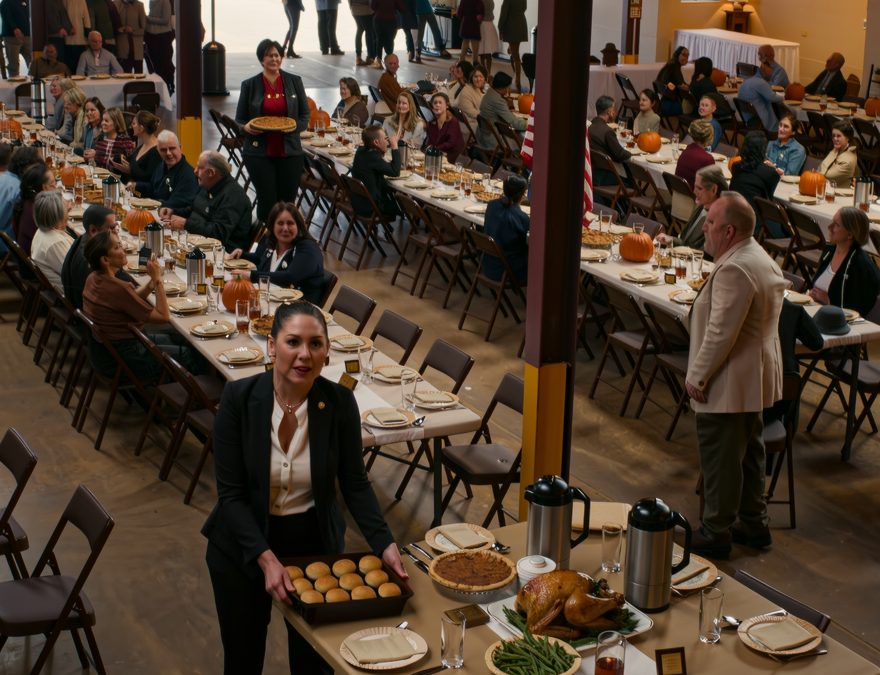
Three hundred people were already seated.
I was standing near the head of the longest dinner table we had ever built when the loading dock doors opened.
My mother came in first.
My father followed.
Then my sister Danielle, holding her phone horizontally in front of her face, already recording.
The noise inside the warehouse faded row by row.
Conversation stopped.
Forks lowered.
People turned in their chairs.
Seven years earlier, those same people had left my Thanksgiving dinner on a paper plate outside a locked front door.
My mother had texted me that I was not clean enough to eat inside.
I had taken the plate to my car and eaten alone at the end of their street.
Then I drove out of their lives.
What none of them knew when they walked into my warehouse seven years later was that every chair in that room existed because of what they had done to me.
To understand that, you have to go back to Hartwell, Ohio, and the smell of bleach on my hands.
I was twenty-seven then.
I rented a room above Kessler’s Laundromat on Main Street because it was cheap and because cheap was what I could afford.
The dryers ran until ten every night, so the floor beneath my bed vibrated gently until closing.
My apartment always smelled faintly of warm lint.
I considered that an improvement.
Most of my waking hours smelled like industrial cleaner.
I worked housekeeping at the Hartwell Motor Inn from six in the morning until two in the afternoon.
After that, I cleaned private homes around town.
Doctors.
Teachers.
Insurance agents.
People who lived in the sort of houses my mother used to point out when I was a child.
My hands were cracked across every knuckle.
I kept heavy-duty salve in my glove compartment and a pair of clean gloves for church.
The salve got more use.
People hear the word cleaner and imagine a mop.
They rarely think about chemistry.
Cross contamination.
Dwell time.
Surface compatibility.
Workflow.
The difference between making something look clean and actually disinfecting it.
I loved the work.
More importantly, I was good at it.
And I had a plan.
I kept it written on an index card folded inside my wallet.
Someday I would own a cleaning company.
Real payroll.
Real insurance.
Real standards.
My name on the paperwork.
I had already chosen a name.
BrightStep.
Sometimes I whispered it while scrubbing grout.
“BrightStep.”
Like a prayer spoken through rubber gloves.
That November, the Motor Inn was short staffed, so I was working doubles and saving every tip in a coffee can I refused to touch.
Two days before Thanksgiving, my mother called while I was flipping a mattress in room eleven.
“Dinner is at two sharp,” she said.
“I know.”
“Danielle is making it elegant this year.”
I tucked the phone between my shoulder and ear.
“Elegant?”
“Cloth napkins. Place cards. Adults at the main table.”
“For ten people?”
She ignored that.
Then, before hanging up, she said what she always said to me before family events.
“Don’t embarrass me.”
The call ended.
No goodbye.
My mother rarely said goodbye.
She preferred leaving you holding the tone.
You had to see Carol O’Neil’s kitchen to understand Carol O’Neil.
I stopped by the Sunday before Thanksgiving with two pie pumpkins from a farm stand because bringing useful things was my role in the family.
Useful.
Quiet.
Gone before dessert.
Danielle was rinsing a wineglass at the sink.
She set it in the drying rack.
My mother picked it up without a word, held it toward the window, inspected it, and washed it again.
That was their relationship in one glass.
My mother had grown up as the daughter of a school janitor.
The kids at Hartwell High called her “the janitor’s kid” for four years.
She told that story like a veteran describing combat.
She married my father, Walt, who had a steady job managing parts at a dealership and a personality designed to survive my mother by remaining mostly silent.
For thirty years, Carol had tried to scrub every trace of poverty from our family name.
Danielle helped.
She married Rick Prescott, whose family owned a regional food distribution company.
They bought a brick house with white columns.
Danielle became the family success story.
I cleaned motel bathrooms.
That made me the thing everyone spoke about carefully.
That Sunday, Danielle had cardstock samples spread across the kitchen counter.
“This year should look like something,” she said.
She held up ivory card stock.
“Place cards.”
My mother nodded approvingly.
“We need them.”
Dad looked over the top of the sports section.
Then he looked back down.
That was his vote.
I remember thinking it was strange to need assigned seating at a family dinner where everyone shared the same last few names.
For just a second, I wondered which names would be printed.
Then I let the thought go.
Letting things go had always been my oldest family responsibility.
I should have counted the cards.
Thanksgiving morning, the other housekeeper scheduled with me quit.
Her name was Rhonda.
At nine fifteen, she walked into the supply room, hung up her apron, and announced that her sister in Dayton had a couch waiting for her.
I did not blame her.
But suddenly fourteen checkout rooms, a full linen turnover, and every holiday mess belonged to me.
I had planned the day carefully.
I had traded shifts so I could finish by noon.
A garment bag hung in my car containing a clean sweater, good jeans, and my church gloves.
I was supposed to leave work, shower, change, and arrive at my mother’s house looking like a daughter instead of housekeeping staff.
Instead, I stripped beds until my forearms burned.
At eleven, I texted Mom.
“Running late. Coming straight from work. Save me a seat.”
The message showed as read almost immediately.
No reply.
I assumed she was busy with the turkey.
At one thirty, I clocked out.
I was still wearing my uniform.
My hair was flattened from work.
My collar smelled like disinfectant.
I had a choice.
Drive home, shower, change, and arrive even later.
Or go directly to Birchwood Lane.
My family kept score with clocks.
I thought they cared more about lateness than clothing.
So I chose the clock.
I drove with the windows cracked despite the November cold, hoping the air would pull the bleach smell out of my shirt.
At every stoplight, I rehearsed.
“Sorry I’m late. Rhonda quit. Fourteen rooms. You would have done the same.”
At two forty, I turned onto Birchwood Lane.
Every car was already there.
Danielle’s SUV.
My aunt’s Buick.
My uncle’s truck.
The dining room windows glowed gold.
For a second, I saw the curtain move.
Then fall.
I parked at the curb.
Grabbed my garment bag out of habit.
Walked to the front door.
The storm door was locked.
So was the main door behind it.
The porch light was on in the middle of the afternoon.
That was a message all by itself.
I rang the bell.
I heard it chime through the house.
I heard laughter.
Chairs.
Silverware.
Nobody came.
I rang again.
Nothing.
Then I looked down.
Centered on the top step was a paper plate covered in foil.
My name had been written across it in black marker.
MYRA.
All capitals.
I lifted the foil.
Turkey.
Stuffing.
Green beans arranged neatly.
A dinner roll with butter already stiffening in the cold.
Whoever prepared the plate had taken care with it.
That was the part that hurt most.
I stood outside my mother’s house holding a warm Thanksgiving dinner made by people who would not open the door.
My phone vibrated.
Mom.
“You can eat on the porch. You’re not clean enough for the table.”
I read it once.
Then again.
I looked through the narrow gap between the dining room curtains.
Cloth napkins.
Candles.
Little folded place cards.
Eight chairs.
Eight people.
Eight cards.
I counted twice.
There had never been a chair for me.
That table had known I was excluded before I even texted that I was running late.
One detail stayed with me for years.
The handwriting on the foil.
My mother wrote in small, slanted cursive.
Tight and sharp.
The letters spelling MYRA were large and rounded.
The A ended in a long gentle tail.
It was not my mother’s handwriting.
I was too hurt to wonder whose it was.
I picked up the plate.
Walked back to my car.
Drove to the end of Birchwood Lane and parked beneath a sycamore where my family could not see me from the windows.
I balanced Thanksgiving on the steering wheel.
The turkey was still warm.
That somehow made it worse.
I managed three bites.
Then I sat there with my uniform still smelling of bleach and my name written on foil in my lap.
I started doing the kind of arithmetic nobody should have to do.
How many holidays had I carried food through that same door?
How many times had I cleaned my mother’s entire house before parties so she could tell guests she had been working all week?
How many times had I paid for things nobody mentioned afterward?
A knock on the passenger window nearly made me drop the plate.
Mrs. Gaines stood outside.
She lived two houses down.
She was in her seventies then and walking an elderly beagle wearing a red holiday coat.
She looked at me.
Then the plate.
Then toward my parents’ glowing dining room.
“Honey,” she said through the glass, “is that your dinner?”
I gave her the smile I had learned in service work.
The one designed to stop questions before they became pity.
“Just heading out.”
She kept looking at me.
“Big family,” I added. “Small table.”
Her face changed.
Not sympathy exactly.
Something more deliberate.
Years later, I realized what she was doing.
She was memorizing the scene.
Finally she nodded and walked away.
I drove past my parents’ house without slowing.
The porch light still burned over the empty step.
I did not know it then, but I was driving toward the rest of my life.
For three days, nobody called me.
That told me everything about what happened after I left.
On Sunday night, I sat on my bed above the laundromat with the dryers humming beneath me and typed the longest message I had ever written.
I explained Rhonda quitting.
The fourteen rooms.
The garment bag in my car.
What it felt like to see my own name written on a meal left outside a locked door.
I read the message twice.
Then deleted the whole thing.
Because explaining yourself to people who locked the door is just another form of knocking.
Instead, I wrote one sentence.
“I got the message. I won’t bother the table again.”
I sent it to Mom.
Then I started blocking numbers.
My mother.
Danielle.
My aunt.
My cousins.
One by one.
My thumb was hovering above Dad’s contact when the phone rang.
It was Tessa.
My cousin on my father’s side.
The only relative who had kept sitting beside me at the kids’ table long after both of us were old enough to leave it.
She did not apologize.
Instead she said, “There’s something in the family group chat you’re going to need someday.”
My grip tightened around the phone.
“What?”
“Not tonight.”
“Tessa.”
“You’re not ready tonight.”
“What is it?”
“When you are ready, I’ll still have it.”
She paused.
Then said, “Keep my number unblocked.”
I said nothing.
“And go build a life so big you forget the porch existed.”
I kept Tessa’s number.
For reasons I could not explain, I also left Dad unblocked.
Then I pulled the coffee can from my closet.
One thousand nine hundred dollars.
Two years of tips and an old security deposit.
That was what I had.
It was also enough.
The week after Thanksgiving, I moved to Columbus.
I rented a room month to month in a house filled with nursing students.
I took an overnight cleaning job at a dental clinic off Sawmill Road.
And I learned the city by its empty parking lots.
There is a lot of time to think while disinfecting dental operatories at two in the morning.
I thought mostly about Grandma Ruth.
Dad’s mother.
She had died two years before the porch.
Ruth was the only person in that family who ever looked at my damaged hands like they were proof of something good.
She had raised four children on a line cook’s wages and vegetables from her garden.
One Sunday, after my mother made a remark about my uniform, Ruth reached across the table and turned my hand palm up.
“Clean hands are hands that worked,” she said.
When she died, she left me two things.
Her recipe box.
And a letter.
I never read the letter aloud to anyone.
Those were the only things from Hartwell I cared about keeping.
In Columbus, I taped a piece of paper to my bathroom mirror.
BRIGHTSTEP.
The company still existed only in my head.
I wanted the name to be the first thing I saw every morning and the last thing I saw before bed.
I kept one other thing too.
The paper plate.
I washed it gently.
Dried it under heavy books so it would stay flat.
Then slid it into a manila envelope.
My roommates thought I was keeping an old concert ticket.
I never corrected them.
Some people save photographs to remember good days.
I saved a paper plate so I would never renegotiate with the bad ones.
In January, Tessa called with what she described as “the official version.”
Apparently my mother had told everyone that I arrived hours late, refused to enter the house, grabbed the loving plate they had prepared, and stormed away because I was ashamed of being a cleaner and jealous of Danielle’s Thanksgiving table.
“She told it at church,” Tessa said.
I closed my eyes.
“She told it at the Cut and Curl. She told Aunt Lorraine you screamed at her on the porch while she begged you to come inside.”
There had been no screaming.
No begging.
Only a locked storm door and a text message.
Tessa asked, “Do you want me to tell them the truth?”
“No.”
“You sure?”
“Let them keep their version.”
“Myra.”
“I’ll keep the receipts from my own life.”
Tessa laughed softly.
“You sound like Grandma Ruth.”
That was the best compliment anyone had ever given me.
After we hung up, I opened the notes file where I was planning BrightStep.
At the top I typed:
BUILD SOMETHING THEY CAN’T IGNORE.
I stared at it for a while.
Then deleted it.
Spite makes a terrible foundation.
I replaced it with:
BUILD SOMETHING THAT DOESN’T NEED THEM.
Seven years is a long time.
For me, it turned out to be exactly enough.
Year one was one woman, one used Corolla, and a trunk organized better than some medical supply rooms.
I worked overnight at the clinic.
Days and weekends belonged to BrightStep.
A chiropractor’s office.
An insurance agency.
A tax preparation storefront that looked as though it had been hit by a hurricane every April.
I never tried to be cheapest.
I tried to be best.
The motel had taught me speed.
The dental clinic taught me standards.
Bloodborne pathogen rules.
Disinfection protocols.
Documentation.
The difference between appearance and actual safety.
I spent money I should have used for groceries on certification classes at the community college.
I sat in the front row wearing my work polo and took notes as though the students behind me were competition.
Because they were.
My first private client wrote the company check to Myra O’Neil.
Wrong name formatting.
Correct amount.
Before cashing it, I photocopied the check.
I taped the copy beside the piece of paper that said BRIGHTSTEP.
Proof beside promise.
The real turn came because of Dr. Feld.
He owned the dental clinic where I worked nights.
One evening he stayed late and watched me disinfect an operatory.
He noticed me cleaning the foot pedal beneath the dental chair.
“Why are you doing that?”
“Cleaning it.”
“Nobody checks the pedal.”
I looked up.
“Patients don’t.”
He waited.
“Germs don’t care what patients check.”
He laughed.
Then he looked around the room differently.
“You’re the only cleaner we’ve had who touches that pedal.”
The company he used was large and cheap.
Also sloppy.
He started leaving notes for me.
At first they were requests.
Then questions.
Finally one night, I found a note on the reception desk.
“What would you charge to clean this whole building under your own company?”
The following evening, I gave him a number.
A fair number.
Not a desperate one.
Every instinct in me wanted to underprice myself.
I did not.
Dr. Feld said, “Yes,” before I finished explaining it.
Then he said the sentence that changed more than my income.
“Get an LLC and liability insurance. I’d rather pay a company than an individual.”
He smiled.
“And you should be a company.”
Six weeks later, I stood inside a print shop holding the operating agreement for BrightStep Cleaning LLC.
My name was printed where ownership names go.
I carried the document to my Corolla.
Closed the door.
Then sobbed with my forehead against the steering wheel.
The last time I had sat alone in a parked car holding something that mattered, it had been turkey on a paper plate.
Same position.
Different cargo.
I gave myself ten minutes.
Then I fixed my face because I had a four o’clock walk-through.
That same week, an envelope arrived from a bank in Hartwell.
It had been forwarded from my old address.
I left it unopened in my passenger seat for three days.
Mail from Hartwell felt like receiving pieces of the porch by post.
Eventually, sitting outside the dental clinic around midnight, I opened it.
Past-due notice.
Second mortgage.
My parents’ names.
Their Birchwood Lane address.
Ninety days delinquent.
Then I saw the monthly payment.
I knew the number.
For three years, that exact amount had left my hands on the first of every month.
Mom called it “gas money.”
“Myra, help your mother with gas.”
The amount could have fueled a vehicle across the country and back several times.
We both knew it was not gas.
Dad’s back had forced him into early retirement.
My parents had refinanced.
My monthly envelopes were keeping the second mortgage current.
Calling it gas simply saved my mother from saying the full sentence.
The daughter she considered too dirty for the table was helping pay for the house.
Those payments stopped the week they locked me outside.
Not because I had planned revenge.
I simply left.
And nobody called.
The account was now ninety days behind.
I checked the calendar.
The timing matched perfectly.
I sat in the car waiting to feel guilty.
Nothing came.
What I felt instead was cold clarity.
They had known what I carried.
They simply believed I would keep carrying it no matter how they treated me.
I wrote the date across the envelope.
Filed it in the glove box.
Sent nothing.
By year three, BrightStep employed three people.
Me.
Rosa.
Dale.
Rosa was a single mother who had been fired by a large cleaning chain after missing a shift when her son had strep.
She arrived at her interview carrying a recommendation letter from a private client.
That told me enough.
Dale was sixty and an Army veteran.
He ironed his shirt before interviewing for a floor stripping job.
I hired them both.
My accountant complained about the wages I offered.
I ignored him.
I had done the work.
I knew what it cost a body.
BrightStep specialized where other companies preferred not to bother.
Medical offices.
Dental practices.
Places where cleaning had real standards and consequences.
We got referrals.
Then more referrals.
I created one company rule that had nothing to do with disinfectant.
I made it on Rosa’s first day.
I found her eating a sandwich while standing beside a janitor sink.
“Sit down.”
She looked confused.
“I’m almost done.”
“Nobody eats standing up on my clock.”
“What?”
“Every work site gets a break table.”
She stared at me.
“And chairs.”
I pointed toward the office.
“Real chairs.”
Rosa thought it was one of my quirks.
Dale understood immediately.
He had eaten too many meals from tailgates and truck hoods in his life.
From then on, he refused to start lunch until everyone had somewhere to sit.
I never told them why.
Word got around anyway.
One clinic manager described BrightStep to another office as “the company that treats cleaners like people.”
Best marketing line we never wrote.
Tessa kept me informed about Hartwell.
Danielle married Rick Prescott under a wedding tent with a string quartet and gold-rimmed tableware.
Tessa described it as “a wedding designed to be photographed instead of attended.”
Rick’s company, Prescott Provisions, supplied food to restaurants and school kitchens across two counties.
Danielle handled the image, paperwork, and most of the talking.
Around year four, Tessa became quiet during one of our calls.
“You should probably know what your mother says about you.”
“I can guess.”
“No. She has a specific line.”
I waited.
“She tells people you clean toilets in Columbus.”
I folded a towel into thirds.
“She says it like a warning.”
I placed the towel on the stack.
“She isn’t wrong.”
“Myra.”
“I do clean toilets.”
I looked at the perfectly folded linens.
“They’re spotless.”
Year four nearly destroyed BrightStep.
A property group controlling six clinics represented almost a third of our revenue.
First they paid at thirty days.
Then sixty.
Then ninety.
Then in promises.
I had eleven employees by then.
I could skip my own paycheck.
I could not skip theirs.
One night I sat at my kitchen table with a business loan agreement in front of me.
The interest rate looked criminal.
I had the pen in my hand.
Then the phone rang.
Hartwell number.
My entire body tightened.
I always assumed an unknown call from Hartwell would eventually be about Dad.
It was not.
A nurse from Hartwell General was calling for Mrs. Gaines.
The woman who had seen me eating Thanksgiving dinner in my car.
She had been admitted overnight for observation.
She was not dying.
She wanted that made clear.
But according to the nurse, she “was not planning to leave the hospital with something still unsaid.”
Mrs. Gaines came on the line.
“You’re the girl who ate dinner in the car.”
I smiled despite myself.
“Hello, Mrs. Gaines.”
“You send me a Christmas card every year like I don’t know who it’s from.”
I looked at the loan document.
“I know who you are, honey.”
She paused.
“I never forgot what I saw on that porch.”
My hand loosened around the pen.
“I wanted you to know somebody saw it.”
I closed my eyes.
“Thank you.”
The next morning, I called the property group.
No apologizing.
No begging.
“Net thirty. Deposits on future work. Or BrightStep walks.”
They resisted.
I held.
They agreed.
The loan agreement went through the shredder.
I sent Mrs. Gaines a Christmas card that year with my full name signed at the bottom.
The following year, I stopped waiting for business to find me.
Carver Medical Group operated nine clinics across three counties.
Their facilities director, Pat Loomis, was known for destroying cleaning vendors during contract renewal.
Four companies bid.
Three had presentations far more polished than mine.
Pat ignored all of them.
Instead, she requested a live walk-through.
One hour.
Working clinic.
Tell her what you see.
One competitor reportedly spent most of his hour talking about his vehicle fleet.
Another repeated pricing from laminated cards.
I walked through Pat’s clinic and showed her what the current cleaning company had missed.
The underside of the reception counter where hands touched constantly.
Sterilization room handles.
Dental chair foot pedals.
A supply closet whose inventory log had not matched the shelf for months.
At the end, Pat asked, “Where did you train?”
Years earlier, the answer would have embarrassed me.
Not anymore.
“Housekeeping.”
She raised an eyebrow.
“Hartwell Motor Inn. Six years.”
She smiled.
“Best infection control program in Ohio. They just don’t call it that.”
Pat laughed once.
Sharp.
Like a stapler.
BrightStep got all nine clinics.
Later, I heard one of the losing vendors had called me “a motel maid playing dress-up.”
Pat reportedly answered, “I’ll take a maid over a salesman in any building where people bleed.”
I sent her a fruit basket that Christmas.
She returned it with a note.
“Spend it on your employees.”
We renewed with Carver three more times.
The week BrightStep moved into its first proper office and warehouse, I finally unpacked boxes that had followed me through years of apartments.
At the bottom of one box, beneath tax folders, was the manila envelope.
I opened it.
The paper plate slid onto my new desk.
Its edges had softened.
The foil was gone.
But the marker remained.
MYRA.
Big round letters.
Long tail on the A.
People often frame their first dollar.
I drove the plate to a frame shop.
The young man behind the counter handled it with white gloves as though I had brought him museum art.
He asked no questions.
The finished frame went on the wall behind my desk.
Beneath it, I added a small brass plaque.
RESERVED SEATING.
Rosa asked about it once.
“It was my first business plan,” I told her.
That was technically true.
But something happened while the plate was under the frame shop lights.
For the first time in years, I looked at the handwriting instead of the memory.
Those rounded letters.
The careful spacing.
The soft tail on the A.
My mother had never written anything gently in her life.
If Mom had not written my name, who had?
The Long Table began by accident in year five.
The Wednesday before Thanksgiving, I found Devon, our newest employee, signing up for an unnecessary holiday monitoring shift.
“Why are you volunteering?”
He shrugged.
“Empty apartment.”
He looked embarrassed.
“Holiday pay seems better than sitting there.”
I stood looking at him.
Twenty-two years old.
BrightStep polo.
Trying to turn loneliness into overtime.
The porch came back so clearly I could almost smell the cold butter on the roll.
“The monitoring shift is canceled.”
His face fell.
“Did I do something wrong?”
“No.”
I went home.
Could not sleep.
At six the next morning, I ordered folding tables.
By Thanksgiving afternoon, thirty people were sitting inside our warehouse.
Employees.
Children.
Rosa’s mother.
Dale wearing a tie.
Families.
I stood to make a toast.
Only one sentence came out before my throat closed.
“Everyone eats on real plates here, and everyone gets a chair.”
They thought it was sentimental.
It was policy.
The following year, we fed one hundred twenty people.
Employees and relatives.
Then neighbors.
Then people we had never met.
By year seven, we were preparing for three hundred.
Residents from senior housing.
Night-shift workers.
College students who could not afford to travel home.
People who would otherwise spend Thanksgiving alone.
We rented three hundred china place settings.
I paid the deposit personally.
Above the warehouse entrance hung a banner containing the only rule.
NO PAPER PLATES.
We also used name cards.
That started after an elderly man once froze in the doorway and asked whether he was really allowed to come inside.
A name card fixed that.
Your name already printed.
Your chair already waiting.
Nobody had to ask whether they belonged.
My staff thought it was hospitality.
They were right.
But every November, while arranging those little folded cards, I remembered looking through my mother’s curtains and counting eight.
Eight names.
Eight chairs.
No Myra.
By year seven, the Long Table had a waiting list.
Mrs. Gaines became a regular guest too.
She had moved to senior housing in Columbus after her husband died.
The first year her building participated, she descended from the bus using a cane like a queen arriving for inspection.
She looked at me.
“You.”
I smiled.
“Yes, ma’am.”
“The girl with dinner in the car.”
“Still me.”
She handed me her cane.
Then took my arm instead.
“I’m sitting near the kitchen.”
“Of course you are.”
“I like my food hot.”
“Yes, ma’am.”
From then on, Mrs. Gaines had a permanent seat.
Every year before leaving, she patted my hand and gave the same review.
“Better than last year. Keep going.”
That autumn, Tessa came to Columbus.
She toured BrightStep.
Met Rosa.
Saluted Dale.
Saw the framed paper plate.
Then, over takeout in my kitchen, she became very quiet.
“You told me someday.”
I looked at her.
“I think it’s someday.”
She placed her phone on the counter.
The family group chat.
The one I had never been included in.
A screenshot from Thanksgiving seven years earlier.
Timestamp: 1:11 p.m.
I was still cleaning rooms at the Motor Inn.
Danielle had written:
“She’s coming straight from work in the uniform.”
Then:
“Just leave her plate outside. She’ll get the hint.”
Below it, Mom had replied:
“Fine. But I’m not dealing with the drama when she cries.”
Two relatives had reacted with thumbs-up icons.
Aunt Lorraine.
One cousin I used to babysit.
That was it.
My exclusion had been planned in less space than a grocery list.
I read the screenshot over and over.
Tessa watched me.
“You okay?”
“Mostly.”
I meant it.
Old scars do not become new wounds simply because you finally see their shape.
But one thing bothered me.
“Who else was in the chat?”
Tessa looked down.
“Who actually put the plate outside?”
She hesitated.
Then said something I had never heard from her before.
“That isn’t mine to tell.”
Two nights later, I drove to Hartwell.
No plan.
No invitation.
Just fifty miles of road.
I parked beneath the same sycamore tree.
The Birchwood house needed paint.
The porch light still cast the same yellow circle onto the top step.
I saw my mother move past the kitchen window.
Dad sat in his recliner watching television.
Ordinary people living an ordinary evening inside a house where they had done an extraordinary thing to their daughter.
My hand rested on the car door.
For a moment, I imagined knocking.
Walking inside.
Putting the plate on their coffee table.
Letting them watch me explain exactly what they had created.
It would have felt wonderful.
For about ninety seconds.
Then my mother would have a new story.
“Myra came screaming to the house in the middle of the night.”
Seven years of peace traded for ninety seconds of theater.
I took my hand off the door.
Some doors should not be knocked on twice.
I drove back to Columbus.
That year, BrightStep reached one hundred twenty employees.
The regional chamber named us Small Business of the Year.
When I saw the email, I closed my office door and cried.
The janitor’s granddaughter.
The motel cleaner.
Businesswoman of the year.
I did not accept the award on stage.
Rosa did.
She deserved the recognition for building our medical division.
I sat in the third row and applauded until my hands hurt.
A newspaper photographer caught me mid-clap.
That photograph eventually reached Amanda Reyes, a features writer for the Columbus Ledger.
She called me.
She knew about BrightStep.
The Long Table.
The framed plate.
She wanted to write the story.
“Thanksgiving morning,” she said.
My instinct was no.
Anonymity had protected me.
Hartwell remained distant because Hartwell did not know what I had built.
But I thought about Rosa holding that award.
About three hundred chairs.
About some twenty-seven-year-old woman somewhere eating a holiday meal in her car.
“Do it.”
Amanda asked, “Anything off limits?”
“One thing.”
“What?”
“The handwriting on the plate.”
“Why?”
“Because I still don’t know who wrote my name.”
She agreed.
Neither of us knew the answer was already moving toward us.
Two weeks before Thanksgiving, my procurement manager forwarded a food-service bid.
We were buying dinner for three hundred guests.
I opened the attachment.
Prescott Provisions.
Hartwell, Ohio.
Richard Prescott, owner.
My brother-in-law.
The cover letter praised BrightStep’s community leadership.
The final line read:
“It would be a privilege to serve your table, Ms. O’Neil.”
I stared at it.
Rick had no idea.
The proposal had been addressed to M. O’Neil.
To him, I was simply a corporate buyer.
Prescott Provisions needed business badly enough to bid on a cleaning company’s holiday dinner.
My brother-in-law was asking for a seat at my table without knowing it belonged to me.
From that moment forward, I knew who they were.
They did not know who I was.
That kind of knowledge can make you dangerous if you enjoy revenge.
I did not want revenge.
So I did due diligence.
Prescott’s bid received the exact same review as everyone else.
Supplier history.
Safety.
Labor records.
Delivery performance.
References.
It failed.
Two supplier judgments.
A recent food safety violation.
Complaints from school kitchens about substitutions and incomplete deliveries.
One settled wage claim.
Another pending.
The wage claims alone were enough for me.
I had spent too many years carrying work nobody respected.
BrightStep would not hire vendors who failed to pay workers.
I called Tessa.
“How bad is Rick’s company?”
“Bad.”
“Actual bad or Hartwell gossip bad?”
“Actual.”
She sighed.
“He’s borrowing against schedules to cover interest. Danielle tells everybody they’re expanding.”
Then she said, “There’s something else.”
A photograph arrived on my phone.
Legal notices.
Pre-foreclosure.
Birchwood Lane.
My parents’ house.
Ninety days from a sheriff’s sale.
I read it slowly.
Tessa explained the seven years after I left.
When my payments stopped, Mom and Dad refinanced.
Then refinanced again.
Dad’s pension could not stretch far enough.
They borrowed against the house.
Interest accumulated.
Appearances cost money.
Eventually the bank stopped caring what Carol O’Neil told women at the Cut and Curl.
None of them had ever connected their earlier stability to me.
In their version of the story, the house functioning for three years was normal.
Its collapse after I left was somehow further evidence that I was selfish.
Families with books like that cannot be audited.
A few days later, flowers appeared at BrightStep.
Autumn chrysanthemums.
No sender.
The card read:
“Proud of you.”
The handwriting was careful.
Slightly slanted.
It reminded me of Dad’s.
I put the card into my desk drawer.
Beside the unanswered questions.
Prescott Provisions lost the food contract.
Hollis Brothers Food Service won.
Their bid cost eight percent more.
Their drivers were union.
Their record was clean.
Normally procurement handled rejection notices.
I wrote Rick’s myself.
Three paragraphs.
Professional.
Objective.
Compliance criteria.
Labor concerns.
Opportunity to reapply after resolving outstanding issues.
No emotion.
Then I reached the signature line.
For seven years, I had signed BrightStep correspondence as M. O’Neil.
Branding, I told myself.
It had also been hiding.
This time, I typed:
Myra O’Neil
Founder and CEO
BrightStep Services
Then I hit send.
Rick’s mailbox was full.
The system bounced it.
My assistant resent the message to Prescott’s general business address.
That evening, Tessa texted me.
“The office inbox is Danielle’s.”
I sat upright in bed.
Somewhere in Hartwell, my full name was waiting inside my sister’s email.
She had not found it yet.
The Tuesday before Thanksgiving, a television crew visited BrightStep to film preparations for the Long Table.
I planned to stay off camera.
Owners should be carrying clipboards, not performing.
But cameras find whoever everyone else keeps looking toward.
At 6:11 that evening, five seconds of my face appeared on Central Ohio television beneath the caption:
FOUNDER MYRA O’NEIL SAYS NO ONE EATS ON PAPER PLATES AT HER TABLE.
Five seconds.
After seven years, that was enough.
My sister happened to be in Columbus that evening.
Her daughter Emma had injured her ankle at a volleyball tournament and was being checked at a pediatric orthopedic clinic.
The waiting-room television showed the news.
Emma later told Tessa what happened.
“Mom stopped talking in the middle of a word.”
Danielle stood up.
Walked toward the television.
Stared.
A nurse asked her to sit down.
She did not.
She took a photograph of the screen.
Then spent the entire drive back to Hartwell typing.
At 7:40, the family group chat exploded.
Tessa sent screenshots in real time.
First, Danielle posted the television image.
“GUYS LOOK WHO I FOUND.”
Then:
“She owns BrightStep.”
“That huge cleaning company.”
“The Thanksgiving table on the news is hers.”
Nine minutes of silence followed.
Nine full minutes in the busiest family group chat in Hartwell.
Then my aunt posted a question mark.
Mom followed.
“Is that our Myra?”
Our.
Seven years of silence, and suddenly I had become plural property.
Messages multiplied.
“Does anyone have her number?”
“Where does she live?”
“Is she married?”
“Does she know about the house?”
Then Danielle:
“Don’t mention the house right away.”
Eleven minutes into rediscovering me, they already had a strategy.
I put the phone facedown.
I knew what was coming.
The calls began immediately.
I ignored them.
At the warehouse, I counted china.
Three hundred plates.
Three hundred water glasses.
Real forks.
The phone rang while Dale and I taped floor plans to the loading dock.
It rang on my drive home.
It rang while I brushed my teeth.
Around midnight, I finally checked.
Eighty-nine missed calls.
Fourteen numbers.
Mom’s cell.
Dad’s landline.
Danielle.
Rick.
Aunt Lorraine.
Cousins who had apparently remembered affection at the same moment they discovered I owned a successful company.
My voicemail was full.
I listened to the first message.
Mom.
Her voice had returned to the sweet church tone I had not heard directed at me since before I started wearing a uniform.
“Sweetheart, it’s Mom. We saw you on the news. Honey, we are so proud of you.”
I leaned against the counter.
“We’ve been looking for you everywhere.”
I laughed once.
I had lived fifty miles away.
My name had been public in business filings for years.
“Call your mother back, sweetheart.”
I deleted the message.
Then went to bed.
Not clean enough for Thanksgiving dinner.
But apparently successful enough for eighty-nine calls in one evening.
Wednesday morning, Danielle finally opened the Prescott Provisions email account.
She found my rejection letter.
Dated before the television broadcast.
That detail mattered.
I had rejected their company before knowing they knew who I was.
Politely.
For documented reasons.
On merit.
Danielle could not even tell herself I had spent seven years plotting revenge.
Her company had simply failed the same test as every stranger.
By lunch, she had developed another plan.
If I would not answer phones, they would appear in person.
The news had shown exactly where BrightStep’s Thanksgiving dinner was happening.
According to Tessa, Danielle said, “She can’t turn away family in front of three hundred people.”
Mom added, “We’ll bring a pie.”
Then she chose the weapon she thought would open any door.
“Ruth’s pumpkin.”
Grandma Ruth’s recipe.
My grandmother’s pie carried like a passport into a table built by the granddaughter she understood better than anyone.
Wednesday afternoon, Aunt Lorraine arrived at my office.
The same aunt who had reacted with a thumbs-up to the plan to leave my dinner outside.
She stood in the lobby wearing her good wool coat.
“Myra Jean.”
I waited.
“Look at all this.”
She spread her hands toward the lobby.
“Look at you.”
Seven years.
That was her opening line.
She tried weather.
My health.
Business.
Then finally reached the actual purpose.
“Your parents are going through something awful with the house.”
I said nothing.
“Thanksgiving would mean so much. Family is family.”
When she finished, I picked up a Long Table flyer.
“I’m glad you came.”
Her face brightened.
I handed her the flyer.
“Doors open at noon tomorrow.”
She looked down.
“Everyone gets a chair.”
“Myra…”
“Everyone is welcome.”
I held her eyes.
“That includes all of you.”
She smiled cautiously.
“But there will be no private meeting.”
The smile disappeared.
“And we will never discuss the house.”
She blinked.
“Family is family.”
“Yes, ma’am.”
I pointed to the flyer.
“That’s why it says everyone.”
She left.
That evening, I walked through the warehouse alone.
Three hundred chairs.
Three hundred china settings.
Three hundred name cards.
Every chair waiting for a person.
Nobody would stand in our doorway wondering if they belonged.
I straightened place cards for nearly an hour.
Tessa called around nine.
“They’re coming.”
“I know.”
“Carol. Walt. Danielle. Rick. Emma.”
I closed my eyes.
“They’re bringing the pie.”
“Of course they are.”
“They’re planning a reunion for the cameras.”
I looked down the length of the empty tables.
“Set three more chairs.”
Tessa became silent.
“Does that mean you’re forgiving them?”
“No.”
“Then why?”
“Because nobody stands in my doorway holding food while three hundred people watch.”
I touched one of the chairs.
“Whatever happens tomorrow, they sit down and they eat.”
“Myra.”
“That is the difference between my table and theirs.”
Thanksgiving morning, the Ledger published Amanda’s story.
The headline read:
THE FOUNDER WHO FRAMES A PAPER PLATE
The lead photograph showed the wall behind my desk.
The framed plate.
MYRA.
The brass plaque.
RESERVED SEATING.
The story told everything.
The locked storm door.
The text.
The meal in my car.
Seven years.
BrightStep.
The Long Table.
Amanda never named my relatives.
She did not need to.
Hartwell was small.
By eleven, the warehouse was alive.
Steam.
Cider.
Children.
An upright piano borrowed from Dale’s church.
Senior buses unloading at the dock.
Rosa’s team guiding guests to their name cards.
Mrs. Gaines sat near the head of the table.
Eighty-one now.
Cane beside her chair.
I was carrying rolls when the noise changed.
It started near the entrance.
Then moved inward.
Conversation falling silent one table at a time.
I set down the tray.
Turned.
My family stood in the loading dock doorway.
Mom in her church coat.
Dad holding his hat.
Danielle.
Rick.
Emma.
And a pumpkin pie.
Mom did not simply enter.
She made an entrance.
Arms opening as she walked down the center aisle.
Voice projected for maximum reach.
“My baby.”
Three hundred people watched her approach.
“There you are.”
She was crying before she reached me.
Real tears.
My mother could cry with remarkable precision.
Behind her, Danielle held her phone horizontally.
Recording.
Rick separated from the group almost immediately and drifted toward the sponsor tables, shaking hands and distributing business cards.
Emma stayed near the coat rack.
Thirteen.
Mortified.
She was the only one who entered that room carrying no guilt.
Mom reached me.
Held up the pie.
“Ruth’s pumpkin.”
She turned slightly toward the room.
“Your grandmother’s recipe, honey.”
Then back to me.
“For our fresh start.”
Three hundred people watched me look at the pie.
Then a chair moved.
Slowly.
Mrs. Gaines stood using her cane.
She straightened.
“I remember you, Carol.”
My mother froze.
Mrs. Gaines continued.
“I remember the plate on the porch.”
Silence filled the warehouse.
“I was there.”
Mom’s smile remained perfectly fixed.
Everything behind it changed.
“That was a misunderstanding.”
She turned toward Mrs. Gaines.
“The story became twisted over the years.”
Mrs. Gaines said nothing.
“It was a difficult day. We kept food warm for her.”
My mother laughed lightly.
“This town does love a story.”
She had practiced the version for seven years.
But I was no longer listening.
That morning, I had taken the framed plate down from my office.
I lifted it from beneath the serving station.
Placed it flat on the head table.
MYRA.
Large rounded letters.
Long tail on the A.
Mom looked at it.
Then away.
Dad did not.
He stared at the handwriting.
His shoulders slowly sank.
Something inside me already knew.
I asked quietly, “Dad?”
He looked up.
“The plate was Mom’s idea.”
His hands tightened around his hat.
“You just watched, right?”
Before Dad could answer, Danielle laughed.
A quick dismissive sound.
“Dad wrote it.”
The entire room heard her.
Her own face changed the moment she realized what she had said.
“Mom told him to put it outside.”
She stopped.
Dad stared at the plate.
When he finally spoke, his voice was barely above a whisper.
“Your mother said if she let you in smelling like that, she might as well eat outside too.”
I looked at him.
His eyes were wet.
Then he said something that nearly broke me in a way anger never could.
“I wrote your name nice.”
His voice shook.
“It was all I could think to do.”
He looked at the plate.
“I wrote it nice.”
Seven years.
That was the answer.
My father had prepared the plate.
He had written my name carefully.
He had also placed it outside and locked me away with the rest of them.
I had imagined this confrontation many times.
In none of those versions did my father sound like that.
I had no prepared speech.
What I had was seven years of learning how to speak quietly in rooms where I held authority.
So I looked at my mother.
“You taught me exactly what a seat at your table costs.”
She opened her mouth.
I continued.
“It costs everything you are.”
The room was completely silent.
“I stopped paying seven years ago.”
Then I told the story the way I would review a cleaning checklist.
One item at a time.
“Rhonda quit that morning.”
Mom looked around.
“I stripped fourteen rooms.”
No one moved.
“At eleven oh four, I texted you that I was coming directly from work.”
I looked at her.
“You read it.”
Her jaw tightened.
“You never answered.”
I continued.
“I arrived at two forty.”
Then the storm door.
The eight place cards.
The empty space that had never been mine.
Finally, I repeated the message.
“You can eat on the porch. You’re not clean enough for the table.”
Someone near the middle of the room murmured.
Then I said something even Amanda’s article had not included.
“The gas money.”
My mother’s eyes changed.
“Three years.”
Dad closed his eyes.
“Every first of the month.”
I looked directly at Mom.
“That money paid the second mortgage.”
She said, “That isn’t…”
“You knew.”
I kept my voice level.
“Dad knew.”
Then I gestured toward the room.
“The bank knows.”
Mom stared at me.
“I stopped paying the month you locked me outside.”
I let the silence hold.
“Seven years later, the foreclosure notice is public.”
I had not accused her.
I had not called her names.
I had simply inventoried the facts.
The room did the rest.
Heads turned toward my mother.
Whispers began.
Then her church voice broke.
The performance fell away.
She slammed Grandma Ruth’s pumpkin pie onto the head table.
The ceramic dish cracked.
“After everything I sacrificed for you!”
Her scream echoed through the warehouse.
“You owe this family!”
I stood still.
“You ungrateful, hateful girl.”
She swung her arm toward the warehouse.
My employees.
The table.
The china.
The guests.
Then she finally said the sentence she had spent her entire life preparing.
“You think these people respect you?”
I waited.
“Look at you.”
Her face twisted.
“You scrub their toilets.”
The silence afterward was different.
Then came a sound I will remember until I die.
A chair moving.
Then another.
Then dozens.
Rosa stood.
Dale stood beside her.
Devon.
The medical division.
Night crews.
Supervisors.
One hundred twenty BrightStep employees rose from their chairs.
Every one of them cleaned for a living.
Nobody spoke.
They simply stood.
My mother turned slowly.
A forest of cleaners surrounded her.
For the first time in my life, she searched a room and found no face willing to agree with her.
I looked at Danielle.
Her phone was still recording.
Then I repeated the sentence she had written seven years earlier.
“Just leave her plate outside.”
Danielle went white.
I finished it.
“She’ll get the hint.”
Her phone lowered slightly.
“Where did you…”
From the far side of the room, Tessa stood.
“I kept the screenshots, Danny.”
Danielle stared at her.
“All of them.”
Everything after that happened quickly.
My mother had wanted an audience.
She got one.
For thirty years she had carefully managed what Hartwell believed about the O’Neil family.
In less than five minutes, surrounded by hundreds of phones and her own daughter’s livestream, she destroyed the only thing she had spent her life protecting.
Her image.
Nobody took it from her.
She surrendered it herself.
Rick tried something different.
He approached me near the sponsor tables.
“Myra, surely the business contract could be reconsidered.”
I looked at him.
“Prescott Provisions was evaluated using the same criteria as every vendor.”
He lowered his voice.
“We’re family.”
“It failed compliance and labor review.”
“Myra…”
“Family does not change arithmetic.”
He looked around.
Too many witnesses.
Nowhere to sell the argument.
Then there was Dad.
He remained near the table.
Hat still in his hands.
I looked at him.
“You can stay.”
His face changed.
“Everyone eats here.”
I nodded toward the empty chair.
“That is the difference between my table and yours.”
For a long moment, he did not move.
Then Walt O’Neil removed his coat.
Sat down.
Placed his hat beneath his chair like a man entering church.
And stayed.
My mother left loudly.
Then suddenly.
Out through the loading dock doors.
The broken pumpkin pie remained on the table.
Danielle stood another few seconds with the phone still in her hand.
Then she realized there was no possible edit that would rescue what she had recorded.
She pocketed it.
Grabbed Rick.
Followed Mom.
The room did not boo.
Nobody applauded.
They simply let them leave.
That quiet was more final than either.
Then I saw Emma.
She stood near the coat rack.
Red-eyed.
Arms wrapped around herself.
Thirteen years old.
Abandoned between the adults leaving through the door and three hundred strangers who had just watched her family collapse.
Everything else disappeared.
I knew exactly what it felt like to be the one left standing at a threshold while adults decided your worth.
I crossed the warehouse.
At that exact moment, the volunteer coordinator’s microphone switched on.
“Dinner is served.”
People began moving.
Noise returned.
I stopped in front of Emma.
Held out my hand.
“Sit with me?”
She looked toward the dock where her mother had disappeared.
Then back at me.
“Okay.”
Her voice was tiny.
Then she said, almost experimentally, “Aunt Myra?”
My throat tightened.
“Aunt Myra.”
Seven years.
Somebody from that family finally said my name correctly.
Dinner continued.
That was always the point.
Three hundred people ate from real china.
Dad passed the rolls when they reached him.
He thanked every volunteer.
He ate everything on his plate with the solemn concentration of a man performing penance through casserole.
Emma sat beside me.
She ate two kinds of pie.
Then asked approximately seventeen questions about how a cleaning company worked.
The framed paper plate remained on the head table all afternoon.
People stopped to read it on their way for seconds.
Some touched the edge of the table near the frame.
Like a memorial.
Maybe it was.
Something ended in that warehouse.
And for once, it was buried properly.
The calls continued the following week.
I blocked the old numbers.
Then blocked the new numbers people found to replace them.
Cousins I barely remembered suddenly had deep emotional wells of family affection.
Aunt Lorraine called through three different phones.
Mom left one final voicemail.
It started with crying.
Two minutes later, the subject somehow became what the family “needed” from me regarding the foreclosure.
I deleted it before she finished.
The Birchwood house went through the legal process.
I did not stop it.
I will not lie and say I never thought about the porch when I saw the auction date.
Mom and Dad eventually moved into a two-bedroom apartment on Miller Street.
I never offered money.
No revenge.
No rescue.
That was the rule I had chosen years earlier while sitting beneath the sycamore tree.
There was still one thing I had to resolve.
The flowers.
The chrysanthemums sent to BrightStep.
“Proud of you.”
One evening, I placed that card beside the framed plate.
Looked at the handwriting.
Then I knew.
The same careful spacing.
Same slant.
The same instinct to make words gentle when the person writing them did not know how to say them aloud.
Dad.
He had written my name on the plate.
Years later, he wrote “Proud of you.”
Once in shame.
Once in something closer to love.
He also sent a thank-you note after Thanksgiving.
I never answered.
But I have not thrown either card away.
That means something.
I am still deciding what.
Danielle sent one message from a number I had not blocked yet.
“You’ve made your point.”
No apology.
Just a referee’s whistle from a woman who believed the problem was that the game had lasted too long.
I did not reply.
Some silences are answers.
She taught me that on Thanksgiving seven years earlier.
Instead, I did paperwork.
My attorney created an education trust for Emma.
Hers alone.
No parent in Hartwell could access it.
She will control it when she turns eighteen.
No announcement.
No leverage.
No conditions beyond education and adulthood.
Emma started taking the bus into Columbus on Saturdays.
She became our youngest Long Table volunteer.
Entirely her idea.
Tessa joined BrightStep full time in January to run our community programs.
The screenshots are archived now.
The receipts have cleared.
The paper plate still hangs behind my desk.
Every Thanksgiving, three hundred or more name cards sit on the Long Table before a single guest arrives.
Nobody has to stand in a doorway wondering whether there is room.
Nobody has to ask if they belong.
And nobody eats from a paper plate.
For years, I thought family meant the people who shared your blood.
Then I thought maybe family meant the people who stayed.
I understand it differently now.
Family is the person who makes sure you do not eat alone.
It is Mrs. Gaines knocking on a car window because she noticed.
It is Rosa refusing to start lunch until everybody is seated.
It is Dale wearing a tie to Thanksgiving.
It is Tessa keeping screenshots for seven years because she knew someday truth would need documentation.
It is three hundred people making space at a table without asking what job you do before deciding whether you deserve a chair.
And sometimes, family is a thirteen-year-old girl standing near a coat rack, saying “Aunt Myra” for the first time.
The cleanest thing I ever did was not cleaning a motel room.
Or a dental clinic.
Or building a company around standards nobody else wanted to maintain.
The cleanest thing I ever did was walking away from a table that only had room for my shame.
Then I built my own.
And I made it long enough for everyone.
