The chairman introduced me to the new CEO as “one of the junior pe
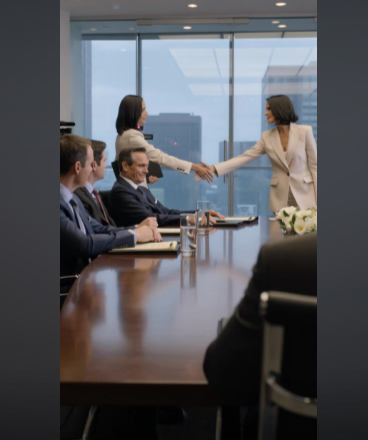
The Chairman Called Me A Low-Level Employee In Front Of The New CEO, But The Empty Seat He Ignored And One Quiet Clause Turned His $2.3 Billion Assumption Into A Morning He Could Not Control While The Cameras Kept Rolling Across The Boardroom
The chairman looked at my hand like I had offered him something dirty.
For one hard second, the whole boardroom seemed to hold its breath around that small, stupid gesture. My palm stayed open in the bright wash of the ceiling lights. The folder under my left arm pressed against my ribs. The arrangement in my other hand smelled clean and expensive, white lilies and eucalyptus tied in a satin ribbon somebody from communications had ordered to make the room look gracious for the cameras.
Richard Voss did not look at my face first.
He looked at my hand.
Then he looked at the folder.
Then he looked at the flowers.
Only after all that did he lift his eyes to mine, as if I had interrupted the natural order of a room where men like him decided where everyone else belonged.
I had stepped forward beside his chair because the incoming CEO, Daniel Hart, had just entered, and because my instructions had been simple: greet him, be visible, keep the close smooth. There were cameras mounted in three places, all with their small red lights on. One was for the internal stream, one for the investor archive, and one for the official record no one ever cared about until something went wrong.
“Welcome to Halcyon Dynamics,” I said.
Daniel’s hand shifted slightly, almost rising.
Richard cut in before it could.
“I don’t shake hands with low-level employees.”
He said it softly, but the lapel mic carried him. The sentence moved through the room with the gentle efficiency of a blade. A few people laughed because people do that when cruelty is dressed in a suit and they are too afraid to call it by its name. Someone near the far side of the table gave a short, embarrassed cough. One of the communications staff lowered his eyes to his clipboard, but his mouth twitched before he could stop it.
Daniel saw me.
That was the detail that landed hardest.
He saw me, recognized enough of me to know something was wrong, then looked down at the polished table as if the wood grain had suddenly become urgent.
I did not pull my hand back right away.
That bothered Richard more than I expected. His smile tightened, not because he was ashamed, but because I had taken half a second longer than the script allowed. People like him depended on immediate retreat. They said the humiliating thing, and everyone else hurried to make the moment smaller for them.
I lowered my hand on my own terms.
Then I set the arrangement at the edge of the table, close enough for Richard to smell it whenever he turned his head.
“I’m here as instructed,” I said.
“Then stand where you’re told,” he replied. “This meeting is for executives.”
The nervous laughter came back, thinner now. Nobody asked my name. Nobody asked why I had a seat on the call sheet. Nobody asked why Rafael Ortiz, Halcyon’s CFO, had gone very still at the other end of the room.
I looked down the long table.
There was one empty chair at the far end, pushed in so neatly it looked less like a place and more like a dare. No name card. No glass of water. No printed agenda waiting in front of it. Just a clean rectangle of table where someone had decided a person could be removed if they were inconvenient to the picture.
I walked to it.
The carpet swallowed my steps. A director leaned back to let me pass, though he did it with the expression of a man avoiding spilled coffee. When I reached the chair, I pulled it out slowly enough that the scrape carried.
No one stopped me.
No one corrected Richard.
No one corrected Daniel.
So I sat down, laid the folder flat in front of me, folded my hands over it, and waited while the chairman turned back toward the screen and said, “Let’s begin.”
Six weeks earlier, I had still believed Halcyon might be worth saving.
That was not sentimental. I did not have the luxury of sentiment in my work. Pelion Growth Capital managed money for hospitals, university endowments, retirement systems, and a dozen foundations whose names never appeared in glossy announcement decks. Every dollar we released belonged to someone’s future before it belonged to any company’s ambition.
Halcyon Dynamics had looked, on paper, like the kind of complicated American company I had spent my career trying to rescue from the blunt instruments of panic. It made control systems for warehouse robotics and battery-cooled industrial equipment, the invisible machinery that kept grocery shelves stocked and hospital deliveries moving. It had debt it could not outrun, contracts it could still protect, and engineers who spoke about thermal failure the way poets talk about weather.
The company did not need a miracle.
It needed discipline, cash, and leadership that understood people were not accessories to the numbers.
That last part was always the hardest.
My name was Nova Ellis. I was thirty-nine years old, though people who wanted something from me often called me “young” until they learned how many distressed balance sheets I had sat across from. I was a managing partner at Pelion, but titles had never been my favorite armor. Titles impressed the wrong people and frightened the right ones into silence. I preferred questions. I preferred watching how someone spoke to the person bringing water, how they waited through a junior analyst’s answer, how they reacted when a door jammed or a projector failed.
Small failures revealed large truths.
My mother had taught me that without ever putting it in those words. She had worked the front desk of a medical clinic outside Des Moines for twenty-eight years. She could tell which doctors were kind by the way they pushed open the lobby door at 7:40 in the morning. She knew which pharmaceutical reps were decent by whether they remembered her name after the samples were gone. When I was in high school, I used to wait for her in a vinyl chair near the coat rack and watch grown adults become two different people depending on who they thought mattered.
“Never confuse manners with softness,” she told me once, pulling her winter coat tight around her shoulders. “Some people only behave because they haven’t been inconvenienced yet.”
I thought about that often at work.
I thought about it the first time Halcyon’s leadership team joined our call and Richard Voss did not.
His assistant sent a message three minutes after the hour.
Richard Is Running Late. Begin Without Him.
We began without him.
Rafael Ortiz appeared on camera from a glass-walled conference room, tie loosened, sleeves rolled to his forearms. He had the careful face of a CFO who had been carrying too much bad news for too long. Daniel Hart joined from Seattle, where he was still finishing his exit from another manufacturing company. He wore a navy quarter-zip and looked polished in the reliable way executive search firms liked. He said all the right things about rebuilding trust, listening to teams, stabilizing vendor relationships.
I listened.
My senior associate, Priya Shah, walked through the model. Rafael asked sharp questions and admitted what he did not know. Daniel asked about timing, governance, and whether employee retention packages could be protected in the restructuring. Those were good questions. I wrote them down.
Richard arrived twenty-six minutes late.
He did not apologize. He appeared in the little square of the video with a silver head of hair, a pressed white shirt, and the faint irritation of a man forced to be somewhere he considered beneath his level of attention.
“Where are we?” he asked.
Priya paused mid-sentence.
I said, “We’re reviewing the revised liquidity bridge and the release conditions.”
Richard glanced down, probably at another screen. “Legal can handle conditions.”
“They can draft them,” I said. “They can’t satisfy them.”
His eyes moved to my square for the first time. I could feel him reading my face and not my title. It happened quickly. It always did.
“And you are?”
“Nova Ellis. Pelion Growth.”
He nodded once, a motion that did not contain recognition. “Right. Capital team.”
“Managing partner,” Rafael said, before I had to.
Richard’s expression barely changed. “Of course.”
But he had filed me away already.
I knew because five minutes later, when Priya explained a covenant issue, he interrupted her with, “Have one of your senior people send that over.”
Priya’s eyes flicked to me.
I did not rescue him from the mistake. “Priya is the senior person on that section,” I said.
Richard smiled thinly. “Then she can send it.”
It was small. No one would have built a case around it. No one would have stopped a transaction because a chairman had been patronizing on a video call. But I wrote it down anyway, not in the official file, not as evidence, but as a marker.
People tell you who they are in increments.
The next increment came during the plant tour in Joliet.
Halcyon’s main assembly facility sat on the edge of a flat industrial corridor where the wind came in hard over the parking lots and made every flagpole rope snap against metal. I arrived before the board group because I liked seeing a place before it performed for visitors. The lobby had a vending machine with one broken coil, a coffee station with mismatched mugs, and a wall of framed safety awards that had been dusted but not replaced in years.
A woman named Tanya met me by the entrance.
She ran second-shift operations and had the calm of someone who had solved three problems before breakfast. She walked me through production lines where technicians adjusted sensor boards under bright magnifying lamps. She knew every name, every bottleneck, every machine that needed a replacement part and every supervisor who could stretch a maintenance budget without lying to finance.
“This place still works because people are stubborn,” she told me.
“That’s usually where the value hides,” I said.
She gave me a quick look, then a smile. “You sound like you’ve been around old factories.”
“My grandfather welded farm equipment in Iowa. He said machinery had moods.”
“It does,” she said. “So do managers.”
Richard arrived forty minutes later with two directors, Daniel, and a photographer. The building changed around him. Not because anyone respected him more than Tanya, but because the air shifted when people were bracing for impact.
He shook hands with the plant general manager. He shook hands with Daniel. He shook hands with a county development official who had come for ten minutes and stayed for the cameras. When Tanya stepped forward to introduce herself, Richard gave her fingers a quick squeeze without making eye contact.
“Great,” he said. “Floor lead?”
“Operations manager,” Tanya replied.
“Right, right.”
Daniel heard it. I saw him hear it. He rubbed one thumb across the seam of his notebook and said nothing.
That was the second marker.
Near line four, a technician named Luis explained a cooling issue that had delayed a major shipment. He spoke carefully, not defensively, and laid out the problem in plain language. Richard listened for half a minute before turning to Daniel.
“This is what I mean,” he said. “We can’t let shop-floor anxiety drive corporate timing.”
Luis stopped talking.
The photographer lowered his camera.
Daniel gave a small laugh, the kind meant to be neutral enough to deny later.
I asked Luis to finish his thought.
Richard looked back at me. “We’re tight on time.”
“So is the shipment,” I said.
The words were mild. The effect was not.
Richard held my gaze for a beat, then spread one hand as if granting a favor. Luis continued. His explanation changed the timeline by two days and saved Halcyon from promising a delivery it could not make. Rafael thanked him later. Daniel did not.
After the tour, I found Tanya in the break room refilling the coffee urn. She did not look surprised to see me.
“You always ask the people at the machines?” she said.
“I try to ask the people closest to the problem.”
“Careful,” she said. “That kind of thinking makes executives nervous.”
“It should.”
She laughed, but not very hard.
That night, in my hotel room, I added a note to the closing memo. Leadership culture requires direct observation. Do not rely only on prepared board materials.
Priya read it the next morning and called me.
“Are we worried?” she asked.
“I’m attentive.”
“That’s your word for worried.”
“It’s my word for not being ready to walk away.”
She went quiet for a moment. “Is this a Richard problem or a Halcyon problem?”
“That’s what I’m trying to learn.”
I wanted it to be a Richard problem. One arrogant chairman could be managed if the rest of the system knew how to contain him. A company could survive a difficult personality if its board had a spine, its CFO had integrity, and its incoming CEO understood that culture was not something you repaired in press releases.
I was looking for the other people in the room.
For a while, I found enough of them to keep going.
Rafael sent clean numbers, including the ugly ones. Tanya forwarded operational details without dressing them up. Priya’s team confirmed the contracts were real, the customer relationships strained but salvageable, and the employee retention risk worse than Halcyon admitted but not impossible.
Daniel called me one evening at 8:13 while I was eating soup from a paper bowl at my kitchen counter.
“I want you to know I understand the cultural piece,” he said.
Rain ticked against my windows. My dog, Maple, slept under the stool with her chin on my shoe.
“What does that mean to you?” I asked.
He laughed once, caught off guard. “It means people need to feel heard.”
“That’s a start.”
“What would be more than a start?”
“People need to be believed before the spreadsheet proves they were right.”
He was quiet.
I gave him credit for not filling the silence too quickly.
“I’ve worked for boards like this,” he said at last. “Richard responds to leverage, not lectures.”
“I’m not planning to lecture him.”
“I didn’t mean—”
“I know what you meant.”
A lesser man would have become defensive. Daniel didn’t. He exhaled and said, “Fair.”
That call kept me in the transaction longer than I might have stayed otherwise. Not because Daniel impressed me completely, but because he seemed capable of discomfort. Capacity for discomfort matters. It is where growth usually begins.
Three days later, Richard’s office sent the revised closing schedule.
My name was not on it.
Pelion was listed, but only as “capital provider representative.” The board dinner included Daniel, Richard, Rafael, two independent directors, outside counsel, and “Pelion senior attendees.” No names. No roles. No acknowledgment that the final release authority sat with one person and not with a logo.
Priya flagged it.
“Could be sloppy,” she said.
“Could be strategic.”
“You want me to correct them?”
“Not yet.”
“You’re going to let them show you who they think they’re dealing with.”
“I’m going to let them choose.”
She sighed, but she knew me well enough not to argue.
The board dinner took place at a steakhouse near the river, all dark wood, brass lamps, and servers who could balance plates like architecture. I arrived five minutes early and found the table set for twelve. My place card had been written by hand. Not Nova Ellis. Not Pelion Growth Capital. Just Nova.
No title.
Everyone else had one.
Richard Voss, Chairman. Daniel Hart, Incoming Chief Executive Officer. Rafael Ortiz, Chief Financial Officer. Margaret Lane, Lead Independent Director. Even outside counsel had his firm name under his.
My card sat near the end, beside an empty service station where spare menus had been stacked.
A hostess saw me looking at it and approached with a professional smile that had panic tucked behind it.
“I’m sorry,” she said. “Mr. Voss’s office handled the cards. Would you like me to have it redone?”
I looked down the table. “No. Thank you.”
Richard arrived with Daniel at his shoulder and saw me standing beside the chair. His eyes moved over the card. The mistake did not surprise him. That told me enough.
“Nova,” he said, warm now because there were other people watching. “Glad you could join.”
“Richard.”
He introduced me to a director as “with Pelion,” then turned away before the director could ask in what capacity.
During the appetizers, he spoke about the company’s “human capital reset” as if people were a misaligned line item. Rafael looked pained. Margaret Lane pressed him once on retention risk, and he gave her a smooth answer about leadership confidence. Daniel added that people wanted certainty.
I said, “They also want proof.”
Richard turned his wineglass by the stem. “Proof of what?”
“That the next version of the company sees them.”
A small silence fell.
Then Daniel said, “That’s the plan.”
I looked at him. “Plans are easy to write.”
Richard smiled. “And expensive to fund.”
“Yes,” I said. “They are.”
He did not like that.
The rest of the dinner stayed polite, but the air had changed. Richard stopped directing comments through me and started directing them around me. When the server asked whether anyone wanted coffee, he said, “The capital side may need it. They read every footnote.”
Everyone chuckled, including two people who should have known better.
I smiled, because sometimes restraint looks like agreement to people who do not recognize restraint.
At my hotel afterward, I called our investment committee chair, June Calloway. She had run public pension allocations for twenty years before joining Pelion, and there was no tone in finance she had not heard.
“Tell me why you’re calling at midnight,” she said.
“Because I want a conduct condition added before close.”
June did not answer right away. I could hear ice settling in a glass on her end.
“Specific to what?”
“Leadership behavior during negotiation, closing, and transition announcements. If they create reputational harm that changes stakeholder confidence, we reserve immediate withdrawal before capital release.”
“That’s not standard.”
“No.”
“Is it warranted?”
“I think it may become warranted.”
“Do you want to walk now?”
I looked through the hotel window at the river reflecting office lights in broken strips. The easy answer would have been yes. Easy answers are not always responsible.
“No,” I said. “There are too many good people inside that company. But I don’t want our money becoming a cushion for contempt.”
June made a thoughtful sound. “That sentence sounds expensive.”
“It might be cheaper than ignoring it.”
“Draft it clean. No drama. No personal language.”
“Already started.”
“And Nova?”
“Yes?”
“Don’t use a clause because someone bruised your pride.”
The words were direct, but not unkind. June had earned that right.
“I won’t.”
“Then make sure you know the difference before you pull it.”
After we hung up, I stood in the dark with my phone in my hand and thought about my mother at that clinic desk, smiling at people who looked past her until they needed directions, insurance forms, or help with a door they should have held themselves.
I knew the difference.
A bruised pride wants applause. A boundary wants clarity.
The revised condition went in the next morning. Halcyon’s outside counsel pushed back, as expected. Rafael called to ask whether the language was negotiable.
“Some of it,” I said.
“The immediate withdrawal right?”
“No.”
“That will make Richard angry.”
“It should make him careful.”
Rafael was quiet.
“Is he capable of that?” I asked.
“I used to think so.”
“And now?”
“Now I think he’s capable of acting careful when someone stronger is in the room.”
“That’s not the same thing.”
“No,” Rafael said. “It isn’t.”
We negotiated the wording over four days. The final version was not dramatic. It did not mention humiliation, hierarchy, arrogance, or any of the words people avoid in business because the truth sounds too emotional beside the balance sheet. It tied release of the $2.3 billion commitment to conduct during negotiations, closing, and public transition events. Conduct that materially undermined stakeholder trust could suspend or terminate the release at Pelion’s discretion.
Richard signed off through counsel without calling me.
That did not mean he accepted it.
It meant he assumed it would never matter.
Two weeks before the announcement meeting, Halcyon held a transition rehearsal in the boardroom. I joined by phone from our New York office because my flight had been delayed. The rehearsal was supposed to confirm camera angles, speaking order, investor language, and the choreography of Daniel’s formal introduction.
Marla Chen, the head of communications, led the call. She had the brisk competence of someone who had cleaned up too many other people’s sentences. I liked her immediately.
“We’ll have three cameras,” she said. “Primary on Richard, secondary on Daniel and the board, wide angle for the room. Internal stream will be archived. Investor version gets edited after approval.”
“Will the capital provider be visible?” Rafael asked.
There was a shuffle of paper.
“Pelion can observe from the side,” Marla said. “Unless Richard wants them at the table.”
“I do,” Rafael said.
Another pause.
Then Richard’s voice came from somewhere off-mic. “Board table is for executives.”
Rafael said, “The release authority should be at the table.”
Richard came closer to the speaker. “We don’t need to turn a closing announcement into a lenders’ conference.”
“We’re not lenders,” I said.
The line went quiet.
Marla said, “Nova, I didn’t realize you were on.”
“I’m on.”
Richard gave a low laugh, the kind men use when they want to make a woman’s presence seem like a scheduling mishap. “Of course you are.”
“I’ll need a seat.”
“We can accommodate a chair near the wall,” he said.
“At the table.”
“Why does that matter?”
“Because the capital release is part of the transaction.”
“The capital release,” Richard said, “has been handled.”
I waited.
Rafael did not.
“It has not been released,” he said.
“Fine,” Richard replied. “It will be handled.”
There it was again. That phrase. Handled. A word that sounded calm and meant ignored. It became the third marker in my notes.
After the call, Marla emailed me privately.
I’m sorry about the confusion. For the seating chart, how would you like to be listed?
I typed: Nova Ellis, Managing Partner, Pelion Growth Capital.
Then I deleted the title.
I stared at the screen for a long minute.
No. The title was not vanity. It was accuracy. Refusing to provide it would turn their mistake into a trap, and I did not set traps. I gave people the information they needed to behave properly.
I typed it again and sent it.
The next seating chart came back with Pelion Representative at the far end of the room.
Priya saw the forwarded version and walked into my office without knocking.
“You’re doing that face.”
“What face?”
“The face where you pretend you’re calm and everyone else should be worried.”
I handed her the printed schedule.
She read it once. “They removed your name.”
“Yes.”
“After you gave it to them.”
“Yes.”
“That’s not an accident.”
“No.”
“What do you want to do?”
“Attend.”
She frowned. “That’s it?”
“Not quite.”
I opened the drawer in my desk and took out the final conditions memo, the version signed by all parties. Not because I needed to wave it around. I hated paper theater. But because when a room was built on selective memory, it helped to know exactly what had been agreed before people began pretending otherwise.
Priya leaned against the doorframe. “You think he’ll do something in front of cameras.”
“I think he’ll behave exactly as he thinks he’s allowed to.”
“And Daniel?”
That question sat between us longer.
“I think Daniel wants the job.”
“More than he wants to be decent?”
“I don’t know yet.”
Priya’s expression softened. “That’s the part bothering you.”
I looked at the schedule again, at the empty language where my name should have been. “Richard’s easy to understand. Daniel still has a choice.”
The day before the announcement, Rafael called from his car.
“I need to tell you something before tomorrow,” he said.
“Go ahead.”
“Richard is planning to frame the capital as already secured.”
“It’s committed, not released.”
“I know.”
“Does Daniel know?”
“Yes.”
“Did Daniel correct him?”
Rafael exhaled. I heard traffic through his hands-free system, the faint rush of Chicago evening around him.
“No.”
I looked across my office at the city lights. Maple slept near the radiator, one paw twitching.
“Thank you for telling me,” I said.
“I should have pushed harder.”
“You’re pushing now.”
“Maybe too late.”
“Maybe not.”
He was quiet for a moment. “Nova, if something goes wrong tomorrow, the company gets hurt too.”
“I know.”
“There are people there who don’t deserve fallout from Richard’s mouth.”
“I know that too.”
“Then I have to ask. How much room are you giving him?”
“As much as he needs to make his choice clear.”
“That sounds like not much.”
“It’s six weeks, Rafael.”
He did not answer.
“I’ve watched him diminish Tanya in a plant she keeps running,” I said. “I’ve watched him talk over Priya, erase my title, ignore release conditions, and treat Daniel’s silence like consent. Tomorrow isn’t a surprise exam. It’s the final question after he saw the study guide.”
Rafael made a small, tired sound that was almost a laugh. “Remind me never to be on the other side of your patience.”
“My patience is generous.”
“I know.”
“My memory is the problem.”
The next morning, Chicago woke gray and wet, the kind of rain that turned sidewalks into mirrors and made every lobby smell faintly of wool coats. I dressed carefully because care steadied me. Cream suit, low heels, small gold hoops. I pinned my hair at the nape of my neck, then took it down and let it fall in loose waves because I did not want to look like I was wearing armor, even though I was.
In my bag, I carried the signed conditions memo, a slim laptop, a charging cord, and the narrow navy folder where I kept my handwritten notes. I did not carry them because I planned to perform. I carried them because a calm person still prepares.
Halcyon’s headquarters rose on the edge of the West Loop, glass and steel against a colorless sky. The lobby had been polished for the announcement. Someone had replaced the ordinary floor mats with charcoal ones and set a vase of branches near the security desk. A muted American flag stood near the elevators, half-hidden behind a marble column.
Elaine, the receptionist, looked relieved when she saw me.
“Ms. Ellis,” she said. “I’m glad you’re early.”
“That sounded loaded.”
She lowered her voice. “The floral delivery came to the lobby. Communications is upstairs already. I called, but nobody’s picking up.”
I glanced toward the desk, where a long white box rested beside a stack of visitor badges.
“I can take it up.”
“You don’t have to.”
“I’m going that way.”
Elaine hesitated. “They also printed your badge wrong.”
She slid it across the counter.
Vendor Support.
For a moment, I simply looked at it.
The wrong detail was not the badge. Mistakes happened in busy buildings. The wrong detail was Elaine’s face, the embarrassment in it, the way she seemed to know the mistake had come from higher up and had rolled downhill until it landed in her hands.
“Who sent the badge request?” I asked.
“Chairman’s office.”
“Thank you.”
“I can reprint it.”
“Please print my name. No title.”
Elaine blinked. “No title?”
“No title.”
She studied me, then nodded. “Yes, ma’am.”
I tucked the incorrect badge into the back pocket of my folder. Not as evidence. As a reminder. There were moments when anger wanted to become noise. I preferred it as information.
The correct badge came out warm from the printer. Nova Ellis. Nothing more. I clipped it to my jacket and picked up the long white box.
By the elevators, Marla Chen appeared, phone at her ear, cheeks flushed with pre-event stress.
“Oh, thank God,” she said when she saw the box. “I am so sorry. I thought the arrangement was already upstairs.”
“It’s fine.”
“It isn’t fine. You are not here to carry flowers.”
“I know.”
She heard something in my voice and lowered her phone. “Do I need to fix something?”
“Probably. But not this.”
She looked at my badge, then at my face. “Nova.”
“Marla.”
“I sent your title.”
“I know.”
Her mouth pressed into a line. “I’ll check the table.”
“Don’t.”
“Why not?”
“Because I want to see what they chose.”
The elevator doors opened before she could answer.
We rode up with two junior communications staffers who stood too straight and pretended not to listen. Marla got off on twenty-six to handle the camera crew. I continued to twenty-eight alone, the white box balanced across my forearm.
The board floor smelled like coffee, carpet cleaner, and money under pressure.
Rafael met me outside the conference room. He wore a dark suit, no tie, and the expression of a man who had already lost an argument that morning.
“Please tell me that isn’t what I think it is,” he said, looking at the box.
“A hospitality crisis.”
“Nova.”
“Rafael.”
He rubbed his forehead. “Your seat is wrong.”
“I assumed.”
“I tried.”
“I know.”
“Daniel is in there.”
“Good.”
“Richard too.”
“Even better.”
He glanced toward the closed doors. “There’s still time to reset this.”
“There was time yesterday.”
“Then tell me what you need from me.”
“The truth when someone asks for it.”
He nodded once. “You have it.”
Inside the boardroom, the production crew was doing final checks. The long table reflected the recessed lights in pale strips. Water glasses stood like small, nervous soldiers at each place. A screen at the far end displayed the Halcyon logo and the words Leadership Transition And Capital Structure Update in clean blue font.
My name did not appear anywhere.
At the far end, near the wall, the empty chair waited without a card.
I set the box down near the sideboard, opened it, and lifted the arrangement out. The white lilies brushed the polished table as I carried it forward. For a ridiculous second, I thought of my mother arranging grocery-store carnations in a jelly jar on Sundays, turning them until the best side faced the room. She said flowers made a place accountable to beauty.
This room resisted the idea.
Richard stood near the head of the table speaking with Daniel and two directors. He had a hand on the back of his chair, claiming it before the meeting had begun. Daniel saw me over Richard’s shoulder. Recognition moved across his face so quickly someone else might have missed it.
I did not.
His eyes dropped.
That was the fourth marker.
Richard turned because Daniel had looked away. His gaze landed on me, the arrangement, the folder, the badge with no title. His expression warmed into performance.
“Excellent,” he said. “Put those in the center, would you?”
Marla, halfway across the room, froze.
Rafael’s jaw tightened.
I looked at Richard. “Of course.”
The words cost me nothing. That was what he misunderstood.
I placed the arrangement where Marla had clearly intended it to go, slightly off-center so it would not block sightlines. Then I took my folder and moved toward the far chair.
Richard watched me. “Staff can remain at the back until we begin.”
A few heads lifted.
“I’ll take my seat,” I said.
His smile did not move. “That area is for board observers.”
“Then I’m in the right place.”
The exchange was quiet, quick enough that someone entering late might have missed it, but Daniel was standing three feet away. He had the moment. It was right there, open and waiting. He could have said, Richard, this is Nova Ellis. He could have said, She’s with Pelion. He could have said anything at all that would have moved the room toward accuracy.
He adjusted his cuff instead.
The first director to arrive after that was Margaret Lane. She had silver-blond hair cut blunt at her jaw and eyes that made small talk feel unnecessary. She read the room in one sweep, saw me at the far end, saw Richard at the head, saw Rafael watching both of us.
“Nova,” she said, coming directly to me. “Good to see you in person.”
I stood and shook her hand.
Richard’s face changed so subtly that only someone looking for it would notice.
Margaret turned to him. “I assume we’ll have Pelion at the table for the capital section.”
Richard’s smile returned. “We’ll manage the flow.”
“I’m sure,” she said.
It was not agreement.
More directors came in. Most nodded politely at me, with the vague caution people use when they recognize that someone may be important but cannot place the context quickly enough. Outside counsel arrived with a leather folio and took the seat nearest Richard. Marla signaled to the camera crew. Red lights blinked alive.
Daniel stepped out and returned a minute later with an aide, as if making an entrance twice might improve the optics.
Richard took his seat. The room settled.
The stream countdown began on the monitor near Marla’s station.
Five.
Four.
Three.
Two.
The red lights stopped blinking and held steady.
Richard turned to the wide camera with a practiced expression. He welcomed the board, the incoming leadership team, and “our valued partners.” He spoke about resilience, continuity, and the future of American industrial technology. His voice was rich and patient. His hands rested lightly on the table. If you knew nothing, you would think him dignified.
Then Daniel entered fully, on cue.
Everyone stood halfway, a polite executive rise. Chairs shifted. Jackets smoothed. Richard moved around his chair to greet him for the official handshake.
I stood too.
It was not grand. It was not defiant. It was what any person in that room might have done if respect had been allowed to remain ordinary.
I stepped forward beside Richard’s chair, extended my hand, and said, “Welcome to Halcyon Dynamics.”
That was when Richard looked at my hand like I had broken a rule he had not needed to speak aloud.
“I don’t shake hands with low-level employees,” he said.
The line traveled farther than he intended, or maybe exactly as far as he intended. It found every corner. It found every microphone. It found the soft place in the room where people could still choose who they wanted to be.
A director smirked and looked down.
Another let out a breath that was almost a laugh.
Marla’s eyes widened in horror behind the camera rig.
Rafael did not move.
Daniel did.
His hand fell back to his side.
He looked at me, then away.
Some humiliations are loud. Others are made louder by the people who refuse to interrupt them.
I kept my hand out for one beat.
Two.
Then I lowered it, slowly, and placed it at my side.
“I’m here as instructed,” I said.
Richard leaned back as though I had proven his point by speaking. “Then stand where you’re told. This meeting is for executives.”
The old version of me, the girl sitting in the clinic lobby watching men toss insurance cards at my mother without looking up, would have burned with the need to correct him. She would have wanted to say everything at once. My name. My title. My authority. My history. My value.
But I had learned that correction given too early could become a favor.
So I let him keep the room he thought he had.
I walked to the far end. I pulled out the empty chair. I sat.
The scrape of the chair sounded louder than his insult.
Richard’s jaw moved once, as if he was chewing back another sentence. Then he turned toward the screen.
“Let’s begin.”
The first slide appeared. Leadership Transition And Capital Structure Update. The logo glowed above a date that had taken three months and half a dozen emergency calls to secure. Rafael sat with his hands folded, eyes on his notes. Daniel took the seat to Richard’s right. Margaret Lane watched me for a moment, not with pity, but with calculation.
Richard began with the same language from rehearsal. Stability. Partnership. Confidence. Strengthened capital base. He gestured toward Daniel, who gave a measured nod.
I let him speak for three minutes.
That was a choice.
Not because I enjoyed listening to him rewrite risk into certainty, but because interruption has a rhythm. Too early, and people dismiss you as emotional. Too late, and they claim you consented. I waited until the slide changed from welcome language to financial structure.
Then I said, “Before you go further.”
My voice was not loud. It did not need to be. The microphones did what microphones do.
Richard turned his head slowly. “We’re not taking staff input during this session.”
There it was. The second cut, delivered after everyone had time to understand the first.
“You can pass notes to investor relations afterward,” he added.
The director who had smirked earlier smiled again, but less comfortably now.
I looked at the screen. “That slide says the capital commitment is secured.”
“It is,” Richard said.
“It is committed.”
Rafael closed his eyes for half a second.
Richard’s stare sharpened. “This is not the time.”
“It’s the exact time.”
A soft movement passed around the table. Pens paused. Chairs adjusted. Daniel stared at his clasped hands.
Richard gave a small laugh. “Someone from Pelion can brief you later on terminology.”
“I am from Pelion.”
“We are aware.”
“No,” I said. “You are not.”
The room cooled.
The camera lights stayed red.
Richard sat back and folded his hands, performing patience for the archive. “All right. Since you seem determined to make this about yourself, please be brief.”
I opened the navy folder.
Not because the answer was in it. The answer was sitting at the table, breathing the same tense air as everyone else. But paper can slow a room down. It reminds people that memory has edges.
“I’m Nova Ellis,” I said. “Managing partner at Pelion Growth Capital.”
No one laughed this time.
A director near the middle leaned forward. “You’re the release authority?”
I turned to him. “Yes.”
Rafael spoke quietly. “Nova has final authorization on the primary tranche.”
The words landed with the dull force of furniture being moved in another room. Not dramatic. Unavoidable.
Richard did not look at Rafael. He looked at me.
For the first time all morning, he really looked.
I watched him rebuild me in his mind. Not as a person. Not yet. As a problem.
Daniel’s face had gone still.
Margaret Lane’s pen rested above her legal pad.
Richard cleared his throat. “Then let’s restart the conversation properly.”
“No,” I said.
The word was small, but it changed the air.
Richard blinked once. “Excuse me?”
“You had the proper conversation available to you when I offered my hand.”
His mouth tightened. “Let’s not dramatize a misunderstanding.”
“It wasn’t a misunderstanding.”
“It was an assumption,” he said, trying to soften the word into something forgivable.
“It was a decision.”
Rafael shifted in his chair, but he did not stop me. That mattered.
Richard’s patience thinned. “Nova, I’m happy to acknowledge your role. This company has been through enough without letting one awkward exchange derail a multiyear restructuring.”
“You didn’t call it awkward when you said it.”
The room stayed still.
Daniel looked up then.
Good, I thought. Look.
Richard’s eyes narrowed. “What exactly are you suggesting?”
I rested my hands on the folder. “I’m suggesting the conduct condition is active.”
Outside counsel moved for the first time.
Margaret turned a page without looking down.
Richard looked toward counsel, then back at me. “That is standard language.”
“No,” Rafael said.
Richard’s head snapped toward him.
Rafael’s voice remained even. “It was revised. At Pelion’s request.”
“At my request,” I said.
The sentence removed the last place for Richard to hide.
He gave a faint scoff. “Because you anticipated someone might fail to flatter you?”
“No. Because I anticipated that a leadership team asking for trust might reveal whether it deserved any.”
The director who had laughed earlier lowered his eyes.
Richard leaned forward. “Careful.”
The word was quiet.
It was also a warning.
Something in me became very calm.
Careful was the word men like Richard used when they had run out of arguments but still believed they owned the room. My mother had heard versions of it from doctors who wanted her to apologize for asking them not to shout at patients. Tanya had heard it on factory floors. Priya had heard it from clients who thought youth and competence could not occupy the same chair. I had heard it in boardrooms from men who mistook restraint for permission.
I looked at Richard’s hand resting near the table microphone.
Then I looked at the camera light.
Then I looked at Daniel.
He held my gaze for one second and looked away again.
That was his answer.
I closed the folder.
“You just lost $2.3 billion,” I said.
The room did not react at first.
People imagine silence as empty. It is not. Silence has weight and texture. This one arrived heavy, as if every person at the table had inhaled and forgotten what came next.
Then Richard laughed.
It was short and mean and much too loud.
“Absurd,” he said.
A director shifted. “Let’s keep this professional.”
“That would have helped earlier,” Margaret said.
No one expected that. Richard least of all.
He looked at her. “Margaret.”
She met his eyes. “I heard what she heard.”
“That’s not the point.”
“It may be exactly the point.”
Richard turned to Daniel, searching for backup. Daniel adjusted in his chair, caught between the job he wanted and the truth everyone had heard.
“Daniel?” Richard said.
Daniel swallowed. “Maybe we should take a short recess.”
Not an apology. Not a correction. Not even courage dressed in cautious language. Just a recess. A place to put the discomfort until it became manageable.
I almost smiled.
Almost.
Richard seized it. “Yes. Ten minutes. Everyone take ten.”
The room released itself in fragments. Chairs rolled back. Phones appeared. Outside counsel leaned toward Richard. Two directors spoke in low voices near the windows. Marla whispered fiercely to one of the camera operators, and he pointed at the still-red archive light with both hands raised, helpless in the way technical staff are helpless when executives forget they approved the settings.
Rafael came toward me, but I shook my head once.
Not yet.
I stepped into the hallway.
The carpet outside the boardroom was softer, the light dimmer. The city beyond the windows looked pale behind rain-streaked glass. For a moment I stood with my hands at my sides and let my body feel what my voice had refused to show.
My hand trembled.
Not much.
Enough.
Anger had arrived late, and with it came sadness so old it had my mother’s face.
I thought of her at the clinic desk, taking off her reading glasses to look directly at a surgeon who had snapped his fingers at her. He had wanted a file. She had wanted his attention.
“Doctor,” she had said, “I am not a dog.”
He had stared at her, stunned. The waiting room had gone quiet. Then he had apologized, badly, but enough for the patients to hear. My mother’s hands had shaken afterward too. She had hidden them in her coat pockets on the drive home.
“You were scared,” I said then.
“I was furious,” she replied. “Scared came later.”
I had not understood that until boardrooms taught me.
At the far end of the hallway, Richard paced with his phone to his ear.
“It’s theatrics,” he said, voice low but not low enough. “We’ll bring her back in, give her the proper acknowledgment, and close.”
The proper acknowledgment.
As if respect were a mint placed on a pillow after the room had already been used.
Daniel stood near the windows, hands in his pockets. He saw me and hesitated before walking over.
“Nova.”
I waited.
“I should have said something.”
“Yes.”
He flinched, though I had not raised my voice.
“I didn’t know he was going to say that.”
“You knew after he said it.”
He looked down. “I was trying not to escalate.”
“Who did that protect?”
The question stayed between us.
Daniel’s mouth opened, then closed.
I had wanted him to have an answer. That was the humiliating part. Even after six weeks of watching him choose caution, some stubborn piece of me had hoped he might find a spine when the moment finally had a name.
He rubbed the back of his neck. “This company needs the capital.”
“I know.”
“Thousands of people could be affected.”
“I know that too.”
“Then don’t make this about Richard.”
“I’m not.”
“What is it about, then?”
“Whether the person leading a company can mistake contempt for authority while everyone around him helps make it comfortable.”
His face tightened. “That’s a hard standard.”
“No,” I said. “It’s a basic one.”
Rafael approached slowly, giving Daniel enough time to step back. Daniel did, because stepping back had become his native language.
Rafael looked tired enough to age in front of me.
“Nova,” he said. “I told them the authorization question is real. Counsel understands the clause can be invoked.”
“Good.”
“Do you want a private call with June before we resume?”
“I’m calling her now.”
He nodded. “I’ll be in the room.”
“You don’t have to carry this for me.”
“I’m not,” he said. “I’m carrying my part.”
That was the first decent sentence I had heard from anyone in leadership all morning.
I moved toward the service elevator alcove, where the hallway bent away from the glass and the noise of the boardroom thinned. I called June.
She answered on the second ring.
“How bad?” she asked.
“Recorded insult during transition meeting. Chairman called me a low-level employee after refusing a handshake. Board laughed. Incoming CEO stayed silent. Capital represented as secured before release. Conduct condition is active.”
June did not interrupt.
When I finished, she said, “Do you have doubt?”
That was why I trusted her. She did not ask whether I had authority. She knew I did. She asked the only question that mattered.
I looked back toward the boardroom doors.
Richard stood inside now, visible through the glass, smiling at Margaret with both palms open in a performance of reason. Daniel watched him. Outside counsel whispered. Marla stared at the floor. Rafael stood alone near his chair.
“No,” I said. “I have grief.”
June exhaled. “Grief is not doubt.”
“No.”
“Then activate suspension. Full release withheld. We review after governance change, not before.”
“Make it withdrawal.”
She was quiet.
“The company still has options,” I said. “Bridge alternatives, asset sales, board action. Our commitment should not be the thing that teaches them they can behave this way and survive it.”
“You understand the market reaction.”
“Yes.”
“You understand they will call you emotional.”
“They already did without using the word.”
“And you’re certain this is not pride.”
I thought of the empty chair, the missing name, Tanya stopping mid-sentence, Priya being told to find someone senior, Daniel looking down.
“I’m certain.”
June’s voice softened, just slightly. “Then say it clearly.”
“Withdraw the $2.3 billion commitment. Effective immediately. Conduct condition. No release.”
“I’ll notify operations.”
“Thank you.”
“Nova?”
“Yes.”
“Do not let them turn your calm into an invitation.”
The line ended.
I stood there with the phone still in my hand and let the quiet collect around me.
Then I went back in.
The room had rearranged itself without moving any furniture. Richard was seated again, no longer lounging. Daniel had taken a sip of water and left the glass too close to the edge of the table. Rafael’s laptop was open. Margaret had her pen ready. The director who had laughed earlier avoided looking at me entirely.
Richard gave me a controlled smile.
“Nova,” he said, warm enough for the archive and cold enough for me. “I think we can all agree that the opening moment was unfortunate.”
“No.”
The smile held, but his eyes hardened. “No?”
“We cannot agree on that language.”
His fingers tapped once against the table, then stilled. “Fine. It was inappropriate.”
I waited.
He looked around, irritated by the cost of the next word.
“I apologize,” he said.
It came out clean enough to be useful and empty enough to mean nothing.
I looked at Daniel.
His face gave nothing.
Richard continued. “Now, with that addressed, we should return to the purpose of this meeting. Halcyon’s employees, investors, and partners need stability.”
“Yes,” I said. “They do.”
“Good.”
“That’s why I withdrew the commitment.”
Rafael looked down.
Margaret’s pen stopped.
Richard’s face did not change right away. His mind refused the sentence before his expression could receive it.
“What did you say?”
“The $2.3 billion commitment has been withdrawn.”
The room seemed to shrink.
Outside counsel leaned sharply toward Richard. Someone at the far end whispered, “Can she do that?”
Rafael answered without looking up. “Yes.”
Richard turned on him. “Rafael.”
“The condition was agreed,” Rafael said. “Release had not occurred.”
“But the announcement—”
“Was premature,” I said.
His eyes came back to me.
There was the real Richard now, stripped of the chairman’s varnish. Not shouting. Not yet. But offended in the deepest part of him, not because the company was in danger, but because control had moved without asking his permission.
“This is an overreaction,” he said.
“No,” I replied. “This is a consequence.”
Phones began lighting up.
One buzzed against the table near Daniel’s elbow. Another followed. Then another, a quiet insectile tremor spreading from chair to chair. Marla looked toward the camera crew. The archive light remained red because no one had officially ended the session, and no one with authority had remembered to care.
Richard snapped, “Silence your devices.”
Nobody did.
A director read his screen and went pale. “Investor relations just got the notice.”
Outside counsel stood halfway, then sat again.
Daniel’s phone buzzed a second time. He looked at it and closed his eyes.
Richard pushed back from the table. “We are not doing this on a live internal stream.”
Margaret said, “Richard, sit down.”
His head turned slowly.
It was the first time all morning anyone had given him an instruction and expected him to obey.
He did not sit.
Margaret’s voice stayed even. “The board needs to address this.”
“This is not a governance matter.”
“It became one when you created a capital event in a recorded leadership transition meeting.”
He laughed once, but there was no humor left in it. “A capital event? I made a comment.”
“You made a decision,” I said.
He looked at me with open dislike. “You are enjoying this.”
The room waited for me to defend myself.
I did not.
That would have put the conversation back where he wanted it, in the soft territory of feelings and motives. I had feelings. I had motives. They were not the issue.
“The release condition gave Pelion discretion,” I said. “I used it.”
Daniel finally spoke. “Nova, if we pause and talk through revised terms—”
I looked at him.
He stopped.
Not because I interrupted. Because he heard, maybe for the first time, what his voice sounded like arriving late.
“You had the moment,” I said.
His face tightened.
Richard seized on the opening. “This is exactly the problem. You’re making a major institutional decision because you felt disrespected.”
“I made it because I watched a pattern become public under pressure.”
“What pattern?”
He asked it with genuine irritation, as if the demand for examples would erase the examples themselves.
So I gave them to him.
“You removed my title after it was provided. You categorized my attendance as observer status while representing our capital as secured. You dismissed a plant operations manager on a tour of her own floor. You interrupted my senior associate and asked for someone senior. You let your incoming CEO understand that silence was the price of belonging. And this morning, in front of cameras you approved, you told the person authorized to release your capital that you did not shake hands with low-level employees.”
Nobody moved.
The words did not sound dramatic when placed in order. They sounded factual. That made them harder to wave away.
Richard’s mouth opened, then closed.
For the first time, he seemed unsure which version of himself would be most useful.
Margaret turned to outside counsel. “End the stream for general viewers. Preserve the archive.”
Marla moved at once.
Richard said, “Margaret.”
She did not look at him. “Not now.”
Those two words took more power from him than anything I had said.
The wide camera light went dark. The archive light stayed red for several seconds longer, then shut off. The absence of it changed the room, but not in Richard’s favor. Without the camera, there was less performance available. Only the people remained.
Rafael’s phone rang. He declined it. It rang again.
“Banks?” Margaret asked.
He nodded.
“Answer after we establish board procedure.”
Richard stared at her. “You can’t be serious.”
“I am.”
“We need to call Pelion back.”
“I’m sitting here,” I said.
The director who had laughed earlier finally looked at me. Shame made his face smaller. “Ms. Ellis,” he said, “is there any path to reinstate today?”
“No.”
Richard’s chair rolled back another inch. “You don’t have authority to make that final.”
“I do.”
“Your committee—”
“My committee authorized me.”
He looked toward Rafael, needing contradiction.
Rafael said, “She does.”
The simplicity of it seemed to offend him more than any argument.
Margaret folded her hands on the table. “Richard, we are moving into an extraordinary governance session.”
“No,” he said.
She continued as if he had not spoken. “Rafael, please remain. Counsel remains. Daniel, you remain for the first portion. Nova, we would ask you to stay available for partnership questions, but the board understands if you decline.”
The room heard the difference.
Ask.
Not order.
Available.
Not staff.
Richard heard it too. His face flushed along the cheekbones.
“This is insane,” he said, but it came out quieter than he intended.
No one echoed him.
That was when he understood he had been alone for longer than he knew.
I stayed for ten more minutes, not because I owed them my presence, but because leaving too quickly would have turned dignity into theater. Margaret asked whether Pelion would consider future engagement under changed governance. I said yes, but not as a cosmetic revision. Daniel asked whether a formal statement from him would help. I told him statements were not the same as choices.
He absorbed that badly, but he absorbed it.
Richard said nothing.
The chairman’s silence felt different from mine. Mine had been chosen. His had been forced.
When the board moved into procedure, I left the room.
The hallway outside had filled with people pretending not to wait. Assistants moved with careful urgency. A young analyst held two phones, one at each ear, and looked like she might cry if anyone asked her to solve one more impossible thing. Marla stood near the windows with her arms crossed tightly over her ribs.
She saw me and came over.
“I’m sorry,” she said.
“For which part?”
Her eyes shone, though she kept her voice steady. “For not fixing the table. For letting the badge thing go. For knowing something felt off and hoping the meeting would just move.”
That answer mattered because it did not try to escape itself.
“Thank you,” I said.
“I should have said something sooner.”
“A lot of people should have.”
She nodded.
Behind her, through the glass wall, Richard stood at the head of the table while Margaret spoke. He was no longer the center. He was simply the person standing where the problem had begun.
Rafael came out twenty minutes later.
“They’ve placed him on administrative leave pending review,” he said.
I leaned against the window ledge, suddenly very tired. “That was fast.”
“Self-preservation has excellent reflexes.”
“And Daniel?”
“Appointment suspended.”
I watched rain slide down the glass. “He wanted the chair more than he wanted the moment.”
Rafael nodded slowly. “I think he knows that now.”
“Knowing after cost is not the same as knowing before.”
“No.”
His phone buzzed again. He glanced at it and winced.
“How bad?” I asked.
“Bad enough that nobody will pretend the capital was a footnote.”
“I didn’t want to hurt the people who work here.”
“I know.”
“Do they?”
He looked back at the closed boardroom doors. “Some will. Some won’t. Not today.”
That was honest, and I needed honesty more than comfort.
By late afternoon, the official internal message went out. It did not mention the insult. Companies rarely write their own shame plainly. It said the board had initiated a governance review, suspended the leadership transition, and was reassessing capital strategy after an unexpected withdrawal of external funding.
Unexpected.
That word did a lot of work.
Pelion sent its own notice to limited partners. Clean. Direct. No outrage. No adjectives. Commitment withdrawn prior to release due to unsatisfied conduct condition during closing process. The capital would be reallocated pending review. June approved every sentence.
At 6:40, Daniel texted me.
I should have said something.
I sat in the back of a hired car outside Halcyon’s building, reading those five words while the driver waited for the light to change. The sidewalks were crowded with people heading home in damp coats, holding tote bags over their heads, checking phones, carrying dinners in paper sacks. Ordinary life continued with its usual indifference to boardroom consequences.
I typed three different replies and deleted them.
Finally, I wrote: You had the moment. You chose not to use it.
He did not answer.
That was fine.
I did not need him to answer. I had needed him to speak when it mattered, and that time had passed.
At my hotel, I kicked off my heels and sat on the edge of the bed without turning on the television. The room was quiet in the polished, anonymous way expensive hotel rooms are quiet. My phone kept flashing. Priya. June. Rafael. News alerts beginning to circle the edges without knowing the full shape. I put the phone face down and let myself feel tired.
For a few minutes, doubt came in like water under a door.
Not doubt about Richard.
Doubt about impact.
There were engineers in Joliet who would come to work the next morning and hear rumors. There were managers who had been counting on stability. There were families attached to paychecks attached to contracts attached to the very capital I had just withdrawn. Responsible decisions did not become painless because they were right.
I called Tanya.
She answered with factory noise behind her.
“Nova?”
“I wanted you to hear from me before it turns into hallway speculation.”
“Too late,” she said. “Hallways are undefeated.”
Despite myself, I smiled. “Pelion withdrew.”
“I figured something happened. Rafael sounded like he swallowed a wrench.”
“I’m sorry for the uncertainty that creates.”
Tanya was quiet long enough that I could hear a machine alarm chirp and stop.
“Did Richard finally say the quiet part out loud?” she asked.
My throat tightened. “Yes.”
“Then maybe everybody else finally heard what we’ve been hearing.”
“That doesn’t make tomorrow easier.”
“No,” she said. “But easy wasn’t on the menu anyway.”
I looked toward the dark window, where my reflection sat alone on the bed. “Are people scared?”
“Of course.”
“I hate that.”
“I know. But don’t put all of it on your back. He was spending money he hadn’t earned yet, including trust.”
I closed my eyes.
Tanya continued, “You asked Luis to finish his thought on line four. Do you remember that?”
“Yes.”
“Richard didn’t. Daniel didn’t. You did. People remember who lets them finish.”
After we hung up, I sat very still.
That sentence did more for me than any reassurance from another investor could have. People remember who lets them finish. The whole day had turned on the opposite: Richard had not let a person begin.
I slept badly.
At 5:12 the next morning, my phone buzzed with a call from June.
“Are you awake?” she asked.
“Now I am.”
“Halcyon’s pre-market debt is moving. Equity indications are down hard. The headline number is everywhere.”
I sat up and pushed my hair out of my face. “How bad?”
“Bad enough that Richard’s phrase ‘secured capital’ is going to have a short life.”
“Is the company stable?”
“For the day, yes. Rafael arranged emergency calls overnight. They have liquidity to breathe, not enough to pretend.”
I let that settle.
“Board?”
“Meeting again at seven. Margaret requested a call with us at eight.”
“Do we take it?”
“We listen.”
I walked to the window and opened the curtains. Dawn had spread a pale blue line over the city. Trucks moved below. Office lights blinked on floor by floor. Somewhere down there, thousands of people were beginning ordinary mornings inside consequences they had not chosen.
By morning, the $2.3 billion was gone.
Not stolen. Not burned. Not thrown away in revenge. Gone from the assumption that it would arrive no matter how the people asking for it behaved. Gone from the slide deck. Gone from Richard’s control. Gone from Daniel’s easy transition. Gone from every sentence that treated respect as decoration and capital as entitlement.
What remained was harder.
Work.
Accountability.
Repair, if they had the courage for it.
At 8:03, Margaret Lane joined the Pelion call with Rafael beside her and two other directors in separate squares. She did not waste time.
“Richard has been removed from board leadership pending completion of review,” she said. “Daniel’s appointment remains suspended. We are forming an interim operating committee with Rafael and Tanya Reed included.”
I sat forward slightly. “Tanya?”
“She understands the company better than most people in that room yesterday.”
Rafael looked tired, but I saw the flicker of satisfaction in his face.
Margaret continued, “We are not asking for immediate reinstatement of the full commitment. That would be unrealistic. We are asking whether Pelion would consider a smaller bridge under new governance while we stabilize employees and customers.”
June looked at me.
This was the part no headline would understand. The easy emotional ending would have been walking away forever while Richard vanished into consequence. But real life rarely gave clean curtain drops. The people who suffered under a culture were often the same people left holding the pieces when that culture cracked.
“What changes are effective today?” I asked.
Margaret answered with specifics. Interim board leadership. Direct employee communication. Correction of capital disclosures. Plant leadership included in restructuring calls. Independent review of executive conduct and transition process. No Daniel appointment without board reconsideration and employee confidence work. No Richard involvement in capital discussions.
I listened without expression, but the details mattered.
“Rafael,” I said. “Do employees know payroll is safe?”
“Yes,” he replied. “For the next cycle and the one after. We’re prioritizing that before vendor smoothing.”
“Tanya agreed to be in the operating committee?”
“She told Margaret she’d join if no one expected her to translate reality into polite fiction.”
I almost laughed. “That sounds like her.”
June said, “A bridge is possible, not promised.”
“Understood,” Margaret said.
I looked at her. “The full commitment is not coming back because the board found better language.”
“I know.”
“It comes back only if the behavior changes before the pressure is gone.”
Margaret nodded. “That is clear.”
After the call, June stayed on with me.
“You’re thinking about the bridge,” she said.
“I’m thinking about the employees.”
“That’s why you’re good at this and why it exhausts you.”
“Flattering and unhelpful.”
“Accurate and affectionate.”
I smiled faintly.
June’s expression softened. “You did not cause their crisis.”
“I changed its timing.”
“Yes,” she said. “And maybe that was the only way it stopped being hidden.”
I wanted that to comfort me more than it did.
The next few days were not cinematic. They were not clean. There were emergency calls, revised models, employee town halls, customer reassurances, and quiet departures from people who had survived by attaching themselves to Richard’s weather. Halcyon’s share price fell, then steadied. Analysts wrote confident paragraphs based on partial facts. Commentators argued about whether Pelion had been too harsh, too cautious, too sensitive, too strategic. Everyone loved a motive when they did not have to live with the decision.
Inside Halcyon, the harder work began.
Tanya joined the interim committee and immediately asked why production forecasts had been softened before board meetings. Rafael found three vendor issues that had been minimized because nobody wanted to tell Richard bad news. Marla rewrote the internal communications process so people closest to a problem had names in the room, not just departments in a deck. Margaret called me twice a week for a month and never once asked me to forget what happened.
Daniel asked for a meeting.
I agreed to one video call.
He looked different without the boardroom around him. Less polished, more awake. He had not shaved. There were shadows under his eyes.
“I’m not calling to ask for the job back,” he said.
“Good.”
He almost smiled, then thought better of it. “I deserved that.”
I did not soften it for him.
He looked down, caught himself, and looked back at the camera. “I keep replaying the moment. I knew who you were.”
“Yes.”
“I told myself I was protecting the process.”
“Yes.”
“I was protecting myself.”
The admission sat there.
“What are you going to do with that?” I asked.
“I don’t know yet.”
“Then don’t rush to turn it into a speech.”
He nodded slowly. “That’s fair.”
“It’s more than fair.”
“I know.”
For the first time, I believed he might.
That did not make him the right leader for Halcyon. Knowing you failed was not the same as becoming trustworthy. But it was a beginning if he let it hurt long enough to teach him something.
Three weeks later, Pelion approved a limited bridge facility under new terms, smaller by far than the original commitment and tied to specific governance milestones. It was not a rescue wrapped in applause. It was a careful hand extended to the parts of Halcyon that had been trying to tell the truth all along.
Rafael called after the approval.
“You know what Tanya said?” he asked.
“I’m afraid to guess.”
“She said, ‘Tell Nova the machines still have moods, but the managers are finally checking the gauges.’”
“That may be the best operating update I’ve ever received.”
“She also said to tell you Luis got his cooling fix approved.”
That made me happier than the financing approval did.
Richard resigned before the review was complete. The announcement thanked him for years of service. It did not say he had mistaken a person for a prop and discovered too late that the prop had agency. Corporate language rarely has room for poetry or shame.
I did not attend his final board call.
I had nothing to add.
One month after the meeting, I returned to Halcyon’s headquarters for a smaller session. No stream. No announcement deck. No staged handshake. Just Margaret, Rafael, Tanya, Marla, two directors, Priya, and me in a conference room two floors below the boardroom because Tanya said the upstairs room “still smelled like old decisions.”
Elaine greeted me in the lobby.
This time, my badge was waiting.
Nova Ellis. Managing Partner, Pelion Growth Capital.
I looked at it and shook my head, smiling.
Elaine caught the smile. “Too much?”
“No,” I said. “Accurate.”
She lowered her voice. “For what it’s worth, people still talk about the chair.”
“The chair?”
“The one at the far end. Facilities moved the table setup after everything. No more nameless seats.”
I looked past her toward the elevators.
By the elevators, I could still smell the white lilies in memory, though the lobby held only raincoats and coffee now. It surprised me, how a scent could stay attached to a moment long after the object was gone. For weeks, I had thought of that arrangement as part of the insult, something Richard used to misread me. Standing there, I understood it differently.
I had carried welcome into a room that refused to offer it back.
That was not foolish.
That was evidence of who I had chosen to be before anyone else chose who they were.
Upstairs, the smaller conference room had a plain oval table and too many outlets. Tanya sat with her work jacket over the back of her chair. Rafael had a stack of notes. Margaret had coffee in a paper cup instead of porcelain. Marla had no cameras with her, just a legal pad and a pen.
Priya leaned over as I sat. “No flowers this time?”
“Don’t start.”
She smiled.
The meeting began with Tanya, not Margaret, explaining the operational reality. No one interrupted her. When she finished, Rafael added numbers. Priya asked a question about supplier timing. Marla explained the employee communication plan. Margaret listened more than she spoke.
It was not perfect.
No room is cured because one man leaves it. Culture is not a stain that lifts in a single wash. People still hedged. Some still glanced toward Margaret before telling the full truth. Daniel’s future remained undecided somewhere outside the room. The bridge was fragile, the market skeptical, the work enormous.
But when Tanya paused to find the right word, nobody stepped in to finish her sentence.
That mattered.
After the meeting, I walked alone into the old boardroom.
It was empty.
The big table had been rearranged. Name cards were gone. Cameras had been removed from their tripods and stored somewhere else. The screen was dark. Rain tapped lightly against the windows.
I stood near the head of the table where Richard had placed his hand on the back of his chair as if touching a throne.
Then I walked to the far end.
The empty chair was still there, but it looked different without the morning around it. Just a chair. Wood, leather, wheels, height lever. Ordinary. Waiting for whoever came next.
I pulled it out and sat.
For a while, I did nothing.
I let the silence be silence instead of strategy. I let my shoulders lower. I let myself feel the cost of being the person who says no in a room trained to reward yes. No one tells you that dignity can be lonely even when it is right. No one tells you that power, used cleanly, can still leave a bruise where it passed through your hand.
My phone buzzed.
A message from my mother.
Priya told me you did well. I assume that means you made someone uncomfortable.
I laughed out loud, alone in the boardroom.
Then another message came through.
Proud of you. Come home soon. I made soup.
I pressed the phone against my chest for a second before answering.
Soon.
I looked down the table, not imagining Richard there, not Daniel, not the directors who had laughed. I imagined Tanya sitting where her work could not be dismissed. I imagined Luis explaining a problem without being hurried. I imagined Priya speaking without being asked for someone senior. I imagined my mother at her clinic desk, refusing to be summoned like a pet.
The room did not transform because I imagined better people in it.
But imagination is sometimes the first honest renovation.
Before I left, I pushed the chair back in.
Not because I wanted the room neat.
Because the next person deserved to find a place ready.
In the elevator down, I caught my reflection in the brushed metal doors. Cream suit replaced by a navy one. Hair pinned this time. Eyes tired. Mouth steadier than I felt. I thought about the way Richard had looked at my hand, the certainty with which he had decided my value before my name reached him.
For years, people had told me not to take things personally in business. They meant well, mostly. They meant survive. They meant do not let every slight turn into a wound. But some things were personal because people were personal. Money moved through human hands. Companies were made of human time. Leadership was not an abstract structure. It was a thousand daily moments where someone decided whether another person counted.
Richard believed I needed a title to deserve his courtesy.
The room believed, for a few seconds, that he might be right.
I did not argue with the room.
I let the room finish revealing itself.
Then I chose.
Outside, the rain had stopped. Elaine waved from the desk as I crossed the lobby. A delivery driver came in carrying a stack of boxed lunches that blocked most of his view. The security guard hurried to open the gate for him before he had to ask. It was a small thing. Barely a thing at all.
But small things were where the truth usually started.
I stepped out into the damp Chicago air and felt the city moving around me, indifferent and alive. Somewhere above me, people were rebuilding schedules, renegotiating terms, rewriting roles. Somewhere beyond that, analysts were still reducing the story to the number because numbers were easier to print than behavior.
They would say $2.3 billion vanished by morning.
They would say a chairman lost control of his company.
They would say a CEO appointment stalled, a board shifted, a capital plan broke open.
They would not say that it began with a hand.
They would not say it began with a chair.
They would not say it began with everyone in a powerful room deciding that a stranger’s dignity was optional until her authority became useful.
But I knew.
I knew because I had been there, palm open, waiting to see who would meet it.
What would you have done with that empty seat waiting at the end of the table?
