The morning we were supposed to leave for the Maldives, my husba
My Husband Texted Me: “I’m Taking My Mistress Instead.” I Sold Our House Before They Returned…
IN THE MORNING, MY HUSBAND TEXTED ME: “DON’T GO TO THE AIRPORT. I’M TAKING MY SECRETARY TO THE MALDIVES INSTEAD. SHE DESERVES THIS VACATION MORE THAN YOU.”
THE NEXT DAY I CALLED A REALTOR, SOLD OUR PENTHOUSE FOR CASH, AND LEFT THE COUNTRY. WHEN THEY CAME BACK BRONZED AND HAPPY, THE HOUSE…
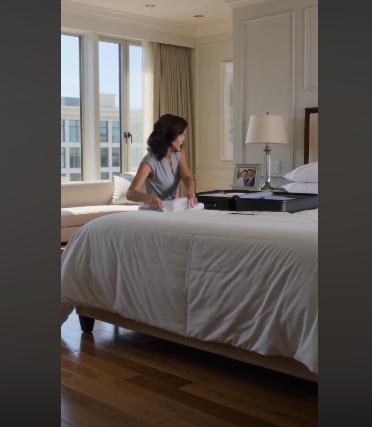
I was folding my husband’s shirts for our second honeymoon when he texted me that he was taking his secretary instead.
“Don’t go to the airport. I’m taking Jessica to the Maldives. She deserves this vacation more than you.”
I read the message three times.
Then another appeared.
“Tell Maria not to come this week. We’ll be gone until Sunday.”
That was it.
Twenty five years of marriage reduced to two text messages.
One informing me that another woman deserved my vacation.
The other reminding me to manage the housekeeper.
I sat on the edge of our bed with one of Richard’s white shirts still folded across my lap and realized that even while replacing me, he expected me to keep his life organized.
Something inside me became very quiet.
Not calm.
Clear.
My name is Margaret Henley.
I was fifty five years old when my husband finally made me understand that being needed and being loved are not the same thing.
Richard and I had been married for twenty five years.
When we met, I was an architect.
Not someone who had once taken a drafting class.
An architect.
I had my own small practice before I turned thirty.
Commercial interiors.
Residential renovations.
Small office buildings.
Nothing famous, but my name appeared on plans people actually built from.
I loved the work.
Then I married Richard.
He was an attorney with ambition large enough to occupy any room before he entered it.
At first, I admired that.
He admired me too.
At least I thought he did.
In the early years, we would lie in bed and talk about the future.
His law practice.
My architecture firm.
Travel.
Children, although those never came.
A house we would choose together.
Two careers.
One marriage.
That was the blueprint.
What happened instead was gradual enough that I barely noticed the design changing.
First I missed a client meeting because Richard needed me at a firm dinner.
Then I postponed a project because he had an important trial and wanted the house quiet.
Then I turned down work because we were traveling for one of his conferences.
Within five years, I had sold my practice.
“You don’t need all that stress,” Richard told me.
He stroked my hair while I cried after signing the sale documents.
“I make enough for both of us. You can focus on us now.”
I believed that was love.
Years later, I understood it had also made me dependent.
Richard controlled most of our household finances.
I had cards.
A checking account for expenses.
Access to what I needed.
But everything significant passed through him.
He never called it an allowance.
He did not have to.
When I wanted to buy something expensive, I explained it.
When he wanted something expensive, he bought it.
Still, I told myself we had a good life.
Beautiful house.
Comfort.
Travel.
Dinner parties.
People who admired us.
And after enough years of being admired as Richard Henley’s wife, I stopped asking whether anyone remembered Margaret.
The Maldives was supposed to fix us.
At least that was the story I told myself.
Richard had been working late for months.
Guarding his phone.
Showering when he came home.
Smiling at messages he never showed me.
His secretary, Jessica, had been at the firm for six months.
Twenty nine.
Beautiful.
Smart.
Ambitious.
I had met her twice.
Both times she looked at me with an expression I could not name then.
Now I could.
She knew something I did not.
I had spent weeks planning the trip.
The resort.
Restaurants.
Excursions.
Even ridiculous new lingerie that made me blush while buying it.
I thought if we could get far enough away from work, Richard might look at me again.
Instead, he gave the trip to her.
I stood and began removing his clothes from the suitcase.
One shirt.
Then another.
Socks.
Swimwear.
The blue linen shirt I had bought because it made his eyes look younger.
I put everything back in his closet.
Then I opened my jewelry box.
Beneath my mother’s pearls was a bank statement.
Eight hundred and twelve thousand dollars.
My father’s money.
He had left it to me five years earlier.
Richard knew I had received an inheritance.
He believed most of it had been absorbed into investments managed with the rest of our finances.
It had not.
My father had insisted the inheritance stay in an account in my name.
His lawyer had helped me keep it separate.
At the time, I was almost embarrassed by the secrecy.
My father had not been.
Three months before he died, he told me, “Keep something that belongs only to you.”
I said, “Dad, Richard and I are married.”
He answered, “That is not what I said.”
There had also been a letter.
I found it beneath the statement.
I had read it once.
Then buried it because it made me uncomfortable.
“Margaret,
I worry that you have confused being supportive with disappearing.
Richard is charming. Charm is not character.
Love should make room for you. It should not require you to become smaller so someone else can feel important.
You were building things before you met him. Remember that.
Keep the money separate.
Not because I expect your marriage to fail.
Because I want you to have choices if one day you realize you need them.
For when you remember who you are.
Dad.”
I sat at my vanity and cried.
Not because my father had been right.
Because I had known he was right when he wrote it.
I just had not been ready to admit it.
My first instinct was to punish Richard.
Sell the house.
Empty the accounts.
Disappear.
I even opened my laptop and started searching cash buyers.
Then something stopped me.
Maybe the architect in me.
Before you demolish a structure, you find out what is load bearing.
So I called a lawyer.
Not Richard’s lawyer.
Mine.
Her name was Sarah Kaplan.
She had handled an estate matter for a friend and practiced family law.
I told her what had happened.
All of it.
When I finished, she asked, “Where is Richard now?”
“Probably on a plane with Jessica.”
“Do you feel physically unsafe?”
“No.”
“Good. Then do nothing dramatic tonight.”
That irritated me.
“I want out.”
“I understand.”
“The house is titled in my name.”
“That does not automatically make it entirely yours in a divorce.”
I closed my eyes.
Of course.
We had bought it during the marriage.
Paid the mortgage during the marriage.
Renovated it with marital funds.
The deed mattered.
It was not magic.
Sarah continued, “And do not empty joint accounts.”
“He humiliated me.”
“That may matter emotionally and possibly strategically. It does not give you permission to hide or dissipate marital assets.”
I almost laughed.
“You are ruining my revenge.”
“I’m trying to keep your revenge from becoming evidence against you.”
That was when I hired her.
The next morning, I sat in Sarah’s office with twenty five years of financial documents.
We made lists.
Separate property.
Marital property.
Joint accounts.
Retirement assets.
House.
Richard’s partnership interest at the law firm.
My inheritance.
Personal property.
Debt.
Sarah said, “Your father did you a favor. If that inheritance stayed separate and you did not commingle it, we have a strong argument that it remains your separate property.”
“I can use it?”
“It’s yours to live on, subject to verifying the records.”
“Good.”
“What you cannot do is use it to conceal marital funds.”
“I don’t want his money.”
Sarah looked at me.
“Do not say that again.”
I frowned.
“Why?”
“Because after twenty five years, you may have rights in marital property whether or not you personally earned the paycheck. You gave up a career. You supported the household. You contributed.”
I looked down.
Richard had trained me to think his income was his achievement and my comfort was his gift.
Sarah refused that framing.
That mattered.
She also told me to preserve evidence.
Legally.
The texts Richard had sent me.
Financial records I already had lawful access to.
Documents in the home.
Nothing involving guessed passwords.
Nothing hacked.
Nothing secretly transferred.
I remembered Richard’s laptop sitting open in his home office.
I had almost gone through it the day before.
Now I did not.
I did not need to.
His message was enough to establish what he himself had chosen to tell me.
If additional evidence became necessary, discovery existed for a reason.
By the end of that week, Sarah had prepared the divorce filing.
We also requested ordinary temporary financial protections.
No unusual transfers.
No disposal of significant assets outside normal expenses.
Preservation of records.
The sort of things that sounded boring until you realized boring was what kept angry people from turning a divorce into financial warfare.
I moved out before Richard returned.
Not secretly.
Not forever.
I took clothes.
My mother’s pearls.
My grandmother’s gold locket.
My father’s letter.
My personal documents.
My architectural portfolio from before the marriage.
I left Richard’s jewelry gifts behind for the moment because Sarah wanted ownership sorted properly before I made assumptions.
That was another thing divorce teaches quickly.
Sentimental certainty and legal certainty are not the same.
I rented a furnished apartment.
Nothing glamorous.
Large windows.
White walls.
A terrible sofa.
I loved it.
For the first time in twenty five years, I entered a room and did not ask myself whether Richard would like it.
I bought red cushions.
He hated red.
I bought four.
When Richard returned from the Maldives, the house had not been sold.
The bank accounts had not been emptied.
There was no bottle of wine beside a dramatic farewell note.
There was something worse for a man like him.
A process he could not charm away.
He received the divorce papers through proper service.
Then he called me twenty three times.
I answered none.
His first voicemail said, “Margaret, this is ridiculous.”
The second said, “We need to discuss what you’ve done.”
By the sixth, he was angry.
“You cannot blow up twenty five years because I took a trip.”
The trip.
As if he had forgotten the part where he replaced his wife with his secretary.
By voicemail twelve, his tone changed.
“Please call me.”
I did not.
Sarah called his attorney instead.
That became our communication for the first few weeks.
Richard hated it.
He was accustomed to controlling conversations.
Family law reduced him to written requests, disclosures, deadlines, and counsel.
He could no longer win by exhausting me.
Jessica disappeared from the story faster than I expected.
Not because I had cleverly predicted she would leave him once his finances became complicated.
I had no idea what she would do.
What I learned later, through the divorce process, was simply that their relationship did not last.
The Maldives did not become the beginning of a grand romance.
It became what affairs often become once exposed to ordinary life.
Complicated.
Embarrassing.
Unsustainable.
That was enough.
I did not need Jessica punished.
Richard had made vows to me.
She had not.
The house became one of our largest disputed assets.
Because it was titled in my name, Richard initially argued I was trying to take it all.
Sarah disagreed.
Then so did his own lawyer.
Title was relevant.
Source of funds was relevant.
Marriage was relevant.
We had both contributed in different ways.
Eventually, we agreed to sell.
Not in forty eight hours.
Not to a cash investor at a massive loss.
We listed it properly.
The process took three months.
I walked through the house one last time before photographs were taken.
The kitchen where I had cooked thousands of meals.
The dining room where I hosted partners Richard wanted to impress.
The bedroom where I had folded his shirts the morning he discarded me.
I expected grief.
Instead, I felt recognition.
The house was beautiful.
It had also been a stage.
I had spent years managing scenery.
When it sold, the proceeds went into escrow until the divorce settlement determined how they would be divided.
No disappearing money.
No offshore accounts.
No tricks.
Just accounting.
It was strangely satisfying.
Richard and I finally met face to face at mediation.
Seven months after the Maldives.
He looked older.
So did I.
That felt fair.
During a break, he asked whether we could speak alone.
Sarah asked, “Do you want to?”
I thought about it.
“Ten minutes.”
We sat in a small conference room.
Richard looked at me for a long time.
“You cut your hair.”
I almost laughed.
“That is what you noticed?”
“I didn’t know what else to say.”
“Try the truth.”
He looked down.
“I was unhappy.”
“So was I.”
“I felt old.”
“So did I.”
“Jessica made me feel…”
He stopped.
“Young?”
“Yes.”
“Important?”
“Yes.”
“Desired?”
He nodded.
I leaned back.
“And what did I make you feel?”
His silence lasted too long.
“Safe,” he finally said.
There it was.
The answer to our marriage.
Not loved.
Safe.
I was the infrastructure.
The schedule.
The meals.
The social calendar.
The person who remembered birthdays.
Packed suitcases.
Hosted partners.
Listened to trial stories.
Made home frictionless.
Jessica made him feel alive.
I made his life work.
He had mistaken one for romance and the other for furniture.
I asked, “Why did you text me?”
He looked ashamed.
“I don’t know.”
“You do.”
“I was angry.”
“At me?”
“At myself, maybe.”
I waited.
He rubbed his face.
“I wanted to make the decision final.”
That was brutally honest.
“If I called you, you would have asked questions. You might have cried. I didn’t want to deal with it.”
I nodded slowly.
“So you hurt me enough that you wouldn’t have to feel responsible for hurting me.”
He closed his eyes.
“That sounds terrible.”
“It was.”
He looked at me.
“Can we fix this?”
“No.”
The answer came without effort.
He flinched.
“Twenty five years, Margaret.”
“I know exactly how long.”
“Does none of it matter?”
“Of course it matters.”
I looked at him.
“That is why I refuse to spend the next twenty five pretending the last ones were enough.”
After mediation, I booked a flight to Italy.
Not to disappear.
Sarah had my address.
Richard’s counsel had the contact information legally required.
The court had everything it needed.
I was simply no longer needed in Connecticut every day.
My separate inheritance could support me.
So I rented a small farmhouse outside Montalcino for three months.
The first evening, I stood on the terrace overlooking vineyards and felt terrified.
That surprised me.
I thought freedom would feel like champagne.
It felt more like standing at the edge of a pool knowing no one would push you in.
You had to jump yourself.
A woman named Francesca managed the property.
She showed me how the heating worked.
Where to buy groceries.
Which road to avoid after rain.
Before leaving, she asked, “You are here alone?”
“Yes.”
“For vacation?”
I looked at the hills.
“I’m not sure yet.”
She smiled.
“That is sometimes the best reason.”
My days became embarrassingly simple.
Coffee.
Walking.
Italian lessons.
Museums.
Cooking classes.
Reading.
For the first month, I kept waiting for someone to tell me what I was supposed to be doing.
No one did.
Then one afternoon in Florence, I entered an architecture exhibition.
Restoration projects.
Adaptive reuse.
Historic buildings converted into modern spaces without losing their original structure.
I stood in front of a set of drawings for nearly an hour.
My hands started itching.
I had forgotten that feeling.
The urge to draw.
To solve.
To imagine.
The next day, I bought pencils.
Tracing paper.
A ruler.
Not a computer.
I wanted the physical movement.
I began sketching the farmhouse.
Not because anyone asked me to redesign it.
Because I wanted to know whether I still could.
I could.
Badly at first.
Then better.
I contacted an old professional colleague in the United States.
He almost shouted when he heard my voice.
“Margaret Henley?”
“Still alive.”
“I heard you quit architecture.”
“I did.”
“Twenty years ago.”
“Twenty three.”
“And now?”
“I want to know what returning would require.”
He did not say I could simply walk into a firm and become principal architect again.
That would have been fantasy.
Codes changed.
Software changed.
Licensing requirements changed.
Professional practice changed.
He said, “Start with continuing education.”
So I did.
Online coursework.
Software training.
Sustainable design seminars.
Historic preservation.
I was fifty five, not dead.
There is a difference.
The divorce took almost a year.
Financial disclosure showed things about our marriage I had never known.
Richard had earned very well.
We also spent more than I realized.
His partnership interest required valuation.
Retirement assets had to be divided.
The house proceeds had to be allocated.
My inheritance remained separate because I had kept it separate.
That eight hundred thousand dollars was not a secret weapon.
It was security.
There were no miraculous clean breaks where Richard walked away with nothing.
He received his share of marital property.
So did I.
No alimony became necessary because the final division and my resources allowed me independence.
We each paid substantial legal fees.
Divorce is expensive even when nobody gets theatrically destroyed.
Jessica did not become a villain in my ending.
I learned through counsel that the law firm investigated Richard’s relationship with a subordinate because workplace relationships create issues beyond marriage.
I did not know what conclusions they reached.
I did not need to.
That belonged to their workplace.
Not my healing.
Richard called me once near the end.
I answered because by then, hearing his voice no longer made my chest tighten.
“Margaret.”
“Hello, Richard.”
“I wanted to apologize.”
I waited.
“I treated you badly.”
“Yes.”
“I treated you like staff.”
That was new.
He continued.
“I thought because I earned the money, everything else you did somehow counted less.”
I felt tears rise.
Not because I wanted him back.
Because the woman I had been needed to hear someone finally name what happened.
“I made you smaller,” he said.
“Yes.”
“I don’t know why you stayed.”
I looked across my terrace.
“Neither do I.”
That was not entirely true.
I stayed because leaving was frightening.
Because comfort can hide emptiness.
Because marriage becomes identity if you let it.
Because every year that passes makes the previous years feel like evidence that continuing must be right.
Because hope is stubborn.
Because I loved him once.
Many things can be true at once.
Richard asked, “Are you happy?”
I thought about the question.
My Italian was still terrible.
I had no new romantic partner.
No dramatic makeover.
No company named after me.
I had an apartment lease ending in two months and a stack of architecture textbooks on the table.
And I woke up without fear of disappointing anyone.
“Yes.”
Then I corrected myself.
“Actually, happy isn’t the important word.”
“What is?”
“Free.”
He was quiet.
Finally he said, “I’m glad.”
I believed him.
Then he asked, “Do you forgive me?”
I looked toward the hills.
“I don’t know.”
That surprised him.
“I thought you might.”
“Maybe someday.”
I paused.
“But forgiveness is not required for me to move on.”
He breathed out slowly.
“I understand.”
“No.”
I smiled faintly.
“But maybe you will.”
That was our last personal conversation.
After the divorce became final, I did not frame the signature page.
I thought I would.
Instead, I filed it.
It was a legal document.
Nothing more.
The beginning of my new life had not been signed by a judge.
It began the morning Richard texted me from the airport and I stopped asking what I needed to do to make him love me again.
A year later, I moved back to the United States part time.
Italy remained important to me, but I did not need a foreign country to stay free.
I began consulting on residential renovations with an architecture practice owned by a woman I had known years earlier.
I was not licensed to stamp every drawing immediately, and I did not pretend otherwise.
I worked under proper professional structures while updating credentials and training.
My first project was the renovation of an old stone library.
I spent three hours choosing how to bring natural light into a reading room without destroying the historic window rhythm.
Three hours.
I forgot lunch.
When I finally looked up, I laughed.
There she was.
Margaret.
Not Richard’s wife.
Not the woman folded into photographs beside him.
Not the hostess.
Not the abandoned spouse.
The architect.
I had not lost her.
I had simply stopped giving her work.
My father’s letter sits framed above my desk now.
Not the divorce decree.
His letter.
“Love should make room for you.”
That is the line I kept.
Richard’s text is gone.
I deleted it months after the divorce.
For a while, I thought I needed to preserve it as proof.
Then I realized I did not need evidence anymore.
I believed myself.
That was enough.
Sometimes people ask whether I regret the marriage.
No.
That answer surprises them.
I regret pieces of it.
I regret leaving architecture.
I regret how small I allowed myself to become.
I regret confusing financial comfort with partnership.
But regret is not the same as wishing twenty five years never happened.
There were good years.
Real laughter.
Friendships.
Trips I truly enjoyed, despite Richard later claiming otherwise.
A life does not become entirely fake because it ends badly.
I refuse to give him enough power to rewrite my past in either direction.
Jessica did not steal my husband.
Richard made choices.
So did I.
Then, finally, I made a different one.
The Maldives trip I lost no longer matters.
I eventually went there myself.
Three years later.
Not because I needed to reclaim it.
Because a friend invited me to a design conference in Singapore, and I decided to spend five days by the ocean afterward.
One morning I stood barefoot on white sand with coffee in my hand.
I thought about that text.
“She deserves this vacation more than you.”
I almost laughed.
Richard had been wrong, but not in the way I once imagined.
It was never about who deserved the Maldives.
No vacation could have fixed what was broken.
What I deserved was something far less glamorous and far more valuable.
A life in which nobody had to choose me because I had already chosen myself.
