When I stepped forward to greet the new chief executive, the cha
When I Reached Out To Greet The New Chief Executive, The Chairman Called Me Low-Level On Camera, But The Quiet Clause In My Folder Turned His Perfect $2.3 Billion Morning Into A Lesson About Respect He Never Thought Could Ever Reach Him
My hand hung above the boardroom table while the chairman smiled like I had dirt under my nails.
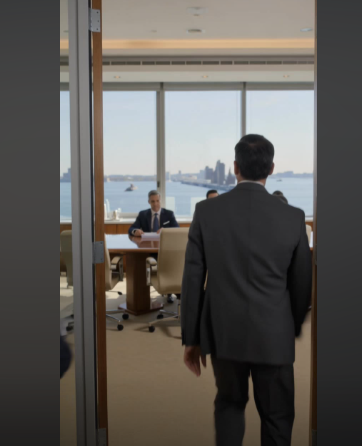
The new chief executive had not even settled fully into his chair. The cameras were already rolling, three small red lights burning from three corners of the room, steady as warning dots in the polished glass. Outside the high windows, Boston Harbor looked silver and cold, the kind of morning a company chose when it wanted investors to think of clean beginnings.
I stood near the head of the table with a folder tucked beneath one arm and a welcome arrangement balanced against my hip. White lilies and eucalyptus, ordered by someone in communications, were supposed to soften the room. Instead, the scent made the air feel staged.
“Welcome to Halcyon Dynamics,” I said to Daniel Hart, keeping my voice even.
Daniel looked up at me. Recognition moved across his face, quick and uncomfortable, before he buried it under the executive calm he had been hired to perform.
Then Graham Voss, chairman of the board, turned in his leather chair.
He looked first at my hand, then at the folder, then at the flowers. Not my face. Not my name. Not the fact that I had been in negotiations with his company for four months.
He gave a small scoff that carried cleanly into his lapel microphone.
“I don’t shake hands with low-level employees.”
A laugh broke near the far end of the table. Not a real laugh. A survival laugh. The kind people make when a powerful man says something ugly and everyone else decides, in the space of half a second, that decency is too expensive.
I did not pull my hand back right away.
For one beat, Graham’s smile tightened. He had expected me to fold at once, maybe apologize for stepping out of the invisible lane he had drawn under my shoes.
“I’m here as instructed,” I said.
“Then stand where you’re told,” he replied. “This meeting is for executives.”
The flowers grew heavier in my arm. I lowered my hand, but slowly, on my own timing. I set the arrangement at the edge of the table, right in his line of sight. Then I walked to the empty chair at the far end and sat down.
No one stopped me.
No one asked who I was.
That was how the morning began, but not where it started.
Four months earlier, I had been standing barefoot in my kitchen at six in the morning, eating toast over the sink while my phone buzzed against the counter. Rain tapped the window above the radiator. A garbage truck groaned down my block in South Boston, and the coffee maker clicked through its last tired cough like it had something personal against Mondays.
The message was from Ellen Park, Halcyon’s chief financial officer.
Nova, we need to talk. Privately. Before the board presentation.
I read it twice, then set the phone face down.
My apartment was still dark except for the under-cabinet light over the sink. I liked mornings before the city assembled itself. Before the horns, before the elevators, before grown people put on tailored jackets and pretended their choices were just strategies. In that quiet hour, I could almost hear the old version of myself asking whether rooms like Halcyon’s had ever really been built for me.
On my desk by the window, my father’s silver fountain pen lay beside the Halcyon folder, its cap scratched from years of riding in his shirt pocket at the insurance office where he had worked until his knees gave out. He had never owned much that looked expensive, but he took care of what was his. “A signature means your name has weight,” he used to tell me. “Don’t put it down for people who make your stomach warn you.”
I had laughed at that when I was twenty-three. By thirty-eight, I understood it better than I wanted to.
Pelion Growth Partners did not look like the kind of firm people imagined when they heard that it could move billions. We had no marble lobby, no wall of founders staring down in oil paint. Our office took up two floors in a renovated warehouse near the Fort Point Channel, all brick columns, exposed beams, practical conference rooms, and one espresso machine nobody knew how to clean correctly. We invested in companies that built things instead of companies that merely renamed things. Grid storage. Industrial software. Precision manufacturing. Boring work, if you measured glamour by glossy magazine covers. Essential work, if you cared whether the country could actually function.
Halcyon Dynamics had been on our radar for years.
They made modular battery systems for freight depots, hospitals, water plants, and mid-sized cities trying to keep the lights on when weather stopped behaving. Their engineers were brilliant. Their plant teams in Ohio and Pennsylvania knew every bolt and thermal warning by touch. Their debt, however, had become a knife pressed quietly against the company’s ribs.
The incoming chief executive, Daniel Hart, was supposed to fix that. Former operations star, clean résumé, calm voice, handsome in the neutral way leadership consultants loved. His arrival was wrapped inside a broader capital restructuring: Pelion would provide a $2.3 billion commitment, released in tranches, enough to refinance the worst debt, stabilize the supply chain, and give Daniel eighteen months to prove Halcyon could become the company its deck claimed it already was.
I had authority over the primary release.
That was not because I was the loudest partner at Pelion. I was not. Marcus Reed could command a room just by removing his glasses. Leena Shah could dismantle a financial model with three questions and one eyebrow. I had earned the Halcyon account because I had spent fourteen years doing the unglamorous work no one clapped for: reading footnotes, walking factory floors, asking receptionists what changed when executives visited, learning which numbers sounded clean because someone had swept the mess into another column.
People mistook quiet for softness. I let them. Quiet was useful. It made careless people generous with the truth.
Ellen’s private message did not surprise me, but it did make my coffee taste bitter.
By seven-thirty, she was sitting across from me in Pelion’s smaller conference room with wet hair tucked behind one ear and the exhausted look of someone who had learned to survive inside a culture she no longer respected.
“I’m not here to derail the deal,” she said.
“Nobody comes here at seven-thirty in the rain to tell me everything is fine.”
She gave a short breath through her nose. Not quite a laugh. “Fair.”
I slid a cup of coffee toward her. She wrapped both hands around it.
“What happened?” I asked.
She looked toward the glass wall, where my assistant, Thomas, was setting out printed materials for another meeting. Ellen waited until he left.
“Graham is treating the transition announcement like a coronation,” she said. “He wants cameras. Investor stream. Internal stream. Archive footage. The board wants transparency because of the restructuring.”
“And you don’t.”
“I don’t trust him with a microphone.”
That landed because it was too plain to be politics.
Graham Voss had been Halcyon’s chairman for eight years. Before that, he had been the kind of executive whose biography used words like decisive and uncompromising because ruthless sounded too honest in print. He was tall, silver-haired, athletic from expensive discipline, with a voice that moved smoothly from charm to contempt depending on whether he thought the person in front of him mattered.
The first time I met him, he mistook me for someone hired to take notes.
It had been at Halcyon’s Seaport office in early March. I arrived with Marcus for a preliminary review, wearing a navy suit and carrying the same black leather portfolio I had carried into half the boardrooms on the East Coast. Graham was standing near the windows, talking to two directors and Daniel, who had not yet been publicly announced.
When we entered, Graham shook Marcus’s hand with both of his.
“Marcus Reed,” he said. “Glad you could come.”
Marcus turned toward me. “You remember Nova Mercer.”
Graham looked at me then, briefly, the way people glance at a thermostat. “Of course.”
He did not offer his hand.
Instead, he pointed toward a side table where a stack of agendas sat beside a pitcher of water.
“Would you make sure everyone gets the revised schedule?”
The room barely shifted. No one wanted the discomfort of naming what had just happened. Marcus’s eyes cut to me, asking without asking whether I wanted him to step in.
I crossed to the side table, picked up the schedules, and carried them back.
Then I placed one in front of Graham.
“The revised schedule begins with my diligence questions,” I said. “So we can save time by starting now.”
Marcus coughed into his fist.
Daniel looked down at his notebook.
Graham blinked once, then smiled as if I had passed an amusing test he had invented.
“Right,” he said. “Nova. Good. Let’s begin.”
I asked my questions. He answered most of them with sentences designed to impress people who did not know the work. When I asked about delayed warranty accruals, Ellen Park looked at me with a small, wary gratitude, and Graham’s smile thinned.
That was the first wrong detail: my name had been on every email, every term sheet, every capital memo, yet he had chosen not to know it until forced.
I noticed. I did not make a speech. Speeches, in rooms like that, usually helped the people who wanted to call you emotional.
The second wrong detail came two weeks later at the Lancaster plant.
Halcyon’s battery assembly facility sat outside a town where brick row houses backed up against chain-link fences and winter still hung around the edges of April. The plant smelled like warm dust, metal shavings, machine oil, and the cafeteria’s burnt coffee. I liked it immediately. It felt honest in a way the headquarters did not.
A floor supervisor named Maria Ortega walked me through the line. She wore steel-toed boots, safety glasses on top of her head, and a wedding ring scratched dull by years of work. She knew each station by sound.
“That rattle?” she said, pausing beside a sealed testing bay. “Bearing needs replacement before the end of the week. It’s not dangerous yet. It’s just asking politely.”
Graham arrived twenty minutes late with Daniel and two directors in suits too fine for the concrete floor. He did not apologize. He clapped Daniel on the shoulder and gestured around the facility like a man showing off a yacht.
“This is what we’re buying time for,” Graham said. “Real assets. Real output. Not spreadsheet fantasies.”
Maria stepped forward. “We also need to discuss staffing on the second shift. If the release happens in June, we can avoid—”
Graham cut her off without looking at her.
“We’ll handle labor alignment at the executive level.”
Maria’s mouth closed.
Daniel heard it. I knew he heard it because his eyes moved from Maria to Graham and then to the painted safety line on the floor.
I waited.
Daniel said nothing.
That was the third wrong detail: the man brought in to fix operations had chosen silence in front of the people whose work he would soon lead.
Graham kept walking. “The floor people worry because they don’t see the full picture.”
I watched Maria’s face settle into something practiced and old. Not surprise. Recognition.
At lunch, in a glass-walled conference room above the plant, Graham praised the workforce with phrases that sounded generous until you noticed he never used anyone’s name. He said committed labor, skilled operators, institutional knowledge. Maria sat three seats away from him, eating half a turkey sandwich, unseen by the man describing her life.
I asked him, “How many supervisors have you spoken to directly about the transition plan?”
He took a drink of water. “We have channels for that.”
“That wasn’t my question.”
Daniel’s expression tightened. Ellen looked down, then back up.
Graham set the glass down with care. “Nova, we’re not going to manage a multibillion-dollar restructuring by collecting feelings from every badge holder.”
Maria’s sandwich stopped halfway to her mouth.
I looked at her. Then at Daniel.
Still nothing.
When I returned to Boston that night, I wrote one sentence in my private notes: Culture speaks most clearly when it thinks capital is already committed.
The fourth wrong detail came over dinner.
Graham had chosen a steakhouse in Back Bay with dark wood, low light, heavy glasses, and a hostess who smiled like she had been trained never to blink. The reservation was under his name. Of course it was. Men like Graham liked even dinner to establish ownership.
I arrived ten minutes early and found Daniel already at the bar. He stood when he saw me.
“Nova,” he said. “Good to see you.”
He meant it. That was what made him complicated. Daniel was not cruel in the obvious way. He listened when the cost was low. He asked good questions when Graham was not watching. He knew plant metrics. He remembered engineer names. He also had the cautious posture of a man who had learned to treat powerful people as weather.
“Do you know what kind of company you’re inheriting?” I asked him.
He glanced toward the dining room, where Graham had not yet appeared. “One with great technology and bad habits.”
“Bad habits don’t stay in corners. They become systems.”
“I know.”
“No,” I said gently. “You know it as a sentence. I’m asking if you know it as a price.”
Before he could answer, Graham arrived with two directors and took the head of the table without looking at the place cards. They rearranged around him as if gravity had made a decision.
Dinner began with charm. Graham asked about Pelion’s industrial portfolio, flattered Marcus though Marcus was not there, praised Daniel’s future, mocked a competitor’s “committee culture,” and ordered wine without asking whether anyone wanted it. I drank water.
Halfway through the meal, I asked about governance changes after Daniel’s appointment.
Graham leaned back. “We’ll modernize where useful.”
“That’s not a structure.”
“It’s a direction.”
“It’s a phrase.”
A director laughed softly, then stopped when no one joined him.
Graham’s eyes brightened. He enjoyed resistance when he thought he could turn it into theater.
“You’re very precise,” he said.
“I try to be.”
“Precision is admirable. But at some point, people in your position need to trust the operators.”
People in your position.
He said it warmly enough that a transcript would not show the blade. I watched Daniel hear it and decide again not to touch it.
“My position,” I said, “is the person being asked to release $2.3 billion into a leadership culture I’m still evaluating.”
Graham’s smile held. “And my position is the person who has kept Halcyon alive long enough for firms like yours to discover an opportunity.”
“Then we both understand positions.”
Ellen almost smiled into her napkin.
The check came. Graham reached for it and said, “Let’s not drown a good transaction in sensitivity. Capital should be rational.”
“Capital is rational,” I said. “That’s why it pays attention to behavior.”
He looked at me for a long second, and for once he did not smile.
The next morning, I asked our counsel to draft a revised conduct clause.
Not a morality clause. Not a trap. Not a weapon hidden in fine print. I wanted clear language tied to reputational conduct during negotiation, transition, and closing. Any documented behavior by current or incoming leadership that materially undermined trust in the company’s governance could delay or withdraw Pelion’s capital release. Direct authorization would remain with the managing partner assigned to the transaction.
Me.
Leena read the draft in my office and looked over the top of the page. “Graham will hate this.”
“Good clauses are usually hated by the people who need them.”
Marcus stood by the window, coffee in hand. “Are you sure you want the authority to sit with you alone? It will make you the person everyone blames if you use it.”
“I’m already the person they blame when I ask questions.”
“That isn’t an answer.”
“It is the answer,” I said.
He nodded once. Marcus had known me long enough to recognize when I was done decorating a truth.
We sent the revision.
Graham called within twenty minutes.
I put him on speaker because Leena was still in the room and because some conversations deserved witnesses even when they did not deserve an audience.
“Nova,” he said, voice smooth. “This conduct language is unnecessary.”
“Then it should be easy to live with.”
“We’re talking about a complex capital restructuring, not a preschool manners policy.”
Leena stared at the ceiling.
“We’re talking about trust,” I said.
“We already have trust. We’ve been working on this for months.”
“We have progress. Trust is separate.”
He went quiet just long enough to show irritation.
“I don’t like clauses that can be triggered by someone’s mood.”
“Neither do I. That’s why this one requires documented conduct and material impact.”
“You’re putting personal judgment into an institutional transaction.”
“I am putting institutional consequences around leadership behavior.”
He laughed once. “That sounds expensive.”
“So does bad leadership.”
When the final agreement came back, the clause remained. Graham had not conceded because I convinced him. He conceded because Halcyon needed the money more than he hated the leash.
During the revised terms meeting, I set the silver fountain pen beside the clause and watched him sign with the expression of a man swatting a fly he expected never to see again.
Daniel signed after him. His signature was quick, neat, and quiet.
Ellen signed last for Halcyon finance. Before she passed the packet back to our counsel, her eyes found mine.
She knew.
I knew.
The deal could still close. It should have closed. That was the part people later misunderstood when they tried to turn the story into a simple lesson about arrogance. I did not go to Halcyon’s transition announcement looking for a reason to pull capital. Pulling that much money was not dramatic from inside the decision. It was painful. It meant suppliers waiting. Lenders calling. Plant managers waking up to uncertainty they had not created. Families at kitchen tables trying to read corporate news through the lens of rent, insulin, daycare, tuition.
I carried that with me.
That was why I waited as long as I did.
On the morning of the announcement, I arrived at Halcyon’s Seaport headquarters at eight-fifteen. The lobby smelled faintly of lemon cleaner and expensive coffee. A security guard glanced at my license, compared it to the visitor list, and frowned.
“Ms. Mercer?” he said.
“That’s me.”
He tapped at the keyboard. “They have you marked as external support.”
I looked at the badge printer. “External support for what?”
His ears reddened. “It doesn’t say.”
A woman at the reception desk leaned over. “Just print visitor. They’re behind upstairs.”
The badge came out with VISITOR in bold letters and my name in smaller type. No Pelion. No managing partner. No capital provider.
Wrong detail number five, though by then I had stopped numbering them as if they were separate things. They were one thing showing me different faces.
I clipped the badge to my jacket.
“Thank you,” I said.
The guard looked relieved to be thanked for a mistake he had not made.
Upstairs, the executive floor had the anxious shine of an event that had been revised too many times. Assistants moved with tablets. Communication staff adjusted camera angles in the boardroom. Someone carried a tray of water glasses. Someone else whispered into a headset near the elevators.
Mara from communications found me near the frosted glass wall.
“Ms. Mercer?” she said, breathless. She was maybe twenty-six, with a navy dress, practical flats, and panic pressed into the corners of her smile. “I am so sorry. We’ve had three schedule changes and the florist sent these to the wrong floor, and Daniel wanted something welcoming on the table before cameras locked. Could you bring them in when you go? I know that’s not—”
“It’s fine,” I said.
“It’s absolutely not your job.”
“No,” I said. “But it’s flowers. Not a confession.”
Her shoulders dropped a fraction.
She handed me the arrangement, white lilies arranged with eucalyptus and pale ribbon in a heavy glass vase. The scent was clean and a little funeral, which should have warned someone.
“Thank you,” she said.
I wanted to tell her not to apologize so easily in buildings like this. I wanted to tell her that powerful people built whole systems out of other people’s quick apologies. Instead, I asked, “Where does Daniel want it?”
“Near the head of the table, but not blocking the camera.”
Of course.
I carried it down the hall.
Through the glass, I could see Graham already inside, standing with two directors near the main screen. He wore a charcoal suit and a blue tie, television-ready. Daniel stood by the far window, alone for a moment, reading something on his phone. Ellen sat near the middle with her laptop open and a stack of financial schedules squared precisely in front of her.
The boardroom itself was built to flatter control. Long walnut table. Cream leather chairs. Hidden microphones. Three cameras mounted discreetly but visibly enough to remind everyone the company valued transparency. A small American flag stood in a brass base on a credenza near the windows, half-hidden by a plant. The harbor shone beyond it.
I stepped inside.
Mara followed me with a headset wire tucked beneath her hair. “Two minutes,” she called softly to the room. “Internal stream will start first.”
No one looked at me except Ellen, whose expression changed in one small pulse.
She saw the flowers.
Then she saw the badge.
Then she looked at Graham.
I gave her the smallest shake of my head. Not yet.
My place at the table should have been beside Ellen, where the capital provider could hear and be heard. Instead, there was no place card for me at all. At the far end sat one blank chair with a pad, a water glass, and no printed name.
I almost laughed.
Not because it was funny. Because after everything, after months of diligence, after revised terms, after signatures, after Daniel had sat across from me and admitted the company had bad habits, their first public act under the new leadership announcement was to leave my name off the table.
Daniel crossed the room as if to speak to me.
Graham saw him move.
“Daniel,” he said, bright and loud, “let’s get you at the head before they start rolling. We need the image right.”
Daniel stopped. He looked at me once, apologetic in advance, then turned.
It was a small betrayal. Small enough that he could have denied it even to himself. Large enough that my stomach understood.
The cameras came on.
A red light blinked, steadied, and held.
Mara counted down under her breath. “Five, four, three…”
The room arranged its faces.
Graham took his chair. Daniel sat to his right. Ellen glanced at the first slide. Directors straightened jackets, adjusted cuffs, softened mouths into expressions of disciplined optimism.
I was still standing beside Daniel’s chair with the arrangement in my hands.
That was when I extended my hand.
Not to trap anyone. Not to test anyone. To greet the man whose leadership I had been asked to finance.
“Welcome to Halcyon Dynamics,” I said.
Daniel’s eyes flicked to my hand. Then to Graham.
Graham saw the hesitation and seized it.
“I don’t shake hands with low-level employees.”
His voice was mild. That was what made it worse. He did not sound angry. He sounded amused, like the world had handed him a small chance to remind everyone where the floors were.
The first laugh came from Vince Malloy, an outside director who had spent the morning telling a camera operator to capture his better side. Then another director smiled and looked down. Someone at the back tried to cover a grin with a folder.
Ellen closed her eyes for half a second.
Daniel looked at the table.
That was the moment I felt the old instinct rise in me. Not fear, exactly. Training. The trained reflex of every person who has been insulted in a room that rewards restraint only when it comes from the powerful. Smile. Move aside. Prove later. Do not make them uncomfortable. Do not give them a story to tell about your tone.
My hand stayed in the air.
Graham noticed.
“I’m here as instructed,” I said.
“Then stand where you’re told. This meeting is for executives.”
A microphone caught it. The cameras kept their patient red eyes open.
I lowered my hand.
Then I set the arrangement down at the table’s edge, close enough that Graham had to look past it to see the main screen. The glass base made a soft, final sound against the walnut.
I walked to the blank chair at the far end and sat.
A director whispered, “Awkward.”
Mara stood at the back, pale, one hand against her headset.
Graham turned forward. “Let’s begin.”
The first slide filled the screen: Halcyon Dynamics Leadership Transition And Capital Structure Update. Beneath it, smaller text listed the date and the phrase Primary Capital Secured.
There it was. The wrong assumption made clean and corporate in blue and gray.
I folded my hands on the table.
Ellen began with the agenda. Her voice was steady, but she skipped one word in the second sentence, then corrected herself. I knew her well enough by then to hear the distress beneath the professionalism.
Graham welcomed Daniel. Daniel thanked the board. He spoke about humility, stewardship, operational discipline, and respect for the people who made Halcyon possible. The words were good. Many words were good. They could sit shining in a sentence without changing the mouth that spoke them.
As he talked, I watched the room instead of him.
Vince Malloy checked his reflection in the dark glass of his tablet. Director Sandra Keene kept her eyes on her notes, jaw working slightly. Ellen’s thumb rested against the edge of her printed schedule as if she were holding a seam closed. Graham leaned back, satisfied, his body open to the cameras. He had enjoyed the laugh. Worse, he had trusted it.
Daniel finished.
Graham nodded. “Excellent. Ellen, take us through the capital update.”
Ellen clicked to the next slide. “As you can see, the restructuring plan assumes release of the Pelion primary commitment following today’s leadership transition acknowledgment and final authorization.”
Graham’s eyes cut toward her.
It was quick. A warning.
She continued anyway. “The first tranche—”
“Before we go any further,” I said.
My voice was calm, which made everyone turn a half second later than they would have if I had sounded upset.
Graham did not look surprised. He looked inconvenienced.
“We’re not taking input from staff during this session,” he said. “You can pass your notes to investor relations afterward.”
The old reflex knocked once more at the back of my ribs.
I did not answer it.
“If you are refusing to shake my hand,” I said, “then by tomorrow morning, $2.3 billion will not be where this slide says it is.”
The room paused.
Not silence, not yet. Silence is too clean a word for that first moment. It was more like the room forgot which performance came next.
Then Vince laughed too loudly.
“All right,” he said, lifting a hand as if calming a child. “Let’s keep this professional.”
“This is professional,” I said.
Graham’s smile returned, thinner now. “Sit down.”
“I already am.”
A few heads turned toward the far end of the table, as if only then remembering I had taken the blank chair they had left for nobody in particular.
Graham looked at Ellen. “Continue.”
She did, because she had to. That was how systems kept moving. A person was dismissed, a warning was spoken, a contradiction showed itself, and the machinery tried to bury all of it beneath the next slide.
Cash flow. Debt maturity. Supplier stabilization. Workforce retention. Words that mattered deeply to thousands of people and were being presented by a room that had just laughed at the person authorized to release the money behind them.
I listened.
That was important. Anger can make you miss the useful thing. I had learned to let anger stand behind me instead of driving.
Graham had not asked who I was. Daniel had not corrected him. The directors had laughed or looked down. The company had placed Primary Capital Secured on the screen before I had released it. The cameras were still recording. The conduct clause was not hidden. It was waiting in the agreement Graham had signed because he never believed respect could have a balance sheet.
Ellen clicked to a timeline. “Pending final confirmation, the primary release would support the bridge refinancing by end of week, followed by—”
She stopped.
It was not dramatic. Her mouth simply closed around the next word. She looked at the schedule in front of her, then toward me, then toward Graham.
“Ellen,” Graham said.
She swallowed. “We should clarify the authorization sequence before presenting the release as complete.”
“We have covered this.”
“With respect, we have covered it conceptually.”
His face hardened. “Meaning?”
“The release requires direct authorization from the capital controller.”
Vince frowned. “From legal?”
“No,” Ellen said. “From Pelion.”
No one looked at me right away. That would have required admitting they knew where the answer lived.
I let the delay stretch.
Finally, Sandra Keene turned first. She had not laughed. She had not helped either, but her eyes met mine with something like belated recognition.
Graham followed her gaze.
The room’s attention moved toward me, chair by chair.
“Who exactly are you here for?” he asked.
It was still the wrong question.
“I’m here for the capital,” I said.
A director near Daniel leaned forward. “Are you with Pelion?”
“I am Pelion on this transaction.”
Graham made a small sound. “Let’s not dramatize titles.”
“I agree,” I said. “That would have been useful ten minutes ago.”
Daniel’s face tightened.
Graham stared at me now, really stared, trying to reconcile the woman with the flowers, the visitor badge, the blank chair, and the sentence he should have heard months earlier.
Ellen spoke before he did. “Nova Mercer is the managing partner with sole authorization over the primary release.”
The room changed.
Again, not loudly. Rooms like that rarely changed loudly. They changed in posture first. Shoulders straightened. Hands withdrew from phones. Directors who had been angled toward Graham shifted a few inches toward the far end of the table. Daniel sat very still.
“All of it?” Vince asked.
Ellen looked at him. “All of it.”
“Two point three?” Sandra asked quietly.
I answered. “Yes.”
Graham leaned back, but his body did not relax. “Then perhaps we should restart this conversation properly.”
The sentence was meant to sound reasonable. It was also an attempt to rewind. Powerful people loved restarts when the damage was theirs.
I looked at the slide still glowing behind him.
Primary Capital Secured.
“There’s nothing proper about a restart that only begins after the money introduces me,” I said.
No one laughed.
Daniel shifted. “Nova, I should have—”
“Yes,” I said.
That one word stopped him. Not because it was loud. Because it gave him nowhere comfortable to stand.
Graham tapped the table once. “Let’s take a ten-minute recess.”
He stood before anyone agreed.
Chairs moved. The cameras remained on for a few seconds longer, then Mara hurried to pause the internal stream. The red lights went dark one by one. Even then, the room stayed crowded with what they had captured.
People rose too quickly, taking papers they did not need, checking phones that had not buzzed. Vince avoided my eyes. Sandra gave me a small nod that apologized for nothing and acknowledged too late. Ellen closed her laptop halfway, then opened it again, because work was safer than feeling.
I stayed seated until the room thinned.
Then I stood and walked into the hallway.
The executive corridor was too bright, all pale wood and frosted glass and framed photographs of Halcyon products powering hospitals, depots, municipal buildings, places where failure was not theoretical. Near the windows, two directors stopped talking when they saw me. One checked his watch as if time might save him.
Ellen came up beside me near a recessed alcove.
“I’m sorry,” she said.
“Don’t take his sentence and make it yours.”
“I didn’t stop it.”
“No,” I said. “You didn’t.”
She absorbed that without flinching. I respected her for it.
“I tried to warn Daniel,” she said. “He thought Graham would behave once the cameras were on.”
“That was the bet?”
Her mouth tightened. “That public visibility would make him careful.”
“Public visibility makes people careful only when they believe the people watching matter.”
Ellen looked away.
Daniel appeared at the far end of the hall. For a second, he seemed to consider turning back. Then he came toward me with that controlled executive walk, the one that pretends urgency is strategy.
“Nova,” he said. “Can we talk?”
“We are talking.”
He lowered his voice. “I knew Graham’s comment was out of line.”
“You knew who I was.”
“Yes.”
“And you let him call me staff.”
His face colored. “It happened fast.”
“It happened clearly.”
A group of junior finance staff came out of a conference room nearby, saw us, and slowed. Daniel noticed them noticing, and something in him shifted toward reputation management.
“I was going to correct it once we got through the opening,” he said.
“You were going to correct my humanity after the agenda?”
“That is not what I meant.”
“It rarely is.”
He looked down the hall toward the boardroom. “Halcyon needs this capital.”
“I know that better than you think.”
“Then you know a public confrontation could hurt people who had nothing to do with Graham’s comment.”
That was the smartest thing he had said all morning, and because it was smart, it hurt.
I thought of Maria in Lancaster, hearing a bearing ask politely to be replaced. I thought of the second shift, the suppliers, the people whose names never made it onto transition slides. I thought of how often executives used workers as shields after using them as scenery.
“That is why I gave you months,” I said. “Not seconds. Months.”
Daniel exhaled slowly.
“I should have spoken.”
“Yes.”
“I can speak now.”
“No,” I said. “Now you want the benefit of having spoken earlier.”
The junior staff had disappeared. Ellen remained a few feet away, not pretending not to listen.
Daniel’s face went still.
“What do you want?” he asked.
There it was. The negotiating question. The assumption that dignity, once injured, could be converted into terms.
“I wanted to see whether the leadership culture matched the story you sold us.”
“And now?”
“Now I have.”
He stepped closer, not aggressively, but with pressure. “Nova, don’t make a permanent decision in a hallway.”
“I didn’t.”
For the first time that morning, he looked afraid.
I left him there and walked toward the service elevator alcove, where the noise from the executive floor softened. A vending machine hummed behind me. Somewhere below, a cart rattled over tile. Ordinary sounds. Useful sounds. They reminded me that companies were not boardrooms. Companies were people moving through practical days, fixing what leadership broke, making the place function despite the speeches above them.
My phone was in my jacket pocket.
I did not take it out immediately.
This is the part people later wanted to sharpen into triumph. They wanted me to say I felt powerful. I did not. I felt the weight of every person whose paycheck might get pulled into the consequences of a man who had mistaken contempt for authority.
I leaned against the wall and closed my eyes.
My father’s voice came back to me, not as a ghost, not as drama, just memory doing what memory does when the present asks for help.
Don’t put your name down for people who make your stomach warn you.
My stomach had warned me in March.
It had warned me in Lancaster.
It had warned me at dinner.
It had warned me when Daniel looked at the table.
I opened my eyes and called Marcus.
He answered on the second ring. “How bad?”
“You watched?”
“Internal stream link came through late. I saw enough before it paused.”
Of course he had. Transparency had a way of traveling faster than control.
“I’m invoking the conduct clause,” I said.
Marcus did not speak for a moment.
“You know what happens next.”
“Yes.”
“Are you certain the record is clear?”
“Three cameras. Two direct dismissals. Prior signed provision. CFO confirmation. Incoming chief executive failed to correct a known false assumption.”
“You sound like you’re writing the memo already.”
“I don’t want to write it twice.”
A quiet breath from his end. “And the workers?”
“We reallocate the stabilization reserve to the supplier-protection fund we discussed. We do not release primary capital to current leadership. We make it clear we remain open to a new governance structure later, but not under this behavior.”
“That will hold.”
“I know.”
Another pause.
Then Marcus said, softer, “Nova, are you all right?”
The question nearly undid me because it was not strategic.
“No,” I said. “But I’m clear.”
“Clarity is enough for the next five minutes.”
“Activate withdrawal,” I said. “Effective immediately. Full primary commitment.”
“Under conduct?”
“Under conduct.”
“I’ll notify Leena and the capital desk.”
“Thank you.”
I ended the call and stayed in the alcove a moment longer.
When I returned to the boardroom, the recess was ending. The directors were back in their seats, though no one seemed as settled as before. The arrangement sat where I had left it, pale against the dark table. Graham was standing near Daniel, speaking low and fast. Daniel listened with his mouth set tight.
Mara gave me a look from the back wall that held apology, fear, and something else I could not name yet.
Respect, maybe. Or recognition.
I took the blank chair again.
Graham waited until I sat, then returned to his place. He did not apologize. Men like him often believed apology was a door that locked from the outside.
“We are resuming,” he said. “Let’s stay focused on the company.”
I looked at the slide still waiting on the screen.
Focus on the company. Another phrase that sounded clean until you asked who had dirtied it.
Ellen’s laptop chimed softly. She muted it at once.
Graham turned toward her. “From the top of the capital section.”
She began again, carefully.
“As noted, the restructuring plan has been built around Pelion’s primary commitment, pending final authorization. The company’s liquidity runway assumes—”
Her phone buzzed against the table.
She did not look at it.
Then Sandra’s phone buzzed.
Then Vince’s.
Then Daniel’s.
It happened in small vibrations, like insects under glass.
Graham’s face tightened. “Devices off.”
No one moved.
Ellen looked down first. Her eyes scanned the screen. Her complexion changed so quickly it seemed the light had shifted.
“Ellen,” Graham said.
She looked at me.
I gave no signal. I did not need to.
She turned to the board. “The capital desk has issued formal notice.”
“What notice?” Graham asked.
Ellen’s voice remained steady by force. “Pelion has withdrawn the primary commitment.”
No one breathed in a way I could hear.
Graham stared at her. “Withdrawn how?”
“Executed under the conduct provision.”
“That is not possible.”
“It is completed.”
Vince leaned forward. “Full amount?”
Ellen nodded once. “Full primary commitment. Two point three billion.”
Daniel closed his eyes.
The room did not explode. It tightened around the missing money like a fist.
Graham stood. “Nova.”
I looked up at him.
“You cannot pull that kind of capital over a comment.”
“I didn’t.”
His jaw flexed. “You’re playing a dangerous game.”
“No,” I said. “You mistook a pattern for a comment.”
Sandra looked down at the table.
Graham pointed toward the dark camera in the corner. “This was a misunderstanding.”
“The camera understood you.”
That stopped him for half a second.
Then he recovered the only way he knew how, by pushing harder.
“You walked in carrying flowers,” he said. “You sat at the end of the table. You let people assume.”
The accusation was so cleanly shaped that I almost admired its nerve.
I rose.
Not quickly. Not dramatically. Just enough that the room had to adjust to my height the way it had adjusted to his all morning.
“I walked in carrying what your staff asked me to carry,” I said. “I sat in the only chair your office left without a name. I extended my hand to the man you asked me to finance. You looked at a visitor badge, a vase, and a quiet woman, and you decided that was enough information.”
A silence opened.
Not empty silence. Full silence.
The kind that held every earlier laugh and made each person hear their own part in it.
Graham’s mouth tightened. “This is punitive.”
“This is contractual.”
“You’re hiding behind language.”
“You signed the language.”
Vince shifted. “Graham—”
“No,” Graham snapped, not looking at him. “We are not letting one offended investor jeopardize this company.”
Ellen’s voice cut through, quiet but firm. “The clause does not require offense. It requires documented conduct with material governance impact.”
Graham turned on her. “You are still employed by this company.”
Ellen’s face went pale, but she did not look away.
“That is why I’m telling the truth carefully,” she said.
Something moved around the table then. Not a grand rebellion. Just a set of private calculations crossing into public action. Sandra put her phone face down. Another director removed his glasses. Daniel stared at his folded hands as if they belonged to someone who had disappointed him.
I had seen boards change allegiance before. It was never noble at first. Nobility usually arrived later in press language. In the moment, it was survival. But survival, pointed in the right direction, could still stop damage.
Sandra spoke first.
“We need to address governance exposure.”
Graham laughed, one hard sound. “Now?”
“Yes,” she said.
The word was small. It landed like furniture being moved against a door.
Vince rubbed his forehead. “Pre-market reaction is already moving.”
“It’s not public,” Graham said.
“Investor lines are active,” another director replied. “Lenders will know before noon.”
“It was an internal stream.”
“Internal doesn’t mean invisible.”
Graham looked from face to face, searching for the old room. The old room had laughed when he laughed. It had looked down when Daniel looked down. It had let him define the shape of the morning. Now it was gone, replaced by people who could finally see the cost of standing too close to him.
He turned back to me.
“What do you want?” he asked, and there was Daniel’s question again, but uglier from Graham’s mouth.
I thought of giving him a speech. I had several available. Years of rooms like that had written them inside me line by line. I could have told him about reception desks, plant floors, women mistaken for assistants, men praised as direct for what women were punished for naming, workers described as labor units by people who needed them to make every number real. I could have told him about my father’s stomach warning. I could have told him about Maria’s face when he called people like her badge holders.
But the room did not need my autobiography. It needed a boundary.
“I want Halcyon to become the company it claims to be,” I said. “But Pelion will not fund the version sitting in this room under your control.”
He stared at me.
Outside, a gull moved past the window, white against the harbor, ordinary and unreachable.
Sandra turned to the corporate secretary. “We need an extraordinary governance session recorded.”
Graham’s face changed.
Not fear yet. Not fully. Something closer to insult. He had believed the room belonged to him so completely that procedure itself felt like betrayal.
“This is absurd,” he said.
“No,” Sandra replied. “This is necessary.”
The secretary, a woman named Judith with careful hair and a calm I suddenly trusted, opened her laptop. “Noted.”
Mara stood at the back wall, frozen, headset still in place.
Daniel finally spoke. “Graham, we should cooperate.”
Graham looked at him with open disgust. “Now you find your voice?”
Daniel flinched.
I did not enjoy that. I had not come there to watch one weak man get cut by a crueler one. Still, the line revealed what Daniel should have understood long before: silence never bought safety from contempt. It only rented delay.
Sandra asked Graham to sit.
He remained standing.
The governance discussion began around him.
That was the quiet brutality of board procedure. It did not need to shout. It could proceed while a powerful man stood in place, discovering that authority was not the same as control once people stopped granting it.
They reviewed the conduct provision. They reviewed the recording. They reviewed the risk to the transition. They reviewed Daniel’s failure to correct a known misstatement during a recorded investor-adjacent session. Daniel accepted that without argument, which was something, though not enough to undo the moment.
The outside world pressed closer through vibrating phones and silent glances. Lenders wanted calls. Investment banks wanted language. Communications wanted a statement. The board wanted time it no longer had.
Within forty minutes, Graham was placed on administrative leave pending governance review.
He did not shout. He did not apologize. He collected his tablet, straightened his jacket, and looked at me one last time with the stunned anger of a man who still believed the insult had been that I refused to stay small.
“You’ll regret making this personal,” he said.
I looked at him across the table he no longer commanded.
“You made it personal when you decided respect had a rank.”
His eyes narrowed.
Then he left.
No one clapped. No one smiled. Life is rarely as clean as the stories people want afterward. The door closed behind him with a soft hydraulic sigh, and the room remained full of consequences.
Daniel stayed seated.
Sandra rubbed both hands over her face, then looked at me. “Ms. Mercer, we would like to discuss whether Pelion would consider a revised path under immediate governance changes.”
Her tone was respectful now. Too respectful, maybe. Overcorrection has its own smell.
“I’ll listen,” I said.
Ellen looked exhausted.
Vince looked like he wanted someone to blame and had not yet found a safe target.
Mara quietly removed the arrangement from the head of the table and carried it to the credenza. She did it with both hands, careful not to spill water. For reasons I could not explain, that small act nearly made me cry.
We moved into a smaller conference room after noon. The harbor had lost its shine and gone flat under a sheet of cloud. People brought coffee. Nobody drank much of it.
Sandra laid out a framework: interim chair, expanded operations oversight, independent culture review, direct engagement with plant leadership, delayed CEO confirmation, possible reopening of capital discussions after governance milestones. She spoke well. She might even have meant it.
Daniel sat at the end of the smaller table, no longer at the center.
When he finally looked at me, the apology in his face seemed older than the morning.
“I failed that moment,” he said.
“Yes.”
“I thought if I challenged Graham publicly, the transition would fracture.”
“It fractured anyway.”
“I know.”
“Do you?”
He took that in.
Ellen stared into her coffee.
Daniel said, “I have spent a career learning how not to provoke men like him.”
That was the first honest thing he had said all day.
I nodded once. “That skill can get you promoted.”
“It doesn’t make you worthy of the promotion.”
“No,” I said. “It doesn’t.”
Sandra’s eyes moved between us, cautious.
Daniel leaned forward. “What would it take for you to reconsider?”
I looked past him to the framed photograph on the wall. It showed a Halcyon battery unit outside a rural hospital after a storm. The sky in the picture was bruised purple. A nurse stood near the loading dock, smiling with tired relief. That was the company worth saving. Not the one that had laughed in the boardroom. The one underneath it, built by people who knew the work mattered.
“Not language,” I said. “Not a statement. Not a listening tour with cameras. Real authority moved away from people who confuse fear with alignment. Plant leadership at the table. Finance allowed to say no. Communications allowed to stop a recording when values fail instead of polishing failure into content. And Daniel would need to prove, before any confirmation, that he can interrupt contempt while it is happening.”
Daniel nodded slowly.
“I understand.”
“I hope you do.”
Sandra asked, “Does that mean Pelion may reopen the commitment?”
“It means we are not destroying our files,” I said. “It does not mean the money comes back because everyone learned the correct tone by lunch.”
For the first time all day, Ellen smiled.
By late afternoon, Halcyon released a short statement about a delayed capital event and governance review. The language was careful. The market did not reward careful. It rarely does when uncertainty has already learned to run.
By evening, analysts had pulled the $2.3 billion commitment out of their models. Suppliers began calling. Lenders requested amended discussions. The story moved through financial circles with the distorted speed of anything that involved money, cameras, and a sentence too ugly to bury.
Nobody outside the room had the full recording. That mattered. I did not leak it. I did not need strangers to turn Graham’s contempt into entertainment. Consequence did not require spectacle.
Still, by morning, the capital was gone from Halcyon’s plan.
Not stolen. Not lost in the dramatic sense people used online. Withdrawn. Removed. No longer available to leadership that had been warned in writing, in meetings, in the faces of the people it dismissed.
The headlines focused on the money.
I expected that. Money gave people something simple to point at. A number that large looked like the story. It was not. The story was a hand left hanging above a table. A blank chair. A missing name. A chief executive who knew better and waited too long. A chairman who believed low-level was a fact instead of a confession.
Two days later, I flew to Lancaster.
Not because Pelion required it. Because I did.
Maria Ortega met me near the plant entrance wearing the same scratched ring and safety glasses. She looked tired but not surprised.
“Rough week,” she said.
“That’s one word for it.”
We walked the line together. The bearing she had mentioned had been replaced. She pointed it out with the satisfaction of someone who had won a small, practical argument with decay.
“People are scared,” she said.
“I know.”
“They think investors get mad in some room and workers pay for it.”
“They’re not wrong often enough.”
She glanced at me then.
I stopped beside a stack of completed modules waiting for inspection. “Pelion is setting aside supplier and workforce stabilization support through existing channels if Halcyon’s board accepts the conditions. It won’t solve everything. It should keep the panic from becoming policy.”
Maria studied my face, weighing whether this was another executive sentence wearing work boots it had not earned.
“You pulled the big money,” she said.
“Yes.”
“Because of what he said?”
“Because of what he showed.”
She nodded slowly. “There’s a difference.”
“There is.”
She looked down the line, where a technician checked a seal with careful hands. “People like Graham always think respect is extra. Like heated seats.”
I smiled despite myself. “That’s a good line.”
“It’s not a line. It’s a Tuesday.”
We stood there while the machines hummed.
I had spent so much of my career proving I belonged in rooms above places like this that I sometimes forgot those rooms were supposed to answer to the work, not the other way around.
Before I left, Maria walked me back to the entrance.
“For what it’s worth,” she said, “word got around that somebody finally made him hear a word he couldn’t talk over.”
“I’m not sure he heard it.”
“Doesn’t matter,” she said. “Everyone else did.”
On the flight home, Daniel sent a message.
I should have corrected him immediately. I am sorry.
I read it over the wing while the clouds beneath us turned pink, then gray.
There were many things I could have written. I could have been gracious. I could have been sharp. I could have performed forgiveness because people like a clean ending almost as much as they like a clean villain.
Instead, I wrote what was true.
You had the moment. You chose not to use it. I hope you use the next one differently.
He did not reply for a long time.
That was fine.
Some sentences needed to sit without being managed.
A week later, Pelion’s partners met to review the Halcyon file. Leena believed we should wait for governance milestones. Marcus agreed. Another partner worried about reputational blowback if we appeared too moralistic.
“Respect is not moralistic,” Leena said. “It is risk management with a pulse.”
I loved her for that.
Marcus looked at me. “Nova?”
I had slept badly all week. My inbox was full of strangers who either applauded a story they did not fully know or criticized a decision they did not have to carry. Some called me brave. Some called me reckless. A few suggested I had overreacted because people said rude things in business all the time.
That last argument stayed with me.
Not because it was convincing. Because it revealed how many people had mistaken endurance for professionalism.
“I don’t want us to become a firm that polices manners,” I said.
“No one does,” Marcus replied.
“I also don’t want us financing cultures that punish everyone below the room while calling it discipline.”
Leena nodded.
“Halcyon can come back,” I said. “But not through Daniel alone. Not through a statement. Not through a reshuffled deck. We need proof in how decisions are made before cameras turn on, not after.”
The partners approved that position.
When the meeting ended, I returned to my office and closed the door.
The city outside looked washed clean after rain. Below, people crossed the street with hoods up and coffee cups in hand, moving through weather that had no interest in titles. I thought about my father and the way he used to polish his shoes on Sunday nights even when no one at the office noticed. I thought about my mother, who had spent twenty-seven years managing the front desk of a medical building and could identify every doctor’s character by whether he said good morning to the janitor before asking for messages.
Neither of them had taught me to chase power.
They had taught me to recognize weight.
At home that night, I placed the silver fountain pen back in the chipped mug on my desk and stood for a moment with my hand resting on the chair. The apartment was quiet. The radiator hissed. Downstairs, someone laughed on the sidewalk, the sound rising and disappearing.
I thought I would feel satisfied.
I mostly felt tired.
But beneath the tiredness there was something steadier than satisfaction. I had not won a game. I had refused a bargain. That mattered more.
Three weeks later, Halcyon’s interim board invited me back to the Seaport office.
I almost said no.
Then Ellen called.
“I think you should come,” she said. “Not for them. For the record.”
“What record?”
“The one in the room. Not the archived kind.”
So I went.
The boardroom looked the same at first glance. Long walnut table. Cream chairs. Harbor beyond the windows. Small flag on the credenza. Cameras mounted in their corners, dark this time. But my name was printed at the place beside Ellen, not at the far end. Nova Mercer, Pelion Growth Partners. No title inflation. No correction wrapped in performance. Just accuracy.
Mara met me at the door.
She looked more rested. Or maybe less afraid.
“Good morning, Ms. Mercer,” she said.
“Nova is fine if you want.”
“Nova,” she said, and smiled.
On the table near the center, there were no flowers. Just water, agendas, and a stack of plain notebooks.
Sandra opened the meeting.
“We have work to do,” she said.
That was better than a speech.
Daniel was there, but not at the head. His confirmation remained paused. He had spent two weeks at the plants, not for a tour, Ellen told me, but for full shifts. No cameras. No prepared listening session. Maria had made him wear the ear protection that pinched. I liked that detail more than I wanted to.
When he saw me, he stood.
This time he did not look at anyone else first.
He extended his hand.
I looked at it.
Then at him.
The room waited, but differently now. Not hungry for embarrassment. Aware of itself.
I shook his hand.
His grip was steady. Mine was, too.
“I’m glad you came,” he said.
“I came to listen.”
“I know.”
“Do you?”
He nodded. “Yes.”
Graham’s chair had been removed from the head of the table. Not replaced. Removed. The space looked strange for a minute, like a missing tooth. Then it looked honest.
Ellen presented the revised governance structure. Plant leadership would have quarterly access to the board without management filtering the agenda. Finance could delay capital-dependent announcements until authorizations were complete. Communications had authority to stop or cut a stream if conduct in the room contradicted company values. Executive evaluations would include documented behavior from cross-level teams, not just board impressions.
Good first steps. Not redemption. Redemption was too large a word for policy. But policy was where sincerity either learned to walk or died pretty.
When Sandra finished, she looked at me. “We are not asking for the full commitment today.”
“Good.”
“We are asking what trust would require.”
I looked around the table. Vince was gone. Two new directors sat with open notebooks. Ellen’s shoulders were lower than I had ever seen them in that room. Daniel held eye contact without performing it. Mara moved by the wall, then paused when Sandra turned toward her.
“Mara,” Sandra said, “did we miss anything from the communications protocol?”
Mara froze for one small second.
Then she stepped forward.
“Yes,” she said. Her voice shook at first, then steadied. “There should be a named person outside the board hierarchy who can flag an issue during a live event without fear of retaliation.”
Sandra wrote it down.
“Agreed,” she said.
I watched Mara’s face as she realized she had not been punished for speaking. It changed slowly, like a room finding another window.
That was the first moment I considered that Halcyon might become something different.
Not because Graham was gone. Removing one man did not remove every habit that had fed him. But a room where Mara could speak and be written into the protocol was not the same room that had laughed at my hand.
After the meeting, Daniel walked with me to the elevator.
“I went to Lancaster,” he said.
“I heard.”
“Maria Ortega scares me.”
“She should.”
He smiled faintly. “She told me respect is not a memo.”
“That sounds like Maria.”
“She also told me I looked better holding a torque wrench than holding my tongue.”
I laughed before I could stop myself.
The elevator doors opened, then waited.
Daniel grew serious. “I don’t expect you to trust me because I’m embarrassed.”
“Good.”
“I’m going to earn whatever version of trust is still available.”
“That’s the only version worth having.”
He nodded.
This time, when the doors closed between us, I did not feel like I had left something unfinished. I felt like I had left it where it belonged: in the hands of people who now understood that rooms remember.
Months later, people still brought up the number.
At conferences, someone would lower their voice over coffee and say, “Is it true you pulled $2.3 billion because a chairman wouldn’t shake your hand?”
I would usually say, “No.”
Then I would wait, because waiting had always been my sharper instrument.
If they cared enough to ask the better question, I answered.
I pulled it because he showed me how the company treated people when it thought the outcome was already secured.
Some understood. Some did not. That became its own test.
The truth was never that I disliked Graham Voss. Dislike was too small to move capital. The truth was that he had signed a condition he did not respect because he assumed respect was ceremonial. Something you performed upward. Something you withheld downward. Something soft people requested and serious people ignored.
But respect was infrastructure.
It held rooms together before money entered them. It told a supervisor whether she could speak before a bearing failed. It told a chief financial officer whether truth would cost her job. It told a communications assistant whether a live event could be stopped when the performance broke. It told a new chief executive whether silence was wisdom or cowardice.
And it told me whether my name belonged on a signature.
The last time I saw the full boardroom recording, it was during a private review with Pelion’s legal team. I had avoided watching it at first. I had lived it. I did not need the replay.
But Leena asked me to sit in, so I did.
There I was on screen, standing beside Daniel’s chair. Smaller than I had felt. Calmer than I remembered. Graham’s smile arrived before the sentence, which told me the insult had been waiting for a body to land on. The laughter came. My hand stayed out. Ellen closed her eyes. Daniel looked down.
Then I watched myself lower my hand and place the arrangement on the table.
White lilies, pale and formal, between contempt and capital.
For a moment, I did not see the money. I saw every person who had ever stood in a room holding something useful and been mistaken for the help until the powerful needed saving.
Leena paused the video.
“You okay?” she asked.
I nodded.
This time, I meant it.
The recording moved on. I watched the slide appear. Primary Capital Secured. I watched myself sit in the nameless chair. I watched Graham build the trap around himself out of assumption, sentence by sentence, while believing the entire time that I was the one out of place.
By the end, I felt no rush of victory.
Only a kind of quiet mercy for the younger version of myself who might have apologized, might have smiled, might have accepted the blank chair as the price of staying in the room.
I wished I could tell her what I knew now.
The room is not always worth staying in.
Sometimes your dignity is the only capital you cannot replace.
Sometimes the hand they refuse is the one holding the door open.
And sometimes, by morning, what disappears is not just money, but the illusion that power can keep taking respect on credit.
If you had been standing there with your hand still in the air, what would you have done?
