When my husband brought his mother home because her health had begun to
Beneath the Pickle Jar
My husband brought his seriously ill mother home for me to care for while he left on a year-long business trip, and shortly before she passed, she quietly told me, “Look in the kitchen corner, beneath the pickle jar,” but when I finally checked the spot she meant, what I discovered left me staring in disbelief…
The cab stopped at our curb just after five on a wet October evening.
I watched from the front window as Michael stepped out first, opened the rear door, and reached inside for his mother.
Six months earlier, Elizabeth Thompson had been the kind of seventy-two-year-old woman who refused help carrying grocery bags because, as she liked to say, “If I can still complain about my knees, my knees are still working.”
The woman who emerged from that cab was different.
Smaller.
Quieter.
Wrapped in a gray cardigan despite the mild fall weather, Elizabeth leaned heavily on her son’s arm as they crossed our driveway. Her hair had thinned, her shoulders had narrowed, and every few steps she stopped to collect her breath.
I opened the door before Michael reached it.
“Mom.”
Elizabeth looked up.
Her tired face softened.
“There’s my girl.”
She called me that sometimes.
Not daughter-in-law.
Her girl.
I took the old canvas overnight bag from Michael and helped guide her into the house we had bought three years earlier on the outskirts of Chicago.
The downstairs bedroom had been prepared the day before.
Fresh sheets.
A small television.
A tray for medicine.
An upholstered chair near the window.
I had even moved the framed photograph of Michael’s late father from our upstairs hall to her bedside table because I thought seeing Matthew’s face might comfort her.
Elizabeth sat carefully on the bed.
For several seconds, she simply breathed.
Then she reached for my hand.
Her fingers were cool and surprisingly strong.
“Thank you, Sophia.”
“You don’t have to thank me.”
Her eyes moved past me toward the doorway.
Michael was no longer there.
I found him in the living room adjusting the cuffs of his dress shirt.
A large charcoal suitcase stood beside the couch.
Fully packed.
I stopped.
“What’s that?”
He looked at me as though he had been waiting for the question.
“Sophia, I need you to sit down.”
I did not sit.
“Michael.”
He exhaled.
“My company approved the Germany assignment.”
I stared at him.
“What Germany assignment?”
“I told you they were discussing overseas expansion.”
“You said maybe next spring.”
“It moved up.”
“How far up?”
“My flight leaves tonight.”
For a moment, the rain against the front windows seemed louder.
“Tonight?”
“I found out this afternoon.”
His answer came too quickly.
I looked at the suitcase.
“You packed all of that this afternoon?”
His eyes shifted toward it.
“I had some things ready.”
That was the first tiny crack.
I noticed it.
I did not understand it yet.
“How long?”
He rubbed the back of his neck.
“The initial contract is twelve months.”
I thought I had misheard him.
“A year?”
“I may be able to come back for holidays.”
“Your mother just arrived.”
“I know.”
“She can barely walk from the car to the bedroom.”
“I know.”
“She has appointments. Medication. Home-care assessments. I work full-time.”
“I know, Sophia.”
He stepped closer and put both hands on my shoulders.
It was a gesture he used when he wanted to make a difficult decision sound like something we had chosen together.
“This assignment changes everything for us.”
“For us?”
“There’s a promotion attached. Regional operations director. Better salary. Better benefits. Mom’s care is going to cost money.”
His voice softened.
“I’m doing this because we need it.”
There it was.
The moral trap.
If I objected, I was standing between Michael and his career.
If I objected, I was standing between Elizabeth and the money needed for her care.
If I objected, I became selfish at exactly the moment everyone expected me to be generous.
I looked toward the hallway.
“Does she know you’re leaving tonight?”
Michael hesitated.
“She knows I have work.”
“That isn’t what I asked.”
“She knows enough.”
I pulled away from his hands.
“How much will you send?”
He took a debit card from his wallet and set it on the coffee table.
“Company deposits should go through this account. Use it for Mom.”
“How much?”
“The overseas payroll is complicated the first few months. Taxes, housing offsets, insurance. But I’ll make sure there’s money.”
I picked up the card.
It felt almost weightless.
“The PIN?”
“Our anniversary.”
That detail irritated me more than it should have.
Michael checked his watch.
“My cab back to the airport will be here in ten minutes.”
I stared at him.
“You already arranged another cab.”
He said nothing.
“You knew before this afternoon.”
“Sophia.”
“How long have you known?”
“We can argue about timing later.”
I laughed once.
There was no humor in it.
“You’re leaving for a year and we’ll argue later?”
Michael lowered his voice.
“I need you on my side right now.”
I looked toward Elizabeth’s room again.
“What about her side?”
His jaw tightened.
“My mother needs practical help. I’m earning money. You’re here.”
The sentence was so simple it nearly hid what he was asking.
You’re here.
Therefore the responsibility belongs to you.
A horn sounded outside.
Michael grabbed his suitcase.
He kissed my forehead.
“I love you.”
I did not answer fast enough.
He noticed.
Then he hugged me anyway.
“Take care of Mom.”
The suitcase wheels rolled across our tile floor.
The front door opened.
Cold rain-scented air entered.
Then the door closed.
I stood alone in the living room holding a debit card in my hand.
A minute later, I heard Elizabeth call from the bedroom.
“Sophia?”
I went to her.
She was sitting exactly where I had left her.
“Did he go?”
“Yes.”
She nodded.
No surprise.
No complaint.
No tears.
I tucked the blanket around her legs.
“He said the project is important.”
Elizabeth looked at me for a long moment.
Then she whispered, “Poor child.”
“Who?”
“You.”
I tried to smile.
“I’ll be fine.”
Her expression did not change.
“He is gone,” she said quietly.
“For a year.”
Elizabeth turned toward the rainy window.
“Maybe longer than that.”
At the time, I assumed illness had made her pessimistic.
Three months later, I understood that Elizabeth had not been talking about geography.
My life narrowed quickly.
Work.
Home.
Pharmacy.
Clinic.
Grocery store.
Repeat.
I worked as an office administrator for a physical therapy practice, and before Elizabeth moved in, I had been proud of how organized I was.
I knew every therapist’s schedule.
Every insurance deadline.
Every supplier invoice.
Every staff birthday.
Within six weeks, I was arriving late twice a week.
My boss, Dr. Patel, called me into his office one Monday morning.
“You look exhausted.”
“I’m fine.”
“You’re answering the phones with your coffee in one hand and your car keys in the other.”
I smiled weakly.
“I’m expanding my skill set.”
He did not smile back.
“Do you need time off?”
“I can’t afford time off.”
He nodded because he understood that answer.
Elizabeth’s insurance covered a portion of her treatment and home services, but there were constant extras.
Special nutritional drinks.
Medical supplies.
Transportation.
Prescription copays.
A shower chair.
A better mattress after the first one aggravated her back.
I used the debit card Michael left me.
The first month, $500 appeared.
I called him.
“Is this all?”
His face filled my phone screen.
Behind him was a plain white wall.
“Payroll is still sorting the overseas withholding.”
“Five hundred barely covers supplies.”
“I know. I’m trying.”
“When will the rest come?”
“Soon.”
The following month, another $500.
Then another.
Meanwhile, Michael’s Sunday calls became strangely polished performances.
He always looked well-rested.
Fresh shirt.
Neatly trimmed hair.
Sometimes he sat in a café.
Sometimes a hotel room.
Once, I heard what sounded like gulls through an open window.
“What city are you in this week?” I asked.
“Hamburg.”
“Gulls?”
He smiled.
“Port city.”
Perfectly reasonable.
I let it go.
Elizabeth never asked to speak to him first.
If I carried the phone into her room, she would look at his face and say, “Hello, Michael.”
He would brighten artificially.
“Mom! How are you?”
“Old.”
“Come on.”
“Sick.”
“Mom.”
“What answer do you want?”
Michael would laugh awkwardly and change the subject.
The calls rarely lasted five minutes.
Afterward, Elizabeth would watch the screen go dark.
“He looks healthy,” she said once.
“He does.”
“Very healthy.”
There was something in her tone.
I noticed.
I was too tired to investigate it.
By January, my personal savings had dropped by nearly nine thousand dollars.
I had started putting expenses into a spreadsheet.
Not because I distrusted Michael.
At least that was what I told myself.
I simply wanted records.
The date.
The amount.
What it was for.
Elizabeth saw me working at the kitchen table one night.
“You’re spending your money.”
“It’s our money.”
“No.”
She pointed to the spreadsheet.
“That came from before him.”
I looked at her.
“How would you know?”
“You told me once.”
I had forgotten.
Years earlier, during a Thanksgiving dinner, I mentioned that my father had taught me never to enter adulthood without savings in my own name.
Apparently Elizabeth remembered.
“I’ll replace it when Michael’s payroll gets straightened out.”
Her mouth tightened.
“You believe that?”
“He’s my husband.”
“That wasn’t my question.”
Before I could respond, she asked me to warm some soup.
The moment passed.
In February, I needed an old insurance authorization from Elizabeth’s previous specialist.
Michael had scanned several of her documents onto an old laptop that sat in the back of our hall closet.
The computer took almost ten minutes to start.
When it finally did, I found the medical folder.
I printed what I needed.
Then a notification appeared.
Family Photos Updated.
Michael and I had set up a shared photo folder years earlier for vacations and family events.
I clicked without thinking.
I expected pictures from Germany.
A street.
A work dinner.
Maybe some old church or snow-covered building.
Instead, the screen filled with bright blue water.
I stared.
A resort pool stretched toward a line of palm trees.
The next photograph showed a plate of seafood beside two tall glasses.
The third showed Michael wearing sunglasses.
No coat.
No scarf.
No Germany.
He was reclining beside a pool in a short-sleeve linen shirt.
I felt my fingers tighten around the mouse.
Then I noticed the woman reflected in a glass door behind him.
Light brown hair.
Large loose curls.
Orange sundress.
I knew her.
Natalie Cole.
Not the singer.
The twenty-nine-year-old marketing coordinator Michael had introduced to me at the previous year’s company holiday party.
“She’s basically my little sister at work,” he had said.
I clicked another photograph.
Natalie sat across from him at an outdoor table.
Nothing about the image was explicit.
That almost made it worse.
It was intimate in an ordinary way.
Two people sharing breakfast.
His coffee near her hand.
Her sunglasses beside his room key.
His smile relaxed in a way I had not seen at home for months.
I checked the photo information.
Miami Beach.
Two hours earlier.
I sat completely still.
From Elizabeth’s bedroom came the small sound of her calling my name.
I closed the laptop.
Then opened it again.
I took photographs of the screen with my phone.
Not because I had a plan.
Because some part of me understood that evidence disappears much more easily than memory.
“Sophia?”
I went to Elizabeth.
She looked at my face.
“What happened?”
“Nothing.”
Her eyes narrowed.
I had never been a convincing liar.
She patted the chair beside the bed.
“Sit.”
I sat.
For a minute, neither of us spoke.
Then I said, “Michael isn’t in Germany.”
Elizabeth closed her eyes.
That was not the reaction of a surprised woman.
“You knew.”
She opened them.
“I suspected.”
“How?”
“Because he asked me for money before he brought me here.”
My stomach tightened.
“What money?”
Elizabeth looked toward the door as though Michael might somehow be standing outside it.
“He thought I had savings.”
“Do you?”
She ignored the question.
“He said he had an investment opportunity. I told him no.”
“When?”
“Last summer.”
“That was before your health got worse.”
“Yes.”
“What happened after you refused?”
“He became busy.”
I sat back.
I suddenly remembered missed Sunday dinners.
Cancelled visits.
Michael complaining that his mother had become “difficult.”
“What did you know about Natalie?”
“Only that there was someone.”
“How?”
“Mothers know when their sons start lying badly.”
I stood and paced to the window.
“You let me think he was in Germany.”
Elizabeth’s face crumpled.
“I hoped I was wrong.”
“He left you here.”
“Yes.”
“He left me to pay for your care while he’s at a resort.”
“Yes.”
My voice rose.
“And you said nothing.”
Tears filled her eyes.
“I was ashamed.”
That stopped me.
Not afraid.
Ashamed.
“For him?”
“For myself.”
“Why yourself?”
“Because I raised him.”
I sat again.
Elizabeth reached for my hand.
“I kept thinking if I had loved him better, taught him better, expected more…”
“No.”
The word came out more firmly than I intended.
“You do not get to take responsibility for a grown man’s decisions.”
Her expression almost became a smile.
“You should listen to yourself.”
I looked away.
She squeezed my fingers.
“Now you know.”
“Yes.”
“What will you do?”
I thought about Michael’s smiling face beside the Miami pool.
Then about the $500 deposits.
Then about my savings account.
“I don’t know yet.”
Elizabeth nodded.
“Good.”
“Good?”
“Anger makes people hurry. Don’t hurry.”
That night, I moved the old laptop into my locked desk drawer.
I did not confront Michael.
I did not call Natalie.
I did not post anything.
I started collecting information.
Every care expense.
Every deposit Michael sent.
Every medical bill.
Every message in which he claimed to be abroad.
Every photograph that appeared in the shared family folder.
Two weeks later, Michael video-called from another white wall.
“Sorry I’m late. Huge meeting.”
I looked at the tropical redness across his nose.
“Long day?”
“You have no idea.”
“I’m sure.”
He smiled.
“How’s Mom?”
I turned the phone toward Elizabeth.
She looked at him.
“Still here.”
“Mom, don’t talk like that.”
“Where are you?”
Michael paused.
“Berlin.”
Elizabeth glanced at me.
Then back at him.
“Is it warm in Berlin?”
His smile changed slightly.
“Hotel heating.”
She nodded.
“Of course.”
He ended the call three minutes later.
Elizabeth and I looked at each other.
Neither of us laughed.
But something between us changed.
We were no longer two women carrying Michael’s story.
We were two women standing outside it.
March came with cold rain and long gray mornings.
Elizabeth grew weaker.
Her doctor discussed additional care options, and eventually we arranged home hospice support so she could remain where she felt comfortable.
Michael offered no opinion.
He said he trusted me.
That phrase began to make me angry.
I trust you.
Meaning: You handle it.
I trust you.
Meaning: I will not return.
I trust you.
Meaning: Carry what I have decided not to.
One night, shortly after midnight, rain tapped steadily against the windows.
Elizabeth had been restless all evening.
I sat beside her with a blanket over my knees.
The house was quiet except for the humidifier and the occasional passing car on the wet street.
Elizabeth opened her eyes.
“Sophia.”
“I’m here.”
“Closer.”
I leaned toward her.
She took my wrist.
“Promise something.”
“What?”
“After.”
I knew what she meant.
I did not correct her.
“After what?”
“After I’m gone.”
My throat tightened.
“Mom.”
“Listen.”
Her voice was thin but clear.
“Take me home.”
“Your old house?”
She nodded.
“Don’t let Michael decide.”
“I won’t.”
“Promise.”
“I promise.”
She relaxed slightly.
Then her eyes sharpened.
“And go to the kitchen.”
“The kitchen?”
“The old one.”
Elizabeth’s family home sat nearly four hours south, outside a small Illinois town where she and Matthew had lived before moving closer to us.
I had been there only twice.
The house had been empty for years.
“What am I looking for?”
She pulled me closer.
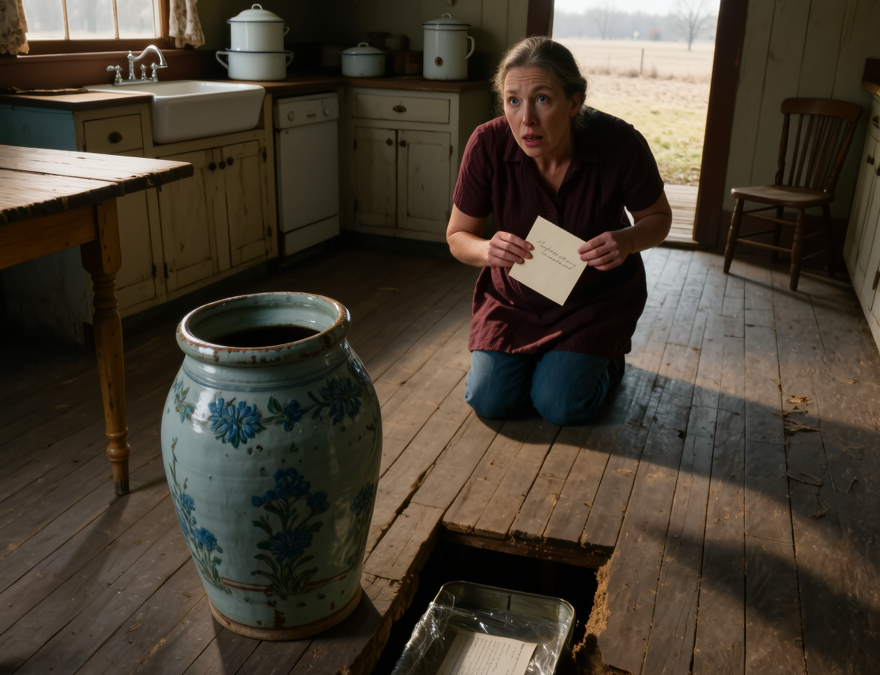
“In the corner there’s a big pickle jar. Ceramic. Blue flowers.”
I remembered it.
An old crock, too large to lift easily, that Elizabeth had once used for preserving vegetables.
“Look beneath it.”
“Beneath the jar?”
She nodded.
“There’s something for you.”
“What?”
“For you.”
“Mom, what is it?”
Her grip tightened.
“Go alone.”
“Why?”
“Because Michael will come if he knows.”
The answer chilled me.
“Does he know something is there?”
“No.”
“Then why hide it?”
Elizabeth closed her eyes briefly.
“When I could still make decisions, I made them.”
I leaned closer.
“What decisions?”
“Good ones, I hope.”
She breathed slowly.
Then whispered, “You were my daughter when my son forgot how to be a son.”
I felt tears rise.
“Don’t say that.”
“It’s true.”
She opened her eyes one final time.
“Don’t let guilt make you foolish.”
Those were the last complete words Elizabeth said to me.
She passed peacefully before dawn.
I sat beside her until the sky turned pale.
Then I called Michael.
No answer.
Again.
No answer.
I sent a message.
Your mom passed this morning. Please call me.
The read receipt appeared.
Ten minutes later, he replied.
In meetings all day. I’m so sorry. Call tonight.
I stared at the screen.
His mother had just died.
He was too busy to call.
Something inside me became very calm.
Not numb.
Clear.
I arranged everything.
The funeral home.
The obituary.
The service.
The flowers.
The calls to relatives.
Dr. Patel gave me the week off without asking whether I could afford it.
“Go,” he said. “We’ll manage.”
Michael joined the memorial through a video call.
He wore a black suit.
He looked devastated.
He said all the right things.
“I wish I could have been there.”
“I’ll regret this forever.”
“Mom sacrificed everything for me.”
Several relatives nodded sympathetically.
One of Elizabeth’s cousins squeezed my hand.
“Poor Michael. So far away.”
I looked at the phone screen.
Behind him, partly visible through a curtain gap, was sunlight.
Bright sunlight.
I said nothing.
After the service, I placed Elizabeth’s urn in the passenger seat of my car and drove south.
Michael had texted that I should keep the ashes near Chicago because it would be “more convenient.”
For whom, I wondered.
Certainly not Elizabeth.
Her hometown sat among flat winter fields and long county roads.
By sunset, I reached the old house.
The porch sagged slightly.
Paint peeled near the gutters.
A rust-colored wind chime moved in the cold breeze.
I unlocked the front door with the key Elizabeth had kept in a small envelope beside her insurance card.
Dust covered the furniture.
The air smelled like old wood and closed rooms.
I placed the urn on the mantel beneath a photograph of Elizabeth and Matthew from 1989.
They looked young.
Happy.
Michael was about six in the photograph, standing between them with one missing front tooth.
I stared at him.
Then at Elizabeth.
“What did you leave me?”
The kitchen was detached from the main house by a narrow covered walkway, an old-fashioned arrangement left from a much earlier renovation.
I waited until morning.
Maybe because I was tired.
Maybe because searching for a dead woman’s secret in darkness felt like something from a story rather than my life.
At sunrise, I carried a flashlight and small garden spade into the kitchen.
The ceramic pickle crock was exactly where Elizabeth said it would be.
Blue flowers.
Chipped rim.
Dust thick enough to write my name in.
I moved it with difficulty.
The floor beneath was not concrete.
It was old plank flooring, and one narrow section near the wall looked newer than the boards around it.
My heart began beating faster.
I found a screwdriver in a drawer.
The plank lifted.
Underneath was a shallow cavity.
Inside sat a rectangular metal tin wrapped in two layers of heavy plastic.
I stared at it for several seconds before reaching down.
The tin was the kind people once used for butter cookies at Christmas.
My hands were shaking when I opened it.
There was no jewelry.
No cash.
Inside were four things.
A small bank envelope.
A handwritten letter.
A photocopy of an adoption record.
And a business card.
Katherine Ellis
Estate Planning Attorney
Springfield, Illinois
I opened the bank envelope first.
Inside was a recent account statement.
Balance: $152,438.17.
I read the number three times.
Then I noticed the line beneath Elizabeth’s name.
Payable-on-death beneficiary: Sophia Thompson.
I sat on the dusty floor.
For years, Elizabeth had worn the same winter coat.
She saved plastic grocery bags.
She reused aluminum foil until it became too wrinkled to flatten.
She had once driven twenty minutes back to a store because a cashier accidentally gave her three dollars too much change.
Where had $152,000 come from?
Then I remembered.
Five years earlier, a highway expansion had taken part of the farmland Elizabeth still owned outside town.
Michael had asked repeatedly about the compensation.
Elizabeth told him it was “enough to fix the roof.”
Apparently she had not told him the rest.
I picked up the adoption record.
Michael Thompson.
Adoptive parents: Matthew and Elizabeth Thompson.
The date was more than forty years old.
I stopped breathing for a moment.
Michael had been adopted.
I had never known.
As far as I understood, neither had he.
I opened Elizabeth’s letter.
Sophia,
If you are reading this, then I did not have the courage or the time to explain everything while I was alive.
First, understand that Michael is my son.
Do not let any piece of paper tell you otherwise.
Matthew and I could not have children. Michael came into our lives when he was only days old, and from the moment I held him, there was never a difference in my heart between the child I imagined and the child I was given.
We decided not to tell him because in those days people spoke differently about adoption, and I was afraid he would grow up believing he had been unwanted.
Maybe that was a mistake.
Maybe some truths become heavier when buried.
I stopped reading.
The words were already changing the way I saw Elizabeth.
I continued.
The money you found came from the land compensation and years of savings.
Michael asked me for it more than once.
The last time, he said he had an investment that would make us all wealthy. I asked questions. He became angry.
That was when I went to Katherine Ellis.
The originals are not buried with this letter. Katherine has them.
I smiled through tears.
Of course Elizabeth had been smarter than to bury original legal documents under a pickle crock.
This tin was not the inheritance.
It was the map.
I kept reading.
I placed the savings account in your name as beneficiary.
I also created a trust for the old house and the remaining land. Katherine will explain it.
I did not do this because Michael is adopted.
Please never let him believe that.
I did it because you cared for me when he chose not to.
Blood has nothing to do with gratitude.
If Michael had come home, cared for me, treated you with respect, and shown that I had judged him too harshly, I intended to change everything.
I did not change it.
That should tell you what I decided.
Sophia, do not spend the rest of your life proving you are a good wife to a man who is not trying to be a good husband.
Do not use my secrets to humiliate him.
Use them to protect yourself.
And when you finally tell him about his adoption, tell him that his father and I chose him every day of his life.
Whatever he became later does not erase that he was loved.
My hands shook so badly I had to lower the letter.
For months, I had felt abandoned.
Used.
Invisible.
Elizabeth had seen everything.
She had not left me revenge.
She had left me a way out.
I called Katherine Ellis.
Her receptionist transferred me immediately.
“Sophia Thompson?”
“Yes.”
Katherine’s voice softened.
“I’m sorry about Elizabeth.”
“You knew her well?”
“Well enough to know she would make you find that ridiculous cookie tin.”
I laughed.
A real laugh.
The first in weeks.
“She made me promise not to tell you,” Katherine continued. “She wanted the choice to remain hers until the end.”
“What exactly did she do?”
“Come to my office tomorrow. Bring the letter and identification. I’ll show you the originals.”
The next afternoon, I sat across from Katherine in a modest law office near Springfield.
She was in her late fifties with short silver hair and red-framed glasses.
She opened a thick folder.
Elizabeth’s trust documents were valid and had been completed nearly two years earlier.
The old house and remaining acreage were held in the trust.
I was the successor beneficiary.
The savings account passed directly to me through the beneficiary designation.
There was also a small life insurance policy intended to cover final expenses.
Michael was not excluded from everything.
Elizabeth had left him Matthew’s restored woodworking tools, several family photographs, and a separate letter.
Most importantly, Katherine explained something I needed to hear.
“Michael’s adoption has no bearing on whether he was Elizabeth’s son.”
“I know.”
“Legally or otherwise. Elizabeth was very clear about that.”
“Then why leave me the property?”
“Because she wanted to.”
Katherine pushed the trust toward me.
“People are allowed to decide who receives their property. She documented her reasons. She also met privately with me more than once. There was no question about her capacity when these documents were signed.”
I thought of the months Elizabeth had spent in our downstairs bedroom.
“Michael is going to fight this.”
“He may.”
“Can he win?”
Katherine chose her words carefully.
“Anyone can challenge an estate plan. That doesn’t mean the challenge is strong. Your best defense is exactly what you’ve been doing.”
“What?”
“Keeping records.”
I almost laughed.
My spreadsheets.
Receipts.
Messages.
Photographs.
The boring pieces of life.
Suddenly they mattered.
That evening, sitting in Elizabeth’s old house, my phone buzzed.
Michael.
He had sent a photograph.
A white sand beach.
Palm trees.
A sparkling blue pool.
The message underneath said:
Partners took us to a resort outside Munich for a few days after closing the quarter. Finally some sun. Wish you were here.
I zoomed in.
He had become careless.
Reflected faintly in a glass tabletop was Natalie.
And beyond the pool stood a hotel sign I recognized from the photographs already synced to our family account.
Florida.
Not Germany.
I took a screenshot.
Then I called Katherine.
“I need my own divorce attorney.”
She was quiet for half a second.
“I can recommend someone.”
Two days later, I met Rachel Moreno in Chicago.
Rachel did not encourage dramatic confrontation.
She did not tell me to empty accounts.
She did not promise revenge.
She asked for documents.
Marriage length.
Income.
Home ownership.
Retirement accounts.
Debt.
Michael’s business interest.
My savings.
The money I had spent on Elizabeth’s care.
Then she looked at me.
“What outcome do you actually want?”
I had expected the question.
I still needed time to answer.
“I want to stop being responsible for choices I didn’t make.”
Rachel nodded.
“That’s a good place to start.”
Together we built a plan.
We documented Michael’s limited contributions to his mother’s care.
We separated Elizabeth’s inherited assets from marital property.
We reviewed joint debts.
We preserved every statement.
I did not touch Michael’s personal accounts.
I did not need tricks.
The truth was enough.
Then I sent Michael one message.
I’m settling your mother’s estate. There are documents here that involve you personally and property you should know about. Katherine Ellis, Mom’s attorney, recommends you come home.
His phone call came less than two minutes later.
“What property?”
Not How are you?
Not How was Mom’s burial?
Property.
“I don’t know how much I should discuss by phone.”
“What did she have?”
“There’s a trust.”
“A trust?”
“And some other records.”
“How much?”
“I don’t know what you’re entitled to.”
He became silent.
Then his voice softened.
“I’ll see if I can get leave.”
Three days later, Michael came home.
He arrived with the same charcoal suitcase.
He looked rested.
Tanned.
Expensive.
When he entered our house, his eyes went immediately to the dining table.
“Where are the documents?”
I stood near the kitchen island.
“Hello to you too.”
He paused.
“Sorry. Long flight.”
“From Germany?”
His gaze met mine.
“Yes.”
I nodded.
“Of course.”
Something in my tone unsettled him.
“Where’s Mom’s stuff?”
“Some of it is with her attorney.”
“What did she leave?”
“Sit down.”
Michael frowned.
“Sophia, I just traveled halfway across the world.”
“No, you didn’t.”
The room changed.
Completely.
Michael did not move.
I took my phone from the counter.
Opened the first photograph.
Miami.
Then another.
Natalie.
Then the reflection in the beach-resort picture.
Then screenshots showing the location tags from the shared family album.
I placed the phone on the table between us.
Michael’s face lost color.
“Sophia.”
“Don’t.”
“I can explain.”
“You’ve had months to explain.”
“It isn’t what you think.”
“That sentence should cost you money every time you use it.”
He sat slowly.
I remained standing.
“You left your seriously ill mother in my care.”
“I had work.”
“You were in Florida.”
“There was work there too.”
“You told us Germany.”
“The project changed.”
“You sent five hundred dollars a month.”
“I told you payroll—”
“You spent more than that on one hotel weekend.”
He looked at the photographs again.
His expression shifted from fear to calculation.
Then he made the mistake that ended whatever part of me had still been undecided.
“So what did Mom leave?”
I stared at him.
After everything I had put on the table, that was the question he chose.
Not, How much did you spend caring for her?
Not, Was she afraid at the end?
Not, Did she ask for me?
What did Mom leave?
I pulled a folder from the chair beside me.
Inside were copies of invoices.
Medical supplies.
Home care.
Transportation.
Final arrangements.
Receipts.
My spreadsheet.
I pushed it toward him.
“What’s this?”
“What caring for your mother actually cost.”
Michael flipped through several pages.
His brows rose.
“This can’t all be right.”
“It is.”
“Why didn’t you tell me?”
“I did.”
“When?”
“Every month.”
“You never said it was this much.”
“I said five hundred dollars wasn’t enough.”
He closed the folder.
“We’ll sort it out later. Show me the trust.”
“No.”
His eyes hardened.
“What do you mean, no?”
“I mean you’re not seeing another document until Katherine is present.”
“I’m her son.”
“Yes.”
“That gives me a right to know.”
“You have a right to receive what the attorney is required to provide you. You do not have a right to order me around.”
Michael stood.
“You’re acting strange.”
I almost smiled.
“For the first time in months, I’m acting like myself.”
He studied me.
“Is this because of Natalie?”
“This is because of you.”
He looked toward the stairs.
“Where are my things?”
“Guest room.”
His face changed.
“You moved my things?”
“Yes.”
“Sophia.”
“Rachel Moreno will contact you tomorrow.”
“Who is Rachel Moreno?”
“My attorney.”
That finally silenced him.
The next morning, we drove separately to Katherine’s office.
Michael arrived ten minutes late.
He wore a dark suit.
No tie.
The expression he carried into the conference room was the same one I had seen him use with contractors and salespeople.
Confident.
Controlled.
Prepared to negotiate.
Katherine greeted him politely.
“Michael.”
“I wish we were meeting under different circumstances.”
“So do I.”
He sat.
Katherine opened the estate file.
“Your mother left clear instructions.”
Michael leaned forward.
“About the land?”
“Among other things.”
“What’s it worth?”
Katherine looked over her glasses.
“We’ll get there.”
She removed an envelope.
“First, Elizabeth left this for you.”
Michael stared at his name written in his mother’s handwriting.
“What is it?”
“A letter.”
“Can I read it later?”
Katherine paused.
“Yes.”
He set it aside.
The movement was small.
But I saw Katherine notice it.
“Now the trust,” Michael said.
Katherine folded her hands.
“The house and remaining acreage pass to Sophia.”
Michael stared.
“What?”
“The trust names Sophia Thompson as successor beneficiary.”
“That’s impossible.”
“It isn’t.”
“I’m her only child.”
“This was Elizabeth’s property.”
“She would never do that.”
“She did.”
Michael turned toward me.
“What did you make her sign?”
I did not move.
Katherine’s voice sharpened.
“Be careful.”
He looked back at her.
“Excuse me?”
“I met with your mother privately. More than once. Sophia was not present. Elizabeth created this plan while she was fully able to make her own decisions.”
Michael laughed in disbelief.
“She was sick.”
“She was also competent.”
“How much money?”
Katherine opened another page.
“The savings account passed by beneficiary designation.”
“To who?”
He already knew.
His face told me.
“To Sophia.”
“How much?”
“Approximately one hundred fifty-two thousand dollars at the date of death.”
Michael pushed back from the table.
“You have got to be kidding me.”
Katherine did not react.
“She hid that from me.”
“Yes.”
“She told me she barely got anything for the land.”
“I can’t speak to what she told you privately.”
He looked at me.
“So you get everything.”
“No.”
Katherine corrected him.
“You received personal property specifically listed in her memorandum. Your father’s woodworking tools. Photographs. Several family items.”
Michael stared at her.
“Tools?”
His voice made the word sound insulting.
Katherine’s eyes cooled.
“And a letter.”
He looked at the envelope again.
Only then did I realize Elizabeth had understood him better than either of us wanted to admit.
Michael picked up the letter.
He tore it open.
His eyes moved across the first page.
Then stopped.
He reread one line.
His face changed.
“What is this?”
Katherine glanced at me.
I said nothing.
Michael looked at her.
“She says they adopted me.”
“Yes.”
“That’s not true.”
Katherine slid the certified record copy across the table.
Michael did not touch it.
“No.”
“Michael.”
“No.”
He looked at me as though I had created the document myself.
“You knew?”
“Only after she passed.”
“My whole life?”
I heard something break in his voice.
Not greed.
Something younger.
For the first time since he returned, I saw the frightened son underneath the grown man.
I could have used that moment against him.
Elizabeth had asked me not to.
So I said quietly, “She loved you.”
Michael laughed bitterly.
“She gave everything to you.”
“That wasn’t because you were adopted.”
“How would you know?”
“Because she wrote that too.”
I reached into my bag and removed Elizabeth’s letter to me.
I did not hand it over.
I read only the line that mattered.
“I did not do this because Michael is adopted. I did it because Sophia cared for me when he chose not to.”
Michael looked down.
No one spoke for several seconds.
Then Katherine said, “Your mother was very clear that adoption never changed your place in her heart.”
Michael rubbed both hands over his face.
“This is insane.”
“No,” I said. “It’s sad.”
His head snapped up.
“You think you won?”
“I don’t think there was anything to win.”
“You got her money.”
“I got three months of sitting beside her while she asked why you didn’t call.”
“I was working.”
“You were in Miami.”
Katherine became very still.
Michael looked at her.
“That has nothing to do with the estate.”
“No,” I said. “But it has everything to do with our marriage.”
I placed another envelope on the table.
Rachel’s card was clipped to the front.
Michael stared at it.
“What’s that?”
“The beginning of us separating properly.”
His expression hardened.
“You’re divorcing me because I made a mistake?”
“No.”
I had rehearsed the answer in my head.
Now I did not need the rehearsal.
“I’m ending our marriage because for months you made hundreds of decisions that required me not to know the truth.”
He opened his mouth.
I continued.
“You chose the trip. You chose the lies. You chose the money. You chose to leave your mother. You chose to let me spend my savings while you sent five hundred dollars and complained about imaginary German weather.”
Michael looked toward Katherine as though hoping another adult in the room would stop me.
She did not.
“You chose all of that,” I said. “I’m choosing now.”
That was the first time I saw the balance change.
For years, Michael had assumed he was the person who decided where we lived, which financial risks were reasonable, when work came first, and what sacrifice should look like.
Now he sat in a quiet law office with his mother’s letter in one hand and my attorney’s card in the other.
For once, nobody needed his permission.
Our separation took months.
There was no magical signature across a kitchen table.
No trap.
No loophole.
Rachel would not have allowed it even if I wanted one.
We exchanged financial disclosures.
Reviewed retirement accounts.
Separated personal debt from joint obligations.
Evaluated our suburban house.
Michael tried several times to argue that Elizabeth’s inheritance should somehow be part of our marital negotiations.
Rachel shut that down quickly.
“It is Sophia’s separate inheritance.”
Michael complained.
His attorney stopped him from wasting more money arguing about it.
The photographs from Florida were useful mostly because they established the timeline of our separation and helped explain certain personal charges.
I did not need to destroy him financially.
I wanted clarity.
Michael kept his business interest.
His retirement share was handled according to the settlement.
We sold the suburban house because neither of us could afford to buy the other out comfortably without damaging our long-term finances.
The day the realtor put the SOLD sign in the yard, Michael stood in the empty kitchen.
“This didn’t have to happen.”
I was packing the last ceramic mugs.
“Yes, it did.”
“We could have gone to counseling.”
“You could have come home.”
He looked away.
“I was afraid.”
“Of what?”
“Everything.”
I waited.
“My job. Money. Mom getting sick. Getting older.”
I almost felt sorry for him.
Then I remembered Elizabeth lying awake while rain hit the windows.
“You were allowed to be afraid.”
He looked at me.
“You weren’t allowed to make me carry the consequences of your fear while you escaped from it.”
Michael leaned against the kitchen island.
“What am I supposed to do now?”
It was such a familiar question.
He had asked versions of it throughout our marriage.
Where’s the insurance card?
Did you pay the taxes?
What do we bring to your mother’s birthday?
What am I supposed to do?
For years, I answered.
This time I put the mug into the box.
“Figure it out.”
Natalie disappeared from Michael’s life before our divorce was final.
I did not know the details.
I did not ask.
One evening, Molly, Michael’s cousin who still worked in his company, called me.
“I heard Natalie transferred to another office.”
“Okay.”
“That’s all you’re going to say?”
“What should I say?”
“I don’t know. I thought you’d be happy.”
I looked around Elizabeth’s old house.
I had moved there temporarily while deciding what to do with the property.
“I don’t want to build my happiness out of somebody else’s collapse.”
Molly became quiet.
“You sound different.”
“I feel different.”
The rural house needed work.
A lot of it.
The roof leaked near the back porch.
The kitchen floor sloped.
The electrical panel looked old enough to vote.
The well pump complained every morning.
But for reasons I could not explain, I loved waking there.
Maybe because nothing in the house asked me to pretend.
Elizabeth’s blue-flowered pickle crock remained in the kitchen corner.
I cleaned it carefully.
I did not move it.
The savings account allowed me to pay the remaining care expenses, replace what I had taken from my own savings, and create a financial cushion.
I did not buy a luxury car.
I did not take an expensive revenge vacation.
I paid off my credit card.
I fixed the roof.
I met with a financial planner.
Then I sat at the small dining table with a notebook and asked myself a question nobody had asked in years.
What do I want?
The answer surprised me.
I wanted less.
Less pretending.
Less rushing.
Less proving.
I reduced my commute by taking an office management position at a therapy clinic twenty minutes from the old house.
The salary was slightly higher.
The staff was smaller.
On Fridays, I left by four.
Sometimes I stopped at the farmers market on the way home.
Sometimes I sat on the porch and did absolutely nothing.
The first few weeks, doing nothing made me anxious.
Then it became peaceful.
Katherine eventually helped me decide to keep the property.
The remaining acreage was leased to a neighboring farmer.
The rent covered taxes and maintenance.
The old house became mine without consuming my future.
That mattered.
One afternoon, Katherine called.
“I found something in Elizabeth’s file you may want.”
“What?”
“A note she wrote after your last meeting with her.”
I drove to Springfield the next week.
Katherine handed me one sheet of yellow legal paper.
Elizabeth’s handwriting slanted across the page.
Sophia thinks strength means carrying things quietly. Someone needs to tell her strength also means putting things down.
I sat there crying and laughing at the same time.
“She knew you well,” Katherine said.
“Yes.”
“Did she ever tell you that directly?”
“Not in those words.”
Katherine smiled.
“She was saving them.”
Almost a year after Elizabeth passed, Michael asked if I would meet him.
I nearly refused.
Then curiosity won.
We chose a diner halfway between Chicago and the old town.
Neutral territory.
He arrived early.
He looked older.
Not ruined.
Not broken.
Just changed.
He had lost some weight.
The expensive watch he once wore was gone.
He ordered coffee.
I ordered tea.
For several minutes, we discussed nothing important.
Traffic.
Weather.
The diner’s terrible parking lot.
Then Michael placed a small wooden box on the table.
“I brought something.”
I opened it.
Inside was Matthew’s old hand plane from the woodworking tools Elizabeth left him.
The wooden handle had been polished smooth by decades of use.
“What is this?”
“Dad’s.”
“I know.”
“I almost sold the tools.”
I looked at him.
“Why?”
“I was angry.”
“At your mother?”
“At everyone.”
He turned his coffee cup slowly.
“Then I read her letter again.”
I waited.
“She wrote that Dad used that plane when he built my first bed.”
Michael swallowed.
“I didn’t know that.”
Neither did I.
He stared through the diner window.
“I spent months thinking she punished me.”
“Did she?”
“No.”
The answer came quietly.
“She judged me.”
I said nothing.
“That was worse.”
“Why?”
“Because she was right.”
I looked at the man I had spent most of my adult life with.
There was a time hearing those words would have filled me with satisfaction.
Now they only made me sad.
Michael continued.
“I started counseling.”
“I’m glad.”
“I should have done it years ago.”
“Probably.”
He smiled faintly.
“You still don’t make things easy.”
“I made things easy for twenty years.”
“Twenty-seven.”
“Exactly.”
He laughed once.
Then grew serious again.
“I want you to know something about Mom.”
“What?”
“I was angry about the adoption.”
“I figured.”
“For a while I thought everything was fake.”
“Your childhood?”
“All of it.”
He looked at the wooden box.
“Then I realized nobody fakes forty years that thoroughly.”
I smiled.
“No.”
“She chose me.”
“Yes.”
Michael nodded slowly.
“I wish I had understood what that meant before she died.”
I reached across the table and touched the wooden box.
“She knew you loved her.”
His eyes filled.
“Did she?”
“Yes.”
That was true.
Elizabeth had never stopped loving him.
She had simply stopped protecting him from every consequence of who he had become.
Michael wiped at his eye quickly.
“Thank you.”
We sat in silence.
Then he asked, “Are you happy?”
I thought about the old house.
The porch.
The kitchen floor.
The blue pickle crock.
My new job.
My own bank account.
The quiet.
“Yes.”
He nodded.
“I’m glad.”
And I believed him.
That mattered more than I expected.
Before leaving, Michael pushed the wooden box toward me.
“I think you should keep this.”
“No.”
“Sophia.”
“Your father left those tools to you.”
“He wasn’t my biological father.”
I looked at him.
Michael caught himself.
Then smiled sadly.
“You know what I mean.”
“Yes.”
I pushed the box back.
“He was your father.”
Michael placed his hand over the lid.
This time, he nodded.
“Yeah.”
We walked to our cars separately.
There was no dramatic goodbye.
No second chance.
No suggestion that we had made a mistake divorcing.
Forgiveness did not require reunion.
Understanding did not erase damage.
Some relationships end because they should.
That does not mean every good thing inside them was false.
The following spring, I renovated Elizabeth’s kitchen.
Not completely.
I kept the old cabinets.
I kept the uneven window over the sink.
I kept the scarred pine table.
And I kept the blue-flowered pickle crock in the corner.
A contractor asked if I wanted it removed.
“No.”
“It’s heavy.”
“I know.”
“You actually use it?”
“Not for pickles.”
He shrugged.
“Decorative?”
I looked at the crock.
“No.”
I smiled.
“It’s a reminder.”
“Of what?”
I thought about it.
“Where to look when someone tells you the truth is buried somewhere inconvenient.”
He laughed, assuming I was joking.
I let him.
On the first anniversary of Elizabeth’s passing, I invited a few people to the house.
Dr. Patel drove down from the city.
Katherine came from Springfield.
Two of Elizabeth’s neighbors brought casseroles.
Molly brought flowers.
Even Michael came.
I had debated whether to invite him.
Then I remembered whose mother we were honoring.
He arrived carrying Matthew’s wooden tool box.
This time, he brought it because he wanted to repair one of the porch rails.
“You know how to use those?” I asked.
“Dad taught me.”
There was pride in the answer.
Healthy pride.
He spent an hour working outside.
Nobody treated him like a villain.
Nobody pretended nothing had happened.
We simply occupied the same space without asking the past to become something it wasn’t.
After lunch, Michael stood alone in front of Elizabeth’s photograph.
I watched from the kitchen.
He touched two fingers to the frame.
Then he whispered something I could not hear.
I did not try.
Some conversations belong to the people having them, even when one of them is no longer physically present.
That evening, after everyone left, I carried dishes into the kitchen.
Sunset filled the windows with gold.
I noticed the pickle crock.
For a moment, I could almost see Elizabeth sitting at my old kitchen table in Chicago, telling me not to hurry.
Anger makes people hurry.
She had been right.
If I had confronted Michael the night I found the Miami photographs, perhaps I would have screamed.
Perhaps he would have denied.
Perhaps I would have doubted myself.
Instead, I waited.
I documented.
I cared for Elizabeth.
I listened.
And when the time came, I learned the difference between revenge and protection.
Revenge would have been using Michael’s adoption to humiliate him.
Protection was giving the document to him privately, exactly as his mother asked.
Revenge would have been trying to leave him with nothing.
Protection was making sure his choices stopped draining my future.
Revenge would have been hating Natalie forever.
Protection was deciding I no longer needed to know where she went.
Revenge would have kept me tied to them.
Protection let me walk away.
Months later, I used part of Elizabeth’s money to do something I think she would have approved of.
I created a small caregiver assistance fund through the local community foundation.
Nothing enormous.
Nothing with my name on it.
The fund helped families pay for temporary home-care support when an older relative became seriously ill.
The paperwork asked what I wanted to call it.
I wrote:
The Elizabeth Thompson Family Care Fund.
Then I crossed out Family.
I replaced it with:
The Elizabeth Thompson Care Fund.
The coordinator looked at me.
“You changed your mind?”
“Yes.”
“Why?”
“Care creates family in ways paperwork doesn’t always capture.”
She smiled.
“I like that.”
So did I.
Sometimes people ask whether I regret the years I spent with Michael.
I don’t.
Regret is too simple.
I regret what he did.
I regret what I tolerated after I should have asked harder questions.
I regret that Elizabeth spent her final months knowing her son had chosen distance.
But I do not regret every Christmas.
Every road trip.
Every ordinary dinner.
Every year.
If I erased all of that, I would erase parts of myself too.
Michael was not a stranger who appeared one day and ruined my life.
He was a man I loved.
A man who loved me in ways that were real and failed me in ways that were real too.
Both can be true.
That was one of Elizabeth’s final gifts.
The courage to hold two truths at once.
She could love her son and still protect me from him.
I could forgive Michael without returning to the marriage.
I could appreciate what we once had without sacrificing what I needed next.
And I could accept Elizabeth’s inheritance without believing money was the most important thing she left.
The most valuable thing was her permission.
Put it down.
That was what her note meant.
Put down the responsibility for another adult’s choices.
Put down the belief that a good wife must absorb every disappointment quietly.
Put down the fear that leaving means the whole past was wasted.
Put down the shame of admitting someone you trusted did not protect what you built together.
Put it down.
The blue pickle crock still sits in my kitchen.
Visitors sometimes ask about it.
Most assume it is an antique I bought at an estate sale.
I usually tell them it belonged to my mother-in-law.
That is enough.
But once in a while, late in the afternoon when sunlight catches the faded flowers on the ceramic, I remember kneeling on that dusty floor and opening a rusted cookie tin with shaking hands.
I thought I was about to find money.
Instead, I found a woman’s final act of love.
Not for the son she had raised.
Not against him either.
For me.
A woman who had no biological daughter chose to treat me like one when her own son had forgotten what family required.
She left me the truth.
She left me legal protection.
She left me financial breathing room.
And most of all, she left me a sentence I did not know I needed until long after she was gone.
Strength also means putting things down.
I did.
And for the first time in years, my hands were finally free.
If this story touched your heart or stayed with you after the final page, please consider supporting us by following our Facebook page, leaving a like, and sharing your thoughts in the comments below. Every reaction, every kind word, and every new follower helps us continue bringing meaningful stories like this to you. From the bottom of my heart, thank you for reading, for being here, and for becoming part of our storytelling community. Your support truly means more than words can express.
“`
