At a family barbecue, my sister pointed at my fifteen-year-old son and joked, “He’ll
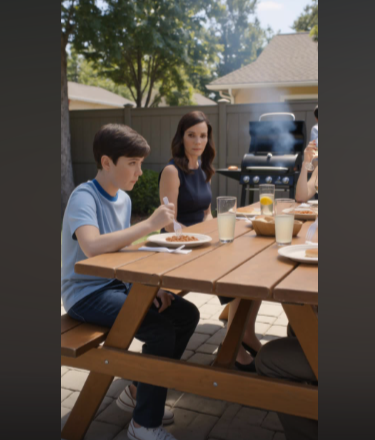
At the Barbecue, My Sister Said, “Your Son Will Always Need Help” — Then Laughed……
AT THE BARBECUE, MY SISTER SAID “YOUR SON WILL ALWAYS NEED HELP” THEN LAUGHED. MY SON STOPPED EATING. I SAID, “LIKE HOW YOUR KIDS NEED MY HELP EVERY DAY?” MY SISTER STOPPED MID-BITE. MOM WHISPERED, “PLEASE DON’T.” BUT I…
THE DAY I STOPPED PAYING TO BE DISRESPECTED
The barbecue sauce on my plate suddenly looked too red.
I remember that more clearly than the heat.
More clearly than the charcoal smoke drifting over my parents’ backyard.
More clearly than the paper plates bending under burgers, baked beans, and deviled eggs.
My sister Amanda was holding a glass of wine.
She had one elbow resting on the long picnic table, sunglasses pushed up into her perfectly highlighted hair, and she was smiling as though she had just delivered the cleverest line of the afternoon.
She pointed her fork at my fifteen-year-old son.
“Come on, Julia.”
Her voice carried.
“Let’s be realistic.”
I looked at Alex.
He sat beside me with both hands in his lap.
Too still.
He had learned that stillness in family gatherings.
The less he moved, the less likely someone was to comment on how he moved.
Amanda continued.
“Alex is always going to be special.”
The word landed exactly the way she intended.
Soft enough to sound polite.
Sharp enough to cut.
“He’s limited.”
“A kid like that is always going to need help just to get through the day.”
Then she laughed.
Not nervously.
Not because she realized she had gone too far.
She laughed because she thought everyone at the table understood the joke.
I waited.
My mother lifted her iced tea.
My father looked toward the grill.
Greg, Amanda’s husband, studied the fence.
Nobody said:
Stop.
Nobody said:
He can hear you.
Nobody said:
That is a child.
Alex’s face turned red.
His fork slipped from his fingers.
Plastic against wood.
A tiny sound.
Somehow it seemed louder than Amanda’s voice.
That was the moment everything changed.
My name is Julia Baker.
I was forty-two that summer.
Software developer.
Founder of a small but highly profitable consulting firm.
Single mother.
Owner of a modest house in a quiet suburb where the loudest recurring problem was a neighbor’s leaf blower.
I had spent most of my adult life allowing people to underestimate me because correcting them seemed exhausting.
That habit began in childhood.
Amanda was the sparkly one.
The one who needed dance lessons.
The right dresses.
The emotional rescue.
I was the stable one.
The child who did homework without reminders.
Who handled disappointment without making noise.
Who learned early that competence can become a reason people stop checking whether you need anything.
“Julia is fine.”
My mother used to say.
“Julia can take care of herself.”
Amanda, apparently, needed the whole family.
That distinction followed us into adulthood.
Amanda married Greg.
Greg worked in sales.
Good-looking.
Charming.
Income variable enough that he always sounded more successful than the tax returns would suggest.
They bought too much house.
Joined Oak Haven Country Club because, according to Amanda, “relationships happen there.”
Leased luxury cars.
Enrolled three children in St. Augustine Academy.
Curated a life that photographed beautifully.
I went into software.
Stayed in a rented apartment until I had a down payment.
Started my consulting firm at twenty-eight.
No brand launch.
No founder story.
No public profile.
I wrote systems.
Fixed expensive problems.
Took contracts from regional companies that preferred discretion.
Then national ones.
By thirty-five, I made more money in a year than Amanda believed possible without a corner office and a husband.
I never told her the number.
That was partly privacy.
Partly cowardice.
If she knew, every family problem would become a financial request.
I was right.
The requests began anyway.
Alex had been diagnosed with autism at three.
By then his father was already drifting out of our lives.
He left completely before Alex turned five.
Not because autism made Alex unlovable.
Because some men interpret responsibility as a trap once responsibility stops looking easy.
I raised him.
Therapy when useful.
School advocacy.
Occupational support.
Noise-canceling headphones.
Coding classes when he discovered computers.
Time.
Mostly time.
Amanda’s response to the diagnosis had told me who she was before I was willing to believe it.
“Oh, Julia.”
She had said.
“I’m so sorry.”
Then:
“I can’t imagine having a child who isn’t all there.”
I remember the room.
The coffee cup in my hand.
How I went cold.
I corrected her.
She apologized.
Then repeated the same idea in softer language for twelve years.
At Christmas:
“Connor made varsity.”
Then, to Alex:
“Still doing Legos?”
“He’s building mechanical structures.”
I would explain.
Amanda smiled.
“Whatever keeps him occupied.”
At birthdays, she spoke loudly and slowly to him.
At family dinners, she asked me questions about his future as if he were not sitting three feet away.
She had never learned the difference between autistic and incapable.
The strangest part was that while Amanda pitied me, I was quietly funding her life.
Five years before the Labor Day barbecue, my father had a cardiac procedure.
Nothing catastrophic.
Enough to scare my parents.
Their retirement accounts had already taken a hit from a bad investment and medical expenses.
Mom came to my house crying.
Not about Dad.
About Amanda.
“They’re going to lose the house.”
She said.
“Greg’s commissions are down.”
“The school tuition is due.”
“The kids cannot be pulled out.”
“It would destroy Amanda.”
That sentence should have stopped me.
It did not.
I loved my niece and nephews.
Connor.
Sarah.
Braden.
Good kids.
Caught inside adult choices.
I agreed to help.
At first, tuition only.
Direct payment to St. Augustine.
Then a temporary monthly transfer.
Five thousand dollars.
Groceries.
Gas.
Mortgage support.
Just until Greg’s numbers improved.
The transfer continued three years.
Country-club dues came later.
Amanda insisted the membership supported Greg’s client development.
I paid directly because I did not want to hand over unrestricted money.
That distinction made me feel responsible.
In reality, I was funding the same lifestyle from a different route.
I drove a five-year-old sedan.
Owned a small house.
Wore clothes until they wore out.
Amanda drove a Range Rover and talked about self-care weekends.
From the outside, she looked rich.
I looked ordinary.
She began believing the appearance.
That was the part that still astonished me.
Six months before the barbecue, we had lunch.
I paid.
Of course.
Amanda picked at a salad and told me I should dress better.
“You look tired.”
She said.
“That sweater looks like something Mom would wear.”
Then:
“Maybe if you made more effort, you could meet someone like Greg.”
I nearly laughed into my water.
I was paying for her lunch.
Her children’s school.
Her monthly support.
The club where Greg supposedly met clients.
And she was explaining how I needed a man to take care of me.
I said nothing.
That silence was not maturity.
It was an addiction to peace.
By the time we reached Labor Day, I had given Amanda’s household nearly three-quarters of a million dollars over five years.
I knew the number.
I maintained a spreadsheet called FAMILY SUPPORT.
I rarely opened the total row.
Looking at it made me nauseous.
Tuition.
Ninety-six thousand per year for three children.
Monthly transfers.
Country club.
Some renovation help.
A shortfall when Greg’s commission check came late.
One summer camp.
A dental emergency.
Several expenses I did not regret.
Several I did.
I told myself it was for the children.
Sometimes it was.
Sometimes I was buying access to a family system that still considered me lesser.
Then Amanda pointed a fork at Alex and called him limited.
The illusion ended.
My mother took another sip of tea.
Amanda reached for a deviled egg.
As though nothing had happened.
That silence around the table told me the truth.
I was not preserving family.
I was financing a hierarchy in which my money was welcome and my son was not.
That could not continue.
Amanda did not stop.
People who have been allowed to speak without consequence often interpret silence as permission.
She leaned back in her chair.
“I’m just saying we have to be realistic about the future.”
My father’s expression tightened.
“Amanda.”
She ignored him.
“Julia, have you looked at group homes?”
The table went quiet again.
“For when he’s older.”
I stared at her.
She continued.
“You cannot do this forever.”
“You’ll get older.”
“He’s not going to live independently.”
“He’s not going to have a normal job.”
“He’s probably not going to get married.”
Her voice softened into false concern.
“That is a life sentence for you.”
Alex stood so quickly his knee struck the underside of the table.
Lemonade jumped from his cup.
“I need the bathroom.”
He said.
Nobody answered.
He walked toward the house with the rigid, rapid gait he used when sensory overload and humiliation were colliding.
Amanda rolled her eyes.
“He’s so sensitive.”
I stood.
“You are the one being cruel.”
She laughed.
“I am the only person being honest.”
“No.”
“You are being cruel.”
“Same thing, sometimes.”
I walked into the house.
Cool air hit my skin.
The guest-room door was closed.
I knocked.
“Alex.”
No answer.
I opened it.
He sat on the floor between the bed and the wall.
Headphones on.
Knees up.
Rocking.
Tears running silently down his face.
I sat near him.
Not touching.
He needed control of physical contact when overwhelmed.
Minutes passed.
Then he removed the headphones.
“Is it true?”
My heart broke.
“What?”
“That I’m a burden.”
“No.”
“That I’m broken.”
“No.”
“Aunt Amanda says I’m limited.”
“Aunt Amanda does not understand you.”
“She says I’ll never do anything real.”
I breathed.
“Do you remember the regional coding qualifier?”
He nodded.
“Do you remember building the home server?”
“Yes.”
“Do you remember helping Mr. Chen recover his family photos after his laptop failed?”
A tiny nod.
“Those are real things.”
“She laughs at me.”
“I know.”
His voice dropped.
“They all do.”
That sentence changed the problem.
It was not one insult.
It was environment.
I put my hand on the carpet between us.
Not on him.
A place he could choose to reach.
“Listen to me.”
“This is the last time I am asking you to sit through that.”
He looked up.
“What does that mean?”
“It means I have been making choices because I wanted everyone to get along.”
“And those choices are hurting you.”
“That stops now.”
He stared.
“Are we leaving?”
“Soon.”
“But first I need to take care of something.”
I waited until his breathing slowed.
Then left him with his tablet and headphones.
In the bathroom mirror, I looked exactly the same.
Navy sundress.
Hair pulled back.
Forty-two-year-old woman.
Nothing dramatic.
Inside, the pleasing reflex was gone.
I went into Dad’s den.
Opened my laptop.
Logged into the FAMILY SUPPORT spreadsheet.
This time I looked at the total.
$748,430 over five years.
I sat with it.
Not all exploitation.
Some gifts I chose freely.
Those remained gifts.
Money I spent on my niece’s surgery.
A tutoring program for Connor.
Emergency mortgage help during one bad quarter.
I would not rewrite every act of generosity as abuse because Amanda had behaved badly.
That would make me dishonest too.
But the recurring systems had become something else.
Tuition sponsorship.
Monthly support.
Country club billing.
Authorized card access.
Those were ongoing choices.
I could change ongoing choices.
I opened the bank portal.
Scheduled transfer:
AMANDA MILLER.
$5,000.
First business day monthly.
I selected:
Cancel future series.
The bank asked:
Are you sure?
Yes.
Done.
Then the credit-card account.
Amanda and Greg were authorized users on one card I had opened specifically for family support.
I removed them.
The issuer warned:
Existing settled transactions remain due.
New authorizations will be declined after removal.
Correct.
Done.
Then Oak Haven Country Club.
The membership itself was in Amanda and Greg’s names.
My card was simply the payment method.
I removed my card.
I did not cancel their membership.
That was not mine to cancel.
They would receive their own invoice.
Then St. Augustine Academy.
This required more thought.
The source of my anger wanted one email.
Immediate termination.
Kids pulled from classrooms Monday morning.
That would have punished children for their mother’s cruelty.
I did not want that.
I called the school’s business office.
Holiday voicemail.
I left a message requesting a written review of my sponsorship.
Then emailed.
I stated that I would honor the current paid term but would not renew financial sponsorship for the next billing period.
No new charges without separate written approval.
Future invoices should go to the legal guardians.
I also asked the school not to involve the children in any billing communication.
That was important.
Private-school status was not more important than dignity.
Neither was my revenge.
I scheduled the sponsorship end date.
Then I closed the laptop.
Twelve minutes.
That was all it took to change the future.
Not destroy Amanda.
Not evict her children from school.
Stop volunteering to fund choices that no longer aligned with my values.
Outside, she laughed.
I could hear her through the open window.
“She’s just bitter.”
Amanda said.
“I think she’s jealous of how normal our family is.”
Jealous.
I almost smiled.
I carried the laptop back to my bag.
Went outside.
Mom looked up.
“Alex okay?”
“He’s calming down.”
“Amanda didn’t mean it.”
She whispered.
“You know how she is.”
That phrase had protected Amanda for forty years.
You know how she is.
Translation:
Everyone else adjusts.
“I know exactly how she is.”
I said.
Mom frowned.
“Don’t hold a grudge.”
“I’m not.”
That was true.
I felt no rage.
Only separation.
Amanda waved a fork.
“What were you doing inside?”
“Work emergency?”
“On Labor Day?”
“I was doing housekeeping.”
“Boring.”
She sang.
“Necessary.”
I sat for another forty minutes.
Listened.
Greg discussed golf.
Amanda planned a Martha’s Vineyard trip.
Mom talked about fall holidays.
Dad avoided looking at Alex when he finally came outside to stand beside me.
We left before dessert.
“Say goodbye.”
Mom told him.
Alex looked at Amanda.
Said nothing.
She shrugged.
“Whatever.”
Then:
“Try to be more social next time.”
I put one arm around him.
“We’re going.”
In the car, he asked:
“Did you mean it?”
“Yes.”
“What happens now?”
“Nothing tonight.”
I said.
“Your aunt and uncle will make their own decisions with their own money.”
He considered that.
“So you stopped paying?”
“Yes.”
His face changed.
Not satisfaction.
Concern.
“What about Connor and Sarah and Braden?”
“I am not taking away anything already paid for.”
“The school has time to talk with their parents.”
“I am not punishing them.”
“Good.”
He looked out the window.
Then:
“Mom?”
“Yes?”
“Thank you.”
“For what?”
“For believing me when I said it hurts.”
I pulled over two blocks later because I could not see through tears.
Not from Amanda.
From the realization that my son had been waiting for me to believe his pain strongly enough to act.
That was mine to carry.
Monday morning arrived quietly.
That felt almost insulting.
The sun came through my kitchen window.
Alex ate oatmeal.
I packed his lunch.
He complained that I had bought the wrong yogurt.
Ordinary.
I dropped him at school and watched him walk toward the entrance with his headphones around his neck.
He looked back once.
I waved.
Then I went home.
At 9:15, my phone rang.
Amanda.
I let it ring twice.
Answered.
“Hello.”
“Julia.”
Her voice was high enough that I pulled the phone slightly away.
“You need to call St. Augustine.”
“Why?”
“The business office says you stopped the sponsorship.”
“I did.”
“They sent us a notice.”
“Yes.”
“What is happening?”
I sat at my desk.
The school had done exactly what I requested.
Current term remained funded.
The next scheduled tuition cycle would become Amanda and Greg’s responsibility.
No children removed from class.
No public confrontation.
A thirty-day planning window.
Apparently, that was still catastrophic.
“You cannot just stop.”
Amanda said.
“I can stop future voluntary payments.”
“You promised.”
“I promised to help when you were in trouble.”
“We are still in trouble.”
“You have been in ‘trouble’ for five years.”
Silence.
Then:
“This is because of the barbecue.”
“It is because the barbecue clarified something.”
“Oh my God.”
She groaned.
“Julia, I apologized.”
“No.”
“You said I was sensitive.”
“That is not an apology.”
“I said I was sorry your feelings were hurt.”
“That is also not an apology.”
She exhaled hard.
“Fine.”
“I’m sorry.”
The words came fast.
Transactional.
“Now fix the tuition.”
“No.”
The silence afterward felt larger.
“What?”
“No.”
“Julia.”
“The current term is covered.”
“You have a month to decide whether to continue at St. Augustine.”
“The public schools in your district are strong.”
“You can explore financial aid.”
“You can change your household budget.”
“You have options.”
Her breathing changed.
“You are doing this to my children.”
“No.”
“I am stopping a payment.”
“Those are different things.”
“That school is their entire social world.”
“Then you and Greg need to decide whether keeping them there is worth changing other expenses.”
“Other expenses?”
Her voice sharpened.
“Yes.”
“The Range Rover.”
“The country club.”
“Trips.”
“Renovation plans.”
“You cannot tell me how to live.”
“I agree.”
“That is exactly why I am no longer financing how you live.”
She went silent again.
Then:
“Greg is going to kill me.”
I closed my eyes.
That sentence told me something.
He did not know the full truth.
“How much does Greg know about my support?”
“Enough.”
“That is not an answer.”
“Julia.”
“How much?”
She lowered her voice.
“He thinks tuition comes partly from the investment account Grandma left me.”
“Grandma left us five thousand dollars each.”
“I know.”
“Does he know about the monthly five thousand?”
Pause.
“Not exactly.”
“Country club?”
“He thinks I handle it.”
“Amanda.”
“Do not start.”
I leaned back.
“I am not starting anything.”
“You built your marriage around money you were embarrassed to admit came from me.”
“That is not my problem to maintain.”
She swore.
Then:
“What else did you cancel?”
“The monthly transfer.”
A small sound.
“The authorized cards.”
Another.
“I removed my card from Oak Haven.”
“No.”
She whispered.
“Yes.”
“That transfer is our grocery money.”
“Five thousand dollars is not your grocery budget.”
“It covers everything.”
“Then build a budget around your household income.”
“You are destroying us.”
The old me would have panicked at that sentence.
The new me asked:
“Why can my stopping a voluntary gift destroy a household with two adults?”
Amanda had no answer.
Instead she yelled.
Called me jealous.
Vindictive.
Cold.
Said I had always resented her.
Said Alex’s autism had made me bitter.
That last one ended the call.
“Goodbye, Amanda.”
I hung up.
My hand shook.
Not with regret.
Adrenaline.
I stared at the phone.
Then opened my work email.
I had code to review.
A client deployment.
People who paid me because I solved problems rather than because I absorbed them.
Forty-five minutes later, Mom arrived.
Her car stopped halfway onto my grass.
She entered before I had fully opened the door.
“Fix it.”
No hello.
No question about Alex.
“Coffee?”
“I do not want coffee.”
She placed her purse on the counter.
“Amanda is hysterical.”
“She has thirty days before the next tuition billing.”
“That is not the point.”
“What is?”
“The family.”
Of course.
“You cannot pull the rug out.”
“I did not.”
“I gave them years.”
“You set them up to rely on you.”
That landed.
Because partly, yes.
I had.
“I did.”
Mom’s expression changed.
She had expected denial.
“I should not have created an indefinite subsidy.”
“I should have put an end date on it.”
“I should have required Amanda and Greg to build a plan.”
“That was my mistake.”
Mom seized the opening.
“Then fix it.”
“No.”
I shook my head.
“Recognizing my mistake does not mean continuing it.”
Her face flushed.
“This is all because Amanda made one bad comment.”
“Two.”
“What?”
“She called Alex limited.”
“Then a life sentence.”
Mom looked away.
“She was frustrated.”
“No.”
“She was entertained.”
“Julia.”
“You sat there.”
My voice stayed quiet.
“That is the part I cannot forget.”
“You heard her.”
“You watched Alex leave.”
“You did nothing.”
Mom’s face drained.
“I did not know what to say.”
“You could have said his name.”
“You could have said stop.”
“You could have said he is fifteen.”
She sat at my table.
Suddenly older.
“I hate conflict.”
“I know.”
“That is why I have been handling it for everyone.”
“What does that mean?”
“It means I paid Amanda so she would not fail publicly.”
“I stayed quiet so you would not have to choose.”
“I let her talk to Alex however she wanted so family dinners stayed peaceful.”
I looked at my mother.
“That peace was expensive.”
Her eyes filled.
“But what will they do?”
There it was.
Not:
What did she do to Alex?
What will Amanda do now?
“They will adjust.”
“They may sell the Range Rover.”
“Leave the club.”
“Move.”
“Change schools.”
“Greg may need steadier work.”
“Amanda may need a job.”
Mom whispered:
“She has not worked in years.”
“Then this is a good time to start.”
“That sounds cruel.”
“No.”
“It sounds adult.”
She stared at me.
“You really are not changing your mind.”
“No.”
Mom picked up her purse.
At the door, she said:
“You are breaking the family.”
I answered:
“The family broke every time everyone watched someone get hurt and chose silence.”
She left.
I locked the door.
Then I cried for ten minutes.
Boundaries do not always feel powerful.
Sometimes they feel like standing alone in a quiet kitchen after your mother chooses the person screaming over the person who finally stopped paying.
But the quiet was clean.
That mattered.
The fallout was less dramatic than Amanda predicted.
And more instructive.
St. Augustine did not remove the children the next day.
The business office offered Amanda and Greg three options.
Pay the next term.
Apply for financial aid.
Withdraw at the natural semester transition.
For the first time, they had to look at actual numbers.
Ninety-six thousand dollars a year in tuition.
Country club.
Luxury vehicles.
Mortgage.
Insurance.
Dining.
Travel.
Three children.
Greg’s commissions.
No five-thousand-dollar transfer.
No Julia card.
The math had apparently never existed in one room before.
Greg called me once.
He sounded controlled.
“Did you really pay all three tuition accounts?”
“Yes.”
“For four years?”
“Yes.”
“Why didn’t you tell me?”
I almost laughed.
“Ask your wife.”
Silence.
Then:
“She said part came from family money.”
“It did.”
“Mine.”
Another silence.
“Club too?”
“Yes.”
Greg swore softly.
Not at me.
Then:
“I need to go.”
That was the entire call.
Two weeks later, Amanda’s Range Rover disappeared.
Then Greg’s second car.
Oak Haven membership lapsed at the end of the billing period.
They withdrew from a planned kitchen renovation.
Cancelled Martha’s Vineyard.
The children finished the semester at St. Augustine while Amanda and Greg applied for aid.
They received some.
Not enough.
At winter break, all three transferred to the public schools in their district.
No one was cast into the street.
No child’s education ended.
They simply stopped living inside an expensive structure financed by someone outside the household.
Amanda found this humiliating.
That was different from harmful.
I ran into her at the grocery store in October.
She wore yoga pants.
No makeup.
Generic cereal in her cart.
I hated myself for noticing the cereal.
Poverty is not a brand choice.
Buying store-brand food is not a moral consequence.
Still, the contrast with her old performance was impossible to ignore.
She froze.
“Hi.”
I said.
“You really did it.”
Her voice was hollow.
“Yes.”
“We sold the Range Rover.”
“I heard.”
“We’re down to one car.”
“That sounds manageable.”
Her mouth twisted.
“Greg is sleeping in the guest room.”
I waited.
“He blames me.”
“For the money?”
“For lying about it.”
That mattered.
Amanda looked at the apples in my cart.
“I told him I was handling everything.”
“I know.”
“He thought I was better with money than I was.”
“What did you think?”
She laughed bitterly.
“That I could keep it going forever.”
Then she looked at me.
“Did you enjoy this?”
“No.”
I meant it.
“I enjoyed stopping.”
“That is different.”
She stared.
Then nodded once.
I walked away.
Did not offer to buy her groceries.
Did not ask whether the mortgage was current.
That was harder than it sounds.
The rescuer in me remained alive.
I was simply no longer letting her drive.
At home, Alex was changing too.
The absence of family gatherings had lowered a tension I had underestimated.
He spent less time recovering from comments he could not predict.
He coded more.
Talked more.
Slept better.
I did not turn this into a story where autism disappeared once toxic relatives left.
Autism was not the problem.
Environment was.
Alex still wore headphones.
Still became overwhelmed in noisy rooms.
Still needed direct communication.
Still missed jokes.
Still loved routines.
He was also brilliant.
Those things had always coexisted.
In November, he entered a regional coding competition.
His project was a study-organizing application designed for students with ADHD and executive-function difficulties.
It used machine-learning tools to categorize notes, detect repeated concepts, and create simple review plans.
Not magic AI.
A clever student project.
He had spent months on it.
Competition night took place at a local university.
Alex wore a blue button-down.
He hated the collar.
We compromised by letting him remove the top button.
Backstage, he paced.
“I’m going to forget words.”
“You can use your note cards.”
“That makes me look stupid.”
“No.”
“It makes you look prepared.”
He stared at me.
“Is that what you tell clients?”
“Yes.”
“That’s manipulative.”
“Correct.”
He smiled.
Then walked on stage.
I held my breath.
He spoke too quickly for the first thirty seconds.
Then slowed.
Showed the interface.
Explained why standard study apps overwhelmed some users.
Demonstrated the sorting model.
One judge asked about bias in the recommendation system.
Alex paused.
Then gave a better answer than I expected.
He admitted the dataset was too small.
Explained limitations.
Proposed user-controlled overrides.
That answer won the room.
When the category results came, Alex placed first.
He looked stunned.
I stood and clapped until my hands hurt.
Afterward, we ate pizza.
The trophy sat beside him.
He touched it between bites.
“Do you think Aunt Amanda knows?”
My chest tightened.
“I don’t know.”
“I kind of want her to.”
“Why?”
“Not to make her feel bad.”
He looked at the trophy.
“I just want her to know I’m not stupid.”
I reached across the table.
“You never had to prove that to her.”
“I know.”
“Do you?”
“Not always.”
That was the truth.
Cruel words do not disappear because someone wins a trophy.
They leave residue.
Healing is not a reversal scene.
It is repetition.
People seeing you correctly long enough that the wrong voices become quieter.
“I’m proud of you.”
I said.
“For winning?”
“For building something useful.”
“And for admitting where it still needs work.”
He looked down.
Then smiled.
“That part was hard.”
“Usually is.”
We finished the pizza.
He carried the trophy to the car himself.
Two weeks and two days after Labor Day, Amanda arrived at my house in the rain.
Not luxury-car rain.
No dramatic vehicle repossession.
Just bad weather.
Her umbrella had turned inside out.
Hair soaked.
She stood on the porch with both hands wrapped around the broken handle.
“Can I come in?”
The fact that she asked stopped me.
I stepped aside.
She dripped water onto the floor.
“I’ll get a towel.”
“No.”
“I’m fine.”
She was not.
We sat at the kitchen table.
Same table where Mom had told me to fix everything.
Amanda clasped her hands.
Nails chipped.
No wine.
No performance.
“We listed the house.”
I nodded.
“The mortgage is too much.”
“We’re going to rent a townhouse on the east side.”
“That area is nice.”
“It’s smaller.”
“Yes.”
She almost smiled.
“Mom already said that six times.”
I waited.
Amanda looked at her hands.
“Greg is staying.”
“For now.”
“We had to tell each other the truth.”
“That sounds unpleasant.”
“It was awful.”
She laughed once.
Then cried.
Not pretty tears.
Real ones.
“I wanted to hate you.”
“I did hate you.”
“For a week.”
“I told everyone you were jealous.”
“I know.”
“How?”
“Mom.”
“Of course.”
Amanda wiped her face.
“Then Connor came home from orientation at the public school upset.”
My stomach tightened.
“What happened?”
“Some kid made fun of his shoes.”
“He was embarrassed.”
“He said he felt like everybody was looking at him.”
She swallowed.
“And I heard myself telling him not to care.”
“To remember who he is.”
“To not let somebody else decide what he is worth.”
Her face collapsed.
“That is what I should have done for Alex.”
I said nothing.
She needed to finish without me making it easier.
“I saw it.”
She continued.
“I saw myself.”
“A grown woman picking at a child because it made me feel bigger.”
Tears ran onto the table.
“I am ashamed.”
I watched her.
For most of my life, Amanda’s apologies included explanations.
Stress.
Personality.
Misunderstanding.
That night, none came.
“Why Alex?”
I asked.
She closed her eyes.
“Because you scared me.”
That surprised me.
“What?”
“You never needed Mom and Dad the way I did.”
“You built a career.”
“You bought your own house.”
“You raised Alex alone.”
“You never seemed to care what people thought.”
“I cared.”
“Well, you hid it.”
She laughed bitterly.
“I had attention.”
“You had competence.”
“And every time I felt small next to you, I found something I could call wrong.”
“Your clothes.”
“Your car.”
“Being single.”
“Alex.”
She looked sick.
“He was the easiest target because everybody let me pretend autism meant less.”
My throat tightened.
“You hurt him.”
“I know.”
“You do not get to fix that by crying in my kitchen.”
“I know.”
Another surprise.
“I’m not asking for money.”
“Good.”
“I’m not asking you to restart anything.”
“Good.”
“I came to apologize.”
Silence.
Then:
“I’m sorry.”
This time, I believed she understood the sentence.
“Thank you.”
That was all I could give.
Footsteps sounded in the hallway.
Alex entered holding his coding trophy.
He stopped.
Looked at Amanda.
Then at me.
“It’s okay.”
I said.
“Aunt Amanda is visiting.”
His grip tightened around the trophy.
Amanda saw it.
“What’s that?”
Alex hesitated.
“Coding competition.”
“I won my category.”
Amanda looked at the plaque.
Then at him.
“You won?”
“Yes.”
“What did you build?”
“A study app.”
His voice was guarded.
Amanda nodded slowly.
“That’s amazing.”
Alex looked at her.
“I’ve been coding for a while.”
“I know.”
She stopped.
Then corrected herself.
“No.”
“I didn’t know.”
“I wasn’t paying attention.”
The room went still.
Amanda’s voice shook.
“I’m sorry, Alex.”
He said nothing.
She continued.
“I said things about you that were wrong.”
“And cruel.”
“I treated you like autism meant you couldn’t do things.”
“That was ignorant.”
Alex looked at me.
I did not rescue anyone.
Finally:
“Okay.”
One word.
Not forgiveness.
Acknowledgment.
Amanda smiled through tears.
“Congratulations.”
“Thanks.”
He went back down the hall.
Amanda watched him leave.
“He hates me.”
“No.”
“He doesn’t trust you.”
“Different.”
She nodded.
“I deserve that.”
At the door, she turned.
“When we get settled.”
“Maybe we could have pizza.”
“Nothing fancy.”
“You, me, Alex.”
I thought.
“Not yet.”
Her face fell slightly.
Then she nodded.
“Okay.”
“Give it time.”
“I will.”
She stepped into the rain.
No restored card.
No tuition promise.
No check.
That was important.
Reconciliation that requires money is not reconciliation.
For the first time, Amanda left my house with less financial access than when she arrived and more honesty.
That felt like progress.
The next six months were not a straight line.
That is the part people usually leave out when they tell boundary stories.
They want the clean version.
One insult.
One decision.
One collapse.
One apology.
Then everyone becomes better.
That is not how families work.
Amanda had days when she was sincere and days when she was furious.
Sometimes both within the same week.
She sent me one message in October:
I know why you stopped.
Then three days later:
I still think you could have given us more warning.
Both were true from her perspective.
I had been funding their household for years.
Stopping future payments exposed how dependent they had become.
Even with a transition on tuition, the household had to change fast.
Greg found a second income stream through contract sales work.
Amanda started applying for jobs.
Her résumé looked strange after so many years outside the workforce.
Volunteer committees.
School fundraising.
Country-club events.
Very little recent paid employment.
She hated starting at the bottom.
Eventually, a dental office hired her as a receptionist.
The pay was modest.
The work was not glamorous.
Phones.
Insurance forms.
Scheduling.
Patients arriving late and blaming her.
She complained bitterly for the first month.
Then something unexpected happened.
She became good at it.
Amanda had always been excellent with people when she wanted to be.
She learned the software.
Handled conflict.
Remembered patients’ names.
Within four months, the office manager began training her on billing coordination.
She did not tell me directly.
Mom did.
Proudly.
The same mother who once acted as if Amanda having a job would be a family tragedy now described every raise possibility as though Amanda had invented dentistry.
I let her.
Family systems change awkwardly.
Mom also changed.
Not quickly.
At first, every phone call carried pressure.
“Do you think maybe you could cover one activity?”
“Just until Christmas?”
“Connor is embarrassed.”
“Sarah misses her friends.”
I answered the same way.
“I am not restarting recurring support.”
Then I redirected.
“How is Alex?”
Mom often had no answer.
That embarrassed her.
So she started calling him.
Not me.
Alex did not love phone calls.
He preferred texts.
Mom learned.
Her first message:
HI ALEX THIS IS GRANDMA HOW ARE YOU
He showed me.
“Why is she yelling?”
I laughed.
“She does not understand text etiquette.”
He replied:
I’m good.
Then she asked about coding.
Not school generally.
Not therapy.
Coding.
Alex sent a screenshot.
Mom did not understand it.
She said so.
That was new too.
I don’t understand what this does but I’d like to.
Alex stared at the message.
Then spent twenty minutes explaining.
Not because she suddenly became perfect.
Because she finally asked a question without assuming the answer.
Dad’s change was quieter.
He called me one Sunday.
“I should have said something at the barbecue.”
“Yes.”
No defense.
“I did not know what.”
“Stop would have worked.”
“I know.”
He exhaled.
“I kept thinking Amanda would calm down if nobody challenged her.”
“She never had to.”
“No.”
He sounded tired.
“Your mother and I did that for years.”
“Yes.”
“I think we taught you to absorb things because you could.”
That sentence surprised me.
“We called you strong.”
He continued.
“Sometimes what we meant was convenient.”
I sat down.
No parent had ever apologized to me that precisely.
“Thank you.”
He did not ask me to restore money.
That mattered.
Greg took longer.
Our relationship had never been close.
Before the financial collapse, he thought his household’s lifestyle came mostly from his own income plus vague family wealth.
When he learned how much I had contributed, shame became anger.
At first, toward Amanda.
Then himself.
Then me.
He called once.
“I wish you had told me.”
I answered:
“I wish your wife had.”
“Fair.”
Then:
“I feel like an idiot.”
“I’m not interested in making you feel like one.”
“Doesn’t change it.”
He said.
“We built a budget last night.”
“How bad?”
“Bad.”
I almost laughed.
He did.
Then:
“I can see now why nothing ever improved.”
“What do you mean?”
“Every shortfall disappeared.”
“Every time commissions dropped, the account filled back up.”
“We never had to make structural decisions.”
That was the same lesson I had been learning.
My support had protected the children.
It had also protected two adults from the information their own budget was trying to give them.
Helping was not wrong.
Helping without review had become harmful.
I changed how I gave after that.
Not only with Amanda.
With everyone.
If I paid for something, I named the purpose.
Defined the duration.
Decided whether it was a gift or loan.
Avoided automatic recurring support unless I genuinely wanted it permanent.
For Alex, I established a protected education and support account.
Not because autism made him dependent.
Because all children benefit from intentional planning, and Alex’s future might involve supports I wanted him to access without needing family permission.
An independent adviser helped structure it.
Alex knew.
I explained every part.
“This is your money?”
He asked.
“Eventually for your benefit.”
“Can I buy a gaming computer?”
“Not from that account.”
“That seems unfair.”
“It is extremely unfair.”
He rolled his eyes.
Good.
I wanted him informed, not managed.
My consulting firm grew too.
Not because the family conflict magically unlocked success.
It was already successful.
What changed was how I spent my own earnings.
For five years, I automatically carved out a large share for family rescue.
After stopping, I saw the surplus clearly.
I increased retirement contributions.
Hired another senior engineer.
Reduced my own hours.
Took Fridays off twice a month.
That may have been the most radical change.
Rest.
Not productivity.
Not sacrifice.
The first Friday, I kept checking email until Alex said:
“Mom.”
“What?”
“You’re bad at days off.”
He was right.
We went to a science museum.
He spent forty minutes at one exhibit about autonomous systems.
I sat on a bench.
Did nothing.
No one needed me to pay a mortgage.
No one needed a tuition transfer.
No one needed me to fix the family.
I watched my son learn.
That was enough.
Thanksgiving came six months after Labor Day.
I almost did not invite everyone.
The idea of another family table made my stomach tighten.
Then Alex surprised me.
“You should.”
I looked up from the grocery list.
“Invite them?”
“Yes.”
“Why?”
He shrugged.
“Because if it’s weird, we can make them leave.”
I laughed.
“That is one strategy.”
He became serious.
“I don’t want Aunt Amanda to think I’m scared of her.”
“You do not need to prove anything.”
“I know.”
“Then why?”
He considered.
“I want her to see the website.”
That made sense.
Alex had started building a site for a local animal shelter.
Nothing commercial.
Volunteer work.
Adoption profiles.
Donation links.
Simple filters for size, age, and medical needs.
He was proud of it.
“Okay.”
I said.
“But you are not performing for her.”
“I know.”
“And if anyone says something disrespectful, we end the conversation.”
“Okay.”
I hosted Thanksgiving for the first time.
My house was smaller than my parents’.
Six adults and four teenagers made the dining room crowded.
Perfect.
Amanda and Greg arrived with a store-bought pie.
No designer hostess gift.
No bottle chosen to signal price.
Just pie.
Greg drove a used Honda.
Amanda wore clothes I had seen before.
None of that made them morally better.
But it showed the performance had loosened.
Mom brought green beans.
Dad brought wine.
Connor, Sarah, and Braden helped set the table.
Alex stayed close to me at first.
Then relaxed.
Dinner began awkwardly.
Everybody remembered Labor Day.
Nobody named it.
I almost did.
Then Alex said:
“I can say grace.”
Every face turned.
He spoke clearly.
“Thank you for the food.”
“Thank you that we are all here.”
“Thank you for my mom.”
He paused.
“And for second chances.”
Amanda looked down.
“Amen.”
We ate.
No speeches about private school.
No comparison of children.
Connor talked about joining the public-school basketball team.
Sarah liked her art teacher.
Braden complained about cafeteria pizza.
Ordinary.
That word again.
After dinner, Alex brought out his laptop.
“Can I show the shelter site?”
Dad put on his glasses.
“Absolutely.”
Alex connected the laptop to the television.
A page appeared.
Photographs of dogs.
Profiles.
Buttons.
Filters.
He clicked.
“If you select senior dogs, it moves them up because they get adopted less often.”
Amanda leaned forward.
“How did you make the pictures slide like that?”
Alex looked at her.
Not suspicious exactly.
Careful.
“CSS transitions.”
“I don’t know what that means.”
“I can show you.”
“Okay.”
He did.
Amanda listened.
Asked another question.
Then another.
She did not pretend to understand.
That mattered.
At one point, Alex said:
“This part is JavaScript.”
Amanda nodded.
“Different from Java?”
“Yes.”
“I only know the coffee.”
Alex laughed.
A real laugh.
I felt something inside me unclench.
Not forgiveness completed.
Safety beginning.
Later, while the others cleared plates, Amanda stood beside me at the sink.
“I meant what I said in September.”
“I know.”
“I still think about his face.”
“So do I.”
She looked toward the living room.
“He seems happier.”
“He is.”
“Because I’m gone?”
“Because he feels safer.”
That hurt her.
I did not soften it.
She nodded.
“Fair.”
Then:
“I hate the job some days.”
“The dental office?”
“Yes.”
“People are rude.”
“Patients blame me for insurance.”
“I make less in a month than I used to spend without thinking.”
She smiled.
“And somehow, I sleep better.”
“Why?”
“I know what’s mine.”
The sentence stopped me.
Amanda continued.
“When money just appeared, I never knew whether I was successful or being carried.”
“I decided it did not matter.”
“It did.”
She looked at me.
“I think that’s why I needed to feel above you.”
“If I admitted you were carrying us, then everything I thought made me special disappeared.”
I dried a plate.
“You were special before the Range Rover.”
She laughed softly.
“I wish somebody had told me.”
“We did.”
“No.”
“You told me I was pretty.”
“Popular.”
“Charming.”
“That’s not the same as telling a person who they are without an audience.”
I understood.
Our parents had harmed us differently.
Amanda had been over-attended.
I had been under-attended.
Both created distortions.
Not excuses.
Context.
Mom entered with serving containers.
“Are you two okay?”
Amanda looked at me.
I looked at her.
“Yes.”
I said.
For that evening, it was true.
When they left, Alex stood at the window.
“Was that good?”
“What?”
“Thanksgiving.”
“Yes.”
He nodded.
“Me too.”
Then:
“Aunt Amanda asked real questions.”
“She did.”
“She still doesn’t understand coding.”
“Neither do I.”
“You understand more.”
“I pay you in pizza.”
“That helps.”
He smiled.
I turned off the porch light.
The house became quiet.
Not the old kind.
No dread.
No performance.
Just people gone home after dinner.
Family had not returned to what it was.
Good.
What it was had allowed cruelty.
We were building something else.
The money never restarted.
That was important.
Amanda and Greg did not become kinder because I resumed paying.
They became more responsible because the relationship had to exist without payment at the center.
The children remained in public school.
They adapted.
St. Augustine did not collapse without them.
Their futures did not collapse without St. Augustine.
Connor thrived on the basketball team.
Sarah discovered ceramics.
Braden joined a science club.
None of those facts proved private school had been bad.
Only that prestige and opportunity are not identical.
Amanda stayed at the dental office.
Eventually promoted to scheduling coordinator.
Greg’s sales work stabilized after he stopped relying on expensive networking rituals.
He joined a local professional association that cost a fraction of the club.
Closed two clients there.
That amused him.
“I spent years insisting I needed golf.”
He told me.
“Turns out people buy things indoors too.”
Dad apologized to Alex directly.
Not on my behalf.
Not through me.
He asked permission first.
That mattered.
They sat on the back porch.
I stayed inside.
Later, Alex said:
“Grandpa said he should have protected me.”
“What did you say?”
“I said okay.”
“Do you forgive him?”
Alex frowned.
“I don’t know.”
“That is allowed.”
Mom’s apology took longer.
She had spent a lifetime avoiding conflict.
Admitting silence was participation threatened her identity as the peacemaker.
One evening, she finally said:
“I thought keeping everyone together was the same as keeping everyone safe.”
I answered:
“It isn’t.”
“I know now.”
That was enough.
My relationship with Amanda remained uneven.
Some weeks we texted daily.
Other times, nothing.
She never regained access to my accounts.
Never asked.
The country club bill disappeared from my statements permanently.
I occasionally bought gifts for the children.
Birthday.
Graduation.
A summer coding program Connor wanted for a project.
Chosen.
Specific.
No recurring entitlement.
The difference changed me as much as them.
I learned generosity feels lighter when the recipient understands it can end.
Alex continued coding.
The animal-shelter website went live.
Three adoptions came through the site in the first month.
He printed the analytics and taped them above his desk.
Not because traffic numbers mattered enormously.
Because dogs went home.
At sixteen, he began thinking about college.
Computer science.
Maybe engineering.
Maybe something else.
He still did not know.
Good.
Fifteen-year-olds should not need finalized identities.
He asked once whether he would always need support.
The question hurt.
I answered honestly.
“Everyone needs support.”
“That’s not what I mean.”
“I know.”
I sat beside him.
“You may need help with some things longer than other people.”
“You may be independent in ways other people are not.”
“We will learn what works.”
“That does not make you a burden.”
He stared at the floor.
“Aunt Amanda said—”
“I know.”
“Was she just lying?”
“No.”
“She believed something ignorant.”
“People can believe wrong things very strongly.”
He thought.
“Like bad code.”
I smiled.
“Yes.”
“You debug it.”
“Exactly.”
That metaphor stayed between us.
Our family had spent decades running bad code.
Amanda gets protected.
Julia absorbs.
Julia pays.
Alex gets underestimated.
Conflict is avoided.
Appearances are maintained.
Then one day I stopped executing the program.
Everything crashed.
People blamed the crash.
Then we found the bugs.
That is the ending I understand now.
Not revenge.
Not financial punishment.
Debugging.
I did not “teach Amanda a lesson” by taking away private school.
I stopped funding a structure I no longer consented to support.
Amanda and Greg had to decide what came next.
They downsized.
Worked.
Argued.
Adjusted.
Some lessons happened.
Some consequences hurt.
Their growth belonged to them.
I am careful about that distinction because power can disguise itself as wisdom.
The same money that allowed me to rescue Amanda for years could have allowed me to punish her extravagantly.
Neither would have been healthy.
The boundary needed to be narrow.
Stop the payments.
Protect Alex.
Let adults handle their own household.
Nothing more.
A year after the barbecue, we returned to my parents’ backyard for Labor Day.
I almost laughed at the symmetry.
Same table.
Same grill.
Different seating.
Alex sat beside Connor discussing a game mod.
Amanda carried potato salad.
Mom had iced tea.
Dad grilled burgers.
No one mentioned “special.”
No one discussed group homes.
At one point, Amanda looked across the table at Alex.
“How’s the shelter site?”
“Version two.”
“What changed?”
“Better mobile layout.”
“Can you show me later?”
“Sure.”
That was all.
No grand apology speech.
No applause.
Respect becomes real when it stops needing ceremony.
I looked around the table.
For years, I had believed money gave me the loudest voice.
It did not.
Money gave me options.
My voice came from deciding which options belonged to me.
I could pay.
I could stop.
I could leave.
I could invite people back.
I could forgive without restoring access.
I could love my sister without financing her life.
I could love my mother without obeying her fear.
I could raise an autistic son without accepting anyone’s pity.
Most importantly, I could stop treating usefulness as the price of belonging.
That lesson cost close to three-quarters of a million dollars.
Expensive education.
Still worth learning.
Later that evening, Alex and I drove home in my old sedan.
Still five years old.
Still running perfectly.
He looked out the window.
“Mom?”
“Yes?”
“Are we rich?”
I laughed.
“What made you ask?”
“Aunt Amanda said you make a lot.”
“She talks too much.”
“So?”
I thought.
“We are secure.”
“What does that mean?”
“It means bills are paid.”
“We have savings.”
“We can handle emergencies.”
“We can help people when we choose.”
“And?”
“And money does not get to decide who we are.”
Alex considered.
“That sounds like rich.”
“Maybe.”
He returned to his phone.
A few minutes later, he said:
“If I make a lot of money from software, I’m buying a ridiculous computer.”
“That is your right.”
“And maybe a dog.”
“Also your right.”
“A very expensive dog.”
“No.”
He smiled.
The road home was quiet.
No Range Rover.
No country club.
No family rescue.
Just my son beside me.
That was enough.
More than enough.
The next morning, I opened the FAMILY SUPPORT spreadsheet one last time.
I did not delete it.
Those numbers were part of my life.
Some lines represented fear.
Some represented love.
Some represented choices I would make again.
Others I would not.
I added one final note beneath the total:
Support must remain voluntary.
Love must survive the word no.
Then I archived the file.
Not hidden.
Not erased.
Archived.
Alex wandered into my office wearing mismatched socks.
“What are you doing?”
“Closing an old project.”
“Did it work?”
I thought about Amanda’s smaller house.
Greg’s steadier budget.
Mom learning to text Alex instead of talking around him.
Dad apologizing.
Alex’s trophy.
My quieter bank account.
My quieter mind.
“Yes.”
I said.
“Eventually.”
He nodded as though that answer made perfect sense.
Then he asked whether I wanted to see a bug he had found in his code.
I closed the spreadsheet.
“Absolutely.”
We spent the next hour debugging something that had nothing to do with family.
That felt like freedom too.
