At sixty, I was working as a waitress at a small diner when I started sharing my lunch
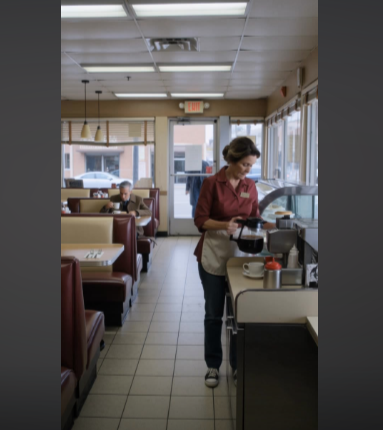
A Waitress Helped an Old Man Every Morning Until His Son Walked In Mocking Her. But When The Old Man
ROBBED BY MY CHILDREN, I WORKED AS A WAITRESS AT 60. EVERY DAY, I SHARED MY LUNCH WITH A TREMBLING OLD MAN. ONE DAY, MY SON ENTERED LAUGHING AT MY ‘DOWNFALL’: ‘YOU LOOK PITIFUL.’ SUDDENLY, 4 BODYGUARDS STORMED IN. THE OLD MAN STOOD UP, POINTED AT MY SON, AND SAID SOMETHING THAT NOBODY COULD EVER IMAGINED! EVERYTHING CHANGED!
THE WOMAN WHO SHARED HER LUNCH
At sixty years old, I never imagined I would be wearing a faded red polyester uniform with my name peeling off a plastic badge.
COLETTE.
The first morning I put it on, I stood in the employee restroom at Murphy’s Diner and looked at myself beneath fluorescent lights that were not kind to anybody.
The blouse was two sizes too big.
The apron had a bleach mark near one pocket.
My shoes came from a discount store and pinched across the toes.
Three months earlier, I had been planning what retirement might look like.
A little travel.
More time with my grandchildren.
Maybe finally sorting Robert’s photographs into albums.
Then my husband died.
Then my children took almost everything else.
Robert and I had been married for forty years.
We were not wealthy, but we had built a stable life.
A paid-off house.
Retirement savings.
Investments.
A pension.
Good credit.
The kind of security that comes from decades of saying no to things you cannot afford so you can say yes to peace later.
Robert died six months before I started at Murphy’s.
Heart failure.
Sudden enough that I woke one morning a wife and went to sleep that night a widow.
My son, Carlton, and my daughter, Rebecca, arrived immediately.
They handled the funeral.
The paperwork.
The calls.
At first, I was grateful.
Grief reduces a person.
Not intelligence.
Capacity.
Energy.
I could understand every document placed in front of me.
I simply did not have the emotional strength to question every explanation.
That difference became important.
Carlton said we needed to simplify the estate.
Rebecca said probate would be easier if assets were consolidated.
They talked about taxes.
Liability.
Future care.
Avoiding problems later.
They brought papers.
Some were ordinary.
Beneficiary changes.
Bank authorizations.
Deed-related forms.
A durable financial power of attorney.
A revocable trust amendment.
Then several transfers I did not understand well enough at the time.
I signed.
Not everything.
Enough.
I trusted them.
They were my children.
By the time I understood what had happened, the house had been moved into a family entity controlled by Carlton and Rebecca.
Investment accounts had been liquidated.
Large sums transferred.
Several credit lines opened in my name under authorities I had granted too broadly.
The clean legal version was not that they “stole everything with one signature.”
It was worse in a quieter way.
They used documents I had signed while grieving to gain authority I did not understand I was surrendering.
Then they exercised that authority in ways that benefited themselves.
Carlton moved into my house with his wife and children.
Rebecca relocated to California with a substantial transfer she described as “her inheritance in advance.”
When I objected, they both returned to the same language.
“Mom, we’re protecting you.”
“You don’t need that much space.”
“You don’t need complicated accounts.”
“This will force you to live more simply.”
Carlton was crueler.
“You would have wasted it anyway.”
He said that in the living room where I had raised him.
At first, I hired a lawyer.
Then I fired him because I could not afford the retainer he estimated for a full asset-recovery case.
That was another consequence of financial exploitation people do not talk about enough.
The person harmed often needs money to prove the money was taken.
I moved into a studio apartment.
Twelve hundred dollars a month.
Thin walls.
Old heating system.
One window facing an alley.
I needed income immediately.
Murphy’s hired me.
Ten-hour shifts.
Minimum base wage plus tips.
My body objected loudly.
Ruth, a waitress who had been there fifteen years, showed me how to survive.
“Keep your shoes loose.”
“Do not lock your knees.”
“Write orders until you think you don’t need to, then write them another month.”
“Drink water before you’re thirsty.”
She was fifty-eight and moved through the diner like she had invented efficiency.
“You’ll hurt for about four weeks.”
She told me.
“Then you’ll just hurt in specific places.”
I laughed.
It was the first time I had laughed in months.
Three weeks into the job, I noticed the old man at table seven.
Corner by the window.
Silver hair.
Thin shoulders.
Hands that trembled when he lifted his cup.
He ordered toast and coffee.
Nothing else.
Two dollars and fifty cents.
He counted exact change from a coin purse.
Quarter by quarter.
What struck me most was not poverty.
Dignity.
He ate slowly.
Savored the toast.
Folded the paper napkin after using it.
When he left, he placed one dollar beneath the cup.
Forty percent tip on an order that barely cost anything.
The next day, he came again.
Same time.
Eleven-thirty.
Same table.
Toast.
Coffee.
I brought extra butter.
He looked up.
“That’s very kind.”
His voice was educated.
Soft.
Slight accent I could not place.
“We all need a little extra kindness.”
I said.
He studied me.
Then smiled.
Over the next two weeks, he became part of my routine.
I learned his name was Lance.
He learned mine from the tag.
We did not exchange last names.
At first, our conversations stayed small.
Weather.
Food.
Books.
The bus schedule.
One Thursday, he sat without touching his toast.
I was carrying coffee when I noticed.
His hands rested in his lap.
His eyes remained on the window.
I went over.
“Everything all right?”
He looked up.
“Just thinking about my children.”
There was something in his face I recognized.
Loss.
Not death.
Rejection.
“Sometimes I wonder whether they think about me at all.”
The words went straight through me.
I sat down before I remembered waitresses are not supposed to sit with customers during a rush.
“I understand.”
I said.
“More than you think.”
Lance looked at me.
“Children?”
“Two.”
“Son and daughter.”
I touched the photograph I still carried inside my apron pocket.
Carlton at sixteen.
Rebecca at fourteen.
Robert behind them pretending to hold rabbit ears over both heads.
I had not thrown it away because betrayal does not erase childhood.
“They made choices.”
I said.
Lance nodded.
“It is a special pain.”
“Yes.”
He asked what time my shift ended.
Then offered to buy me lunch.
I almost laughed.
The man was counting quarters.
“You are not buying.”
I said.
“I get an employee discount.”
We shared the meatloaf special after work.
That became the beginning.
Lance spoke little about his career.
“Business.”
He said.
“Mostly numbers and meetings.”
He had traveled.
London.
Tokyo.
Paris.
Chicago.
Dubai.
Places that did not fit with the coin purse.
I noticed an expensive watch one day.
Old.
Understated.
The kind Robert would have called “quietly expensive.”
I assumed it was a remnant from a better life.
I never asked.
The first time I told Lance what Carlton and Rebecca had done, I expected pity.
He gave me questions instead.
“What did you sign?”
“I don’t remember every page.”
“Were you represented?”
“No.”
“Did you receive independent advice?”
“No.”
“Was there a power of attorney?”
“Yes.”
“Did they use it after you objected?”
“I believe so.”
His trembling slowed.
“Do you have copies?”
“Some.”
“Bank statements?”
“Old ones.”
“Did your lawyer file anything?”
“No.”
“He reviewed and said the case would be expensive.”
Lance became quiet.
Then:
“Expense and impossibility are not the same.”
I looked at him.
“What does that mean?”
“It means people sometimes confuse not being able to fight today with having no rights.”
That sentence stayed with me.
A week later, we were short-staffed.
The lunch rush overwhelmed us.
Lance waited forty minutes.
I saw him becoming tired.
My own lunch sat in a paper bag in the back.
Turkey sandwich.
Apple.
I brought it out.
Set it in front of him.
“No.”
He said immediately.
“Yes.”
“Colette.”
“I can eat later.”
“You need this.”
“So do you.”
His eyes filled.
He looked away.
“No one has done that for me in a long time.”
I shrugged because if I took the moment seriously, I would cry.
“It is a sandwich.”
“No.”
Lance said.
“It is not.”
I did not understand then.
I thought I was feeding an old man who had less than I did.
I had no idea the man at table seven could have bought the diner before dessert.
And I certainly did not know that by sharing one ordinary sandwich, I had stepped into a relationship that would eventually return me not to my old life, but to the right to decide what my life would become.
Over the next month, Lance and I became friends in the way older people sometimes do—quickly, because we no longer have patience for pretending not to need company.
He arrived at eleven-thirty.
Toast.
Coffee.
Sometimes soup if I insisted.
I learned his wife’s name had been Eleanor.
They had been married forty-eight years.
She died of pancreatic cancer after eighteen months of treatment.
His son, Marcus, lived three states away.
His daughter, Elena, lived in Boston.
I almost laughed when I heard Elena’s name because my own daughter was Rebecca and I had spent weeks wishing every kind woman I met could somehow replace her.
Lance never criticized his children directly.
That told me more than anger would have.
He said:
“They became very interested in estate planning after Eleanor died.”
I understood immediately.
“How interested?”
“Enough to arrive with a lawyer.”
My stomach tightened.
“What happened?”
“They wanted me to simplify.”
The same word.
The same clean little word that had stripped my own life down to a studio apartment.
“They said the house was too much.”
“That the companies were complicated.”
“That my advisers were old.”
“That I needed to think about the future.”
“And what did you say?”
“I said the future still included me.”
I laughed despite myself.
“Good.”
Lance smiled.
“They did not think so.”
He had refused to change his estate plan immediately.
Within weeks, both children stopped calling regularly.
When he would not put them on accounts or distribute assets early, communication almost disappeared.
“They still send birthday cards.”
He said.
“Nice paper.”
“Cold sentences.”
I knew that language too.
Rebecca mailed Christmas photographs from California every year.
Perfect children.
Matching sweaters.
Typed note.
Hope you’re doing well.
No phone number.
No question.
Lance and I sat through many lunches without pretending our children were monsters.
That was important.
Carlton had once brought me coffee in bed on Mother’s Day.
Rebecca had cried when Robert died.
Marcus had taken Lance to cardiology appointments.
Elena had spent summers helping Eleanor garden.
People who later betray you were often kind before.
That is why betrayal works.
There has to be something real underneath for you to trust.
One Tuesday, Lance did not come.
By twelve, I had checked the window six times.
Ruth noticed.
“Your gentleman is late.”
“He is not my gentleman.”
“Mmm-hmm.”
“He is seventy-four.”
“You are sixty.”
“That proves nothing.”
“It proves you are both old enough to stop wasting time.”
I threw a napkin at her.
He returned Wednesday.
Paler.
Hands trembling worse.
“Doctor.”
He explained.
“Nothing dramatic.”
I sat with him after shift.
“You sure?”
“Yes.”
Then he asked:
“Do you ever wonder if you matter to anyone?”
The question was so naked I almost looked away.
“Every day.”
He nodded.
“I used to know exactly why people called me.”
“Work.”
“Money.”
“Decisions.”
“Introductions.”
“After Eleanor died, I discovered how quiet a phone can become when you stop being useful.”
I reached across the table.
“You matter to me.”
His fingers tightened around mine.
“You matter to me too.”
That was the first time his hand stopped trembling completely.
I noticed.
Did not mention it.
The next week, Carlton came into Murphy’s.
I saw him through the window before the bell rang.
Charcoal overcoat.
Tailored suit.
Leather shoes.
The watch I had given him after his first promotion.
For one stupid second, hope rose inside me.
He came.
He finally came.
Maybe he had seen me through the window weeks earlier and regretted driving away.
Maybe he wanted to talk.
Maybe this was the moment my son remembered I was his mother.
Then he saw me.
And smiled.
Not warmly.
Amused.
“Well.”
He walked toward the coffee station.
“Look at you.”
The diner quieted in the strange way public places do when conflict begins.
Not silence.
Attention.
“Carlton.”
“I didn’t know you were coming.”
“I was driving by.”
He looked me up and down.
Uniform.
Shoes.
Apron.
“God.”
He laughed softly.
“You look pitiful.”
The word landed harder because he sounded almost delighted.
I put down the coffee pot.
“Please lower your voice.”
“Why?”
“You embarrassed?”
Several customers looked away.
Others did not.
Carlton continued.
“I knew things were bad.”
“But this?”
“A waitress at sixty?”
He shook his head.
“You really managed to burn through everything.”
My face went hot.
“You know what happened.”
“I know you signed papers.”
“Yes.”
“Because I trusted you.”
“And I know you refused to accept that you were not capable of managing that much anymore.”
The lie came so smoothly that for one second I almost admired it.
“Carlton.”
“You and Rebecca transferred my house.”
“We protected it.”
“You liquidated accounts.”
“Consolidated.”
“You opened credit lines.”
“To manage debt.”
“Debt you created.”
He exhaled.
“Mom.”
That tone.
Patient.
Adult speaking to a child.
“You were grieving.”
“You were not making good decisions.”
“We stepped in.”
“You benefited.”
“Family benefited.”
I stared at him.
He genuinely believed the wording made the conduct clean.
Lance sat at table seven.
Still.
Watching.
Carlton noticed him eventually.
The old coat.
Toast.
Coffee.
He dismissed him immediately.
“You’ve been hanging around people like this?”
His voice dropped.
“That explains a lot.”
Something changed in Lance’s face.
Not anger.
Focus.
He stood slowly.
For weeks, I had watched him rise like an elderly man protecting his balance.
That day, he simply stood.
Straight.
His shoulders settled into a posture I had never seen.
The tremor disappeared.
“Excuse me.”
Carlton looked over.
“This is private.”
“No.”
Lance said.
“You made it public when you decided to humiliate your mother in a restaurant.”
Carlton stared.
Lance walked closer.
He did not raise his voice.
That made everyone listen harder.
“I have watched your mother work here for weeks.”
“I have watched her treat customers with respect when they tip badly.”
“I have watched her help an elderly man she believed had nothing.”
“I have watched her give away food she needed.”
“And I just watched her own son come into a diner and mock her for surviving what he helped cause.”
Carlton’s face reddened.
“You do not know anything about my family.”
“I know what I saw.”
“That is enough for today.”
Carlton laughed.
“Who are you?”
Lance considered the question.
Then took out his phone.
Not dramatically.
Just efficiently.
“My name is Lance Morrison.”
He called someone.
“Marcus.”
“Yes.”
“I need a conflict check and public-record pull on Carlton Matthews.”
He looked at my son.
“Employer?”
Carlton did not answer.
Lance continued into the phone.
“Start with public sources.”
“Civil filings.”
“Property records.”
“Corporate affiliations.”
“Nothing private without proper authority.”
“Yes.”
“Today.”
He ended the call.
Carlton had gone pale.
Not because a mysterious billionaire threatened him.
Because the old man he had dismissed suddenly sounded like somebody accustomed to giving instructions.
“Who are you?”
Carlton asked again.
Lance looked at him.
“Someone who thinks character is easiest to see when people believe the person in front of them cannot matter.”
The entire diner had gone still.
Then Lance turned to me.
“Colette.”
“I will see you tomorrow.”
He put cash beneath his cup.
More than enough this time.
At the door, he stopped.
Looked back at Carlton.
“You drove past this place once and saw your mother working.”
Carlton froze.
I had told Lance that.
“You did not come inside.”
Lance continued.
“That was a choice.”
Then he left.
Carlton turned on me.
“Who is he?”
“I thought he was a lonely old man.”
“You thought?”
“Yes.”
“What does that mean?”
“It means I may have been wrong.”
For the first time in months, my son looked uncertain around me.
Not guilty.
Not sorry.
Uncertain.
I hated how much satisfaction that gave me.
Then I hated myself for hating it.
Carlton left without apologizing.
The bell above the door rang once.
Then shut.
Ruth came from behind the counter.
“Colette.”
“Yes?”
“Your old man is not poor.”
“I gathered.”
She stared at the door.
“He moved like my first husband when the IRS called.”
Despite everything, I laughed.
That night, sleep would not come.
I replayed Lance’s voice.
Public records.
Conflict check.
Proper authority.
Those words mattered.
He had not threatened to ruin Carlton.
He had not promised punishment.
Still, something had shifted.
The old man at table seven had been hiding a life.
I knew something about hidden lives.
The next morning, I arrived early.
At eleven-fifteen, Lance walked in.
Same coat.
Same careful steps.
Same table.
But once you see performance, you cannot make it invisible again.
His hands trembled as he removed his gloves.
Then stopped the moment he rested them on the table.
I stood across from him.
“Who are you?”
He smiled.
“My name really is Lance Morrison.”
“That is not what I asked.”
“No.”
He looked toward the empty chair.
“Sit.”
Ruth covered my section.
I sat.
Lance folded his hands.
“I spent fifty years building companies.”
“Technology.”
“Manufacturing.”
“Real estate.”
“Restaurants.”
“Financial services.”
“Some succeeded.”
“Some failed.”
“A few succeeded so well that one person no longer needs to think about money.”
I stared.
“How much?”
He smiled faintly.
“Enough that the number is not useful.”
“Try me.”
“Public estimates range from five hundred to eight hundred million.”
My mouth opened.
Nothing came out.
Lance took a sip of coffee.
“Eleanor hated those estimates.”
“She said people begin behaving strangely once they know.”
“You pretended to be poor.”
“Yes.”
“For eight months.”
“Why?”
His expression changed.
“After Eleanor died, my children wanted immediate control over estate planning.”
“When I refused, they withdrew.”
“I became curious.”
“About what?”
“Whether anyone would treat me well if they believed I had nothing to offer.”
The answer bothered me.
“You were testing people.”
“Yes.”
“Including me.”
“At first.”
I stood.
Lance’s eyes widened.
“That is manipulative.”
“I know.”
“You let me think you were hungry.”
“I was hungry.”
“You could buy this entire diner.”
“Yes.”
“And I gave you my lunch.”
“Yes.”
He looked ashamed now.
“I should have told you sooner.”
“Why didn’t you?”
“Because once I realized you were kind without knowing who I was, I was afraid the truth would destroy the one honest friendship I had.”
That answer did not excuse him.
It did make sense.
I sat again.
“What did you find about Carlton?”
Lance pulled a thin folder from his coat.
“Only public and lawfully obtained information.”
“I have counsel reviewing the rest through your situation, if you want help.”
“My situation?”
“Your asset transfers.”
He slid the folder toward me.
Carlton worked for Henderson & Associates.
Salary around eighty-five thousand.
No scandal.
No secret empire.
He was heavily leveraged.
Mortgage against my old house.
Credit cards.
Two vehicle loans.
Tax lien released the previous year.
Nothing illegal in being in debt.
Then:
He had told colleagues he expected a future inheritance through his wife’s family.
A brag.
Not actionable.
“He did not need my money.”
I whispered.
“No.”
Lance said.
“He wanted it.”
That was different.
He continued.
“I asked an elder-law attorney to review a hypothetical fact pattern matching yours.”
“Without your name.”
“He believes there may be serious grounds to challenge the transfers.”
“Undue influence.”
“Breach of fiduciary duty under the power of attorney.”
“Failure to account.”
“Possibly financial elder abuse depending on the exact documents and state law.”
Hope frightened me more than despair.
“My first lawyer said it would cost too much.”
“Litigation can.”
Lance nodded.
“Which is why I am offering to fund an independent legal review.”
“No strings.”
“Your lawyer.”
“Not mine.”
“You choose counsel.”
“You decide what relief to seek.”
“I do not control the case.”
I stared.
“Why?”
“Because help is different from control.”
He said.
“And I have been thinking about that distinction a great deal.”
That answer was the first one I trusted completely.
The lawyer Lance recommended was named Miriam Cole.
Not one of his personal attorneys.
That was important to me.
Miriam ran an elder-law and fiduciary-abuse practice downtown.
Her office had no marble reception desk.
No leather wall.
Just file cabinets, books, two patient paralegals, and a framed print that read:
DOCUMENT FIRST.
ANGER LATER.
I liked her immediately.
Lance paid an initial consultation retainer into a client trust account through a charitable legal-support foundation he already funded.
The agreement named me as the client.
Not Lance.
He had no authority to direct strategy.
Miriam explained this three times because she wanted me to understand.
“If Mr. Morrison calls me tomorrow and tells me to settle, I ignore him.”
“If he tells me to sue your son for ten million dollars, I ignore him.”
“If he withdraws funding, we discuss alternatives with you.”
“You are the client.”
That sentence felt more valuable than money.
I brought everything.
The papers I still had.
Old bank statements.
The power of attorney.
Trust amendment.
Copies of emails.
The deed transfer notice.
Credit reports.
The collection letters.
Miriam reviewed for two hours.
Then called in a forensic accountant.
Not Jamal.
No dramatic computer expert.
A woman named Denise Park who specialized in tracing fiduciary misuse.
For six weeks, they built the case.
What happened to my money was uglier and more ordinary than I had understood.
Carlton and Rebecca had not simply “taken the house.”
They used a broad durable power of attorney I signed after Robert’s death to transfer the property into a family LLC.
The operating agreement then gave voting control to them.
The stated purpose was estate efficiency.
The practical result was that I no longer controlled the asset.
They sold securities from my investment account under authority that allowed them to manage assets for my benefit.
Then distributions left the account.
Some paid legitimate bills.
Funeral costs.
Taxes.
Insurance.
But large amounts went elsewhere.
Carlton’s mortgage.
Rebecca’s relocation.
Tuition for one grandchild.
A vehicle.
A business investment Carlton later described as “temporary.”
The power of attorney required them to act in my interest.
That was the key.
Miriam tapped the document.
“An agent is not an owner.”
“You gave authority.”
“You did not give beneficial ownership of everything.”
My throat tightened.
“So they broke the law?”
“Potentially.”
She refused to overstate.
“We need exact accounting.”
“We also need to understand what you knowingly gifted.”
“Some transfers may have been valid gifts.”
“Some may be voidable.”
“Some may support a fiduciary-breach claim.”
“Some may trigger elder financial abuse statutes.”
“None of that is decided because you feel betrayed.”
I nodded.
Facts.
I was learning to love facts.
Denise traced almost four hundred thousand dollars in questionable transfers.
Not every penny Robert and I had ever saved.
The house itself remained inside the LLC.
It had not been sold, despite what I had believed.
Carlton had refinanced it.
That distinction was enormous.
My old lawyer had seen the LLC transfer and assumed expensive litigation would be required to unwind it.
Miriam saw leverage.
Carlton had signed several certifications stating I had received independent advice before the transfer.
I had not.
The notary on one document worked at Carlton’s bank.
Another form contained an acknowledgment that the attorney who explained the transaction to me had no conflict.
There had been no such attorney.
“Who drafted this?”
Miriam asked.
I recognized the firm name.
Rebecca’s college friend.
Not a criminal mastermind.
A general practitioner who had apparently relied on information Carlton supplied.
Miriam sent a preservation letter.
Then a demand for full fiduciary accounting.
Carlton’s response came through counsel.
For the first time since Murphy’s, he stopped calling me directly.
His attorney denied wrongdoing.
Said all transactions reflected my wishes.
Said I had frequently expressed desire to support my children.
True.
Said I wanted Carlton and Rebecca to “handle everything.”
Partly true.
Then they produced a letter.
My signature at the bottom.
I want my children to use the family assets as they see fit.
I trust them completely.
I do not want to be burdened with financial decisions.
I stared.
“I signed that.”
Miriam looked at me.
“Do you remember it?”
“Vaguely.”
“Context?”
“Carlton gave me a stack of papers.”
“Robert had been dead maybe three weeks.”
“I was exhausted.”
“He said it was a general statement for the bank.”
Miriam nodded.
“Not ideal for us.”
My stomach fell.
Then she continued.
“Not fatal.”
“Why?”
“Because trust does not eliminate fiduciary duty.”
“You can tell an agent you trust them.”
“They still must act within law and authority.”
Denise found another problem.
Several transfers from my accounts were made after I revoked Carlton’s authority in writing during our first confrontation.
That revocation email was still in my sent folder.
Carlton’s bank acknowledged receiving it two days later.
Yet one transfer occurred eleven days after that.
Another twenty-three days later.
The bank’s response became cautious quickly.
Now we had not only a family dispute.
We had an institution processing transactions after notice of revoked authority.
Miriam filed suit.
Not against Carlton’s job.
Not his car.
Not his pride.
Against the people and entities tied to the disputed assets.
Carlton.
Rebecca.
The family LLC.
And, in a limited claim, the bank that processed post-revocation transfers.
We asked for an injunction preventing further transfer or encumbrance of the house.
The judge granted a temporary preservation order after reviewing the documents.
Not because I was sixty.
Because there was enough evidence to preserve the status quo.
Carlton called me that night despite counsel.
I almost did not answer.
Then I did.
“Mom.”
His voice shook.
“You froze the house.”
“No.”
“The court restricted transfers while the case is pending.”
“You are going to make us homeless.”
“No.”
“You still live there.”
“You just cannot sell or refinance it again.”
Silence.
“Who is paying for this?”
I looked toward table seven.
Lance was not there.
This was after my shift.
I was home.
“That is none of your business.”
“Is it him?”
“Carlton.”
“You should speak through your lawyer.”
His voice hardened.
“So that old man is financing a lawsuit against your own children.”
“A lawyer is reviewing what happened to my property.”
“You signed everything.”
“Yes.”
“I also revoked authority.”
Another silence.
“Mom.”
“Please.”
The word struck differently now.
Not because I was cruel.
Because I had spent years responding to please before asking what the request cost me.
“What do you want?”
“Drop the case.”
“No.”
“We can work this out.”
“We are.”
“Through lawyers.”
“That’s not family.”
I closed my eyes.
“Neither was taking money after I told you to stop.”
He hung up.
I expected to feel triumphant.
I felt sick.
Lance arrived the next day and saw it immediately.
“You spoke to him.”
“Yes.”
“How do you know?”
“You are stirring coffee you already put cream in.”
I looked down.
He was right.
“I hate this.”
“Good.”
I frowned.
He continued.
“If you enjoyed every part of holding your son accountable, I would worry about you.”
“I keep thinking about my grandchildren.”
“So protect them where you can.”
“How?”
“Do not turn them into leverage.”
“Do not discuss litigation with them.”
“Do not threaten their home.”
“Do not make them choose.”
“That is what their parents did to you.”
The clarity hurt.
I nodded.
Then:
“What did Marcus find about Carlton?”
Lance looked uncomfortable.
“That was a mistake.”
“What?”
“My call in the diner.”
“I was angry.”
“I had Marcus pull public information because I wanted to know who he was.”
“I should not have made it sound like I was going to investigate him as punishment.”
I stared.
“Are you apologizing?”
“Yes.”
“Why?”
“Because power makes bad impulses easier to act on.”
He looked at me.
“And because I do not want to become another person deciding what consequences your family deserves.”
That was the moment I began trusting him for real.
Not when he revealed his wealth.
When he admitted restraint was something he had to practice too.
The lawsuit changed Carlton before it changed anything else.
For years, he had moved through life assuming his explanations would become the accepted version simply because he delivered them confidently.
In court, confidence became one item among many.
Documents mattered more.
Dates mattered.
Authority mattered.
The temporary injunction prevented another refinance.
The bank agreed to reverse one post-revocation transfer while its internal investigation continued.
A second transfer went into a disputed-assets escrow.
The family LLC was ordered to preserve records.
Rebecca’s attorney appeared separately.
That told me something.
The unity between my children had weakened the moment they needed individual legal advice.
Rebecca claimed Carlton had taken the lead.
Carlton claimed Rebecca had designed the estate plan.
Both statements contained truth.
Neither absolved either of them.
Denise Park’s accounting showed Rebecca received one hundred forty thousand dollars through transfers characterized as advances against future inheritance.
Carlton received more than two hundred thousand through mortgage support, debt payments, and direct transfers.
Other amounts paid legitimate family expenses I had knowingly approved.
Those were not challenged.
That was important to me.
I did not want every birthday gift and tuition payment reclassified as theft because my relationship with my children had collapsed.
If I had given something freely, it remained a gift.
Miriam agreed.
“Good cases get stronger when they do not overreach.”
That sentence became one of my favorites.
The hardest part was the house.
Robert and I had bought it thirty-five years earlier.
Two stories.
Maple tree out front.
A small crack in the kitchen ceiling he promised to fix for eleven years before finally doing it.
Carlton was raising his children there now.
My grandchildren slept in rooms that had once belonged to him and Rebecca.
I wanted the house back.
Then I pictured two children being told Grandma was throwing them out.
That stopped me.
Miriam asked:
“What is the actual goal?”
I thought for several days.
“Control.”
She raised an eyebrow.
“Explain.”
“I want the transaction unwound enough that I am not treated as though I gave away my whole life willingly.”
“Do you want to live there?”
“No.”
“Do you want Carlton removed?”
“Not necessarily.”
“Do you want fair value?”
“Yes.”
“Do you want acknowledgment?”
“That is not something a court can order.”
“No.”
I smiled.
“Then fair value and restored control where possible.”
The litigation moved toward mediation.
Carlton’s finances became relevant because he had leveraged the house after the transfer.
Not because Lance called the mortgage.
Because Carlton had already used the property as collateral.
He had taken a second mortgage against an asset he did not truly own outright.
The injunction made the lender nervous.
The lender’s title insurer got involved.
Suddenly, everyone wanted settlement.
Carlton lost his job during this period.
That fact came from him, not Lance.
Henderson & Associates had been restructuring after losing two large clients.
His position was eliminated along with four others.
The timing was terrible.
And because of Lance’s ownership connection, I immediately assumed the worst.
I confronted him.
We were sitting at Murphy’s after my shift.
“You said you own Henderson.”
“A controlling interest through a holding company.”
“Carlton was fired.”
Lance closed his eyes.
“I know.”
“Did you do it?”
“No.”
“Did you tell anyone to do it?”
“No.”
“Did anyone know about him because of you?”
He hesitated.
That hesitation made me furious.
“Lance.”
“I disclosed a conflict to the operating CEO after the diner.”
“Why?”
“Because I had requested public background information on an employee while angry.”
“I wanted the company to know I should have no role in decisions concerning him.”
“Then what?”
“The restructuring plan was already underway.”
“His business unit had missed targets.”
“Five positions were cut.”
“Carlton was one.”
I stared.
“Can you prove that?”
“Yes.”
“Show me.”
He did.
Board minutes.
Restructuring proposal dated before the diner.
HR notice.
List of eliminated roles.
Carlton’s name among several.
No instruction from Lance.
No mention of me.
I felt both relief and shame.
“I thought you did it.”
“You had reason to ask.”
“What about his mortgage?”
“Not mine.”
“You said one of your companies held it.”
“I was wrong.”
That surprised me.
“The original loan was sold out of a servicing platform in which one of my firms owns a minority stake.”
“I do not control the note.”
“I made a sloppy assumption after Marcus’s public-record pull.”
He looked disgusted with himself.
“That is what happens when a rich man starts thinking every institution he has touched belongs to him.”
I sat back.
“You’re not as frightening as Carlton thinks.”
“Good.”
He smiled faintly.
“Most frightening rich men are just men who have gone too long without anyone telling them no.”
I laughed.
Then cried unexpectedly.
Lance waited.
When I could speak:
“He called me.”
“Carlton?”
“Yes.”
“He lost his job.”
“What did he want?”
“Help.”
“Did you offer any?”
“No.”
“How do you feel?”
“Terrible.”
Lance nodded.
“That sounds about right.”
The next call from Carlton came two days later.
This time, I answered from my apartment.
“Mom.”
His voice was smaller.
“I know my lawyer said not to call.”
“Then why are you calling?”
“Because I don’t know who else to call.”
The old reflex rose.
Fix it.
Ask how much.
Transfer something.
Tell him it will be okay.
I pressed my palm flat against the table.
“What happened?”
“The mortgage company wants updated title information because of the injunction.”
“Okay.”
“Without my job, I’m not sure we qualify to refinance anything.”
“Okay.”
“Sarah is scared.”
His wife.
My daughter-in-law.
I had barely spoken to her since the lawsuit.
“The kids know something is wrong.”
My chest tightened.
“What do you need from me, Carlton?”
Silence.
Then:
“I don’t know.”
That was new.
Not money.
Not exactly.
He sounded like a boy who had finally reached a place where confidence no longer knew the route.
“I need you to tell me this is not the end.”
I closed my eyes.
“It is not the end.”
His breathing changed.
“But I am not dropping the case.”
“I know.”
“You need to work through your lawyer.”
“I know.”
“You need to protect your children from adult details.”
“I know.”
Another pause.
“Mom.”
“Yes?”
“I saw you through the diner window before that day.”
“I know.”
“I drove by more than once.”
That hurt more than the public humiliation.
“Why didn’t you come in?”
“I was ashamed.”
“Of me?”
“No.”
He cried then.
Quietly.
“Of what I had done.”
I sat very still.
“And seeing you in that uniform made me feel like I had proof that what I did was necessary.”
My hand tightened around the phone.
“What?”
“If you were struggling, then I could keep telling myself you needed me to take control.”
“That I had made the hard choice.”
“So you stayed outside.”
“Yes.”
“And then when I finally came in, I made you smaller.”
“Yes.”
“I am sorry.”
The sentence arrived without conditions.
No request attached.
I did not forgive him immediately.
I did not say it was all right.
I said:
“Thank you for saying it.”
That was enough.
The mediation happened three weeks later.
Carlton.
Sarah.
Rebecca by video from California.
Miriam.
Denise.
Lawyers.
No Lance.
He deliberately stayed away.
“This is your family.”
He said.
“Your case.”
“My money should not become another person in the room.”
I understood.
The settlement took eleven hours.
The house remained occupied by Carlton’s family temporarily, but the LLC transfer was unwound.
Title returned to a trust established for my benefit.
Carlton received an option to purchase the house at an independently appraised price within eighteen months.
If he could not, the house would be sold.
He would receive no windfall from appreciation created before the transfer.
The disputed transfers were divided into categories.
Valid gifts.
Reimbursable expenses.
Unauthorized or fiduciary-breach transfers.
Carlton and Rebecca agreed to repay the last category over time, with interest below commercial judgment rates but enough to acknowledge the loss.
The bank contributed to settlement for processing transactions after documented revocation.
No public trial.
No criminal charges.
Miriam had discussed referring potential elder financial abuse to prosecutors.
I chose not to make criminal referral a settlement condition either way.
That decision remained with authorities if mandatory reports or independent evidence required it.
The civil case restored substantial assets.
Not every dollar.
Enough.
My retirement accounts were rebuilt in part.
A separate settlement fund held house proceeds or future payments.
My debts caused by unauthorized credit lines were corrected through the credit bureaus and lenders after documentation.
It took months.
Not one magical signature at a diner.
Miriam slid the final agreement toward me.
“Read every page.”
I did.
Slowly.
This time I asked questions.
This time no one said:
Just sign.
When I finished, I signed my name.
Not because my children told me it was easier.
Because I understood exactly what the document did.
That difference was worth more than the settlement itself.
The first payment from Carlton arrived on the first of the following month.
Not much.
Five hundred dollars.
Memo line:
Settlement installment 1.
I stared at it longer than the amount deserved.
The money itself meant almost nothing compared with what had been lost.
It was the direction that mattered.
For years, support had moved from me to my children.
Now responsibility moved back.
Rebecca’s first payment came on time too.
Larger.
No message.
That was Rebecca.
Even as a child, she could apologize through behavior before she could do it with words.
I did not mistake compliance for reconciliation.
Miriam warned me about that.
“People can honor contracts and remain emotionally unchanged.”
“I know.”
“Good.”
“Because your heart keeps trying to turn every payment into meaning.”
She was right.
Carlton did more than pay.
He found another job.
Not through Lance.
Not at a company Lance controlled.
A smaller consulting firm.
Lower base salary.
Less prestige.
Better hours.
He took it because he needed work.
At first, he hated it.
Then he discovered something unpleasant.
He had been using status as a substitute for stability.
The old firm had offered a polished lobby.
Expensive clients.
Business travel.
A title that sounded impressive.
The new company offered steady work and no one cared what watch he wore.
Three months after settlement, Carlton asked whether I would meet him for lunch.
Not Murphy’s.
Neutral place.
A small café near the courthouse.
I almost said no.
Then said yes.
He arrived early.
That was new.
No tailored suit.
Button-down shirt.
Dark jacket.
He looked tired.
Not broken.
Human.
“I ordered coffee.”
He said.
“Not food.”
“I didn’t know what you’d want.”
“Thank you.”
We sat.
For a while, neither of us knew how to begin.
Then Carlton said:
“I’ve been seeing a therapist.”
I nodded.
“That’s good.”
“Sarah too.”
“Together?”
“And separately.”
“Good.”
He looked down.
“I spent the first two sessions explaining why what I did was rational.”
I almost smiled.
“How did that go?”
“Badly.”
A laugh escaped me.
Carlton smiled too.
Then became serious.
“She asked me when I first started thinking of your money as family money.”
I waited.
“I don’t know.”
He rubbed his thumb against the coffee cup.
“Maybe college.”
“You paid tuition.”
“Then helped with my first apartment.”
“Then the wedding.”
“Then the house.”
“Every time I needed something, you made it easier.”
He looked at me.
“And instead of learning gratitude, I learned availability.”
The sentence hurt because I recognized my part.
“I made it too easy.”
“No.”
He shook his head.
“That is what I used to say.”
“That you created the problem by giving.”
“My therapist won’t let me do that anymore.”
“You were generous.”
“I was entitled.”
“Both can exist.”
I looked at him.
“I did teach you that I would always fix things.”
“Yes.”
“But I am responsible for deciding that meant I had the right to use your grief.”
That was the first time he named it correctly.
Grief.
Not confusion.
Not incapacity.
Not poor financial judgment.
Grief.
I felt tears come.
Did not hide them.
Carlton’s eyes filled too.
“I don’t know if you’ll ever trust me again.”
“I don’t know either.”
He nodded.
“Fair.”
Then:
“I miss you.”
That almost broke me.
I had missed him every day.
Even while suing him.
Even while listening to lawyers describe him as an adverse party.
A mother can know exactly what her son did and still remember the six-year-old who slept with one shoe on because he forgot to take it off.
“I miss you too.”
I said.
We did not hug.
Not that day.
But we scheduled another lunch.
That was enough.
Rebecca remained distant.
Her attorney handled payments.
Her Christmas card came in December.
Same polished family photograph.
But this time, there was a handwritten line.
Mom,
I know a card is not enough.
I am not ready to say everything correctly.
I am trying.
—Rebecca
I read it three times.
Then placed it on the bookshelf.
No reply.
Not punishment.
Space.
Lance understood without asking.
Our friendship changed too.
Slowly.
Carefully.
After the lawsuit settlement, I returned to Murphy’s part time even though I no longer needed the money urgently.
Ruth called me insane.
“You fought for your retirement and came back here voluntarily?”
“I like the people.”
“You like table seven.”
“That is irrelevant.”
She laughed loud enough for the cooks to hear.
Lance still came at eleven-thirty.
But he stopped pretending he could only afford toast.
That had to end.
The performance had become insulting once I knew.
He usually ordered soup and half a sandwich.
Sometimes the breakfast special.
He left generous tips, but not absurd ones.
The first time he left a hundred dollars, I gave it back.
“You cannot buy absolution in twenties.”
He laughed.
“Fair.”
Then he quietly funded repairs to the diner through a small-business improvement grant his foundation already operated.
Not as a gift to impress me.
Murphy’s owner applied.
Independent committee reviewed.
New refrigerator.
Safer flooring.
Updated ventilation.
Ruth called it “the old man miracle.”
I told her to stop.
She did not.
Lance and I began seeing each other outside the diner.
Walks.
Library lectures.
Coffee.
Nothing romantic at first.
At least not officially.
He had Eleanor.
I had Robert.
The dead remained part of both of us.
One evening, we sat on a park bench after a concert.
Lance said:
“Do you ever feel disloyal for enjoying yourself?”
“Yes.”
He looked relieved.
“I thought it was just me.”
“No.”
“Robert would hate that.”
“Eleanor too.”
We laughed.
That was the first moment I understood companionship could coexist with grief instead of replacing it.
Months later, Lance invited me to his home.
Not mansion.
Large Victorian.
Comfortable.
Books everywhere.
Old photographs.
Furniture worn in the places people actually sat.
His wealth existed in documents more than decor.
That surprised me.
“You expected gold faucets?”
“I expected something ridiculous.”
“I had ridiculous.”
“Eleanor made me sell it.”
“Smart woman.”
“The smartest.”
He showed me a photograph of her.
Dark hair gone silver.
Eyes bright.
I told him about Robert.
How he burned toast.
How he hummed while fixing things.
How he never learned to fold fitted sheets.
Lance said:
“Good.”
“What?”
“I was starting to worry he was perfect.”
“No.”
“Just mine.”
That night, nothing romantic happened.
I drove back to my studio apartment.
Sat on the edge of my bed.
And realized I had spent six hours with a wealthy man without discussing money once.
That felt more intimate than a kiss.
Eventually, I moved.
Not into Lance’s house.
First, into a better apartment.
Two bedrooms.
Safer building.
Sunlight.
A small balcony.
Paid from assets recovered through settlement.
I wanted proof to myself that my restored security did not require attaching my life to another wealthy person.
Lance understood.
More than understood.
He helped carry one box.
Then I made him stop because he had a bad back.
“Serial entrepreneur.”
I said.
“Useless with books.”
“I hire people for this.”
“Exactly.”
My new home held Robert’s photograph.
A chair from our old house recovered through the settlement.
My dishes.
A quilt my mother made.
Nothing from Lance.
That mattered.
I was learning the difference between receiving love and building dependence.
One can resemble the other from outside.
Inside, they feel completely different.
Six months after the diner confrontation, Carlton brought Sarah and the children to my new apartment.
He asked first.
Three days in advance.
That detail mattered.
“Would Sunday afternoon be okay?”
Not:
We’re coming by.
Not:
The kids miss you, so you should make time.
Would Sunday be okay?
I said yes.
The grandchildren had changed.
Not physically.
In the way children change when adults have been speaking carefully around them.
They hugged me hard.
The youngest asked why I had moved.
I answered:
“Because I needed my own home.”
No blame.
No explanation about powers of attorney.
Children should not carry adult filings.
Carlton watched me.
Later, while Sarah took the children to see the balcony, he said quietly:
“Thank you.”
“For what?”
“Not telling them everything.”
“They’ll know age-appropriate truth someday.”
“I know.”
He swallowed.
“I’m just grateful you’re not making them choose.”
That was the line I had been waiting for without knowing it.
“You never get to ask them to choose either.”
“I won’t.”
“Between me and you.”
“I know.”
“Between me and Rebecca.”
“I know.”
“Between your version and mine.”
He nodded.
“Understood.”
Sarah returned.
For years, she had been background in my anger.
Carlton’s wife.
The woman living in my house.
The mother of my grandchildren.
I had assumed she knew everything.
During mediation, I learned she knew much less.
Carlton had told her the house transfer was part of estate planning I had requested.
He told her the family LLC was mine as much as his.
He told her I wanted to downsize.
She should have questioned more.
She admitted that.
But she had not designed the documents.
That mattered.
She sat beside me after the children went to the kitchen.
“I’m sorry.”
I waited.
“For what part?”
Her eyes filled.
“For living in your house and never asking if you actually wanted us there.”
“For believing Carlton when he said you wanted to simplify.”
“For not calling you after you left.”
“Why didn’t you?”
“I was embarrassed.”
The same word.
Shame had become a family disease.
Everyone used distance to avoid the moment they would have to name what happened.
“I thought you hated me.”
Sarah continued.
“I did for a while.”
That startled her.
“I don’t now.”
“Why?”
“Because I have more information.”
She nodded slowly.
“That’s fair.”
We drank coffee.
The children came back.
Life moved.
No cinematic reconciliation.
No family suddenly healed.
Just people beginning to behave differently.
Rebecca took longer.
Almost a year.
She called on Robert’s birthday.
Not mine.
His.
That felt right.
“Mom.”
I knew her voice immediately.
“Rebecca.”
Silence.
Then:
“I went to Dad’s grave today.”
My throat tightened.
“Thank you.”
“I told him I was sorry.”
I closed my eyes.
“For what?”
“For using the money you two built like it was waiting for me.”
She cried.
Not loudly.
“I kept telling myself Carlton was more responsible for all of it.”
“He did most of the paperwork.”
“He stayed in the house.”
“He handled the bank.”
“But I took the transfer.”
“I knew you were grieving.”
“I knew you did not understand every document.”
“And I took the money anyway.”
There it was.
No lawyer language.
No estate planning.
No simplification.
“I don’t know what you want me to say.”
I whispered.
“You don’t have to say anything.”
“I just needed to stop pretending I was less responsible because I live far away.”
That call lasted twenty-three minutes.
At the end, Rebecca asked if she could visit in the spring.
I said:
“Maybe.”
She accepted maybe.
That was progress too.
Lance’s children never came back in the same way.
Marcus sent emails.
Elena occasionally called.
Each contact revolved around practical matters.
Trust documents.
Health updates.
Holiday logistics.
Neither apologized for abandoning him after Eleanor’s death.
At first, Lance pretended that did not bother him.
Then he stopped pretending.
One rainy afternoon, he sat at table seven and said:
“I thought seeing Carlton change would make me believe mine could.”
I sat across from him.
“It can.”
“That is not the same as they will.”
“No.”
He looked toward the window.
“I hate that answer.”
“Me too.”
Our friendship became something deeper not because we saved each other, but because neither of us required the other to lie.
That was new for both of us.
A year after we met, Lance asked me to dinner at his house.
Nothing unusual there.
Except the dining room table had been cleared of everything except one thick folder.
I stopped in the doorway.
“No.”
He laughed.
“You do not even know what it is.”
“If it involves me signing something, no.”
“Excellent.”
“That means you learned.”
I sat.
He pushed the folder toward me.
Estate planning.
Not a finished will.
Draft proposals.
Notes from his attorney.
A letter from an independent estate planner explaining options.
“I want your opinion.”
“I don’t want to be in your will.”
“I know.”
“That is not an opinion.”
“It is the first line of one.”
I crossed my arms.
Lance continued.
“I have revised my plan.”
“Marcus and Elena will receive defined trusts.”
“Enough to be secure.”
“Not controlling interests in my businesses.”
“Most operating-company equity will move to a foundation and employee trust over time.”
“A portion will support programs Eleanor cared about.”
“Cancer care.”
“Caregiver support.”
“Small-business grants.”
I relaxed slightly.
“And me?”
“You have an option.”
I frowned.
“An option?”
“A life estate in this house if I die before you.”
“Not ownership unless you choose to accept it after independent counsel.”
“A separate fund for taxes, insurance, and maintenance.”
“No requirement that you stay.”
“No requirement that you manage my companies.”
“No giant inheritance designed to turn you into the next target.”
That was smarter.
“And if I refuse?”
“Then the house goes to the foundation under existing terms.”
I looked at him.
“You thought this through.”
“My attorney thought it through.”
“I finally listened.”
He smiled.
“There is also a modest unrestricted bequest.”
“How modest?”
He named a number.
My eyes widened.
“That is not modest.”
“For me, it is.”
“That sentence is why rich people need supervision.”
He laughed.
Then became serious.
“Colette.”
“Yes?”
“This is not payment for kindness.”
“Good.”
“It is not repayment for sandwiches.”
“Good.”
“It is not because my children disappointed me and I need to replace them.”
“Good.”
“I am doing it because you are part of my life now.”
“And because I want you safe if I go first.”
I thought about Robert.
About documents signed while grieving.
About how easily love and authority can become tangled.
“If I even consider this, I get my own lawyer.”
“Yes.”
“Not yours.”
“Yes.”
“You are not in the room.”
“Yes.”
“I decide after I understand every line.”
Lance smiled.
“Exactly.”
The romance, if that was what we were calling it, began there.
Not with money.
With permission to say no.
A month later, I kissed him.
He looked so surprised I almost took it back.
“You did that.”
He said.
“Yes.”
“On purpose.”
“Yes.”
“I thought I was supposed to ask.”
“You were taking too long.”
He laughed.
I had forgotten how good it felt to make someone laugh.
Not because I bought something.
Not because I solved a problem.
Because I was there.
We did not marry.
At least not then.
We kept separate accounts.
Separate lawyers.
Separate estate plans.
Separate rooms when I eventually moved into his house two years later.
People found that strange.
We found it peaceful.
The source of our intimacy was not financial merging.
It was chosen proximity.
That distinction became sacred.
Murphy’s Diner remained part of our lives.
Not because I needed the job.
Because the place had become a marker.
The old version of me entered through that back door afraid someone would recognize her.
The newer version kept showing up because she liked Ruth, the regulars, and the strange dignity of carrying coffee to people who were too tired to notice who served them.
I worked three shifts a week.
Then two.
Eventually one.
Friday mornings.
Ruth refused to let me retire completely.
“You leave, I leave.”
“You’ve been saying that for two years.”
“I mean it differently now.”
Lance still came to table seven.
He ordered toast sometimes.
By choice.
The first time Carlton walked into Murphy’s after our reconciliation began, the entire staff went quiet.
They remembered him.
Ruth especially.
She disliked him with an almost athletic commitment.
Carlton noticed.
He came alone.
No suit.
He stopped beside my station.
“Can we have lunch?”
I looked toward Ruth.
She shook her head violently behind him.
I almost laughed.
“Yes.”
We took a booth near the back.
Lance did not join us.
That was intentional.
He had stopped inserting himself into my relationship with Carlton.
My son looked around the diner.
“I hate this place.”
I raised an eyebrow.
“Because I work here?”
“No.”
He looked ashamed.
“Because of who I was when I walked in.”
That answer mattered.
Carlton had repaid nearly half of his settlement obligation by then.
He and Sarah refinanced nothing.
They sold one car.
Cut vacations.
Reduced expenses.
The children stayed in the house while the purchase option remained active.
Eventually, with Sarah’s income and Carlton’s new job, they qualified to buy the property from my trust at appraised value.
I signed no discount.
No punitive premium.
Fair value.
Miriam handled everything.
When closing completed, I cried.
Not because I lost the house.
Because it finally stopped being the object our family fought through.
It became Carlton’s house legitimately.
Not mine taken through grief.
Not his through entitlement.
Purchased.
Documented.
Earned.
Carlton told me:
“I wish I had done it this way the first time.”
“So do I.”
He looked down.
“I don’t think I would have been able to.”
“Why?”
“I thought inheritance was just property arriving late.”
I understood.
“And now?”
“Now I think it is someone else’s decision until they’re dead.”
“Good.”
He smiled faintly.
“That sounds obvious.”
“Most important things do after we learn them.”
He asked about Lance.
I told him we were well.
Carlton hesitated.
“I was terrified of him.”
“I know.”
“Not because he was rich.”
“Because I thought he could make my life disappear.”
I thought about the original diner scene.
The phone call.
The way Lance had sounded.
“He let you think that.”
“Yes.”
“He apologized to me for it.”
Carlton looked surprised.
“Really?”
“Yes.”
“What did he say?”
“That power makes bad impulses easy.”
Carlton became quiet.
Then:
“I owe him an apology too.”
“You owe him nothing.”
“I humiliated his friend.”
“That is between you and him.”
“Would he see me?”
“Ask him.”
Carlton did.
A week later, the two men sat at table seven.
I stayed away.
Ruth tried to eavesdrop and failed.
Afterward, Carlton told me only one thing.
“I expected him to lecture me.”
“What did he do?”
“He asked whether I was ashamed of being caught or ashamed of what I did.”
My chest tightened.
“What did you say?”
“Both.”
Lance later told me he believed that answer.
That was enough.
Rebecca visited the following spring.
No dramatic airport reunion.
She rented a car.
Booked a hotel.
Asked whether she could come to my apartment.
Not Lance’s house.
Mine.
I appreciated that.
We sat for three hours.
Rebecca cried.
I cried.
We spoke about Robert.
The documents.
The money.
Her fear that I would leave everything to Carlton because he lived closer.
Her resentment that I had helped him more often.
Her belief that taking an advance was just correcting imbalance.
None justified what she did.
She knew that.
“I turned fairness into permission.”
She said.
“Yes.”
“I am sorry.”
“I know.”
We hugged.
Not all fractures need to close completely to stop cutting.
Our relationship became limited.
Phone calls.
Visits.
No financial access.
No shared accounts.
No estate authority.
Love without control.
I had once believed those were contradictory.
Now they seemed essential.
Lance watched my family rebuild from the edges.
His did not.
Marcus remained polite but distant.
Elena came once after Lance had a minor surgery.
She was kind.
Then gone.
He stopped building a fantasy around their return.
That did not mean he stopped loving them.
One night, I found him in the library holding an old family photograph.
Eleanor.
Marcus.
Elena.
All four smiling beside a lake.
“You miss them.”
“Yes.”
“You can still love them.”
“I know.”
“And still keep the will the way it is.”
“I know.”
He smiled sadly.
“You’re getting annoyingly good at boundaries.”
“I had excellent teachers.”
We sat together until the room went dark.
No money.
No business.
No consequences.
Just grief allowed to exist without needing a solution.
Three years after my first shift at Murphy’s, I turned sixty-three.
Ruth brought a cake.
Too much frosting.
Lance brought flowers.
Carlton brought nothing.
That was deliberate.
He hugged me and said:
“I was going to buy something expensive.”
“Then I remembered you hate that now.”
“I never hated expensive things.”
“I hated when people used them instead of thought.”
“So I brought myself.”
“Cheaper.”
“Barely.”
We laughed.
Sarah and the children came too.
Rebecca called from California.
Not everyone gathered around one table.
That would have made a cleaner ending.
Real families rarely provide one.
But the people in my life no longer approached me through my bank balance.
That was enough.
The lawsuit settlement payments continued.
Carlton finished his obligation early after receiving a modest bonus.
Rebecca remained on schedule.
The bank completed its corrective action and reimbursed fees tied to unauthorized post-revocation transfers.
My credit fully recovered.
I built a retirement budget with an adviser I chose.
Not Lance’s adviser.
Not Carlton’s.
Mine.
I could stop working entirely.
I kept one Friday shift at Murphy’s for another year.
Then finally retired.
Ruth cried.
Pretended she had onion in her eye.
Murphy’s owner mounted my old name tag beside the register.
I hated that.
Then secretly loved it.
Lance’s health remained good, though the hand tremor he had once exaggerated eventually became real.
Age has a sense of irony.
He developed an essential tremor.
Mild.
Treatable.
The first time I watched his hand shake while lifting coffee, I smiled.
“What?”
He asked.
“Nothing.”
“You’re laughing.”
“I’m remembering when you performed this.”
He looked offended.
“I was method acting.”
“You were manipulative.”
“Also true.”
We had become good at allowing two truths.
That was probably the healthiest thing either of us learned.
Lance’s revised estate plan became final only after I met with my own attorney.
I declined part of the unrestricted bequest.
Accepted the life-estate option in the house.
Agreed to serve, only if willing at the time, on an advisory committee for the charitable foundation.
No management of his operating companies.
No sudden inheritance that would make me responsible for a business empire I had never built.
Marcus and Elena remained beneficiaries through defined trusts.
They would not receive controlling interests merely because they were blood.
They also would not be disinherited for failing to become the children Lance wished they were.
That balance mattered.
When I asked him why he kept anything for them, he said:
“Because boundaries are not revenge.”
I smiled.
“Now you sound like me.”
“Tragic.”
The most surprising change was how little money mattered once security returned.
For months, while I had nothing, money occupied every thought.
Rent.
Food.
Bus fare.
Shoes.
Legal fees.
Then assets returned.
Savings rebuilt.
The house matter resolved.
And money slowly moved back into its proper role.
Tool.
Not identity.
Not proof of love.
Not punishment.
Not family.
One Sunday, I found the old photograph of Carlton and Rebecca from my apron pocket.
The edges had softened.
The colors had faded.
Robert still stood behind them making rabbit ears.
I showed it to Lance.
“That was before.”
He said.
“Yes.”
“Do you miss it?”
I thought.
“I miss parts.”
He nodded.
“That is allowed.”
I framed the photograph.
Placed it beside one of Robert alone.
Not because the past was restored.
Because betrayal should not get to confiscate every good memory that came before it.
That became one of the final lessons.
Accountability does not require rewriting history so the person who hurt you was always terrible.
Carlton was once a loving child.
Rebecca once slept beside my hospital bed after surgery.
Robert adored both of them.
Those facts remained.
So did the papers they asked me to sign.
Both true.
The last time I visited Murphy’s as a customer, I sat at table seven.
Ruth came over.
“Toast and coffee?”
I laughed.
“Breakfast special.”
She raised an eyebrow.
“Moving up in the world.”
“No.”
“Just hungry.”
Lance sat across from me.
His coat was newer.
Still plain.
His watch remained expensive.
Still quiet.
A young waitress brought our coffee.
She did not know who he was.
She did not know who I was.
Perfect.
At the next table, an elderly man counted coins before ordering.
I saw the waitress notice.
She leaned toward him.
“Coffee’s on me today.”
No audience.
No rich benefactor test.
Just kindness.
Lance saw it too.
He smiled.
“Should we tell her?”
“Tell her what?”
“That character is being observed.”
“No.”
I shook my head.
“That was your mistake the first time.”
He laughed.
“Fair.”
We ate.
Outside, rain moved across the windows.
Carlton was meeting me for lunch the following Tuesday.
Rebecca had mailed a birthday card with an actual letter inside.
Marcus had called Lance the previous week after months of silence.
Nothing was fixed.
Everything was possible.
That felt more honest than a miracle.
People often ask whether Lance saved me.
He did not.
He helped.
There is a difference.
He gave me access to competent counsel when I could not afford it.
He paid for a forensic accounting process.
He stood beside me when I was ashamed.
He challenged Carlton once, then learned not to turn wealth into a weapon.
I made the decisions.
I signed the filings.
I sat through mediation.
I decided which claims to pursue.
I decided which gifts remained gifts.
I chose not to turn grandchildren into leverage.
I chose to meet Carlton again.
I chose to answer Rebecca.
I chose what relationship to build with Lance.
That is why the story matters to me.
Not because a poor-looking old man turned out to be rich.
Not because a wealthy stranger punished my son.
Not because kindness earned a financial reward.
Kindness is not an investment strategy.
I shared my sandwich because Lance looked hungry.
If he had actually been poor, the act would have been worth exactly the same.
That was the point Lance needed to learn as much as I did.
My children had once treated money as proof of who mattered.
Lance, for a while, tested people by hiding his.
I had spent years giving mine to secure love.
All three ideas were wrong.
Money can reveal character.
It does not create it.
The people who matter are the ones who see you when there is nothing obvious to gain.
At sixty, wearing a faded uniform in a diner, I thought I had reached the lowest point of my life.
I had not.
I had reached the first place in years where nobody needed anything from me except an order.
That gave me room to discover who I was without being useful to my children.
A woman who could work.
Begin again.
Share food.
Accept help without surrendering authority.
Love people without financing their choices.
Set boundaries without pretending love disappeared.
Forgive without giving back the keys.
At sixty-three, that life felt richer than the one I had before.
Not because Lance was wealthy.
Because I was finally no longer for sale to anyone’s approval.
Ruth set down our check.
Lance reached for it.
I grabbed it first.
“My turn.”
He protested.
“You are impossible.”
“Yes.”
I paid.
Left a proper tip.
Then we walked out together.
No bodyguards.
No grand reveal.
No one watching.
Just two older people crossing a rainy sidewalk after breakfast.
That was enough.
More than enough.
