When I was fourteen, my father told me I had to give up my bedroom for his new
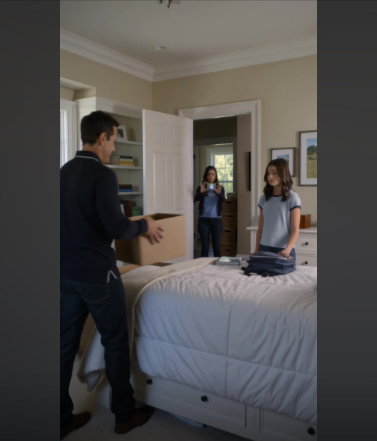
My Dad Locked Me In The Storage Room For His New Family — Then My Mom’s Last Letter Opened
MY FATHER GAVE MY BEDROOM TO HIS NEW BABY AND TOLD ME, 14, TO TAKE THE STORAGE ROOM: “THE BABY NEEDS THAT ROOM MORE THAN YOU.” MY STEPMOTHER FILMED IT AND SENT IT TO 12 RELATIVES IN THE GROUP CHAT. I SAID NOTHING.I JUST PACKED QUIETLY. 58 MINUTES LATER, A CAR MY FATHER NEVER EXPECTED PULLED INTO THE DRIVEWAY AND 90 SECONDS LATER,
THEY SCREAMED MY NAME IN FEAR.
THE WORD DAISY
My name is Matilda Savage.
I was fourteen years old when my father stood in the doorway of my bedroom and told me my mother was dead as if that were a reason I should stop belonging in the room she had made for me.
“Your mother is dead,” he said.
His voice was cold.
Not angry.
Cold was worse.
“Stop acting like this house still belongs to her ghost. The baby needs a real room. Pack your things and move to the storage room tonight.”
My stepmother, Belle, stood behind him with her phone held at chest height.
Recording.
I saw the red dot reflected in the black screen of my laptop.
She was smiling.
Not nervously.
Not apologetically.
Like someone who had been waiting for a moment to finally arrive.
I looked up at the wall above my bed.
My mother had painted three words there six years earlier.
YOU BELONG HERE.
Pale blue.
Her handwriting.
The same slightly slanted letters she used on birthday cards.
She painted them the week before doctors told us her cancer was no longer responding to treatment.
I was eight.
She died on June 15, 2020.
For six years, those words had been the first thing I saw when I woke and the last thing I saw before I slept.
The B in BELONG had chipped near the lower curve.
I touched that spot so often the paint had worn down to drywall.
My thumb fit the mark exactly.
Belle zoomed in on my face.
My father placed a laminated sheet on the desk.
A moving schedule.
He had typed it.
Belle had laminated it.
That detail hurt in a strange way.
Not because lamination is cruel.
Because it meant they had planned this carefully enough to protect the paper.
Bedroom cleared tonight.
Storage room ready by morning.
Nursery setup begins tomorrow.
I stared at the schedule.
“Now.”
My father said.
“We want to show you the room.”
I stood.
I did not argue.
Belle’s phone followed.
The storage room sat at the far end of the upstairs hall beyond the linen closet.
Eighty square feet.
Concrete floor.
A rectangle of remnant carpet placed loose in the center.
Water heater in one corner.
Electrical panel on the wall.
No exterior window.
A small frosted ventilation opening near the ceiling.
No smoke detector inside the room.
The nearest detector was in the hallway.
Belle walked in first and panned the phone slowly across the walls.
“There’s room for a cot.”
She said.
Like a realtor describing potential.
Then she pointed the camera at me again.
“Look at her.”
“She’s not even arguing.”
I asked one question.
“Is this safe?”
My father’s face tightened.
“Matilda.”
“Don’t make this hard.”
“Don’t be dramatic.”
Belle laughed softly.
“Time to grow up, sweetheart.”
Then, looking directly at the camera:
“Time to grow up and make space for the real family.”
She said it twice.
Once to me.
Once to whoever would watch later.
The baby was named Hudson.
He was not yet four months old.
He had a crib downstairs in my father and Belle’s bedroom.
He also had a bassinet in the living room.
But Belle had decided he needed my bedroom.
My room was larger.
Sunny.
Two windows facing the maple tree.
Built-in shelves my mother had painted.
A wall that said I belonged.
I returned to it.
Opened my closet.
Lifted a stack of sweaters.
Placed them on the bed.
The phone remained in the doorway.
“She’s being very mature.”
Belle narrated.
I said nothing.
My mother had taught me, before I understood why I might need the lesson, that there are moments when the only thing you can afford to give someone is silence.
This was one of them.
I took the wooden memory box from the top of my dresser.
Placed it inside my school backpack before any clothing.
Zipped the bag.
That sound was louder to me than Belle’s voice.
At 4:22 p.m., Belle stopped recording.
She typed a caption.
I did not see it then.
I saw screenshots later.
TIME TO GROW UP AND MAKE SPACE FOR THE REAL FAMILY.
She sent the video to a family group chat with twelve people.
My father’s relatives.
Belle’s mother.
Two people who had been friends of my mother.
My aunt Vivien.
A cousin I barely knew.
Adults who would decide, within minutes, whether a fourteen-year-old losing her bedroom was funny.
At 4:23, Cousin Trent replied:
LOL. SHE LOOKS SO OVER IT.
At 4:24, my father’s aunt Pearl wrote:
TROOPER ENERGY. THE REAL FAMILY NEEDS THAT ROOM MORE.
At 4:24, my aunt Carla sent three heart emojis.
Then:
ADOLESCENTS NEED TO LEARN HUMILITY. SHE’LL THANK YOU IN TEN YEARS.
At 4:25, someone named Lorraine wrote:
WAIT, IS THAT THE STORAGE ROOM WITH THE BREAKER PANEL?
Ninety seconds later, she deleted it.
The server did not forget.
At 4:24, one of my mother’s old college friends, Enz Pierce, took a screenshot of Belle’s video and forwarded it to my grandmother Joyce.
Message:
THIS IS NOW.
Joyce read it within seconds.
She had been waiting for something like that message for two and a half years.
Not hoping.
Waiting.
There is a difference.
At 4:27, Aunt Vivien typed one word into the family chat.
DOCUMENTED.
My father read it as agreement.
Belle did too.
They did not understand the difference between documented and good job.
Then Vivien sent me a private message.
One symbol.
A daisy.
I was sitting on my bedroom floor beside the sweaters.
I looked at the screen.
And for the first time that afternoon, I knew exactly what to do.
The word Daisy had been waiting for me since I was eleven.
My grandmother gave it to me in a diner with red vinyl booths.
That summer, Joyce had driven forty-five minutes to see me while my father was at work and Belle was visiting her own family.
She ordered coffee.
I ordered fries I did not finish.
Across the table, she slid a folded piece of paper into my hand.
On the outside she had written:
DAISY.
“If you ever need help.”
Joyce said.
“You do not have to explain everything.”
“You send that word.”
“Three people will see it.”
“Three people will know what to do.”
I had asked:
“What if Dad sees?”
“He won’t.”
“What happens?”
“You let the adults handle the adults.”
I put the paper into the clear sleeve behind my library card.
Every Friday for three years, I checked that it remained there.
I never opened it.
Never used it.
Until that Thursday.
I pulled it out.
Unfolded it.
There was writing beneath the word Daisy.
Not Joyce’s.
My mother’s.
I had not seen Lillian Savage’s handwriting in six years.
The letters hit me harder than my father’s words.
Rules.
DON’T ARGUE.
DON’T POST.
DON’T SLAM DOORS.
PACK WHAT YOU ACTUALLY NEED.
PHOTOGRAPH THE ROOM.
USE THE CLOUD FOLDER.
WHEN YOU ARE SAFE ENOUGH TO DO IT, SEND DAISY.
IF THEY GO FOR YOUR ROOM, THEY MAY GO FOR THE REST.
I read the last sentence twice.
My mother had died before Belle entered our lives.
Before Hudson.
Before the laminated moving schedule.
She could not have predicted the exact people.
She had predicted the pattern.
My grandmother had created the cloud folder two years earlier.
PHOTOS FOR AUNT VIVIEN RECIPES.
There were no recipes.
By April 2026, it contained 217 images.
My mother’s missing belongings.
The Hamilton watch Belle later wore at her baby shower.
The green leather photo album removed from the bookshelf.
The framed photograph of Mom repeatedly moved from the mantle and eventually placed face down in my closet.
A youth custodial statement in my name showing a balance of $312 when Dad had told me every November that my college money was “doing fine.”
A lease page showing the new Audi Q5.
A receipt edge.
A bank envelope.
Things I did not understand fully but knew enough to preserve.
I stood.
Took fourteen photographs.
My bedroom wall.
The words YOU BELONG HERE.
The laminated moving schedule.
The hallway.
The storage-room doorway.
Concrete floor.
Water heater.
Electrical panel.
Vent.
No window.
The hallway smoke detector.
The remnant carpet.
The place they expected me to sleep.
I uploaded each image.
Three activity indicators appeared almost immediately.
Someone was opening them.
Then another.
Then a third.
For the first time that day, I understood I was not alone.
At 5:09 p.m., I sat cross-legged on the concrete floor.
The water heater hummed beside me.
Two folded sweaters lay on the carpet.
I typed:
DAISY.
HE TOOK MY ROOM.
SHE FILMED IT.
STORAGE ROOM.
NO WINDOW.
PHOTOS IN FOLDER.
I sent the message to Grandma Joyce.
Aunt Vivien.
And a number saved in my phone as:
MR. MARSH – SCHOOL PROJECT.
All three typing indicators appeared at once.
The replies came within seconds.
STAY WHERE YOU ARE.
WE ARE COMING.
I put the phone in my lap.
Breathed.
Waited.
My father appeared in the doorway fifteen minutes later.
He saw me on the floor.
Saw the folded clothes.
Saw a child apparently complying.
“See?”
He smiled.
“You’re handling this great.”
I nodded.
He left.
From the nursery, Belle called:
“Damon, Hudson is fussing.”
My father walked away.
They forgot me again.
For the first time, that worked in my favor.
To understand why three adults were ready to move before I even sent Daisy, you need to understand the envelopes.
Every August after my mother died, a Social Security notice arrived in our mailbox.
Plain.
Official.
Addressed to my father as representative payee for me.
Lillian had worked as a public-school librarian from the time she was twenty-four until cancer took her.
Every paycheck carried Social Security taxes.
After she died, I qualified for survivor benefits.
I did not understand the amount when I was eight.
I only knew Dad opened the letters standing at the kitchen counter and told me they were adult paperwork.
When I was twelve, I asked whether any of the money was for college.
He said:
“Your college money is fine.”
Same sentence every year.
In 2025, one envelope looked different.
Thicker.
Green return marking.
Dad did not open it in the kitchen.
He took it to his office.
Placed it at the bottom of his desk drawer.
That memory stayed with me because of how carefully he avoided looking at it.
What I did not know was that Social Security had begun reviewing his representative-payee activity after irregularities surfaced in records connected to an account holding my survivor benefits.
My father was not required to file a dramatic yearly confession simply because he was my parent.
The real process was more complicated.
Agency notices.
Bank information.
Periodic representative-payee review.
Requests for documentation once questions were raised.
The federal case later depended far more on bank records and statements he submitted during review than on one magical form.
Felix Callaway knew that because he worked for the Social Security Administration’s Office of Inspector General.
He was my mother’s first cousin.
I had never really met him.
At Thanksgiving, Joyce occasionally mentioned:
“Felix works for the government.”
Dad assumed he lived in Arizona.
He did not.
He lived twenty-two minutes from us.
At my mother’s funeral, Felix stood behind Joyce in one photograph holding a manila folder against his chest.
For years I assumed it contained funeral programs.
It contained documents Lillian had given him from her hospital bed three days before she died.
Copies of account information.
Her will.
A letter about my survivor benefits.
A note saying that if Damon ever remarried, someone should make sure my money remained mine.
Felix could not investigate his own family member.
When an internal flag involving Dad’s representative-payee activity became serious in 2023, Felix disclosed the relationship and recused himself from the investigation.
The case went to Special Agent Dorian Wexler.
Felix remained only a family contact when allowed.
He did not search accounts.
Did not interview Dad.
Did not build the case.
He knew a case existed.
That was all.
For two and a half years, Wexler built it quietly.
Bank subpoenas.
Account records.
Benefit deposits.
Transfers.
Credit-card spending.
Documents my father supplied when asked to explain how funds had been used for my care.
The more records came in, the worse the pattern looked.
Survivor benefits had helped pay ordinary household expenses in the early period, which can be legitimate when a child lives in the home.
But investigators later found large amounts routed toward expenses with little or no connection to me.
Wedding costs.
Luxury vehicle payments.
Adult travel.
Belle’s purchases.
Nursery renovations.
Meanwhile, my custodial savings account had fallen to almost nothing.
My orthodontic treatment had been postponed.
School expenses often came from Joyce or from the small amount of money I earned tutoring a neighbor’s daughter.
My father kept telling me the money was fine.
The federal file did not become prosecution-ready overnight.
It became ready because numbers repeated themselves.
That was the part Dad never understood.
One lie can be explained.
A pattern becomes harder.
By the time Belle filmed the storage room, Wexler had already spent months tracing the money.
Marsh had a different file.
Theodore Marsh had been my mother’s family attorney.
He handled parts of her estate.
He had copies of records Joyce lawfully obtained as guardian-designated family representative in estate matters.
He had receipts.
Old account statements.
Trust documents.
The youth custodial statement.
Photographs Joyce and Vivien had preserved from the cloud folder.
He did not possess Wexler’s federal evidence.
That line mattered.
The government’s evidence stayed with the government.
The family’s records stayed with Marsh.
Daisy connected the two worlds without mixing them.
At 5:12 p.m., after Joyce saw the storage-room photographs, she called the county child-abuse hotline.
Not because Felix told her to.
Because a fourteen-year-old was being assigned to sleep in a windowless utility room containing a water heater and electrical panel.
The hotline supervisor asked questions.
Was I injured?
No.
Was I locked in?
No.
Was there another safe room available?
Yes.
My old bedroom.
Was there an adult relative available for immediate placement?
Joyce.
Could Joyce arrive quickly?
Yes.
A local sheriff’s deputy and an on-call child-welfare worker were dispatched to make a safety assessment.
That response had nothing to do with the federal benefits investigation.
Felix’s role remained separate.
At 5:20, Joyce called him anyway.
“She sent Daisy.”
Felix went silent.
Then:
“Is she hurt?”
“No.”
“She’s in a storage room.”
Joyce described the photographs.
Felix said:
“Call child welfare.”
“Already did.”
“Good.”
Then Joyce asked:
“Can you come?”
That was the question.
Not:
Can the federal government take her?
Can you come as family?
Felix called his supervisor first.
Explained that a child-safety event had occurred involving the victim in an investigation from which he remained recused.
Asked whether he could be physically present as a relative and liaison without participating in questioning or evidence collection.
His supervisor approved with boundaries.
No interview.
No federal search.
No seizure.
No discussing investigative details beyond what had already been disclosed through counsel.
Wexler would handle the case.
Felix took his personal vehicle.
No government plate.
No dramatic OIG raid.
He picked up Marsh because Marsh had the estate and emergency guardianship documents.
Joyce drove separately.
Vivien left work and headed toward the house.
At 5:47, the sheriff’s deputy arrived first.
Dad opened the door.
From the storage room, I heard a man’s voice.
Then Belle’s.
Then my father saying:
“This is a family matter.”
The deputy answered:
“Maybe.”
Then:
“We’re here because someone reported a minor being placed in a utility room.”
The house became quiet.
At 5:52, the child-welfare worker arrived.
At 5:58, Joyce’s Subaru turned onto our street.
Felix and Marsh pulled in behind her.
Three vehicles.
No sirens.
No television drama.
Still, my father looked through the front window and went pale.
He recognized Joyce.
He recognized Marsh.
He did not recognize Felix until the door opened and Joyce said his name.
“Damon.”
She stepped into the entryway after the child-welfare worker invited her.
“Where is Matilda?”
Dad tried:
“She’s fine.”
Joyce looked at the worker.
“She’s in the storage room.”
Dad said:
“It’s temporary.”
Nobody answered.
The word temporary had to carry itself.
Belle came downstairs holding Hudson.
Her phone was in her hand.
She started recording automatically.
Vivien arrived behind Joyce.
Saw the phone.
“Belle.”
She said.
“Please put that away.”
The child-welfare worker added:
“No recording of the minor during this assessment.”
Belle lowered it.
This time, the phone did not shatter theatrically.
It stayed in her hand.
That was better.
The evidence already existed.
No symbolic broken screen was necessary.
Felix stayed near the doorway.
Dad stared at him.
“Who are you?”
“Felix Callaway.”
Recognition arrived slowly.
“Lillian’s cousin.”
“Yes.”
Dad looked at his jacket.
Then:
“You work for Social Security.”
“I work for OIG.”
Felix said.
“I am not your investigating agent.”
“I am here as family support.”
“Special Agent Wexler remains assigned to the benefits matter.”
The phrase benefits matter changed my father’s face.
He had not known for certain that a matter existed.
Now he did.
“What matter?”
Felix did not answer.
Marsh did.
“You’ll receive communication through proper channels.”
Then the child-welfare worker asked:
“Where is Matilda?”
My father called down the hallway.
This time his voice was different.
“Honey.”
“Come here, please.”
Please.
I had waited fourteen years to hear that word used when he needed something from me.
I picked up my backpack.
Held the wooden box against my chest.
Walked down the hall.
Past the room with the water heater.
Past the bedroom that had been mine.
Into the entryway.
I looked at Joyce first.
Not Dad.
Not Belle.
Joyce held out her hand.
The child-welfare worker knelt slightly so we were closer to eye level.
“Matilda.”
“My name is Erin.”
“Do you feel safe staying here tonight?”
“No.”
One word.
Clean.
She nodded.
“Do you want to go with your grandmother while we work out the next steps?”
“Yes.”
Dad made a sound.
“Wait.”
The deputy lifted one hand.
“Sir.”
“Let her answer.”
I said:
“I want to go with Grandma.”
The sentence was the first complete thing I had said since Dad entered my room.
Joyce took my hand.
Dad looked at Marsh.
“Can she just leave?”
Marsh answered carefully.
“Tonight’s placement is a child-welfare safety decision.”
“Longer-term guardianship will go through court.”
“No one is resolving custody in your entryway.”
That was reality.
Not one lawyer announcing permanent removal in ninety seconds.
Still enough.
I walked out holding Joyce’s hand.
At the curb, I opened the wooden box for the first time.
The manila envelope inside read:
SSA — FOR MATILDA WHEN SHE IS READY.
Joyce sat beside me in the Subaru.
She did not start the car.
I opened it.
The first page was a letter from Mom.
Three weeks before she died.
The first line said:
My cousin Felix knows enough to help you find the right people if anything ever happens to the benefits I leave behind for you.
I stopped reading.
Folded the letter.
Put it back.
Then looked at the house.
Felix stood inside talking quietly to the child-welfare worker.
Marsh had placed one of his folders on the entry table.
Dad stood several feet away.
For the first time since my mother died, the adults around him were not adjusting themselves to his version.
Joyce waited.
When I finally said:
“Okay.”
She started the car.
And we left.
At 7:14 that evening, Aunt Vivien sent one message to the family group chat.
I saw the screenshot later.
She wrote:
Matilda is safe with Joyce.
The video and messages from this afternoon have been preserved.
There is an active child-welfare matter and a separate federal benefits investigation.
Please do not contact Matilda directly tonight.
That was all.
No accusation.
No statute number.
No dramatic threat.
Still, the chat went silent.
Forty seconds.
Long enough to feel like a room full of adults suddenly discovering that screenshots had memories.
Aunt Pearl typed:
????
Then:
VIVIEN, I DON’T UNDERSTAND.
She deleted both.
Then left the chat.
Cousin Trent removed several messages.
Carla stopped responding entirely.
By nine that night, half the group had gone silent or exited.
Enz Pierce called Joyce.
I heard part of the conversation because the phone was on speaker while Joyce washed dishes.
“Lillian told us once what Daisy meant.”
Enz said.
“None of us thought she would ever need it.”
I had a pencil in my hand.
For some reason, that sentence felt important enough to preserve.
I opened the wooden box.
Turned the lid over.
Wrote:
LILLIAN TOLD US ONCE WHAT DAISY MEANT.
The pencil line is still there.
That same night, Belle’s mother texted her.
I did not see the message then.
Belle later included it in records during the family-court case.
PACK A BAG.
COME HOME.
BRING HUDSON.
Belle did not leave immediately.
Shock does not always create motion.
Sometimes it creates stillness.
She sat in the entryway for nearly an hour after everyone else left.
Hudson asleep against her shoulder.
Dad in the kitchen.
The laminated moving schedule still upstairs on my desk.
The federal investigation had not produced charges yet.
The child-welfare worker had not declared anyone permanently unfit.
But the house had changed in less than three hours.
Dad’s sister Carla changed next.
She had sent heart emojis when Belle posted the video.
Slept badly.
Rewatched it.
Saw the water heater.
The breaker panel.
My face.
Read Vivien’s message.
Then drove across the state line before sunrise.
She arrived around eight-thirty Friday morning.
I know this because Carla told Joyce later.
She walked into the house.
Did not yell.
Did not lecture.
She went to the nursery.
Picked up Hudson.
Belle looked at her.
“Where are you going?”
“To Mom’s.”
“Why?”
“Because you need a lawyer who is not Damon’s.”
Dad came into the hall.
“Carla.”
She looked at him.
“You are handling this alone.”
He stared.
“What?”
“Until you can tell me you understand what you did to Matilda, you do not have a sister helping you explain it.”
She carried Hudson outside.
Belle followed twenty minutes later.
Not because anyone ordered her.
Because the marriage cracked under information she had not had.
At least, that was what she later said.
By eleven, she had packed a small bag.
By noon, the Audi was gone.
For Dad, Friday became paperwork.
The child-welfare agency documented the emergency placement with Joyce and scheduled a court review.
Marsh filed for temporary guardianship on Joyce’s behalf.
My father had counsel by then.
His lawyer advised him not to oppose my placement immediately.
That mattered.
No judge had to decide in one frantic night whether I would be safer with the grandmother who had prepared a bedroom for me for years.
The temporary order was entered the following week after a hearing.
My father retained legal parentage.
Joyce received temporary guardianship and decision-making authority while the safety case proceeded.
Contact with Dad would happen only if I wanted it and under terms the court approved.
I did not want it yet.
That was enough.
The federal side also moved.
Special Agent Dorian Wexler returned from Boston Friday morning.
He did not come to Joyce’s house.
He called Marsh.
Then Dad’s lawyer.
Then the United States Attorney’s Office.
The evidence he had been building since 2023 was no longer just about spending.
The storage-room video mattered because it contradicted Dad’s repeated claim that he used benefits to maintain appropriate housing and care for me.
Not because a utility room automatically proves every prior dollar was stolen.
It did not.
But it added context to the bank records.
The agency’s accountants had already traced six years of survivor benefits.
About $151,200 had entered the representative-payee account over that period.
Some spending legitimately supported the household where I lived.
Food.
A share of utilities.
Clothing.
School costs.
Investigators credited those amounts.
The problem was what happened to the rest.
Large transfers to Dad’s personal credit card.
Wedding expenses.
The Audi lease.
Nursery furniture.
Adult travel.
Cash withdrawals unsupported by receipts.
Money moved into accounts I could not access.
Meanwhile, my custodial savings had been depleted.
The final misuse figure was lower than the total benefits received, because federal restitution must reflect provable loss, not a dramatic round number.
Wexler’s team eventually calculated approximately $118,000 in misused or unsupported funds after legitimate expenses were credited.
That number became the government’s loss figure.
Not every ugly purchase became a separate crime.
The strongest charges involved misuse of benefits, false statements during the payee review process, and identity-related conduct tied to records submitted in my name.
Dad surrendered voluntarily the next week through counsel.
No raid.
No handcuffs in front of neighbors.
He appeared at the federal courthouse, was processed, and released under conditions pending resolution.
By then, I was already living in Joyce’s spare bedroom.
The room had been waiting.
That realization hurt in a good way.
A small dresser.
Desk.
Lamp shaped like a turtle from when I was six.
A row of books I had borrowed in 2020 and never returned.
The quilt from Mom’s hospital bed folded across the foot.
A framed photograph of Mom holding me at six months old.
I stared at the quilt for a long time.
“I asked where this was.”
I said.
Joyce nodded.
“I know.”
“You told me it was safe.”
“It was.”
“Why keep it?”
She looked at me.
“For when safe had a room again.”
That sentence became another thing I wrote inside the wooden box.
On Monday, I returned to school.
Mrs. Holloway, my counselor, called me out of second period.
Her office smelled like peppermint tea and printer paper.
She closed the door.
Did not open a form.
Did not pick up a pen.
“You do not have to perform for me.”
She said.
“Tell me what happened.”
I told her in eight sentences.
Dad said Mom was dead and the baby needed my room.
Belle filmed.
They put me in the storage room.
I asked if it was safe.
They said I was dramatic.
I sent Daisy.
Grandma came.
I left.
That was enough.
Mrs. Holloway’s eyes filled.
She did not cry.
“Your grandmother told me you were brave.”
“I wasn’t.”
“Yes.”
She said.
“You were scared and did the safe thing anyway.”
That definition felt possible.
The school had already filed its own mandated report after learning about the placement.
Not because the system had failed to notice forever.
Because multiple systems now had the same information.
Child welfare reviewed Joyce’s home.
Not an eleven-minute courtesy visit.
A real kinship-placement assessment.
Bedroom.
Safety.
School transport.
Medical care.
Background checks.
The caseworker spoke to me privately.
Asked whether Joyce pressured me to say anything.
No.
Asked whether I wanted to stay.
Yes.
Asked whether I feared Dad.
I thought carefully.
“I fear what happens when he decides my needs are inconvenient.”
She wrote that down.
Good.
It was the most accurate sentence I had.
The guardianship remained.
Dad’s house stopped being mine.
Not because he said so.
Because I chose not to return.
Belle retained her own lawyer within forty-eight hours.
That may have been the smartest decision she made that year.
Her attorney told her to stop talking to Dad about the federal investigation.
Stop using shared passwords.
Stop moving money.
Preserve the phone.
Preserve the group chat.
Preserve the account records.
Then tell the truth separately.
Belle did.
At first, I wanted her charged with everything.
The watch.
The Audi.
The nursery.
The phone video.
The sentence about the real family.
I was fourteen.
Anger likes clean categories.
Government investigations do not.
Wexler’s team had to prove what Belle knew when she used the debit card connected to the representative-payee account.
Dad had told her the account was “family money.”
She had used the card for household purchases.
Some for Hudson.
Some for herself.
Some clearly unrelated to me.
But evidence showed Dad controlled the statements, the account credentials, and the agency correspondence.
Belle had benefited.
That was not automatically the same as joining his federal fraud.
She cooperated.
Produced her phone.
Provided messages.
Identified purchases.
Returned the Hamilton watch.
Her attorney arranged repayment for several clearly personal charges through the civil process.
Prosecutors did not charge her federally.
That frustrated parts of my father’s family.
They wanted symmetry.
Dad guilty.
Belle guilty.
Everyone punished.
Reality is rarely symmetrical.
Belle still faced family-court consequences.
The child-welfare case documented her conduct.
The video mattered.
So did the storage room.
So did the way she spoke about me.
Her separation from Dad became permanent.
She moved in with her mother.
Hudson stayed with her under a separate parenting arrangement while Dad’s criminal case continued.
I did not see Hudson for months.
That hurt unexpectedly.
He was not responsible for my room.
He was a baby.
One afternoon, Carla brought him to Joyce’s house with Belle’s permission.
I stood in the kitchen while he sat in a high chair hitting a spoon against the tray.
He looked at me.
Smiled.
No idea who I was.
I cried in the bathroom afterward.
Joyce did not follow.
She understood privacy.
Dad’s criminal case resolved without trial.
The evidence was too strong for his lawyer to pretend otherwise.
Not because the government had “waited for five perfect forms.”
Because it had bank records, review responses, account transfers, card histories, and statements Dad had made when the agency asked about my support.
His lawyer negotiated.
Dad pleaded guilty to federal offenses involving misuse of Social Security benefits and materially false statements connected to his role as representative payee.
An identity-related count tied to one submission was resolved as part of the plea rather than stacked into the kind of automatic dramatic sentence people online later claimed.
The plea agreement calculated the provable misuse at approximately $118,000 after crediting legitimate expenses.
Dad agreed to restitution.
The government agreed not to seek charges on several weaker theories.
Sentencing happened later that summer.
Joyce asked whether I wanted to attend.
“No.”
That answer surprised both of us.
I had imagined seeing him face consequences.
Then the date approached and I realized I did not need to watch.
Marsh attended.
Felix did not.
Recusal still mattered even at the end.
Wexler sat with the prosecution team.
The judge considered the amount of money.
The length of conduct.
Dad’s lack of criminal history.
His acceptance of responsibility.
The fact that the money belonged to a minor beneficiary.
The false records.
The family circumstances.
The sentence was thirty months in federal custody, followed by supervised release and restitution.
He was permanently barred from serving as a Social Security representative payee during the period required by agency rules and, practically, would never be selected for me again.
People later shortened that to:
He stole his daughter’s money and went to prison.
True.
Incomplete.
He also spent years teaching himself that a parent’s control over a child made the child’s money available for adult plans.
The criminal case punished conduct.
It could not explain the belief underneath it.
That part belonged to us.
After sentencing, a letter arrived at Joyce’s house.
My name on the front.
Dad’s handwriting.
Federal facility return address.
Joyce brought it to my room.
Did not open it.
Did not ask whether I would.
“Your decision.”
She said.
I held the envelope.
The corners were already soft from postal handling.
I imagined:
I’m sorry.
I didn’t mean to hurt you.
I was going to replace it.
Belle changed me.
Grief changed me.
Money was tight.
You’ll understand when you’re older.
Maybe none of those things were inside.
Maybe all of them.
I placed the envelope on the shelf beside the wooden box.
Unopened.
It stayed there through April.
May.
My fifteenth birthday.
Then longer.
People sometimes asked later whether refusing to read it was cruel.
I do not think so.
A letter creates an opportunity to communicate.
It does not create an obligation to receive.
I was a child.
Dad had adults.
Lawyers.
Counselors.
A prison chaplain.
I did not need to become the person who stabilized his remorse.
Joyce applied to become my successor representative payee using the proper Social Security process.
Form SSA-11.
Interview.
Identity verification.
Information about my living arrangement.
The agency reviewed her suitability.
Once approved, future survivor benefits went into an account used for my current needs, with conserved funds handled under agency rules.
The amount expected through my eighteenth birthday, if eligibility and benefit levels remained similar, was roughly fifty thousand dollars.
Joyce showed me the account.
Not because I needed to manage it.
Because secrecy had become poison in our family.
“This is what comes in.”
She said.
“This is what gets spent.”
“Food?”
“Yes.”
“Clothes?”
“Yes.”
“School?”
“Yes.”
“Can you use it for the electric bill?”
“A reasonable share of household costs can be appropriate.”
She said.
“Not my whole life.”
“Exactly.”
Every month, she showed me a simple page.
Benefit deposit.
My share of housing.
School lunch.
Shoes.
Medical copay.
Savings.
No mystery.
Money became boring.
That felt safe.
My mother had paid Social Security taxes from every paycheck she earned as a librarian.
When I was younger, survivor benefits felt like government money arriving from nowhere.
Felix explained it differently.
“Your mother paid into an insurance system.”
He said.
“This is part of what that system exists for.”
We were sitting at Joyce’s kitchen table.
No badge.
No case file.
He never discussed Dad’s investigation beyond public information.
“That doesn’t make the money Mom.”
I said.
“No.”
He answered.
“Nothing does.”
That was why I liked him.
He never used money as a replacement metaphor.
My mother was dead.
The benefits were benefits.
The quilt was a quilt.
The blue paint was paint.
Love could attach meaning to things.
It did not have to pretend they were people.
Felix visited rarely after the case.
His job had already taken too much space in the family story.
He seemed determined not to let it take more.
He taught me to change a tire one Saturday.
Not because I owned a car.
Because he said:
“Everybody should know.”
Joyce watched from the porch and yelled instructions that contradicted his.
For twenty minutes, the two of them argued about lug nuts.
It was one of the best afternoons of my fifteenth year.
Normal conflict.
Nobody filmed it.
Nobody sent it to a group chat.
Nobody used the word family as a weapon.
The family group chat never recovered.
For months, I thought that mattered.
It did not.
Group chats are not families.
They are rooms where people sometimes mistake reaction buttons for character.
Aunt Pearl eventually apologized to Joyce, not to me.
She said she had only seen “a teenager being moved to another room.”
Joyce replied:
“You saw the water heater.”
Pearl had no answer.
Cousin Trent deleted his account and created a new one.
Vivien laughed when she told me.
“People think deleting a message changes the witness.”
She sounded almost amused.
Then became serious.
“I’m sorry I was in that chat at all.”
“Why?”
“Because I saw other things before the room.”
“Small things.”
“Jokes.”
“Belle calling you difficult.”
“Damon saying you were too attached to your mother.”
“I should have asked more questions.”
I did not know what to do with adult guilt.
So I said:
“You helped when it mattered.”
Vivien shook her head.
“That is not the same as helping sooner.”
She was right.
Both things could exist.
Carla apologized differently.
She drove to Joyce’s house one Saturday carrying a grocery-store cake and a face that looked as though she had rehearsed nothing.
“I sent heart emojis.”
She said.
“I know.”
“I watched the video.”
“I know.”
“And I thought your father was being strict.”
“Okay.”
“Don’t say okay.”
The word had become complicated.
I looked at her.
“What do you want me to say?”
“Nothing.”
She sat.
“I want to tell you I was wrong.”
No explanation.
No:
I didn’t understand.
No:
I thought Belle meant well.
Just:
I was wrong.
That apology stayed with me.
Carla also returned several of Mom’s things.
Not because she had taken them.
Because after Belle left Dad, boxes from the house had been divided and stored.
Carla found the green leather photo album.
The ceramic loon ornament.
Two scarves.
A recipe binder.
The Hamilton watch arrived separately through Belle’s attorney.
New leather strap.
Same initials on the back.
LCS.
Lillian Claire Savage.
I held it in my palm.
For years, I had imagined getting it back would feel like winning.
Instead, I felt tired.
Joyce asked:
“Do you want to wear it?”
“No.”
“Then don’t.”
We placed it in the wooden box.
That box became less like evidence over time.
More like an archive.
Mom’s letter.
Daisy paper.
Photographs.
The unopened letter from Dad.
A copy of the guardianship order.
Later, a copy of the restitution judgment.
I did not look through it often.
The point of preserving something is not to stare at it forever.
The custodial account required separate work.
The $312 balance I had photographed was real.
The account had once held much more.
Marsh traced withdrawals.
Some had been moved into the same network of household and personal spending reviewed by the federal case.
The final civil accounting folded those amounts into the restitution process where appropriate.
Recovery was slow.
Federal restitution is not a magical check that appears the day someone is sentenced.
Dad’s prison wages were tiny.
Later, future income and certain refunds could be applied.
Some money came from assets he surrendered under the plea and civil settlement.
Some from the sale of items he no longer needed.
The Audi was returned under its lease.
Wedding money, of course, could not be unspent.
The nursery furniture was not seized from Hudson.
No one was going to punish a baby by removing his crib to satisfy an accounting metaphor.
That mattered to me.
By the end of the first year, a meaningful portion had been restored to accounts for my benefit.
More would come over time.
Marsh told me:
“Restitution is not the same as restoration.”
“What’s the difference?”
“Money can be returned.”
“Years cannot.”
I wrote that inside the wooden box too.
School became normal again faster than home did.
Mrs. Holloway checked in once a week at first.
Then every other week.
Then only when I asked.
That was good.
I did not want to become the girl teachers whispered about in hallways.
I wanted to be bad at pre-algebra in peace.
I joined the library aide program after school.
Not because Mom had been a librarian.
At least, that is what I told myself.
The first day, Mrs. Chen, our school librarian, asked me to reshelve biographies.
I held a book about Eleanor Roosevelt and started crying.
No reason I could explain.
Mrs. Chen did not ask.
She took the cart.
Said:
“Go wash your face.”
Then gave me easier books.
That kind of kindness saved me more than speeches.
Joyce did not turn her house into a museum of Mom.
She let me decide what came out.
The quilt stayed on the bed.
The photograph remained on the nightstand.
The blue paint waited in the basement.
For weeks, I stared at the wall above my new bed.
White.
Clean.
Nothing written.
Then one Saturday, I asked:
“Do you still have Mom’s blue?”
Joyce did not ask why.
She brought up a sealed quart can.
Pale blue.
Same color.
We opened it together.
Still usable after mixing.
I used a small brush.
Not Mom’s handwriting.
Mine.
I wrote:
I BELONG HERE.
Four words.
Not three.
I added I because that was the difference.
Mom had told me I belonged.
Now I was telling myself.
The room was eighty-one square feet.
One square foot larger than the storage room.
That fact amused me more than it should have.
But it had a window.
Smoke detector.
Desk.
Books.
A door that closed.
No water heater.
No breaker panel.
No laminated schedule telling me when to disappear.
I stepped back.
Joyce stood in the hallway.
“What do you think?”
I asked.
She looked at the wall.
Then at me.
“I think your mother would complain about your spacing.”
I laughed.
Hard.
For the first time in months.
Then Joyce laughed too.
The paint dried unevenly near the G.
I left it that way.
Perfect lettering would have looked like Mom’s.
I needed mine.
The guardianship hearing several months later became less dramatic than the emergency placement.
Dad appeared by video from custody.
His lawyer did most of the speaking.
The child-welfare agency recommended Joyce remain guardian while Dad served his sentence and until any future contact could be assessed safely.
Dad did not contest.
The judge asked me privately, with my attorney present, where I wanted to live.
“With Grandma.”
“Do you want contact with your father?”
“Not now.”
“Do you want that decision permanent?”
I thought.
“No.”
That surprised everyone.
Even me.
“I want to decide later.”
The judge nodded.
“That is a reasonable answer.”
The order reflected that.
No forced contact.
No permanent termination of parental rights based solely on the federal sentence.
Future requests would require review.
I left the courthouse feeling lighter.
Not because I had won.
Because nobody had made me choose forever at fourteen.
That was a gift.
I am older now than I was that Thursday.
Old enough to tell the story without feeling like I am still sitting on concrete beside a water heater.
Not old enough to pretend it stopped mattering.
Some memories change temperature before they change shape.
For years, the storage room felt cold even when I remembered it in summer.
Now it feels like a place.
A bad place.
A place I left.
That difference took time.
Dad served his sentence.
He paid what restitution he could.
After release, he remained under supervision for several years.
He could not simply resume control over my benefits or my accounts.
The Social Security Administration had long since appointed Joyce.
By the time I became an adult, the representative-payee arrangement ended because I could receive and manage whatever benefits or conserved funds remained directly.
Joyce turned over records.
Every statement.
Every receipt.
Every year.
No mystery.
That was one of the best things she gave me.
Not the money.
The absence of secrecy.
Belle and Dad divorced.
I did not celebrate.
Hudson was my half-brother whether I liked the adults around him or not.
As he got older, Belle allowed occasional contact through Carla.
At first, supervised family visits.
Then birthdays.
He knew me as Matilda.
Not “the sister whose room became yours.”
Children should not inherit adult accusations before they understand what they are carrying.
When Hudson was six, he asked:
“Did this used to be your room?”
We were standing in Dad’s old house after it had been sold and before the new owners took possession.
Carla had been allowed one final retrieval visit.
I had come for the wall.
Not literally.
I could not take drywall.
But I wanted a photograph of Mom’s words.
The nursery had changed again.
Different paint.
Different furniture.
No trace of the room I remembered.
Hudson asked again.
“Was this yours?”
“Yes.”
“Then mine?”
“Yes.”
“Why?”
I looked at him.
“Because adults made decisions.”
He accepted that.
Then ran downstairs.
That was enough truth for six.
The house sold as part of Dad’s financial cleanup after prison.
Not seized by the government because every brick had become tainted.
Sold because he could no longer afford it.
Part of his equity went toward restitution and debts under the court-approved arrangements.
Another part handled ordinary obligations.
Real consequences rarely align perfectly with symbolism.
The room was not given back to me.
The house was not transferred to Joyce.
No judge ordered Belle to repaint the wall.
Life moved forward with less poetry than people expect.
I found my own poetry elsewhere.
The photograph of Mom’s wall became the first image in a small frame above my desk at college.
YOU BELONG HERE.
Below it, taped inside the desk drawer where nobody else saw:
I BELONG HERE.
The second sentence mattered more by then.
Felix remained in my life.
Never as the agent who rescued me.
Because he did not.
That story would have been easier.
One federal cousin appears.
Badge.
Truth.
Bad father defeated.
Reality took more people.
Joyce saw the video.
Vivien preserved it.
Enz forwarded it.
The hotline worker listened.
A deputy showed up.
A child-welfare worker asked me what I wanted.
Marsh knew the family papers.
Wexler built the financial case.
Felix stayed inside the boundaries of his recusal.
Mrs. Holloway noticed what school could notice.
Carla changed her mind.
Belle eventually told investigators what she knew.
The system worked because enough people each did one part correctly.
That became important to me as I got older.
I stopped believing rescue should have one face.
The strongest safety nets are networks.
Dad wrote again after release.
Another letter.
Then a birthday card.
Then nothing for nearly a year.
The original prison letter remained unopened.
It is still unopened as I tell this.
People find that strange.
“How can you heal if you don’t know what he said?”
Healing is not a scavenger hunt where every document must be opened.
Sometimes not knowing is a boundary.
I may read it someday.
I may not.
The decision remains mine.
That is what matters.
The daisy paper also remains in the wooden box.
Folded along the same crease Joyce made when I was eleven.
The outside says DAISY.
Inside, Mom’s rules.
I used to think she had predicted Belle.
She had not.
She had predicted vulnerability.
She knew she was dying.
She knew Dad would be raising me alone.
She knew grief, money, remarriage, and power can change adults.
She also knew children often become quiet because quiet keeps peace.
So she gave quiet a second purpose.
Documentation.
Timing.
A signal.
I understand now that her rules were not a revenge plan.
They were a safety plan.
Don’t argue.
Don’t post.
Photograph.
Call someone.
Leave when safe.
No trap.
No grand conspiracy.
Just a mother trying to give an eight-year-old future options she might need before she was old enough to understand them.
That is more moving to me than any fantasy where Mom somehow planned Dad’s downfall six years in advance.
She did not defeat him from the grave.
She helped me preserve enough agency to ask living people for help.
That is better.
When I tell this story now, people often focus on the money.
The survivor benefits.
The Audi.
The wedding.
The nursery.
The $312 account balance.
The restitution.
Money makes the wrongdoing easy to measure.
But the money was not the part that changed me most.
The sentence was.
Make space for the real family.
For years after, I heard it in rooms where nobody had said it.
At school when friends whispered.
At holidays when Dad’s relatives went quiet around me.
At Belle’s mother’s house when I picked up Hudson.
At college when roommates called their parents and I did not.
Real family.
As if belonging were a fixed number of seats.
Then I grew older.
I watched Joyce set an extra plate without asking whether I had earned it.
I watched Vivien call me because she wanted to hear my voice, not because she needed a statement.
I watched Carla apologize without demanding forgiveness.
I watched Felix leave his badge in the car when he came for dinner.
I watched Mrs. Holloway remember my graduation date years after I left her school.
Family became less like a roster.
More like behavior.
Who makes room.
Who asks.
Who believes you are a person before you become useful to them.
That is why the wall matters.
Mom wrote:
YOU BELONG HERE.
Dad tried to turn belonging into a square-footage problem.
Baby gets room.
Teenager gets leftover space.
New wife becomes real family.
Dead mother becomes ghost.
But belonging is not architecture.
The storage room was eighty square feet.
Joyce’s room was eighty-one.
One square foot did not save me.
The window did not save me.
The smoke detector did not save me.
What changed was that the second room existed inside a home where nobody needed me to disappear for someone else to matter.
Years later, Joyce repainted that room.
I stopped her before she covered my words.
“Leave those.”
She did.
I BELONG HERE stayed above the bed even after I moved out.
The letters faded.
The G cracked.
One corner of the I chipped.
I liked that.
Belonging does not need to look new to stay true.
The first time Dad told me to move, I said nothing.
Silence was what I could afford.
The last word I needed, I eventually painted myself.
Not Daisy.
Not documented.
Not guilty.
Not restitution.
I.
That was the word my mother added to my life without ever writing it.
I belong here.
I decide when I leave.
I decide who gets access.
I decide which letters open.
I decide what family means.
And no one gets to shrink me to fit the space they have left over.
